Housing the homeless

Sometimes it just takes an illness in the family or a loss of job often combined with drug or alcohol abuse to make someone homeless.  Throw in the cost of rent – even for an affordable unit – and the scarcity of rental units and you have a problem with housing the homeless.

A view of the Pine Street Inn Homeless Shelter

A view of the Pine Street Inn Homeless Shelter

Each year the Department of Housing and Urban Development (HUD) requires a census of the homeless population.  This includes people living on the streets, in shelters, in motels, and anyone who, on the night of the census, is in a treatment program or hospital but has no other address.  The City of Boston does its census in December; most other localities in January.  At the end of January, the Boston Globe reported the results for Boston.

The number of men, women, and children living in shelters or on the streets in Boston continues to increase, growing 3.8 percent in 2013 over the previous year, according to an annual city tally.

The city identified 7,255 homeless people living in the city when volunteers conducted the annual homeless census last month, up from 6,992 during its 2012 count.

The census found 1,234 homeless families on the night of the survey, as well as 2,056 homeless children, the first time Boston counted more than 2,000 homeless children since the city began keeping track more than three decades ago.

That’s a lot of people.

While the raw number of homeless people in Boston continues to increase year after year, city officials stress that very few of the city’s homeless adults, just 2.5 percent, are living on the street. The number of homeless living in emergency shelters, domestic violence shelters, hospitals, and substance abuse homes saw significant increases from 2012.

The citywide census located 180 adults who were living on the street, down from 193 in 2012

This has been a very cold winter with lots of snow early.  I’ve learned that many of those 180 persons have mental health issues which make it doubtful that they would move to a shelter or accept housing.  Others prefer the streets to a crowded shelter. Boston reduced the number living on the street with a “housing first” program.  This model moves the person into housing, and then provides supportive services rather than providing services first and then shelter.  The Boston Globe explained it this way in a June 2007 story.

In the past, society’s approach to homeless people with chronic health problems such as addiction has been governed by tough love: Stay in treatment, or you don’t get the opportunity for publicly supported housing. People who could not confront their addiction, the thinking went, could not handle an apartment.

But a new approach, called “housing first,” is gathering momentum. The idea is to target the most difficult cases — the chronically homeless who make up between 10 and 20 percent of the homeless population and spend years cycling between the streets, shelters, jail cells, and emergency rooms — and give them apartments without requiring them to get sober, in the hope that having a place to live will help them address their other problems. More than 150 cities or counties around the country already have programs of some kind or plans to initiate one, and last month the Massachusetts Senate Ways and Means Committee recommended doubling the size of a small pilot program in the state. If the pilot succeeds, proponents say it could force dramatic changes in homeless policy — and a recognition that the current shelter system, built on what they call a punitive moralism, has fundamentally failed.

With money carved from various grants from the state and HUD, the Department of Neighborhood Development built or rehabbed units for people to move into.  Housing First is a collaboration between state and city agencies and several non-profits.  The stability of having a permanent place that does not required moving possession with you with a high risk of theft helps many.  It has also reduced the number of long-term stayers in shelters some of whom had been in shelters so long, they considered them home.  But there are never enough apartments.

I’m not writing this because I have a solution, far from it.  I’m writing this because we need to start thinking about housing for everyone in ways that are different from the traditional ways we think about it.  Many of us equate homeless shelters with housing for the homeless but shelters are not a long-term solution.  In a post to follow, I will talk about an experiment taking place in Washington State.

Photograph of Pine Street Inn from the Pine Street Inn website pinestreetinn.org

Spending and the deficit

There is a lot of information floating around out there, but I just got these charts from my Congressman, Mike Capuano, and I wanted to share them.

The Bottom Line
The statistics and chart below will prove two points despite any rhetoric to the contrary:
  1. Federal spending is headed towards the lowest share of GDP in memory;
  2. The federal government is making great progress towards reducing our annual deficit.
A Note about Federal Spending
If you listen only to a few talking heads you might think that the federal government is engaged in a spending frenzy.  That is actually not the case.  In fact, our government is currently spending LESS than it did in 1974 on discretionary spending programs, the year that detailed economic records were first compiled.
We all know that a dollar doesn’t go as far as it once did – so measuring any spending over a 40 year period demands adjustment.  One way to do this is to look at government spending as a percentage of the Gross Domestic Product (GDP). The chart below with data from the Congressional Budget Office (CBO) illustrates that in 1974, federal government spending under the Nixon Administration equaled 9.3% of ALL spending in the country (the GDP).  Discretionary spending peaked in 1983 under the Reagan Administration at 10% of GDP.  The most recent figures show that federal spending last year under President Obama fell to just 7.2% of GDP and is estimated to decline even further over the next several years.
Historically, the lowest level of discretionary government spending in the last 40 years occurred in 1999 under the Clinton Administration, and it rose steadily from 6.1% to 7.7% during the George W. Bush Administration.
The point I am trying to make is that it is important to keep federal spending in perspective.  Your federal government today is spending a much smaller share than President Reagan ever did and more spending cuts are coming.  Many of us think it is long past time to face reality and truly consider the future of our country. Do we want good roads? Do we want good schools?  If the answer is yes, then it’s time to start paying for them.
At this point in our nation’s history, we should be investing again in our future. Our economy is improving and the federal budget has stabilized. The notion that federal spending is out of control just isn’t accurate. Take a look at the chart (or click here for a larger version) and table below, which illustrate my argument:
Discretionary Outlays Since 1974
as % of Gross Domestic Product (GDP)

FY

Defense

Nondefense

Total

Nixon 1974

5.4

3.9

9.3

Ford 1975

5.4

4.4

9.8

Ford 1976

5.0

4.8

9.8

Carter 1977

4.8

4.9

9.7

Carter 1978

4.6

5.0

9.6

Carter 1979

4.5

4.8

9.3

Carter 1980

4.8

5.1

9.9

Reagan 1981

5.0

4.8

9.8

Reagan 1982

5.6

4.2

9.8

Reagan 1983

5.9

4.1

10.0

Reagan 1984

5.8

3.8

9.6

Reagan 1985

5.9

3.8

9.7

Reagan 1986

6.0

3.6

9.7

Reagan 1987

5.9

3.4

9.3

Reagan 1988

5.6

3.4

9.0

Bush 1989

5.5

3.3

8.8

Bush 1990

5.1

3.4

8.5

Bush 1991

5.2

3.5

8.7

Bush 1992

4.7

3.6

8.3

Clinton 1993

4.3

3.6

7.9

Clinton 1994

3.9

3.6

7.5

Clinton 1995

3.6

3.6

7.2

Clinton 1996

3.3

3.3

6.7

Clinton 1997

3.2

3.2

6.4

Clinton 1998

3.0

3.1

6.2

Clinton 1999

2.9

3.1

6.0

Clinton 2000

2.9

3.1

6.1

GW Bush 2001

2.9

3.2

6.1

GW Bush 2002

3.2

3.5

6.7

GW Bush 2003

3.6

3.7

7.3

GW Bush 2004

3.8

3.6

7.4

GW Bush 2005

3.8

3.7

7.5

GW Bush 2006

3.8

3.6

7.4

GW Bush 2007

3.8

3.4

7.3

GW Bush 2008

4.2

3.5

7.7

Obama 2009

4.6

4.0

8.6

Obama 2010

4.7

4.5

9.1

Obama 2011

4.5

4.2

8.8

Obama 2012

4.2

3.8

8.0

Obama 2013

3.8

3.5

7.2

Obama 2014 EST

3.5

3.4

6.9

Obama 2015 EST

3.3

3.2

6.6

Obama 2016 EST

3.2

3.0

6.2

2017 EST

3.1

2.9

6.0

2018 EST

3.0

2.8

5.8

2019 EST

2.9

2.7

5.7

2020 EST

2.9

2.7

5.6

2021 EST

2.8

2.6

5.4

2022 EST

2.8

2.6

5.4

2023 EST

2.7

2.5

5.3

2024 EST

2.7

2.5

5.2

Sources: Cong Budget Office; Office of Management and Budget

The Federal Deficit
We have heard a lot of talk about the federal deficit. The chart belowshows the amount of the annual deficit, or in some cases, surplus,generated by the federal government.  There are many ways to interpret these statistics and I would like to offer a few comments.
You can see there have been only four years since 1974 wherea surplus was generated– the last three years under PresidentClinton and the first year under PresidentGW Bush.  One could argue that the 2001 surplus should be credited to Clinton policies – butI will leave that aside.  However, it is clear that the federal governmentstarted regenerating deficits under Bush policies – most notably his first tax cut in 2001 (before the 9/11 attack).  Certainly, the terrorist attacks on September 11th and the country’s decision to engage in Afghanistan impacted the economy. However,the federal government made a conscious decision to turn away from fiscal discipline BEFORE September 11th.
One can quickly notice the impact of the 2008 economic crisis and our reaction to it.  Regardless of how you might feel about the stimulus and the bailouts – at least it was clearwhat the short term effect would be on the federal deficit.  I happen to think BOTH those actions were necessary and appropriate to save our economy from an even worse fate. Certainly the bailout should have had more teeth. Remember though it was passed under the Bush Administration so those of us calling for more teeth were drowned out.The only choice we faced was action or inaction, and we chose action. I also believe that the stimulus should have been more targeted on creating jobs.  Unfortunately, Congress never has a choice between perfect options – it is always a choice between imperfect plans.  I understand thatmost people have formed pretty strongopinionsabout the actions that the government took and I will let history decide whether those actions were appropriate.
Since the economic crisis in 2008, the federal government has been making significant and steady progress towards reducing our annual deficit.  The average deficit over the 43 years covered by this table equals 3.1% of the GDP. This chart doesn’t show it, but by the end of the Obama Administration it will be below that historic average. Remember, absolute numbers like these only tell a portion of the story.
My final note on this is historic.  This chart shows the deficits and surpluses under 20 years of Democratic Presidents and 22 years of Republican Presidents … good times and bad … war and peace.  I think the most important measure is the change from one year to the next. Maybe we cannot achieve our goals in one year, but are we making progress?  Based on this chart you can calculate that under Democratic Presidents, the deficit was REDUCED by an average of $22.3 billion each year … under Republican Presidents that Deficit has been INCREASED by an average of $44.5 billion each year.  I’ll let you decide which course is the better one.

Revenues

Revenues Change %

Outlays

Outlays Change %

Total Deficit / Surplus

Change $

Nixon 1974

263.2

269.4

-6.1

Ford 1975

279.1

6%

332.3

23%

-53.2

-47.1

Ford 1976

298.1

7%

371.8

12%

-73.7

-20.5

Carter 1977

355.6

19%

409.2

10%

-53.7

20.1

Carter 1978

399.6

12%

458.7

12%

-59.2

-5.5

Carter 1979

463.3

16%

504.0

10%

-40.7

18.5

Carter 1980

517.1

12%

590.9

17%

-73.8

-33.1

Reagan 1981

599.3

16%

678.2

15%

-79.0

-5.1

Reagan 1982

617.8

3%

745.7

10%

-128.0

-49.0

Reagan 1983

600.6

-3%

808.4

8%

-207.8

-79.8

Reagan 1984

666.4

11%

851.8

5%

-185.4

22.4

Reagan 1985

734.0

10%

946.3

11%

-212.3

-26.9

Reagan 1986

769.2

5%

990.4

5%

-221.2

-8.9

Reagan 1987

854.3

11%

1,004.0

1%

-149.7

71.5

Reagan 1988

909.2

6%

1,064.4

6%

-155.2

-5.4

Bush 1989

991.1

9%

1,143.7

7%

-152.6

2.5

Bush 1990

1,032.0

4%

1,253.0

10%

-221.0

-68.4

Bush 1991

1,055.0

2%

1,324.2

6%

-269.2

-48.2

Bush 1992

1,091.2

3%

1,381.5

4%

-290.3

-21.1

Clinton 1993

1,154.3

6%

1,409.4

2%

-255.1

35.3

Clinton 1994

1,258.6

9%

1,461.8

4%

-203.2

51.9

Clinton 1995

1,351.8

7%

1,515.7

4%

-164.0

39.2

Clinton 1996

1,453.1

7%

1,560.5

3%

-107.4

56.5

Clinton 1997

1,579.2

9%

1,601.1

3%

-21.9

85.5

Clinton 1998

1,721.7

9%

1,652.5

3%

69.3

91.2

Clinton 1999

1,827.5

6%

1,701.8

3%

125.6

56.3

Clinton 2000

2,025.2

11%

1,789.0

5%

236.2

110.6

GW Bush 2001

1,991.1

-2%

1,862.8

4%

128.2

-108.0

GW Bush 2002

1,853.1

-7%

2,010.9

8%

-157.8

-286.0

GW Bush 2003

1,782.3

-4%

2,159.9

7%

-377.6

-219.8

GW Bush 2004

1,880.1

5%

2,292.8

6%

-412.7

-35.1

GW Bush 2005

2,153.6

15%

2,472.0

8%

-318.3

94.4

GW Bush 2006

2,406.9

12%

2,655.1

7%

-248.2

70.2

GW Bush 2007

2,568.0

7%

2,728.7

3%

-160.7

87.5

GW Bush 2008

2,524.0

-2%

2,982.5

9%

-458.6

-297.9

Obama 2009

2,105.0

-17%

3,517.7

18%

-1,412.7

-954.1

Obama 2010

2,162.7

3%

3,457.1

-2%

-1,294.4

118.3

Obama 2011

2,303.5

7%

3,603.1

4%

-1,299.6

-5.2

Obama 2012

2,450.2

6%

3,537.1

-2%

-1,087.0

212.6

Obama 2013

2,774.0

13%

3,454.3

-2%

-680.3

406.7

Obama 2014 EST

-514.0

166.3

Obama 2015 EST

-478.0

36.0

Obama 2016 EST

-539.0

-61.0


 My bottom line? Let’s spend some money and create some jobs.

Post is cut and pasted from an email update from Congressman Michael Capuano. 7th CD, Massachusetts.

Maps, urban planning, and open space: the saga of Long Wharf

When I was working, I would often take a walk from the office down to Long Wharf and look out at the harbor.  There is a small open shelter and some benches at the end.  Walking with co-workers, we talked about the plan to build a restaurant and wondered how it would change the peaceful quiet that one found there.  Years passed and nothing happened which was fine with us.

A bit of background.  According the National Park Service,

Construction of Long Wharf began in 1710, though the idea of building a new wharf over the remains of the Barricado—a 2,200 foot long defensive wall/wharf of stone and wood piles that encircled the harbor—had been discussed as early as 1707. The wharf extended from the base of King Street (now State Street) and provided direct access to the commercial center of colonial Boston. By 1711 a number of warehouses had been built atop the wharf, and by 1715 the last 600 feet of wharf were completed.

In its heyday, Long Wharf was 1,586 feet in length and 54 feet wide, providing docking facilities for up to 50 vessels. In the 18th century, Boston was the leading colonial port (it would be surpassed by both New York and Philadelphia by the end of the century). Long Wharf was the nucleus of Boston’s maritime trade—by the end of the 18th century it reigned pre-eminent among Boston’s 80 wharves, handling both international and coastal trade. Its extraordinary length allowed large ships to dock and unload directly into warehouses without the use of   small boats. Because the wharf served   private merchants and the public, who could buy directly from the warehouses and stores on the wharf, it was a marketplace long before the construction of Faneuil Hall (Quincy Market) in the 1820s.

In addition to the economic importance of the wharf, it was also associated with the military history of Boston. Among the events that occurred here were the landing of British troops in 1770 to enforce the King’s laws and the evacuation of the same troops in March 1776; the landing of a vessel from Philadelphia bringing news of the signing of the Declaration of Independence; and during the Revolution, privateers and blockade runners sailed from Long Wharf and military stores were kept in its warehouses.

And today, the NPS describes Long Wharf this way

The Long Wharf and Custom House Block, a National Historic Landmark, is located at the end of State St. and east of Atlantic Ave. in Boston Harbor. The wharf buildings have been converted to residential, commercial and office spaces. On the northwest side of the wharf, a wood planked walkway is lined with benches, and at the end of Long Wharf, there is a large plaza, a covered shelter and a pink stone compass rose, which is  set into the ground. Various tour boat operators are located on the wharf and dock their vessels here.

The plans of the BRA to build a restaurant on the historic wharf may have been ended by the discovery of a National Park Service map.  The story of how the map was found is a fascinating one.

The Boston Redevelopment Authority was so close to realizing its vision of a restaurant on the tip of Long Wharf that you could almost smell the fried clams.

For nearly five years, BRA officials had fought a group of determined North End residents who had raised objections in administrative hearings and state courts.

The BRA spent close to a quarter of a million dollars on legal bills. Last year it finally won a Supreme Judicial Court decision almost certainly clearing the way for a private company to build Doc’s Long Wharf restaurant on the dramatic public space jutting into Boston Harbor.

But it seems that BRA officials, in their zeal to promote waterfront dining, failed to take into account an old map outlining the edge of Long Wharf as protected space. According to a 1980s agreement, the BRA had promised to forever preserve it for outdoor recreation.

Map of Long Wharf with the proposed restaurant marked.

Map of Long Wharf with the proposed restaurant marked.

It took a retired National Park Service employee to read an earlier Globe story, get a map from archives and bring things to a halt.

A retired National Park Service manager, reading about the controversy in the Globe, remembered the map and made a call. Sure enough, the Park Service found the 1980s map in a federal archive in Philadelphia, prompting a state judge to put the restaurant plans on hold in late December and leaving the BRA with ketchup on its face.

“The strange manner in which the [newly discovered map] came to light requires this court” to allow the map into evidence “in the interests of justice,” Suffolk Superior Court Judge Elizabeth Fahey wrote in voiding the restaurant’s state environmental permit and calling for the BRA to reapply, this time using the correct map.

But the  BRA being so convinced that no one else can ever be right seems to be pushing on.

Opponents of the proposed restaurant, many of them neighbors untrained in the law who spent countless hours preparing legal briefs to counter the BRA, said Fahey’s ruling probably settles a debate that should never have begun in the first place. “To us, discovery of the right map means we definitely should win,” said Sanjoy Mahajan, an MIT electrical engineering professor, a former neighbor of the site, and a restaurant opponent. “We think this undercuts the entire BRA case. We only wish it had come to light earlier.”

But the BRA appears determined to plow on. It requested court permission to conduct its own investigation into the map, describing it in court filings as a mere “sketch” and as a “roughly drawn rendering” made by “an unknown individual . . . allegedly found” in archives.

BRA spokeswoman Susan Elsbree said: “We are following the process in good faith, and we will get to the bottom of this. Our mission is to get people to enjoy the waterfront, and not let a few neighbors trump the public interest.”

But people do enjoy the park.  On a nice day to sit and watch the boats and the gulls while the breeze blows and it is quiet is a wonderful thing.  I understand the goal of the BRA is development, but one does not have to build everywhere.  When I was working for the City of Somerville, there was a fire and a house was destroyed.  Someone asked Mike Capuano, the Mayor at the time, what he thought should be built there.  His response, “Probably nothing.”  Somerville was, at the time, the most densely populated city in Massachusetts, if not the United States.  It needed some green space and the lot became open space.  Once does not need to build on every square inch of land.

“I don’t know what map they were using before, but I provided them with the one we have on record for that project,” Jack W. Howard, a National Park Service manager, said in an interview.

The new map, pulled from National Park Service files, shows that the proposed restaurant lies squarely within the bounds of a park financed under the federal Land and Water Conservation Fund Act. Federal law prohibits such restaurants in these federally funded parks with few exceptions. Apparently no one had previously asked the Park Service for a copy of the map.

Edward Rizzotto was a young National Park Service manager in the 1980s when a deal was struck for the federal government to provide almost $1 million to clean up the tip of the wharf. He says — and documents later uncovered by restaurant opponents bear this out — that the BRA agreed to record an easement guaranteeing it to be open space for 99 years.

“This was always intended as public open space in perpetuity,” Rizzotto, 70, said during an interview on the park site.

The park reaches into wind-swept Boston Harbor, a 35,000-square-foot plaza paved with granite flagstones, with a bronze plaque proclaiming Long Wharf Park and bearing the BRA’s  name. On one side of the site is an open air brick pavilion that provides shade for summertime picnickers.

More than 25 years passed before the BRA decided in 2006 that more people would enjoy one of the city’s premier outdoor spots if the pavilion were converted into a restaurant and tavern. Agency officials envisioned indoor and outdoor tables, live entertainment, takeout service, and food and alcohol until 1 a.m.

After years of hearings and a pile of legal briefs, a story on the restaurant battle published on the front page of the Globe on Oct. 10, 2012, caught the eye of Rizzotto, he said. He wondered why the restaurant plan had gotten so far when he recalled that the entire area was protected. Rizzotto eventually contacted Howard, the National Park Service manager, with whom he once worked. A search of the archives dredged up the one-page map now central to the case.

By then, the case had been argued before the Supreme Judicial Court but had not been decided. The map circulated among the Park Service, the Environmental Protection Department, the BRA, and restaurant opponents, but no one informed the court of its discovery. Fahey, who ruled on remaining state issues in the restaurant fight nine months after the SJC decision, noted that the BRA did not alert the SJC “that the material it was then considering may be incorrect.”

The Long Wharf area already has the Aquarium and hotels.  I hope that the end of the wharf remains the equivalent of open space.  As I learned 18 years ago, there is no need to build on every square inch of land.

Mayor Marty Walsh has called for a financial and programmatic audit of the BRA.  I hope the auditors look at this incident and ask why so much tax payer money was spent of legal fees.  Maybe it could have been spent on some new benches instead.

Map is from court filing and published in the Boston Globe.

Kids and guns

Yesterday a nine year old boy was shot by his fourteen year old brother.  It is an old story here in Boston as well as throughout the country.  After every death, officials, neighbors, clergy vow “Never again.”  But it does happen again.  And again. We don’t know exactly what happened in that apartment in Mattapan, but there are some things we need to look at and questions we need to answer.  The Boston Globe story has some of the details.

In what police described as a horrific tragedy, a 9-year-old boy was shot and killed in his family’s Mattapan apartment by his 14-year-old brother Friday morning, anguishing neighbors and prompting a plea from the city’s mayor for residents to surrender unwanted guns.

Just before noon on a school day, the older brother was playing with a gun when it fired, striking the younger boy in the chest, police said. The boy was rushed to Boston Medical Center, where he was pronounced dead.

The older boy left his Morton Street home, but was apprehended nearby still carrying the weapon police said was used to shoot his brother.

Question one:  Why weren’t the kids in school?  At least one of the schools left a message that the child was not in school, but the mother evidently wasn’t home.

Police investigating the fatal shooting of a Mattapan boy outside the Morton Street home where he was shot.

Police investigating the fatal shooting of a Mattapan boy outside the Morton Street home where he was shot.

Authorities charged the 14-year-old with unlawful gun possession and involuntary manslaughter, saying that he was handling the gun recklessly when it fired.

There was no evidence that anyone else in the home knew he had the gun, they said.

Authorities were quick to call the shooting an apparent accident, but homicide detectives continued their investigation Friday.

But was it an accident?  I’m not so sure.

Last June, police responded to the same address for a domestic violence report in which the 14-year-old allegedly slapped his younger brother in the face and threw him to the ground. His older teenage sister told police that he then pushed his mother to the ground and threatened to kill her.

In a police report on that visit, the sister stated the brother had “been very aggressive toward the family lately and that this was not the first time the police were called to their residence.”

The mother also told police that it was “not the first time” she had problems with her 14-year-old, according to the report. The older brother was charged with assault in the June incident.

Neighbors and police also said that officers had been previously called to the three-decker on Morton Street because of loud parties and, in one case, a shooting.

Question two:  Why were there no places to which the police could refer the boy?  We know that the Massachusetts Department for Children and Families is under a lot of scrutiny right now but we also know that generally the social workers are underpaid and overworked.  I expect that the independent study of DCF will show this.  DCF has refused comment on this incident.

At the scene, Mayor Martin J. Walsh called the death a tragedy and urged residents to turn in guns to police.

“A 14-year-old should not have access to a gun,” he said. “There are far too many guns in our streets.”

“I’m calling for the community to step up to the plate and report these guns. Parents, siblings — we need to get these guns off the street,” he added.

Daniel Conley, the Suffolk district attorney, said investigators would work to determine how the boy acquired the weapon.

“In the meantime, I want to make something crystal clear: If you know about an illegal firearm in this city, help us prevent another tragedy like this one,” he said.

Even my own state representative, Gloria Fox, called for tighter gun control measures.  Massachusetts already has some of the stricter laws, but this doesn’t seem to have really dealt with the problem.

Question 3:  Mayor Walsh has talked about treatment for all victims of gun and street violence.  Why didn’t he use this opportunity to call for more programs instead of asking people to turn in their weapons?

Yes, guns are a problem, but what troubles me about this incident is that there were clear warning signs.  We don’t know yet if there was any attempt at intervention, but I wonder if a nine-year old really had to die.

Photograph:  David L Ryan/Globe Staff

About traffic studies

Unless you’ve been in a coma or cave or maybe sequestered somewhere you’ve heard about the traffic problems on the George Washington Bridge last September.  Everyone is investigating:  A joint special committee of the New Jersey legislature, the United States Attorney for New Jersey, at least two Congressional Committees and a great many news investigative reporters.  But until subpoenas come due in a week or so and people have a chance to digest all the material that will be submitted, including listening to cell phone conversations and searching for text messages and email, there is likely to be no new information.  So in case you are suffering from bridgegate withdrawal, here is some information on traffic studies.

Trust Calvin Trillin to be on the case.  First, his poem as published in the Nation.

Fort Lee Jam   

Chris Christie insists he knew nothing at all
Re jams at the bridge lanes. Well, maybe.
But, now, those commuters are smiling. They say,
“So who’s in a bigger jam, baby?”

traffic study

And then we have his imaginary consultant’s report from the traffic study published in the New York Times Sunday Review.

FINAL REPORT OF A TRAFFIC STUDY CONDUCTED AT THE FORT LEE, N.J., APPROACH TO THE GEORGE WASHINGTON BRIDGE, SEPT. 9-12, 2013

Object of the study. The study was designed to ascertain the effect on traffic if two out of three tollbooths at the Fort Lee, N.J., approach to the George Washington Bridge were closed.

Study designer. The traffic study was designed by Duane C. Milledge, Ph.D. Dr. Milledge was most recently the designer of a traffic study submitted to the agency that operates the two bridges that cross the Missouri River near downtown Kansas City, Mo. The design for that study calls for furnishing commuters on one bridge with $20 bills and instructions to say to the toll taker, “Sorry, it’s the smallest I’ve got,” collecting no tolls on the other bridge, and observing the result. Dr. Milledge is a member of the American Association of Traffic Engineers, a contributor to Queue Quarterly, and a Republican precinct captain in Summit, N.J.

Hypotheses. The principal hypothesis of the study was that the tollbooth closings might ease traffic flow onto the bridge, due to fewer cars from Fort Lee being able to gain bridge access.

Additional benefits that might accrue if the two tollbooths were closed permanently. It was posited that the space occupied by the two tollbooths in question might more efficaciously serve the revenue-flow needs of the Port Authority of New York and New Jersey through a use other than collecting tolls — for instance, concessioning them out as a Shake Shack or a retail outlet for selling such souvenirs as George Washington Bridge coffee mugs, Springsteen memorabilia and CDs of Don Imus drive-time radio shows from the ’80s.

¶ Methodology. The methodology of the study was to shut down two out of three tollbooths and see what happened.

Interaction of researchers and commuters. The research team had no problem collecting data from individual drivers waiting to go through the one open lane, since their cars were virtually stationary. There were only 14 instances of violence directed at the survey takers, almost all of which consisted of commuters throwing coffee from travel mugs or paper cups. Fortunately, no researcher was scalded, since the drivers had been waiting so long that their coffee was cold.

…Corporal Sicola [research assistant]  found that 58 percent of the motorists in line shouted some imprecation, ranging from the sort often heard in the stress of a rush-hour subway or an overcrowded emergency room (e.g., “You people should burn in hell” or “You can take your study and stick it where the sun don’t shine”) to rare curses, presumably ethnic in origin (e.g., “May streetcars grow on the back of your throat”).

As we all know the lane closures were ended on Day 4, so a follow-up study is recommended.

Now, here is advice from Dr. Gridlock of the Washington Post on how to do an actual traffic study.

For close to three millennia— from the days of the Romans until the interstates were built — conducting a traffic study was simple, dreary work: send somebody out with a clip board to count ox carts or stage coaches or automobiles.

Did this create traffic jams on the Appian Way or Oregon Trail? Probably not.

Like everybody else who drives, Christie knows about traffic cameras. New Jersey has almost as many of them as it does cranberries,  and they outnumber the pigeons on the suddenly-controversial approaches to the George Washington Bridge.

Back in the days before he acquired a chauffeur Christie had to listen to the same radio traffic reports as the plebeians. As an observant fellow, he’s bound to have noticed that in the past decade they’ve gotten much more sophisticated.

Those cameras have helped, but a major advance has been because a company called Inrix and a few competitors take the heartbeat of traffic and supply local radio and TV stations with what they report. Inrix has a world-wide network of transponders installed in most trucks and what are called “fleet vehicles” — rental cars and delivery vans.

Those transponders provide real-time information, so your cheerful traffic reporter can tell you exactly how much traffic to expect — or where the major tie ups are — on, for example, the George Washington Bridge.

And then you can take the data collected and do some computer modeling.  Bill Baroni who was the one who tried to explain the fake alleged traffic study would have had some really nice charts to show them.  You don’t need poor Corporal Sicola!

Illustration by Peter Arkle for the New York Times

The perpetual war on women

I’m baffled.  When a political party loses a large, important demographic in an election, I would think that they would change tactics so the same thing doesn’t happen again.  I’m not saying they necessarily need to give up a favored policy position but certainly they could maybe talk about something different.  They could follow the example of Pope Francis.  The Pope is certainly not going to change the Catholic Church position on abortion or ordination of women, but he doesn’t want those kind of issues to be the focus of Church teaching. I refer, of course, to the Republican Party.

I think that all of them need to go back and take Biology 101 again because starting with Todd Akin, they really don’t know how the reproductive system works.  The latest is from Mike Huckabee.  The Nation has provided the full quote via Yahoo! News.

Here are Huckabee’s comments in full, provided by Yahoo! News’s Chris Moody:

I think it’s time for Republicans to no longer accept listening to Democrats talk about a war on women. Because the fact is, the Republicans don’t have a war on women. They have a war for women. For them to be empowered; to be something other than victims of their gender. Women I know are outraged that Democrats think that women are nothing more than helpless and hopeless creatures whose only goal in life is to have a government provide for them birth control medication. Women I know are smart, educated, intelligent, capable of doing anything anyone else can do. Our party stands for the recognition of the equality of women and the capacity of women. That’s not a war on them, it’s a war for them. And if the Democrats want to insult the women of America by making them believe that they are helpless without Uncle Sugar coming in and providing for them a prescription each month for birth control because they cannot control their libido or their reproductive system without the help of the government, then so be it, let’s take that discussion all across America because women are far more than Democrats have made them to be. And women across America have to stand up and say, Enough of that nonsense.

Maybe he should stick to playing the guitar.

Maybe he should stick to playing the guitar.

While his remarks are somewhat muddy and unclear I think the gist is that the Democrats are paternalistic.  Sorry, Mike, but I think that it is the Republicans who are paternalistic.  They assume that women don’t understand about birth control, abortion, and their own bodies.  Otherwise, why would they need to have a doctor do a vaginal ultrasound and explain to them about fetal development.  But I think that Gail Collins had the best response.

Say what? Basically, Huckabee seems to be telling us that the Republican Party will not insult women by suggesting the federal government should require health insurance policies to include birth control pills in the prescription drug coverage.

He appears confident that women will find that an attractive proposition.

Huckabee was at a meeting of the Republican National Committee that was supposed to be pondering ways to close the gender gap. Instead, he laid bare a fact that the party has always tried desperately to hide — that its anti-abortion agenda is also frequently anti-contraception.

Back in 2011, Mississippi voted down a referendum that would define life as beginning at conception.  One reason it failed was because women came to understand that passage might outlaw certain kinds of contraception.  Women, as Collins points out, believe that the right to control their own reproductive schedules was long since established.  Most women find the idea that this might not be so beyond imagination.

Once upon a time, Republicans took the lead when it came to helping women get access to birth control. Now, the whole party is hostage to an anti-abortion movement that harbors a wide-ranging contempt for sex outside of marriage, combined with a strong streak of opposition to any form of artificial birth control, even for married couples.

“What does that make her? It makes her a slut, right?” Rush Limbaugh said of Sandra Fluke, the law student who was lobbying for inclusion of contraceptives in health care plans. However garbled his language, Huckabee’s control-their-libido harks back to the same mind-set.

This is a super political strategy. Let’s target all the voters who waited until they were married and then practiced the rhythm method.

The Republican party continues to be tone deaf when it comes to women’s health.

And there was no backtracking after the “Uncle Sugar” speech. In fact, Huckabee sent an email to his supporters replaying his remarks. Then he asked for a donation.

Photograph from Wikipedia.

Beware gifts from friends

As long time readers of this blog probably know, I worked for many years in Virginia state government and I grew up in Virginia politics.  OK, so the Virginia laws on accepting gifts may be a little murky, but every state employee I’ve ever known understands that one cannot accept anything of any value from anyone with whom one does business.  The constituent who sends Christmas candy, for example, to thank you for providing some information.  That candy can be accepted if shared with the office.  You can’t take it home.  Plus you should consult the assistant attorney general assigned to your office so there is a record.

A former governor and former state attorney general should know this.  Bob McDonnell likely did and decided he was above the law.  He isn’t.  At least he isn’t above indictment.  The Washington Post published a list of the most interesting of the counts.  Here are some of them.  It begins with shopping.

April 11-13, 2011: The dress and a seat next to the governor

Maureen McDonnell called Star Scientific chief executive Jonnie R. Williams Sr. on April 11 and asked him to take her on a shopping trip to New York to buy a dress by designer Oscar de la Renta. The first lady explained that she was attending a political event at the Union League Club in New York two days later and promised to get Williams seated next to McDonnell (R). On the shopping trip, Williams accompanied the first lady to numerous designer stores and spent $10,999 at Oscar de la Renta, more than $5,500 at Louis Vuitton and roughly $2,604 at Bergdorf Goodman for dresses and accessories that McDonnell said she needed for her daughter’s wedding and for her own anniversary party. Williams was seated next to the governor at the Union League Club event.

May 9-June 1, 2011: Receiving checks from Williams and promoting his company

A member of the governor’s staff indicated May 9 that the staff was considering plans to have McDonnell visit a Star Scientific promotional event on June 1 in Florida. “[T]he person inviting the Governor is a good friend so I would like to be as responsive as possible,” the staff member wrote. A staff member told the company that the McDonnells’ daughter’s wedding, the same week as the corporate event, would make the trip impossible.

“I’m so sorry this won’t work out! What else can we do to fix this?” the staff member wrote.

On May 17, Maureen McDonnell scheduled herself to attend the promotional event.

On May 23, Williams had his office assistant write two checks, for $50,000 and for $15,000 as a wedding gift, and delivered them in person to the governor’s mansion.

On June 1, Maureen McDonnell attended the company’s promotional event in Sarasota, Fla., which was also attended by numerous Star Scientific investors, and announced that she was offering the governor’s mansion for the official product launch of Anatabloc.

August 2011: The Rolex, free golf and a product launch

On Aug. 1, Maureen McDonnell met privately with Williams before the state health official’s briefing to discuss ways that the state could research Star Scientific’s Anatabloc product. The first lady asked about the Rolex watch that Williams was wearing and mentioned that she wanted to get one for her husband, but Williams expressed surprise that the governor would want to wear a luxury item, given his role as a public official. The first lady responded that she wanted Williams to buy her one to give to the governor. Soon afterward, he did buy the watch and called the first lady to ask what she wanted engraved on the Rolex. She replied: “71st Governor of Virginia.” The same day, the governor’s wife entered an electronic calendar event for herself to attend an Aug. 30 luncheon with Virginia state researchers.

On Aug. 12, Maureen McDonnell’s chief of staff arranged for the governor to attend the Aug. 30 luncheon.

On Aug. 30, the governor and his wife played host at a luncheon at the governor’s mansion for the launch of Anatabloc. Williams helped craft the guest list, which included some of the same University of Virginia and Virginia Commonwealth University research scientists whom Star Scientific was trying to persuade to conduct clinical trials of Anatabloc. The first lady and Williams placed Anatabloc samples at each table setting.

January-February 2012: Big loans to the McDonnells and a push for state research:

In late January, the governor’s brother-in-law e-mailed him to say that “the guy who is helping us” had contacted him about where to send the first check he planned to provide for MoBo, a real estate holding company that McDonnell owned with his sister.

On Feb. 9, the first lady e-mailed her husband and copied his senior policy adviser under the subject heading: “FW: Anatabine clinical studies – UVA, VCU, JHU.” In her message, she wrote: “Here’s the info from JW. He has calls in to VCU & UVA & no one will return his calls.”

The next day, she asked her husband’s policy adviser to please call Williams that same day and “get him to fill u in on where this is at. Gov wants to know why nothing has developed w studies after [JW] gave $200,000

Thanks, -mm.”

The McDonnells

Jeff Schapiro wrote in his column in the Richmond Times-Dispatch

In the indictment Tuesday, a picture emerges of McDonnell as a politician who rationalizes his behavior. This is a man who apparently told himself that — because Williams had become an intimate and because gifts from friends do not have to be disclosed under state law — he could conceal from the public beneficence that it would almost certainly deem indefensible.

And it was behind that screen, the indictment argues, that an elaborate scheme unfolded — one in which the government of Virginia, following enthusiastic assurances by Maureen McDonnell to Williams, pledged to support his money-losing company.

Was it the Governor’s wife who was the real driving force behind all of this?  Did they have financial problems all along?  Did they see election to Governor as a signal they needed to live the life of the rich?  Will Governor Bob “Ultrasound” McDonnell end up in federal prison?  I guess we will find out.

Photograph:  Bob Brown, Richmond Times Dispatch

The state rep and domestic violence

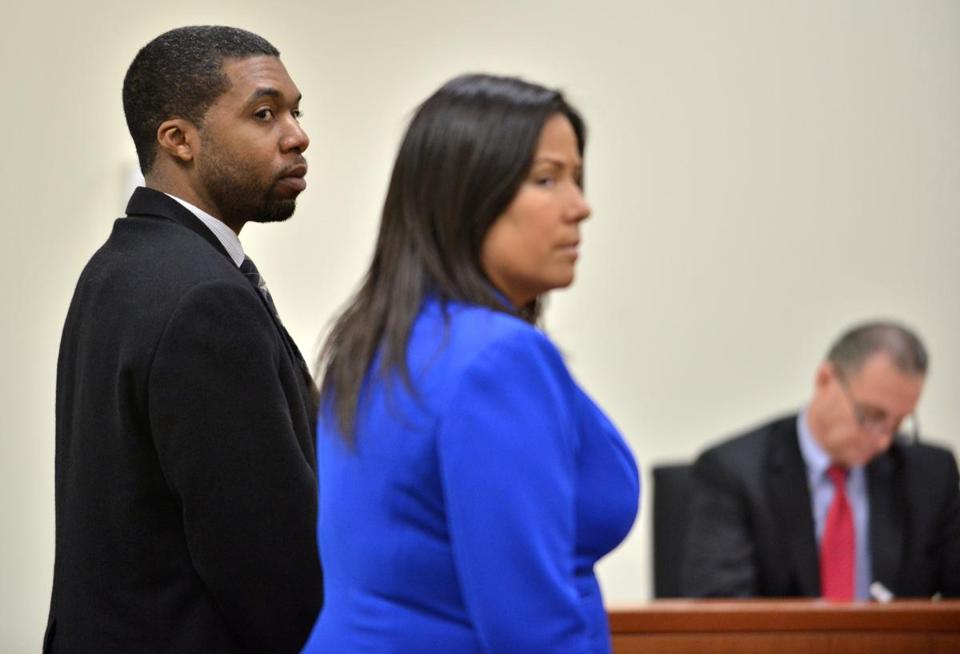
He was convicted of two counts of domestic violence resulting from a date – or a hook-up – gone very wrong.  State Representative Carlos Henriquez was sentenced to 2 and a half years and has to serve 6 months.  This happened on January 15 and I’ve been thinking about it ever since.  Much of the debate centers around his sentence since in Massachusetts most first time offenders are told to stay away from the victim and go to a batterer’s program.  Henriquez is planning to appeal.  The Boston Globe reported

State Representative Carlos Henriquez will spend six months in prison after a jury convicted him Wednesday of holding down a woman and punching her in the chest after she refused to have sex with him.

Jurors convicted Henriquez of some of the acts of violence he was accused of, but acquitted him of others.  The lawmaker was found guilty of two counts of assault and battery, but he was acquitted of a charge that he had struck the victim in her face. Jurors also found Henriquez not guilty of witness intimidation and larceny.

Dressed in a dark suit and tie, Henriquez was without expression as Cambridge District Court Judge Michele Hogan said she was sending him to prison in part because of the serious nature of his crime and because of his refusal to accept responsibility for his actions.

“When a woman tells you she doesn’t want to have sex, that means she does not want to have sex,” Hogan said. “You don’t hit her. You don’t punch her. . . . I’m very concerned that you’re not remorseful.”

State Representative Carlos Henriquez of Dorchester looked toward the jury Wednesday.

State Representative Carlos Henriquez of Dorchester looked toward the jury Wednesday.

I have to interject here that I worked for Carlos’ mother, Sandi, for a number of years and he occasionally stopped by the office.  She is now a high-ranking official at HUD.  His late father was a community activist and very involved in the Dudley Street Neighborhood Initiative not too far from where we live.  Carlos had a promising career ahead of him but something happened.  The incident for which he was convicted occurred not too long after his father’s death and with his mother mostly in Washington, perhaps he felt adrift.  The family always appeared to be close and he lived in an apartment connected to the family house. But this does not excuse what happened.

A few days after his conviction, Farah Stockman wrote a compelling piece published in the Globe opinion section.

You know your political career is on the rocks when the evidence that is produced in your assault trial is a fake fingernail. Bright pink.

What’s the jury going to think when they see that fingernail, found in the Zipcar you drove when you picked up the 23-year-old college student who accuses you of hitting her after she refused to have sex?

Are those jurors thinking: “A Zipcar! What an ecologically conscious elected official?” Probably not.

You know your reputation as an up-and-coming politician is bound to suffer when the most compelling evidence in your favor is a series of racy messages between you and said college student, sent from your VoteforCarlos e-mail. Katherine Gonsalves picks you out of the crowd at a community meeting, and asks to interview you for a class paper. Days later, she’s asking: “Are you still coming out to play tonight?” You’re a 35-year-old man. You’re Carlos Henriquez, representing the 5th Suffolk district. You’re the son of a well-known political family. A man whose endorsements are sought in mayoral campaigns. But you answer: “For Sure. I hope you are ready.” And you spell it F-O-S-H-O. Then you misspell her name in your phone.

Five months later, she’s begging you to come over. “Babe, I miss you,” she texts. You’re too busy, making the kind of neighborhood appearances that got you elected. Late into the night, she’s still trying to get you to pick her up. She describes partying with her sister and her sister’s friends, drinking. Your response: Send the address if you want to have sex.

Monica Lewinsky, anyone?  Anthony Weiner?  Elliot Spitzer?  Or even worse, Chandra Levy who ended up dead in Rock Creek Park.  Even though someone else was convicted of her murder, suspicion ruined the a California Congressman, Gary Condit with whom she had been having an affair.  Sex and politics are a lethal combination.  Elected officials seem never to learn and in the Henriquez case, there is not only political ruin but jail time.

More from Stockman

You pick her up. You both climb into the backseat of the car. What happens next defines both of you, maybe for the rest of your lives. She tells you she can’t go home with you as she had planned because her mother caught her sneaking out of the house. You complain that she dragged you all the way over here. You argue. She pulls out a cell phone and tells you she’s recording you. Do you struggle over the phone? Steal the SIM card? Do you backhand her, punch her, and choke her — and then climb into the driver’s seat and drive into Boston, without ever giving her a chance to get out of the car?

Or did everything happen differently? We don’t know your side of the story because you never take the stand. All we know is that your defense itself is unflattering: Your lawyer says you only wanted sex, but Gonsalves wanted more, and went “Fatal Attraction’’ when she didn’t get it.

I heard the evidence at the trial and I’m still not sure exactly what happened in the car that night. Justice, at its best, is an approximation. In the end, the jury — five women and three men — had an easier time picturing Carlos Henriquez beating a young woman than that young woman making it up, bruises and all.

Carlos Henriquez is clearly guilty: if not of assault, then of really poor judgment. In court, Gonsalves looked miserable in the witness box. Henriquez looked miserable at the defense table. Once, she stole an awkward glance at him. I felt sorry for them both.

So why sentence him to jail time?  On the surface, the only difference between Henriquez and other men who are convicted of domestic violence and get sent to a batterer’s program is that he is an elected official.  Unfortunately for him, the incident comes on the heels of the Jared Remy case.  Jared Remy was in court for beating up his girlfriend and mother of his child the most recent in a series of incidence with increasing violence.  He was released and, the next day, she was dead.  I think the trial is this summer.  The DA has said that releasing him was an error.

My question is this:  why have men been let off the hook so easily in the first place?  If I am right and the Remy case served as a wake-up call to the criminal justice system, the sentence of Henriquez to jail time was fallout.  When other men are also given jail time, we will know that things are finally changing for the better.

And a final word to Carlos:  Please resign.

Photograph:  Josh Reynolds for The Boston Globe

Robert Livingston: forgotten man of the Revolution

A couple of days ago, I read a story in the New York Times about the discovery of a draft of a letter written in July 1775 to the British people from the American revolutionaries that was a last ditch effort at reconciliation.  While the name Robert Livingston rang a faint bell, I did not remember learning anything about a letter back to England.

According to the Times story

It was lying in a drawer in the attic, a 12-page document that was not just forgotten but misfiled. Somehow it had made its way into a folder with colonial-era doctor’s bills that someone in the 1970s decreed was worthless and should be thrown away.

Luckily, no one did. For when Emilie Gruchow opened the folder last summer and separated it from the doctor’s bills, she recognized it as a one-of-a-kind document.

Ms. Gruchow, an archivist at the Morris-Jumel Mansion, was an intern at the museum in Upper Manhattan when she made her discovery. The mansion served as George Washington’s headquarters during the Revolutionary War. She realized the document was the draft of an urgent plea for reconciliation from the Continental Congress. It was addressed to the people of Britain, not King George III and his government, and began by mentioning “the tender ties which bind us to each other” and “the glorious achievements of our common ancestors.”

The letter, which Ms. Gruchow found last summer, was written in 1775 by the New York jurist Robert R. Livingston.

The letter, which Ms. Gruchow found last summer, was written in 1775 by the New York jurist Robert R. Livingston.

A little searching led me to Yale University’s Avalon Project and the discovery that there had been two letters:  one to the King and one to the “FRIENDS, COUNTRYMEN, AND BRETHREN!”.  Both were from the Continental Congress.  The letter to the King does not list all of the colonists grievances, but mentions them more generally.

We shall decline the ungrateful task of describing the irksome variety of artifices, practiced by many of your Majesty’s Ministers, the delusive presences, fruitless terrors, and unavailing severities, that have, from time to time, been dealt out by them, in their attempts to execute this impolitic plan, or of traceing, thro’a series of years past, the progress of the unhappy differences between Great Britain and these colonies, which have flowed from this fatal source.

The open letter to the British people is a precursor to the Declaration of Independence with a list of grievances.  For example this mention of Boston

We could wish to go no further, and, not to wound the Ear of Humanity, leave untold those rigorous Acts of Oppression, which are daily exercised in the Town of Boston, did we not hope, that by disclaiming their Deeds and punishing the Perpetrators, you would shortly vindicate the Honour of the British Name, and re-establish the violated Laws of Justice.

That once populous, nourishing and commercial Town is now garrisoned by an Army sent not to protect, but to enslave its Inhabitants. The civil (government is overturned, and a military Despotism erected upon its Ruins. Without Law, without Right, Powers are assumed unknown to the Constitution. Private Property is unjustly invaded. The Inhabitants, daily subjected to the Licentiousness of the Soldiery, are forbid to remove in Defiance of their natural Rights, in Violation of the most solemn Compacts. Or if, after long and wearisome Solicitation, a Pass is procured, their Edects are detained, and even those who are most favoured, have no Alternative but Poverty or Slavery. The Distress of many thousand People, wantonly deprived of the Necessaries of Life, is a Subject, on which we would not wish to enlarge.

Became

He has kept among us, in times of peace, Standing Armies without the Consent of our legislatures.

and

For Quartering large bodies of armed troops among us:

as well as

He has plundered our seas, ravaged our Coasts, burnt our towns, and destroyed the lives of our people.

Robert Livingston

Robert Livingston

Which brings us to Mr. Livingston.  According to the Times

Until Ms. Gruchow found it, only the final, printed version from July 1775 had been known to exist. She consulted with Michael D. Hattem, a teaching fellow and research assistant on The Papers of Benjamin Franklin at Yale. He analyzed the handwriting on the yellowed pages of the manuscript and did textual analysis that led to an unexpected conclusion: The document was written by Robert R. Livingston, a prominent New York jurist who had been on the fence about whether to support independence for the colonies.

The following year, Congress tapped Livingston to draft the Declaration of Independence along with Thomas Jefferson, John Adams, Benjamin Franklin and Roger Sherman.

Curiously, Mr. Livingston (1746-1813) did not actually sign the Declaration because he was recalled to New York before he could do so.  I’ve searched, but could find no reason for his recall.  He did go on to administer the oath of office to George Washington and, under the Jefferson administration, to help negotiate the Louisiana Purchase.  And now we know that it is his list in a letter to the British people which likely inspired the list in the Declaration of Independence.

Photograph of Document: Suzanne DeChillo/The New York Times