Moving toward the cliff

Yesterday I had lunch with a friend, a federal employee, who is not working because of the shutdown.  She can’t check her work email or phone messages and fears the backlog of problems that awaits her when she does get back to work.  She said the only way she was fortunate was that she was not one of the essential employees who had to work anyway.  We speculated on how people will get to work if October moves to November and people’s monthly transit passes run out.  Will they be expected to shell out money they don’t have to get to a job they aren’t paid for?  All her friends can do is to buy her lunch.  Fast forward 24 hours and we still have no deal.  Even if the Senate comes up with a solution it is not clear if 1) the House will even vote on it and 2) if they do, if this is just another short term postponement.  All my friend hopes is that the next deadline is past the holidays and that there is back pay.

I was trying to find some humor in the whole situation, but find that I actually feel very sorry for John Boehner.  John Cassidy posted this for the New Yorker.

Give the Republicans on Capitol Hill one thing: they don’t leave a job half done. Evidently disturbed by polls showing Congress with a single-digit approval rating, they appear intent on driving it to zero.

What other explanation can there be for Tuesday’s farcical maneuvers, which saw the House Republican leadership try and fail to seize the initiative in the debt-ceiling standoff from the Senate, in the process humiliating Speaker Boehner yet again. By the end of the day, facing renewed opposition from some of his own members, Boehner had dropped his efforts to pass a bill that would have ended the shutdown and raised the debt ceiling until February, but one with more riders than an agreement that Mitch McConnell, the Republican leader in the Senate, and Harry Reid, the Democratic leader, have been working on.

From the point of view of the country, that’s good news. Overnight, officials representing McConnell and Reid were rushing to complete their negotiations, which were called off on Tuesday after Boehner’s unwise intervention. As it stands now, the Senate agreement would reportedly fund the government until January 15th and raise the debt ceiling until February 7th, with the only concession from the Democrats being an agreement to toughen up the policing of eligibility requirements for obtaining federal subsidies to buy health insurance under the Affordable Care Act.

Boehner is in a box.  He can’t control his own party caucus and can’t turn to Democratic votes because then he would lose his Speakership.  If the country goes into default, he will likely lose it anyway.

Once the Senate passes a bill and sends it to the House, the Speaker will face the unenviable choice of allowing it to pass with Democratic support or exercising the nuclear option of forcing a default. Having already ruled out this second option in public comments, there were reports on Tuesday night that Boehner was prepared to bring the Senate bill to the floor, which would probably insure its passage. That wouldn’t end the budget crisis—it’s never-ending—but it would put off the next showdown until the new year, whilst ensuring that the Republican ultras had gained almost precisely nothing for their willingness to shut down the government and raise the prospect of a debt default. (In another development on Tuesday, Fitch, one of the big ratings agencies, placed U.S. government debt on watch for a potential downgrade, saying that “the prolonged negotiations over raising the debt ceiling (following the episode in August 2011), risks undermining confidence in the role of the U.S. dollar as the preeminent global reserve currency by casting doubt over the full faith and credit of the U.S.”)

From the point of view of the Republican Party, things have been going from bad to worse. With the party divided, its poll ratings tanking fast, and its leadership unwilling to risk an actual default, it has been clear for some time that it was in a losing position. The discussions in the past few days have been about the terms of surrender, with the White House and Reid pressing for something close to an unconditional capitulation.

So here are a few cartoons to weep at as we proceed at a Senate’s slow pace, to the edge.

From Tony Auth

From Tony Auth

Tom Toles

Tom Toles

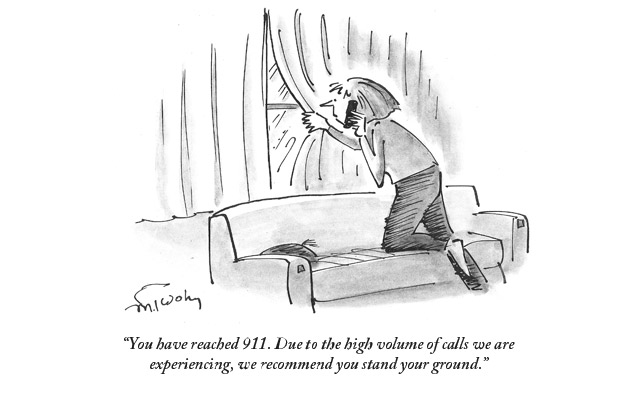
Signe Wilkerson

Signe Wilkerson

And Wilkerson, again.

Wilkinson2

Can we hope that there are still some adults who won’t drive us over the edge?

Cartoonists view the government shutdown

We need to keep a sense of humor about things so we can survive this Republican tantrum.  Here is my contribution.

Dan Wasserman from the Boston Glove.

101toon_wasserman


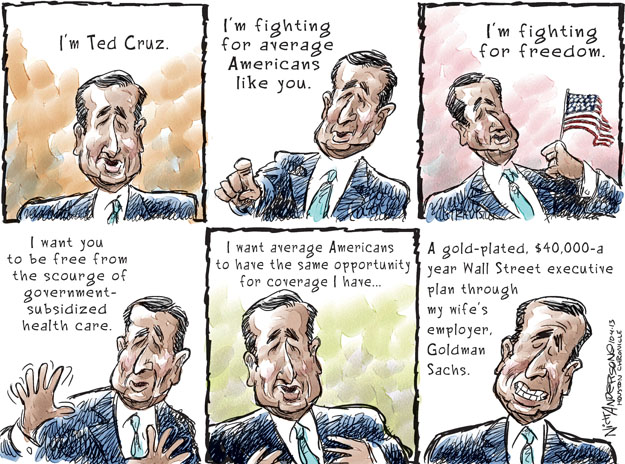
Nick Anderson on Ted Cruz.

Anderson on Cruz


Carlson on Infant nutrition.

Carlson


The new axis of evil?

luckovich

Dorothy in Iraq…or is it Afganistan? Or maybe Syria or Lybia?

It may work out that because he needed to save face, President Putin is going to end up saving President Obama and the Congress from a collision that neither can win – and saving us from another war as a bonus.  As I write this, it appears that Putin’s proposal to put Syria’s chemical weapons under international control will be coming before the Security Council.  Our Congress is very good at stalling so waiting for the Security Council to act should not be a problem and we may actually get a peaceful resolution.

While we wait, we can enjoy Tom Tomorrow’s updated Dorothy back from Oz.

Tom and Dorothy

Thank you, Ruben Bolling.

(Click picture to enlarge.)

More politics, race and South Boston

Earlier this year I wrote about Linda Dorcena Forry, the Haitian American who won the special state Senate election to represent South Boston and parts of Dorchester.  I know Linda and I assumed that she would do a great job and win over any reluctant Southie constituents by sheer force of her personality if not her voting record.  Someone, I think it was Jim Braude on Boston Public Radio, said that she lights up a room when she walks into it.  So Dorcena Forry gets elected and you would think that would be it.  You would be wrong.  There is the small matter of St. Patrick’s Day.

For many decades there have been two events marking the holiday in Boston.  First, there is a breakfast at which Boston and Massachusetts political figures tell bad jokes and try to sing.  It was once just a small event, but now it gets TV coverage.  I think it has gone downhill the last few years, maybe since the William Bulger/Stephen Lynch hosting days ended.  Second, there is a parade.  This is a huge event, also televised.  It is notable for the drinking that takes place among those watching and for the fact that few politicians march.  They don’t march because the breakfast tuckers them out, but because the organizers do not allow LGBT groups to participate.  (I should note here that both events are organized by private non-profits and that my husband has marched in the parade as a 000000000paying gig.)  These events are an opportunity for South Boston to shine and celebrate.  Everyone is Irish at these events.  Or so we all thought.

Yesterday we woke up to this front page news. 

Southie St. Patrick’s Day breakfast slugfest begins early

Emcee struggle raises questions of tradition

What was this about?   Last year’s temporary host, William Linehan, the city councilor from South Boston, was making noises that he was not going to give up his hosting.  Linda Dorcena Forry who by longstanding tradition should be the next host was, ahem, not Irish you see.  The Boston Globe explains

The battle is over who has the rightful claim to host the event. Call it the Southie version of Game of Thrones.

For generations, the breakfast — which is essentially a political roast — has been hosted by the sitting senator in the First Suffolk Senate district. And since the 1940s, that office has been held by an Irish-American man from South Boston — from John Powers to Joe Moakley to Billy Bulger to Stephen Lynch to Jack Hart.

The neighborhood’s stranglehold on the office was so pronounced that it was referred to as the “Southie seat,” even though it also includes much of Dorchester, Mattapan, and a piece of Hyde Park.

But in May, Linda Dorcena-Forry, a Haitian-American woman from Dorchester, won that Senate seat after narrowly defeating Nick Collins, a young state representative from South Boston, in the Democratic primary.

Everyone had something to say.

William M. Bulger, the former senator who transformed the event into the made-for-television spectacle that it is today, took over hosting duties from then-senator Joe Moakley while Bulger was still a state representative. But in a phone interview this week, Bulger said “that’s mostly because I was such a ham, and Moakley finally said, ‘You want to take this thing over?’ ”

But Bulger went on to support Dorcena-Forry’s thinking, saying that “it has always been the understanding that it was the state senator that was the host.”

US Representative Stephen Lynch, who succeeded Bulger as state senator and breakfast host in 1997, also supported the idea that Dorcena-Forry should host.

“I believe the sitting state Senator has always served as host,” Lynch said in a statement. “As our new Senator, Linda should be the host, and I am happy to lend her my expertise and any assistance I can provide.”

Linehan and his supporters also weighed in.

“It’s never been stated anywhere that it has to be the state senator,” Linehan said. “It’s a cultural thing. There has never been anyone who hosted it who does not live in South Boston, but there have been people who have hosted it who were not the state senator.”

and the last host who was a state senator?

But Jack Hart, the last of the sitting senators to host the event, took a different approach. He said the election of Dorcena-Forry ushered in an “unprecedented time,” and he said he hoped that Linehan and Dorcena-Forry could sit down and work out a compromise. “There are no rules. There’s no rule book to go by regarding who hosts the thing.”

He said he did not hand over the duties to Linehan; he simply left politics, and later got a call from Linehan saying that as the ranking South Boston elected official, he wanted to host, and asked for Hart’s advice on how to do it.

Representative Nick Collins who lost to Dorcena Forry agreed with Linehan leading some to accuse them of trying to revive the racial divisions of the past.

For her part, Dorcena Forry believed she should be host and pointed out

“The sitting senator has always hosted, and you don’t have to be Irish to do it,” Forry said in a phone interview. “I believe that everyone is Irish on St. Patrick’s Day. Everyone’s celebrating Irish culture. You don’t have to be 100 percent Irish.”

Dorcena-Forry argues that she is no stranger to the Irish-American community. She is married to Bill Forry, an Irish-American who is editor of the Dorchester Reporter.

“I have four bi-racial children — Irish-American and black. I’ve been to Ireland four times. We celebrate the culture in my house. My two oldest sons were baptized in St. Augustine’s chapel in South Boston. I’m not just a random black woman who has this seat.”

Linda Dorcena Forry

Linda Dorcena Forry

I think that everyone realized that they were in tricky political waters which could rapidly become dangerous.  Dorcena Forry wants to win re-election next year.  Bill Linehan is facing Suzanne Lee, a Chinese American woman who narrowly lost last time, this fall.  (The South Boston council district includes Chinatown and what people would call “downtown” Boston, so it is not really a Southie seat.)  So this morning the headline read

After backlash, St. Patrick’s roast dispute is over

Dorcena Forry to host fest as councilor relents

The resolution followed mounting criticism of Linehan’s refusal to allow Dorcena Forry to host the event, as officials from the governor to the mayor to the mayoral candidates said she was the rightful emcee.

The controversy shined an uncomfortable spotlight, at least momentarily, on racial tensions that many hoped Boston had left behind. It touched a raw nerve from the halls of the State House to the walking paths of Castle Island.

Many who live in South Boston will be unhappy because Linda Dorcena Forry is not only Irish but has dark skin, but most won’t really care.  But for politicians – particularly the white men running for Mayor this fall – it was important.  They mostly lined up to support Dorcena Forry.

“It will be different, but Boston is changing, South Boston is changing,” Mayor Thomas M. Menino said after a ribbon-cutting in Faneuil Hall. “Let’s have a change in leadership over there, and let’s have Linda Dorcena Forry be the mistress of ceremonies.”

And so she will be.  By next March, it is possible that there will be Councilor Lee and the Mayor of Boston will be black or Hispanic.  Boston is changing fast and Southie has to change also.  Maybe I’ll watch the breakfast next year:  All the folks running for Governor will be putting in an appearance.

Photograph: Jonathan Wiggs/Globe staff/file

Voting rights: 2013

This Brian McFadden cartoon seemed appropriate for posting as people are Marching on Washington for Jobs and Freedom once again.

mcfadden voting

Justice Ruth Bader Ginsberg has it right in her dissent from the recent decision:  Why would we want to do away with something that is working?

Boston’s men in the news

No, I am not talking about the mayoral candidates all but one of whom is a man.  And I’m not talking about Alex Rodriquez and the Yankee who beat the Sox last night. (Maybe we shouldn’t have taunted him so much?)  I’m speaking of James “Whitey” Bulger, recently convicted felon and Larry Summers who thinks he should run the Federal Reserve.  Here is a great take on the two from cartoonist Dan Wasserman.

wise guys

Maybe I’ll go for a walk at Castle Island this week in memory of Whitey.  While I’m walking, I can send negative thought waves to President Obama about Larry.

What’s on your money?

Back in January I wrote about the new Treasury Secretary nominee’s signature.  Today, the Treasury unveiled Jack Lew’s new Hancock.

Here it is thanks to the Wonkblog on the Washington Post.

Lew sig on bill

Remember his original signature looked like this.

lew-sig old

He did promise President Obama that at least one letter would be legible and the “J” for Jacob is readable so he kept his promise.  I can’t wait until the money starts being issued.

Baseball and Justice Sotomayor or Flood v. Kuhn revisited

Anyone who loves baseball and history will love this story.  I found it on NPR reported by Nina Totenberg who covers the Supreme Court.  It is about a combination moot court and historic re-enactment.  The case is Curt Flood v. Bowie Kuhn from 1972.  Law school often do this kind of re-enactment, but this one was sponsored by the Supreme Court Historical Society.  Justice Sotomayor presided from the seat of the Chief Justice.

For those who don’t remember, the case was brought by St. Louis Cardinals great Curt Flood, who challenged baseball’s reserve clause — the provision that allowed teams to virtually own players, set salaries and conduct trades, with the players for all practical purposes never able to negotiate freely with other teams. That meant that at the time Flood brought his challenge in 1970, he was earning what was then considered a top salary of $90,000. This, for a player who had signed with the Cards at age 18, with no agent or lawyer, and who in six of the next 12 seasons batted .300 and won seven Gold Glove awards. So, when he was traded to the Philadelphia Phillies, a definitely lesser team at the time, he refused to go, and could not play for any team.

He wrote to the then-baseball commissioner, Bowie Kuhn, protesting that he was “not a piece of property to be bought and sold.” Kuhn denied his request for free agency — a concept unrecognized by baseball back then — and Flood sued, seeking to block the perpetual use of the reserve clause.

Flood lost, but baseball changed forever as the free agency system was put into place anyway.

In 1994, however, nearly two decades after the Flood decision and the ensuing changes in baseball, the owners sought to effectively nullify the free agency system, and the baseball players struck, wiping out the playoffs and the World Series. The National Labor Relations Board went to court, contending that the owners were negotiating in bad faith, and the case came before a young federal district court judge named Sonia Sotomayor.

She agreed that the owners were colluding illegally to fix salaries and granted a temporary injunction barring them from doing that. Sotomayor, a wildly dedicated Yankees fan, issued her opinion in time to allow the new baseball season to begin as scheduled on opening day, with the old baseball contract in effect. She thus earned the title, “the judge who saved baseball.”

The arguments in the re-enactment veered between history and current day baseball.

Representing Flood at the re-enactment was Stanford Law professor Pamela Karlan, a frequent Supreme Court advocate, and ironically, a former Blackmun law clerk. And representing Major League Baseball was another frequent Supreme Court advocate, Roy Englert.

Karlan opened, noting that the Supreme Court’s 1922 and 1953 decisions upholding baseball’s antitrust exemption were outliers and that the court had not permitted such an exemption for any other professional sport.

Sotomayor asked why the court should “break with tradition,” thus depriving the owners of their “reliance” on previous decisions.

Karlan shot back that if the court were to side with the owners for a third time, it would amount to something done in baseball only once before — three errors on a single play.

Sotomayor, with a straight face, opined that the court could apply another baseball rule: three strikes and you’re out.

Karlan, undaunted, replied, “I’m swinging for the fences here, your honor.”

Sotomayor is escorted onto the field by New York Yankees catcher Jorge Posada to throw out the ceremonial first pitch before the New York Yankees game against the Boston Red Sox at Yankee Stadium on Sept. 26, 2009.

The next exchange con free agency and salaries management to get in a dig at Sotomayor’s favorite Yankees.

Sotomayor asked what would happen if the court were to take away the antitrust exemption. Wouldn’t the players move around so much that fans would have no team loyalty?

No, rejoined Karlan, the owners would just have to pay the players what they are worth in order to hold on to them, and instead of year-to-year contracts that leave players with no leverage, the owners would have to negotiate longer-term contracts.

Sotomayor, in mock horror, said that if the antitrust exemption were abolished and owners could no longer collude to set player salaries at will, the Yankees might have to pay Reggie Jackson $1 million a year!

Worse, replied Karlan, would be if the Yanks paid Alex Rodriguez a quarter of a billion dollars not to play.

“I can’t imagine such a thing!” answered a shocked Sotomayor.

Next at bat were the owners.

Next up to the lectern was Roy Englert, representing the baseball commissioner and owners. He noted that some 50 bills had been introduced in Congress over the years to eliminate the antitrust exemption, and none had passed. The court, he said, should leave the question to Congress.

But Sotomayor asked, “Where are the rights of the players?” Quoting Curt Flood, she said that the baseball system was a form of “involuntary servitude” that does not exist in any other industry.

Englert replied that “these young men are making on average $28,000 … as much as Supreme Court justices.” Moreover, unlike other sports, he observed, baseball puts enormous investment into training players in the minor leagues.

The case does involve some serious legal questions, some raised by the decision written by Justice Blackmun.  It appears that Blackmun was reluctant to overturn the prior decisions, but wrote his opinion in such a was that everyone understood that baseball did in fact fall under that anti-trust laws and does engage in interstate commerce.

Justice Sotomayor concluded

‘There are Supreme Court decisions that are wrong,” she said. The court’s 1896 decision upholding segregation was wrong, and the Supreme Court was right to reverse it in 1954. But sometimes, she said, the question is not whether the decision was wrong, but whether this is the right time to overrule it.

Today, she observed, we see as “horrible” the reserve clause that deprived players of any real negotiating power. But at the time, what both sides thought they were arguing about was “the very survival of baseball.”

A little humor for a gray day

It is kind of gray and coolish today the kind of weather that makes you wish that spring would really arrive in New England, that the weather would be a little more consistently 60s and 70s.  So to cheer myself up I put up a new theme.  I’d had the old one for a few years (!) now and it was time for a change.

To go with the new theme, here are 10 Great Headlines which I have copied out of the 2013 Old Farmer’s Almanac.  They were submitted to the Almanac by S.P. of Manchester, NH.

1.  Hospitals Sued by 7 Foot Doctors

2.  Police Begin Campaign to Run Down Jaywalkers

3.  Panda Mating Fails: Veterinarian Takes Over

4.  War Dims Hope for Peace

5.  Astronaut Takes Blame for Gas in Spacecraft

6.  Juvenile Court to Try Shooting Defendant

7.  Something Went Wrong in Jet Crash

8.  New Study of Obesity Looks for Larger Test Group

9.  Cold Wave Linked to Temperatures

10.  Typhoon Rips Through Cemetery; Hundreds Dead.

Cover of the Old Farmer's Almanac.

Cover of the Old Farmer’s Almanac. (Photo credit: Wikipedia)

I was once the headline editor of my high school newspaper so I have a lot of sympathy for those who wrote these.  Which is your favorite?  I’m torn between 7 and 10.