Still more on sequestration

This morning The Fix by Chris Cillizza included this interesting post by Aaron Blake.  Blake posted four great graphics explaining the impact of the sequester.  I am going to copy 2 of them here, but you should look at the entire post.

Blake explains

First up is Pew’s illustration of the year-by-year spending cuts that are included in the sequester. As you can see, the cuts start out relatively small — less than $75 billion in 2013 — but they grow to more than twice that size by 2021, for a total of more than $1 trillion.

The biggest growth in cuts over that time occurs in the interest payments, but everything except for mandatory spending cuts grow steadily over time.

And then there is this depressing news.  Sequester will not have that big of a positive impact.

There has to be a better way.  Maybe spend some money to put people back to work and let them pay taxes thus increasing revenue?  And we do have to fix the tax code so Facebook executives actually pay taxes.  And maybe we can cut programs and defense more selectively.  This won’t be as dramatic, and it might be slower, but it will hurt fewer people.

Meanwhile, members of Congress of both parties are doing their best to keep funding for their own districts.  Politico quotes Senator Lindsey Graham, an opponent of the sequester

I’m almost relishing the moment all these tough-talking guys say: ‘Can you  help me with my base?’” Sen. Lindsey Graham (R-S.C.), one of the most vocal  critics of the sequester, told POLITICO.

“When it’s somebody else’s base and district, it’s good government. When it’s  in your state or your backyard, it’s devastating,” he added.

Of course Graham’s solution is to do away with the Affordable Care Act or Obama care.  Is the momentum swinging toward a rational budget and solution?  Probably not.

What’s up with sequestration? Or we should have issued war bonds.

When I looked up sequestration in Merriam Webster, the closest meaning I could find to what is going on with the federal budget is

2
a: a legal writ authorizing a sheriff or commissioner to take into custody the property of a defendant who is in contempt until the orders of a court are complied with
b: a deposit whereby a neutral depositary agrees to hold property in litigation and to restore it to the party to whom it is adjudged to belong
So our tax dollars are being put aside until we pay down the debt or is it cut the deficit?  Back in 2004, the Treasury Department explained the difference this way.

What is the difference between the public debt and the deficit?

The deficit is the difference between the money Government takes in, called receipts, and what the Government spends, called outlays, each year.  Receipts include the money the Government takes in from income, excise and social insurance taxes as well as fees and other income.  Outlays include all Federal spending including social security and Medicare benefits along with all other spending ranging from medical research to interest payments on the debt.  When there is a deficit, Treasury must borrow the money needed for the government to pay its bills.

We borrow the money by selling Treasury securities like T-bills, notes, Treasury Inflation-Protected securities and savings bonds to the public. Additionally, the Government Trust Funds are required by law to invest accumulated surpluses in Treasury securities. The Treasury securities issued to the public and to the Government Trust Funds (intragovernmental holdings) then become part of the total debt.

One way to think about the debt is as accumulated deficits.

So back when Bill Clinton balanced the budget, we did not run a deficit and did not accumulate more debt.

While some on the right would argue that Clinton really didn’t reduce the deficit and he ruined the economy by raising taxes, I seem to remember that things were going pretty well for the average person during the Clinton years.

When George W. came into office he said he wanted to give us taxpayers back our surplus which probably would have been OK if he hadn’t then started 2 wars which we didn’t raise taxes of any kind to pay for.  No war bonds, no special tax assessment (used by state and local governments to pay for things), no general tax increase.  Thus the red ink on the chart above.  Then came what everyone is now calling the Great Recession.  Barack Obama really had no choice but to spend money to get the economy moving again.  We can argue about some of the spending – like saving some of the banks – but much of it work out pretty well, I think.

So now we have the sequester.  This was a deal made in 2011 to keep everything from coming to a halt.  I don’t think that anyone thought at the time that there wouldn’t be another budget deal to keep the cuts from going into effect, but so far no dice.  The New York Times ran an editorial on Sunday which is the best explanation of what the cuts would mean that I have seen.  For example:

NATIONAL SECURITY Two-week furloughs for most law-enforcement personnel will reduce Coast Guard operations, including drug interdictions and aid to navigation, by 25 percent. Cutbacks in Customs agents and airport security checkpoints will “substantially increase passenger wait times,” the Homeland Security Department said, creating delays of as much as an hour at busy airports. The Border Patrol will have to reduce work hours by the equivalent of 5,000 agents a year.

AIR TRAFFIC About 10 percent of the Federal Aviation Administration’s work force of 47,000 employees will be on furlough each day, including air traffic controllers, to meet a $600 million cut. The agency says it will be forced to reduce air traffic across the country, resulting in delays and disruptions, particularly at peak travel times.

CRIMINAL JUSTICE Every F.B.I. employee will be furloughed for nearly three weeks over the course of the year, the equivalent of 7,000 employees not working each day. The cut to the F.B.I. of $550 million will reduce the number of background checks on gun buyers that the bureau can perform, and reduce response times on cyberintrusion and counterterrorism investigations.

A three-week furlough of all food safety employees will produce a shortage of meat, poultry and eggs, pushing prices higher and harming restaurants and grocers. The Agriculture Department warns that public health could be affected by the inevitable black-market sales of uninspected food.

RECREATION National parks will have shorter hours, and some will have to close camping and hiking areas. Firefighting and law enforcement will be cut back.

DEFENSE PERSONNEL Enlisted personnel are exempt from sequester reductions this year, but furloughs lasting up to 22 days will be imposed for civilian employees, who do jobs like guarding military bases, handle budgets and teach the children of service members. More than 40 percent of those employees are veterans.

The military’s health insurance program, Tricare, could have a shortfall of up to $3 billion, which could lead to denial of elective medical care for retirees and dependents of active-duty service members.

And the list goes on.

The editorial concludes

Last week, Senate Democrats produced a much better plan to replace these cuts with a mix of new tax revenues and targeted reductions. About $55 billion would be raised by imposing a minimum tax on incomes of $1 million or more and ending some business deductions, while an equal amount of spending would be reduced from targeted cuts to defense and farm subsidies.

Republicans immediately rejected the idea; the Senate minority leader, Mitch McConnell, called it “a political stunt.” Their proposal is to eliminate the defense cuts and double the ones on the domestic side, heedless of the suffering that even the existing reductions will inflict. Their refusal to consider new revenues means that on March 1, Americans will begin learning how austerity really feels.

Remember the definition of sequestration I began with?  It is a temporary thing.  The money is supposed to come back to us.  If the sequestration cuts really happen, I can bet you they won’t be temporary.  We are reaping the cost of wars most of us didn’t want and any rational solution will be held up by the same folks who did want to go to war.  We should have had war bonds.

THE VICTORY FUND COMMITTEE CAN HELP YOUR MONEY...

THE VICTORY FUND COMMITTEE CAN HELP YOUR MONEY WIN THIS WAR THROUGH INVESTMENT IN U.S. TREASURY SECURITIES SUITED TO… – NARA – 515674 (Photo credit: Wikipedia)

Re-reading “The Daughter of Time” or was Richard III a murderer?

"The Princes in the Tower"

“The Princes in the Tower” (Photo credit: Wikipedia)

I am a re-reader.  If I like a book, particularly a mystery, I will read it again.  Josephine Tey is a writer I first read in high school when I was introduced by my mother.  I remember thinking at the time that ‘The Daughter of Time” was one of her least interesting stories.  After all, Alan Grant is in a hospital bed reading books about Richard III and sending researcher Brent Carradine to look for answers about someone who died 400 years before.  I believed in the Thomas More/William Shakespeare version of Richard.  I was probably fourteen.  But since then, I have re-read it several times and since the discovery of Richard’s bones have done so again.

It is a very carefully constructed guide to how to conduct an investigation.  Grant starts out with one of his nurses’ history books from school and moves on to more complete histories of Richard and England.  He finds out that Thomas More, although written as if he were a witness to the events surrounding the princes in the tower, was actually between 5 and 8 years old.  Grant and Carradine go to original sources for answers to the kinds of questions anyone conducting an investigation would ask.  Who benefits?  What were people saying at the time?  Where were the relevant people at the time of the alleged murders?  Who was still alive after Richard died?

There are many, like Winston Churchill, who are unconvinced by Tey.  Thomas B. Costain presented much the same evidence as Tey in his history, “The Last Plantagenets.”

Many who believe that Richard was guilty believe that Richard somehow stole the throne.  Edward IV had died, his oldest son was very young and Richard was to be Regent.  Instead, Richard learned that his brother’s marriage was, as they said, irregular.  Parliament declared a Titulus Regulus making Edward’s son ineligible for the throne and Richard became King.

There is no question that Richard had been an excellent administrator of north England, including York.  At the end of the book, Grant lays out his case.

In the matter of the presumed crime:

(a)  He did not stand to benefit; there were nine other heirs to the house of York, including three males;

(b)  There is no contemporary accusation.

(c)  The boys’ mother continued on friendly terms with him until his death, and her daughters attended Palace festivities.

(d)  He showed no fear of the other heirs of York, providing generously for their upkeep and granting all of them their royal state.

(e)  His own right to the crown was unassailable, approved by Act of Parliament and public acclamation; the boys were out of the succession and of no danger to him.

(f)  If he had been nervous about disaffection then the person to have got rid of was not the two boys, but the person who really was next in succession to him:  young Warwick.  Whom he publicly created his heir when his own son died.

And Grant’s case against Henry VII.

(a)  It was of great importance to him that the boys should not continue to live.  By repealing the Act [Titulus Regulus] acknowledging the children’s illegitimacy, he made the elder boy King of England and the youngest boy the next heir.

(b) In the Act which he brought before Parliament for the attainting of richard he accused Richard of the conventional tyranny and cruelty but made no mention of the two young Princes.  The conclusion is that at that time the two boys were alive and their whereabouts known.

(c)  The boys’ mother was deprived of her living and consigned to a nunnery eighteen months after his succession.

(d) He took immediate steps to secure the persons of all the other heirs to the crown, and kept them in close arrest until he could with the minimum of scandal get rid of them.

(e)  He had no right whatever to the throne.  Since the death of Richard, young Warwick was de jure King of England.

I can’t predict whether the discover of Richard’s bones will lead to his rehabilitation as a ruler, but Tey makes an interesting case in his favor.  If you like mysteries or history or both, I recomment “The Daughter of Time.”

Cartoonists look at Rubio

Last night I watched the local news as well as New England Cable News and the Rachel Maddow show.  Everyone had their Rubio water bottle thing, including the weather and sports people.  Is this news as parody?  Or just another way to talk about something everyone is discussing?

Here are some cartoonist views of the Rubio incident.

Nick Anderson and the Poland Springs hat.

Nick Anderson's Editorial Cartoons 02/14

And Tom Toles

toles20130214

Note the kool aid and tea references.

I’m sure there will be more to come.  This may not end Rubio’s political future for a Presidential run, but you can bet it will end up being like Mitt Romney’s dog on the roof of his car.

Marco and Barack and the State of the Union

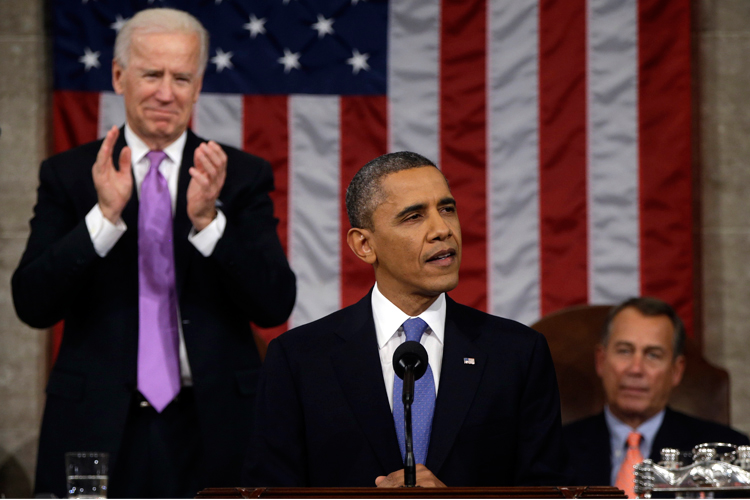
The President did not awkwardly reach for a bottle of water during his speech.  In fact, I don’t remember him drinking at all.  John Boehner, however, seemed to be sipping from his glass often.  When he wasn’t looking dour, that is.  I’ll write more about substance later, but this post is about impressions.

The best description of the Speaker is from Joan Walsh in Salon

But Boehner’s disdain was unrivaled. He also managed not to rise even for a shout-out to “wounded warriors,” or 102-year-old Deseline Victor, who waited seven hours to vote in Miami on Election Day. It was sometimes hilarious to watch him next to Vice President Joe Biden, who looked like a happy Easter Bunny with his white hair, lavender tie, pink-tinted glasses and green Newtown ribbon. Biden seemed to occasionally enjoy standing up, clapping while looking down at Boehner sulking in his chair.

This is what she means.

When John Boehner just sat there

And then we can move on to Maureen Dowd on Marco Rubio.

The ubiquitous 41-year-old — who’s on the cover of Time as “The Republican Savior” — looked as if he needed some saving himself Tuesday night as he delivered the party’s response to the State of the Union address in English (and Spanish). He seemed parched, shaky and sweaty, rubbing his face and at one point lunging off-camera to grab a bottle of water.

Oh, that water lunge.  How it will haunt poor Marco!

John Cassidy writing for the New Yorker, calls him “Water Boy”.

To be fair to Rubio, with a combination of eye contact and vigorous hand  gestures, he was doing a decent job with the tough task of delivering a lengthy  speech to a camera in an empty room. But then, for some reason—and it must have  seemed like an urgent one to him—he decided to reach for a small plastic bottle  on a nearby table and take a swig, thereby almost ducking out of the camera shot  and sending the Twitterverse into hysterics. “Uh-oh. Water gulp—really bad TV  optics,” Larry Sabato, a political science professor at the University of  Virginia, tweeted. “SNL, Colbert, Stewart…here they come.” After that  diversion, Rubio appeared to realize his error, and he looked a bit shaken. For  some reason, the camera closed in on his face, which didn’t improve things. As  the Democratic pundit Paul Begala cruelly noted on Twitter, the Senator was sporting a sheen  of sweat that inspired memories of Richard Nixon.

Meanwhile, the President looked confident and sometimes very passionate as when he mentioned the need for Congress to vote on gun safety legislation.

The Republicans looked more like their leader.

That is Paul Ryan in the center.

For right now, the President has the upper hand.  Neither Marco Rubio nor Rand Paul advanced any ideas beyond those from the last election – which they lost.  Plus they presented a bad image all around.  Maybe the Republicans are right in saying the President offered nothing new, nothing really that he didn’t talk about during the campaign, but there is a big difference:  Barack Obama won based in large measure on those ideas.  No wonder they look like four year olds being told they can’t have desert.  And poor Marco.  Only time will tell if he can overcome his reach for water.

Photographs AP/Charles Dharapak, Bill O’Leary/Post, Melina Mara/Post

Responses to the State of the Union Address: being picked isn’t always a good thing

Quick.  Name the four responders to President Obama’s State of the Union/Joint addresses to Congress.  (The first one is not considered to be formal State of the Union.)  Give up?  I could only remember Bobby Jindal and Bob McDonnell so I had to look them up.

2009 – Bobby Jindal in an address remembered for his Kenneth the Page imitation.  If he ever decides to run for President, this will haunt him.

English: Governor Bobby Jindal at the Republic...

English: Governor Bobby Jindal at the Republican Leadership Conference in New Orleans, Louisiana. (Photo credit: Wikipedia)

2010 – Bob McDonnell the governor of Virginia who tried to rectify Jindal’s mistakes by giving his speech in the Virginia State House before a live hand-picked audience.  And then he became known as Governor Ultrasound and his Presidential chances disappeared.

2011 – Paul Ryan.  Representative Ryan did run for higher office tied to Mitt and, as we know, they lost.  He is young and maybe can run again someday if the Tea Party ever gains firm control over the Republican Party.

2012 – Mich Daniels, governor of Indiana.  This was supposed to be a stepping stone to the Presidential nomination.  Didn’t happen.

So this year we have Marco Rubio giving the response in English and in Spanish (so we are told).  He is trying to position himself as the young, fresh face for a 2016 run for the Presidency.  I have alread heard some Republican consultants saying  he’s young and Joe Biden and Hillary Clinton are old and that is good for the Republicans.  But State of the Union responders don’t have a very good track record, so we shall see.

English: Official portrait of US Senator Marco...

English: Official portrait of US Senator Marco Rubio of Florida. (Photo credit: Wikipedia)

Go to this link to see a short video of memorable moments.

What does Chuck Hagel have to do with Benghazi?

I wish someone would explain to me what someone who was not even a government official at the time has to do with Benghazi?  Is Chuck Hagel just leverage?  Believe me, the Obama Administration could show live action footage of the event as it unfolded and the Republicans still wouldn’t be happy.

According to Politico

One Armed Services Committee member, South Carolina Republican Sen. Lindsey  Graham, has made clear that he considers Benghazi and Hagel to be one issue —“no confirmation without information,” he said Sunday, threatening to block both  Hagel and CIA nominee John Brennan. Graham is demanding more details from the  administration about its response to the Benghazi attacks, particularly the  direct involvement of President Barack Obama.

And then you have James Inhofe.  Again from Politico

A spokeswoman for Sen. Jim Inhofe (R-Okla.) confirmed to POLITICO that he wanted  to drag out the confirmation process for the former Republican senator from  Nebraska.

Inhofe’s threat continued GOP brinksmanship that got under way on Sunday when  Republican aides first said that some senators might walk out of a meeting that  included a vote on Hagel. Inhofe and another top Republican on the committee,  Sen. John McCain of Arizona, both said Monday they would not walk out, but  Inhofe repeated his vow to press the battle against Hagel.

It appears very much as if the Republicans have forgotten that they are a minority in the Senate.  If Chair Senator Carl Levin calls for a committee vote, it will be along party lines which he didn’t want.  But I don’t think there will be any bipartisan agreement there.  According to the New York Times, Levin

…called Monday for a committee vote on Tuesday afternoon on the nomination of former Senator Chuck Hagel to be the next secretary of defense.

The committee action has been postponed for the past week over evolving demands from Republicans for new documentation on Mr. Hagel’s past statements, personal financial records and even a sexual harassment allegation involving two former staff members, but not Mr. Hagel himself. As action has drawn closer, Republican opponents to a former Senate Republican colleague have threatened filibusters and even a walkout from the committee.

Once Hagel’s nomination reaches the floor, vote counters believe that there will be 60 votes to break any attempt at a filibuster.  Maybe Majority Leader Reid need to reconsider his agreement with Senator McConnell since I don’t think it is going to work.

But Mr. Levin’s decision to call for a public discussion and vote, starting at 2:30 p.m. Tuesday ahead of President Obama‘s State of the Union address, indicated that the chairman still believes that Mr. Hagel has enough support to be confirmed. Committee aides say they have no indication that any Democrats or Senate independents will oppose him, putting him at 55 votes to start. Two Republican senators, Thad Cochran of Mississippi and Mike Johanns from Mr. Hagel’s home state, Nebraska, have pledged their support, and at least four Republicans have said they will oppose a filibuster.

And I still want to know what Chuck Hagel has to do with Benghazi, Senator Graham.  I think we all know that this really has to do with the fact that Hagel is not a war hawk and will figure out a way to cut the defense budget.

Photograph Brendan Hoffman for The New York Times

More on the Storm of 2013 – with Dustin Pedroia

We have a lot of snow here in Boston and the hot discussion is whether the T or train system could have reopened faster – not until tomorrow morning for the Monday commute.  For those of you who don’t know, the train is partially underground and partially above.  I can hear them working on the orange line which runs down the hill from our house and is above ground where we are.  And while our street has been plowed there are places where the wind has blown snow back across it and people are getting stuck.

But Brendan Lynch at public radio WGBH is trying his best to look forward to spring.  He is measuring the snow in Dustin Pedroias.  Dustin is the shortest member of the Red Sox.  I think that Brendan is working on the official Major League height and Dustin is actually shorter, but here is what was posted yesterday morning.  There have been so new totals since then so you can do your own math.

Spencer (which is near Worcester, MA) is now reported at 34.5″  clearly half a Pedroia.  Logan Airport (which will be the official Boston total) is 24.9″   And Jamaica Plain, a section of Boston right across those Orange Line tracks from us, is 25.5″  These totals are from David Epstein’s Weather Wisdon blog.

So while we aren’t quite half a Pedroia here in Boston, that is still a lot of snow!

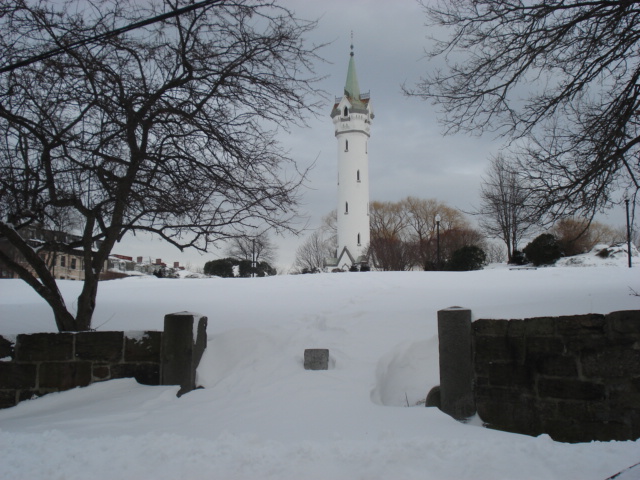
Highland Park 2-9-2013

Another view of the park across the street.

Snowed in

The blizzard of 2013 is what we are calling it here in Boston.  And it is still snowing.  No cars allowed on the streets and highways, no public transportation.  Because of the blowing snow it is hard to figure exactly how much has fallen, but it is currently in excess of 20 inches and another 5 to 8 may accumulate before it is all finished.  Luckily we didn’t lose power but we are snowed in.  It is also cold currently 20 degrees.

From Boston.com (The paper is not being delivered today.  Also no mail.)

Hundreds of thousands of Massachusetts residents have lost power because of the mammoth blizzard that lashed Massachusetts with hurricane-force winds and dumped more than two feet of snow in some areas overnight.

The state is at a standstill, with residents hunkering down at home under a rare travel ban imposed by the governor on Friday, and the MBTA saying it will not be able to restore service today. Snowplows are out in force struggling to clear the roads, but the storm is expected to continue dumping snow into midday.

National Guard troops are heading to coastal communities to assist in possible evacuations due to giant waves whipped up by the storm that are expected to batter the beaches at high tide at 10 a.m., potentially devouring beaches and homes.

State emergency management officials said there were no reports of major injuries due to the storm, even though there were two truck rollovers and about 30 stranded motorists had to be rescued from the roads.

According to New England Cable News (NECN) the Governor had this to say

Governor Patrick says he’s impressed with the fact there have not been any serious injuries yet as a result of this storm.

“When you consider the scope of the storm and the severity of it, it’s really a minor triumph that we haven’t had serious injuries,” Governor Patrick said. “We had a couple people out last night, I guess, defying the ban and taking their chances, and we had vehicles driving the wrong way on the Pike, on Storrow Drive … but no serious injuries.”

I guess it takes all kinds!

This picture was just posted on Boston.com

This is in the Charlestown section of Boston.

This is in the Charlestown section of Boston.

We have cousins who live in this area of town.  Like where we live, the streets are narrow and winding.

So why was the storm so bad?  Like Hurricane Sandy, two fronts converged over New England.  According to the Boston Globe

The fierce nor’easter that began walloping New England on Friday was the product of two storms that merged, causing a rapidly strengthening storm known in weather jargon as a “meteorological bomb.”

“We just have the right setup,” said Lance Franck, a National Weather Service meteorologist in Taunton. “It really is just a classic snowstorm.”

Forecasters said Friday night the storm remained on track to produce prodigious amounts of snow. But, in many ways, it reflects an utterly typical winter weather pattern, meteorologists said. Its path just happens to be dead-on, landing at a meteorological sweet spot to produce substantial snowfall in New England.

The jet stream that flows from west to east, 18,000 feet above the surface of the Earth, has two branches: a polar stream that takes a northerly route and a second, more southerly stream. When those branches converge, which is a pretty routine event during winter, snow is a possibility, as the frigid air from the north mingles with the humid air from the south.

“This winter has been interesting because the two streams have been largely separate,” Franck said.‘But the process of this happening isn’t unusual, it happens almost every winter.’

Until Friday.

This time, separate storms were brewing in each branch of the jet stream. The storm in the northern branch had deposited light snow in the upper Midwest. The storm in the southern branch had spawned rain in the mid-Atlantic, Franck said.

They separately swept toward New England, and by Friday night, meteorologists were saying the storms appeared destined to combine — very near a spot meteorologists call the “benchmark” because it is a pivotal spot for understanding how storms are likely to behave.

“The intersection point where the storms will ultimately become one . . . just south of Block Island, in that area — that’s just the perfect location,” said David Epstein, a meteorologist whose forecasts appear on Boston.com.

The bottom line is that the two fronts merged at the sweet spot to produce our blizzard.

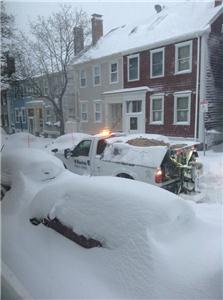
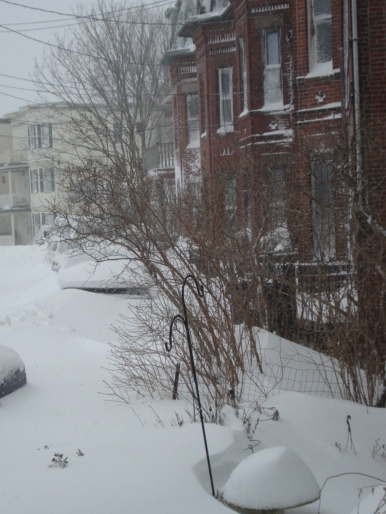
Here are some pictures I took from the house this morning.

my street

my street

The park across the street

The park across the street

Why are we still fighting over birth control?

The Affordable Care Act aka Obamacare, included a provision for insurance to cover the cost of birth control.  After all, it has been estimated that 99% of all women use birth control at some point in their lives.  This is not just non-Catholic women.  Contraception is not cheap.  Without insurance, birth control pills can cost up to $100 a month.  Not affordable to lower income women who are also ones who can least afford to have unplanned children.  The pill is used for hormone regulation, not just birth control, a fact often ignored.

In fact, regardless of what the Pope and Cardinals and Archbishops in the United States think, Catholic women do use birth control.  I’m sorry, but no one has explained to me why a bunch of celibate men want to control women.  If you are against abortion, birth control would seem to be reasonable.  Of course, if you believe that life begins at the moment of conception, then some methods are problematic.  But we have no idea how many fertilized eggs just naturally abort, but I guess the distinction here is one is natural and the other has an artificial cause.  I should say that birth control also faces opposition from fundamentalist churches that are not Catholic.  The other thing that plays into the objection to birth control is that sex is to be reserved for marriage and for procreation.  There:   The objections to both birth control and gay marriage in one neat package.

The Obama administration has been twisting itself into knots to make sure that women who choose to use birth control have it covered under their health insurance.  The most recent proposal was outlined by the New York Times.

The Obama administration on Friday proposed yet another compromise to address strenuous objections from religious organizations about a policy requiring health insurance plans to provide free contraceptives, but the change did not end the political furor or legal fight over the issue.

The proposal could expand the number of groups that do not need to pay directly for birth control coverage, encompassing not only churches and other religious organizations, but also some religiously affiliated hospitals, universities and social service agencies. Health insurance companies would pay for the coverage.

The latest proposed change is the third in the last 15 months, all announced on Fridays, as President Obama has struggled to balance women’s rights, health care and religious liberty. Legal experts said the fight could end up in the Supreme Court

You can see the Department of Health and Human Services (HHS)  fact sheet here.

Religious groups dissatisfied with the new proposal want a broader, more explicit exemption for religious organizations and protection for secular businesses owned by people with religious objections to contraceptive coverage.

The tortured history of the rule has played out in several chapters. The Obama administration first issued standards requiring insurers to cover contraceptives for women in August 2011, less than a month after receiving recommendations to that effect from the National Academy of Sciences. In January 2012, the administration rejected a broad exemption sought by the Roman Catholic Church for insurance provided by Catholic hospitals, colleges and charities. After a firestorm of criticism from Catholic bishops and Republican lawmakers, the administration offered a possible compromise that February. But it left many questions unanswered and did not say how coverage would be provided for self-insured religious organizations.

Under the new proposal, churches and nonprofit religious organizations that object to providing birth control coverage on religious grounds would not have to pay for it.

Female employees could get free contraceptive coverage through a separate plan that would be provided by a health insurer. Institutions objecting to the coverage would not pay for the contraceptives.

Yesterday the Catholic Bishops weighed in

“The administration’s proposal maintains its inaccurate distinction among religious ministries,” said Cardinal Timothy M. Dolan of New York, the president of the United States Conference of Catholic Bishops. “It appears to offer second-class status to our first-class institutions in Catholic health care, Catholic education and Catholic charities. The Department of Health and Human Services offers what it calls an ‘accommodation,’ rather than accepting the fact that these ministries are integral to our church and worthy of the same exemption as our Catholic churches.”

The bishops’ statement, issued after they had reviewed President Obama’s proposal for six days, was more moderate and measured than their criticisms of the original rule issued by the White House early last year. Cardinal Dolan said the bishops wanted to work with the administration to find a solution.

The administration had no immediate reaction to the bishops’ statement, other than to say it was not a surprise.

One thing is clear, the Obama administration does not want to start saying the private business owners can opt out of paying for insurance that covers things they find objectionable.  What if we go from birth control to vaccinations to flu shots?

The birth control issue will end up in court and probably the Supreme Court.  For people who say they don’t want the ACA because they don’t want government controlling their health care, this the ultimate irony.  In case they haven’t noticed.  The Supreme Court is a branch of government.

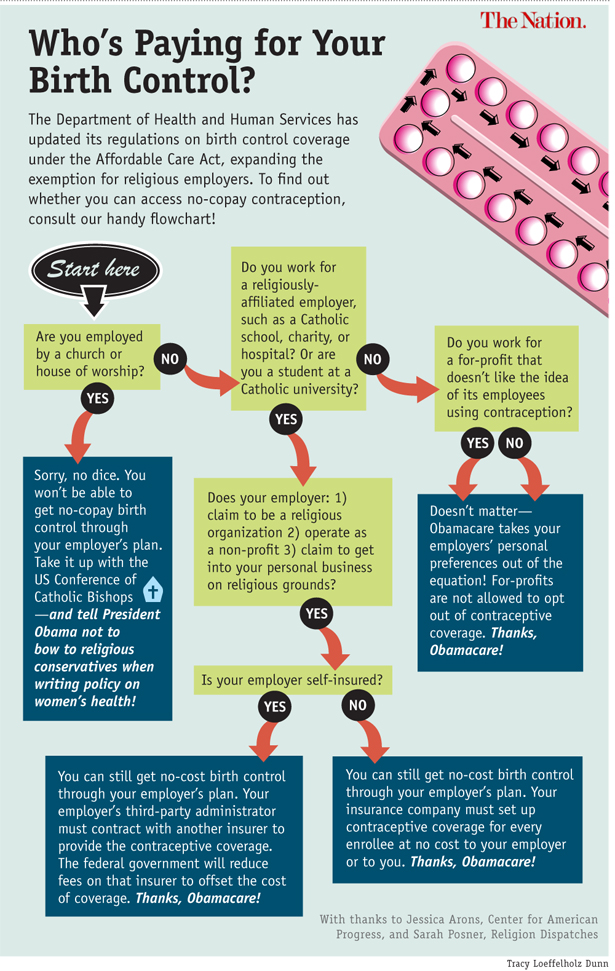
So until the courts decide, Emily Douglas at the Nation has prepared this handy chart for you.

How to pay for your bith control

I guess I sound bitter, but I thought we already had this fight 40 years ago.  Contraception is supposed to be a routine option for women’s health care.