Responses to the State of the Union Address: being picked isn’t always a good thing

Quick.  Name the four responders to President Obama’s State of the Union/Joint addresses to Congress.  (The first one is not considered to be formal State of the Union.)  Give up?  I could only remember Bobby Jindal and Bob McDonnell so I had to look them up.

2009 – Bobby Jindal in an address remembered for his Kenneth the Page imitation.  If he ever decides to run for President, this will haunt him.

English: Governor Bobby Jindal at the Republic...

English: Governor Bobby Jindal at the Republican Leadership Conference in New Orleans, Louisiana. (Photo credit: Wikipedia)

2010 – Bob McDonnell the governor of Virginia who tried to rectify Jindal’s mistakes by giving his speech in the Virginia State House before a live hand-picked audience.  And then he became known as Governor Ultrasound and his Presidential chances disappeared.

2011 – Paul Ryan.  Representative Ryan did run for higher office tied to Mitt and, as we know, they lost.  He is young and maybe can run again someday if the Tea Party ever gains firm control over the Republican Party.

2012 – Mich Daniels, governor of Indiana.  This was supposed to be a stepping stone to the Presidential nomination.  Didn’t happen.

So this year we have Marco Rubio giving the response in English and in Spanish (so we are told).  He is trying to position himself as the young, fresh face for a 2016 run for the Presidency.  I have alread heard some Republican consultants saying  he’s young and Joe Biden and Hillary Clinton are old and that is good for the Republicans.  But State of the Union responders don’t have a very good track record, so we shall see.

English: Official portrait of US Senator Marco...

English: Official portrait of US Senator Marco Rubio of Florida. (Photo credit: Wikipedia)

Go to this link to see a short video of memorable moments.

Why are we still fighting over birth control?

The Affordable Care Act aka Obamacare, included a provision for insurance to cover the cost of birth control.  After all, it has been estimated that 99% of all women use birth control at some point in their lives.  This is not just non-Catholic women.  Contraception is not cheap.  Without insurance, birth control pills can cost up to $100 a month.  Not affordable to lower income women who are also ones who can least afford to have unplanned children.  The pill is used for hormone regulation, not just birth control, a fact often ignored.

In fact, regardless of what the Pope and Cardinals and Archbishops in the United States think, Catholic women do use birth control.  I’m sorry, but no one has explained to me why a bunch of celibate men want to control women.  If you are against abortion, birth control would seem to be reasonable.  Of course, if you believe that life begins at the moment of conception, then some methods are problematic.  But we have no idea how many fertilized eggs just naturally abort, but I guess the distinction here is one is natural and the other has an artificial cause.  I should say that birth control also faces opposition from fundamentalist churches that are not Catholic.  The other thing that plays into the objection to birth control is that sex is to be reserved for marriage and for procreation.  There:   The objections to both birth control and gay marriage in one neat package.

The Obama administration has been twisting itself into knots to make sure that women who choose to use birth control have it covered under their health insurance.  The most recent proposal was outlined by the New York Times.

The Obama administration on Friday proposed yet another compromise to address strenuous objections from religious organizations about a policy requiring health insurance plans to provide free contraceptives, but the change did not end the political furor or legal fight over the issue.

The proposal could expand the number of groups that do not need to pay directly for birth control coverage, encompassing not only churches and other religious organizations, but also some religiously affiliated hospitals, universities and social service agencies. Health insurance companies would pay for the coverage.

The latest proposed change is the third in the last 15 months, all announced on Fridays, as President Obama has struggled to balance women’s rights, health care and religious liberty. Legal experts said the fight could end up in the Supreme Court

You can see the Department of Health and Human Services (HHS)  fact sheet here.

Religious groups dissatisfied with the new proposal want a broader, more explicit exemption for religious organizations and protection for secular businesses owned by people with religious objections to contraceptive coverage.

The tortured history of the rule has played out in several chapters. The Obama administration first issued standards requiring insurers to cover contraceptives for women in August 2011, less than a month after receiving recommendations to that effect from the National Academy of Sciences. In January 2012, the administration rejected a broad exemption sought by the Roman Catholic Church for insurance provided by Catholic hospitals, colleges and charities. After a firestorm of criticism from Catholic bishops and Republican lawmakers, the administration offered a possible compromise that February. But it left many questions unanswered and did not say how coverage would be provided for self-insured religious organizations.

Under the new proposal, churches and nonprofit religious organizations that object to providing birth control coverage on religious grounds would not have to pay for it.

Female employees could get free contraceptive coverage through a separate plan that would be provided by a health insurer. Institutions objecting to the coverage would not pay for the contraceptives.

Yesterday the Catholic Bishops weighed in

“The administration’s proposal maintains its inaccurate distinction among religious ministries,” said Cardinal Timothy M. Dolan of New York, the president of the United States Conference of Catholic Bishops. “It appears to offer second-class status to our first-class institutions in Catholic health care, Catholic education and Catholic charities. The Department of Health and Human Services offers what it calls an ‘accommodation,’ rather than accepting the fact that these ministries are integral to our church and worthy of the same exemption as our Catholic churches.”

The bishops’ statement, issued after they had reviewed President Obama’s proposal for six days, was more moderate and measured than their criticisms of the original rule issued by the White House early last year. Cardinal Dolan said the bishops wanted to work with the administration to find a solution.

The administration had no immediate reaction to the bishops’ statement, other than to say it was not a surprise.

One thing is clear, the Obama administration does not want to start saying the private business owners can opt out of paying for insurance that covers things they find objectionable.  What if we go from birth control to vaccinations to flu shots?

The birth control issue will end up in court and probably the Supreme Court.  For people who say they don’t want the ACA because they don’t want government controlling their health care, this the ultimate irony.  In case they haven’t noticed.  The Supreme Court is a branch of government.

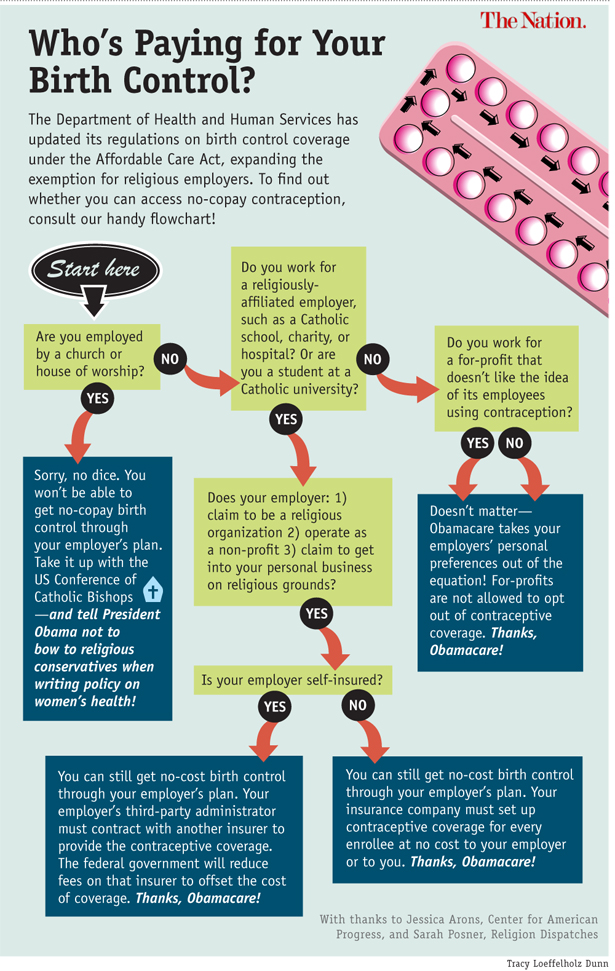
So until the courts decide, Emily Douglas at the Nation has prepared this handy chart for you.

How to pay for your bith control

I guess I sound bitter, but I thought we already had this fight 40 years ago.  Contraception is supposed to be a routine option for women’s health care.

Voting in America

We all saw the lines on television last November. A lot of us stood in them.  In Florida, in Ohio.  I saw at least a 20 minute wait on election morning as I timed a friend who went into vote while I was outside handing out Warren/Obama literature.  This was much longer than usual at my precinct.  It turns out that these are only the outward manifestations of larger problems.  President Obama has said fixing the problems is one of his priorities.  Now he can look at a couple of studies to see exactly what needs to be fixed.

Voter buttons

First the Daily Kos posted a story about the MIT study showing that black and Hispanic voters waited longer to vote than other voters.

You’d think after two hundred years (including some awkward Constitution-patching, here and there) we would finally have this “voting” thing down. Nope:

A Massachusetts Institute of Technology analysis determined that blacks and Hispanics waited nearly twice as long in line to vote on average than whites. Florida had the nation’s longest lines, at 45 minutes, followed by the District of Columbia, Maryland, South Carolina and Virginia, according to Charles Stewart III, the political science professor who conducted the analysis.

So how are states going to fix this?  Maybe by making it harder to register and then harder to vote.

…In states like Virginia, in fact, they’re still trying their level best to make sure certain people don’t have to wait in long lines to vote by making sure certain people aren’t allowed to vote at all. Newly passed legislation would:

eliminate the use of a utility bill, pay stub, bank statement, government check and Social Security card as acceptable identification that can be presented at the polls. Voters would still be able to use a voter identification card, concealed handgun permit, driver’s license and student ID card.

Well, so long as you’re still taking concealed handgun permits.

Since most of those now-banned documents are still perfectly acceptable for obtaining “real” ID’s, like drivers licenses, the possibilities for thwarting rampant voting fraud are approximately nil. The only substantive outcome is to make it ever more inconvenient for certain people (i.e. poor, elderly, and those that don’t have cars, those city-living bastards) to vote.

So I’m not sure that we can depend on states to fix their own problems.

On the heels of the MIT study comes Pew Research.  The New York Times reported on the study which looked at 17 factors.

The flaws in the American election system are deep and widespread, extending beyond isolated voting issues in a few locations and flaring up in states rich and poor, according to a major new study from the Pew Charitable Trusts.

The group ranked all 50 states based on more than 15 criteria, including wait times, lost votes and problems with absentee and provisional ballots, and the order often confounds the conventional wisdom.

In 2010, for instance, Mississippi ranked last over all. But it was preceded by two surprises: New York and California.

The project includes an interactive tool that allows rankings by individual criteria or clusters of them.

Some states, for instance, lost very few votes because of shortcomings in voting technology and voter confusion, with the best 10 reporting failure rates of 0.5 percent or less in 2008. In West Virginia, by contrast, the rate was 3.2 percent.

I hope you will click on the interactive link and look up your state.  The study covers the 2008 and 2010 elections and will be updated with 2012 data when it is available.  Massachusetts is only ranked in the middle at 64% overall which is interesting as I would have guessed it would have been higher.

The study also covered the new trend of voting by mail.

The shift to voting by mail, which now accounts for some 20 percent of all ballots cast, tends to eliminate lines. But it has also produced new problems, especially in places where mail voting has soared because the state does not require an excuse or a new ballot request for each election. Arizona and California, where voting by mail is commonplace, had among the highest rates of problems with voter registration and absentee ballots.

In 2010, California rejected absentee ballots 0.7 percent of the time, a higher rate than any other state.

Dean C. Logan, the registrar for Los Angeles County, said the rate was partly a byproduct of the popularity of voting by mail in California and partly a function of how the state defines rejected ballots. Its definition includes ballots that voters requested but that the Postal Service returned to election officials as undeliverable.

“Voter behavior is changing and evolving,” Mr. Logan said. Young people do not sign their names as consistently as older ones, he said, and mail delivery is becoming less reliable.

He also cautioned that statewide results can mask the fact that “the elections process is extremely decentralized.”

Provisional ballots are also a potential problem according to the study.

Charles Stewart III [cited also by the Daily Kos], a political scientist at the Massachusetts Institute of Technology and a Pew adviser, said that high provisional ballot rates were an important signal of potential trouble.

“Nationwide, a bit over 1 percent of voters are given a provisional ballot,” he said. “In Arizona in 2008, the rate was 6.5 percent. In the battleground state of Ohio, it was 3.6 percent. While these numbers may seem small, in a recount or election dispute, they would be huge.”

There are lots of things to consider as we look at ways to fix things.  How can people more easily register to vote?  What kind of ID, if any, should a voter have to show?  Do we vote by mail?  Online?  In person?  How many options should voters be offered?  I don’t know how many of the issues raised by the Pew study are local and how many can be federally mandated.  I believe that the federal government may have more say if the election is for a national office and is not just a state or local election.

I hope we can tackle some of these issues before 2014 and more of them before 2016.

Professor Stewart said the study should focus attention on the infrastructure of democracy.

“Among all important areas of public policy, election administration is probably the most episodic and prone to the problem of short attention spans,” he said. “What would the world be like if we only gave intense attention to education, corrections, transportation and public health problems for a one-week period every four years?”

An Oregon mail-in ballot for a special electio...

An Oregon mail-in ballot for a special election in May 2005. (Photo credit: Wikipedia)

Hopes for Obama 2.0

I thought this was a good summary of President Obama’s first term and what we hope can be avoided.

And they are still working on it.  Just look at Mike Luckovich

The more things change the more they stay the same.  John McCain is mischaracterizing Hillary Clinton’s testimony and it looks, right now like Harry Reid is going to cave on filibuster reform after all but it is an evolving situation.

And if you want another sign that nothing has changed, John Boehner is accusing Obama of destroying the Republican party.  I think they are doing a pretty good job without the President’s help.

Collage of pictures of John Boehner crying.

Boehner Collage – Jed Lewison

Taking the oath

President Obama just became the 16th President to take the oath of office for the second time.  There have been 57 inaugurations.

President Barack Obama is officially sworn-in by Chief Justice John Roberts in the Blue Room of the White House. | AP Photo

Josh Gerstein commented on Politico

Barack Obama and John Roberts were all smiles when the chief justice swore in  the president on Sunday — and they’ll likely repeat the performance on  Monday.

But the serene tableau obscures the tumultuous relationship between the two  men since their first awkward public interaction during the botched oath of  office four years ago.

On Sunday, Roberts read the oath from a piece of paper — and both men seemed  relieved when it was over. They exchanged congratulations and thanks, and then  Obama turned to his daughter Sasha. “I did it,” he told her.

Vice President Joe Biden was sworn in earlier by Justice Sotomayor.

Vice-president Joe Biden takes the oath

Obama Photograph AP

Biden photograph Carolyn Kaster/AP

Impeaching President Obama?!

Every time I think that the Republican party has reached the apex of craziness something else happens.  Have the Republican’s who have called for President Obama’s impeachment over his 23 Executive Orders to promote gun safety and curb gun violence actually read them?  I know anyone who wants to impeach him will not read this blog, but here is the complete list as posted on the Wonkblog:

The White House also announced 23 executive orders on guns and gun violence that Obama would sign immediately:

1. Issue a Presidential Memorandum to require federal agencies to make relevant data available to the federal background check system.

2. Address unnecessary legal barriers, particularly relating to the Health Insurance Portability and Accountability Act, that may prevent states from making information available to the background check system.

3. Improve incentives for states to share information with the background check system.

4. Direct the Attorney General to review categories of individuals prohibited from having a gun to make sure dangerous people are not slipping through the cracks.

5. Propose rulemaking to give law enforcement the ability to run a full background check on an individual before returning a seized gun.

6. Publish a letter from ATF to federally licensed gun dealers providing guidance on how to run background checks for private sellers.

7. Launch a national safe and responsible gun ownership campaign.

8. Review safety standards for gun locks and gun safes (Consumer Product Safety Commission).

9. Issue a Presidential Memorandum to require federal law enforcement to trace guns recovered in criminal investigations.

10. Release a DOJ report analyzing information on lost and stolen guns and make it widely available to law enforcement.

11. Nominate an ATF director.

12. Provide law enforcement, first responders, and school officials with proper training for active shooter situations.

13. Maximize enforcement efforts to prevent gun violence and prosecute gun crime.

14. Issue a Presidential Memorandum directing the Centers for Disease Control to research the causes and prevention of gun violence.

15. Direct the Attorney General to issue a report on the availability and most effective use of new gun safety technologies and challenge the private sector to develop innovative technologies.

16. Clarify that the Affordable Care Act does not prohibit doctors asking their patients about guns in their homes.

17. Release a letter to health care providers clarifying that no federal law prohibits them from reporting threats of violence to law enforcement authorities.

18. Provide incentives for schools to hire school resource officers.

19. Develop model emergency response plans for schools, houses of worship and institutions of higher education.

20. Release a letter to state health officials clarifying the scope of mental health services that Medicaid plans must cover.

21. Finalize regulations clarifying essential health benefits and parity requirements within ACA exchanges.

22. Commit to finalizing mental health parity regulations.

23. Launch a national dialogue led by Secretaries Sebelius and Duncan on mental health.

I think the NRA wanted more cops at schools.  That is #18.  A cop at a school is a resource officer who is especially trained to be around kids and knows what to do in a school setting.  See also #19.  They also wanted more emphasis on mental health issues.  Look at #17, #20, #21, and #22.

Here are the pictures of those who, as of today, are supporting impeachment I guess because they got some of what they wanted.   Remember impeachment begins in the House.  These were posted by Think Progress.

Rep. Steve Stockman (R-TX)

Rep. Trey Radel (R-FL)

Rep. Louie Gohmert (R-TX)

Former Attorney General Edwin Meese (R)

And I’m sure there will be more to add.  Like Senator Rand Paul.

Like I said, it just gets crazier.

The President, Big Business and the Republicans

You may have noticed that the President has met more than once with various business groups and corporate leaders about fiscal and economic issues.  In today’s New York Times, Jackie Calmes has an interesting analysis.

Corporate chiefs in recent months have pleaded publicly with Republicans to raise their taxes for the sake of deficit reduction, and to raise the nation’s debt limit without a fight lest another confrontation like that in 2011 wallop the economy. But the lobbying has been to no avail. This is not their parents’ Republican Party.

In a shift over a half-century, the party base has been transplanted from the industrial Northeast and urban centers to become rooted in the South and West, in towns and rural areas. In turn, Republicans are electing more populist, antitax and antigovernment conservatives who are less supportive — and even suspicious — of appeals from big business.

The article quotes Senator Cruz

“One of the biggest lies in politics is the lie that Republicans are the party of big business,” Ted Cruz, a new senator from Texas and a Tea Party favorite, told The Wall Street Journal during his 2012 campaign. “Big business does great with big government. Big business is very happy to climb in bed with big government. Republicans are and should be the party of small business and of entrepreneurs.”

Senator Cruz

This brings me to the question, once more, as to who is actually represented by people like Senator Cruz.  OK, I get the small town and rural but what I don’t get is what exactly does he and his wing of the party want to do for those they represent.  My husband would tell me that they don’t want to do anything except blow up government.  Maybe so, but how politically popular would it be to do away with money for roads and railroads that move the farm products that are produced?  (Heard of infrastructure, Senator?)  Or the rural subsidies that provide phone and internet services?  Or the various farm subsidies?  I admit, that I’m not clear on where they are on the corporate farm versus the family farm issue.

But big business isn’t interested in blowing up the government.

Big business is so fearful of economic peril if Congress does not allow the government to keep borrowing — to pay creditors, contractors, program beneficiaries and many others — that it is nearly united in skepticism of, or outright opposition to, House Republicans’ demand that Mr. Obama first agree to equal spending cuts in benefit programs like Medicare and Medicaid.

That explains the administration’s outreach to corporate chiefs, like Monday’s conference call. Mr. Obama wants business’s support to buttress his vow that he will never again negotiate over so essential an action like he did in 2011, when the nation flirted with default and the economy suffered. Vexing Republicans, many business leaders are siding with him.

“I’m agreeing with the president — you should not be using the debt limit as a bargaining chip when it comes to how you run the country,” said David M. Cote, chief executive of Honeywell, and a Republican. “You don’t put the full faith and credit of the United States at risk.”

And the party reaction?

Some of the Republicans’ distancing from big business is a matter of political tactics — to alter their image as the party of wealth and corporate power. A writer for the conservative Weekly Standard said of the fiscal fight last month, “While big business cozies up to Obama once again, Republicans have an opportunity to enhance their reputation as the party of Main Street.”

But if we default on our debt by no raising the debt ceiling, what will happen to all those small Main Street businesses?  People with no social security, unemployment, and in the case of thousands of furloughed government workers at all levels will have no money to spend and those very businesses will be at risk.

Let’s face it.  No one “likes” government until they want or need government to do something for them then we all love government.  All those Republican’s in Congress, many from the South, who voted against Sandy relief will be crying in August and September when a storm hits the Gulf.

President Barack Obama talks with Michael G. M...

President Barack Obama talks with Michael G. Morris, right, of American Electric Power Company, and David Cote in the Cross Hall of the White House, before a dinner with CEOs, Feb. 24, 2010. (Photo credit: Wikipedia)

The trillion dollar coin explained – sort of

When I started hearing about the possibility of the treasury minting a trillion dollar coin which could end all the endless debates about the debt ceiling, I thought it was a joke.  Turns out, that is only partly true.  Here are two views of the platinum coin.

The first is Neil Irwin’s as posted on the Wonkblog.

I’ll lay out this econo-pundit’s conclusion upfront: I hate the platinum coin idea. But if there is no resolution of the debt ceiling through the legislative process, I hate some of the alternatives more.

The issue, for those who need a refresher: To avoid running into the debt ceiling in the next couple of months, the Treasury secretary could exploit a legal loophole, create a platinum coin, assign it a value of $1 trillion or some other very high number, and deposit it at the Fed, thus enabling the government to carry out its previously promised tax and spending policies without broaching the legal cap on debt issuance.

To back up a minute, it is important to understand what the debt ceiling does, and why it is problematic. Congress passes laws to spend money: This many dollars for fighter aircraft, Social Security benefits paid according to such and such formula, and so on. It passes laws to enact a tax code. And the difference between that spending and the money raised in taxes the government funds by issuing debt. But Congress also has a third constraint: An overall ceiling on how much debt the Treasury can issue. In the past, Congress has raised that ceiling to whatever it needed to be to match the previously approved taxes and spending as a matter of course.

Now, House Republicans are viewing the debt ceiling differently. They are treating the debt ceiling–and the need to raise it–as a lever through which to try to win battles over spending that they lost in previous negotiations. They want to not pass an increase to the debt ceiling unless they get some major concessions from Democrats on cutting spending—concessions that Democratic senators and the White House say are non-starters.

So the idea of the trillion dollar coin would be to put this whole impasse to rest.  Irwin goes on to explain what the coin would not do.

A couple of the widespread objections don’t hold water. So long as the Federal Reserve does its job, the platinum coin would not be inflationary. In the current ultra-low interest rate environment, the Treasury depositing a $1 trillion coin at the Fed would not affect the supply of money in the broader economy any differently from it issuing $1 trillion in Treasury bills. Nothing about the platinum coin would prevent the Fed from hiking interest rates when it sees an inflationary threat on the horizon.

That’s not to say a platinum coin gambit would be much fun for the Fed. Chairman Ben Bernanke and New York Fed president Bill Dudley would face a moment of truth, and scores of Fed lawyers would be working overtime, as the central bank had to decide whether to treat the $1 trillion coin as a legal deposit. The Fed in general hates to end up in the middle of political disputes, and this would be a highly uncomfortable spot.

On the other side is Paul Krugman who begins by explaining the whole debt ceiling business.

Where does the debt ceiling fit into all this? Actually, it doesn’t. Since Congress already determines revenue and spending, and hence the amount the Treasury needs to borrow, we shouldn’t need another vote empowering that borrowing. But for historical reasons any increase in federal debt must be approved by yet another vote. And now Republicans in the House are threatening to deny that approval unless President Obama makes major policy concessions.

It’s crucial to understand three things about this situation. First, raising the debt ceiling wouldn’t grant the president any new powers; every dollar he spent would still have to be approved by Congress. Second, if the debt ceiling isn’t raised, the president will be forced to break the law, one way or another; either he borrows funds in defiance of Congress, or he fails to spend money Congress has told him to spend.

So in reality, Congress would just have to authorize borrowing money that they have already said could be spent.  And part of the issue is that not enough people are working and paying enough taxes to create enough revenue.  In some ways you can understand the Republicans who want to set a fixed amount for a budget and then make everything fit.  No borrowing.  But then you have things like Hurricane Sandy and extra spending for the Bush wars for which no revenue was ever raised, and etc., etc. and we end up either cutting things no one wants to cut or borrowing.  Back to Krugman.

Finally, just consider the vileness of that G.O.P. threat. If we were to hit the debt ceiling, the U.S. government would end up defaulting on many of its obligations. This would have disastrous effects on financial markets, the economy, and our standing in the world. Yet Republicans are threatening to trigger this disaster unless they get spending cuts that they weren’t able to enact through normal, Constitutional means.

Republicans go wild at this analogy, but it’s unavoidable. This is exactly like someone walking into a crowded room, announcing that he has a bomb strapped to his chest, and threatening to set that bomb off unless his demands are met.

Which brings us to the coin.

Here’s how it would work: The Treasury would mint a platinum coin with a face value of $1 trillion (or many coins with smaller values; it doesn’t really matter). This coin would immediately be deposited at the Federal Reserve, which would credit the sum to the government’s account. And the government could then write checks against that account, continuing normal operations without issuing new debt.

But wouldn’t the coin trick be undignified? Yes, it would — but better to look slightly silly than to let a financial and Constitutional crisis explode.

A downgrade of the United States credit rating again will end up costing us in interest which seems to me to defeat the purpose since we will probably have to borrow more to pay extra to borrow.  Maybe enough Republicans will join with enough Democrats to raise the ceiling to a trillion dollars and we won’t need the magic coin.  This is what Irwin is hoping for.

The platinum coin gambit could be terrible for the U.S. government’s long-term standing as a premier destination for global capital. This is a moment for Republicans to take responsibility for governing and to accept the fact that their leverage is limited with control of only one house of Congress. But if the alternative truly is default, a crazy coin option may indeed be less bad than the alternatives.

What would be on the other side?  Some suggestions include the Cat in the Hat, Alfred E. Newman (both sent in to the Takeaway) and my favorite idea, Mark Twain who once said, “Suppose you were an idiot. And suppose you were a member of Congress. But I  repeat myself.”

Jack Lew, Secretary of the Treasury UPDATED

If Jack Lew is confirmed, we have a great thing to look forward to according to Ezra Klein.

The Treasurer signs our money.  This is Lew’s signature.

lew sig

I can’t wait to get my first bills signed by him.

But as Klein cautions

Obviously, that would turn American currency into the best money
ever. Unfortunately  there’s always the chance that Lew could ruin everything by
making his signature less, well, loopy. That’s what the fun destroyer Timothy
Geithner didwhen he became treasury secretary.

We can only hope that Mr. Lew is true to himself and we have great money for the next four years.  Don’t change your signature, Mr. Lew!


UPDATED:

President Obama had this today about his signature

“I had never noticed Jack’s signature” until media coverage of the looping letters on Wednesday, Obama said at the East Room ceremony where he announced his nomination of Lew. “I considered rescinding my offer to appoint him.”

Obama said he’s asked Lew to “make at least one letter legible in order to not debase our currency should he be confirmed as secretary of the Treasury.”


Looking back at 2012 progressively

2012 was a pretty good year for those of a progressive/liberal political point of view and Winning Progressive has compiled a good summary.  You can read the entire article here, but I’ve pulled out some of my particular favorites – in my own order of significance.

First I have to talk about Mitch McConnell who not only lost his effort to make President Obama a one-termer, but last night voted to increase taxes.  (Although since it happened after we technically went off the cliff  at midnight, he will probably spin it as a decrease.)  I think he an John Boehner were the big losers last year, not Mitt.  Mitt is done with politics, but McConnell and Boehner have to continue to try to herd their Republican members and get re-elected.

President Obama re-elected

So now to some accomplishments.

* President Obama Re-Elected With A More Diverse and Progressive Congress– The November elections saw the re-election of President Obama and the election of four new progressive U.S. Senators – Mazie Hirono (D-HI), Elizabeth Warren (D-MA), Chris Murphy (D-CT), and Tammy Baldwin (D-WI).  In addition, Joe Lieberman (I-CT) is finally leaving the Senate!  On the House side, the Democrats elected in November will be the first major party caucus in US history that is majority female and people of color.  New House progressives will include Alan Grayson (FL-09), Jared Huffman (CA-02), Dan Kildee (MI-05), Ann McLane Kuster (NH-02), Grace Meng (NY-06), Patrick Murphy (FL-18), Rick Nolan (MN-08), Mark Pocan (WI-02), Raul Ruiz (CA-36), Carol Shea-Porter (NH-01), Mark Tacano (CA-41), Hakeem Jeffries (NY-08), and Kyrsten Simena (AZ-09).  On the flip side, tea party conservatives Allen West (FL), Chip Cravaack (MN), Bobby Schilling (IL), Roscoe Bartlett (MD), Ann-Marie Buerkle (NY), Francisco Canseco (TX), and Joe Walsh (IL) were all defeat and, hopefully, will never be heard from politically again.

* LGBT Equality– 2012 was, of course, a banner year for advancing LGBT equality.  For the first time in US history, equality was supported by a majority of voters facing ballot proposals approving marriage equality in Maine, Washington, and Maryland, and refusing to ban equality in Minnesota. The first openly lesbian U.S. Senator, Tammy Baldwin (D-WI) was elected in November as were a record seven openly-gay House members.  President Obama publicly supported marriage equality, and anti-equality forces in Iowa failed in their effort to recall a state Supreme Court justice who declared that state’s ban on marriage equality unconstitutional.  In February, a federal appellate court ruled California’s anti-marriage equality Proposition 8 unconstitutional, and two federal courts in 2012 did the same with the Defense of Marriage Act.

* Health Care Reform – In a decision that surprised many commentators, the U.S. Supreme Court upheld the Patient Protection and Affordable Care Act, aka “ObamaCare.”And while the GOP-controlled House has voted at least 33 times to repeal ObamaCare, President Obama’s re-election in November virtually guarantees that will never occur.   In implementing ObamaCare, the Obama Administration, standing up to strong opposition from conservative religious organizations, finalized rules requiring that contraception be included as a preventive health service that insurance policies must cover with no co-pay.  This will help millions of women afford access to birth control and also save money by reducing unintended pregnancies.

Those are my personal big three.

Yes, there is a lot left to do and a lot that happened that I didn’t particularly think was terrific, but on the first day of a new year, we should celebrate our successes!