A few thoughts from Professor Krugman on unemployment and my own on the mid-term election

One of the issues in the mid-term elections is the failure of the economy to fully recover.  Having watched bits and pieces of the new Ken Burns series on the Roosevelts  I see some parallels between FDR and President Obama.  Both Presidents saw the economy begin to slow after showing good signs of recovery. In FDR’s case it actually fell back into recession.  The mistake in both cases is, at least in part, the failure to continue to fund government programs to create jobs,  to end the programs too quickly.  FDR came to understand this; Barack Obama always did.  But the current Congress doesn’t seem to get it.
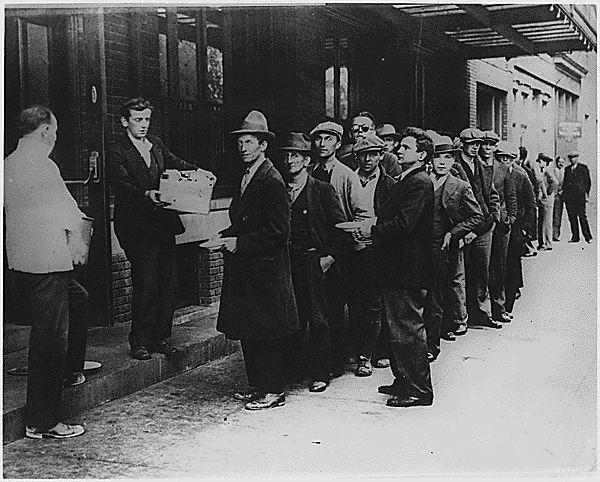
Breadlines: long line of people waiting to be fed: New York City: in the absence of substantial government relief programs during 1932, free food was distributed with private funds in some urban centers to large numbers of the unemployed. (Circa February 1932)

Breadlines: long line of people waiting to be fed: New York City: in the absence of substantial government relief programs during 1932, free food was distributed with private funds in some urban centers to large numbers of the unemployed. (Circa February 1932)

At the end of my work life I got to administer some of the stimulus funding.  What I saw was not the direct creation of a huge number jobs with government  funding, but many jobs created as the result of the opening of a new business, new hotel, or new housing.  Those employed persons paid taxes which helped bolster the economy.  If the benefits of having people employed are obvious to an economic novice like me,  I don’t understand why the Republicans in Congress don’t want to fund infrastructure projects.  Road and bridge repairs, creating a grid that can tie in with alternative energy sources, construction of affordable housing:  these are just a few of the types of projects that can be government funded and that can create jobs.  While construction jobs may disappear, the infrastructure created will result in new opportunities.

Paul Krugman’s recent column helps me understand a little what may be going on.  He begins

Last week John Boehner, the speaker of the House, explained to an audience at the American Enterprise Institute what’s holding back employment in America: laziness. People, he said, have “this idea” that “I really don’t have to work. I don’t really want to do this. I think I’d rather just sit around.” Holy 47 percent, Batman!

People are just lazy.  Krugman continues

First things first: I don’t know how many people realize just how successful the campaign against any kind of relief for those who can’t find jobs has been. But it’s a striking picture. The job market has improved lately, but there are still almost three million Americans who have been out of work for more than six months, the usual maximum duration of unemployment insurance. That’s nearly three times the pre-recession total. Yet extended benefits for the long-term unemployed have been eliminated — and in some states the duration of benefits has been slashed even further.

The result is that most of the unemployed have been cut off. Only 26 percent of jobless Americans are receiving any kind of unemployment benefit, the lowest level in many decades. The total value of unemployment benefits is less than 0.25 percent of G.D.P., half what it was in 2003, when the unemployment rate was roughly the same as it is now. It’s not hyperbole to say that America has abandoned its out-of-work citizens.

If unemployment is too costly, then any kind of jobs program must cost way too much.

…My question for today is instead one of psychology and politics: Why is there so much animus against the unemployed, such a strong conviction that they’re getting away with something, at a time when they’re actually being treated with unprecedented harshness?

Is it race? That’s always a hypothesis worth considering in American politics. It’s true that most of the unemployed are white, and they make up an even larger share of those receiving unemployment benefits. But conservatives may not know this, treating the unemployed as part of a vaguely defined, dark-skinned crowd of “takers.”

My guess, however, is that it’s mainly about the closed information loop of the modern right. In a nation where the Republican base gets what it thinks are facts from Fox News and Rush Limbaugh, where the party’s elite gets what it imagines to be policy analysis from the American Enterprise Institute or the Heritage Foundation, the right lives in its own intellectual universe, aware of neither the reality of unemployment nor what life is like for the jobless. You might think that personal experience — almost everyone has acquaintances or relatives who can’t find work — would still break through, but apparently not.

The bottom line:  If you are still unemployed or if you are poor it is your own fault.  Besides, those people live in a world far from the world of Fox News.

I hope that people think about the state of the semi-recovered economy when they vote and that they vote for candidates who can learn from the lessons of the Depression, will vote some funding for jobs programs and not worry so much about the deficit which is shrinking.  They should instead worry about our infrastructure which is failing.  If they fix that, they may find people aren’t lazy, they just need jobs.

 Photograph:  Picture from the Franklin D. Roosevelt Library, courtesy of the National Archives and Records Administration

Hitting reset

A few weeks ago, my husband and I both noted an article in the New York Times Week in Review section called “Hit the Reset “Button in Your Brain.”  The authors argued the need for a true vacation from work.  In other words not one like President Obama had where according to a news report I heard he talked to at least 9 foreign leaders and held at least 4 press conferences.  This would be in addition to the normal routine of daily briefings, etc.  Some of the rest of us call work and read email while ostensibly on vacation.  They argue

If you’re feeling overwhelmed, there’s a reason: The processing capacity of the conscious mind is limited. This is a result of how the brain’s attentional system evolved. Our brains have two dominant modes of attention: the task-positive network and the task-negative network (they’re called networks because they comprise distributed networks of neurons, like electrical circuits within the brain). The task-positive network is active when you’re actively engaged in a task, focused on it, and undistracted; neuroscientists have taken to calling it the central executive. The task-negative network is active when your mind is wandering; this is the daydreaming mode. These two attentional networks operate like a seesaw in the brain: when one is active the other is not.

0810BRAIN-master495


So what helps us reset and overcome the overload?

Increasing creativity will happen naturally as we tame the multitasking and immerse ourselves in a single task for sustained periods of, say, 30 to 50 minutes. Several studies have shown that a walk in nature or listening to music can trigger the mind-wandering mode. This acts as a neural reset button, and provides much needed perspective on what you’re doing.

Daydreaming leads to creativity, and creative activities teach us agency, the ability to change the world, to mold it to our liking, to have a positive effect on our environment. Music, for example, turns out to be an effective method for improving attention, building up self-confidence, social skills and a sense of engagement.

I suspect that by moving to Vermont with cleaner air, quiet, and lots of space to walk and appreciate nature even within a few blocks of our house, we have hit our reset buttons.  Being able to sit on the screened in porch and watch daylight fade as I did last night or taking a walk to see the stars tonight provides time to think and reflect.  We did try to do this in Boston by walking around Jamaica Pond for example, but even there you could hear traffic.  I used to walk over to Boston Harbor at lunch and look at the water.  These are urban dwellers solutions which people in cities can employ.  But they need to do so without cellphones and other devices.

I know it is a privilege to be able to retire to a place where we can so easily hit reset.

Illustration by Matthieu Bourel

The politics of macho

In 1992 when he was running for President in a tight Democratic primary race, Bill Clinton rushed back to Arkansas where he was governor to preside over the execution of Ricky Ray Rector.  According to a New York Times article at the time

Mr. Rector, 40 years old, was convicted in November 1982 and sentenced to die for the 1981 shooting death of Police Officer Bob Martin in Conway, Ark. He was also convicted of another murder that occurred two days earlier….

After shooting Officer Martin, Mr. Rector turned the gun on himself, destroying part of his brain. His lawyers said that even though he could speak, his mental capacities were so impaired that he did not know what death is or understand that the people he shot are not still alive.

“He is, in the vernacular, a zombie,” said Jeff Rosenzweig, a lawyer for Mr. Rector before the execution. “His execution would be remembered as a disgrace to the state.”

Mr. Rosenzweig said Mr. Clinton was harshly criticized as being soft on crime in 1980, when he was defeated by Frank White, his Republican opponent, in his first re-election bid. Mr. Clinton defeated Mr. White two years later and has been re-elected three more times.

Bill Clinton needed to show that a Democrat could be just as tough on crime as any Republican.

Oklahoma Governor Mary Fallin

Oklahoma Governor Mary Fallin

Twenty-two years later we have Oklahoma governor, Mary Fallin, threatening to defy the Oklahoma Supreme Court while her allies in the legislature start to impeach justices.  Why?  Because they wanted to proceed with two executions.

States like Oklahoma have tried to protect drug companies by passing laws prohibiting the disclosure of what’s in their lethal injections. But attorneys have argued that state secrecy about what’s in those lethal injections violates the ban on “cruel and unusual punishment,” and some courts have agreed, including a court in Oklahoma that blocked Lockett’s execution. When the state Supreme Court backed the lower court, Fallin said she would defy it, insisting the court only had authority over civil, not criminal matters. Then the court shamefully reversed itself, after a state legislator promised to impeach the justices for staying the executions. Fallin forged ahead with the killing of Lockett and Charles Warner.

Now she is investigating what happened.  I think we know already.  Mary Fallin was so anxious to prove her toughness that she abandoned all good sense and tried to execute Clayton Lockett.  We all know how that worked out.

Then there is the critique of President Obama’s foreign policy from those who seek more military intervention in places like Ukraine and Syria.  The President has his own ideas as reported in the New York Times

On a day in which he announced new sanctions against Russia for its continued threats to Ukraine, Mr. Obama said his foreign policy was based on a workmanlike tending to American priorities that might lack the high drama of a wartime presidency but also avoided ruinous mistakes.

“You hit singles, you hit doubles; every once in a while we may be able to hit a home run,” Mr. Obama said at a news conference with Mr. Aquino. “But we steadily advance the interests of the American people and our partnership with folks around the world.”

He was mocked in some circles with it being characterized as the “Ichiro” foreign policy after Ichiro Suzuki, the former Seattle Mariner and now New York Yankee who has made a very successful career out of hitting singles.  It shows that one doesn’t always have to hit home runs; home run hitters tend to strike out a lot.

Mr. Obama offered this trip as Exhibit A for the virtues of an incremental approach: He nudged along trade negotiations with Japan, consoled a bereaved ally in South Korea, cultivated ties with a once-hostile Malaysia and signed a modest defense agreement with the Philippines.

“Why is it that everybody is so eager to use military force,” Mr. Obama said, “after we’ve just gone through a decade of war at enormous cost to our troops and to our budget. And what is it exactly that these critics think would have been accomplished?”

I was hoping that the era of macho politics was fading, but now, it seems that women governors need prove themselves just a tough as a man.  No one is saying that Clayton Lockett is a wonderful man who doesn’t deserve punishment, but perhaps Mary Fallin should take a page out of the President’s book and slow down.  Mr. Lockett wasn’t going anywhere and neither are the other inmates on Oklahoma’s death row.

Photograph: AP/Cliff Owen


Solving the pay equity problem: Not that easy

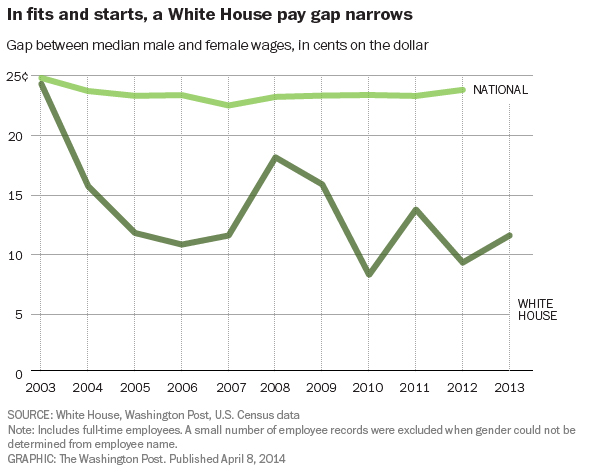
white-house-wage-gapIs the gender gap in wages a myth or is it as the President said yesterday just math?  If a company pays, as does the White House and most other government agencies, equally for the same job, why is there still a gap in total pay?  Is that as Christina Hoff Summers would argue, not a wage gap since the cause is that women are in different job?  Christopher Ingraham wrote in the Washington Post

The American Enterprise Institute caught the White House flat-footed yesterday with its finding that female White House workers earned roughly 88 cents to the dollar compared to male employees. This came the day before two high-profile executive orders aimed at narrowing the gender wage gap among federal contractors.

When asked about the discrepancy by reporters, spokesman Jay Carney said that those figures are based on the total of all staff jobs, and that women tend to fill more lower-paying positions than men. When you break it out by position, “men and women in equivalent roles here earn equivalent salaries,” Carney said. Incidentally, this is the pretty much the same argument that AEI scholar Christina Hoff Summers makes to argue that the gender wage gap is a myth.

Human Resource people (of which I was once one) would say it is all about classifying jobs.  There is an endless debate about what jobs require more skills, more effort, more responsibility.  Is the woman who comes to help your sick mother as a home health aide worth less than the man who manages the local convenience store? (Neither gets paid very well.)  Is a pre-school teacher worth less than the CEO of Facebook?  Ok.  I can hear people saying that I’m comparing apples and oranges, but these are the kind of things we need to consider as we look at not only the gender issues but also at low wage jobs generally.  If you look at the Washington Post chart, you can see that the national wage gap is pretty constant, but the general trend of the White House gap is down.

There are really several problems at work here.  First is the failure to pay women an equivalent wage for the same work done by a man.  This may be deliberate or the women may simply be given a different job title and classification.  The second is what the Institute for Women’s Policy Research calls occupational segregation.

Pay equity may also be impacted by other more subtle factors than workplace discrimination. IWPR’s research shows that, irrespective of the level of qualification, jobs predominantly done by women pay less on average than jobs predominantly done by men. Women have made tremendous strides during the last few decades by moving into jobs and occupations previously done almost exclusively by men, yet during the last decade there has been very little further progress in the gender integration of work. This persistent occupational segregation is a significant contributor to the lack of significant progress in closing the wage gap.

The third problem is one that speaks mainly to women in the private sector at high levels:  Women appear to be less willing to ask for more in salary negotiations.  While this is unimportant and insignificant, more women are hurt by the first two problems.

In the late 1970s I was working as a research analyst for the Virginia State Equal Opportunity Office.  We got a complaint from a woman professor at a state college who suspected that she was being paid less than a male colleague who started around the same time as she did.  They were, I think, both coming up for tenure.  This was the age before editable spreadsheets were common, but I managed to make a chart showing hire dates, educational levels, teaching load and teaching evaluations among other factors I can’t remember now for that department.  When laid out, it became very clear that the women, including the complainant were being paid less.  This set off a request for an analysis of the entire school as well as requests from several other state colleges and universities.  I ended up teaching people from the schools how to do this themselves since there was no way I could tackle such a large project on my own.  Problems were corrected, but I don’t recall that we ever compared  salary levels at the Department of Physics (probably mostly men) to the School of Nursing (mostly women).

I tell this story for two reasons.  One, the problem and issue has been around a long, long, time.  And second, I think we need to look harder at occupational segregation and, if we can’t totally solve that, we need to look at how we, as a society, value what we call “women’s work.”  In the end, that is the only way to cure the pay equity problem.


As the dust settles

on the first enrollment period of the new Affordable Care Act, we are learning that a lot more people than a lot of people predicted have signed up for insurance.  President Obama is claiming 7.1 million people signed up on the health insurance exchanges – along with unknown numbers of others who signed up directly with insurance companies.  There was a claim yesterday that 90% of the enrollees had actually paid a first premium, a crucial step to being able to actually use the insurance.  We all know that there will be hassles when people go to their medical provider, when insurance cards don’t arrive in the mail, when someone with expanded Medicaid goes to a doctor who doesn’t accept that plan, but then, there have always been hassles with health insurance.  This will be nothing new.  What will be new is the massive number of new people suddenly looking for a provider.  Adjustments will have to be made all around.

But the biggest losers as of this morning would seem to be the opponents of the ACA or Obamacare as they call it.  Here is Dan Wasserman’s cartoon from this morning’s Boston Globe.

obamacare wasserman


And then there is this story from Politico.

Back in the fall, conservatives seized on the flubbed Obamacare rollout as proof that President Barack Obama’s brand of liberalism doesn’t work.

Now, the law’s opponents aren’t about to say that critique was wrong — but they’ve lost the best evidence they had.

On Tuesday, Obamacare sign-ups passed 7 million, six months after the launch of a federal website that could barely sign up anybody. There are still a lot of questions about how solid that figure is, but the idea that the law could even come close to the original goal after such a disastrous start would have been laughable even a few weeks ago.

That’s left the critics questioning the early numbers or changing the subject. It’s a reminder that the attacks on the website were more than complaints about technology, but a proxy for a much deeper argument about what government should do and what it can’t do

But the Republicans do seem to be suffering from a compulsion disorder.  Here is Representative Paul Ryan quoted in the Politico story

And House Budget Committee Chairman Paul Ryan, who on the same day released a budget plan that would repeal the law, wasn’t fazed by the enrollment news.

“I think Obamacare is a slow-rolling fiasco. I think it’s a Pyrrhic victory,” the Wisconsin lawmaker said during a conference call with reporters Tuesday, at the same time that Obama was giving his victory speech in the Rose Garden.

But it was so much easier when they could just say the federal government can’t tie its own shoelaces. Now, they have to acknowledge that the government fixed the problem — and enrollment came roaring back.

Louisiana Governor Bobby Jindal is set to release his health care plan – I guess he is running for President.  According to the Washington Post

Louisiana Gov. Bobby Jindal will announce Wednesday a plan to repeal and replace President Obama’s health-care law, an effort by the Republican to insert himself into the increasingly competitive early maneuvering for his party’s presidential nomination.

In his 26-page plan, Jindal lays out a lengthy critique of the health law — which he refers to throughout as “Obamacare” — and reiterates his belief that it needs to be entirely done away with. In its place, he sets forth a bevy of ideas that have run through conservative thought for years, in some cases renaming them and in other cases suggesting new variations on old themes.

These themes appear to include giving those on Medicare a subsidy to buy private insurance and giving Medicaid money to the states to provide whatever care they decide on.  I have a feeling that this every-state-for-itself  idea will be proven to be a real problem as people in states that didn’t accept the expanded Medicare under the ACA are faced with citizens who won’t understand why Uncle Charlie can get health insurance subsidies and they can’t.  I don’t think this is a plan people will go for – especially after they get a feel for what is covered under ACA – but at least Jindal has something.

President Obama’s poll numbers are creeping up.  Democrats running for re-election would do well to be cautious about running away from the ACA, and optimistic me says that Nate Silver might just be wrong this time with is prediction that the Republicans have the edge in the mid-terms.  It won’t be easy for the Democrats:  They have to turn out their base in larger numbers than is usual for a mid-term, but it can be done.  Nate did favor Duke which lost in the first round of the NCAA men’s basketball tournament.

Random thoughts on the state of the world on the first day of spring

Today, the first day of spring, is warmish outside.  I think it actually broke 50!  We had a few hours of sun, but now it is mostly cloudy.  I finally purchased John Grisham’s “Sycamore Row”.  I had been resisting but succumbed because I loved “A Time to Kill” and I ended up getting 45% off the cover price.  Don’t know if a new Grisham is a sign of spring or not, but I’m going to take it as one.

It is hard for me to concentrate on much the last few days.  There is just too much news! Between the missing Malaysian airliner, Crimea, and worrying about the Democrats retaining Congress in the fall, things are pretty depressing even for someone who tends to be an optimist.

Unfortunately, I think that time ran out a long time ago for the passengers on the airliner and now all we can do is watch as the world tries to locate the remains of the plane and the black box.  While everyone points out that they did eventually find the Air France plane that went down in the Atlantic, it was very difficult even though we had a much better of idea of where it went down.  I see the families on television and wonder what I would feel if I just didn’t know what happened.  At this point one almost has to treat it as a forensic mystery to be solved.

I don’t think we are on the verge of a war over Russia and the Crimea, but I do think that things will be difficult internationally for a while.  This will affect negotiations in Iran and Syria as well as people in the Ukraine and Crimea.  But the ultimate losers may be the Crimeans.  David M. Herszenhorn had an article in the New York Times yesterday which pointed out that the troubles there may just be starting.

Many A.T.M.s in this sun-dappled seaside resort city in Crimea, and across the region, have been empty in recent days, with little white “transaction denied” slips piling up around them. Banks that do have cash have been imposing severe restrictions on withdrawals.

All flights, other than those to or from Moscow, remain canceled in what could become the norm if the dispute over Crimea’s political status drags on, a chilling prospect just a month before tourist season begins in a place beloved as a vacation playground since czarist times.

He points out that Ukraine could cut off electricity and water supplies and that there is no direct overland route between Crimea and Russia.  The story ends with this

Some Crimeans said they were already feeling the financial sting from political instability.

As crowds in the cities of Simferopol and Sevastopol held raucous celebrations well into Monday morning after the vote, here in Yalta, Ihor B., the owner of a small travel business, went to bed with a growing sense of dread: The roughly two dozen bookings that he had received since the start of the year had all disappeared.

“I got 10 requests from Germany, and 10 assignments from Ukrainian agencies for Western tourists; a couple of requests from Dutch tourists and cruise ships,” said Mr. B, who asked that his last name not be used for fear of reprisal by the new Russian government. “At the moment, all of them, absolutely all of them, are canceled.”

In the same issue of the Times was a long cautionary story about South Ossetia which was liberated from Georgia five years ago.  But things have moved on and South Ossetia is not doing very well.

When Russia invaded Georgia, repelling a Georgian attack on South Ossetia and taking control of the separatist enclaves of South Ossetia and Abkhazia, it seemed most unlikely that the Kremlin was thinking about long-term consequences.

As in Crimea, the war was presented to Russians as a humanitarian effort to protect its citizens, and more broadly as a challenge to encirclement by the United States, which was aligned with Georgia. Television stations gave the intervention blanket coverage, and it was wildly popular in Russia, lifting the approval ratings of Dmitri A. Medvedev to the highest point of his presidency.

The aftermath of recognition, however, has presented Russia with a long series of headaches. This week, economists have warned repeatedly that Crimea, if it is absorbed, will prove a serious drag on Russia’s budget, but their arguments have been drowned out in the roar of public support for annexation.

Aleksei V. Malashenko, an analyst at the Carnegie Moscow Center, said Russian officials “will be shocked” with the challenges they face when trying to manage Crimea — reviving its economy, distributing money and influence among its ethnic groups, and trying to control the corruption that accompanies all big Russian projects. And, judging from precedent, the public’s euphoria will fade, he said.

“I think that in Russia, the majority of the society forgot about Ossetia, and if it weren’t for the Olympics, the majority of the society would also forget about Abkhazia,” Mr. Malashenko said. “Of course, Crimea is not Ossetia. But anyway, the popularity of Crimeans, and the Crimean tragedy, will be forgotten in a year.”

So maybe we don’t need to do anything except some sanctions and make sure that Russia and Putin’s next move is not to march into eastern Ukraine.  Forget John McCain’s mockery and advice.

As for domestic politics, I recalled Andrew Sullivan’s March 13th blog entry on The Dish. The Boring, Relentless Advance Of Obama’s Agenda.  To read the entire piece one has to subscribe [which I would encourage you to do], but here is his conclusion.

…One side is theater – and often rather compelling theater, if you like your news blonde, buxom and propagandized. The other side is boring, relentless implementation. At any one time, you can be forgiven for thinking that the theatrics have worked. The botched roll-out of healthcare.gov, to take an obvious example, created a spectacular weapon for the GOP to hurl back at the president. But since then, in undemonstrative fashion, the Obama peeps have rather impressively fixed the site’s problems and signed up millions more to the program. As the numbers tick up, the forces of inertia – always paramount in healthcare reform – will kick in in defense of Obamacare, and not against it. Again, the pattern is great Republican political theater, followed by steady and relentless Democratic advance.

Until the theater really does create a new majority around Republican policies and a Republican candidate, Obama has the edge. Which is to say: he has had that edge now for nearly six years. Even if he loses the entire Congress this fall, he has a veto. And then, all he has to do is find a successor able to entrench his legacy and the final meep-meep is upon us. And that, perhaps, is how best to see Clinton. She may not have the stomach for eight years in the White House, and the barrage of bullshit she will have to endure. But if you see her as being to Barack Obama what George H.W. Bush was to Reagan, four years could easily be enough. At which point, the GOP may finally have to abandon theater for government, and performance art for coalition-building.

Plus, it is spring.

Mutts by Patrick McDonnell

Mutts by Patrick McDonnell

St. Patrick’s Day 2014

I’m not quite sure I understand the whole controversy about openly gay persons marching in a St. Patrick’s Day parade.  The parade is just a celebration of heritage and the Irish are just as diverse as any other group.  Boston’s old Mayor, Tom Menino, simply didn’t march in the South Boston parade because of the restriction, upheld by a Supreme Court decision, that the parade organizers could choose who they wanted to march.  But new Boston Mayor Marty Walsh is, along with U. S. Representative Stephen Lynch, doing his best to broker a compromise that would allow Mass Equality to march with a banner.  I think the parade organizers that include a fellow called Wacko Hurley fear that their parade would turn into another gay pride march if they let any LGBT groups march.  Presumably, the LGBT community knows the difference: March is not June.  Plus, there is a picture from the 1992 parade, pre-Supreme Court decision,  that shows there is nothing to fear.

The parade is only a couple of days away, and Mayor Walsh is making one last try.  Most Boston and Massachusetts state-wide elected officials have already announced they are not going to march.  I think the only exception is Nick Collins, the State Representative from South Boston.

The 1992 South Boston parade after a court order.

The 1992 South Boston parade after a court order.

Kevin Cullen has a wonderful column in today’s Boston Globe about the Boston and New York City parades.

So Marty Walsh, God love ’im, is going to make one last-ditch effort to hammer out a compromise so gay people can march openly in Sunday’s parade in Southie.

As they say in the Irish-speaking Gaeltacht, from where Marty’s parents are from, “Beir bua agus beannacht.” Look it up.

Down here in New York, where its St. Patrick’s Day parade is older than the Declaration of Independence and lasts anywhere from six to seven hours, there’s the same standoff, with organizers refusing to let gay people march with banners that identify themselves as gay.

Mayor Bill de Blasio, as the Irish say, couldn’t be arsed when it comes to forging compromise. He boycotted the parade when he was the city’s public advocate. He’s not going to start marching now.

De Blasio’s predecessor, Michael Bloomberg, of the Medford [MA] Bloombergs, marched in the parade but de Blasio is about as different from Bloomberg as the Irish are from Irish-Americans.

De Blasio, who grew up in Cambridge, is married to a black woman and has biracial kids, so he’s not really into exclusion. But neither is he into cozying up to the New York Irish, who were in the corner of de Blasio’s primary opponent, Christine Quinn, who was the city council president.

The irony in this — and it wouldn’t be Irish if there weren’t irony — is that Quinn is openly gay. Which means, even when she led the city council delegation in the parade she wasn’t allowed to identify herself as being gay.

So the New York Irish wanted to elect an openly gay mayor but wouldn’t let her march in the parade as openly gay.

And people in New York think we’re nuts?

Mayor Walsh, on the other hand, had support from both the gay community and South Boston so he’s kinda caught in the middle.  But he has said that if he can’t work a compromise, he won’t march.

Linda Dorcena Forry

Linda Dorcena Forry

Boston also has this breakfast before the parade.  Politicians come and roast each other and try to sing Irish songs.  Last May I wrote about South Boston and the election of Linda Dorcena Forry.  I predicted that she would bring some life back to the St. Patrick’s Day Breakfast.  Dorcena Forry is Hatian American married to an Irish man.  The City Councilor from South Boston tried to wrest control, but tradition prevailed:  The State Senator who represents Southie hosts the breakfast.  So Bill Linehan is taking his ball and going to Ireland for the day.  I hope he realizes that this will make him the butt of a lot of jokes.  Whatever.Linda is doing her best to live up to my prediction.  First she announced that the Dropkick Murphy’s, Boston’s very popular Irish punk group, would perform.  Then the Boston Globe had news today of  her most recent announcement about the breakfast.

State Senator Linda Dorcena Forry’s groundbreaking debut as the first woman, first Haitian-American, and first Dorchester resident to host the storied St. Patrick’s Day breakfast on Sunday is apparently drawing some international attention.

Dorcena Forry announced Thursday that Enda Kenny — Ireland’s prime minister, or taoiseach — has agreed to attend the ribald political roast in South Boston.

The visit by a sitting head of state is a coup for Dorcena Forry, who promised to raise the profile of a breakfast that in recent years seemed to have lost some of its star power.

“I am honored that Taoiseach Kenny will join us for this year’s breakfast,” Dorcena Forry said. “I have had the pleasure of meeting the taoiseach during his previous visits to Boston. His attendance at the breakfast is a wonderful affirmation of the deep bonds of friendship between Boston and Ireland.”

No word on whether President Obama will be appearing either on tape or by live feed, but I wouldn’t be surprised.  The Prime Minister is not marching in the parade.

The times are rapidly changing.  Boston Beer Company (think Sam Adams) just announced they have pulled their parade sponsorship.  Wacko and his veterans group are doing a great job of killing the parade.  Meanwhile, the breakfast thrives.  Is there a lesson here?

Photograph of GLIB marching:  Marilyn Humphries

The state of health care reform

As everyone knows, the rollout of the Affordable Care Act has been pretty bumpy what with website problems, Congress not providing funding for getting the word out, and states refusing expanded Medicaid even if it is free money.  There have been surprises also.  The red state of Kentucky with a Democratic Governor, Steve Beshear, is running a successful program.  Connecticut has an online program that it is thinking of selling to other states.  Massachusetts with the original universal health care program hired the same folks that messed up the federal website resulting in problem after problem resulting in a backlog in processing paper applications.

In the meanwhile, the Congressional Republicans would still like to either eliminate or defund the ACA, but as Greg Sargent wrote recently in the Washington Post people are beginning to move away from supporting those actions.

Obamacare is a disaster for Democrats, and a certain winner for Republicans. That’s what we keep hearing, anyway.

So why does it look as if the percentage of Americans who favor repeal may have actually shrunk since its rollout problems began?

That’s what the February tracking poll for the Kaiser Family Foundation suggests. To be sure, the new poll finds that opinion of the law is more negative than positive: 47 percent of Americans view the law unfavorably, while 35 percent view it favorably (though opinions have improved a bit since October).

But unfavorable views have not translated into support for the GOP position of repeal; indeed the repeal position may have lost ground since the October rollout problems, while a clear majority favors keeping and improving the law.

Some Kaiser survey results

Some Kaiser survey results

I think most people, including President Obama, would say that the ACA could be improved.  Any piece of legislation of that scope is going to have parts that don’t work well or have unintended consequences which need fixing.  And they need fixing in a systematic way and not just on the fly through delays and exceptions as the administration has been trying to do.  The poll results show support for making fixes.

The poll shows that 48 percent want to keep and improve the law, and another eight percent want to keep it as is — for a total of 56 percent who want to keep it. (50 percent of independents want to keep and fix.)

Meanwhile, 19 percent want to repeal the law and not replace it, while 12 percent want to repeal and replace with a GOP alternative — totaling 31 percent.

Back in October Kaiser found that 37 percent want repeal/replace or just repeal, versus 47 percent who want to keep/expand it. There was a temporary spike for repeal in December, at the height of the problems; now it appears to be back down to below where it was.

In fairness, the wording is not directly parallel. The new poll offers respondents the option of keep and improve, while the October poll offered folks keep or expand. But this underscores the point: When people are offered keep and improve — the Dem stance — support for keeping the law grows.

Paul Krugman pointed out in his last New York Times column that Republican attempts to find horror stories have so far not really succeeded.

Remember the “death tax”? The estate tax is quite literally a millionaire’s tax — a tax that affects only a tiny minority of the population, and is mostly paid by a handful of very wealthy heirs. Nonetheless, right-wingers have successfully convinced many voters that the tax is a cruel burden on ordinary Americans — that all across the nation small businesses and family farms are being broken up to pay crushing estate tax liabilities.

You might think that such heart-wrenching cases are actually quite rare, but you’d be wrong: they aren’t rare; they’re nonexistent. In particular, nobody has ever come up with a real modern example of a family farm sold to meet estate taxes. The whole “death tax” campaign has rested on eliciting human sympathy for purely imaginary victims.

And now they’re trying a similar campaign against health reform.

Krugman cites the Response to the State of the Union Address.

 In the official G.O.P. response to the State of the Union address, Representative Cathy McMorris Rodgers alluded to the case of “Bette in Spokane,” who supposedly lost her good health insurance coverage and was forced to pay nearly $700 more a month in premiums. Local reporters located the real Bette, and found that the story was completely misleading: her original policy provided very little protection, and she could get a much better plan for much less than the claimed cost.

Louisiana is running ads about people losing health care insurance with actors.

In Michigan, Americans for Prosperity is running an ad that does feature a real person. But is she telling a real story? In the ad, Julia Boonstra, who is suffering from leukemia, declares that her insurance has been canceled, that the new policy will have unaffordable out-of-pocket costs, and that “If I do not receive my medication, I will die.” But Glenn Kessler of The Washington Post tried to check the facts, and learned that thanks to lower premiums she will almost surely save nearly as much if not more than she will be paying in higher out-of-pocket costs. A spokesman for Americans for Prosperity responded to questions about the numbers with bluster and double-talk — this is about “a real person suffering from blood cancer, not some neat and tidy White House PowerPoint.”

Even supporters of health reform are somewhat surprised by the right’s apparent inability to come up with real cases of hardship. Surely there must be some people somewhere actually being hurt by a reform that affects millions of Americans. Why can’t the right find these people and exploit them?

The most likely answer is that the true losers from Obamacare generally aren’t very sympathetic. For the most part, they’re either very affluent people affected by the special taxes that help finance reform, or at least moderately well-off young men in very good health who can no longer buy cheap, minimalist plans. Neither group would play well in tear-jerker ads.

There is about a month left to sign-up before one has to pay a tax penalty for not having coverage for 2014.  The last number reported was 4 million sign-ups.  A priority:  Get the young and healthy to sign-up.

.

.

Chart from Kaiser via the Washington Post

Picture of buttons from sites.tufts.edu

Spending and the deficit

There is a lot of information floating around out there, but I just got these charts from my Congressman, Mike Capuano, and I wanted to share them.

The Bottom Line
The statistics and chart below will prove two points despite any rhetoric to the contrary:
  1. Federal spending is headed towards the lowest share of GDP in memory;
  2. The federal government is making great progress towards reducing our annual deficit.
A Note about Federal Spending
If you listen only to a few talking heads you might think that the federal government is engaged in a spending frenzy.  That is actually not the case.  In fact, our government is currently spending LESS than it did in 1974 on discretionary spending programs, the year that detailed economic records were first compiled.
We all know that a dollar doesn’t go as far as it once did – so measuring any spending over a 40 year period demands adjustment.  One way to do this is to look at government spending as a percentage of the Gross Domestic Product (GDP). The chart below with data from the Congressional Budget Office (CBO) illustrates that in 1974, federal government spending under the Nixon Administration equaled 9.3% of ALL spending in the country (the GDP).  Discretionary spending peaked in 1983 under the Reagan Administration at 10% of GDP.  The most recent figures show that federal spending last year under President Obama fell to just 7.2% of GDP and is estimated to decline even further over the next several years.
Historically, the lowest level of discretionary government spending in the last 40 years occurred in 1999 under the Clinton Administration, and it rose steadily from 6.1% to 7.7% during the George W. Bush Administration.
The point I am trying to make is that it is important to keep federal spending in perspective.  Your federal government today is spending a much smaller share than President Reagan ever did and more spending cuts are coming.  Many of us think it is long past time to face reality and truly consider the future of our country. Do we want good roads? Do we want good schools?  If the answer is yes, then it’s time to start paying for them.
At this point in our nation’s history, we should be investing again in our future. Our economy is improving and the federal budget has stabilized. The notion that federal spending is out of control just isn’t accurate. Take a look at the chart (or click here for a larger version) and table below, which illustrate my argument:
Discretionary Outlays Since 1974
as % of Gross Domestic Product (GDP)

FY

Defense

Nondefense

Total

Nixon 1974

5.4

3.9

9.3

Ford 1975

5.4

4.4

9.8

Ford 1976

5.0

4.8

9.8

Carter 1977

4.8

4.9

9.7

Carter 1978

4.6

5.0

9.6

Carter 1979

4.5

4.8

9.3

Carter 1980

4.8

5.1

9.9

Reagan 1981

5.0

4.8

9.8

Reagan 1982

5.6

4.2

9.8

Reagan 1983

5.9

4.1

10.0

Reagan 1984

5.8

3.8

9.6

Reagan 1985

5.9

3.8

9.7

Reagan 1986

6.0

3.6

9.7

Reagan 1987

5.9

3.4

9.3

Reagan 1988

5.6

3.4

9.0

Bush 1989

5.5

3.3

8.8

Bush 1990

5.1

3.4

8.5

Bush 1991

5.2

3.5

8.7

Bush 1992

4.7

3.6

8.3

Clinton 1993

4.3

3.6

7.9

Clinton 1994

3.9

3.6

7.5

Clinton 1995

3.6

3.6

7.2

Clinton 1996

3.3

3.3

6.7

Clinton 1997

3.2

3.2

6.4

Clinton 1998

3.0

3.1

6.2

Clinton 1999

2.9

3.1

6.0

Clinton 2000

2.9

3.1

6.1

GW Bush 2001

2.9

3.2

6.1

GW Bush 2002

3.2

3.5

6.7

GW Bush 2003

3.6

3.7

7.3

GW Bush 2004

3.8

3.6

7.4

GW Bush 2005

3.8

3.7

7.5

GW Bush 2006

3.8

3.6

7.4

GW Bush 2007

3.8

3.4

7.3

GW Bush 2008

4.2

3.5

7.7

Obama 2009

4.6

4.0

8.6

Obama 2010

4.7

4.5

9.1

Obama 2011

4.5

4.2

8.8

Obama 2012

4.2

3.8

8.0

Obama 2013

3.8

3.5

7.2

Obama 2014 EST

3.5

3.4

6.9

Obama 2015 EST

3.3

3.2

6.6

Obama 2016 EST

3.2

3.0

6.2

2017 EST

3.1

2.9

6.0

2018 EST

3.0

2.8

5.8

2019 EST

2.9

2.7

5.7

2020 EST

2.9

2.7

5.6

2021 EST

2.8

2.6

5.4

2022 EST

2.8

2.6

5.4

2023 EST

2.7

2.5

5.3

2024 EST

2.7

2.5

5.2

Sources: Cong Budget Office; Office of Management and Budget

The Federal Deficit
We have heard a lot of talk about the federal deficit. The chart belowshows the amount of the annual deficit, or in some cases, surplus,generated by the federal government.  There are many ways to interpret these statistics and I would like to offer a few comments.
You can see there have been only four years since 1974 wherea surplus was generated– the last three years under PresidentClinton and the first year under PresidentGW Bush.  One could argue that the 2001 surplus should be credited to Clinton policies – butI will leave that aside.  However, it is clear that the federal governmentstarted regenerating deficits under Bush policies – most notably his first tax cut in 2001 (before the 9/11 attack).  Certainly, the terrorist attacks on September 11th and the country’s decision to engage in Afghanistan impacted the economy. However,the federal government made a conscious decision to turn away from fiscal discipline BEFORE September 11th.
One can quickly notice the impact of the 2008 economic crisis and our reaction to it.  Regardless of how you might feel about the stimulus and the bailouts – at least it was clearwhat the short term effect would be on the federal deficit.  I happen to think BOTH those actions were necessary and appropriate to save our economy from an even worse fate. Certainly the bailout should have had more teeth. Remember though it was passed under the Bush Administration so those of us calling for more teeth were drowned out.The only choice we faced was action or inaction, and we chose action. I also believe that the stimulus should have been more targeted on creating jobs.  Unfortunately, Congress never has a choice between perfect options – it is always a choice between imperfect plans.  I understand thatmost people have formed pretty strongopinionsabout the actions that the government took and I will let history decide whether those actions were appropriate.
Since the economic crisis in 2008, the federal government has been making significant and steady progress towards reducing our annual deficit.  The average deficit over the 43 years covered by this table equals 3.1% of the GDP. This chart doesn’t show it, but by the end of the Obama Administration it will be below that historic average. Remember, absolute numbers like these only tell a portion of the story.
My final note on this is historic.  This chart shows the deficits and surpluses under 20 years of Democratic Presidents and 22 years of Republican Presidents … good times and bad … war and peace.  I think the most important measure is the change from one year to the next. Maybe we cannot achieve our goals in one year, but are we making progress?  Based on this chart you can calculate that under Democratic Presidents, the deficit was REDUCED by an average of $22.3 billion each year … under Republican Presidents that Deficit has been INCREASED by an average of $44.5 billion each year.  I’ll let you decide which course is the better one.

Revenues

Revenues Change %

Outlays

Outlays Change %

Total Deficit / Surplus

Change $

Nixon 1974

263.2

269.4

-6.1

Ford 1975

279.1

6%

332.3

23%

-53.2

-47.1

Ford 1976

298.1

7%

371.8

12%

-73.7

-20.5

Carter 1977

355.6

19%

409.2

10%

-53.7

20.1

Carter 1978

399.6

12%

458.7

12%

-59.2

-5.5

Carter 1979

463.3

16%

504.0

10%

-40.7

18.5

Carter 1980

517.1

12%

590.9

17%

-73.8

-33.1

Reagan 1981

599.3

16%

678.2

15%

-79.0

-5.1

Reagan 1982

617.8

3%

745.7

10%

-128.0

-49.0

Reagan 1983

600.6

-3%

808.4

8%

-207.8

-79.8

Reagan 1984

666.4

11%

851.8

5%

-185.4

22.4

Reagan 1985

734.0

10%

946.3

11%

-212.3

-26.9

Reagan 1986

769.2

5%

990.4

5%

-221.2

-8.9

Reagan 1987

854.3

11%

1,004.0

1%

-149.7

71.5

Reagan 1988

909.2

6%

1,064.4

6%

-155.2

-5.4

Bush 1989

991.1

9%

1,143.7

7%

-152.6

2.5

Bush 1990

1,032.0

4%

1,253.0

10%

-221.0

-68.4

Bush 1991

1,055.0

2%

1,324.2

6%

-269.2

-48.2

Bush 1992

1,091.2

3%

1,381.5

4%

-290.3

-21.1

Clinton 1993

1,154.3

6%

1,409.4

2%

-255.1

35.3

Clinton 1994

1,258.6

9%

1,461.8

4%

-203.2

51.9

Clinton 1995

1,351.8

7%

1,515.7

4%

-164.0

39.2

Clinton 1996

1,453.1

7%

1,560.5

3%

-107.4

56.5

Clinton 1997

1,579.2

9%

1,601.1

3%

-21.9

85.5

Clinton 1998

1,721.7

9%

1,652.5

3%

69.3

91.2

Clinton 1999

1,827.5

6%

1,701.8

3%

125.6

56.3

Clinton 2000

2,025.2

11%

1,789.0

5%

236.2

110.6

GW Bush 2001

1,991.1

-2%

1,862.8

4%

128.2

-108.0

GW Bush 2002

1,853.1

-7%

2,010.9

8%

-157.8

-286.0

GW Bush 2003

1,782.3

-4%

2,159.9

7%

-377.6

-219.8

GW Bush 2004

1,880.1

5%

2,292.8

6%

-412.7

-35.1

GW Bush 2005

2,153.6

15%

2,472.0

8%

-318.3

94.4

GW Bush 2006

2,406.9

12%

2,655.1

7%

-248.2

70.2

GW Bush 2007

2,568.0

7%

2,728.7

3%

-160.7

87.5

GW Bush 2008

2,524.0

-2%

2,982.5

9%

-458.6

-297.9

Obama 2009

2,105.0

-17%

3,517.7

18%

-1,412.7

-954.1

Obama 2010

2,162.7

3%

3,457.1

-2%

-1,294.4

118.3

Obama 2011

2,303.5

7%

3,603.1

4%

-1,299.6

-5.2

Obama 2012

2,450.2

6%

3,537.1

-2%

-1,087.0

212.6

Obama 2013

2,774.0

13%

3,454.3

-2%

-680.3

406.7

Obama 2014 EST

-514.0

166.3

Obama 2015 EST

-478.0

36.0

Obama 2016 EST

-539.0

-61.0


 My bottom line? Let’s spend some money and create some jobs.

Post is cut and pasted from an email update from Congressman Michael Capuano. 7th CD, Massachusetts.

Predicting 2014

I don’t have a crystal ball and haven’t thrown the I Ching, so I can’t really say what will happen. but Mark Bittman had an amusing column in yesterday’s New York Times about years ending in four.  Bittman seems to be of the opinion that nothing much that is good happens during such years, but we can hope that he just has a selective memory.

Bittman begins with 1944, but I’ll add 1914.  That was the year Austria-Hungary declared war on Serbia to begin World War I. On the plus side, the Panama Canal opened and the Boston Braves won the World Series.
Bittman writes

1944 Those of us who don’t remember this year are lucky; a soldier cited in Rick Atkinson’s brilliantly horrifying saga of the last two years of the war in Europe, “The Guns at Last Light,” quotes King Lear: “The worst is not, So long as we can say, ‘This is the worst.’ ” The end of the war was in sight; getting there was the trick, and millions were killed in the interval. Things have not been this bad since.

1954 If there was a golden era of United States foreign policy, it ended here, as Eisenhower warned against involvement in Vietnam while espousing the domino theory. Good: Joe McCarthy’s power began to ebb. Not good: The words “under God” were added to the Pledge of Allegiance.

1964 The last year of the baby boom was mind-blowing. In the 28 months beginning that January, Bob Dylan made five of the best albums of the era — and there were the Beatles.

Nelson Mandela was sentenced to life in prison, and Lyndon Johnson single-handedly sent everyone into a tizzy by signing the Civil Rights Act, sending more “advisers” to Vietnam, talking about bombing North Vietnam and proposing the Great Society. Huh? The first anti-Vietnam War demonstrations and draft-card burnings took place. Pot smoking officially began. (Not really, but sorta.)

1964 was also the year my husband graduated from high school.  I’ll call that a plus.

Skipping to 1994

Whoa: Not only did Nelson Mandela not spend his life in jail, but he became president. The Brady Law went into effect, and Bill Clinton signed the assault weapons ban. (It expired in 2004.) O. J. Simpson spurred a national obsession. Four bombers were convicted of the 1993 attack on the World Trade Center.

Reagan was implicated in the Iran-contra cover-up, but it seemed more important to torture the Clintons over a bad real estate investment. (Still, Paula Jones wasn’t the Republicans’ fault, was she?) Clinton fired Joycelyn Elders for discussing masturbation.

The first credit default swap was created. Nearly everyone in Rwanda became either a killer or a victim, or so it seemed. And there was that messy thing in “the former Yugoslavia.”

Netscape Navigator was released.

1994 was an important year for me.  We got married and I moved to Boston.  Thomas Menino was mayor but not yet The Mayor.

Which brings us to 2004.

2004  Barack Obama spoke at the Democratic convention and there seemed reason for hope; then John Kerry went windsurfing and W., incredibly, became president again (what were 62 million of us thinking?) several months after endorsing a constitutional amendment banning same-sex marriage, which Massachusetts had already legalized. (By 2013, even Utah is on the right side of this issue.) W. also promised to improve education and access to health care; we all know how that worked out. Lance Armstrong won his sixth Tour de France; we all know how that worked out, too.

And also in 2004, the Red Sox won the World Series for the first time in 86 years ending the mythical curse of Babe Ruth.

So, 2014.  I know what I hope for:  the Democrats retain control of the Senate and, at a minimum, creep closer to a majority in the House. I hope the ACA enrolls so many people who like their benefits that we don’t have to listen to Ted Cruz reading “green eggs and ham” again.  I hope, though it seems unlikely, that we get tax and immigration reform.  I hope that President Obama has a better year. And I hope everyone comes home safely from Afghanistan.  I wish Marty Walsh all the best as he becomes mayor and I hope that Michelle Wu gives up her crazy idea of voting for Bill Linehan for City Council president and picks Tito Jackson instead.  Most of all, I hope that all of us have a safe and healthy year.

2014