Spending and the deficit

There is a lot of information floating around out there, but I just got these charts from my Congressman, Mike Capuano, and I wanted to share them.

The Bottom Line
The statistics and chart below will prove two points despite any rhetoric to the contrary:
  1. Federal spending is headed towards the lowest share of GDP in memory;
  2. The federal government is making great progress towards reducing our annual deficit.
A Note about Federal Spending
If you listen only to a few talking heads you might think that the federal government is engaged in a spending frenzy.  That is actually not the case.  In fact, our government is currently spending LESS than it did in 1974 on discretionary spending programs, the year that detailed economic records were first compiled.
We all know that a dollar doesn’t go as far as it once did – so measuring any spending over a 40 year period demands adjustment.  One way to do this is to look at government spending as a percentage of the Gross Domestic Product (GDP). The chart below with data from the Congressional Budget Office (CBO) illustrates that in 1974, federal government spending under the Nixon Administration equaled 9.3% of ALL spending in the country (the GDP).  Discretionary spending peaked in 1983 under the Reagan Administration at 10% of GDP.  The most recent figures show that federal spending last year under President Obama fell to just 7.2% of GDP and is estimated to decline even further over the next several years.
Historically, the lowest level of discretionary government spending in the last 40 years occurred in 1999 under the Clinton Administration, and it rose steadily from 6.1% to 7.7% during the George W. Bush Administration.
The point I am trying to make is that it is important to keep federal spending in perspective.  Your federal government today is spending a much smaller share than President Reagan ever did and more spending cuts are coming.  Many of us think it is long past time to face reality and truly consider the future of our country. Do we want good roads? Do we want good schools?  If the answer is yes, then it’s time to start paying for them.
At this point in our nation’s history, we should be investing again in our future. Our economy is improving and the federal budget has stabilized. The notion that federal spending is out of control just isn’t accurate. Take a look at the chart (or click here for a larger version) and table below, which illustrate my argument:
Discretionary Outlays Since 1974
as % of Gross Domestic Product (GDP)

FY

Defense

Nondefense

Total

Nixon 1974

5.4

3.9

9.3

Ford 1975

5.4

4.4

9.8

Ford 1976

5.0

4.8

9.8

Carter 1977

4.8

4.9

9.7

Carter 1978

4.6

5.0

9.6

Carter 1979

4.5

4.8

9.3

Carter 1980

4.8

5.1

9.9

Reagan 1981

5.0

4.8

9.8

Reagan 1982

5.6

4.2

9.8

Reagan 1983

5.9

4.1

10.0

Reagan 1984

5.8

3.8

9.6

Reagan 1985

5.9

3.8

9.7

Reagan 1986

6.0

3.6

9.7

Reagan 1987

5.9

3.4

9.3

Reagan 1988

5.6

3.4

9.0

Bush 1989

5.5

3.3

8.8

Bush 1990

5.1

3.4

8.5

Bush 1991

5.2

3.5

8.7

Bush 1992

4.7

3.6

8.3

Clinton 1993

4.3

3.6

7.9

Clinton 1994

3.9

3.6

7.5

Clinton 1995

3.6

3.6

7.2

Clinton 1996

3.3

3.3

6.7

Clinton 1997

3.2

3.2

6.4

Clinton 1998

3.0

3.1

6.2

Clinton 1999

2.9

3.1

6.0

Clinton 2000

2.9

3.1

6.1

GW Bush 2001

2.9

3.2

6.1

GW Bush 2002

3.2

3.5

6.7

GW Bush 2003

3.6

3.7

7.3

GW Bush 2004

3.8

3.6

7.4

GW Bush 2005

3.8

3.7

7.5

GW Bush 2006

3.8

3.6

7.4

GW Bush 2007

3.8

3.4

7.3

GW Bush 2008

4.2

3.5

7.7

Obama 2009

4.6

4.0

8.6

Obama 2010

4.7

4.5

9.1

Obama 2011

4.5

4.2

8.8

Obama 2012

4.2

3.8

8.0

Obama 2013

3.8

3.5

7.2

Obama 2014 EST

3.5

3.4

6.9

Obama 2015 EST

3.3

3.2

6.6

Obama 2016 EST

3.2

3.0

6.2

2017 EST

3.1

2.9

6.0

2018 EST

3.0

2.8

5.8

2019 EST

2.9

2.7

5.7

2020 EST

2.9

2.7

5.6

2021 EST

2.8

2.6

5.4

2022 EST

2.8

2.6

5.4

2023 EST

2.7

2.5

5.3

2024 EST

2.7

2.5

5.2

Sources: Cong Budget Office; Office of Management and Budget

The Federal Deficit
We have heard a lot of talk about the federal deficit. The chart belowshows the amount of the annual deficit, or in some cases, surplus,generated by the federal government.  There are many ways to interpret these statistics and I would like to offer a few comments.
You can see there have been only four years since 1974 wherea surplus was generated– the last three years under PresidentClinton and the first year under PresidentGW Bush.  One could argue that the 2001 surplus should be credited to Clinton policies – butI will leave that aside.  However, it is clear that the federal governmentstarted regenerating deficits under Bush policies – most notably his first tax cut in 2001 (before the 9/11 attack).  Certainly, the terrorist attacks on September 11th and the country’s decision to engage in Afghanistan impacted the economy. However,the federal government made a conscious decision to turn away from fiscal discipline BEFORE September 11th.
One can quickly notice the impact of the 2008 economic crisis and our reaction to it.  Regardless of how you might feel about the stimulus and the bailouts – at least it was clearwhat the short term effect would be on the federal deficit.  I happen to think BOTH those actions were necessary and appropriate to save our economy from an even worse fate. Certainly the bailout should have had more teeth. Remember though it was passed under the Bush Administration so those of us calling for more teeth were drowned out.The only choice we faced was action or inaction, and we chose action. I also believe that the stimulus should have been more targeted on creating jobs.  Unfortunately, Congress never has a choice between perfect options – it is always a choice between imperfect plans.  I understand thatmost people have formed pretty strongopinionsabout the actions that the government took and I will let history decide whether those actions were appropriate.
Since the economic crisis in 2008, the federal government has been making significant and steady progress towards reducing our annual deficit.  The average deficit over the 43 years covered by this table equals 3.1% of the GDP. This chart doesn’t show it, but by the end of the Obama Administration it will be below that historic average. Remember, absolute numbers like these only tell a portion of the story.
My final note on this is historic.  This chart shows the deficits and surpluses under 20 years of Democratic Presidents and 22 years of Republican Presidents … good times and bad … war and peace.  I think the most important measure is the change from one year to the next. Maybe we cannot achieve our goals in one year, but are we making progress?  Based on this chart you can calculate that under Democratic Presidents, the deficit was REDUCED by an average of $22.3 billion each year … under Republican Presidents that Deficit has been INCREASED by an average of $44.5 billion each year.  I’ll let you decide which course is the better one.

Revenues

Revenues Change %

Outlays

Outlays Change %

Total Deficit / Surplus

Change $

Nixon 1974

263.2

269.4

-6.1

Ford 1975

279.1

6%

332.3

23%

-53.2

-47.1

Ford 1976

298.1

7%

371.8

12%

-73.7

-20.5

Carter 1977

355.6

19%

409.2

10%

-53.7

20.1

Carter 1978

399.6

12%

458.7

12%

-59.2

-5.5

Carter 1979

463.3

16%

504.0

10%

-40.7

18.5

Carter 1980

517.1

12%

590.9

17%

-73.8

-33.1

Reagan 1981

599.3

16%

678.2

15%

-79.0

-5.1

Reagan 1982

617.8

3%

745.7

10%

-128.0

-49.0

Reagan 1983

600.6

-3%

808.4

8%

-207.8

-79.8

Reagan 1984

666.4

11%

851.8

5%

-185.4

22.4

Reagan 1985

734.0

10%

946.3

11%

-212.3

-26.9

Reagan 1986

769.2

5%

990.4

5%

-221.2

-8.9

Reagan 1987

854.3

11%

1,004.0

1%

-149.7

71.5

Reagan 1988

909.2

6%

1,064.4

6%

-155.2

-5.4

Bush 1989

991.1

9%

1,143.7

7%

-152.6

2.5

Bush 1990

1,032.0

4%

1,253.0

10%

-221.0

-68.4

Bush 1991

1,055.0

2%

1,324.2

6%

-269.2

-48.2

Bush 1992

1,091.2

3%

1,381.5

4%

-290.3

-21.1

Clinton 1993

1,154.3

6%

1,409.4

2%

-255.1

35.3

Clinton 1994

1,258.6

9%

1,461.8

4%

-203.2

51.9

Clinton 1995

1,351.8

7%

1,515.7

4%

-164.0

39.2

Clinton 1996

1,453.1

7%

1,560.5

3%

-107.4

56.5

Clinton 1997

1,579.2

9%

1,601.1

3%

-21.9

85.5

Clinton 1998

1,721.7

9%

1,652.5

3%

69.3

91.2

Clinton 1999

1,827.5

6%

1,701.8

3%

125.6

56.3

Clinton 2000

2,025.2

11%

1,789.0

5%

236.2

110.6

GW Bush 2001

1,991.1

-2%

1,862.8

4%

128.2

-108.0

GW Bush 2002

1,853.1

-7%

2,010.9

8%

-157.8

-286.0

GW Bush 2003

1,782.3

-4%

2,159.9

7%

-377.6

-219.8

GW Bush 2004

1,880.1

5%

2,292.8

6%

-412.7

-35.1

GW Bush 2005

2,153.6

15%

2,472.0

8%

-318.3

94.4

GW Bush 2006

2,406.9

12%

2,655.1

7%

-248.2

70.2

GW Bush 2007

2,568.0

7%

2,728.7

3%

-160.7

87.5

GW Bush 2008

2,524.0

-2%

2,982.5

9%

-458.6

-297.9

Obama 2009

2,105.0

-17%

3,517.7

18%

-1,412.7

-954.1

Obama 2010

2,162.7

3%

3,457.1

-2%

-1,294.4

118.3

Obama 2011

2,303.5

7%

3,603.1

4%

-1,299.6

-5.2

Obama 2012

2,450.2

6%

3,537.1

-2%

-1,087.0

212.6

Obama 2013

2,774.0

13%

3,454.3

-2%

-680.3

406.7

Obama 2014 EST

-514.0

166.3

Obama 2015 EST

-478.0

36.0

Obama 2016 EST

-539.0

-61.0


 My bottom line? Let’s spend some money and create some jobs.

Post is cut and pasted from an email update from Congressman Michael Capuano. 7th CD, Massachusetts.

Winners and losers

Not talking about baseball today but about  the 16 day drive toward the fiscal cliff.   One of my favorite commentators, Ana Marie Cox, has compiled a list that you can see in its entirety here in the Guardian.  You can agree with her or not about her choices, but she gives us some things to think about.  Here are my favorites among Cox’s choices.

Winners

Ted Cruz

Ted Cruz. The punchline for a thousand Twitter humorists and the lead for most of the many stories about GOP dysfunction, Cruz is laughing in that whiny way of his all the way to the campaign war chest. He raised over $1m in the third quarter that ended 1 October, before the shutdown, half of it through the new “Ted Cruz Victory Committee” formed last year specifically to benefit from Cruz’s “defund Obamacare” petition. Cruz’s floor speech before the Senate vote seemed to imply that the fundraising was continuing at that pace; he referred to the “millions of millions [sic] of American people rising up across this country, over two million people signing a national petition to defund Obamacare”. The online petition is also an email harvesting gambit from the Senate Conservative Fund, the PAC that helped bring Cruz to Washington in the first place.

Harry Reid

Harry Reid. The former pugilist only won a technical knockout, but that’s probably the way the Senate majority leader likes it. That Reid’s compact and focused rage held Democrats together and in chorus was obvious from the outside. Senator Dick Durbin’s insinuation that we will “never know, you will never know, how much he put in to accomplish this” only ups the suspicions about the incredible power Reid wields.

Speaker Pelosi

Nancy Pelosi. Drudge called it, naming the Democratic congresswoman from California the once and future Speaker of the House. In other words, Matt Drudge thinks the Democrats have a serious chance of winning back the House of Representatives in the 2014 midterms. Or, you know, he could have been trolling us.

John McCain

John McCain. The septuagenarian’s bipolar relationship with the media started on the upswing with his early ridicule of Cruz (though now Cruz wears “wackobird” as a badge of honor). With the threat of a shutdown, the love affair really flared back up. McCain gave both earnest indictments of the strategy and exasperated quips. He dusted off the chestnut that congressional popularity is down to “paid staffers and blood relatives” and declared sarcastically of the GOP, “We’re livin’ the dream.”

And now the

Losers

majority rule

Majority rule. While the fundamental principle of democracy seems to have survived the 16-day crisis, the fact of the shutdown and the tiny minority of congressmen that created it, the Tea Party Republicans of the House have nonetheless managed to poke serious holes in the constitution they hold so dear. Presumably, the second amendment was left unscathed.

economic principles

Economic principles. People who didn’t even know what the debt limit was last month now think it’s some kind of conspiracy. Even as the US dodged a bullet this time – though suffering the collateral damage of further credit-rating downgrades – one can’t help feeling that we haven’t heard the last of the GOP’s new caucus of “debt default skeptics”.

apples and oranges

“False equivalence” reporting. James Fallows at the Atlantic documented some of the worst offenders and as “it’s everybody’s fault” became a Republican talking point, many media critics joined him in denouncing the faux-even-handedness as actually putting a finger on the scale. The “serious people” trope (as in, “serious people are above partisan bickering”) popularized by op-ed writers such as Michael Kinsley and Ron Fournier became especially ridiculous as the crisis wore on. Kinsley’s column beseeching Obama to “give in” to Republicans “for the sake of the country” (“media will no doubt call Obama weak”!) should be taught as a cautionary example against this desire to be “taken seriously”.

gop logo

The GOP. I mean, really.

This effort has only cost us an estimated 24 Billion dollars (and counting) and there is no saying that it won’t happen again in January.  It drives me nuts that the President is blamed by many while Ted Cruz used me – and everyone else who pays taxes and needs government services – to raise money for his 2016 Presidential bid.  But the silver lining is that if the Democrats get to work, it looks like they can hold on to the Senate and take back the House.  And then John Boehner will really have something to cry about.

Moving toward the cliff

Yesterday I had lunch with a friend, a federal employee, who is not working because of the shutdown.  She can’t check her work email or phone messages and fears the backlog of problems that awaits her when she does get back to work.  She said the only way she was fortunate was that she was not one of the essential employees who had to work anyway.  We speculated on how people will get to work if October moves to November and people’s monthly transit passes run out.  Will they be expected to shell out money they don’t have to get to a job they aren’t paid for?  All her friends can do is to buy her lunch.  Fast forward 24 hours and we still have no deal.  Even if the Senate comes up with a solution it is not clear if 1) the House will even vote on it and 2) if they do, if this is just another short term postponement.  All my friend hopes is that the next deadline is past the holidays and that there is back pay.

I was trying to find some humor in the whole situation, but find that I actually feel very sorry for John Boehner.  John Cassidy posted this for the New Yorker.

Give the Republicans on Capitol Hill one thing: they don’t leave a job half done. Evidently disturbed by polls showing Congress with a single-digit approval rating, they appear intent on driving it to zero.

What other explanation can there be for Tuesday’s farcical maneuvers, which saw the House Republican leadership try and fail to seize the initiative in the debt-ceiling standoff from the Senate, in the process humiliating Speaker Boehner yet again. By the end of the day, facing renewed opposition from some of his own members, Boehner had dropped his efforts to pass a bill that would have ended the shutdown and raised the debt ceiling until February, but one with more riders than an agreement that Mitch McConnell, the Republican leader in the Senate, and Harry Reid, the Democratic leader, have been working on.

From the point of view of the country, that’s good news. Overnight, officials representing McConnell and Reid were rushing to complete their negotiations, which were called off on Tuesday after Boehner’s unwise intervention. As it stands now, the Senate agreement would reportedly fund the government until January 15th and raise the debt ceiling until February 7th, with the only concession from the Democrats being an agreement to toughen up the policing of eligibility requirements for obtaining federal subsidies to buy health insurance under the Affordable Care Act.

Boehner is in a box.  He can’t control his own party caucus and can’t turn to Democratic votes because then he would lose his Speakership.  If the country goes into default, he will likely lose it anyway.

Once the Senate passes a bill and sends it to the House, the Speaker will face the unenviable choice of allowing it to pass with Democratic support or exercising the nuclear option of forcing a default. Having already ruled out this second option in public comments, there were reports on Tuesday night that Boehner was prepared to bring the Senate bill to the floor, which would probably insure its passage. That wouldn’t end the budget crisis—it’s never-ending—but it would put off the next showdown until the new year, whilst ensuring that the Republican ultras had gained almost precisely nothing for their willingness to shut down the government and raise the prospect of a debt default. (In another development on Tuesday, Fitch, one of the big ratings agencies, placed U.S. government debt on watch for a potential downgrade, saying that “the prolonged negotiations over raising the debt ceiling (following the episode in August 2011), risks undermining confidence in the role of the U.S. dollar as the preeminent global reserve currency by casting doubt over the full faith and credit of the U.S.”)

From the point of view of the Republican Party, things have been going from bad to worse. With the party divided, its poll ratings tanking fast, and its leadership unwilling to risk an actual default, it has been clear for some time that it was in a losing position. The discussions in the past few days have been about the terms of surrender, with the White House and Reid pressing for something close to an unconditional capitulation.

So here are a few cartoons to weep at as we proceed at a Senate’s slow pace, to the edge.

From Tony Auth

From Tony Auth

Tom Toles

Tom Toles

Signe Wilkerson

Signe Wilkerson

And Wilkerson, again.

Wilkinson2

Can we hope that there are still some adults who won’t drive us over the edge?

The government shutdown: a letter from Congressman Capuano

I am posting the entire weekly email newsletter I just got from my Congressman, Mike Capuano.    I am proud to say that he was my boss for several years when he was the Mayor of Somerville.

Dear Friends,

The government shutdown is in its fourth day. Speaker Boehner still refuses to bring up a clean Continuing Resolution (CR), even though it would pass Congress and be signed by the President, reopening the government.

The House has spent most of this week considering bills to partially fund the government. This process is more about appearances than responsible legislating. That’s why you’ve seen attempts to fund the National Park Service so tourist attractions can reopen but not the Transportation Department. The Senate and President have both rejected this path. I’m not sure where or when this all ends. It’s certainly true that this battle is about the Affordable Care Act (ACA) and the obsession many Republicans have with sabotaging it. I think there’s more to it though.

This is also about one of the fundamental principles of our government, the idea of majority rule. The importance of that principle is vividly on display here and it’s one worth protecting.

The ACA was signed into law in 2010 after months and months of substantive and at times contentious debate. Since Republicans regained control of the House in 2010, there have been 42 attempts to repeal, defund or gut the law. Each time the effort has accomplished essentially nothing. As I noted earlier this week, Mitt Romney ran on a promise to repeal “Obamacare”. He lost the election. House Democrats got more votes than House Republicans and Democrats retained control of the Senate. The ACA was even declared constitutional by the Supreme Court.

Despite all of that, a small percentage of the House Republican Caucus refuses to accept the will of the majority, democratically expressed. They shut the government down because they can’t accept it. The ACA is the law of the land, affirmed by the results of a national election and a Supreme Court ruling. More and more moderate Republicans are speaking out on the need for a clean CR. Unfortunately there aren’t enough of those moderate voices and the extremists in the House continue to drown them out.

Imagine what our government would look like if more Members refused to respect the principle of majority rule and insisted on getting their way without regard for the consequences. It wouldn’t be 17 years between government shutdowns, that’s for sure.

I believe that this battle is also about the role that government should play in our lives. Do we want to provide some help to those less fortunate in the form of nutrition assistance or home heating aid? Do we want to help our states build world class roads, bridges and subway systems? Do we want to attract cutting edge research that results in medical advances? All of that takes an investment of federal dollars.

What has been happening over the past couple years is a steady and steep reduction in federal spending. That often gets lost in the din but numbers don’t lie. In two years, a total deficit reduction of almost $2.4 trillion has been achieved. In 2011, the Budget Control Act placed a cap on discretionary spending at $1.066 trillion for fiscal year 2014. That cap has been ignored by the House, with much deeper cuts going into effect as a result of sequestration.

Here are just a couple examples of how those cuts have impacted some important programs. In the past year, funding for the National Institutes of Health has been cut by $1.6 billion. Funding for Head Start has been cut by $400 million.

Earlier this year, the Senate passed a budget that proposed spending $1.058 trillion for fiscal year 2014. Under the clean CR proposed in the Senate in order to reopen the government, that spending is cut to $986 billion. This is much closer to the Republican proposal than the Senate’s.

In terms of cutting spending, Republicans don’t seem to recognize that they are gaining significant ground. The CR that many of them say they won’t support includes deep cuts to discretionary programming.

More votes are expected in the House tomorrow and the schedule for next week is unclear. Thanks for your calls and emails of support. I appreciate all of them.

Best,

Mike

English: Official Congressional portrait for C...

English: Official Congressional portrait for Congressman Mike Capuano. (Photo credit: Wikipedia)

Trying to made sense of it all

I think I may be ready to retreat to my cocoon to read trashy books and watch baseball and reruns of NCIS before my head explodes from trying to make sense of what is going on out there.

Yesterday, Boston Globe columnist Adrian Walker had a little anecdote from my Congressperson, Mike Capuano.

…Capuano said he was in an airport last weekend flying home from Washington when a TSA screener stopped him and said, “You really need to cut our taxes!” Capuano was incredulous to hear that from a federal employee, though he probably shouldn’t have been.

“I asked him, ‘Do you know taxes pay your salary?’ ” Capuano said with a laugh.

I wish I knew what the silly TSA screener said then.  It is an example of how divorced from reality so many people are.  Maybe we should expand the shut down to include furloughs for half of the screeners.  This would cut flights so many of the members of Congress would have trouble getting home.  I don’t think this would be a bad thing.  Maybe if they stayed in Washington more, they would figure out how to talk to each other informally over a beer.  That could only help.  Maybe some of them would get a grip on reality.

As I was getting ready to write this, I Googled  both “Republican Alternate Reality” and “Republican Alternate Universe”.  Turns out people have been writing about the topic for a number of years now.  It is one thing to talk sans facts, but another to act.  And what is happening now is the action that they have all wanted:  a government shutdown.  I think they are hoping that a few weeks without government will show people they can live without it.  Maybe a good plan except that there are already Republicans complaining that monuments in Washington are closed so veterans can’t visit them.  Duh!

Back in August 2012 (2012 not 2013), Michael Cohen wrote a piece in the Guardian about the Presidential campaign.  If you recall, they had a slogan “You didn’t build that”.

On 17 July, President Barack Obama spoke at a campaign rally in Roanoke, Virginia. It was a typical event for an incumbent president who is seeking a second term. In his remarks, he offered his vision of government’s role in spurring entrepreneurship and creating jobs in the United States:

“If you were successful, somebody along the line gave you some help. There was a great teacher somewhere in your life. Somebody helped to create this unbelievable American system that we have that allowed you to thrive. Somebody invested in roads and bridges. If you’ve got a business – you didn’t build that. Somebody else made that happen. The internet didn’t get invented on its own. Government research created the internet so that all the companies could make money off the internet.”

This is all fairly boilerplate rhetoric – a basic recitation of how Democrats view the role of government and its interplay with the private sector. But in this statement, there was one phrase that Republicans have grabbed on to like a famished dog with a new bone:

“You didn’t build that.”

That single phrase, taken out of context by Republicans, has become the GOP’s symbol of Obama’s supposed contempt for the free market and entrepreneurship, and for his socialist assault on America.

The Affordable Care Act is a prime example of government overreach and socialism even though it is built on private insurance companies.

“You didn’t build that” became “We built that”

And so, the Republicans made “We built that” the theme of Tuesday’s convention proceedings. Speaker after speaker hammered on this theme, accusing Obama of disrespecting small business. But they did so with almost a wilful sense of hypocrisy. For example, Delaware lieutenant governor candidate Sher Valenzuela attacked Obama for the line despite the fact that, just a few months ago, she gave a detailed speech to a business group about how they could do a better job getting government contracts.

Cohen goes on to detail a number of instances where the speakers at the Republican Convention ignored facts and concludes

But all of this is at pace with a conservative worldview that considers government to be nothing more than malevolent interference with the smooth operation of the private sector – except when it’s not. “Jobs don’t come from government,” said Texas Senate candidate Ted Cruz last night, a view that basically sums up GOP economic thinking. But if you listened to Republican governors on Tuesday, you might have found yourself surprised to discover that, in their states, the government has played an oddly integral role in spurring job creation. If you listened to Mary Fallin, governor of Oklahoma, extol the virtues of the energy industry in her state and bemoan “more government, bigger spending and more regulation”, you might never know that the oil and gas industry is deeply reliant on – and spends millions lobbying for – tax breaks from the federal government.

One can believe that government should play a less direct role in the workings of the private economy – clearly, this is a defensible notion. But to listen to Republicans harping on Obama’s “you didn’t build that” line is to hear a party that views “government” in the most simplistic imaginable terms. This isn’t a governing philosophy; it’s a caricature of how the economy actually works.

To be sure, it’s hardly unusual for political rhetoric to take liberties with the truth, or to stretch an argument to breaking-point, but with Republicans today, the issues runs much deeper. Very simply, the way they talk about what the federal government does or should do, and about the role of spending, taxation and regulation, is more than just a compendium of lies: it describes an alternate reality.

In the GOP’s defense: at least they can argue they built that.

So now they have shutdown the federal government which was a goal all along.  They built it.  And in their alternate universe, President Obama and the Democratic congressional leadership should negotiate with them.  Nancy Pelosi has tried to explain what she calls “regular order”:  The Senate passes a bill.  Then the House passes one.  Then there is a conference committee.  Budget bills were passed back in March, but the House declined to appoint members to a conference committee.  Contrary to what some members of Congress seem to believe there are rules and conventions as to how to proceed.

Gail Collins has a response in the New York Times.

On Wednesday, House Republicans pushed to refund bits and pieces of the government that the members particularly like, such as veterans and the National Guard. Also anything that lends itself to a dramatic press conference, such as national parks and cancer treatment for children. Since the House proposals are never going anywhere in the Senate, there’s a limit to what you want to know about what went on during the debate. Let’s summarize:

Democrats: “Meaningless political theater!”

Republicans: “Come to the table!”

Coming to the table has now replaced strangling Obamacare as the most popular G.O.P. war cry. There is a longstanding political rule that when all else fails, you demand more talking. If you’re running for office against a guy who’s got 70 percent in the polls, it’s time to call for a debate. If you’re already having four debates, it’s time to call for six.

“Why don’t we sit down and have a conference committee about how we’re going to fund the federal government?” demanded Representative Ander Crenshaw of Florida. Republicans have posed this question a lot, and it would be an excellent one if they were not the same folks who have spent the last half-year refusing to sit down and have a conference committee about the federal budget.

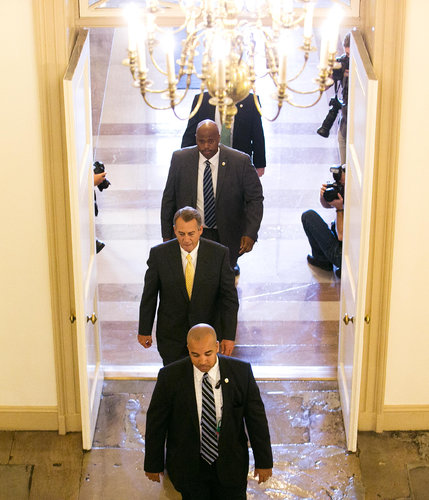
Representative John A. Boehner, the House speaker, arrived at the Capitol on Thursday with his security personnel on the third day of the government shutdown.

Representative John A. Boehner, the House speaker, arrived at the Capitol on Thursday with his security personnel on the third day of the government shutdown.

I’ll give the final word on reality to Elizabeth Kolbert in her New Yorker posted this morning.

…Shuttering the government is a dumb idea under pretty much any circumstances. Still, the objections that Republicans in Congress raise to the health-care law might be worth considering if they bore any relationship to the law in question. Rarely do they.

Some lawmakers’ comments have been so off the wall that they defy parody. A few months ago, for example, Representative Michele Bachmann announced on the House floor that Obamacare needed to be repealed “before it literally kills women, kills children, kills senior citizens.”

“Let’s not do that,” she added helpfully. “Let’s love people.”

“All of this would be funny,” President Obama noted the other day, after bringing up the Bachmann line, “if it weren’t so crazy.”

The crazy list goes on and on. As the economist Paul Krugman has repeatedly pointed out in his Times column, congressional Republicans these days seem to think that they can override not just the laws of physics but also the rules of arithmetic. They insist that the federal budget is so bloated it could easily be cut by hundreds of billions of dollars. But when a transportation bill was drafted this summer that would have actually reduced spending, they refused to vote for it. (The bill had to be pulled from the floor.) It’s hard to cut the federal budget if you’re not willing to reduce the amount of money the government spends. “What Republicans really want to do,” Krugman wrote recently, is “repeal reality.”

It’s been so long since reality has made much of a difference on Capitol Hill that it sometimes seems it genuinely has been repealed. But the thing you can always count on with reality is that it has staying power.

I hope I can hold out until reality and fact make a comeback.

Photograph: Doug Mills/The New York Times

What’s next? Impeachment!

I sense there is a growing level of frustration among Republican members of Congress.  Their opposition to immigration reform is not playing well with either the public or Republican party elders.  Same for their desire to shut down government to prevent the Affordable Care Act/Obamacare from full implementation.  Some of them have been hammered at town hall meetings and the videos are posted all over YouTube.  The deficit is actually shrinking.  Republican governors like Rick Perry are reversing themselves and asking for Medicaid funds.  And the President and his administration are doing the best they can given that no proposal will pass the House.  So what is left for them.  Impeach Obama!

Steve Breen wrote on MaddowBlog

When fringe figures like Rep. Kerry Bentivolio (R-Mich.) talk about impeaching President Obama without cause, it’s a mild curiosity. When U.S. senators push the same idea, it’s more alarming.

“I think those are serious things, but we’re in serious times,” said Oklahoma Sen. Tom Coburn during a town hall in his home state. “And I don’t have the legal background to know if that rises to ‘high crimes and misdemeanors,’ but I think you’re getting perilously close.”

The remark came after an attendee called the Obama administration “lawless” and asked, “who is responsible for enforcing [Obama’s] constitutional responsibilities?”

Coburn apparently has given this a fair amount of thought, telling constituents, “What you have to do is you have to establish the criteria that would qualify for proceedings against the president, and that’s called impeachment. That’s not something you take lightly, and you have to use a historical precedent of what that means.” He added that he believes “there’s some intended violation of the law in this administration.”

Official portrait of Tom Coburn, U.S. Senator.

Official portrait of Tom Coburn, U.S. Senator. (Photo credit: Wikipedia)

But what violation?

And what, pray tell, has the president done that Coburn perceives as possible “high crimes”? In keeping with the recent trend, the Oklahoma Republican never got around to explaining what the grounds for impeachment would be. Coburn mentioned that he’d heard a rumor about the Department of Homeland Security choosing to “ignore” background checks for immigrants, but he did not elaborate.

Meanwhile Sam Stein tweeted David Axelrod’s reaction

“that was his considered legal opinion as an obstetrician”

Maybe it is just wishful thinking on my part, but I think that Americans still want government to fix roads and bridges, regulate our food, water, drugs and financial institutions, and help those you are in need.  Sure, we all wish for new, creative solutions to some of the problems that seem intractable, but on the whole I think Americans just wish that Congress would actually work with the President instead of just voting “no”.  But the fact that even Mitch McConnell has a challenger from the right in the Republican Primary does not make this seem possible.

I’ll give the last word to Steve Breen

And finally, for every Beltway pundit who proclaims with a tear in their eye, “Washington would be more effective if Obama showed leadership by reaching out to Republicans, schmoozing them, and offering to work cooperatively with his critics,” I hope they’re paying very close attention to current events. It is, as a practical matter, awfully difficult for a president to work constructively with radicalized lawmakers who refuse to compromise and cherish the idea of impeachment without cause.

Just so we’re clear, I don’t really expect Republicans to pursue this in a serious way, and my coverage on the issue is intended more as a “look how silly this is” than a “look at this threat to our constitutional system of government.” If for no other reason, GOP lawmakers wouldn’t try impeaching the president because they’d risk motivating the Democratic base to show up in the 2014 midterms.

That said, the recent talk about impeachment is nevertheless unnerving.

A cautionary tale

Some Republicans want to pass a comprehensive immigration bill and some voted to do so in the Senate.  And now two of them, Marco Rubio and Lindsey Graham, will likely have challengers from the Tea Party wing.  Which brings me to the cautionary tale.  They should read some history and look at what happened to the Federalist Party.  They could begin by reading the very interesting piece in yesterday’s New York Times by James Traub.

Tea Partyers often style themselves as disciples of Thomas Jefferson, the high apostle of limited government. But by taking the ramparts against immigration, the movement is following a trajectory that looks less like the glorious arc of Jefferson’s Republican Party than the suicidal path of Jefferson’s great rivals, the long-forgotten Federalists, who also refused to accept the inexorable changes of American demography.

The Federalists began as the faction that supported the new Constitution, with its “federal” framework, rather than the existing model of a loose “confederation” of states. They were the national party, claiming to represent the interests of the entire country.

Culturally, however, they were identified with the ancient stock of New England and the mid-Atlantic, as the other major party at the time, the Jeffersonian Republicans (no relation to today’s Republicans), were with the South.

John Quincy Adams portrait. "John Quincy ...

John Quincy Adams portrait. “John Quincy Adams”. Metropolitan Museum of Art . . Retrieved September 4, 2009 . (Photo credit: Wikipedia)

And then came the Louisiana Purchase.

“The people of the East can not reconcile their habits, views and interests with those of the South and West,” declared Thomas Pickering, a leading Massachusetts Federalist.

Every Federalist in Congress save John Quincy Adams voted against the Louisiana Purchase. Adams, too, saw that New England, the cradle of the revolution, had become a small part of a new nation. Change “being found in nature,” he wrote stoically, “cannot be resisted.”

But resist is precisely what the Federalists did. Fearing that Irish, English and German newcomers would vote for the Jeffersonian Republicans, they argued — unsuccessfully — for excluding immigrants from voting or holding office, and pushed to extend the period of naturalization from 5 to 14 years.

They even thought about separating New England from the rest of the country.

,,,in the fall of 1814, the Federalists convened the Hartford Convention to vote on whether to stay in or out of the Union. By then even the hotheads realized how little support they had, and the movement collapsed. And the Federalists, now scorned as an anti-national party, collapsed as well.

Contrast that defiance with Jefferson’s Republicans, who stood for decentralized government and the interests of yeoman farmers, primarily in the coastal South.

They ruled the country from 1801 to 1825, when they were unseated by Adams — who, after splitting with the Federalists, had joined with a breakaway Republican faction.

In response, Jefferson’s descendants, known as the Old Radicals, did exactly what the Federalists would not do: they joined up with the new Americans, many of them immigrants, who were settling the country opened up by the Louisiana Purchase.

Their standard-bearer in 1828, Andrew Jackson, favored tariffs and “internal improvements” like roads and canals, the big-government programs of the day. The new party, known first as the Democratic-Republicans, and then simply as the Democrats, thrashed Adams that year. (Adams’s party, the National Republicans, gave way to the Whigs, which in turn evolved into the modern Republican Party.)

Will the Republicans disappear like the Federalists?  Traub doesn’t think so.  But hey are, like the Federalists, on the wrong side of history.

More nails in the Republican coffin?

For a number of years now, I have watched part of the Republican party that has as its main, if not sole, purpose, to dismantle government.  They called the Democrats bluff with the sequester which so far has appeared to have little effect.  Who cares if a military base can’t afford fireworks or if the Blue Angels can’t afford to do a fly over?  In the big scheme of things, those are pretty unimportant.  But now more and more federal workers are being furloughed.  For example, local HUD (Housing and Urban Development) offices are closing for five Fridays in July and August.  That is 5 Fridays that staff will not be paid.  This is money that won’t be spent on a vacation or for car repairs or for food and clothing – all things that add to the economy.  (Here is an interesting website that tracks furloughs.)  And while a number of agencies have figured out ways to avoid furloughs, many workers will still be affected – still more if Congress can’t manage to pass a budget for the fiscal year that begins in October.  The loss of incomes will slowly begin to mount.

But it isn’t just the failure to produce a budget.  A recent New York Times editorial summed up the issue quite neatly.  They called it a refusal to govern.

On two crucial issues this week, the extremists who dominate the Republican majority in the House of Representatives made it clear how little interest they have in the future prosperity of their country, or its reputation for fairness and decency.

The two issues are immigration reform and the removal of the food stamp program for the House agriculture bill.

These actions show how far the House has retreated from the national mainstream into a cave of indifference and ignorance. House members don’t want to know that millions of Americans remain hungry (in an economy held back by their own austerity ideology), and they don’t want to deal with the desperation of immigrant families who want nothing more than a chance to work and feed themselves without fear of deportation.

On both issues, in fact, many House Republicans are proudly asserting that they will stand in the way of any attempts to conduct a conference with the Senate. That might, after all, lead to a compromise.

And it isn’t just in the House.

Few things sum up the attitude of the current crop of Republicans in Washington than their loathing of conference committees. On issue after issue, they have passed radical bills and then refused to negotiate. On Thursday, for example, Senate Republicans refused for the 16th time to allow the Democratic Senate budget to be negotiated with its dangerously stingy counterpart in the House.

On immigration, House members fear a conference with the Senate would add back the pathway to citizenship that they consider a giveaway to undesirable non-English speakers. The eventual House border bills “should not be handed to a conference committee so that they can be reconciled with the Senate bill,” wrote Representative Tom Cotton of Arkansas in The Wall Street Journal on Thursday. Instead, he and others say, the Senate should be forced to take up whatever the House produces.

Senate Minority Leader Mitch McConnell may believe that ending the filibuster with a majority vote will spell the end of the Senate and cause Harry Reid to be remembered “as the worst leader of the Senate ever”, but in my opinion, the continuous use of the filibuster has already come close to destroying the Senate.  Everything should not require 60 votes.

The New York Times editorial ends with this

A refusal to even to sit at a bargaining table is another way of refusing to govern. The nation’s founders created two chambers for a reason, but Republicans, in their blind fury to harm the least fortunate, are forgetting even those fundamental national values.

From left, Representatives Tim Murphy, Mark Sanford, Cathy McMorris Rodgers and Sean P. Duffy, all Republicans, after the House approved an agriculture bill.

From left, Representatives Tim Murphy, Mark Sanford, Cathy McMorris Rodgers and Sean P. Duffy, all Republicans, after the House approved an agriculture bill.

This is why the most recent Quinnipiac poll shows that while 53% felt the President was doing too little to compromise with Congress, a whopping 68% felt the Republicans leaders in Congress were doing to little to compromise with the President.  And everyone thinks Congress is dysfunctional blaming both parties.

There is something called the greater good and I think many in Congress, particularly Republicans, have forgotten that ideal.

Photograph: Christopher Gregory/The New York Times

Republican gerrymandering

With the Supreme Court saying that Section 4 of the voting rights act needs a do over thus making Section 5 void, many of us are not happy.  The odds of Congress coming up with a new formula are pretty slim.  But, all may not be lost.

We know that the Republican controlled state houses used the 2010 Census to draw districts that allowed them to hold on to the House last year.  This despite Section 4 in at least some of those states.  This morning, Politico.com published a story by Alex Isenstadt in which he points out that this gerrymandering may have unintended consequences for them.

No one disputes Republicans used the once-a-decade redistricting process to  lock in their House majority — almost certainly through 2014 and possibly until  the next round of line-drawing in 2020.

But the party could pay a steep price for that dominance.

Some top GOP strategists and candidates warn that the ruby red districts the  party drew itself into are pushing House Republicans further to the right —  narrowing the party’s appeal at a time when some GOP leaders say its future  rests on the opposite happening. If you’re looking for a root cause of the  recurring drama within the House Republican Conference — from the surprise  meltdown on the farm bill to the looming showdown over immigration reform — the  increasingly conservative makeup of those districts is a good place to start.

Opposition to immigration reform by the Tea Party.

Opposition to immigration reform by the Tea Party.

These gerrymandered districts are also less diverse.

Gerrymandering and partisanship, of course, aren’t new phenomena in the  House. But the post-2010 redistricting process driven by GOP-controlled state  legislatures — Republicans wielded line-drawing power in nearly five times as  many districts as Democrats — produced significantly more districts that are  overwhelmingly conservative.

Of the 234 House Republicans, just four now represent districts that favor  Democrats, according to data compiled by The Cook Political Report. That’s down  from the 22 Republicans who resided in Democratic-friendly seats following the  2010 midterms, prior to the line-drawing.

They’re also serving districts that are increasingly white. After  redistricting and the 2012 election, according to The Cook Political Report, the  average Republican congressional district went from 73 percent white to 75  percent white. And even as Hispanics have emerged as America’s fastest-growing  demographic group, only about one-tenth of Republicans represent districts where  the Latino population is 25 percent or higher.

My Ezra Klein Wonkbook email this morning pointed out

The conventional wisdom around Washington these days is that the Republican Party needs to pass immigration reform if it’s going to survive. But remember: House Republicans aren’t the same thing as “the Republican Party.” And they probably don’t need to pass immigration reform to keep their majority. In fact, passing  immigration reform — at least with a path to citizenship — might put them in more danger. Two figures from Janet Hook in the Wall Street Journal show why.

First, “only 38 of the House’s 234 Republicans, or 16%, represent districts in which Latinos account for 20% or more of the population.”

Second, “only 28 Republican-held districts are considered even remotely at risk of being contested by a Democratic challenger, according to the nonpartisan Cook  Political Report.”

So for about 200 of the House’s Republicans, a primary challenge by conservatives angry over “amnesty” is probably a more realistic threat than defeat at the hands of angry Hispanic voters, or even angry Democrats. “Our guys actually do primary over immigration,” a top House Republican aide who wants to get immigration done told me.

Of course, that leaves some 34 Republicans who have reason to fear a Democratic challenge. And  it leaves dozens who privately support immigration reform and don’t have much to fear from either Democratic or Republican challengers.

So the Republican House members mostly represent people like themselves and need to become more conservative, not less, to keep their seats.  We aren’t talking just about immigration reform here, but a whole range of issues.  It also explains why the House’s favorite vote is to repeal the Affordable Care Act.

What does all this mean for Democratic chances to take back the House in the next election?  Isenstadt writes

New York Rep. Steve Israel, chairman of the Democratic Congressional Campaign  Committee, argued that Republicans in moderate suburban and exurban areas will  find themselves under increasing pressure in the months leading up to the  midterms.

“The problem for many Republicans in these specific districts is that if  they’re less partisan, they face a primary from the right. If they protect  themselves from a primary by being more partisan, they’re in trouble in the  general election,” Israel said. “They’re getting squeezed. We’re going to make  sure that hole is very small.”

The question is:  Are there enough of those districts for the Democrats to take the House?

It would appear that much of what is holding up legislation in the House are internal Republican fights.

When House Republicans have rallied behind legislation, it’s often been for  something deeply conservative. Two weeks ago, Republicans passed a measure that  would ban abortions after the 20th week of pregnancy. Just six GOP members  opposed the bill, including two because it didn’t go far enough.

To the conservatives, softening the GOP’s positions isn’t what’s going to  save the party in the long run.

“Political success doesn’t come from moderation,” said Arizona Rep. David  Schweikert, a Republican who opposed the farm bill and supported the  anti-abortion measure. “It’s from having principles and articulating them in a  forthright fashion.”

Schweikert, who represents a conservative Scottsdale-area district that Mitt  Romney carried with nearly 60 percent of the vote, called the Senate immigration  bill a “nonstarter.” His district is 12 percent Hispanic.

The bottom line is that so-called national Republican leaders who currently do not hold elective office along with some governors and Senators who have to run statewide campaigns can call for the party to moderate positions all they want.  The House has hitched its horse to some very conservative ideals so Republican members can get re-elected.  In the long run, this is probably good for the Democrats.

Photograph:  AP

Markey v. Gomez: The Massachusetts Senate Race

With a few days left to go, this race is officially a snoozer.  Ed Markey is a fine Representative and will make a fine Senator but somehow I can’t work up any enthusiasm.  You know, if you read this blog with any regularity, that I am a campaigner and it is a measure of something that I haven’t done much of anything for Ed except throw him a few bucks and vote in the primary where he was unopposed.  I think the race would have been a lot more exciting if someone like Mike Capuano were running, but too late for that.  Maybe we should just feel sorry for these guys since after the Elizabeth Warren – Scott Brown tussle almost anything would seem dull.  This is the assessment of the race from the Daily Kos Election update for June 21.

MA-Sen: Gabriel Gomez has gotten some “next Scott Brown” hype, to the extent that he’s a moderate Republican who’s a fresh face and running in a Massachusetts Senate special election (which will be held next Tuesday) against a charisma-challenged Democrat. However, there’s one important element that seems missing: the ability to mount a late surge and actually win the race, at least if the newest public poll is any indication. UMass Lowell, on behalf of the Boston Herald, gives Ed Markey his biggest lead of any pollster who’s looked at the race so far: among likely voters, Markey leads Gomez 56-36 (and 53-32 among all registered voters). This is the pollster’s first look at the race since the primary; they did poll the general way back in early March, and found an almost identical margin (47-28 for Markey).

Most pollsters have shown a closer race, usually in the high single digits, although the last couple public polls (from UNH for the Boston Globe, and from Harper Polling) both had it in the low teens; only one recent poll (a Suffolk poll with a 17-point margin in early May) had anything similar to this one.   And then there’s the GOP internal pollsters, who continue to see the race within low single digits; the most recent of these came out Thursday from McLaughlin, with Markey up 47-44. That follows a McLaughlin poll from two weeks ago with Markey up 45-44 (on behalf of donor John Jordan), in addition to two OnMessage polls directly on behalf of Gomez, one from less than a week ago with Markey up 47-40, and one from early May with Markey up 46-43. It’s not clear what the GOP hopes to gain from constantly leaking those polls, since most observers know that leaked internal polls usually overstate support for their candidate and none of these best-case-scenarios still manage to have Gomez winning.   The 47-44 topline is all that McLaughlin leaked to Politico, but Dave Weigel seems to have gotten his hands on the crosstabs, which show Gomez’s favorables falling from 48/27 to 41/35, while Markey’s are up a little, from 42/42 to 47/40. Again, not a sign of progress for Gomez, though maybe the GOP thinks the toplines are enough to convince donors that it’s not entirely a lost cause. (Although donations at this point would probably arrive too late to do anything other than last-minute GOTV.)

As for the original Scott Brown, the ex-Senator had publicly said that he was willing to campaign for Gomez as his schedule permitted, but so far he hasn’t done anything (apparently impeded by his busy dual careers of lobbying and appearing as a Fox News analyst). Well, he is finally popping up: he’ll be appearing at a rally with Gomez on Monday night, the night before the election. Is it really a case of a busy schedule, or just not wanting to let Gomez’s likely loss appear to be a referendum on Brown himself (especially considering that he may still get in to the Massachusetts gubernatorial race… or the New Hampshire Senate race)?

And if you’ve gotten the impression that Massachusetts voters are responding to the Ed Markey vs. Gabriel Gomez special election with a collective yawn, now we’ve gotten some quantitative proof. Absentee ballot requests are down significantly from the 2010 special election that elected Scott Brown; only 49.7K ballots have been requested, compared with 63.6K at the comparable point in 2010. The absentee ballot application deadline is on Monday, one day before the election.

This photo provided by WGBH shows U.S. Senate candidates, Republican Gabriel Gomez, left, and Democratic U.S. Rep. Edward Markey, right before a debate moderated by R.D. Sahl, center, Tuesday at WGBH studios in Boston. (THE ASSOCIATED PRESS)

This photo provided by WGBH shows U.S. Senate candidates, Republican Gabriel Gomez, left, and Democratic U.S. Rep. Edward Markey, right before a debate moderated by R.D. Sahl, center, Tuesday at WGBH studios in Boston. (THE ASSOCIATED PRESS)

I won’t be home on Tuesday so I’ve already voted absentee – for Markey.

As an aside:  I believe this is my 600th post.  When I started posting in July 2008, it was as a lark.  I write mostly for myself about what interests me which sometimes interests others.  I’ve had periods of inactivity and have a small, but faithful  following.    If you read FortLeft, thank you!