Dorothy in Iraq…or is it Afganistan? Or maybe Syria or Lybia?

It may work out that because he needed to save face, President Putin is going to end up saving President Obama and the Congress from a collision that neither can win – and saving us from another war as a bonus.  As I write this, it appears that Putin’s proposal to put Syria’s chemical weapons under international control will be coming before the Security Council.  Our Congress is very good at stalling so waiting for the Security Council to act should not be a problem and we may actually get a peaceful resolution.

While we wait, we can enjoy Tom Tomorrow’s updated Dorothy back from Oz.

Tom and Dorothy

Thank you, Ruben Bolling.

(Click picture to enlarge.)

Red Sox and Yankees: September 2013

Sox fans always worry about a big fold in September.  I’m beginning to breathe a little easier after yesterday afternoon when they had a huge lead, started to give it up, stopped the bleeding and added a run.  The Sox last loss was six games ago and they will, before September is done, lose again.  But probably not often.  Not more than a game here or there.  The losers from last year are now the team to beat.  The only possible rain cloud is the injury to Jacoby Ellsbury which may mean he has already played his last game for the Sox.  As another fan tweeted, “Let the Bradley [Jackie Jr.} era begin.”  But I think the air has gone out of the Sox-Yankees games that remain.  The Sox have a replacement for Ells, but the Yankees can’t really replace Derek Jeter who appears to have re-injured himself after missing most of the season.

The different coverage from the Boston Globe and the New York Times this morning tells the story.  First Tyler Kepner from the Times.

Before this weekend, the Yankees had never lost three games in a row while scoring at least eight runs every time. Now it has happened, against the surging Boston Red Sox in the Bronx, and if that were not sobering enough, Derek Jeter aggravated his fragile left ankle Saturday and departed Yankee Stadium for a hospital.

His CT scan was negative, according to the Yankees, who sent the test results to Jeter’s ankle surgeon in Charlotte, N.C., anyway. There is a reason only one player in Jeter’s lifetime (Omar Vizquel) has played 100 games at shortstop at age 39 or older.

Alex Rodriguez missed Saturday’s game altogether. Rodriguez has helped the lineup during his appeal of his drug suspension, and he had no injury on Saturday, Manager Joe Girardi said. He is simply 38 years old and has played a lot lately. A day game after a night game was too much for Girardi to ask.

So it goes for the Yankees, who have fewer quality starts than the Mets this season and a bullpen ravaged by injuries. Shawn Kelley and Boone Logan are out, and the indispensable David Robertson will miss at least a few more days with shoulder soreness.

The Yankees are old and have no pitching, but they can still insult the Sox.

The Red Sox, quite clearly, made the most of their bailout by the Los Angeles Dodgers last August. They gave short-term contracts to professional, if poorly groomed, hitters in their primes. The newcomers Shane Victorino, Stephen Drew, Jonny Gomes and especially Mike Napoli have taken turns drilling big hits all series, and Xander Bogaerts, the 20-year-old shortstop, clubbed his first career homer on Saturday, a rocket over the bullpen in left.

Bogaerts connected off Jim Miller, who made his Yankees debut in relief of David Huff. Huff had been impressive in relief, but his first Yankees start was a fiasco. It was the first time since 1941 that a Yankee starter allowed at least nine earned runs to the Red Sox in fewer than four innings.

Poorly groomed?  I guess Kepner means they have beards.  And Drew, by the way,  is clean-cut enough to be a Yankee.

Third base coach Brian Butterfield (left) congratulated Xander Bogaerts after the 20-year-old’s first major league home run.

Third base coach Brian Butterfield (left) congratulated Xander Bogaerts after the 20-year-old’s first major league home run.

What is Nick Cafardo saying in the Globe?

If I were Brian Cashman or Joe Girardi, what would bug me the most about Saturday’s 13-9 loss to the Red Sox was seeing Will Middlebrooks, Jackie Bradley Jr., Ryan Lavarnway, and Xander Bogaerts occupying the 6-9 spots in the Boston order and having them go 6 for 17 with four RBIs, a home run, and six runs.

Here we are in the middle of a September pennant race and the Red Sox have four of their guys from the farm system providing that type of production. The Yankees have nothing resembling that, and are in fact a very old team, albeit a team that has lost three straight to Boston and still managed to score 25 runs. Which is why, folks, the Yankees still have a chance to make the playoffs.

I think Xander speaks five languages and thinks he would be teaching school if he couldn’t play baseball.

Bogaerts, who is the youngest player (20 years, 341 days) to homer for the Red Sox since Dwight Evans (who was 20 years, 322 days old on Sept. 20, 1972), claimed, “I wasn’t sharp at all. I was bad in batting practice so I went back to my leg kick. I’ve always had a leg kick so I went back to that. I got some new bats, so I tried them out and it worked good. Give credit to the bat.”

On the barehanded play on Cano, the shortstop said, “I saw Cano hustle down the line so I didn’t know if I had a chance. So that was real good that I got him.”

Plus the kid got his first homer on his mother’s birthday.  I bet he gives her the ball. [The Yankees got it back for him.]

Will the Yankees even make the playoffs?  Kepner thinks they aren’t ready for the fork just yet.

The Yankees are far from finished. The Rays’ slump — they have lost 11 of 14 after Saturday’s loss in Seattle — has kept the race close. But a deep Boston lineup has exposed a thin and weary Yankees pitching staff.

“Our guys are battling,” Cashman said. “They’ve been battling all year. We’re obviously up against a really good team. You can’t afford to make mistakes, or you can’t afford to not be at full strength, or you can’t afford to not be firing on all cylinders, or they’ll take advantage. And they’ve been taking advantage of every extra inch you give.”

To be fair, the Red Sox are not at full strength, either. Their center fielder, Jacoby Ellsbury, is in Colorado for a second opinion on his injured right foot. If further tests reveal a broken bone, the Red Sox would lose a major catalyst at the top of their lineup.

Of course, they have not needed Ellsbury to thump the Yankees the last few days. The Yankees have been too old, too young or too overmatched to hang with the Red Sox, no matter which players they use.

And Cafardo pointed out that Yankees still scored 25 runs in the last three losses which makes them ever dangerous, especially with the Tampa Bay Rays beginning their own collapse.

These are two teams that seem to be headed in opposite directions.  The Sox have their veterans and youngsters, while the Yankees have mostly old guys – and are likely to lose Alex Rodriguez during his suspension next year.

Cafardo writes

The Yankees are going to try to rebuild their team this offseason similar to the way the Red Sox did with strategically placed veteran players. What they can’t do is come up with a Bogaerts, Bradley, or a Middlebrooks, because they don’t have any of those types in their system.

Their young catchers haven’t come around as they had hoped and their young relievers such as Shawn Kelley and Preston Claiborne have hit walls. Brett Marshall pitched well in 4⅓ innings Saturday after starter David Huff allowed nine earned runs in 3⅓ innings. But Boston’s answer to Marshall, Brandon Workman, has been successful in high-leverage situations.

It was doubly good for the Red Sox — they beat up the Yankees for a third straight day and showed them a glimpse of the future, which right now, the Yankees have no answer for.

According to Kepner, the Yankees have used 54 different players this year, most of whom I’ve never heard of and likely won’t again.

Give credit to Girardi for extracting a winning season from these 54, whether or not they reach the playoffs. It has been a noble run, but on days like Saturday, it seems destined to collapse before October.

So my question is this:  Who is the manager of the year?  John Farrell or Joe Girardi?

Photograph:  Bill Kostroun/Associated Press

More politics, race and South Boston

Earlier this year I wrote about Linda Dorcena Forry, the Haitian American who won the special state Senate election to represent South Boston and parts of Dorchester.  I know Linda and I assumed that she would do a great job and win over any reluctant Southie constituents by sheer force of her personality if not her voting record.  Someone, I think it was Jim Braude on Boston Public Radio, said that she lights up a room when she walks into it.  So Dorcena Forry gets elected and you would think that would be it.  You would be wrong.  There is the small matter of St. Patrick’s Day.

For many decades there have been two events marking the holiday in Boston.  First, there is a breakfast at which Boston and Massachusetts political figures tell bad jokes and try to sing.  It was once just a small event, but now it gets TV coverage.  I think it has gone downhill the last few years, maybe since the William Bulger/Stephen Lynch hosting days ended.  Second, there is a parade.  This is a huge event, also televised.  It is notable for the drinking that takes place among those watching and for the fact that few politicians march.  They don’t march because the breakfast tuckers them out, but because the organizers do not allow LGBT groups to participate.  (I should note here that both events are organized by private non-profits and that my husband has marched in the parade as a 000000000paying gig.)  These events are an opportunity for South Boston to shine and celebrate.  Everyone is Irish at these events.  Or so we all thought.

Yesterday we woke up to this front page news. 

Southie St. Patrick’s Day breakfast slugfest begins early

Emcee struggle raises questions of tradition

What was this about?   Last year’s temporary host, William Linehan, the city councilor from South Boston, was making noises that he was not going to give up his hosting.  Linda Dorcena Forry who by longstanding tradition should be the next host was, ahem, not Irish you see.  The Boston Globe explains

The battle is over who has the rightful claim to host the event. Call it the Southie version of Game of Thrones.

For generations, the breakfast — which is essentially a political roast — has been hosted by the sitting senator in the First Suffolk Senate district. And since the 1940s, that office has been held by an Irish-American man from South Boston — from John Powers to Joe Moakley to Billy Bulger to Stephen Lynch to Jack Hart.

The neighborhood’s stranglehold on the office was so pronounced that it was referred to as the “Southie seat,” even though it also includes much of Dorchester, Mattapan, and a piece of Hyde Park.

But in May, Linda Dorcena-Forry, a Haitian-American woman from Dorchester, won that Senate seat after narrowly defeating Nick Collins, a young state representative from South Boston, in the Democratic primary.

Everyone had something to say.

William M. Bulger, the former senator who transformed the event into the made-for-television spectacle that it is today, took over hosting duties from then-senator Joe Moakley while Bulger was still a state representative. But in a phone interview this week, Bulger said “that’s mostly because I was such a ham, and Moakley finally said, ‘You want to take this thing over?’ ”

But Bulger went on to support Dorcena-Forry’s thinking, saying that “it has always been the understanding that it was the state senator that was the host.”

US Representative Stephen Lynch, who succeeded Bulger as state senator and breakfast host in 1997, also supported the idea that Dorcena-Forry should host.

“I believe the sitting state Senator has always served as host,” Lynch said in a statement. “As our new Senator, Linda should be the host, and I am happy to lend her my expertise and any assistance I can provide.”

Linehan and his supporters also weighed in.

“It’s never been stated anywhere that it has to be the state senator,” Linehan said. “It’s a cultural thing. There has never been anyone who hosted it who does not live in South Boston, but there have been people who have hosted it who were not the state senator.”

and the last host who was a state senator?

But Jack Hart, the last of the sitting senators to host the event, took a different approach. He said the election of Dorcena-Forry ushered in an “unprecedented time,” and he said he hoped that Linehan and Dorcena-Forry could sit down and work out a compromise. “There are no rules. There’s no rule book to go by regarding who hosts the thing.”

He said he did not hand over the duties to Linehan; he simply left politics, and later got a call from Linehan saying that as the ranking South Boston elected official, he wanted to host, and asked for Hart’s advice on how to do it.

Representative Nick Collins who lost to Dorcena Forry agreed with Linehan leading some to accuse them of trying to revive the racial divisions of the past.

For her part, Dorcena Forry believed she should be host and pointed out

“The sitting senator has always hosted, and you don’t have to be Irish to do it,” Forry said in a phone interview. “I believe that everyone is Irish on St. Patrick’s Day. Everyone’s celebrating Irish culture. You don’t have to be 100 percent Irish.”

Dorcena-Forry argues that she is no stranger to the Irish-American community. She is married to Bill Forry, an Irish-American who is editor of the Dorchester Reporter.

“I have four bi-racial children — Irish-American and black. I’ve been to Ireland four times. We celebrate the culture in my house. My two oldest sons were baptized in St. Augustine’s chapel in South Boston. I’m not just a random black woman who has this seat.”

Linda Dorcena Forry

Linda Dorcena Forry

I think that everyone realized that they were in tricky political waters which could rapidly become dangerous.  Dorcena Forry wants to win re-election next year.  Bill Linehan is facing Suzanne Lee, a Chinese American woman who narrowly lost last time, this fall.  (The South Boston council district includes Chinatown and what people would call “downtown” Boston, so it is not really a Southie seat.)  So this morning the headline read

After backlash, St. Patrick’s roast dispute is over

Dorcena Forry to host fest as councilor relents

The resolution followed mounting criticism of Linehan’s refusal to allow Dorcena Forry to host the event, as officials from the governor to the mayor to the mayoral candidates said she was the rightful emcee.

The controversy shined an uncomfortable spotlight, at least momentarily, on racial tensions that many hoped Boston had left behind. It touched a raw nerve from the halls of the State House to the walking paths of Castle Island.

Many who live in South Boston will be unhappy because Linda Dorcena Forry is not only Irish but has dark skin, but most won’t really care.  But for politicians – particularly the white men running for Mayor this fall – it was important.  They mostly lined up to support Dorcena Forry.

“It will be different, but Boston is changing, South Boston is changing,” Mayor Thomas M. Menino said after a ribbon-cutting in Faneuil Hall. “Let’s have a change in leadership over there, and let’s have Linda Dorcena Forry be the mistress of ceremonies.”

And so she will be.  By next March, it is possible that there will be Councilor Lee and the Mayor of Boston will be black or Hispanic.  Boston is changing fast and Southie has to change also.  Maybe I’ll watch the breakfast next year:  All the folks running for Governor will be putting in an appearance.

Photograph: Jonathan Wiggs/Globe staff/file

Gay rights and the Supremes

Justice Antonin Scalia has made it clear that he is, at best, uncomfortable with the series of decisions made by the Supreme Court on gay rights.  Soon after the decisions last June on DOMA and Prop 8,  Asawin Suebaeug wrote an article for Mother Jones in which the best and worst parts of his dissents were highlighted. 

Justice Antonin Scalia is not a big fan of gay sex, gay marriage, or gay anything. His dissent to Wednesday’s decision on United States v. Windsor, in which the Supreme Court ruled, 5-4, that legally married same-sex couples should get the same federal benefits as straight ones, shows as much. (The high court’s ruling invalidates a provision of the Defense of Marriage Act that barred same-sex couples from receiving health, tax, and retirement benefits.) In a nutshell, Scalia’s dissent focuses on the court’s prime purpose and power, and he is aghast that the majority assumed the power to shoot down DOMA. (To read the seven worst things Scalia has said or written about homosexuality, click here.)

And Andy Borowitz has made a cottage industry out of zinging him including “Scalia Arrested Trying to Burn Down the Supreme Court”.

WASHINGTON (The Borowitz Report)—In a shocking end to an illustrious legal career, police arrested Justice Antonin Scalia today as he attempted to set the Supreme Court building ablaze.

Justice Scalia, who had seemed calm and composed during the announcement of two major rulings this morning, was spotted by police minutes later outside the building, carrying a book of matches and a gallon of kerosene.

Back at the Supreme Court, Justice Scalia’s colleagues said they hoped he would get the help he needed, except for Justice Clarence Thomas, who said nothing.

Meanwhile  Justice Ruth Bader Ginsburg celebrated the marriage of a long time friend to another man while Justice Anthony Kennedy who wrote the decision on DOMA is being celebrated himself.

Justice Kennedy was a guest at an event in San Francisco featuring the Gay Men’s Chorus and speeches thanking him for his DOMA decision as well as his two previous decisions expanding gay rights.  The New York Times reported

The San Francisco Gay Men’s Chorus sang “Give ’Em Hope” for a revered and in some ways surprising guest who shared a California stage with them last month: Justice Anthony M. Kennedy.

Justice Kennedy was in San Francisco for an American Bar Association meeting, but he was also there to be celebrated by the men on the risers behind him. In remarks from the stage, San Francisco’s mayor, Edwin M. Lee, thanked the justice “for upholding the Constitution and justice for all” in his majority opinion in June in United States v. Windsor, a major gay rights victory.

“Freedom is always a work in progress,” Justice Kennedy said in his own remarks, making clear that there was more work to be done.

Justice Ginsburg performs an historic marriage ceremony.

Justice Ginsburg performs an historic marriage ceremony.

justice Ginsburg became the first Supreme to officiate at a gay wedding.

Ginsburg officiated Saturday at the marriage of Kennedy Center President Michael Kaiser and John Roberts, a government economist.

“Michael Kaiser is a friend and someone I much admire,” Ginsburg said in a written statement Friday. “That is why I am officiating at his wedding.”

“I think it will be one more statement that people who love each other and want to live together should be able to enjoy the blessings and the strife in the marriage relationship,” Ginsburg told The Washington Post in an interview.

“It won’t be long before there will be another” performed by a justice. She has another ceremony planned for September.

Kaiser told The Associated Press that he asked Ginsburg to officiate because she is a longtime friend.

So at least two, and if we take Justice Ginsburg at her word, three Supreme Court Justices moving forward with the times.

Has anyone else noted that one of those getting married was John Roberts?  Wonder what the Chief Justice thinks about that?
Photograph:  Margo Schulman/Kennedy Center

Increased violence. Another consequence of global warming?

I read a lot of mystery stories.  Old ones, new ones, ones set in times past and ones set it the future.  A common thread is it is summer and a heat wave so crime is up.  You hear this every spring from the Boston Police and the Mayor – we need to prepare for the combination of hot weather and school being out.  So is this just an urban myth?  Maybe not.  A new study to be published in the journal, Science, was summarized in Sunday’s New York Times.

But researchers are now quantifying the causal relationship between extreme climate and human conflict. Whether their focus is on small-scale interpersonal aggression or large-scale political instability, low-income or high-income societies, the year 10,000 B.C. or the present day, the overall conclusion is the same: episodes of extreme climate make people more violent toward one another.

In a paper published this month in the journal Science, we [MARSHALL BURKE, SOLOMON HSIANG and EDWARD MIGUEL] assembled 60 of the best studies on this topic from fields as diverse as archaeology, criminology, economics, geography, history, political science and psychology. Typically, these were studies that compared, in a given population, levels of violence during periods of normal climate with levels of violence during periods of extreme climate. We then combined the results from those studies that concerned modern data in a “meta-analysis,” a powerful statistical procedure that allowed us to compare and aggregate findings across the individual studies.

We found that higher temperatures and extreme rainfall led to large increases in conflict: for each one standard deviation change in climate toward warmer temperatures or more extreme rainfall, the median effect was a 14 percent increase in conflict between groups, and a 4 percent increase in conflict between individuals.

Global mean surface temperature difference fro...

Global mean surface temperature difference from the average for 1880–2009 (Photo credit: Wikipedia)

The study went beyond the present day, back to the collapse of several civilizations:  The Maya, Angkor Wat and the Akkadian in Syria.  Climate appears to have played a role in the collapse of each.

Our findings held at very high levels of statistical confidence. To illustrate the consistency of the results: of the 27 quantitative studies we looked at that examined a link between temperatures and modern conflict, all of them found that higher temperatures were associated with more violence. This sort of pattern in the results was extremely unlikely to happen by chance. (Imagine trying to get 27 “heads” in a row when flipping a coin.)

What explains the strong link between climate and conflict? Different mechanisms are most likely operating in different settings, but the two most important factors appear to be aggression and scarcity. The aggression factor is intuitively easy to understand (again, recall summer in the city), and it probably underlies the finding that anomalously hot months have significantly higher crime rates in cities in the United States. As for scarcity, the logic is only slightly more complex. In low-income countries largely dependent on agriculture — like those in much of sub-Saharan Africa and parts of Asia and Latin America — when the rains fail and temperatures scorch, crops wilt and die. This leaves many people dangerously close to the edge of survival, which can lead to social strife and even civil war.

So besides gearing up for more shootings, stabbings and homicides on the summer streets, what are the implications?  The study concludes

Our findings help us better understand both the past and the present, but they are particularly important for what they imply about the future. Many global climate models project global temperature increases of at least 3.6 degrees Fahrenheit (2 degrees Celsius) over the next half century. Our results imply that if nothing changes, this rise in temperature could amplify the rate of group conflicts like civil wars by an astonishing 50 percent in many parts of the world — a frightening possibility for a planet already awash in conflict.

Decision makers must show an understanding that climate can fundamentally shape social interactions, that these effects are already observable in today’s world and that climate’s effects on violence are likely to grow in the absence of concerted action. Our leadership must call for new and creative policy reforms designed to tackle the challenge of adapting to the sorts of climate conditions that breed conflict — for instance, through the development of more drought- and heat-resistant agricultural technologies.

As we contemplate intervention in Syria and look at the increasing and never-ending violence in Africa, we also need to ask ourselves some questions about violence here at home.  Will global warming lead to increased domestic violence?  What do we do with this knowledge and all the guns on the streets?  And will anyone pay any attention?

The war in Syria: a confused state of affairs

English: The United Nations Security Council C...

English: The United Nations Security Council Chamber in New York, also known as the Norwegian Room Français: La Salle de réunion du Conseil de sécurité des Nations Unies à New York Nederlands: De Zaal van de Veiligheidsraad van de Verenigde Naties in New York (Photo credit: Wikipedia)

I’m probably like most Americans: confused.  On one hand, I look at the pictures of the victims in Syria, not only the dead and injured from the chemical weapons attack, but also those in refugee camps or living in caves and wonder why the world can’t do anything to help.  On the other hand, there is a seemingly intractable diplomatic stalemate and no one wants “boot on the ground”.  So what to do.

The British drafted a resolution that was discussed by the United Nations Security Council condemning use of chemical weapons but it didn’t get anywhere because of the threat of a Russian veto.  This morning, the Guardian reports on President Putin’s reaction

Vladimir Putin has rejected US intelligence claims that Bashar al-Assad’s regime used chemical weapons in Syria, saying it would be “utter nonsense” for government troops to use such tactics in a war it was already winning.

“That is why I am convinced that [the chemical attack] is nothing more than a provocation by those who want to drag other countries into the Syrian conflict, and who want to win the support of powerful members of the international arena, especially the United States,” Putin told journalists in Vladivostok.

The Russian president also challenged the US to present its case for military intervention to the UN security council, after suggesting that if Barack Obama was worthy of his Nobel peace prize, he should think about the possible victims of any intervention by foreign forces.

Is this a signal that the United States should wait to take action?  Is Putin ready to compromise – or at least to talk?

Meanwhile John Kerry, the hero of the anti-Vietnam War movement, is sounding more and more like Donald Rumsfeld – or maybe Colin Powell at the UN.  The New York Times reports

Again and again, some 24 times in all, he used the phrase “we know” as he described the intelligence that Syria’s government massacred more than 1,400 people with chemical weapons. And then, while saying no decision had been made, he left no doubt that the United States would respond with military power.

“We know that after a decade of conflict, the American people are tired of war — believe me, I am, too,” said Mr. Kerry, who opposed the Iraq war in his failed presidential bid in 2004. “But fatigue does not absolve us of our responsibility. Just longing for peace does not necessarily bring it about. And history would judge us all extraordinarily harshly if we turned a blind eye to a dictator’s wanton use of weapons of mass destruction against all warnings, against all common understanding of decency.”

Just seven months after being sworn in as secretary of state, Mr. Kerry has become President Obama’s frontman in the public argument for a military strike against the Syrian government. While the president sounds restrained in his language and even perhaps personally ambivalent about the operation he seems likely to order, Mr. Kerry came across on Friday as an unstinting advocate for action against what he called “a despot’s brutal and flagrant use of chemical weapons.”

The problem is that we were lied to once, told that there was intelligence that proved there were weapons of mass destruction in Iraq and even though some of us may want to trust Kerry, it is hard to do so even with the level of specificity in the summary report he released.

As to allies, the British Parliament has voted not to participate in any military action and French public opinion is also against.  The Arab League has said that while they think Assad used chemical weapons, they can’t support any military action.  The public here is lukewarm at best.

This is not Libya.  In Libya there was a recognized opposition which had actually established a shadow government with diplomats working with the European Union, Arab League and the United States.  We know that when she was Secretary of State, Hillary Clinton tried hard to get the opposition in Syria to form a similar government but was unable to do so.  The situation is that someone, most likely the Syrian government or someone fighting with the government, has used chemical weapons on the civilian population.  (I think we can trust Doctors Without Borders when they say they were used.)  This use goes against what 99% of the world’s people believe is right.

A large, but so far not a majority, of members of Congress think there should be a debate and resolution under the War Powers Act.  I know that Kerry and the President both believe they have already followed the Act by consulting with Congress.  It is up to John Boehner and Harry Reid to call Congress back for a debate and not just a consultation.  The question now is whether Obama will act before they can do so.  The summit for the G20 is next week.  Will the missiles fly before then?  The UN inspectors have left Syria.  Have they been told an attack is imminent?

I’m not sure that I agree with Bob Dreyfuss who called the President a “schoolyard bully” but there is a great deal of irony in seeing two men who made their reputations opposing war now trying to justify military action.

Let’s say the President waits a week.   He can talk to folks at the summit.  The UN Security Council can talk some more.  Congress gets back into town and holds a debate.  I don’t see that anything is lost.  The Syrians have all ready evacuated areas and moved military assets so maybe we don’t need an actual strike with the potential for civilian casulties.  Plus we don’t really know all the consequences of a strike.  More acts of terrorism in the United States?  More chemical attacks on civilians?  A wider conflict?  An excuse for the Republicans to try to impeach him?

There are a lot of negatives and unknowns to military action, but I haven’t heard a credible alternative either.  I can only hope that the President, who says he hasn’t made up his mind yet, thinks about this a bit longer.  Maybe he is actually like the rest of us – wanting to do something, but not sure what the something should be.  All the more reason to wait.

Economic justice and the March on Washington

Correction:  I refer to today as if it were the 28th.  The date I posted this is the 27th.  I seem to not know what day it is!


The official name of the march we celebrate today is the March on Washington for Jobs and Freedom.  Notice what comes first.  Jobs.  And while no one can deny that Martin Luther King, Jr. was a brilliant leader who served as a public face for the civil rights movement, we tend to forget that when he was assassinated in Memphis he was there to support sanitation workers striking for higher wages and employment rights.  Dr. King had moved past the simple movement for integration of public facilities and voting rights to understand that gaining equality meant a great deal more that sitting at a lunch counter or riding in the front of a bus.  Yes, those were monumental achievements, but true equality also means economic justice.

One man to whom we owe the March on Washington 50 years ago today is someone few have heard of:  Asa Philip Randolph.  Jack Curtis celebrated him in last Sunday’s Boston Globe.  The headline and subhead kinda of say it all:

Economic equality: What the March on Washington didn’t win

Fifty years later, why we remember King and not A. Philip Randolph

Rep. Byron Rushing (left) from Roxbury and John Dukakais at the unveiling of the A. Phillip Randolph statue in Boston’s Back Bay Station.

Rep. Byron Rushing (left) from Roxbury and John Dukakais at the unveiling of the A. Phillip Randolph statue in Boston’s Back Bay Station.

Today we can still point to the high unemployment rates, the lack of health care in many places, the failing schools and know that black Americans suffer the most.

The director of the march and its opening speaker, A. (for Asa) Philip Randolph (1889 – 1979) was established by 1963 as the century’s preeminent force on black labor and the dean of American civil rights leaders. Born in Crescent City, Fla., the son of a minister and a seamstress, Randolph moved in 1911 to Harlem, where he became a staunch socialist, a labor organizer, and a renowned soapbox orator. In 1925, Randolph was named the first president of the Brotherhood of Sleeping Car Porters, which he guided for over four decades.

In 1941, Randolph leapt onto the national stage. He and his fellow activist Bayard Rustin initiated what they called the March on Washington Movement, or MOWM, with the goal of staging a massive march to protest racial discrimination in the armed forces and defense industries. An alarmed Franklin Roosevelt summoned Randolph to the White House. Just one week later, Roosevelt issued an order prohibiting workplace discrimination throughout the nation’s defense industries, which led Randolph to call off the scheduled march
MOWM lasted only through 1946. But in the 1960s, as the nation’s African-Americans faced high unemployment and low wages and the country was shocked by violent attacks on civil rights demonstrators in the South, Randolph and Rustin turned to the same organizing tactics. In early 1963, Rustin and three associates addressed a memo to Randolph, then 74, calling for “mass descent” upon Washington, with 100,000 participants protesting “the economic subordination of the American Negro.” They envisioned a groundswell of protest calling for freedom and jobs.  Randolph and Rustin, aided by labor organizers and civil rights activists, organized the march with the dual goals of ending racial segregation and discrimination in the Jim Crow South and achieving economic equality for all Americans.
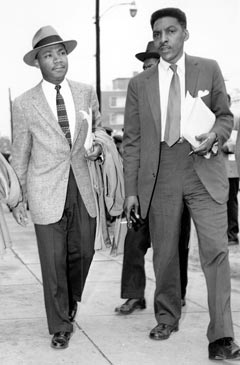
Randolph was a union organizer and Bayard Rustin (someone else you may never have heard of), often called “brother outsider” was a pacifist and gay.  Together they put together the event now best known for Martin Luther King, Jr.’s “I have a dream speech.  Rustin was also a major influence in bringing Dr. King  to embrace non violence.
Bayard Rustin with Martin Luther King, Jr.  in 1956

Bayard Rustin with Martin Luther King, Jr.
in 1956

In February 1956, when Bayard Rustin arrived in Montgomery to assist with the nascent bus boycott, Martin Luther King, Jr. had not personally embraced nonviolence. In fact, there were guns inside King’s house, and armed guards posted at his doors. Rustin persuaded boycott leaders to adopt complete nonviolence, teaching them Gandhian nonviolent direct protest.
Rustin was the speaker who read the list of the marcher’s demands.  You can read or listen to the transcript of Rustin reading the list of the demands in this link from WGBH radio.   They were seen as quite militant and including a living minimum wage. We all recited the pledge that committed ourselves to action.  I think it was in our programs.  (I found my button but so far haven’t located my program.)
As you watch the 50th anniversary coverage, remember A. Phillip Randolph and Bayard Rustin.  Without them, we would not be celebrating this important milestone today,  We can honor them by supporting the continuing fight for economic justice.
Jack Curtis concludes

But King’s emphasis on integration and legal equality gradually came to be seen as the primary impetus for the movement. In the years since, the optimistic and basically patriotic appeal of King’s speech has served to eclipse the march’s agenda and distort the popular understanding of its significant challenge to the status quo. The standard narrative skirts the more controversial, no less patriotic, themes of the march, and the radicalism that was front and center that day.

Randolph’s legacy is not forgotten, including in Boston. In the waiting area of Back Bay Station sits a larger-than life statue of Randolph by sculptor Tina Allen, dedicated in 1988 by Governor Michael Dukakis. Speakers at the dedication ceremony, including state Representative Byron Rushing, hailed the contributions to the railroad industry by porters and waiters from the black community, many of whom had lived in the Roxbury and South End neighborhoods by the station. A quote inscribed in the monument’s base attests to Randolph’s militant stance: “Freedom is never granted; it is won. Justice is never given. It is exacted.”

As we look back over the last 50 years, and look around at a country with rising and racially inflected economic inequality, that revolutionary spirit sits less easily than the hope of King’s “dream speech.” We embrace King’s dream in part because we sense that the country has indeed gone some way down that long road to freedom, and his vision can still set us dreaming and move us forward. But focusing on the demands by Randolph that fell to the wayside, we see even more glaringly that the march’s core aims of economic justice are not close to fruition; even today, we stand at the start of that path. It’s been a long time coming, and it may be a long time yet to come.

Photograph:  Randolph Statue John Tlumacki/Globe staff
Photography:  Rustin and King Associated Press

Voting rights: 2013

This Brian McFadden cartoon seemed appropriate for posting as people are Marching on Washington for Jobs and Freedom once again.

mcfadden voting

Justice Ruth Bader Ginsberg has it right in her dissent from the recent decision:  Why would we want to do away with something that is working?

What’s next? Impeachment!

I sense there is a growing level of frustration among Republican members of Congress.  Their opposition to immigration reform is not playing well with either the public or Republican party elders.  Same for their desire to shut down government to prevent the Affordable Care Act/Obamacare from full implementation.  Some of them have been hammered at town hall meetings and the videos are posted all over YouTube.  The deficit is actually shrinking.  Republican governors like Rick Perry are reversing themselves and asking for Medicaid funds.  And the President and his administration are doing the best they can given that no proposal will pass the House.  So what is left for them.  Impeach Obama!

Steve Breen wrote on MaddowBlog

When fringe figures like Rep. Kerry Bentivolio (R-Mich.) talk about impeaching President Obama without cause, it’s a mild curiosity. When U.S. senators push the same idea, it’s more alarming.

“I think those are serious things, but we’re in serious times,” said Oklahoma Sen. Tom Coburn during a town hall in his home state. “And I don’t have the legal background to know if that rises to ‘high crimes and misdemeanors,’ but I think you’re getting perilously close.”

The remark came after an attendee called the Obama administration “lawless” and asked, “who is responsible for enforcing [Obama’s] constitutional responsibilities?”

Coburn apparently has given this a fair amount of thought, telling constituents, “What you have to do is you have to establish the criteria that would qualify for proceedings against the president, and that’s called impeachment. That’s not something you take lightly, and you have to use a historical precedent of what that means.” He added that he believes “there’s some intended violation of the law in this administration.”

Official portrait of Tom Coburn, U.S. Senator.

Official portrait of Tom Coburn, U.S. Senator. (Photo credit: Wikipedia)

But what violation?

And what, pray tell, has the president done that Coburn perceives as possible “high crimes”? In keeping with the recent trend, the Oklahoma Republican never got around to explaining what the grounds for impeachment would be. Coburn mentioned that he’d heard a rumor about the Department of Homeland Security choosing to “ignore” background checks for immigrants, but he did not elaborate.

Meanwhile Sam Stein tweeted David Axelrod’s reaction

“that was his considered legal opinion as an obstetrician”

Maybe it is just wishful thinking on my part, but I think that Americans still want government to fix roads and bridges, regulate our food, water, drugs and financial institutions, and help those you are in need.  Sure, we all wish for new, creative solutions to some of the problems that seem intractable, but on the whole I think Americans just wish that Congress would actually work with the President instead of just voting “no”.  But the fact that even Mitch McConnell has a challenger from the right in the Republican Primary does not make this seem possible.

I’ll give the last word to Steve Breen

And finally, for every Beltway pundit who proclaims with a tear in their eye, “Washington would be more effective if Obama showed leadership by reaching out to Republicans, schmoozing them, and offering to work cooperatively with his critics,” I hope they’re paying very close attention to current events. It is, as a practical matter, awfully difficult for a president to work constructively with radicalized lawmakers who refuse to compromise and cherish the idea of impeachment without cause.

Just so we’re clear, I don’t really expect Republicans to pursue this in a serious way, and my coverage on the issue is intended more as a “look how silly this is” than a “look at this threat to our constitutional system of government.” If for no other reason, GOP lawmakers wouldn’t try impeaching the president because they’d risk motivating the Democratic base to show up in the 2014 midterms.

That said, the recent talk about impeachment is nevertheless unnerving.

The world loses two jazz greats

One played the piano and hosted a wonderful radio show; the other was a writer who wrote about jazz and blues (among many other things) and whose prose style was said to reflect those musical styles.  Marion McPartland was 95; Albert Murray, 97.

Marion McPartland was a white English woman in the world of American jazz first coming to New York in 1964.  Her New York Times obituary quotes the critic Leonard Feather

“Oh, she’ll never make it: she’s English, white and a woman.”

Mr. Feather, she [McPartland] added, “always used to tell me it was a joke, but I don’t think he meant it as a joke.”

Little did he know.  After many several years  of touring with her husband, Jimmy McPartland’s group, she struck out on her own.

The bare-bones accompaniment of bass and drums was always Ms. McPartland’s preferred format, but she also appeared in concert with symphony orchestras, and in 1996 she recorded an album of her own compositions, “Silent Pool,” on which she was accompanied by a string orchestra.

Marian McPartland, who became an articulate spokeswoman for jazz, and the jazz trumpeter Roy Eldridge around the 1950s.

Marian McPartland, who became an articulate spokeswoman for jazz, and the jazz trumpeter Roy Eldridge around the 1950s.

But what she will most be remembered for in the United States is “Piano Jazz”.

Ms. McPartland’s contributions to jazz were not limited to her piano playing. An enthusiastic and articulate spokeswoman for the music, she lectured at schools and colleges and wrote for Down Beat, Melody Maker and other publications. (A collection of her essays, “All in Good Time,” was published in 1987 and reissued in 2003.) Most notably, for more than 30 years her “Piano Jazz” was one of the most popular jazz shows ever on the radio.

The show, produced by South Carolina’s public radio network, made its debut on NPR in 1978. The format was simple: an informal interview interspersed with extemporaneous duets.

“I didn’t have any idea I’d be good at something like this,” Ms. McPartland told The Associated Press in 2000. “I certainly never thought people would know me because of my voice.” But she proved a natural.

As its title suggests, “Marian McPartland’s Piano Jazz” was originally a show about piano players. But the guest list came to include vocalists, among them Mel Tormé, Tony Bennett and even Willie Nelson and Elvis Costello, as well as trumpeters, saxophonists and other instrumentalists.

I listened on the radio and in recent years often streamed it though headphones at work.  She was understated in her interview style and never got too tangled in the technical aspects of the music she and her guest were performing.  Her voice was instantly recognizable.

In her last years Ms. McPartland received numerous honors. She was named a National Endowment for the Arts Jazz Master in 2000, given a lifetime achievement Grammy Award in 2004, inducted into the National Radio Hall of Fame in 2007 and named a member of the Order of the British Empire in 2010.

And she continued playing almost to the end. Reviewing her appearance at Dizzy’s Club Coca-Cola in Manhattan the night before her 90th birthday in 2008, Nate Chinen wrote in The Times, “Ms. McPartland still has her pellucid touch and her careful yet comfortable style.”

Albert Murray was not a musician.  In fact he was about as different from Marion McPartland as one could be.  Murray was black (a term he disliked), he was born in the segregated American south, and he was an academic.  The New York Times said in his obituary

As blacks fought in the streets for civil rights, black integrationists and black nationalists dueled in the academy and in books and essays. And Mr. Murray was in the middle of the debate, along with writers and artists including James Baldwin, Richard Wright, Romare Bearden and his good friend Ralph Ellison.

One of his boldest challenges was directed toward a new black nationalist movement that was gathering force in the late 1960s, drawing support from the Black Panthers and the Nation of Islam, and finding advocates on university faculties and among alienated young blacks who believed that they could never achieve true equality in the United States.

With a freewheeling prose style influenced by jazz and the blues — Duke Ellington called him “the unsquarest man I know” — Mr. Murray challenged conventional assumptions about art, race and American identity in books like the essay collection “Stomping the Blues” and the memoir “South to a Very Old Place.” He gave further expression to those views in a series of autobiographical novels, starting with “Train Whistle Guitar” in 1974.

Mr. Murray insisted that integration was necessary, inescapable and the only path forward for the country. And to those — blacks and whites alike — who would have isolated “black culture” from the American mainstream, he answered that it couldn’t be done. To him the currents of the black experience — expressed in language and music and rooted in slavery — run through American culture, blending with European and American Indian traditions and helping to give it its very shape and sound.

“The United States is not a nation of black and white people,” Mr. Murray wrote. “Any fool can see that white people are not really white, and that black people are not black.” America, he maintained, “even in its most rigidly segregated precincts,” was a “nation of multicolored people,” or Omni-Americans: “part Yankee, part backwoodsman and Indian — and part Negro.”

Albert Murray in his home in Harlem in 1998

Albert Murray in his home in Harlem in 1998

He wrote often about blues and jazz as part of the American culture.

In Mr. Murray’s view, the essential bond between American culture and what he called Negro culture is the shared embrace of a “blues aesthetic,” which he said permeated the works of black musicians, writers and artists and was being increasingly adopted by whites. To Mr. Murray, the blues were “the genuine legacy of slavery,” Laura Ciolkowski, a professor of literature now at Columbia University, wrote in The New York Times Book Review in 2002.

“For him,” she wrote, “blues music, with its demands for improvisation, resilience and creativity, is at the heart of American identity.”

In “Stomping the Blues” (1976), he argued that the essence of the blues was the tension between the woe expressed in its lyrics and the joy infusing its melodies. He saw the blues, and jazz, as an uplifting response to misery.

“The blues is not the creation of a crushed-spirited people,” Mr. Murray said years later. “It is the product of a forward-looking, upward-striving people.”

He next began a long collaboration with Count Basie on his autobiography, “Good Morning Blues,” which was published in 1985, a year after Basie’s death. Along with the writer Stanley Crouch and the trumpeter Wynton Marsalis, Mr. Murray was actively involved in the creation of Jazz at Lincoln Center, the institution’s first permanent jazz program.

Murray tried to help us understand that our American culture is not purely one thing or another, but a mix.  That mix is what makes us different from any other country in the world.

I couldn’t find any mention of a meeting between McPartland and Murray, but I can’t imagine that they never met.  I hope they are with the other jazz and blues performers and critics gone before them talking and improvising.

Photograph of Marion McPartland:  Bob Parent/Getty Images

Photograph of Albert Murray:  Suzanne Mapes/Associated Press