The perpetual war on women

I’m baffled.  When a political party loses a large, important demographic in an election, I would think that they would change tactics so the same thing doesn’t happen again.  I’m not saying they necessarily need to give up a favored policy position but certainly they could maybe talk about something different.  They could follow the example of Pope Francis.  The Pope is certainly not going to change the Catholic Church position on abortion or ordination of women, but he doesn’t want those kind of issues to be the focus of Church teaching. I refer, of course, to the Republican Party.

I think that all of them need to go back and take Biology 101 again because starting with Todd Akin, they really don’t know how the reproductive system works.  The latest is from Mike Huckabee.  The Nation has provided the full quote via Yahoo! News.

Here are Huckabee’s comments in full, provided by Yahoo! News’s Chris Moody:

I think it’s time for Republicans to no longer accept listening to Democrats talk about a war on women. Because the fact is, the Republicans don’t have a war on women. They have a war for women. For them to be empowered; to be something other than victims of their gender. Women I know are outraged that Democrats think that women are nothing more than helpless and hopeless creatures whose only goal in life is to have a government provide for them birth control medication. Women I know are smart, educated, intelligent, capable of doing anything anyone else can do. Our party stands for the recognition of the equality of women and the capacity of women. That’s not a war on them, it’s a war for them. And if the Democrats want to insult the women of America by making them believe that they are helpless without Uncle Sugar coming in and providing for them a prescription each month for birth control because they cannot control their libido or their reproductive system without the help of the government, then so be it, let’s take that discussion all across America because women are far more than Democrats have made them to be. And women across America have to stand up and say, Enough of that nonsense.

Maybe he should stick to playing the guitar.

Maybe he should stick to playing the guitar.

While his remarks are somewhat muddy and unclear I think the gist is that the Democrats are paternalistic.  Sorry, Mike, but I think that it is the Republicans who are paternalistic.  They assume that women don’t understand about birth control, abortion, and their own bodies.  Otherwise, why would they need to have a doctor do a vaginal ultrasound and explain to them about fetal development.  But I think that Gail Collins had the best response.

Say what? Basically, Huckabee seems to be telling us that the Republican Party will not insult women by suggesting the federal government should require health insurance policies to include birth control pills in the prescription drug coverage.

He appears confident that women will find that an attractive proposition.

Huckabee was at a meeting of the Republican National Committee that was supposed to be pondering ways to close the gender gap. Instead, he laid bare a fact that the party has always tried desperately to hide — that its anti-abortion agenda is also frequently anti-contraception.

Back in 2011, Mississippi voted down a referendum that would define life as beginning at conception.  One reason it failed was because women came to understand that passage might outlaw certain kinds of contraception.  Women, as Collins points out, believe that the right to control their own reproductive schedules was long since established.  Most women find the idea that this might not be so beyond imagination.

Once upon a time, Republicans took the lead when it came to helping women get access to birth control. Now, the whole party is hostage to an anti-abortion movement that harbors a wide-ranging contempt for sex outside of marriage, combined with a strong streak of opposition to any form of artificial birth control, even for married couples.

“What does that make her? It makes her a slut, right?” Rush Limbaugh said of Sandra Fluke, the law student who was lobbying for inclusion of contraceptives in health care plans. However garbled his language, Huckabee’s control-their-libido harks back to the same mind-set.

This is a super political strategy. Let’s target all the voters who waited until they were married and then practiced the rhythm method.

The Republican party continues to be tone deaf when it comes to women’s health.

And there was no backtracking after the “Uncle Sugar” speech. In fact, Huckabee sent an email to his supporters replaying his remarks. Then he asked for a donation.

Photograph from Wikipedia.

Nadal and Federer, Borg and McEnroe

In June 2009, I wrote a post about Rafael Nadal as a role model for young athletes.  It began

I’ve just come back from visiting my mother a 90 year old tennis fanantic.  I picked up last week’s New York Times Magazine and there, on the cover, is Rafael Nadal, the curremt number one in men’s tennis and as well as the current heartthrob for women.  I look at Nadal and Federer as Borg and McEnroe:  Borg was the pin-up but they could both play tennis.

Yesterday I watched the semifinal of the Australian Open between Nadal and Federer and was reminded again of all those great Borg/McEnroe matches.   Bjorn Borg and John McEnroe last played each other in 2011 at a charity event.  The New York Times reported

They were like oil and water during their heyday three decades ago, but John McEnroe, the brassy New Yorker, and Bjorn Borg, the cool Swede, are the best of friends now. Such good friends that Borg agreed to fly to New York to play McEnroe on Thursday in a charity match on Randalls Island.

Bjorn Borg, at left, and John McEnroe at a charity match on Randall's Island in New York.  July 2011

Bjorn Borg, at left, and John McEnroe at a charity match on Randall’s Island in New York. July 2011

True to form, McEnroe won many of his points at the net, while Borg favored backhand slices and a strong serve. McEnroe, who had played a doubles match before taking on Borg, was in character, slamming his racket against a baseboard and holding his hands on his hips after losing several points.

But when their match ended in front a crowd that included the former Mayor David N. Dinkins, they hugged at center court. The result, they said, was less important than their friendship and their efforts to promote tennis.

Borg and McEnroe, of course, are best known for their epic 18-16 tie-breaker in the fourth set of the final match at Wimbledon in 1980, which Borg eventually won. McEnroe won the next year, ending Borg’s five-year championship run at the event. By 1983, Borg retired; McEnroe followed him a few years later.

But for those few years, they played great tennis and provided a contrast in styles that came to characterize their generation. Borg, the quiet gentleman, was a link to the game’s more patrician roots, which were fading. McEnroe, an argumentative finger-pointer, typified a new era when athletes were more openly blunt and out for money.

According to the ATP, Borg and McEnroe played 14 times and 7-7.

This is where Nadal and Federer are a bit different.  After yesterday, they had played 33 times; Nadal had won 23.  The Guardian reported

Rafael Nadal will have to beat Swiss players back to back to win his second Australian Open on Sunday, and may have a slightly tougher time of it against Stanislas Wawrinka than he did in a curiously uneven semi-final against Roger Federer on Friday.

The world No1 took two hours and 23 minutes to win 7-6, 6-3, 6-3 – his 23rd victory over the Swiss, in 33 matches, moving him to within a win of drawing alongside Pete Sampras on 14 slam titles – and three behind Federer. Sampras was in the audience at the Rod Laver Arena, the first time he saw them play each other live.

“I never thought about 13 grand slams, or 14 either,” Nadal said. “I need to keep playing great to win this title. Stan’s serve is huge, and he is hitting the ball very hard. I will try to play the same as I did tonight. When I play with Roger, it’s a very special feeling. We play a lot of times for important things in our career. He’s a really great champion, and it’s an honour to play him. We played some tough rallies in the first set, he was playing some very aggressive tennis. I think tonight I played my best tennis of the tournament. After missing last year, it is very emotional for me to be back on this court.”

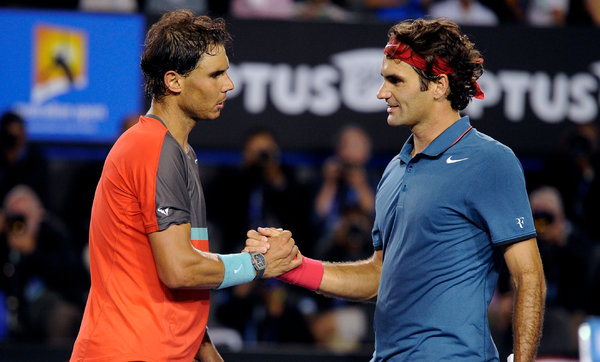
Rafael Nadal, left, shaking Roger Federer's hand after their match. The Nadal-Federer rivalry ranks among the most compelling and the most lopsided in tennis history.

Rafael Nadal, left, shaking Roger Federer’s hand after their match. The Nadal-Federer rivalry ranks among the most compelling and the most lopsided in tennis history.

The first set, won by Nadal in a tie breaker, was classic.  Both men were asked why Nadal wins so often.  The New York Times summarizes

Nadal would be content with never answering another question about his ability to turn any version of Federer — the invincible Federer, the injured, the best, the greatest — into just another guy. But he took one Friday anyway. His answer was a roundabout route to “it is what it is.”

“The real thing is I played a lot of times against him,” Nadal said. “And a lot of times I played great against him.”

And Federer

It was more difficult for Federer to explain why he struggled so with Nadal. He tried. To play Nadal, he said, was different from playing Djokovic or Murray. To beat Nadal, Federer could not play the way he wanted. He needed to be more aggressive, to hit at sharper angles, to take more risks.

His explanation was more fact than excuse. Nadal makes Federer play like someone else.

“I enjoy playing against him,” Federer said, a comment that all but begged for a lie-detector test.

Pete Sampras watched them live for the first time.

…Earlier in the day, Sampras gave a long, thoughtful, conflicted answer about the greatest-of-all-time debate.

Some decades, he said, seemed to have one player who stood above the rest. There was Rod Laver. There was Sampras, although of himself he said only, “I certainly had my moments.” Now, there is Federer and Nadal, greatness squared, and while Federer is 32 and Nadal is 27, their respective careers have overlapped for years — and much of their primes have, too.

“Let’s just appreciate what we’re watching,” Sampras said. “These are two of the greatest players of all time, playing in the same decade. It’s one for the ages.”

That it is, an era-defining rivalry, must-watch TV, every time the two of them take to the court. Even if one of them, the left-handed baseline bully, the Spaniard who answers to Rafa, now seems to win most every match that matters.

And my mother would have enjoyed every minute of yesterday’s match.

Photograph of Borg and McEnroe:  Barton Silverman/The New York Times

Photograph of Nadal and Federer:  Andrew Brownbill/Associated Press

Beware gifts from friends

As long time readers of this blog probably know, I worked for many years in Virginia state government and I grew up in Virginia politics.  OK, so the Virginia laws on accepting gifts may be a little murky, but every state employee I’ve ever known understands that one cannot accept anything of any value from anyone with whom one does business.  The constituent who sends Christmas candy, for example, to thank you for providing some information.  That candy can be accepted if shared with the office.  You can’t take it home.  Plus you should consult the assistant attorney general assigned to your office so there is a record.

A former governor and former state attorney general should know this.  Bob McDonnell likely did and decided he was above the law.  He isn’t.  At least he isn’t above indictment.  The Washington Post published a list of the most interesting of the counts.  Here are some of them.  It begins with shopping.

April 11-13, 2011: The dress and a seat next to the governor

Maureen McDonnell called Star Scientific chief executive Jonnie R. Williams Sr. on April 11 and asked him to take her on a shopping trip to New York to buy a dress by designer Oscar de la Renta. The first lady explained that she was attending a political event at the Union League Club in New York two days later and promised to get Williams seated next to McDonnell (R). On the shopping trip, Williams accompanied the first lady to numerous designer stores and spent $10,999 at Oscar de la Renta, more than $5,500 at Louis Vuitton and roughly $2,604 at Bergdorf Goodman for dresses and accessories that McDonnell said she needed for her daughter’s wedding and for her own anniversary party. Williams was seated next to the governor at the Union League Club event.

May 9-June 1, 2011: Receiving checks from Williams and promoting his company

A member of the governor’s staff indicated May 9 that the staff was considering plans to have McDonnell visit a Star Scientific promotional event on June 1 in Florida. “[T]he person inviting the Governor is a good friend so I would like to be as responsive as possible,” the staff member wrote. A staff member told the company that the McDonnells’ daughter’s wedding, the same week as the corporate event, would make the trip impossible.

“I’m so sorry this won’t work out! What else can we do to fix this?” the staff member wrote.

On May 17, Maureen McDonnell scheduled herself to attend the promotional event.

On May 23, Williams had his office assistant write two checks, for $50,000 and for $15,000 as a wedding gift, and delivered them in person to the governor’s mansion.

On June 1, Maureen McDonnell attended the company’s promotional event in Sarasota, Fla., which was also attended by numerous Star Scientific investors, and announced that she was offering the governor’s mansion for the official product launch of Anatabloc.

August 2011: The Rolex, free golf and a product launch

On Aug. 1, Maureen McDonnell met privately with Williams before the state health official’s briefing to discuss ways that the state could research Star Scientific’s Anatabloc product. The first lady asked about the Rolex watch that Williams was wearing and mentioned that she wanted to get one for her husband, but Williams expressed surprise that the governor would want to wear a luxury item, given his role as a public official. The first lady responded that she wanted Williams to buy her one to give to the governor. Soon afterward, he did buy the watch and called the first lady to ask what she wanted engraved on the Rolex. She replied: “71st Governor of Virginia.” The same day, the governor’s wife entered an electronic calendar event for herself to attend an Aug. 30 luncheon with Virginia state researchers.

On Aug. 12, Maureen McDonnell’s chief of staff arranged for the governor to attend the Aug. 30 luncheon.

On Aug. 30, the governor and his wife played host at a luncheon at the governor’s mansion for the launch of Anatabloc. Williams helped craft the guest list, which included some of the same University of Virginia and Virginia Commonwealth University research scientists whom Star Scientific was trying to persuade to conduct clinical trials of Anatabloc. The first lady and Williams placed Anatabloc samples at each table setting.

January-February 2012: Big loans to the McDonnells and a push for state research:

In late January, the governor’s brother-in-law e-mailed him to say that “the guy who is helping us” had contacted him about where to send the first check he planned to provide for MoBo, a real estate holding company that McDonnell owned with his sister.

On Feb. 9, the first lady e-mailed her husband and copied his senior policy adviser under the subject heading: “FW: Anatabine clinical studies – UVA, VCU, JHU.” In her message, she wrote: “Here’s the info from JW. He has calls in to VCU & UVA & no one will return his calls.”

The next day, she asked her husband’s policy adviser to please call Williams that same day and “get him to fill u in on where this is at. Gov wants to know why nothing has developed w studies after [JW] gave $200,000

Thanks, -mm.”

The McDonnells

Jeff Schapiro wrote in his column in the Richmond Times-Dispatch

In the indictment Tuesday, a picture emerges of McDonnell as a politician who rationalizes his behavior. This is a man who apparently told himself that — because Williams had become an intimate and because gifts from friends do not have to be disclosed under state law — he could conceal from the public beneficence that it would almost certainly deem indefensible.

And it was behind that screen, the indictment argues, that an elaborate scheme unfolded — one in which the government of Virginia, following enthusiastic assurances by Maureen McDonnell to Williams, pledged to support his money-losing company.

Was it the Governor’s wife who was the real driving force behind all of this?  Did they have financial problems all along?  Did they see election to Governor as a signal they needed to live the life of the rich?  Will Governor Bob “Ultrasound” McDonnell end up in federal prison?  I guess we will find out.

Photograph:  Bob Brown, Richmond Times Dispatch

The state rep and domestic violence

He was convicted of two counts of domestic violence resulting from a date – or a hook-up – gone very wrong.  State Representative Carlos Henriquez was sentenced to 2 and a half years and has to serve 6 months.  This happened on January 15 and I’ve been thinking about it ever since.  Much of the debate centers around his sentence since in Massachusetts most first time offenders are told to stay away from the victim and go to a batterer’s program.  Henriquez is planning to appeal.  The Boston Globe reported

State Representative Carlos Henriquez will spend six months in prison after a jury convicted him Wednesday of holding down a woman and punching her in the chest after she refused to have sex with him.

Jurors convicted Henriquez of some of the acts of violence he was accused of, but acquitted him of others.  The lawmaker was found guilty of two counts of assault and battery, but he was acquitted of a charge that he had struck the victim in her face. Jurors also found Henriquez not guilty of witness intimidation and larceny.

Dressed in a dark suit and tie, Henriquez was without expression as Cambridge District Court Judge Michele Hogan said she was sending him to prison in part because of the serious nature of his crime and because of his refusal to accept responsibility for his actions.

“When a woman tells you she doesn’t want to have sex, that means she does not want to have sex,” Hogan said. “You don’t hit her. You don’t punch her. . . . I’m very concerned that you’re not remorseful.”

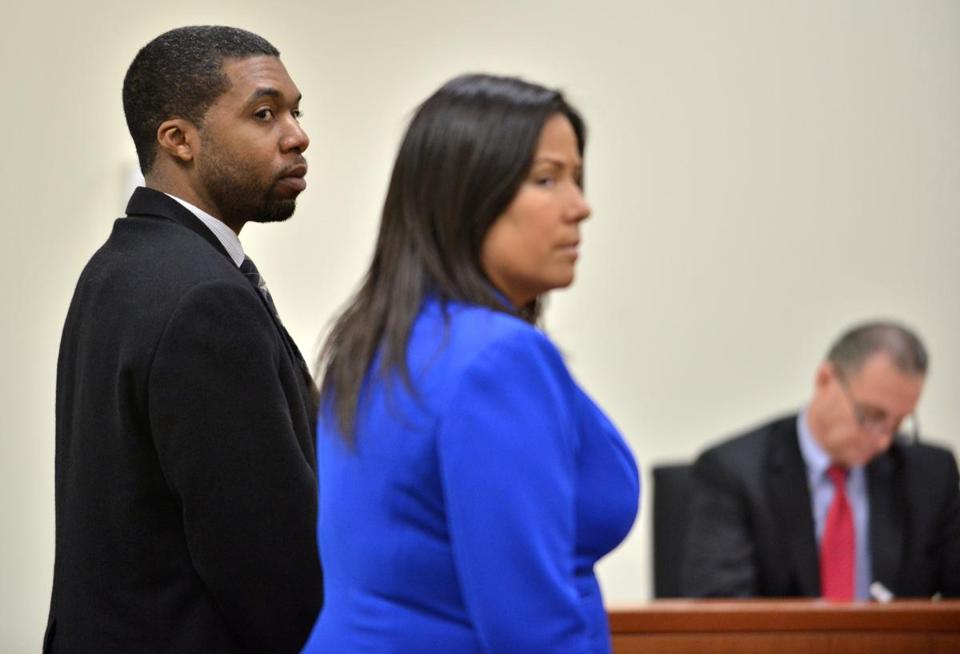
State Representative Carlos Henriquez of Dorchester looked toward the jury Wednesday.

State Representative Carlos Henriquez of Dorchester looked toward the jury Wednesday.

I have to interject here that I worked for Carlos’ mother, Sandi, for a number of years and he occasionally stopped by the office.  She is now a high-ranking official at HUD.  His late father was a community activist and very involved in the Dudley Street Neighborhood Initiative not too far from where we live.  Carlos had a promising career ahead of him but something happened.  The incident for which he was convicted occurred not too long after his father’s death and with his mother mostly in Washington, perhaps he felt adrift.  The family always appeared to be close and he lived in an apartment connected to the family house. But this does not excuse what happened.

A few days after his conviction, Farah Stockman wrote a compelling piece published in the Globe opinion section.

You know your political career is on the rocks when the evidence that is produced in your assault trial is a fake fingernail. Bright pink.

What’s the jury going to think when they see that fingernail, found in the Zipcar you drove when you picked up the 23-year-old college student who accuses you of hitting her after she refused to have sex?

Are those jurors thinking: “A Zipcar! What an ecologically conscious elected official?” Probably not.

You know your reputation as an up-and-coming politician is bound to suffer when the most compelling evidence in your favor is a series of racy messages between you and said college student, sent from your VoteforCarlos e-mail. Katherine Gonsalves picks you out of the crowd at a community meeting, and asks to interview you for a class paper. Days later, she’s asking: “Are you still coming out to play tonight?” You’re a 35-year-old man. You’re Carlos Henriquez, representing the 5th Suffolk district. You’re the son of a well-known political family. A man whose endorsements are sought in mayoral campaigns. But you answer: “For Sure. I hope you are ready.” And you spell it F-O-S-H-O. Then you misspell her name in your phone.

Five months later, she’s begging you to come over. “Babe, I miss you,” she texts. You’re too busy, making the kind of neighborhood appearances that got you elected. Late into the night, she’s still trying to get you to pick her up. She describes partying with her sister and her sister’s friends, drinking. Your response: Send the address if you want to have sex.

Monica Lewinsky, anyone?  Anthony Weiner?  Elliot Spitzer?  Or even worse, Chandra Levy who ended up dead in Rock Creek Park.  Even though someone else was convicted of her murder, suspicion ruined the a California Congressman, Gary Condit with whom she had been having an affair.  Sex and politics are a lethal combination.  Elected officials seem never to learn and in the Henriquez case, there is not only political ruin but jail time.

More from Stockman

You pick her up. You both climb into the backseat of the car. What happens next defines both of you, maybe for the rest of your lives. She tells you she can’t go home with you as she had planned because her mother caught her sneaking out of the house. You complain that she dragged you all the way over here. You argue. She pulls out a cell phone and tells you she’s recording you. Do you struggle over the phone? Steal the SIM card? Do you backhand her, punch her, and choke her — and then climb into the driver’s seat and drive into Boston, without ever giving her a chance to get out of the car?

Or did everything happen differently? We don’t know your side of the story because you never take the stand. All we know is that your defense itself is unflattering: Your lawyer says you only wanted sex, but Gonsalves wanted more, and went “Fatal Attraction’’ when she didn’t get it.

I heard the evidence at the trial and I’m still not sure exactly what happened in the car that night. Justice, at its best, is an approximation. In the end, the jury — five women and three men — had an easier time picturing Carlos Henriquez beating a young woman than that young woman making it up, bruises and all.

Carlos Henriquez is clearly guilty: if not of assault, then of really poor judgment. In court, Gonsalves looked miserable in the witness box. Henriquez looked miserable at the defense table. Once, she stole an awkward glance at him. I felt sorry for them both.

So why sentence him to jail time?  On the surface, the only difference between Henriquez and other men who are convicted of domestic violence and get sent to a batterer’s program is that he is an elected official.  Unfortunately for him, the incident comes on the heels of the Jared Remy case.  Jared Remy was in court for beating up his girlfriend and mother of his child the most recent in a series of incidence with increasing violence.  He was released and, the next day, she was dead.  I think the trial is this summer.  The DA has said that releasing him was an error.

My question is this:  why have men been let off the hook so easily in the first place?  If I am right and the Remy case served as a wake-up call to the criminal justice system, the sentence of Henriquez to jail time was fallout.  When other men are also given jail time, we will know that things are finally changing for the better.

And a final word to Carlos:  Please resign.

Photograph:  Josh Reynolds for The Boston Globe

Robert Livingston: forgotten man of the Revolution

A couple of days ago, I read a story in the New York Times about the discovery of a draft of a letter written in July 1775 to the British people from the American revolutionaries that was a last ditch effort at reconciliation.  While the name Robert Livingston rang a faint bell, I did not remember learning anything about a letter back to England.

According to the Times story

It was lying in a drawer in the attic, a 12-page document that was not just forgotten but misfiled. Somehow it had made its way into a folder with colonial-era doctor’s bills that someone in the 1970s decreed was worthless and should be thrown away.

Luckily, no one did. For when Emilie Gruchow opened the folder last summer and separated it from the doctor’s bills, she recognized it as a one-of-a-kind document.

Ms. Gruchow, an archivist at the Morris-Jumel Mansion, was an intern at the museum in Upper Manhattan when she made her discovery. The mansion served as George Washington’s headquarters during the Revolutionary War. She realized the document was the draft of an urgent plea for reconciliation from the Continental Congress. It was addressed to the people of Britain, not King George III and his government, and began by mentioning “the tender ties which bind us to each other” and “the glorious achievements of our common ancestors.”

The letter, which Ms. Gruchow found last summer, was written in 1775 by the New York jurist Robert R. Livingston.

The letter, which Ms. Gruchow found last summer, was written in 1775 by the New York jurist Robert R. Livingston.

A little searching led me to Yale University’s Avalon Project and the discovery that there had been two letters:  one to the King and one to the “FRIENDS, COUNTRYMEN, AND BRETHREN!”.  Both were from the Continental Congress.  The letter to the King does not list all of the colonists grievances, but mentions them more generally.

We shall decline the ungrateful task of describing the irksome variety of artifices, practiced by many of your Majesty’s Ministers, the delusive presences, fruitless terrors, and unavailing severities, that have, from time to time, been dealt out by them, in their attempts to execute this impolitic plan, or of traceing, thro’a series of years past, the progress of the unhappy differences between Great Britain and these colonies, which have flowed from this fatal source.

The open letter to the British people is a precursor to the Declaration of Independence with a list of grievances.  For example this mention of Boston

We could wish to go no further, and, not to wound the Ear of Humanity, leave untold those rigorous Acts of Oppression, which are daily exercised in the Town of Boston, did we not hope, that by disclaiming their Deeds and punishing the Perpetrators, you would shortly vindicate the Honour of the British Name, and re-establish the violated Laws of Justice.

That once populous, nourishing and commercial Town is now garrisoned by an Army sent not to protect, but to enslave its Inhabitants. The civil (government is overturned, and a military Despotism erected upon its Ruins. Without Law, without Right, Powers are assumed unknown to the Constitution. Private Property is unjustly invaded. The Inhabitants, daily subjected to the Licentiousness of the Soldiery, are forbid to remove in Defiance of their natural Rights, in Violation of the most solemn Compacts. Or if, after long and wearisome Solicitation, a Pass is procured, their Edects are detained, and even those who are most favoured, have no Alternative but Poverty or Slavery. The Distress of many thousand People, wantonly deprived of the Necessaries of Life, is a Subject, on which we would not wish to enlarge.

Became

He has kept among us, in times of peace, Standing Armies without the Consent of our legislatures.

and

For Quartering large bodies of armed troops among us:

as well as

He has plundered our seas, ravaged our Coasts, burnt our towns, and destroyed the lives of our people.

Robert Livingston

Robert Livingston

Which brings us to Mr. Livingston.  According to the Times

Until Ms. Gruchow found it, only the final, printed version from July 1775 had been known to exist. She consulted with Michael D. Hattem, a teaching fellow and research assistant on The Papers of Benjamin Franklin at Yale. He analyzed the handwriting on the yellowed pages of the manuscript and did textual analysis that led to an unexpected conclusion: The document was written by Robert R. Livingston, a prominent New York jurist who had been on the fence about whether to support independence for the colonies.

The following year, Congress tapped Livingston to draft the Declaration of Independence along with Thomas Jefferson, John Adams, Benjamin Franklin and Roger Sherman.

Curiously, Mr. Livingston (1746-1813) did not actually sign the Declaration because he was recalled to New York before he could do so.  I’ve searched, but could find no reason for his recall.  He did go on to administer the oath of office to George Washington and, under the Jefferson administration, to help negotiate the Louisiana Purchase.  And now we know that it is his list in a letter to the British people which likely inspired the list in the Declaration of Independence.

Photograph of Document: Suzanne DeChillo/The New York Times

Predicting 2014

I don’t have a crystal ball and haven’t thrown the I Ching, so I can’t really say what will happen. but Mark Bittman had an amusing column in yesterday’s New York Times about years ending in four.  Bittman seems to be of the opinion that nothing much that is good happens during such years, but we can hope that he just has a selective memory.

Bittman begins with 1944, but I’ll add 1914.  That was the year Austria-Hungary declared war on Serbia to begin World War I. On the plus side, the Panama Canal opened and the Boston Braves won the World Series.
Bittman writes

1944 Those of us who don’t remember this year are lucky; a soldier cited in Rick Atkinson’s brilliantly horrifying saga of the last two years of the war in Europe, “The Guns at Last Light,” quotes King Lear: “The worst is not, So long as we can say, ‘This is the worst.’ ” The end of the war was in sight; getting there was the trick, and millions were killed in the interval. Things have not been this bad since.

1954 If there was a golden era of United States foreign policy, it ended here, as Eisenhower warned against involvement in Vietnam while espousing the domino theory. Good: Joe McCarthy’s power began to ebb. Not good: The words “under God” were added to the Pledge of Allegiance.

1964 The last year of the baby boom was mind-blowing. In the 28 months beginning that January, Bob Dylan made five of the best albums of the era — and there were the Beatles.

Nelson Mandela was sentenced to life in prison, and Lyndon Johnson single-handedly sent everyone into a tizzy by signing the Civil Rights Act, sending more “advisers” to Vietnam, talking about bombing North Vietnam and proposing the Great Society. Huh? The first anti-Vietnam War demonstrations and draft-card burnings took place. Pot smoking officially began. (Not really, but sorta.)

1964 was also the year my husband graduated from high school.  I’ll call that a plus.

Skipping to 1994

Whoa: Not only did Nelson Mandela not spend his life in jail, but he became president. The Brady Law went into effect, and Bill Clinton signed the assault weapons ban. (It expired in 2004.) O. J. Simpson spurred a national obsession. Four bombers were convicted of the 1993 attack on the World Trade Center.

Reagan was implicated in the Iran-contra cover-up, but it seemed more important to torture the Clintons over a bad real estate investment. (Still, Paula Jones wasn’t the Republicans’ fault, was she?) Clinton fired Joycelyn Elders for discussing masturbation.

The first credit default swap was created. Nearly everyone in Rwanda became either a killer or a victim, or so it seemed. And there was that messy thing in “the former Yugoslavia.”

Netscape Navigator was released.

1994 was an important year for me.  We got married and I moved to Boston.  Thomas Menino was mayor but not yet The Mayor.

Which brings us to 2004.

2004  Barack Obama spoke at the Democratic convention and there seemed reason for hope; then John Kerry went windsurfing and W., incredibly, became president again (what were 62 million of us thinking?) several months after endorsing a constitutional amendment banning same-sex marriage, which Massachusetts had already legalized. (By 2013, even Utah is on the right side of this issue.) W. also promised to improve education and access to health care; we all know how that worked out. Lance Armstrong won his sixth Tour de France; we all know how that worked out, too.

And also in 2004, the Red Sox won the World Series for the first time in 86 years ending the mythical curse of Babe Ruth.

So, 2014.  I know what I hope for:  the Democrats retain control of the Senate and, at a minimum, creep closer to a majority in the House. I hope the ACA enrolls so many people who like their benefits that we don’t have to listen to Ted Cruz reading “green eggs and ham” again.  I hope, though it seems unlikely, that we get tax and immigration reform.  I hope that President Obama has a better year. And I hope everyone comes home safely from Afghanistan.  I wish Marty Walsh all the best as he becomes mayor and I hope that Michelle Wu gives up her crazy idea of voting for Bill Linehan for City Council president and picks Tito Jackson instead.  Most of all, I hope that all of us have a safe and healthy year.

2014

The joys of aging

Having been retired now for almost 18 months, I can say  after the getting through adjustments of the first few months – getting into a new routine, figuring out which of the many projects I had always said I would do when I retired, and adjusting to living with another retired person – that retirement has been a joy.  As people before me have said, “I wonder how I ever had time to work.”  But the last few months have reminded me that getting older is not all fun.

This is my first post since mid-November when I was diagnosed with tendonitis in one of my wrists.  I pretty much stayed away from the computer for a couple of weeks and have cautiously approached email.  I am trying very hard to limit my time at the keyboard to 15-20 minute stretches which means I haven’t really been on Facebook or Twitter both of which can be super addictive and could lead me to pass my time limit without knowing it.

And now I have another challenge.  Cataract surgery.  I think cataracts may be genetic on my mother’s side of the family, at least the relatively early need for surgery  has been the rule for my mother, my sister (who is 5 years younger) and me.  I’ve known the day would come sooner rather than later for several years as my doctor and I waited until they got bad enough to warrant surgery.  So a week ago, I had the operation on my right eye.  Very little pain, just a little discomfort.   Which brings us to the challenging phase.  That is what my sister labeled the period between the two surgeries.  Your old glasses don’t work too well because the prescription is very wrong for the implanted lens.  So your choices are to live with really blurry vision in that eye and mostly use the other eye and to periodically take off your glasses when you are looking far away (I had a distance lens implanted.) or, as my doctor suggested, take out the right lens.

I had an old pair of glasses with a prescription that wasn’t too bad for the left eye.  My husband took the right lens out after we went on the internet to learn how.  I did that for a couple of days, but it got tiresome not being able to really see well out of either eye.  Since I knew that none of my glasses were ever going to work for me again, we took the right lens out of my most recent glasses  last night.  That works well, as long as you make adjustments for whether you are looking away or reading.  Middle distance is still a challenge which involves moving my head around until I find a decent focus.  I think this works for people who can adjust to having each eye see differently.  Depth perception is almost non-existent for me at this point although it is better than it was two days ago.  And the right eye is still healing and adjusting so sometimes I think my vision is changing by the minute!

English: A pair of reading glasses with LaCost...

English: A pair of reading glasses with LaCoste frames. (Photo credit: Wikipedia)

Tomorrow is the day I can fully resume all normal activities (like bending over and taking a shower and washing my hair without worrying about getting water in my eye) but the challenging phase will remain until I have the cataract removed from the left eye in early January.  Then I’ll have the new challenge of reading glasses for a month or so while both eyes heal and I can get proper glasses.  But even now I can wake up and see more clearly without glasses than I have since I was in my teens.  It will be wonderful to not have to reach  for my glasses the minute I open my eyes!

Silence

Just a brief post to explain why I haven’t and won’t be posting or commenting much for a while.  I have been diagnosed with tendonitis in one of my wrists and advised to stay off of the computer as much as possible.  And we all know that once you start reading posts or emails it is hard to stop!  Like peanuts you want more.

This is tough because right now I have a lot I want to say about the sequester, the ACA, and the elections just past, but I also don’t want the tendonitis to get worse….  Don’t know how long I will be silent (mostly), but hopefully soon.

Can we cure Congressional dysfunction?

The pundits are dissecting the results of the local and state elections and speculating on what, if any, effect they will have on the 2014 mid-terms and the 2016 Presidential election.  There is plenty of time for that.  I want to talk about the current dysfunction in Congress.

George Packer posted an interesting comment in the New Yorker yesterday.  His Daily Comment began

Going to cast a vote Tuesday, less than three weeks after the government shutdown and the near-default, put me in a sour mood. Usually, I exercise the franchise in a state of embarrassing, heart-swelling affection for the imperfect republic, my under-informed fellow-citizens, confused poll workers, even the dubious names on the ballot. But yesterday, with the gross malpractice of elected officials in Washington still fresh in mind, I walked to the local polling place thinking about some of the stupidities of our democracy, grouping them into two categories: necessary and unnecessary.

His list of unnecessary traditions includes the filibuster.  While the Senate is slightly more functional than the House, the idea that every piece of legislations needs 60 votes to pass needs to be changed before that morphs into a new “tradition”.

The filibuster is an unnecessary stupidity. Senators speak reverently of the filibuster as if it were inscribed in the Preamble to the Constitution, but it’s nowhere in our founding documents. The Senate created the rule almost by accident, in 1806, and for around the next hundred and seventy years used it sparingly, until self-restraint began to disappear from the upper chamber. It has almost no positive effect—try to think of the last time a truly terrible bill was prevented from being stampeded into law by the Senate’s failure to pass a cloture vote. Rampant abuse has exposed the filibuster as an anti-democratic tool of the defeated minority to thwart the will of the elected majority.

Some senators keep making noises about reforming, if not abolishing, the filibuster—most recently last month, when two Obama Administration nominees were blocked by Senate Republicans. But it never happens, and I don’t think it ever will happen, which only shows the profound conservatism of our democratic system. We’re stuck with necessary stupidities because trying to eliminate them would do more damage than it’s worth, but why are we stuck with so many unnecessary stupidities?

While we are talking about traditions, what about the tradition that an president’s nominees get approved absent clear evidence of criminal past, lack of qualifications, or some moral issue.  The putting a “hold” on a nominee, sometimes almost at random, because the Senator wants something else to happen, is an other tradition we don’t need.  At least the Senate has managed to pass Immigration Reform, a non-sequester budget, and the Employment Non-discrimination Act (ENDA).  There seems to be little hope for ENDA or Immigration Reform in the House.

IVoted

Packer goes on to cite the New York Times columnist, Joe Nocera on what we might do to fix some of the dysfunction.  Nocera’s suggestions include moving election day to the weekend, term limits for the Supreme Court, and an end to gerrymandering.

Move elections to the weekend. Do you know why elections fall on a Tuesday in early November? I didn’t either. According to a group called Why Tuesday?, it goes back to the 1840s, when “farmers needed a day to get to the county seat, a day to vote, and a day to get back, without interfering with the three days of worship.” Today, of course, casting your ballot on a Tuesday is an impediment: lines in urban areas are long, people have to get to work, etc. It is especially difficult for blue-collar workers — a k a Democratic voters — who don’t have the same wiggle room as white-collar employees.

Chris Rock — yes, Chris Rock — has been quoted as saying that this is the reason Election Day remains on Tuesday. “They don’t want you to vote,” he said in 2008. “If they did, they wouldn’t have it on a Tuesday.” Even if you aren’t conspiratorially minded, you have to admit that moving elections to the weekend makes a ridiculous amount of sense.

Moving election day is a solution, but we could also expand early voting and explore voting by computer and mail.  Most of all we need to do away with the absurd new ID laws where there is no evidence of widespread fraud which so far no one in Florida, Texas, North Carolina and other states has produced.  Why have ID laws when we could just prosecute anyone who tries to vote illegally?

Nocera also proposes terms limits for the Supreme Court.

 Somewhat to my surprise, most of the experts I spoke to were against Congressional term limits. Norman Ornstein, the resident scholar at the American Enterprise Institute, believes that the unintended consequences of term limits would outweigh the benefits. (He cited, among other things, the likelihood that “they come to office thinking about their next job.”)

Instead, Ornstein proposes term limits for Supreme Court justices. If he could wave his magic wand, he would give the justices one 18-year term, and he would stagger them, so that a new justice joined the court — while another departed — every two years. Ornstein likes this idea, in part, because presidents would be willing to nominate older justices; now, the emphasis is on younger nominees who can remain on the court, and influence American society, for decades. I like the idea because nothing fuels partisan politics like a Supreme Court nomination. If the parties knew there would be a new nominee every two years, it might lessen the stakes just a bit, and bleed some of the anger out of politics.

I’m not sure about this, but it is interesting to contemplate.

The next suggestion, open primaries, is something we have in Boston for municipal elections.  I should note that very few candidates here identify as Republicans (I think there was one running for Mayor), but that shouldn’t hold true for most places.

Why are so many extremist Republicans being elected to Congress? A large part of the reason is that highly motivated, extremist voters dominate the current Republican primary system. Mickey Edwards, the former congressman who is now at the Aspen Institute, wrote a book last year called “The Parties Versus The People: How to Turn Republicans and Democrats Into Americans.” At the top of his list of reforms is open primaries — which would allow anybody to vote for any candidate. Indeed, California has already adopted an open primary system, in which the top two vote-getters run against each other in the general election — even if they are from the same party. As Adam Nagourney wrote in The Times a few weeks ago, this reform is one of the reasons California’s Legislature has become less partisan and more productive. Chances are good that the same reform at the federal level would produce the same result.

California also provides an example that could reduce, if not end, gerrymandering.

As a tool to entrench the party in power, few maneuvers can beat gerrymandering. It’s another reason that the Tea Party Republicans can pursue an agenda that most citizens disagree with: thanks to gerrymandering, their districts could not be safer. Here, again, California offers a better model. It has a 14-person commission made up of five Democrats, five Republicans and four people unaffiliated with either party. In 2011, the new commission redrew lines in a way that broadened the diversity of many districts. That is exactly what should happen everywhere.

Nocera talks about bringing back small donors.  I think this will take a Congressional change to modify or repeal Citizens United.

Many of these suggestions have to be implemented on the state/local level, but we should start talking about them now.  Change comes slowly because of “tradition” and people wanting to retain power, but unless something changes we are going to sink further and further into dysfunction.