The trillion dollar coin explained – sort of

When I started hearing about the possibility of the treasury minting a trillion dollar coin which could end all the endless debates about the debt ceiling, I thought it was a joke.  Turns out, that is only partly true.  Here are two views of the platinum coin.

The first is Neil Irwin’s as posted on the Wonkblog.

I’ll lay out this econo-pundit’s conclusion upfront: I hate the platinum coin idea. But if there is no resolution of the debt ceiling through the legislative process, I hate some of the alternatives more.

The issue, for those who need a refresher: To avoid running into the debt ceiling in the next couple of months, the Treasury secretary could exploit a legal loophole, create a platinum coin, assign it a value of $1 trillion or some other very high number, and deposit it at the Fed, thus enabling the government to carry out its previously promised tax and spending policies without broaching the legal cap on debt issuance.

To back up a minute, it is important to understand what the debt ceiling does, and why it is problematic. Congress passes laws to spend money: This many dollars for fighter aircraft, Social Security benefits paid according to such and such formula, and so on. It passes laws to enact a tax code. And the difference between that spending and the money raised in taxes the government funds by issuing debt. But Congress also has a third constraint: An overall ceiling on how much debt the Treasury can issue. In the past, Congress has raised that ceiling to whatever it needed to be to match the previously approved taxes and spending as a matter of course.

Now, House Republicans are viewing the debt ceiling differently. They are treating the debt ceiling–and the need to raise it–as a lever through which to try to win battles over spending that they lost in previous negotiations. They want to not pass an increase to the debt ceiling unless they get some major concessions from Democrats on cutting spending—concessions that Democratic senators and the White House say are non-starters.

So the idea of the trillion dollar coin would be to put this whole impasse to rest.  Irwin goes on to explain what the coin would not do.

A couple of the widespread objections don’t hold water. So long as the Federal Reserve does its job, the platinum coin would not be inflationary. In the current ultra-low interest rate environment, the Treasury depositing a $1 trillion coin at the Fed would not affect the supply of money in the broader economy any differently from it issuing $1 trillion in Treasury bills. Nothing about the platinum coin would prevent the Fed from hiking interest rates when it sees an inflationary threat on the horizon.

That’s not to say a platinum coin gambit would be much fun for the Fed. Chairman Ben Bernanke and New York Fed president Bill Dudley would face a moment of truth, and scores of Fed lawyers would be working overtime, as the central bank had to decide whether to treat the $1 trillion coin as a legal deposit. The Fed in general hates to end up in the middle of political disputes, and this would be a highly uncomfortable spot.

On the other side is Paul Krugman who begins by explaining the whole debt ceiling business.

Where does the debt ceiling fit into all this? Actually, it doesn’t. Since Congress already determines revenue and spending, and hence the amount the Treasury needs to borrow, we shouldn’t need another vote empowering that borrowing. But for historical reasons any increase in federal debt must be approved by yet another vote. And now Republicans in the House are threatening to deny that approval unless President Obama makes major policy concessions.

It’s crucial to understand three things about this situation. First, raising the debt ceiling wouldn’t grant the president any new powers; every dollar he spent would still have to be approved by Congress. Second, if the debt ceiling isn’t raised, the president will be forced to break the law, one way or another; either he borrows funds in defiance of Congress, or he fails to spend money Congress has told him to spend.

So in reality, Congress would just have to authorize borrowing money that they have already said could be spent.  And part of the issue is that not enough people are working and paying enough taxes to create enough revenue.  In some ways you can understand the Republicans who want to set a fixed amount for a budget and then make everything fit.  No borrowing.  But then you have things like Hurricane Sandy and extra spending for the Bush wars for which no revenue was ever raised, and etc., etc. and we end up either cutting things no one wants to cut or borrowing.  Back to Krugman.

Finally, just consider the vileness of that G.O.P. threat. If we were to hit the debt ceiling, the U.S. government would end up defaulting on many of its obligations. This would have disastrous effects on financial markets, the economy, and our standing in the world. Yet Republicans are threatening to trigger this disaster unless they get spending cuts that they weren’t able to enact through normal, Constitutional means.

Republicans go wild at this analogy, but it’s unavoidable. This is exactly like someone walking into a crowded room, announcing that he has a bomb strapped to his chest, and threatening to set that bomb off unless his demands are met.

Which brings us to the coin.

Here’s how it would work: The Treasury would mint a platinum coin with a face value of $1 trillion (or many coins with smaller values; it doesn’t really matter). This coin would immediately be deposited at the Federal Reserve, which would credit the sum to the government’s account. And the government could then write checks against that account, continuing normal operations without issuing new debt.

But wouldn’t the coin trick be undignified? Yes, it would — but better to look slightly silly than to let a financial and Constitutional crisis explode.

A downgrade of the United States credit rating again will end up costing us in interest which seems to me to defeat the purpose since we will probably have to borrow more to pay extra to borrow.  Maybe enough Republicans will join with enough Democrats to raise the ceiling to a trillion dollars and we won’t need the magic coin.  This is what Irwin is hoping for.

The platinum coin gambit could be terrible for the U.S. government’s long-term standing as a premier destination for global capital. This is a moment for Republicans to take responsibility for governing and to accept the fact that their leverage is limited with control of only one house of Congress. But if the alternative truly is default, a crazy coin option may indeed be less bad than the alternatives.

What would be on the other side?  Some suggestions include the Cat in the Hat, Alfred E. Newman (both sent in to the Takeaway) and my favorite idea, Mark Twain who once said, “Suppose you were an idiot. And suppose you were a member of Congress. But I  repeat myself.”

Bipartisan detente

No.  I’m not talking about Congress where even the nomination of  a former Republican Senator to be Secretary of Defense, can’t bring Republicans and Democrats together.  I’m talking about the American Prospect and the American Conservative magazines.

The headline to the short article in the New York Times reads:

Magazines on Left and Right Unite to Share Office Space

The financial crisis did not bring bipartisanship to Congress, but a difficult media environment may have brought that spirit to two political standard-bearers.

In need of cash and with extra space on its hands, the liberal magazine The American Prospect decided to sublet part of its Washington offices. The American Conservative, tired of working from Arlington, Va., was looking for a new location. When the publishers Jay Harris of The Prospect and Wick Allison of The Conservative were getting lunch in August, they put two and two together.

A six-month lease was soon signed. The self-described bastion of “traditional conservatism” moved in with the self-described “liberal, progressive, lefty” on Dec. 27.

It is tough times for magazines who now maintain print and on-line presence.

What they lack in ideological viewpoint, the two nonprofit monthlies make up for in an independent, establishment-bucking mind-set. Each has faced the sort of downsizing that has become all too common in the print world.

The American Conservative, founded in 2002 by Pat Buchanan, ran biweekly before it went out of print for six weeks in 2009 and returned as a monthly magazine. It has a circulation of 8,000. The American Prospect, in print since 1990, announced to its staff in April that if the magazine could not find $500,000 in financing, it would close altogether by the end of May.  With help from good publicity from Prospect alumni and a few large donors — and by shrinking its staff by four — the bimonthly magazine has endured. The publication has combined paid print and digital circulation of nearly 45,000. The Conservative’s seven staff members will share the white-walled, blue-carpeted 12th floor of 1710 Rhode Island Avenue with The Prospect’s fund-raising and advertising departments. They must share a conference room, a potential source of conflict, though Mr. Harris says it could be a site for events the magazines co-host.

Could this be a model of some kind for Congress?  A bipartisan caucus?  Of course, the Senate women already have something like this when they get together, I believe, monthly but then as Susan Collins, a Republican Senator said recently, ” If women were in charge, we wouldn’t be heading at breakneck speed toward the looming ‘fiscal cliff.'”

Elizabeth Warren, United States Senator

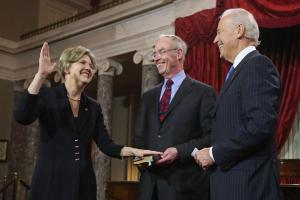
The day we’ve been waiting for.  This picture is from one of her three swearing-ins.  All the Senators get sworn in together and then they get sworn in individually by Vice President, Joe Biden.  Her third, which I plan to attend will be here in Boston, just down the street from me, on Saturday.  Justice Elena Kagan will do the honors.

Elizabeth Warren being sworn in by Vice President Joe Biden

Elizabeth Warren being sworn in by Vice President Joe Biden

The Boston Globe reports

Elizabeth Warren arrived at the Capitol on Thursday morning carrying a black L.L. Bean backpack in the manner of a student in one of her former Harvard classes. Inside was her treasured, tattered King James Bible, used since third grade and chosen for her Senate swearing-in.

“I know people come with big fancy family Bibles,” Warren said in an interview before her induction. “Mine’s a little more modest.”

As she waited, the first woman elected to the Senate from Massachusetts mused about the moment.

“This chair, this particular Senate seat, was held by John Quincy Adams, Daniel Webster, [Charles] Sumner — and of course Senator [Edward M.] Kennedy for half a century,” Warren said. “Men of principle, men who fought hard for the people of the Commonwealth of Massachusetts and for this country.”

All of us who worked for her election – and those who didn’t – should wish her well.  She has history to live up to and we know she will join the list as a great Senator.

[And I just realized I forgot to mention Bruce Mann, Warren’s husband, in the caption to the picture.]

Photograph Chip Somadevilla / Getty Images

The Democratic House Women of the 113th Congress

The New York Times Caucus blog has posted this picture.

Female members of the House Democratic caucus posed for a photograph on Thursday on the steps of the Capitol.

This is most of the 61 women of the Democratic House caucus.

Favoring hues of deep reds and blues, they gathered in the chilly January air, waving to old friends and greeting the new. They laughed and joked, cheekily inviting Representative Barney Frank, a departing Democrat from Massachusetts, to hop in the picture. (He politely demurred.) At one point, a young male aide to Nancy Pelosi, the House minority leader, scurried up to grab some of the members’ coats, juggling the fur and wool throw-overs in his left hand while trying to snap iPhone photos with his right.

As latecomers wandered up, the women called for the photographer to wait, pointing out the stragglers.

There will be 20 women in the Senate and 81 in the House – a record.  Debbie Wasserman Schultz is among the missing from the photograph, however.

But Representative Debbie Wasserman Schultz of Florida emerged from the House moments too late, just as the group was dispersing. However, all was not lost; the photographer took some shots of the late arrivals, and the caucus plans to Photoshop them in.

What did we do before Photoshop?  And don’t the women who did make it look wonderful?

Photograph by Mark Wilson/Getty Images

The “old” House votes on the fiscal cliff

David Jarman posted an interesting analysis of the voting on the Senate Bill to dodge the fiscal cliff in which he credits Nancy Pelosi for getting it done.  Here are some of the highlights.

Tuesday’s House vote on the fiscal cliff is one of those rare votes where you don’t get a straight party line vote like most contentious votes, but one where the House shatters into pieces and the winner is the side that reassembles the most fragments. Of course, this time it was Nancy Pelosi who did that, putting together a strange coalition of most of the Dems (minus a few defections on the caucus’s left and right flanks), plus the bulk of the establishmentarian and/or moderate Republicans (including the vote of John Boehner himself, no “moderate” but certainly “establishment”).

On the Republican side, there were 85 yes and 151 no votes (with 5 non-votes, from Ann Marie Buerkle, Dan Burton, Sam Graves, Jerry Lewis, and Ron Paul). That’s too many votes to replicate the entire list, but there was a significant geographic dichotomy here, one that seems to support the larger idea that the GOP is increasingly becoming a regional rump party.

Look at the New York Times map.  They also have the entire roll call at this link.

Map of fiscal cliff votes

Of those 85 yes votes, only 13 were Republicans from the Census-defined “southern” states, and many of those were either ones with ties to leadership (ex-NRCC chairs Tom Cole and Pete Sessions, Appropriations Chair Hal Rogers) or ones with atypical, moderate districts in Florida (Mario Diaz-Balart, Ileana Ros-Lehtinen, Bill Young). Rodney Alexander, Kevin Brady, Howard Coble, Ander Crenshaw, John Sullivan, Mac Thornberry, and Steve Womack, most of whom are also pretty establishment-flavored, round out the list.

And how did the Democrats vote?

On the Democratic side, there were 172 yes and 16 no votes (with 3 non-votes, from Pete Stark, Lynn Woolsey, and John Lewis). Within those 16, though, there seem to be two camps: Xavier Becerra, Earl Blumenauer, Peter DeFazio, Rosa DeLauro, Jim McDermott, Brad Miller, Jim Moran, and Bobby Scott (most of whom are Progressive Caucus members) voting against it from the left, and John Barrow, Jim Cooper, Jim Matheson, Mike McIntyre, Colin Peterson, Kurt Schrader, Adam Smith, and Pete Visclosky (most of whom are Blue Dogs) voting against it from the right.

It may not be that simple, though: DeFazio has in recent years been one of the likeliest members of the Progressive Caucus to stray from the party line (for example, he voted against both the Progressive budget and even the leadership budget last year); it’s increasingly hard to tell if he’s becoming more conservative or if DeFazio, always irascible, has just gotten more willing to dig his heels in on bills that feel like half-measures. Adam Smith, on the other hand, has generally been a New Democrat establishment-type player, but he might be looking to remake himself a bit with his newly configured, much more liberal district, which now contains a slice of Seattle. And Moran and Visclosky, even though Moran (who represents northern Virginia) is significantly more liberal than Visclosky, are probably coming from the same mindset, whatever that might be; they’re tight, and are some of the last remaining members of that John Murtha/Norm Dicks appropriations clique that didn’t really fit within any of the Dem caucuses.

Jarman doesn’t talk about Bobby Scott and John Lewis but both are in the Black Caucus as well as in the Progressive Caucus.  Lewis just didn’t vote, but Bobby (who I knew from back in my Virginia Days) represents a district that touches Eric Cantor’s and he might also have had the conservative white voter from his district in mind.

Jarman leaves us with this to think about

Fifteen of the GOP “yes” votes were members who, either because of defeat or retirement, won’t be coming back (Charlie Bass, Judy Biggert, Brian Bilbray, Mary Bono Mack, Bob Dold, David Dreier, Jo Ann Emerson, Elton Gallegly, Nan Hayworth, Tim Johnson, Steve LaTourette, Dan Lungren, Todd Platts, John Sullivan, and Bob Turner). Twenty end-of-the-liners, however, voted “no” (Sandy Adams, Todd Akin, Steve Austria, Rick Berg, Quico Canseco, Chip Cravaack, Jeff Flake, Frank Guinta, Connie Mack, Sue Myrick, Mike Pence, Ben Quayle, Denny Rehberg, David Rivera, Bobby Schilling, Jean Schmidt, Tim Scott, Cliff Stearns, Joe Walsh, and Allen West), though I suspect some of the more establishment-flavored names on that list would probably have been willing to offer a “yes” if the vote had looked closer than it actually was.

Tomorrow starts a new Congress so we can’t really look to this vote when we are reading the tea leaves about the upcoming fight on the debt ceiling and the budget.  There will be more Democrats – enough so Nancy Pelosi won’t need so many Republican votes (I think it may be 21, 17 with vacancies) – if John Boehner can be persuaded to bring things to the floor.

Looking back at 2012 progressively

2012 was a pretty good year for those of a progressive/liberal political point of view and Winning Progressive has compiled a good summary.  You can read the entire article here, but I’ve pulled out some of my particular favorites – in my own order of significance.

First I have to talk about Mitch McConnell who not only lost his effort to make President Obama a one-termer, but last night voted to increase taxes.  (Although since it happened after we technically went off the cliff  at midnight, he will probably spin it as a decrease.)  I think he an John Boehner were the big losers last year, not Mitt.  Mitt is done with politics, but McConnell and Boehner have to continue to try to herd their Republican members and get re-elected.

President Obama re-elected

So now to some accomplishments.

* President Obama Re-Elected With A More Diverse and Progressive Congress– The November elections saw the re-election of President Obama and the election of four new progressive U.S. Senators – Mazie Hirono (D-HI), Elizabeth Warren (D-MA), Chris Murphy (D-CT), and Tammy Baldwin (D-WI).  In addition, Joe Lieberman (I-CT) is finally leaving the Senate!  On the House side, the Democrats elected in November will be the first major party caucus in US history that is majority female and people of color.  New House progressives will include Alan Grayson (FL-09), Jared Huffman (CA-02), Dan Kildee (MI-05), Ann McLane Kuster (NH-02), Grace Meng (NY-06), Patrick Murphy (FL-18), Rick Nolan (MN-08), Mark Pocan (WI-02), Raul Ruiz (CA-36), Carol Shea-Porter (NH-01), Mark Tacano (CA-41), Hakeem Jeffries (NY-08), and Kyrsten Simena (AZ-09).  On the flip side, tea party conservatives Allen West (FL), Chip Cravaack (MN), Bobby Schilling (IL), Roscoe Bartlett (MD), Ann-Marie Buerkle (NY), Francisco Canseco (TX), and Joe Walsh (IL) were all defeat and, hopefully, will never be heard from politically again.

* LGBT Equality– 2012 was, of course, a banner year for advancing LGBT equality.  For the first time in US history, equality was supported by a majority of voters facing ballot proposals approving marriage equality in Maine, Washington, and Maryland, and refusing to ban equality in Minnesota. The first openly lesbian U.S. Senator, Tammy Baldwin (D-WI) was elected in November as were a record seven openly-gay House members.  President Obama publicly supported marriage equality, and anti-equality forces in Iowa failed in their effort to recall a state Supreme Court justice who declared that state’s ban on marriage equality unconstitutional.  In February, a federal appellate court ruled California’s anti-marriage equality Proposition 8 unconstitutional, and two federal courts in 2012 did the same with the Defense of Marriage Act.

* Health Care Reform – In a decision that surprised many commentators, the U.S. Supreme Court upheld the Patient Protection and Affordable Care Act, aka “ObamaCare.”And while the GOP-controlled House has voted at least 33 times to repeal ObamaCare, President Obama’s re-election in November virtually guarantees that will never occur.   In implementing ObamaCare, the Obama Administration, standing up to strong opposition from conservative religious organizations, finalized rules requiring that contraception be included as a preventive health service that insurance policies must cover with no co-pay.  This will help millions of women afford access to birth control and also save money by reducing unintended pregnancies.

Those are my personal big three.

Yes, there is a lot left to do and a lot that happened that I didn’t particularly think was terrific, but on the first day of a new year, we should celebrate our successes!

Going over the cliff?!

The Senate is back in town with very unhappy members who would rather be kicking back at home and who can blame them.  Senator McConnell who really, really doesn’ t want to make a fool of  himself a la Boehner and Plan B, keeps asking for a proposal from the President.  I thought the President had made at least two proposals, but I guess Mitch doesn’t follow the new much.  Meanwhile the House is called back into session on Sunday night.  That is the night of December 30 a little more than 24 hours before the cliff.  So what is going on here?  Not being an economist, I can’t explain it all but I have found a couple of things this morning that have given me some things to think about as we play chicken with the deadline.

First is this handy chart from the New York Times from the Debt Reckoning blog.

It was posted last night with this explanation.

The deadline for resolving the pending fiscal crisis is less than a week away and, absent a breakthrough, spending cuts and tax increases on every income level will go into effect on Jan. 2. During their negotiations, President Obama and Speaker John A. Boehner have sought to keep tax rates at their current level for some taxpayers while letting them rise for high earners, but they have not agreed on where to set the income threshold. Mr. Obama has called for rates to go up on income above $250,000 (he later increased his offer to $400,000), Congressional Democrats have said they would agree to $500,000, and Mr. Boehner has called for a $1 million threshold.

So we aren’t talking about a lot of taxpayers here since the vast majority of us make under $250,000 in taxable income.  As I understand it, none of these proposals would impact investment income.  (Which as we have learned from Mitt Romney, is taxed differently.)  But we do pay a lot more taxes than just income tax and if we go over the cliff, these will go up.  Payroll taxes, business taxes, various tax credits like for child care, and unemployment insurance will all be affected.

The other thing I read this morning is from the Washington Post’s Wonkblog, They have put together a set of very helpful Frequently Asked Questions – with answers.

For example

What is the fiscal cliff in one sentence?

Much too much austerity, much too quickly.

And since this is Ezra Klein and company, there are a couple of helpful graphs.

On or around Jan. 1, about $500 billion in tax increases and $200 billion in spending cuts (see table 1) [ above] are scheduled to take effect. That’s equal to about four percent of GDP, which is according to the Congressional Budget Office, more than enough to throw us into a recession

Next question:  What matters most?

It’s important to recognize that the austerity crisis is a collision between deficit reduction and stimulus. The good news is that if you look at the various components of the fiscal cliff separately, you’ll see that the parts that do the most for deficit reduction do the least for the recovery, and vice versa. This suggests the possibility of “a la carte” approach to the fiscal cliff, in which we extend the most stimulative policies and wave goodbye to the most costly policies. And if you’re looking to go a la carte then here, via the Economic Policy Institute, is the menu.

I recommend that Senator McConnell take a look at this list and the chart showing the impact of various tax increase proposals, pull out his own calculator and make a proposal.  Of course given the House and Senate rules, we will probably go over the cliff before anything can be passed.

Replacing John Kerry or potential food fight in Massachusetts

John Kerry has not been appointed to anything as of this writing.  He has certainly not been confirmed by the Senate.  Neither of these facts are keeping the speculation about the race to replace him from heading toward some kind of crescendo.  Ben Affleck, Ted Kennedy, Jr., Congressman Ed Markey, or my former boss, Congressman Mike Capuano.  Will one of them get appointed by Governor Deval Patrick as interim and then be allowed to run or will it be Vicki Kennedy or former governor Michael Dukakis neither of whom will run.  Rumors. Rumors and speculation.

One thing I do know is that Scott Brown is running for something.  He just came out in support of an assault weapons ban which is a change in his previous position.  If he votes for the President’s fiscal cliff plan then we can be absolutely certain he is running.  The cynic in me would say that he likes being a senator more than he values loyalty to his party which, by the way, he didn’t mention much in his campaign against Elizabeth Warren.  It is Republican.

But let us play the game.

Ben Affleck and Ted, Jr. both campaigned for Elizabeth Warren.  Both appear to have good solid Democratic left politics.  Both probably have good name recognition (an issue for Ed Markey and Mike Capuano – although if I remember correctly, Mike came in second to Martha Coakley in Democratic primary to run against Scott Brown in the last special election.  Some, including me, said at the time that Mike would have pushed back harder against Brown than Coakley did).

For one, Ted, Jr. doesn’t really live in Massachusetts even though a lot of people probably think he must.  He would have to hurry and change his residence and registration.

The Boston Globe ran a piece speculating on all of this and said this about Ted, Jr.

The younger Kennedy would have to go out and campaign for the seat, just as his relative, Joseph P. Kennedy III, just did with his recent US House campaign.

Edward Jr. could rely on his father’s legacy, but also highlight his own work with the disability community, as well as his private-sector experience heading a New York-based health care advisory firm.

One immediate challenge, though, is residency. Kennedy may spend time each summer at the family compound on Cape Cod, but he lives in Connecticut.

Massachusetts election law does not require US House members to live in their respective House districts, only that they be an “inhabitant” of the state when elected. The same is true for senators, who don’t represent geographical districts but the entire state. Candidates for both offices, however, have to be registered voters in the state to circulate nomination papers.

President John F. Kennedy famously maintained his voter registration at 122 Bowdoin St., an apartment building across from the State House, all the way until his assassination.

Edward Kennedy Jr. would have to make some sort of formal commitment to Massachusetts before voters made a formal commitment to him.

Ironically enough, Hillary Clinton – the person whose departure may clear the path for a special election campaign – did just the same sort of thing in New York before winning her own seat in the US Senate

Then there is Ben.  His mother lives in Cambridge, but I thought he lived in California.  Anyway, I think he probably has the same residency issues as Ted, Jr.  But, hey, if Sonny Bono could become a Congressman.  A better example for Ben would be Al Franken who went home to Minnesota and visited everyone without cracking a joke.  Franken has made himself into a very good senator.  Unfortunately Ben doesn’t have time to do this.  He does go to Senate hearings, however.

Jay Westcott/POLITICO

The Globe didn’t have much to say about Ben, but Politico reported

“That’s not what I’m here to talk about,” Affleck told POLITICO. “I’m here to talk about what role we can place in making the Eastern Congo a better place.”

Earlier this week, reports surfaced that he was being touted as a possible candidate for Senate in Massachusetts. Affleck campaigned for Sen.-elect Elizabeth Warren (D-Mass.) when she beat freshman Sen. Scott Brown (R-Mass.) in November.

So will Massachusetts go for star power, legacy or a seasoned politician?  And the bigger question:  who can beat Scott Brown?

Photograph of Ted Kennedy, Jr. – Brian Snyder/AP

Photograph of Ben Affleck  – Jay Westcott/Politico

Crazy state gun laws

Dylan Matthews posted this today on Ezra Klein’s Wonkblog.  He lists the 6 craziest.  I will talk about the craziest of the craziest, but the entire list is worth reading.

Concealed carry at 16 — with no permit: Most states that allow people to carry a concealed weapon on their person require gun owners to obtain a permit before doing so. But four states — Alaska, Arizona, Wyoming and Vermont — allow concealed carry without any permit. That means, the Brady Campaign’s Brian Malte tells me, that Jared Loughner was in full compliance with Arizona law up until the moment he used his concealed weapons to kill six people and severely injure Rep. Gabrielle Giffords.

Vermont, however, stands out from the pack because it allows people as young as 16 to conceal carry without parental permission, as well as buy handguns. So a Vermont teenager aged 16 can’t legally go to an R-rated movie alone or join the military, but he can buy a handgun and carry it in his jeans and be completely within the limits of the law.

I have family who have lived in Vermont for years.  My husband lived there for a while.  Who knew?

Property rights end where gun rights begin: According to the Law Centerto Prevent Gun Violence, 17 states, including Oklahomaand Florida, bar employers from preventing their employees from bringing
guns to work and keeping them locked in their vehicles, even if those vehiclesare on the property of the employer. Indiana and North Dakota allowemployees to sue their employers for damages if asked about gun possession. TheNorth Dakota statue specifically bars employers from asking if employees’
vehicles parked on company property have weapons in them. Georgia bars employersfrom making employment conditional on not bringing guns to work.

So when you have to discipline an employee they can go out to their car at lunch or break and come back and shoot you.  This is very rational – not!

Open carry without a permit: Most legal disputes around carrying gunsin public involved concealed carry. But open carry, which is arguably morethreatening to surrounding community members, is largely unregulated.
Thirty-five states allow open carry of handguns without a permit, while only three (plus the District of
Columbia) ban it outright. Forty-seven states plus the District allow open carryof long guns (that is, rifles or shotguns) in public, while only three ban it.

I guess it is better to know the guy next to you at the local bar is carrying so you can avoid arguments about the Red Sox and Yankees.

Members of the Virginia Citizens Defense League gather in July 2010 to celebrate
a new law permitting open carry of guns in bars. (Dayna Smith/For The Washington
Post)

Guns at schools: In 2010, Kansas passed a law allowing the concealed carry of guns in K-12 schools, in violation of the federal Gun-Free School Zones Act, which criminalizing the carrying of firearms in specified school zones. That act was ruled unconstitutional in U.S. v. Lopez as exceeding the federal government’s powers under the Commerce Clause, and a revised statute was passed that limits the ban to guns “involved in interstate commerce,” so it is possible that the Kansas statute does not run afoul of federal law in all cases.

This past week, Michigan followed suit, with state legislators passing a law allowing concealed carry in schools, bars, daycare centers and churches. Gov. Rick Snyder (R) has not signed the bill into law, and its ultimate passage is now in doubt due to the Newtown incident.

We all know that if the principal at Sandy Hook Elementary School had had a gun, she could have shot Adam Lanza.  Of course, no one has talked about where a teacher would keep the weapon so that the kids wouldn’t get access because they are curious.  We all know that kids are curious.

In addition to these gems, there are many states with Stand Your Ground laws and we know from the incidents in Florida how well that works out for the shooters.

If we can just figure out a way to get states to repeal some of these, I think we would be safer than we are today.

Brady Campaign

Brady Campaign (Photo credit: Wikipedia)

About the Republican request for a balanced approach

Ezra Klein posted this today

This is a very sharp point by Josh Barro:

The Republicans’ main problem in this negotiation is that they know President Barack Obama will not agree to cut in the area they want to cut: aid to the poor. The signal Obama has sent is that he is willing to make a deal that cuts old-age entitlements, meaning Medicare and Social Security, and Republicans are internally conflicted over those programs.

He’s right. Think back to Mitt Romney’s proposed budget. Medicare and Social Security were held harmless for at least 10 years. Defense spending got a lift. PBS and the National Endowment for the Arts were on the table, but they cost so little it hardly mattered.

And there is the Ryan budget problem which remains the basic Republican budget outline.  It is what they ran on.

These are, however, classes of cuts the White House won’t even consider. A year ago, they were open to modest cuts in Medicaid, but after the Supreme Court’s health-care decision, even that door has shut. As for discretionary spending cuts, so many of those were made in 2011, there’s just not much left to do.

That leaves Medicare and Social Security. It’s possible that the negotiators will enact a backdoor, but significant, cut to Social Security by changing the government’s measure of inflation. But they’re not going to come at Social Security from the front. It’s too politically potent. Even Ryan’s budget left Social Security alone.

As for Medicare, as Barro says, if “Republicans ask for near-term Medicare cuts, that will mean reversing a position that is popular with a core constituency (old white people) and giving up a cudgel that they feel they have used effectively to beat up the president since 2009.” It’s a pickle.

In addition, as Steve Benen on the Rachel Maddow blog reminds us, the President has already offered spending cuts, of about 1.7 trillion over 10 years.

The White House keeps saying it wants a ‘balanced approach’ but this offer is completely unbalanced and unrealistic,” a Capitol Hill Republican said yesterday. “It calls for $1.6 trillion in tax hikes — all of that upfront — in exchange for only $400 billion in spending cuts that come later.”

Let’s put aside, for now, the irony of hearing Republicans talking about “balanced” debt-reduction plans. Instead, the importance of complaints like these is that they overlook everything that happened a year ago. Jonathan Cohn had a good piece on this.

…As part of the 2011 Budget Control Act, Obama agreed to spending  reductions of about $1.5 trillion over the next ten years. If you count  the interest, the savings is actually $1.7 trillion. Boehner should have  no problem remembering the details of that deal: As Greg Sargent points out, Boehner at the time actually gloated about the fact that the deal was “all spending cuts.”

And now, with this latest offer, Obama is proposing yet more spending  reductions, to the tune of several hundred billion dollars. Add it up  and it’s more than $2 trillion in spending cuts Obama has either signed  into law or is endorsing now. That’s obviously greater than the $1.6 trillion in new tax revenue he’s seeking. (And that doesn’t even take into account automatic cuts  from the 2011 budget sequester, which Obama has proposed to defer, or  savings from ending the wars in Afghanistan and Iraq.)

I can understand the temptation to block 2011 from memory, but what transpired is clearly relevant to the current debate. Obama wanted a “balanced” approach last year — some cuts, some new revenue — but didn’t get it. Instead, faced with the prospect of Republicans crashing the economy on purpose, the president accepted a deal with a whole lot of spending cuts.

How much new tax revenue came as the result of last year’s deal? Zero. The entire package came in the form of spending reductions and savings.

So with the new tax revenues and the already proposed budget cuts, President Obama is offering exactly what the Republicans keep asking for:  a balanced approach.  I’m not sure what they are waiting for.  Senator Harry Reid is mystified and so am I.

We need a comprehensive solution that lasts for a couple of years at a minimum because this non-economist doesn’t think the economy will improve as long as we seem to be in a continuous a budget or debt ceiling crisis.