
The French debate gay marriage

The French Parliament has approved gay marriage.

I started reading the article, The French Debate Gay Marriage, in Their Fashion, from Sunday’s New York Times thinking I wouldn’t learn much.  Wrong.  Turns out some of the ambivalence about gay marriage has to do with ambivalence about marriage generally.

“After May ’68, if you were modern, you didn’t get married,” said Frédéric Martel, organizer of the Rond-Point event and author of the new book, “Global Gay: How the Gay Revolution is Changing the World.” “Now we’re at a moment when we are all a bit hysterical about marriage — gay marriage. But this is really a conservative movement, about stability in society and being good parents and protecting children and becoming rather ordinary.”

Seventy percent of the French do not think it is important for couples living together to get married, according to an Insee poll in 2012. Fewer than four marriages for every 1,000 citizens were performed in France in 2011, compared with nearly eight in 1970.

The civil solidarity pact legislation, which was intended to give gay couples many of the rights of marriage, has been used overwhelmingly by straight couples as a kind of “marriage light.” It is so popular as an alternative to marriage that in 2010, there were four civil unions for every five marriages.

And then there are feminist concerns.

Some feminist lesbians think a change in the law is retrograde. In Elle, the historian Marie-Josèphe Bonnet called marriage an “instrument of domination” and same-sex marriage a project of gay men, not lesbians.

“We want to be able to exist socially as women, without being a mother or ‘the wife of,’ ” she said. Asked why she didn’t mobilize lesbians against the law, she said, “No one can be opposed to equality.”

Plus the fact that the French President, Francois Hollande, has never married.

Mr. Hollande, who made passage of the same-sex law a campaign promise, is a model for unmarrieds. He never married Ségolène Royal, the mother of his four children; she called herself “a free woman” and marriage a “bourgeois institution” when she ran unsuccessfully for president in 2007. There is no indication he intends to marry Ms. Trierweiler.

Valerie Trierweiler supports gay marriage.

When Valérie Trierweiler, the partner of France’s president, François Hollande, announced that if the law came into effect she would attend the wedding of two gay friends, Bernard Debré, a center-right deputy, wrote on his blog that she had no right to enter the debate. “She’s just the mistress of the French president,” he said.

The French support marriage but aren’t so sure about adoption by same sex couples.

While 63 percent of the French favor same-sex marriage, according to a poll by the French Institute of Public Opinion released last Saturday, 49 percent favor the right of same-sex married couples to adopt. There is less support for legalizing artificially induced pregnancies for gay couples. And some liberals and feminists consider surrogate motherhood an exploitation of poor working women by the rich.

“It introduces the notion of the child as merchandise,” the historian Max Gallo said on France Culture radio last Sunday. “You rent a belly and buy the product.”

The concerns of the French who are generally supportive are very different from those of Americans.  Here it is viewed as a matter of equality and civil rights. Here in the United States, we, for the most part, still believe in marriage.  We got past the era when it was an institution of our parents.

But the views of the opposition are pretty much the same in both countries.  The New York Times reported on an anti-gay marriage rally held in January.

“Nobody expected this two or three months ago,” said Frigide Barjot, a flamboyant comedian leading the protest. At the rally, she read out a letter to Mr. Hollande asking him to withdraw the draft bill and hold an extended public debate.

Strongly backed by the Catholic Church hierarchy, Ms. Barjot and groups working with her mobilized churchgoing families and political conservatives as well as some Muslims, evangelicals and even homosexuals opposed to gay marriage to protest.

“The French are tolerant, but they are deeply attached to the family and the defense of children,” said Daniel Liechti, vice president of the National Council of French Evangelicals, which urged its members to join the march.

Opponents of gay marriage and adoption, including most faith leaders in France, have argued that the reform would create psychological and social problems for children, which they believe should trump the desire for equal rights for gay adults.

Sounds familiar.
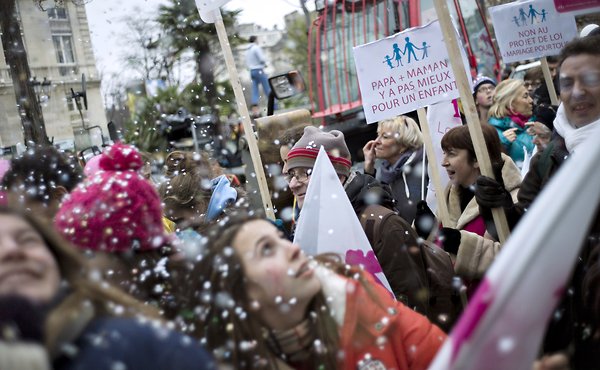
Protesters in Paris opposing gay marriage.

I think both sides will find out what we have already learned in Massachusetts:  The sky won’t fall.

Photograph:  Marriage for all Gonzalo Fuentes/Reuters

Photograph:  Protesters Getty Images.

Richard the Third the last Plantagenet

Richard III was, according to Shakespeare, one of the worst villans to rule England.  On the other hand, there were many, including Josephine Tey who believed otherwise.  And now, his bones have been found and identified.

The bones as discovered.

Greyfriars car park, Leicester, where the remains of King Richard III were found

Grey Friars car park, Leicester, where the remains of King Richard III were found.

According to the BBC

A skeleton found beneath a Leicester car park has been confirmed as that of English king Richard III.

Experts from the University of Leicester said DNA from the bones matched that of descendants of the monarch’s family.

Lead archaeologist Richard Buckley, from the University of Leicester, told a press conference to applause: “Beyond reasonable doubt it’s Richard.”

Richard, killed in battle in 1485, will be reinterred in Leicester Cathedral.

The Guardian detailed the careful science behind the declaration.

There were cheers when Richard Buckley, lead archaeologist on the hunt for the king’s body, finally announced that the university team was convinced “beyond reasonable doubt” that it had found the last Plantagenet king, bent by scoliosis of the spine, and twisted further to fit into a hastily dug hole in Grey Friars church, which was slightly too small to hold his body.

But by then it was clear the evidence was overwhelming, as the scientists who carried out the DNA tests, those who created the computer-imaging technology to peer on to and into the bones in raking detail, the genealogists who found a distant descendant with matching DNA, and the academics who scoured contemporary texts for accounts of the king’s death and burial, outlined their findings.

The skeleton’s injuries were consistent with accounts of Richard’s death.

Richard died at Bosworth on 22 August 1485, the last English king to fall in battle, and the researchers revealed how for the first time. There was an audible intake of breath as a slide came up showing the base of his skull sliced off by one terrible blow, believed to be from a halberd, a fearsome medieval battle weapon with a razor-sharp iron axe blade weighing about two kilos, mounted on a wooden pole, which was swung at Richard at very close range. The blade probably penetrated several centimetres into his brain and, said the human bones expert Jo Appleby, he would have been unconscious at once and dead almost as soon.

The injury appears to confirm contemporary accounts that he died in close combat in the thick of the battle and unhorsed – as in the great despairing cry Shakespeare gives him: “A horse! A horse! My kingdom for a horse!”

Another sword slash, which also went through the bone and into the brain, would also have proved fatal. But many of the other injuries were after death, suggesting a gruesome ritual on the battlefield and as the king’s body was brought back to Leicester, as he was stripped, mocked and mutilated – which would have revealed for the first time to any but his closest intimates the twisted back, a condition from an unknown cause, which began to contort his body from the age of about 10. By the time he died he would have stood inches shorter than his true height of 5′ 8″, tall for a medieval man. The bones were those of an unusually slight, delicately built man – Appleby described him as having an “almost feminine” build – which also matches contemporary descriptions.

According to the Boston Globe story

Richard III ruled England between 1483 and 1485, during the decades-long tussle over the throne known as the Wars of the Roses. His brief reign saw liberal reforms, including introduction of the right to bail and the lifting of restrictions on books and printing presses.

The discovery of Richard’s bones will not resolve the controversy surrounding him, however.  Most believe in the Shakespearean image of him as a the evil hunchbacked killer of two young princes in the Tower of London.

After I read Richard III in high school, my mother introduced me to Josephine Tey’s The Daughter of Time.  Her detective character, Alan Grant, takes up the case while in the hospital with the help of a young researcher who does the leg work.  The Wikipedia article about the book has a good summary of what Grant concluded and Tey believed.

The main arguments presented in the book in defence of King Richard:

  • There was no political advantage for Richard III in killing the young princes. He was legitimately made king.
  • There is no evidence that the princes were missing from the Tower when Henry VII took over.
  • Although a Bill of Attainder was brought by Henry VII against Richard it made no mention of the princes. There never was any formal accusation, much less a verdict of guilt.
  • Henry never produced the bodies of the dead princes for public mourning and a state funeral.
  • The mother of the Princes, Elizabeth Woodville, remained on good terms with Richard.
  • The Princes were more of a threat to Henry VII as the foundation of his claim to the crown was significantly more remote than theirs.

Grant and his American collaborator argue that there is little evidence of resistance to Richard’s rule (ignoring Buckingham’s rebellion). They allow that there were rumours of his murdering the princes during his lifetime, but they decide that the rumours had little circulation, and attribute them to the Croyland Chronicle and to the Lord Chancellor of France, and ultimately to Tudor sympathiser John Morton. They also propose that Morton was the actual author of Thomas More‘s biography of Richard, suggesting that the incomplete manuscript found after More’s death was an unfinished copy by More of Morton’s lost original. They conclude that the princes probably remained alive throughout Richard’s reign and were later killed by Henry.

The Richard III Society which sponsored discovery and will have his bones reinterred will still have work to do to clear his name.  Where are the alleged bones of the princes and can we now do DNA on them?

Photograph of car park Darren Staples/Reuters

Women in combat

The Secretary of Defense, Leon Panetta, and the head of the Joint Chiefs, Martin Dempsey, recently signed an order to allow women to serve in combat.  Each branch of the services will now develop a timetable and guidelines for implementation.  This move will allow for official recognition of roles women are already playing.

I posted a pithy little sentence about this from Winning Progressive on my Facebook page only to set off a sometimes not completely coherent discussion among some who oppose the entire idea.  What I posted was

“Now that women can serve in combat that leaves the neo-cons as the only group that apparently can’t serve in war.” – LOLGOP

When I put the comment on Facebook, I was more interested in the neo-cons not serving than in the decision about women.  But the discussion ended up centering around women and combat.  (Sometimes I think friends on the right don’t have much sense of humor.)  Their arguments against were essentially the same ones that Kathleen Parker made in her column in the Washington Post.

The two most popular arguments for inclusion of women in combat would be valid if only they weren’t incorrect. They are: (1) Only qualified women will be included in combat units; (2) We have a volunteer military and, therefore, only those who want to serve in combat will.

Parker worries about the lowering of physical standards, she call it “gender norming” and the fact that women will now have to register for selective service so we may not have a volunteer army at some point.  Parker also seems to think that women would be able to choose whether to be in combat but men would not which would result in the kind of inequality allowing women in combat is supposed to correct.  It is my understanding that both men and women currently make some choices about what job they want after basic training and there are qualifying tests for those jobs.  But right now, women just can’t choose the jobs that have a combat designation.

So how did the decision happen in the first place?  Here is how CNN reported the story.

For Gen. Martin Dempsey, Thursday’s move to open combat units in the U.S. military to women had its roots nearly a decade ago, on the streets of Baghdad.

Dempsey took command of the Army’s 1st Armored Division in June 2003, when Iraqi insurgents were starting to target American troops with sniper fire, grenades and roadside bombs. As he prepared for a trip outside his headquarters, he took a moment to introduce himself to the crew of his Humvee.

“I slapped the turret gunner on the leg and I said, ‘Who are you?’ And she leaned down and said, I’m Amanda.’ And I said, ‘Ah, OK,’ ” Dempsey told reporters at the Pentagon.

“So, female turret-gunner protecting division commander. It’s from that point on that I realized something had changed, and it was time to do something about it.”

Thursday, Dempsey — now chairman of the Joints Chiefs of Staff — sat alongside Defense Secretary Leon Panetta as both men signed a directive that will open front-line posts to the roughly 200,000 women now serving in the active-duty military.

Panetta said the move is a bow to reality on the battlefield, where women in what are technically non-combat units already find themselves fighting alongside their male comrades.

I think that Parker and other opponents envision battlefields with opposing armies lined up to face each other.  Don’t think this happens any more.

Once we heard similar arguments opposing women in the police force.  I once had a high ranking Virginia State Trooper tell me that women were generally too short to meet what was then a height requirement (I think it was 5’9″ or 5’10”) so they couldn’t be troopers.  Why did they have a height requirement?  So they could fire over their vehicles.  When, I asked, was the last time you fired over your vehicle?  Never have, he said.

There will be a lot of fuss over physical standards and what they really need to be.  And sometimes they will be like the height requirement for Virgina troopers – just tradition.  In the end, women will serve in combat as they do now only they will get credit.  And yes, maybe women will have to register for Selective Service, but maybe we can turn that into a national service requirement for everyone to give a couple of years helping the country in some way.

With this move, we join our allies.

Several U.S. allies, including NATO members France, Canada and Germany, allow women to serve in combat posts. Earlier this month, the U.S. Army opened the 160th Special Operations Aviation Regiment to women, and it has begun recruiting female pilots and crew chiefs. The Navy put its first female officers on submarines in the past year, and certain female ground troops have been attached to combat units in Iraq and Afghanistan.

Change is hard, but we have until January 2016 to see what the actual changes will be.  See what you started, Amanda!

Illustration from the Denver Post.

One view of women in combat

Trust Matt Bors to come up with a unique view of the recent decision by the Secretary of Defense to allow women in combat.

It is the last panel we need to pay the most attention to:  Why are we still there?  And when are we really going to leave?

Snow: It seems to be a theme these days

I’m sitting here working on this post and snow is falling.  We are only supposed to get a couple of inches before it turns to freezing rain.  That should make lovely driving.  But snow seems to be on people’s minds.  How much snow will we get?  Will the ski season be a good one?  And how will climate change impact snow?

Mark Vanhoenaker wrote an opinion piece in the New York Times Review yesterday.  He began

SNOW was my first love. From November’s first flakes and the season’s first blizzard, to unexpected midnight dustings and late March blasts, snow fell frequently and happily on my childhood in western Massachusetts. I never complained about the unshoveled, post-blizzard darkness of my paper route, nor about scrambling over icy drifts en route to school. In the evenings I read in front of our wood stove, captivated by thoughts of Narnia’s endless winter.

Snow gives us a new world. It gives us (not least) a day off to contemplate it. Snow bestows silence: deep snowfalls “spread their peace,” said Saint-Exupéry. Above all, snow gives meaning to the great indoors. Thoreau wrote that in winter, “warmth stands for all virtue.”

But, he wonders, will snow go away?

Fortunately, despite worries about a warming planet, no one is predicting the end of snow anytime soon. Some cold places will see more snow, because warmer air can carry more moisture. In the Northern Hemisphere, snow coverage this past December was the greatest since records began in 1966, Rutgers University’s Global Snow Lab reported. But Dr. David Robinson, a climatologist at Rutgers, warns that year-to-year fluctuations and regional differences can deceive casual observers. In general, he says, there has been an “overall decline in snowfall.”

Other studies echo that conclusion. The United States Global Change Research Program’s recently released draft National Climate Assessment reports that “Overall snow cover has decreased in the Northern Hemisphere, due in part to higher temperatures that shorten the time snow spends on the ground.” The report also notes a decline in the frequency of very snowy winters and in snow accumulations in the American West, and said we can expect more rainstorms “in previously snow-dominated settings.” A recent study by the Natural Resources Defense Council warns that without action on climate change, the snow season in the Northeast will be halved by 2100.

That is a long time off and maybe it won’t happen.  Yes, I think that there use to be a lot more of the white stuff.  The first couple of years after I moved to Boston the snowfall total was measured by Robert Parish.  Then one year a few years ago, it was Shaq O’Neal.  We seem to like to measure by Boston Celtic centers.  But  then I saw Zippy this morning.

Zippy snow

I started thinking about the biggest snowstorm I can remember from my New Jersey childhood and it may be the one from the mid-1950’s.  If Bill Griffith and I are remembering the same storm, it would have still been snowing when they came out of the Museum because the March 1958 storm dropped 11.7 inches on Central Park over several days.

We were living on a small New Jersey farm outside of Philadelphia.  It snowed from March 19 through the 21st.  There wasn’t a lot of warning and it kept snowing and drifting.  I think you could call it a blizzard.  We lost power at some point and it stayed off for at least a week.  The road near our farm looked a little like this.

We did have a small generator and ran the heat and various appliances separately.  I know we had to run the big freezer in the basement often enough to keep things frozen.  We had lots of meat and frozen vegetables.  I think after it stopped snowing, my father may have grilled outside.

We had drifts like this.

There was a path to the chicken house my father and grandfather tried to keep shoveled because the chicken had to be fed and watered.  I think we used the old well and hauled up water in buckets once it stopped snowing.

Looking back is romantic, but I’m sure we were cold, tired of makeshift meals and a little bored.  I still like snow.

Photographs from Google Images of the March 1958 storm

Last meals

Julie Green is an associate professor of art at Oregon State University.  She has also painted at least 500 plates – white with cobalt blue – depicting the last meals requested and eaten by executed prisoners.  It is a grim reminder of our record of state killing but is, at the same time, a record of individuality.  Kirk Johnson wrote in a New York Times story

Julie Green has painted their stories — fittingly enough, on plates, in cobalt-blue paint fired to permanence — along with hundreds of other such chiaroscuro tales of food and death and choice, in a decade-long project she calls “The Last Supper.”

That the world knows what a condemned person was served — indeed, that such information is often part of the narrative of the execution itself, posted on Web sites and in news articles from the prison — is what initially caught Professor Green’s attention.

“The meals were so personal, they humanized death row for me,” she said.

But as she worked — spending six months of each year on the project, and making about 50 plates a year — she came to see the choice of last meal as a window into the soul in an hour of crisis, and also into the strange rituals society has attached to the ultimate punishment.

When I worked for the Virginia Department of Corrections, we all disliked executions.  I would stay up and watch the news until it was over.  Word would circulate about the last meal.  This is why I found Green’s project at once astounding and wonderful.  These men and a few women may have done horrible things.  Some might be innocent.  Others made terrible mistakes, but they are people.

The number of executions has declined in the United States in recent years, from a modern-era high of 98 in 1999 to 43 in 2012. Texas, which has put more people to death than any other state since capital punishment was restored in 1976 by the United States Supreme Court, stopped offering special last meals to the condemned in 2011. But the number of Professor Green’s plates keeps growing: She plans to continue painting as long as there is a death penalty.

Some of the paintings are inspired by long-ago executions, described in news clippings — like the plates she did about two black boys, ages 15 and 16, sent to the electric chair in Mississippi in 1947 on murder charges. They were given fried chicken and watermelon, the records show. Whether they requested that meal is unknown, Professor Green said, but it was dutifully recorded, and so those images — so fraught with racial baggage — went onto plates.

The last meal is one of the very few things over which the condemned has control and the choices show who they are.

But where some critics might see an unduly sympathetic portrait of people convicted of heinous crimes, David Huff, the executive director of the Arts Center in Corvallis, said he saw humanity with all its flaws and foibles. “I don’t think it excuses actions,” he said. “They may have done really bad things.”

“But regardless of what you think about it, you have to accept that these are people,” he added. “They were actual people with likes and dislikes — liking pizza and Coke, or shrimp.”

You can see a slide show of sixteen plated by clicking here.

Photographs Leah Nash

That Lady in Red

I think Rachel Maddow and I were feeling the same level of comfort/discomfort and curiosity about Michelle Obama’s dress the night of the Inauguration.  I say this because when she announced the designer as Jason Wu she said something like “I know you want to know” and then giggled a little.  Plus I think both of us were dying of anticipation before Mrs. Obama appeared.  But this morning I read Amy Davidson’s piece about the dress in the New Yorker and the light went on.  Her dress that night and what she wears in public are a political statement and she understands that.

Then there she was, the First Lady in red.

We only got a glimpse before Obama started dancing with his wife, getting in  the way of our view of the dress, but it was clear that she had  succeeded—gathered halter straps, v-shaped back, and all. The worst one could  say was that it was a little flouncy and not as striking as the  dress that Naeem Khan designed for the India state dinner. And then a  greater revelation: Was a journalist ever as unabashedly excited about anything  as CNN’s Alina Cho was about Michelle’s “extraordinary decision” to turn to the  same designer twice—Jason Wu, who had, as an unknown, designed her dress for the  first inaugural. Then, as now, Wu was surprised; the First Lady had a number of  possibilities assembled, whether out of indecision or arranged as decoys. She  had managed to suppress leaks without putting anyone in jail.

Inaugural dresses  are not just casual cultural relics; not for any First Lady, and especially not  for Michelle Obama. If her husband is a transformational figure, so is she. The  dress worn to a first inaugural goes to the Smithsonian, and the one worn to a  second goes to the National Archives. This is unfortunate for Hillary Clinton,  since  the dress she wore in 1993 was less nice than 1997’s, and represented a low  from which the inaugural gown has only slowly made the steep ascent back. It involved  purple lace, and otherwise defies description. (Clinton wore a pants suit on  Monday.) Looking at that dress now makes one wonder about the nineties—or about  how long the eighties lingered. It was worse than the dress that Rosalynn  Carter recycled from a Georgia gubernatorial inaugural ball in 1977: that  one has some retro appeal, a bit of Leia in Cloud City. Laura  Bush, in red lace and then moony sparkles, wasn’t awful, but that’s all.

The dress that Michelle Obama wore last night represented the full return of the  inaugural gown from the realm of oddity—from being the high-necked, political  version of whatever Cher or Jennifer Lopez wear to the Oscars. Her 2009 dress  looked too much like a lesser, puffier version of Nancy  Reagan’s, in 1981, to be a redeemer of the form. (In the spirit of  bipartisanship, Nancy looked great.)

michelle-dress.jpg

And this is why the dress – and everything she wears is political.

And so Michelle Obama’s inaugural dress is an important subject. To disagree  is to dismiss the idea that politics involves theatre. But that is just for a  start: fashion is also a field (and a business) that matters, and one that has  reacted to the First Lady as a force rather than just as a customer. This is why  the choice of Wu was a surprise, and, in some quarters, a disappointment:  Shouldn’t someone else get a chance to attract investors? At the same time,  there was, in the fashion press, something of a thrill at the definitiveness of  it all: she believed in fashion, and she was committed.

Although it can be harder to talk about—if easier to feel—there is also the  question of how she has confronted images of black women in American culture.  Her first term was so successful that, unless one is a regular viewer of Fox  News or a listener of Rush Limbaugh’s show—which still give her regular doses of  hate—one could forget the resistance to having her in the White House. When her  husband ran for President in 2008, there were barely veiled insinuations about  whether the role of First Lady was really right for her—whether she was too  angry, or could really feel comfortable. (One suspects that a sense of the  pressures on her may explain why she is not taken to task as much as she might  be for the price of these clothes.) Once, when she wore a red dress to a state  dinner, she was accused of sympathizing with Communist China. Michelle might  have responded to that, as many women in similar, if less prominent, situations  do, by being flawlessly proper—some unchallenged idea of ladylike, wearing  dresses and suits and jewelry indistinguishable from Cindy McCain’s or Ann  Romney’s. Or she could have affected dowdiness until getting to the point where,  as Justice  Sotomayor put it, ““They just can’t fire me over the earrings anymore.”

Not being a fashionista, when I saw the red dress, I thought she was flaunting victory.  That the color was celebratory and rightly so.  And she looked fabulous!  But I’m still not sure about the bangs.

Civil Rights and President Obama: the Second Inaugural Address

“We, the people, declare today that the most evident of truths — that all of us are created equal — is the star that guides us still, just as it guided our forebears through Seneca Falls and Selma and Stonewall,”

Inaugural Addresses, particularly second addresses are not generally remembered.  There is John F. Kennedy’s “Ask Not” address and there is Lincoln’s Second address.  You could throw in Franklin D. Roosevelt’s Second.

Lincoln said these now famous words

With malice toward none, with charity for all, with firmness in the right as God gives us to see the right, let us strive on to finish the work we are in, to bind up the nation’s wounds, to care for him who shall have borne the battle and for his widow and his orphan, to do all which may achieve and cherish a just and lasting peace among ourselves and with all nations.

FDR noted the 150th anniversary of the Constitutional Convention and spoke about the role of government.

“We of the Republic sensed the truth that democratic government has innate capacity to protect its people against disasters once considered inevitable, to solve problems once considered unsolvable. We would not admit that we could not find a way to master economic epidemics just as, after centuries of fatalistic suffering, we had found a way to master epidemics of disease. We refused to leave the problems of our common welfare to be solved by the winds of chance and the hurricanes of disaster.”

and pointed out that success would be judged not by adding wealth to those who already had wealth but whether it could

“provide enough for those who [had] too little.”

Add to the great second inaugural speeches of Roosevelt and Lincoln, Barack Obama’s.

John Nichols writing in the Nation said Obama’s speech “charts the arc of history that bends toward justice.”  The President took on  the unfinished business of civil rights – in equal pay for women, voting rights for minorities, and equal rights for gay and lesbian Americans.  He said

It is now our generation’s task to carry on what those pioneers began, for our journey is not complete until our wives, our mothers and daughters can earn a living equal to their efforts.

Our journey is not complete until our gay brothers and sisters are treated like anyone else under the law, for if we are truly created equal, then surely the love we commit to one another must be equal, as well.

Our journey is not complete until no citizen is forced to wait for hours to exercise the right to vote.

Our journey is not complete until we find a better way to welcome the striving, hopeful immigrants who still see America as a land of opportunity, until bright young students and engineers are enlisted in our workforce rather than expelled from our country.

Our journey is not complete until all our children, from the streets of Detroit to the hills of Appalachia to the quiet lanes of Newtown, know that they are cared for and cherished and always safe from harm.

That is our generation’s task, to make these works, these rights, these values of life and liberty and the pursuit of happiness real for every American.

He echoed FDR

“We do not believe that in this country, freedom is reserved for the lucky, or happiness for the few,”

I think the speech showed that second terms can liberate and that his second term will see him push unapologetically for an agenda that includes everyone – even Republicans if they choose to listen.

Photographs: Chang W. Lee/The New York Times and Doug Mills/The New York Times

44 Presidential drinks

I plan to open a bottle of champagne today and start celebrating early and I guess I’m not the only one.  I heard a story on NPR yesterday about Jim Hewes the bartender at the Willard Hotel Bar who has researched presidential history and created 44 drinks for our 44 Presidents.  I went looking for the complete list and found it on a Washington Post GOG blog.  So here, courtesy of NPR and the Post are some of those 44 drinks.

The Post points out

Hewes has certainly done his homework. Franklin D. Roosevelt represented by a Plymouth Gin Martini (the first drink he mixed up after the end of Prohibition), while James Garfield’s tipple is a Dewars Scotch, since industrialist Andrew Carnegie sent Garfield a case of Dewars to celebrate his inauguration.

Some of the list is based on conjecture: We don’t really know if Warren Harding ever drank a Seven and Seven, for example, though the mix of Canadian Whiskey and 7-Up was popular in his day. But it’s a fun and delicious trip through the history of drinking in America.

Hewes has even made some non alcoholic drinks for the teetotalers among our Presidents.

43. George W. Bush: Diet cola with a slice of lemon

Light and crisp, able to keep even the busiest Chief Executive, active, alert, and awake.

39. Jimmy Carter: Alcohol-Free Sparkling Wine

Served, much to the dismay of the fourth estate, throughout his four years in the White House.

30. Calvin Coolidge: Cranberry juice and soda

A gentle New England tonic to fortify one’s Puritan constitution.

19. Rutherford B. Hayes: Orange Blossom

Washington’s pressmen spiked the oranges with gin at the tea-totalling Hayes inaugural in 1877.

Jim Hewes of the Willard’s Round Robin Bar distills presidental history into 44 cocktails on his special inauguration menu. (Bill O’Leary/The Post)

Jim Hewes of the Willard’s Round Robin Bar distills presidental history into 44 cocktails on his special inauguration menu. (Bill O’Leary/The Post)

Is this the Coolidge cranberry with lime?  It looks like it might be. However I am much more interested in Cleveland, Madison  and Reagan who served champagne – or the California sparkling. Or in FDR or JFK who drank martinis.  FDR made his with Plymouth gin the way my husband makes mine. Some of the drinks sound pretty bad like James Monroe’s Sherry Cobbler.

According to NPR

The Round Robin Bar in the Willard Hotel is just a stone’s throw from the White House. Bartender Jim Hewes has been serving up drinks there for nearly 30 years.

“I’ve served presidents prior to their going to the White House and after,” he tells Jacki Lyden, host of weekends on All Things Considered, including Presidents Reagan, Ford and both Bushes.

The original Willard Hotel was built in the 19th Century. Abraham Lincoln slept there the night before his inauguration, and President Ulysses S. Grant would enjoy a drink and a cigar in the lobby.

So what about 44?  A blue drink, of course.

44. Barack Obama: Blue Hawaiian

Combines the president’s penchant for aged Tequila and the cool blue waters of the Pacific. Features aged Tequila, Curacao and fresh lime juice.

NPR provides the recipe

Serves One

Patron Silver Tequila, (2 oz.) Blue Curacao (1/2 oz.), lime juice (2 oz.)

-Muddle 3 lime wedges with tequila

-Add ice, Curacao and lime juice

-Shake and strain over crushed ice

-Garnish with a wheel of lime and pineapple

Washington, D.C., bartender Jim Hewes distills presidential history into cocktails.

So today we either celebrate or drown our sorrows.  Look at the complete list published by the Post and pick a drink.

Thank you, Jim Hewes!

Photograph Hewes at the bar Liz Baker/NPR

Reading Dickens and other stuff

I haven’t written about books for a long time but I am always reading more than one book at a time.  So here is what I’ve been reading the last week or so.

We all know that at Christmas time there are endless versions of Charles Dickens’ “A Christmas Carol” on television, but when, if ever, was the last time you actually read the book?  I was probably in my early teens when I read it last.  This year we decided to purchase a copy which I just finished reading last week.

A Christmas Carol by Charles Dickens

It is nicely illustrated by Greg Hildebrant who used as models various friends and relations.

Dickens wrote in his 1843 introduction

I have endeavoured in this Ghostly little book, to raise the Ghost of an Idea, which shall not put my readers out of humour with themselves, with each other, with the season, or with me. May it haunt their houses pleasantly, and no one wish to lay it.

Their faithful Friend and Servant, C.D.

I think we should all read it and/or watch our favorite movie version at least once a year.  (Here is one persons opinion of the 10 best television and film versions.)  It can teach us something about tolerance and old fashioned Charity.

One of my retirement projects is trying to figure out what books we actually own.  I had the idea of creating my own database and then stumbled upon LibraryThing.  It is a nifty online way to not only keep track of your books, but also to share with others.  You can post reviews, read what others think, and there are a lot of queries and statistics to play with.  Turns out to be a lot of fun in addition to being useful and easy to use.  You can also request free books in exchange for a review.  The book I reviewed for December was “Crime of Privilege” by Walter Walker.  It is a mystery which will be released soon.  Do not spend your money on this thinly disguised Kennedy family mash-up.  So far there is one other review posted and it is not good either.

Crime of Privilege: A Novel by Walter Walker

I am about half way through John Barry’s book about Roger Williams and separation of church and state.  It is fascinating history beginning in England and James’ efforts to make the Church of England more orthodox and more Catholic.

Roger Williams and the Creation of the…

Highly recommended.

And in between Barry, I am re-reading some Georgette Heyer.  Did you know there is a third book to what is called the Alastair trilogy? (“These Old Shades”, “Devil’s Cub” and “The Infamous Army”)  I’ve just ordered volume 3.  Heyer is still readable and fun.  Her stories remind me of  film comedies where people get into impossible situations but somehow all turns out right.  I have fun imagining them as movies.

It is getting cold out so pick up a book and curl up and read.