Warning labels

I know I’ve been neglecting my blog the last few weeks.  I’m finding much of the news depressing and it is finally spring and who wants to be depressed by dwelling on disasters – current and potentially future.  But I’m aroused from my lethargy by a couple of recent stories, so I may well go on a blogging binge.

My first subject is warning labels.  “Cigarettes are Hazardous to your health.”  “Not gluten-free”  “Keep away from water [on my hair dryer]”  All handy and relevant for physical health and safety.  But now some students are agitating for warning labels on books for reasons of psychological health.  Classic books.  Like “The Great Gatsby” .  This follows a commencement season where students got various speakers removed because of something they’d done in the past or some opinion they hold.  Something very disturbing is going on here way beyond the protection of someone’s mental health.  I love the opening of Renee Loth’s column in this mornings Boston Globe

Warning: This column may contain material you disagree with or find offensive. It may provoke a strong reaction, making you feel angry or exposed. Of course, you can log off or turn the page. But this is the opinion section of a general-interest newspaper. Shouldn’t you expect to find provocative, even threatening ideas? And shouldn’t other readers be able to see this column without a cautionary note that it might do them harm?

She goes on to explain

Something similar is happening on college campuses, where reasonable concern for students who may have suffered terrible traumas has morphed into a serious threat to intellectual freedom. Increasingly, students are expecting “trigger warnings’’ to be issued before they are asked to read certain texts or view course material that may be troubling. It can be something as raw as a graphic rape scene or a bloody wartime battle, or more conceptual, such as themes of racism or oppression. At some schools, students want to be allowed to skip a class or reading if they fear it will trigger a stressful reaction.

The criteria for the warnings are varied and ill-defined. At Rutgers University, Virginia Woolf’s novel “Mrs. Dalloway” was targeted for a warning because it contains thoughts of suicide. At Oberlin College, students requested one for Chinua Achebe’s “Things Fall Apart” — a hardy perennial on freshman reading lists — because of its treatment of colonialism. Trigger warnings have been proposed for “The Great Gatsby” and “The Merchant of Venice” because they depict violence, misogyny, or racial slurs.

Warning label

Excuse me if I thought that great writing was supposed to be thought-provoking and maybe disturbing.  In her column on the subject in today’s Washington Post, Kathleen Parker discusses a potential answer.

Without making light of anyone’s ethnicity, race or trauma, especially rape or stress disorder suffered by veterans (another specific group of concern), such precautions are misplaced in an institution of higher learning where one is expected to be intellectually challenged and where one’s psychological challenges are expected to be managed elsewhere.

There are, besides, other ways to inform oneself about a course or literary assignment that might be problematic for whatever reason. Then again, if reading “The Great Gatsby” causes one undue angst owing to its abuse, classism, sexism and whatever-ism, then one might consider that college is not the right place at the right time.

Moreover, part of literary criticism is understanding the historical context of a given work. Thus, when the egregiously offensive N-word appears in the “Adventures of Huckleberry Finn,” is it too much to ask that readers reflect upon the word’s usage when Mark Twain wrote the book?

Within that understanding is a world of learning, from the history of race to the evolution of language. Instead, we are enslaved to “responsible pedagogical practice,” as one sympathetic faculty member put it. Thus, a draft guide at Oberlin College suggests flagging anything that could “disrupt a student’s learning” or “cause trauma”:

“Be aware of racism, classism, sexism, heterosexism, cissexism [transgender discrimination], ableism and other issues of privilege and oppression. Realize that all forms of violence are traumatic, and that your students have lives before and outside your classroom, experiences you may not expect or understand.”

I once co-taught a class on women and war.  We read some disturbing stuff, especially for some class members who were veterans or who had active duty spouses.  But we didn’t have an y”trigger” warnings on what we assigned to read.  What we did was talk.  One can learn from someone else’s experience.  Besides if there are all these warning labels, maybe someone won’t read the book and find out it really isn’t so bad after all.  And where does it end?  Do we not read about the civil rights movement in Mississippi because the murder of three civil rights workers might be disturbing?  Should be miss reading “The Color Purple” because it might be a trigger for someone?  Is talk of the plague in the Middle Ages also a trigger for someone’s trauma?  Parker is right:  the proper response is discussion.

Loth ends her column this way

Trigger warnings aren’t new; they are common on the Internet, where they alert readers to a range of potentially upsetting material from common profanity and insensitive jokes to depictions of drug abuse, eating disorders, even spiders. But they are especially worrisome on college campuses, where exposure to a free exchange of ideas is paramount. “When a student opts for a liberal arts education, they have opted to jump into the cauldron of life,” said attorney Harvey Silverglate, a fierce advocate for freedom of thought on campus. “You should expect to be occasionally very disturbed. That is actually part of the education.”

Much of the focus on content warnings grows out of a concern for marginalized groups, whether minorities, the disabled, or anyone not in the “dominant culture.” Feminist studies in particular have promoted them as a way to make women feel safer in a sometimes hostile campus environment, which can and does include sexual assault. But there are as many potential triggers as there are students. It’s a practical impossibility to protect against all of them.

Nor should we try. Nancy Gertner, a former federal judge and professor at Harvard Law School, says students have asked her to disclose whether an exam in her criminal law course would contain any triggers for rape victims. She has refused. “I have a feminist objection to the notion that women need to be inoculated against certain issues,” she said. “Women need to engage, to come to grips with these issues.” The university should prepare students for the rest of life. “There are no more trigger warnings the minute they graduate,” she said.

Let’s hope that this trend has a very short life.

Picture:  istockphoto/globe staff illustration

The politics of macho

In 1992 when he was running for President in a tight Democratic primary race, Bill Clinton rushed back to Arkansas where he was governor to preside over the execution of Ricky Ray Rector.  According to a New York Times article at the time

Mr. Rector, 40 years old, was convicted in November 1982 and sentenced to die for the 1981 shooting death of Police Officer Bob Martin in Conway, Ark. He was also convicted of another murder that occurred two days earlier….

After shooting Officer Martin, Mr. Rector turned the gun on himself, destroying part of his brain. His lawyers said that even though he could speak, his mental capacities were so impaired that he did not know what death is or understand that the people he shot are not still alive.

“He is, in the vernacular, a zombie,” said Jeff Rosenzweig, a lawyer for Mr. Rector before the execution. “His execution would be remembered as a disgrace to the state.”

Mr. Rosenzweig said Mr. Clinton was harshly criticized as being soft on crime in 1980, when he was defeated by Frank White, his Republican opponent, in his first re-election bid. Mr. Clinton defeated Mr. White two years later and has been re-elected three more times.

Bill Clinton needed to show that a Democrat could be just as tough on crime as any Republican.

Oklahoma Governor Mary Fallin

Oklahoma Governor Mary Fallin

Twenty-two years later we have Oklahoma governor, Mary Fallin, threatening to defy the Oklahoma Supreme Court while her allies in the legislature start to impeach justices.  Why?  Because they wanted to proceed with two executions.

States like Oklahoma have tried to protect drug companies by passing laws prohibiting the disclosure of what’s in their lethal injections. But attorneys have argued that state secrecy about what’s in those lethal injections violates the ban on “cruel and unusual punishment,” and some courts have agreed, including a court in Oklahoma that blocked Lockett’s execution. When the state Supreme Court backed the lower court, Fallin said she would defy it, insisting the court only had authority over civil, not criminal matters. Then the court shamefully reversed itself, after a state legislator promised to impeach the justices for staying the executions. Fallin forged ahead with the killing of Lockett and Charles Warner.

Now she is investigating what happened.  I think we know already.  Mary Fallin was so anxious to prove her toughness that she abandoned all good sense and tried to execute Clayton Lockett.  We all know how that worked out.

Then there is the critique of President Obama’s foreign policy from those who seek more military intervention in places like Ukraine and Syria.  The President has his own ideas as reported in the New York Times

On a day in which he announced new sanctions against Russia for its continued threats to Ukraine, Mr. Obama said his foreign policy was based on a workmanlike tending to American priorities that might lack the high drama of a wartime presidency but also avoided ruinous mistakes.

“You hit singles, you hit doubles; every once in a while we may be able to hit a home run,” Mr. Obama said at a news conference with Mr. Aquino. “But we steadily advance the interests of the American people and our partnership with folks around the world.”

He was mocked in some circles with it being characterized as the “Ichiro” foreign policy after Ichiro Suzuki, the former Seattle Mariner and now New York Yankee who has made a very successful career out of hitting singles.  It shows that one doesn’t always have to hit home runs; home run hitters tend to strike out a lot.

Mr. Obama offered this trip as Exhibit A for the virtues of an incremental approach: He nudged along trade negotiations with Japan, consoled a bereaved ally in South Korea, cultivated ties with a once-hostile Malaysia and signed a modest defense agreement with the Philippines.

“Why is it that everybody is so eager to use military force,” Mr. Obama said, “after we’ve just gone through a decade of war at enormous cost to our troops and to our budget. And what is it exactly that these critics think would have been accomplished?”

I was hoping that the era of macho politics was fading, but now, it seems that women governors need prove themselves just a tough as a man.  No one is saying that Clayton Lockett is a wonderful man who doesn’t deserve punishment, but perhaps Mary Fallin should take a page out of the President’s book and slow down.  Mr. Lockett wasn’t going anywhere and neither are the other inmates on Oklahoma’s death row.

Photograph: AP/Cliff Owen


Some random thoughts about Cliven Bundy

I’m with Jon Stewart:  I just don’t get it.  Here is a man who doesn’t recognize the United States government, but runs around with an American flag.  He thinks slavery was a fine institution, much better I guess than getting welfare, but Mr. Bundy doesn’t seem to realize that by grazing his cattle for free, he has been getting welfare for years.  Talk about welfare cheats!

And ya gotta love all those national political figures now in retreat.  I guess they were initially moved by the pictures of all those armed men prepared to put the women up front so they would die first.  But then came the comments about “Negroes”.   Dana Milbank had a great list of retreaters and their comments in his recent Washington Post column. 

Nevada cattle rancher Cliven Bundy knows how to start a stampede.

After Bundy, who became a right-wing hero for his refusal to acknowledge the authority of the federal government, wondered aloud about whether “Negro” people were “better off as slaves,” conservative figures who had celebrated his cause rushed to distance themselves from him.

Sen. Rand Paul (R-Ky.), who had condemned the federal government’s attempt to enforce court orders against Bundy: “Offensive.”

Sen. Dean Heller (R-Nev.), who had declared Bundy’s followers “patriots”: “Appalling and racist.”

And Sean Hannity, who had led a Fox News campaign that made a hero of Bundy: “Beyond repugnant.”

But Bundy’s daughter is still defending him.  According to Mother Jones

Bundy defended his initial comments on Thursday saying, “If they think I’m racist, they’re totally wrong…Again, I’m wondering are they better off under the old system of slavery or are they better off under the welfare slavery that they’re under now. You know, I’m not saying one way or the other.” And on Friday morning, he told CNN that he didn’t see a problem with using terms like “Negro” or “boy” for black people. “If those people cannot take those kind of words and not be (offended), then Martin Luther King hasn’t got his job done yet,” he told anchor Chris Cuomo.

Meanwhile, Bundy’s daughter, Shiree Bundy Cox, is striking back at conservatives who have turned tail on Bundy, especially Hannity. In a Facebook post Thursday night, she accused Hannity of abandoning her father and pandering to ratings. Here’s a snippet:

I’m sure most of you have heard the news about my dad being called a racist. Wow! The media loves to take things out of context don’t they? First off I’d just like to say that my dad has never been the most eloquent speaking person. Like someone said, he’s a Moses who needs an Aaron to speak for him. This is true. Second, however, is that the media has turned this into a circus side show. It’s like their trying to throw us off the real subject. Why was this ever even brought up? What does this have to do with land rights issues? Sean Hannity was all for reporting the happenings at the Bundy Ranch until this popped up. I wonder if someone hoped it would be that way…By the way, I think Mr. Hannity is more worried about his ratings than he really is about what my dad said. If he supports a supposed racist, what will that do to his ratings? He’s already lost his #1 spot on Fox.

If Shiree wants to understand the connection between land rights, race and taxes, Dana Milbank can explain it to her.

In general terms, Bundy’s notion of state supremacy — “I don’t recognize the United States government as even existing” — is a variant of states’-rights claims that go back to the Civil War and were revived in the segregationists’ opposition to civil rights laws. Because the federal government has been the protector of minority rights, states’ rights have long been used to justify discrimination.

Specifically, the Southern Poverty Law Center, which tracks anti-government and hate groups, says that Bundy’s sentiments align closely with those of the “Posse Comitatus” movement, founded by William Potter Gale in the 1970s. That movement based its anti-tax position — and its belief in the primacy of county and state authority over the federal government — on a belief that the levers of national power were controlled by Jewish bankers. “Most of the ideas that bolster positions like Cliven’s that the federal government doesn’t exist come from Posse Comitatus ideology,” the SPLC’s Ryan Lenz argues. And that ideology is rooted in bigotry.

I’m not sure how this will get resolved without violence, but if no action is taken I’m afraid that the discussion will pivot again into a questioning President Obama’s “manhood” for not fighting.  This will really obscure the issues.  In the meanwhile, we have Tom Tomorrow.

TT and Bundy


Solving the pay equity problem: Not that easy

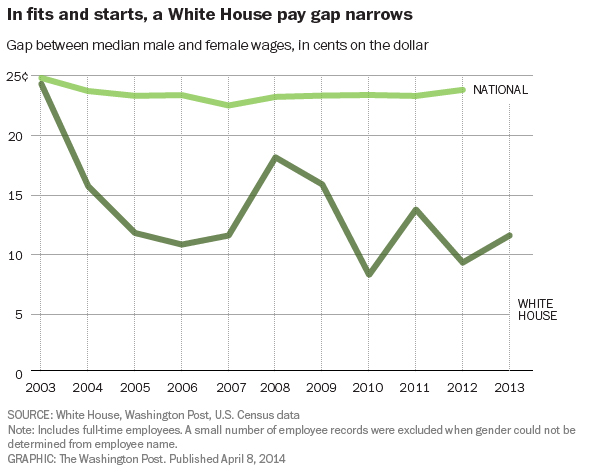
white-house-wage-gapIs the gender gap in wages a myth or is it as the President said yesterday just math?  If a company pays, as does the White House and most other government agencies, equally for the same job, why is there still a gap in total pay?  Is that as Christina Hoff Summers would argue, not a wage gap since the cause is that women are in different job?  Christopher Ingraham wrote in the Washington Post

The American Enterprise Institute caught the White House flat-footed yesterday with its finding that female White House workers earned roughly 88 cents to the dollar compared to male employees. This came the day before two high-profile executive orders aimed at narrowing the gender wage gap among federal contractors.

When asked about the discrepancy by reporters, spokesman Jay Carney said that those figures are based on the total of all staff jobs, and that women tend to fill more lower-paying positions than men. When you break it out by position, “men and women in equivalent roles here earn equivalent salaries,” Carney said. Incidentally, this is the pretty much the same argument that AEI scholar Christina Hoff Summers makes to argue that the gender wage gap is a myth.

Human Resource people (of which I was once one) would say it is all about classifying jobs.  There is an endless debate about what jobs require more skills, more effort, more responsibility.  Is the woman who comes to help your sick mother as a home health aide worth less than the man who manages the local convenience store? (Neither gets paid very well.)  Is a pre-school teacher worth less than the CEO of Facebook?  Ok.  I can hear people saying that I’m comparing apples and oranges, but these are the kind of things we need to consider as we look at not only the gender issues but also at low wage jobs generally.  If you look at the Washington Post chart, you can see that the national wage gap is pretty constant, but the general trend of the White House gap is down.

There are really several problems at work here.  First is the failure to pay women an equivalent wage for the same work done by a man.  This may be deliberate or the women may simply be given a different job title and classification.  The second is what the Institute for Women’s Policy Research calls occupational segregation.

Pay equity may also be impacted by other more subtle factors than workplace discrimination. IWPR’s research shows that, irrespective of the level of qualification, jobs predominantly done by women pay less on average than jobs predominantly done by men. Women have made tremendous strides during the last few decades by moving into jobs and occupations previously done almost exclusively by men, yet during the last decade there has been very little further progress in the gender integration of work. This persistent occupational segregation is a significant contributor to the lack of significant progress in closing the wage gap.

The third problem is one that speaks mainly to women in the private sector at high levels:  Women appear to be less willing to ask for more in salary negotiations.  While this is unimportant and insignificant, more women are hurt by the first two problems.

In the late 1970s I was working as a research analyst for the Virginia State Equal Opportunity Office.  We got a complaint from a woman professor at a state college who suspected that she was being paid less than a male colleague who started around the same time as she did.  They were, I think, both coming up for tenure.  This was the age before editable spreadsheets were common, but I managed to make a chart showing hire dates, educational levels, teaching load and teaching evaluations among other factors I can’t remember now for that department.  When laid out, it became very clear that the women, including the complainant were being paid less.  This set off a request for an analysis of the entire school as well as requests from several other state colleges and universities.  I ended up teaching people from the schools how to do this themselves since there was no way I could tackle such a large project on my own.  Problems were corrected, but I don’t recall that we ever compared  salary levels at the Department of Physics (probably mostly men) to the School of Nursing (mostly women).

I tell this story for two reasons.  One, the problem and issue has been around a long, long, time.  And second, I think we need to look harder at occupational segregation and, if we can’t totally solve that, we need to look at how we, as a society, value what we call “women’s work.”  In the end, that is the only way to cure the pay equity problem.


Death of an angry, unhappy man

I know that many were happy with the news of Fred Phelps’ death but when I first heard, I wasn’t quite sure how I felt.  On one hand, a man who protested at the funerals of men and women who died in combat would no longer be able to do so.  On the other, one could feel sorry for a man who could never get over his anger.  He was once a noted civil rights lawyer in Kansas  and won an award from the local NAACP, but even back then there were signs he was troubled.  The obituary in the New York Times notes

He earned a law degree in 1964 from Washburn University School of Law in Topeka, but his legal career was troubled from the start. According to the Southern Poverty Law Center, which describes Westboro Baptist as “arguably the most obnoxious and rabid hate group in America,” Mr. Phelps struggled to find people to attest to his good character when he wanted to be admitted to the bar, was temporarily suspended for professional misconduct, and was even sued for failing to pay for candy his children sold door to door.

He succeeded in winning settlements in discrimination cases he filed as a civil rights lawyer.

“Most blacks — that’s who they went to,” the Rev. Ben Scott, president of the N.A.A.C.P.’s Topeka branch, said in an interview with CNN in 2010. “I don’t know if he was cheaper or if he had that stick-to-it-ness, but Fred didn’t lose many back then.”

Mr. Phelps, with his wife, Margie M. Phelps, left, and daughter Margie J. Phelps, at a demonstration in Baltimore in 2007.

Mr. Phelps, with his wife, Margie M. Phelps, left, and daughter Margie J. Phelps, at a demonstration in Baltimore in 2007.

Phelps was disbarred in 1979.  While he has said that his anti gay crusade began because a grandson was propositioned he showed a predilection for child abuse.  Amy Davidson writes in the New Yorker piece titled “The Two Freds” about Fred Rogers and Fred Phelps

One unpleasant thing about Fred Phelps was the way in which he and his church members brought children to their protests and had them hold placards like the ones that Roberts quoted, and repeat slogans slurring gay people and praising divine killings. They tended to be Phelps’s own children or grandchildren—how else would you find an eight-year-old to damn Mr. Rogers?—and the bulk of his parishioners were his relatives. The obituaries refer to complicated loyalties and estrangements, but then, those of some very good people do, too. But one can see, in the hanging of hateful signs on children, the very opposite of Fred Rogers’s life’s project, which was to treat young people both morally and as serious moral actors. Mr. Rogers spoke of the intense drama of one’s earliest years, Supreme Court cases or no, and the way that friendship, above all, was orienting. Of the two Freds, he’s the one who endures. Phelps, and all his vitriol, will spin away.

Phelps and his congregation at Westboro Baptist Church (composed primarily, if not entirely of family) demonstrated everywhere.  They spread Phelps angry message at thousands of funerals of the well known and of ordinary people as well as at many events.  Phelps represented an angry God.  The New York Time obituary again

In 1998, he explained his view of a wrathful God in an interview with The Houston Chronicle.

“You can’t believe the Bible without believing that God hates people,” he said. “It’s pure nonsense to say that God loves the sinner but hates the sin. He hates the sin, and he hates the sinner. He sends them to hell. Do you think he loves the people in hell?”

So in the end, I feel sorry for a man filled with so much hate and anger.  I hope he can find peace in another life.

Photograph:  Jed Kirschbaum/Baltimore Sun, via Associated Press

St. Patrick’s Day 2014

I’m not quite sure I understand the whole controversy about openly gay persons marching in a St. Patrick’s Day parade.  The parade is just a celebration of heritage and the Irish are just as diverse as any other group.  Boston’s old Mayor, Tom Menino, simply didn’t march in the South Boston parade because of the restriction, upheld by a Supreme Court decision, that the parade organizers could choose who they wanted to march.  But new Boston Mayor Marty Walsh is, along with U. S. Representative Stephen Lynch, doing his best to broker a compromise that would allow Mass Equality to march with a banner.  I think the parade organizers that include a fellow called Wacko Hurley fear that their parade would turn into another gay pride march if they let any LGBT groups march.  Presumably, the LGBT community knows the difference: March is not June.  Plus, there is a picture from the 1992 parade, pre-Supreme Court decision,  that shows there is nothing to fear.

The parade is only a couple of days away, and Mayor Walsh is making one last try.  Most Boston and Massachusetts state-wide elected officials have already announced they are not going to march.  I think the only exception is Nick Collins, the State Representative from South Boston.

The 1992 South Boston parade after a court order.

The 1992 South Boston parade after a court order.

Kevin Cullen has a wonderful column in today’s Boston Globe about the Boston and New York City parades.

So Marty Walsh, God love ’im, is going to make one last-ditch effort to hammer out a compromise so gay people can march openly in Sunday’s parade in Southie.

As they say in the Irish-speaking Gaeltacht, from where Marty’s parents are from, “Beir bua agus beannacht.” Look it up.

Down here in New York, where its St. Patrick’s Day parade is older than the Declaration of Independence and lasts anywhere from six to seven hours, there’s the same standoff, with organizers refusing to let gay people march with banners that identify themselves as gay.

Mayor Bill de Blasio, as the Irish say, couldn’t be arsed when it comes to forging compromise. He boycotted the parade when he was the city’s public advocate. He’s not going to start marching now.

De Blasio’s predecessor, Michael Bloomberg, of the Medford [MA] Bloombergs, marched in the parade but de Blasio is about as different from Bloomberg as the Irish are from Irish-Americans.

De Blasio, who grew up in Cambridge, is married to a black woman and has biracial kids, so he’s not really into exclusion. But neither is he into cozying up to the New York Irish, who were in the corner of de Blasio’s primary opponent, Christine Quinn, who was the city council president.

The irony in this — and it wouldn’t be Irish if there weren’t irony — is that Quinn is openly gay. Which means, even when she led the city council delegation in the parade she wasn’t allowed to identify herself as being gay.

So the New York Irish wanted to elect an openly gay mayor but wouldn’t let her march in the parade as openly gay.

And people in New York think we’re nuts?

Mayor Walsh, on the other hand, had support from both the gay community and South Boston so he’s kinda caught in the middle.  But he has said that if he can’t work a compromise, he won’t march.

Linda Dorcena Forry

Linda Dorcena Forry

Boston also has this breakfast before the parade.  Politicians come and roast each other and try to sing Irish songs.  Last May I wrote about South Boston and the election of Linda Dorcena Forry.  I predicted that she would bring some life back to the St. Patrick’s Day Breakfast.  Dorcena Forry is Hatian American married to an Irish man.  The City Councilor from South Boston tried to wrest control, but tradition prevailed:  The State Senator who represents Southie hosts the breakfast.  So Bill Linehan is taking his ball and going to Ireland for the day.  I hope he realizes that this will make him the butt of a lot of jokes.  Whatever.Linda is doing her best to live up to my prediction.  First she announced that the Dropkick Murphy’s, Boston’s very popular Irish punk group, would perform.  Then the Boston Globe had news today of  her most recent announcement about the breakfast.

State Senator Linda Dorcena Forry’s groundbreaking debut as the first woman, first Haitian-American, and first Dorchester resident to host the storied St. Patrick’s Day breakfast on Sunday is apparently drawing some international attention.

Dorcena Forry announced Thursday that Enda Kenny — Ireland’s prime minister, or taoiseach — has agreed to attend the ribald political roast in South Boston.

The visit by a sitting head of state is a coup for Dorcena Forry, who promised to raise the profile of a breakfast that in recent years seemed to have lost some of its star power.

“I am honored that Taoiseach Kenny will join us for this year’s breakfast,” Dorcena Forry said. “I have had the pleasure of meeting the taoiseach during his previous visits to Boston. His attendance at the breakfast is a wonderful affirmation of the deep bonds of friendship between Boston and Ireland.”

No word on whether President Obama will be appearing either on tape or by live feed, but I wouldn’t be surprised.  The Prime Minister is not marching in the parade.

The times are rapidly changing.  Boston Beer Company (think Sam Adams) just announced they have pulled their parade sponsorship.  Wacko and his veterans group are doing a great job of killing the parade.  Meanwhile, the breakfast thrives.  Is there a lesson here?

Photograph of GLIB marching:  Marilyn Humphries

Anita Hill and Sandra Fluke: Does 20 years really make a difference?

Tonight while I was surfing around looking for updates on the Malaysian jet still missing somewhere between Malaysia and Vietnam – or perhaps somewhere else – I happened upon a long story in the New York Times about the new documentary about Anita Hill.  Sheryl Gay Stolberg’s review of the movie is actually a long profile of Hill.  I’m very happy that Hill allowed the documentary to be made because it means that a whole new generation of young men and women will be introduced to a remarkable person.

Back then there was no social media, no Facebook, no Twitter but the word still spread quickly among women that someone was about to accuse a nominee for the United States Supreme Court of sexual harassment.  No one knew exactly who she was, but we knew this was going to be important.  I was in Washington, D.C. that day at a meeting, but I remember sitting in a bar that afternoon with several other women all of us transfixed by what was happening on the television.  I was astounded that none of the men, and the Judiciary Committee was all white men, had any clue.  Stolberg puts it this way

“I think this event changed the course of her life and gave her a public mission that she took on,” said Fred Lawrence, the Brandeis president and a Yale Law School classmate of Ms. Hill’s. “It’s not a duty that she volunteered for, but I think she understood that the circumstances had put her in a unique role, and gave her a voice.”

The hearings were a surreal spectacle, as senators prodded an obviously uncomfortable Ms. Hill through awkward testimony about penis size, pubic hair and a pornographic film star known as Long Dong Silver — shocking public discourse at the time. When the hearings ended, Ms. Hill returned to teaching commercial law at the University of Oklahoma, trying, as she says in the film, to find “a new normal.” It proved difficult.

Ms. Hill at the hearings.

Ms. Hill at the hearings.

And I think every women who watched the hearings remembers that electric blue suit.

There were thousands of letters of support, but also death threats, threats to her job. Conservative state lawmakers wanted her fired; fortunately, she had tenure. Even years later, she felt “a discomfort,” she said. One dean confided that he had tired of hearing colleagues at other schools remark, “Isn’t that where Anita Hill is?”

In Washington, her testimony reverberated. Sexual harassment claims shot up. “Our phones were ringing off the hook with people willing to come forward who had been suffering in silence,” said Marcia D. Greenberger, founder and co-president of the National Women’s Law Center in Washington, where Ms. Hill serves on its board.

Congress passed a law allowing victims of sex discrimination to sue for damages, just as victims of racial discrimination could. Waves of women began seeking public office. In 1991, there were two female senators. Today there are 20.

Clarence Thomas was confirmed even though, as Hill puts it

“I believe in my heart that he shouldn’t have been confirmed,” she said in a recent interview, acknowledging that it irritates her to see Justice Thomas on the court. “I believe that the information I provided was clear, it was verifiable, it was confirmed by contemporaneous witnesses that I had talked with. And I think what people don’t understand is that it does go to his ability to be a fair and impartial judge.”

And there are still those who believe she made the whole story up. Then I started thinking about a more recent woman’s experience with Congress. This is from a story in the Daily Beast.

Rep. Darrell Issa’s Thursday hearing went off the rails early. “What I want to know,” demanded Rep. Carolyn Maloney, D-NY, as she looked at the all-male panel of clerics before her, “is, where are the women?”

The hearing, titled “Lines Crossed: Separation of Church and State. Has the Obama Administration Trampled on Freedom of Religion and Freedom of Conscience,” was about religious freedom, Issa said, but it took place against the backdrop of a national controversy regarding the White House’s mandate that all employers provide birth control as part of their insurance plans.

As it happens, there was one woman present prepared to testify on the issue of birth control. Sandra Fluke, a 30-year-old Georgetown University Law School student, had been contacted earlier in the week by committee minority leaders after Democrats saw a video of her speaking about the mandate at the National Press Club on February 9.

Sandra Fluke

Sandra Fluke

Congress had a woman to ask the question, but the panel was all men.  Fluke went on to testify at an informal hearing arranged by Democratic women.  The Huffington Post described it this way

This week she received almost rock-star treatment as the lone witness at an unofficial Democratic-sponsored hearing. While the rest of the Capitol was mostly empty, Democratic leader Nancy Pelosi, three other Democrats and dozens of mainly young women supporters crowded into a House office building room to applaud Fluke as she spoke of the importance of reproductive health care to women.

Prominently displayed by Rep. Carolyn Maloney, D-N.Y., was a photo of five religious leaders, all men and all appearing at the invitation of the Republican majority, testifying last week with Fluke visible in the background, sitting in the visitors’ section.

Democrats pounced on that image of a hearing discussing contraceptive rights being dominated by men while the one person Democrats had asked to appear on the witness stand, a woman, was turned away. Pelosi, D-Calif., said they had since heard from 300,000 people urging that women’s voices be heard on the issue.

“We almost ought to thank the chairman for the lack of judgment he had,” in denying a seat to Fluke, Pelosi said.

Committee chairman Darrell Issa, R-Calif., had said at last week’s hearing that the panel’s focus was on whether the administration policy was a violation of religious freedom. He said at the time that Fluke, invited by Democrats in her capacity as former head of Georgetown Law Students for Reproductive Justice, was not qualified to speak on the religious rights question.

“I’m an American woman who uses contraceptives,” Fluke said, when asked Thursday by Rep. Elijah Cummings, D-Md., about her qualifications to speak on the issue.

So maybe we have made progress in the years since Anita Hill.  Some Republican men don’t seemed to have learned much, but there were plenty of woman and men in Congress who wanted to hear Fluke’s testimony.  And we can thank Anita Hill for her part in making change happen.

Photograph of Anita Hill: American Film Foundation

Photograph of Sandra Fluke:  Getty Images

Daily Beast story: Matthew DeLucca

Huffington Post story: Jim Abrams

Women, gun violence, and domestic violence

According to the op-ed by Nicolas Kristof in last Sunday’s New York Times Review,

Sometimes there’s a perception that domestic violence is insoluble, because it’s such a complex, messy problem with women who are culprits as well as victims. Yet, in fact, this is an area where the United States has seen enormous progress.

Based on victimization surveys, it seems that violence by men against their intimate partners has fallen by almost two-thirds since 1993. Attitudes have changed as well. In 1987, only half of Americans said that it was always wrong for a man to beat his wife with a belt or stick; a decade later, 86 percent said that it was always wrong.

A generation ago, police didn’t typically get involved. “We would say, ‘don’t make us come back, or you’re both going to jail,’ ” recalled Capt. Leonard Dreyer of the DeKalb County Sheriff’s Office. In contrast, sheriff’s officers now routinely arrest the aggressor.

I have to admit that I am skeptical, but hope that his numbers are correct.  Even Kristof opens his column with ” [w]hat strikes one American woman in four and claims a life in the United States every six hours?”  A high profile case such as that of Jared Remy who killed his girlfriend, Jennifer Martel in front of their young daughter confirms that at point at which a woman makes an effort to leave a relationship is the point at which she is most likely to be killed.  Kristof himself recounts this story

American women are twice as likely to suffer domestic violence as breast cancer, and the abuse is particularly shattering because it comes from those we have loved.

“He’s the only person I’ve ever loved,” Ta’Farian, 24, said of her husband, whom she met when she was an 18-year-old college student. He gradually became violent, she says, beating her, locking her up in a closet, and destroying property.

“My family was like, ‘He’s your husband. You can’t leave him. How would you support yourself?’ ”

Still, she says, it became too much, and she called 911. Police arrested him. But she says that the day before the trial, her husband called and threatened to kill her if she testified against him, so she says that out of a mix of fear and love she refused to repeat in court what had happened. Her husband was let off, and she was convicted of false reporting of a crime.

I was still thinking about the Kristof column this morning when I read this front page story in this morning’s Boston Globe on women who buy and hold guns for men.

…As law enforcement agencies and the administration of Mayor Martin J. Walsh ponder ways to get guns off the street, they are learning that targeting the men who historically have been the primary actors in violent crimes is not enough.

They must also disrupt networks of women who buy and hold weapons for men to use.

“We are seeing women with weapons who do not have a direct role in the city’s gun violence,’’ said Jake Wark, spokesman for Suffolk County District Attorney Daniel Conley. “But they are turning up with firearms that are used in that violence.”

Debora Seifert, a special agent with the Bureau of Alcohol,  Tobacco, Firearms and Explosives in Boston, said that she has worked on cases in which women bought firearms for boyfriends who are drug dealers.

Police confiscated a shotgun and ammunition from Arianna Talbert’s Dorchester apartment last year.

“These women can go into a gun shop and buy these guns for a violent criminal,’’ said Seifert. “They can use these weapons to victimize someone in their communities.”

Jahmeilla Tresvant is facing gun charges in two cases. In one, police believe she was holding a gun for her brother

Jahmeilla Tresvant is facing gun charges in two cases. In one, police believe she was holding a gun for her brother

These guns are often hidden in apartments rented by the women and their discovery can result in eviction.

While research is scant on women’s involvement in the gun problem, studies have been clear about who is leading violence by firearms, said David Hemenway, a professor of public health at Harvard School of Public Health.

Men and teenage boys drive gun crime either as victims or perpetrators. If a woman buys a gun, Hemenway added, she is more likely to be buying it for someone who cannot legally buy a gun.

“These young females find themselves facing jail time for holding that gun,’’ said Evans [Boston Police Commissioner William Evans] in a statement.

The mindset that let Ta’Farian stay with her abusive husband is the same one that causes the young women to buy and hold guns.

In the war on illegal guns, Ruth Rollins has heard it all. She’s an advocate for women whose own son was shot and killed. Women have long been flying under radar in police sweeps for illegal guns, she said. And women have become easy prey for criminally-minded men, who are becoming savvy in avoiding arrest for gun possession by having female relatives, partners, or juveniles hold firearms for them.

Women have said they hold the guns for a variety of reasons: to get a few extra dollars, to get drugs, or simply to feel needed. The firearms are sometimes used as community guns stored in a central location, and anyone, from a wayward juvenile to a terrified young man, can have easy access to them.

“It’s no different from years ago when a woman would hold drugs for their men. They would do it for money. They would do it for love,’’ said Rollins. “Now they are holding these guns and they are doing it in the name of love.”

Kim Odom, who lost her 13-year-old son to violence, said some women feel a deep sense of commitment to their men, even the ones wrapped up in crime.

“They are of the mind-set that they are ‘ride-or-die chicks,’ ” Odom said. “These are young ladies who are willing to go all out for their boyfriends.”

This is just another kind of domestic violence.  Maybe more psychological than physical, but still domestic violence.  And like incidents of domestic violence which end either in death or injury to the woman or in which the woman ends up killing her abuser. [And yes, I do know that women can also be abuser, but men  still make up the vast majority.]

Over past year and a half Rollins and Odom have been training and educating women about the consequences of buying and stashing weapons. They urge women to make pledges to not hold or buy guns and warn them of the penalties if caught. For instance, a person who makes a straw purchase faces up to 10 years in prison under federal law, US authorities said.

Their effort, called Operation LIPSTICK, is run through Citizens for Safety, which has enlisted the help of local law enforcement and the mayor to press the issue. On Feb. 25, the group kicked off an ad campaign on the MBTA,  with placards on subway trains  declaring, “His Crime, Your Time — Holding His Gun Can Land You in Jail.”

Perhaps if we used some of the new technology that would prevent anyone but the gun purchaser from firing it, we would be able to cut down on some of the urban gun violence and some young women would be able to stay out of prison.  Massachusetts Senator Edward Markey has proposed a Smart Gun bill.  We should support it.

Photograph:  Dina Rudick/Globe Staff

Globe story:  Meghan E. Irons

The perpetual war on women

I’m baffled.  When a political party loses a large, important demographic in an election, I would think that they would change tactics so the same thing doesn’t happen again.  I’m not saying they necessarily need to give up a favored policy position but certainly they could maybe talk about something different.  They could follow the example of Pope Francis.  The Pope is certainly not going to change the Catholic Church position on abortion or ordination of women, but he doesn’t want those kind of issues to be the focus of Church teaching. I refer, of course, to the Republican Party.

I think that all of them need to go back and take Biology 101 again because starting with Todd Akin, they really don’t know how the reproductive system works.  The latest is from Mike Huckabee.  The Nation has provided the full quote via Yahoo! News.

Here are Huckabee’s comments in full, provided by Yahoo! News’s Chris Moody:

I think it’s time for Republicans to no longer accept listening to Democrats talk about a war on women. Because the fact is, the Republicans don’t have a war on women. They have a war for women. For them to be empowered; to be something other than victims of their gender. Women I know are outraged that Democrats think that women are nothing more than helpless and hopeless creatures whose only goal in life is to have a government provide for them birth control medication. Women I know are smart, educated, intelligent, capable of doing anything anyone else can do. Our party stands for the recognition of the equality of women and the capacity of women. That’s not a war on them, it’s a war for them. And if the Democrats want to insult the women of America by making them believe that they are helpless without Uncle Sugar coming in and providing for them a prescription each month for birth control because they cannot control their libido or their reproductive system without the help of the government, then so be it, let’s take that discussion all across America because women are far more than Democrats have made them to be. And women across America have to stand up and say, Enough of that nonsense.

Maybe he should stick to playing the guitar.

Maybe he should stick to playing the guitar.

While his remarks are somewhat muddy and unclear I think the gist is that the Democrats are paternalistic.  Sorry, Mike, but I think that it is the Republicans who are paternalistic.  They assume that women don’t understand about birth control, abortion, and their own bodies.  Otherwise, why would they need to have a doctor do a vaginal ultrasound and explain to them about fetal development.  But I think that Gail Collins had the best response.

Say what? Basically, Huckabee seems to be telling us that the Republican Party will not insult women by suggesting the federal government should require health insurance policies to include birth control pills in the prescription drug coverage.

He appears confident that women will find that an attractive proposition.

Huckabee was at a meeting of the Republican National Committee that was supposed to be pondering ways to close the gender gap. Instead, he laid bare a fact that the party has always tried desperately to hide — that its anti-abortion agenda is also frequently anti-contraception.

Back in 2011, Mississippi voted down a referendum that would define life as beginning at conception.  One reason it failed was because women came to understand that passage might outlaw certain kinds of contraception.  Women, as Collins points out, believe that the right to control their own reproductive schedules was long since established.  Most women find the idea that this might not be so beyond imagination.

Once upon a time, Republicans took the lead when it came to helping women get access to birth control. Now, the whole party is hostage to an anti-abortion movement that harbors a wide-ranging contempt for sex outside of marriage, combined with a strong streak of opposition to any form of artificial birth control, even for married couples.

“What does that make her? It makes her a slut, right?” Rush Limbaugh said of Sandra Fluke, the law student who was lobbying for inclusion of contraceptives in health care plans. However garbled his language, Huckabee’s control-their-libido harks back to the same mind-set.

This is a super political strategy. Let’s target all the voters who waited until they were married and then practiced the rhythm method.

The Republican party continues to be tone deaf when it comes to women’s health.

And there was no backtracking after the “Uncle Sugar” speech. In fact, Huckabee sent an email to his supporters replaying his remarks. Then he asked for a donation.

Photograph from Wikipedia.

The state rep and domestic violence

He was convicted of two counts of domestic violence resulting from a date – or a hook-up – gone very wrong.  State Representative Carlos Henriquez was sentenced to 2 and a half years and has to serve 6 months.  This happened on January 15 and I’ve been thinking about it ever since.  Much of the debate centers around his sentence since in Massachusetts most first time offenders are told to stay away from the victim and go to a batterer’s program.  Henriquez is planning to appeal.  The Boston Globe reported

State Representative Carlos Henriquez will spend six months in prison after a jury convicted him Wednesday of holding down a woman and punching her in the chest after she refused to have sex with him.

Jurors convicted Henriquez of some of the acts of violence he was accused of, but acquitted him of others.  The lawmaker was found guilty of two counts of assault and battery, but he was acquitted of a charge that he had struck the victim in her face. Jurors also found Henriquez not guilty of witness intimidation and larceny.

Dressed in a dark suit and tie, Henriquez was without expression as Cambridge District Court Judge Michele Hogan said she was sending him to prison in part because of the serious nature of his crime and because of his refusal to accept responsibility for his actions.

“When a woman tells you she doesn’t want to have sex, that means she does not want to have sex,” Hogan said. “You don’t hit her. You don’t punch her. . . . I’m very concerned that you’re not remorseful.”

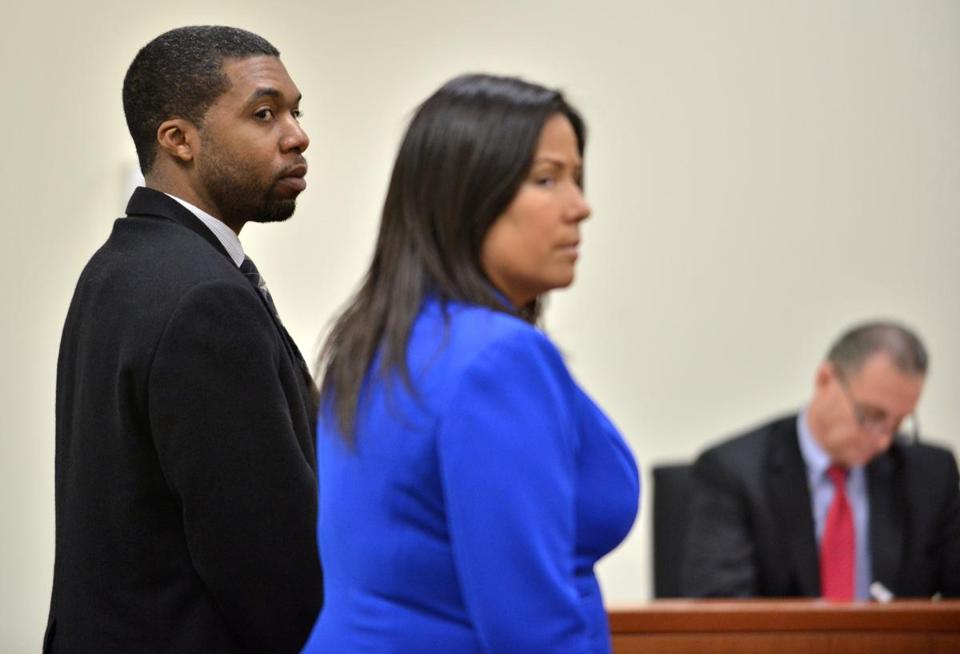
State Representative Carlos Henriquez of Dorchester looked toward the jury Wednesday.

State Representative Carlos Henriquez of Dorchester looked toward the jury Wednesday.

I have to interject here that I worked for Carlos’ mother, Sandi, for a number of years and he occasionally stopped by the office.  She is now a high-ranking official at HUD.  His late father was a community activist and very involved in the Dudley Street Neighborhood Initiative not too far from where we live.  Carlos had a promising career ahead of him but something happened.  The incident for which he was convicted occurred not too long after his father’s death and with his mother mostly in Washington, perhaps he felt adrift.  The family always appeared to be close and he lived in an apartment connected to the family house. But this does not excuse what happened.

A few days after his conviction, Farah Stockman wrote a compelling piece published in the Globe opinion section.

You know your political career is on the rocks when the evidence that is produced in your assault trial is a fake fingernail. Bright pink.

What’s the jury going to think when they see that fingernail, found in the Zipcar you drove when you picked up the 23-year-old college student who accuses you of hitting her after she refused to have sex?

Are those jurors thinking: “A Zipcar! What an ecologically conscious elected official?” Probably not.

You know your reputation as an up-and-coming politician is bound to suffer when the most compelling evidence in your favor is a series of racy messages between you and said college student, sent from your VoteforCarlos e-mail. Katherine Gonsalves picks you out of the crowd at a community meeting, and asks to interview you for a class paper. Days later, she’s asking: “Are you still coming out to play tonight?” You’re a 35-year-old man. You’re Carlos Henriquez, representing the 5th Suffolk district. You’re the son of a well-known political family. A man whose endorsements are sought in mayoral campaigns. But you answer: “For Sure. I hope you are ready.” And you spell it F-O-S-H-O. Then you misspell her name in your phone.

Five months later, she’s begging you to come over. “Babe, I miss you,” she texts. You’re too busy, making the kind of neighborhood appearances that got you elected. Late into the night, she’s still trying to get you to pick her up. She describes partying with her sister and her sister’s friends, drinking. Your response: Send the address if you want to have sex.

Monica Lewinsky, anyone?  Anthony Weiner?  Elliot Spitzer?  Or even worse, Chandra Levy who ended up dead in Rock Creek Park.  Even though someone else was convicted of her murder, suspicion ruined the a California Congressman, Gary Condit with whom she had been having an affair.  Sex and politics are a lethal combination.  Elected officials seem never to learn and in the Henriquez case, there is not only political ruin but jail time.

More from Stockman

You pick her up. You both climb into the backseat of the car. What happens next defines both of you, maybe for the rest of your lives. She tells you she can’t go home with you as she had planned because her mother caught her sneaking out of the house. You complain that she dragged you all the way over here. You argue. She pulls out a cell phone and tells you she’s recording you. Do you struggle over the phone? Steal the SIM card? Do you backhand her, punch her, and choke her — and then climb into the driver’s seat and drive into Boston, without ever giving her a chance to get out of the car?

Or did everything happen differently? We don’t know your side of the story because you never take the stand. All we know is that your defense itself is unflattering: Your lawyer says you only wanted sex, but Gonsalves wanted more, and went “Fatal Attraction’’ when she didn’t get it.

I heard the evidence at the trial and I’m still not sure exactly what happened in the car that night. Justice, at its best, is an approximation. In the end, the jury — five women and three men — had an easier time picturing Carlos Henriquez beating a young woman than that young woman making it up, bruises and all.

Carlos Henriquez is clearly guilty: if not of assault, then of really poor judgment. In court, Gonsalves looked miserable in the witness box. Henriquez looked miserable at the defense table. Once, she stole an awkward glance at him. I felt sorry for them both.

So why sentence him to jail time?  On the surface, the only difference between Henriquez and other men who are convicted of domestic violence and get sent to a batterer’s program is that he is an elected official.  Unfortunately for him, the incident comes on the heels of the Jared Remy case.  Jared Remy was in court for beating up his girlfriend and mother of his child the most recent in a series of incidence with increasing violence.  He was released and, the next day, she was dead.  I think the trial is this summer.  The DA has said that releasing him was an error.

My question is this:  why have men been let off the hook so easily in the first place?  If I am right and the Remy case served as a wake-up call to the criminal justice system, the sentence of Henriquez to jail time was fallout.  When other men are also given jail time, we will know that things are finally changing for the better.

And a final word to Carlos:  Please resign.

Photograph:  Josh Reynolds for The Boston Globe