Jack Lew, Secretary of the Treasury UPDATED

If Jack Lew is confirmed, we have a great thing to look forward to according to Ezra Klein.

The Treasurer signs our money.  This is Lew’s signature.

lew sig

I can’t wait to get my first bills signed by him.

But as Klein cautions

Obviously, that would turn American currency into the best money
ever. Unfortunately  there’s always the chance that Lew could ruin everything by
making his signature less, well, loopy. That’s what the fun destroyer Timothy
Geithner didwhen he became treasury secretary.

We can only hope that Mr. Lew is true to himself and we have great money for the next four years.  Don’t change your signature, Mr. Lew!


UPDATED:

President Obama had this today about his signature

“I had never noticed Jack’s signature” until media coverage of the looping letters on Wednesday, Obama said at the East Room ceremony where he announced his nomination of Lew. “I considered rescinding my offer to appoint him.”

Obama said he’s asked Lew to “make at least one letter legible in order to not debase our currency should he be confirmed as secretary of the Treasury.”


Bipartisan detente

No.  I’m not talking about Congress where even the nomination of  a former Republican Senator to be Secretary of Defense, can’t bring Republicans and Democrats together.  I’m talking about the American Prospect and the American Conservative magazines.

The headline to the short article in the New York Times reads:

Magazines on Left and Right Unite to Share Office Space

The financial crisis did not bring bipartisanship to Congress, but a difficult media environment may have brought that spirit to two political standard-bearers.

In need of cash and with extra space on its hands, the liberal magazine The American Prospect decided to sublet part of its Washington offices. The American Conservative, tired of working from Arlington, Va., was looking for a new location. When the publishers Jay Harris of The Prospect and Wick Allison of The Conservative were getting lunch in August, they put two and two together.

A six-month lease was soon signed. The self-described bastion of “traditional conservatism” moved in with the self-described “liberal, progressive, lefty” on Dec. 27.

It is tough times for magazines who now maintain print and on-line presence.

What they lack in ideological viewpoint, the two nonprofit monthlies make up for in an independent, establishment-bucking mind-set. Each has faced the sort of downsizing that has become all too common in the print world.

The American Conservative, founded in 2002 by Pat Buchanan, ran biweekly before it went out of print for six weeks in 2009 and returned as a monthly magazine. It has a circulation of 8,000. The American Prospect, in print since 1990, announced to its staff in April that if the magazine could not find $500,000 in financing, it would close altogether by the end of May.  With help from good publicity from Prospect alumni and a few large donors — and by shrinking its staff by four — the bimonthly magazine has endured. The publication has combined paid print and digital circulation of nearly 45,000. The Conservative’s seven staff members will share the white-walled, blue-carpeted 12th floor of 1710 Rhode Island Avenue with The Prospect’s fund-raising and advertising departments. They must share a conference room, a potential source of conflict, though Mr. Harris says it could be a site for events the magazines co-host.

Could this be a model of some kind for Congress?  A bipartisan caucus?  Of course, the Senate women already have something like this when they get together, I believe, monthly but then as Susan Collins, a Republican Senator said recently, ” If women were in charge, we wouldn’t be heading at breakneck speed toward the looming ‘fiscal cliff.'”

The hall of fame, drugs, and baseball

The question being asked by many as we wait for the votes to be announced tomorrow is will any one be elected to baseball’s Hall of Fame this year?  I am of two minds about the whole performance enhancing drug business.  Should we be looking at records before and after and, if the before record is Hall worthy go ahead and elect them?  Or should drug use be a total disqualifier?  And what of people we suspect but have never been caught?

I have seen detailed analyses of the records of Barry Bonds, Sammy Sosa and Roger Clemens.  I think they were so caught up in the idea of being ball players they did what they thought they had to to prolong their careers – at least that is true of Roger.  Should they not get into the Hall because they were stupid and lacked character?  The first person elected was Ty Cobb with his reputation for dirty play and racism.

Back in December, Bob Ryan wrote in the Boston Globe

I am in possession of the toxic ballot.

It is the Hall of Fame ballot voting members of the Baseball Writers Association of America (BBWAA) have dreaded for the last five years. Our feet are finally being held to the bonfire. How will we as a body judge the candidacy of the all-time home run leader, the only man to win seven Cy Young Awards, and a man with 609 career home runs who is the only person to homer 60 times or more in three seasons?

Absent, shall we say, a complicating factor, Barry Bonds, Roger Clemens, and Sammy Sosa would be ultra-mortal locks. Based on the numbers, there wouldn’t be the slightest hesitation in checking the box next to their names.

For years I have been saying, publicly and privately, that some day I may wake up and decide that all this agonizing over how to judge admitted or strongly suspected PED users is fruitless, that there was a period of time in baseball’s recent history when juiced pitchers threw to juiced batters and we will never know how many PED-aided home runs would have landed on the warning track or how many fewer strikeouts someone would have had if the people in question had been clean. I might acknowledge that it is an impossible task to act as judge and jury, that I should simply let them all in and not worry about the ethical question posed by the use of PEDs in athletic competition.

I, for one, just can’t do it. Some day, maybe. Or maybe not. I’ve got 15 years to decide what to do with the Toxic Trio.

I know this much: They’re not getting in, at least not this year. Steroid-tinged Mark McGwire­ has had six chances and he’s actually going backward, peaking with 23.7 percent of the vote (75 percent is needed for election) in 2010. Last year, he slipped to 19.5. Admitted user Rafael Palmeiro, he of the 3,020 hits and 569 home runs, got 11 percent of the vote two years ago and 12.6 last year. There will be no need for either to prepare an acceptance speech.

But we’re all curious to see what the vote will be. I’m betting that Bonds and Clemens will come up with something between 40 and 50 percent of the vote, while Sosa will be lucky to crack double figures.

Ryan believes that no one will be elected this year, a opinion echoed by Tyler Kepner of the New York Times.  Kepner points out that a player needs 75% of the ballots which even in year untainted by PED’s is hard.

Historically, this has not been easy. In 1971, when Yogi Berra made his debut on the ballot, he collected only two-thirds of the vote. That’s right — 118 of 360 writers did not vote for Berra as soon as they had the chance. Fifteen players on that 1971 ballot eventually made it to Cooperstown, but that year, the voters could not reach a three-quarters consensus on any of them.

Since then, only one other writers’ ballot has produced no new inductees. That was in 1996, when Phil Niekro, Tony Perez and Don Sutton got more than 60 percent but less than 75. They and three others from that ballot — Ron Santo, Jim Rice and Bruce Sutter — eventually elbowed through the crowd and into the Hall.

So who else is on the ballot?  One of my all time favorites, Dale Murphy.  I first saw him play for the Richmond Braves when he was a catcher.  Bob Ryan writes

This is it for Murphy, Year 15. His son, Chad, has created a petition and has bombarded voters with e-mails. Murphy is a rare back-to-back MVP (1982-83) with 398 career homers. He made an admirable transition from catcher to five-time Gold Glove center fielder. But he has never passed the Hall of Fame I-know-one-when-I-see-one Smell Test, his vote percentage ranging from a low of 8.5 in Year 6 to last year’s high of 14.5. It’s not going to happen.

Curt Shilling is also on there.  When I can put aside my distaste for his politics and for his hypocrisy – belief in smaller government while seeking lots of government economic development money from Massachusetts and then getting it from Rhode Island – he could pitch and if I had a vote would check him off.

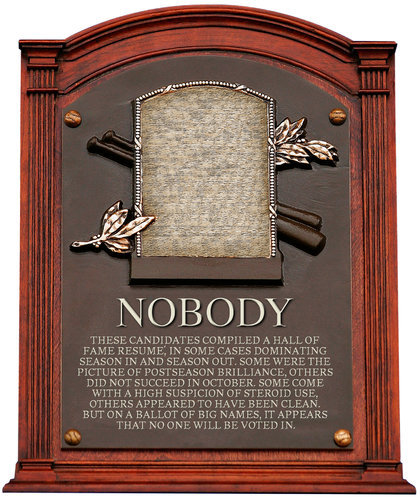
But it is likely that no one will break th 75% barrier and the plaque will look like this.

We will find out tomorrow.

Illustration by Sam Manchester/The New York Times

I had been thinking about a post on the deficit, but then “The Fifth” did the work for me. Thanks, Kstreet607.

kstreet607's avatarThe Fifth Column

The Huffington Post

1.   The Deficit Has Grown Mostly Because Of The Recession

The deficit has ballooned not because of specific spending measures, but because of the recessionThe deficit more than doubled between 2008 and 2009, as the economy was in free fall, since laid-off workers paid less in taxes and needed more benefits. The deficit then shrank in 2010 and 2011.

2.   The Stimulus Cost Much Less Than Bush’s Wars, Tax Cuts

Republicans frequently have blamed the $787 billion stimulus for the national debt, but, when all government spending is taken into account, the stimulus frankly wasn’t that big. In contrast, the U.S. will have spent nearly $4 trillion on wars in the Middle East by the time those conflicts end, according to a recent report by Brown University.  The Bush tax cuts have cost nearly $1.3 trillionover 10 years.

 3.   The…

View original post 474 more words

Elizabeth Warren, United States Senator

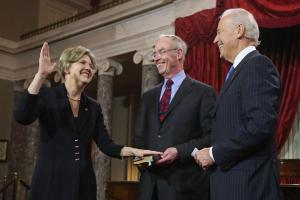
The day we’ve been waiting for.  This picture is from one of her three swearing-ins.  All the Senators get sworn in together and then they get sworn in individually by Vice President, Joe Biden.  Her third, which I plan to attend will be here in Boston, just down the street from me, on Saturday.  Justice Elena Kagan will do the honors.

Elizabeth Warren being sworn in by Vice President Joe Biden

Elizabeth Warren being sworn in by Vice President Joe Biden

The Boston Globe reports

Elizabeth Warren arrived at the Capitol on Thursday morning carrying a black L.L. Bean backpack in the manner of a student in one of her former Harvard classes. Inside was her treasured, tattered King James Bible, used since third grade and chosen for her Senate swearing-in.

“I know people come with big fancy family Bibles,” Warren said in an interview before her induction. “Mine’s a little more modest.”

As she waited, the first woman elected to the Senate from Massachusetts mused about the moment.

“This chair, this particular Senate seat, was held by John Quincy Adams, Daniel Webster, [Charles] Sumner — and of course Senator [Edward M.] Kennedy for half a century,” Warren said. “Men of principle, men who fought hard for the people of the Commonwealth of Massachusetts and for this country.”

All of us who worked for her election – and those who didn’t – should wish her well.  She has history to live up to and we know she will join the list as a great Senator.

[And I just realized I forgot to mention Bruce Mann, Warren’s husband, in the caption to the picture.]

Photograph Chip Somadevilla / Getty Images

The Democratic House Women of the 113th Congress

The New York Times Caucus blog has posted this picture.

Female members of the House Democratic caucus posed for a photograph on Thursday on the steps of the Capitol.

This is most of the 61 women of the Democratic House caucus.

Favoring hues of deep reds and blues, they gathered in the chilly January air, waving to old friends and greeting the new. They laughed and joked, cheekily inviting Representative Barney Frank, a departing Democrat from Massachusetts, to hop in the picture. (He politely demurred.) At one point, a young male aide to Nancy Pelosi, the House minority leader, scurried up to grab some of the members’ coats, juggling the fur and wool throw-overs in his left hand while trying to snap iPhone photos with his right.

As latecomers wandered up, the women called for the photographer to wait, pointing out the stragglers.

There will be 20 women in the Senate and 81 in the House – a record.  Debbie Wasserman Schultz is among the missing from the photograph, however.

But Representative Debbie Wasserman Schultz of Florida emerged from the House moments too late, just as the group was dispersing. However, all was not lost; the photographer took some shots of the late arrivals, and the caucus plans to Photoshop them in.

What did we do before Photoshop?  And don’t the women who did make it look wonderful?

Photograph by Mark Wilson/Getty Images

The “old” House votes on the fiscal cliff

David Jarman posted an interesting analysis of the voting on the Senate Bill to dodge the fiscal cliff in which he credits Nancy Pelosi for getting it done.  Here are some of the highlights.

Tuesday’s House vote on the fiscal cliff is one of those rare votes where you don’t get a straight party line vote like most contentious votes, but one where the House shatters into pieces and the winner is the side that reassembles the most fragments. Of course, this time it was Nancy Pelosi who did that, putting together a strange coalition of most of the Dems (minus a few defections on the caucus’s left and right flanks), plus the bulk of the establishmentarian and/or moderate Republicans (including the vote of John Boehner himself, no “moderate” but certainly “establishment”).

On the Republican side, there were 85 yes and 151 no votes (with 5 non-votes, from Ann Marie Buerkle, Dan Burton, Sam Graves, Jerry Lewis, and Ron Paul). That’s too many votes to replicate the entire list, but there was a significant geographic dichotomy here, one that seems to support the larger idea that the GOP is increasingly becoming a regional rump party.

Look at the New York Times map.  They also have the entire roll call at this link.

Map of fiscal cliff votes

Of those 85 yes votes, only 13 were Republicans from the Census-defined “southern” states, and many of those were either ones with ties to leadership (ex-NRCC chairs Tom Cole and Pete Sessions, Appropriations Chair Hal Rogers) or ones with atypical, moderate districts in Florida (Mario Diaz-Balart, Ileana Ros-Lehtinen, Bill Young). Rodney Alexander, Kevin Brady, Howard Coble, Ander Crenshaw, John Sullivan, Mac Thornberry, and Steve Womack, most of whom are also pretty establishment-flavored, round out the list.

And how did the Democrats vote?

On the Democratic side, there were 172 yes and 16 no votes (with 3 non-votes, from Pete Stark, Lynn Woolsey, and John Lewis). Within those 16, though, there seem to be two camps: Xavier Becerra, Earl Blumenauer, Peter DeFazio, Rosa DeLauro, Jim McDermott, Brad Miller, Jim Moran, and Bobby Scott (most of whom are Progressive Caucus members) voting against it from the left, and John Barrow, Jim Cooper, Jim Matheson, Mike McIntyre, Colin Peterson, Kurt Schrader, Adam Smith, and Pete Visclosky (most of whom are Blue Dogs) voting against it from the right.

It may not be that simple, though: DeFazio has in recent years been one of the likeliest members of the Progressive Caucus to stray from the party line (for example, he voted against both the Progressive budget and even the leadership budget last year); it’s increasingly hard to tell if he’s becoming more conservative or if DeFazio, always irascible, has just gotten more willing to dig his heels in on bills that feel like half-measures. Adam Smith, on the other hand, has generally been a New Democrat establishment-type player, but he might be looking to remake himself a bit with his newly configured, much more liberal district, which now contains a slice of Seattle. And Moran and Visclosky, even though Moran (who represents northern Virginia) is significantly more liberal than Visclosky, are probably coming from the same mindset, whatever that might be; they’re tight, and are some of the last remaining members of that John Murtha/Norm Dicks appropriations clique that didn’t really fit within any of the Dem caucuses.

Jarman doesn’t talk about Bobby Scott and John Lewis but both are in the Black Caucus as well as in the Progressive Caucus.  Lewis just didn’t vote, but Bobby (who I knew from back in my Virginia Days) represents a district that touches Eric Cantor’s and he might also have had the conservative white voter from his district in mind.

Jarman leaves us with this to think about

Fifteen of the GOP “yes” votes were members who, either because of defeat or retirement, won’t be coming back (Charlie Bass, Judy Biggert, Brian Bilbray, Mary Bono Mack, Bob Dold, David Dreier, Jo Ann Emerson, Elton Gallegly, Nan Hayworth, Tim Johnson, Steve LaTourette, Dan Lungren, Todd Platts, John Sullivan, and Bob Turner). Twenty end-of-the-liners, however, voted “no” (Sandy Adams, Todd Akin, Steve Austria, Rick Berg, Quico Canseco, Chip Cravaack, Jeff Flake, Frank Guinta, Connie Mack, Sue Myrick, Mike Pence, Ben Quayle, Denny Rehberg, David Rivera, Bobby Schilling, Jean Schmidt, Tim Scott, Cliff Stearns, Joe Walsh, and Allen West), though I suspect some of the more establishment-flavored names on that list would probably have been willing to offer a “yes” if the vote had looked closer than it actually was.

Tomorrow starts a new Congress so we can’t really look to this vote when we are reading the tea leaves about the upcoming fight on the debt ceiling and the budget.  There will be more Democrats – enough so Nancy Pelosi won’t need so many Republican votes (I think it may be 21, 17 with vacancies) – if John Boehner can be persuaded to bring things to the floor.

Beate Sirota Gordon and women’s rights in Japan

After the surrender of Japan at the end of the Second World War, General Douglas MacArthur was placed in command of the U.S. Occupation forces and the rebuilding of Japan.  Part of the rebuilding was to write a Constitution.  On his staff was a young 22 year old woman, Beate Sirota.  Sirota was the only woman assigned to the group to write the draft.  And as the only woman, she was assigned the sections dealing with women’s rights, sections responsible for the modern role of women in Japan today.  Beate Sirota Gordon died on Sunday at 89.  Her obituary was in today’s New York Times.  Her story is fascinating.

The daughter of Leo Sirota and the former Augustine Horenstein, Beate (pronounced bay-AH-tay) Sirota was born on Oct. 25, 1923, in Vienna, where her parents had settled.

When she was 5, her father was invited to teach at the Imperial Academy of Music in Tokyo, and the family moved there for a planned six-month stay. Mr. Sirota soon became revered in Japan as a performer and teacher, and they wound up living in Tokyo for more than a decade.

Beate was educated at a German school in Tokyo and, from the mid-1930s on, after the school became far too Nazified for her parents’ liking, at the American School in Japan. In 1939, shortly before her 16th birthday, she left for Mills College in Oakland, Calif. Her parents remained in Japan.

In December 1941, after the attack on Pearl Harbor, it became impossible to contact Japan. Beate had no word from her parents, and no money.

Sirota used her considerable language skills to get work listening to Japanese radio while completing work on her degree at Mills.  She did not know if her parents were alive.

For American civilians, travel to Japan was all but impossible. She went to Washington, where she secured a job as an interpreter on General MacArthur’s staff. Arriving in a devastated Tokyo on Christmas Eve 1945, she went immediately to her family’s house. Where it had stood was only a single charred pillar.

She eventually found her parents, who had been interned in the countryside and were malnourished. She took them to Tokyo, where she nursed them while continuing her work for General MacArthur.

She was assigned to the committee drafting the Constitution.

She had seen women’s lives firsthand during the 10 years she lived in Japan, and urgently wanted to improve their status.

“Japanese women were historically treated like chattel; they were property to be bought and sold on a whim,” Ms. Gordon told The Dallas Morning News in 1999. “Women had no rights whatsoever.”

Commandeering a jeep at the start of that week in February, she visited the libraries in Tokyo that were still standing, borrowing copies of as many different countries’ constitutions as she could. She steeped herself in them and, after seven days of little sleep, wound up drafting two articles of the proposed Japanese Constitution.

The two articles she wrote gave Japanese women rights that American women were not, and are still not Constitutionally guaranteed.

One, Article 14, said in part, “All of the people are equal under the law and there shall be no discrimination in political, economic or social relations because of race, creed, sex, social status or family origin.”

The other, Article 24, gave women protections in areas including “choice of spouse, property rights, inheritance, choice of domicile, divorce and other matters.”

Beate Sirota Gordon in 1947, the year the Japanese Constitution took effect.

It set a basis for a better, a more equal society,” Carol Gluck, a professor of Japanese history at Columbia University, said Monday in a telephone interview. “By just writing those things into the Constitution — our Constitution doesn’t have any of those things — Beate Gordon intervened at a critical moment. And what kind of 22-year-old gets to write a constitution?”

Obviously an extraordinary one.  And as if putting women’s rights into the Japanese Constitution were not enough,  she went on to a career with first the Japan Society and then the Asia Society bring exhibits and performers to the United States.  As a child, I probably saw some of the exhibits and performances for which she was responsible since our family often drove up to New York City to view special exhibits or attend performances (particularly Kabuki).

Ms. Gordon was awarded the Order of the Sacred Treasure, a high honor bestowed by the Japanese government, in 1998. But perhaps the greatest accolade she received came from Japanese women themselves.

“They always want their picture taken with me,” Ms. Gordon told ABC News in 1999. “They always want to shake my hand. They always tell me how grateful they are.”

What life to celebrate!

Looking back at 2012 progressively

2012 was a pretty good year for those of a progressive/liberal political point of view and Winning Progressive has compiled a good summary.  You can read the entire article here, but I’ve pulled out some of my particular favorites – in my own order of significance.

First I have to talk about Mitch McConnell who not only lost his effort to make President Obama a one-termer, but last night voted to increase taxes.  (Although since it happened after we technically went off the cliff  at midnight, he will probably spin it as a decrease.)  I think he an John Boehner were the big losers last year, not Mitt.  Mitt is done with politics, but McConnell and Boehner have to continue to try to herd their Republican members and get re-elected.

President Obama re-elected

So now to some accomplishments.

* President Obama Re-Elected With A More Diverse and Progressive Congress– The November elections saw the re-election of President Obama and the election of four new progressive U.S. Senators – Mazie Hirono (D-HI), Elizabeth Warren (D-MA), Chris Murphy (D-CT), and Tammy Baldwin (D-WI).  In addition, Joe Lieberman (I-CT) is finally leaving the Senate!  On the House side, the Democrats elected in November will be the first major party caucus in US history that is majority female and people of color.  New House progressives will include Alan Grayson (FL-09), Jared Huffman (CA-02), Dan Kildee (MI-05), Ann McLane Kuster (NH-02), Grace Meng (NY-06), Patrick Murphy (FL-18), Rick Nolan (MN-08), Mark Pocan (WI-02), Raul Ruiz (CA-36), Carol Shea-Porter (NH-01), Mark Tacano (CA-41), Hakeem Jeffries (NY-08), and Kyrsten Simena (AZ-09).  On the flip side, tea party conservatives Allen West (FL), Chip Cravaack (MN), Bobby Schilling (IL), Roscoe Bartlett (MD), Ann-Marie Buerkle (NY), Francisco Canseco (TX), and Joe Walsh (IL) were all defeat and, hopefully, will never be heard from politically again.

* LGBT Equality– 2012 was, of course, a banner year for advancing LGBT equality.  For the first time in US history, equality was supported by a majority of voters facing ballot proposals approving marriage equality in Maine, Washington, and Maryland, and refusing to ban equality in Minnesota. The first openly lesbian U.S. Senator, Tammy Baldwin (D-WI) was elected in November as were a record seven openly-gay House members.  President Obama publicly supported marriage equality, and anti-equality forces in Iowa failed in their effort to recall a state Supreme Court justice who declared that state’s ban on marriage equality unconstitutional.  In February, a federal appellate court ruled California’s anti-marriage equality Proposition 8 unconstitutional, and two federal courts in 2012 did the same with the Defense of Marriage Act.

* Health Care Reform – In a decision that surprised many commentators, the U.S. Supreme Court upheld the Patient Protection and Affordable Care Act, aka “ObamaCare.”And while the GOP-controlled House has voted at least 33 times to repeal ObamaCare, President Obama’s re-election in November virtually guarantees that will never occur.   In implementing ObamaCare, the Obama Administration, standing up to strong opposition from conservative religious organizations, finalized rules requiring that contraception be included as a preventive health service that insurance policies must cover with no co-pay.  This will help millions of women afford access to birth control and also save money by reducing unintended pregnancies.

Those are my personal big three.

Yes, there is a lot left to do and a lot that happened that I didn’t particularly think was terrific, but on the first day of a new year, we should celebrate our successes!