Who is really European?

I was reading Paul Krugman’s column in the New York Times this morning and I started thinking.  The Republicans accuse President Obama of trying to make us more like European Socialists, but in reality it is they who want to make us European.  Think about it a minute.

Krugman writes

Last week the European Commission confirmed what everyone suspected: the economies it surveys are shrinking, not growing. It’s not an official recession yet, but the only real question is how deep the downturn will be.

And this downturn is hitting nations that have never recovered from the last recession. For all America’s troubles, its gross domestic product has finally surpassed its pre-crisis peak; Europe’s has not. And some nations are suffering Great Depression-level pain: Greece and Ireland have had double-digit declines in output, Spain has 23 percent unemployment, Britain’s slump has now gone on longer than its slump in the 1930s.

Worse yet, European leaders — and quite a few influential players here — are still wedded to the economic doctrine responsible for this disaster.

What is that doctrine?  Basically you gut the retirement system, layoff workers, cut wages, and increase taxes.  Krugman puts it this way

Specifically, in early 2010 austerity economics — the insistence that governments should slash spending even in the face of high unemployment — became all the rage in European capitals. The doctrine asserted that the direct negative effects of spending cuts on employment would be offset by changes in “confidence,” that savage spending cuts would lead to a surge in consumer and business spending, while nations failing to make such cuts would see capital flight and soaring interest rates. If this sounds to you like something Herbert Hoover might have said, you’re right: It does and he did.

President Herbert Hoover.

Image via Wikipedia


Thomas Wright in a column published in the Financial Times brings in the Republicans.  He points out the while Mitt Romney and Newt Gingrich want to deal immediately with the debt crisis – like the Europeans – Democrats and, in particular the President, believe that the debt is a long term issue and not a near term crisis. 

I’m certainly not an expert, but it does appear that the European Hooverism is being largely driven by Germany.  It will be interesting to see how that works out for them in the long run.  What happens when the Greek economy continues to sink and they decide to pull out of the Euro? 

Back to Krugman again.

Meanwhile, countries that didn’t jump on the austerity train — most notably, Japan and the United States — continue to have very low borrowing costs, defying the dire predictions of fiscal hawks.

So what will it take to convince the Pain Caucus, the people on both sides of the Atlantic who insist that we can cut our way to prosperity, that they are wrong?

After all, the usual suspects were quick to pronounce the idea of fiscal stimulus dead for all time after President Obama’s efforts failed to produce a quick fall in unemployment — even though many economists warned in advance that the stimulus was too small. Yet as far as I can tell, austerity is still considered responsible and necessary despite its catastrophic failure in practice.

The big question:  Will the Congress pass the President’s new jobs bill?  Or will it stick to slash, slash, slash?  Increasing aid to local governments for police, fire, schools and programs like the Community Development Block Grant (CDBG) will prevent layoffs and enable hiring.  Take CDBG  for example.  The City of Boston uses the funds to assist human services programs like afterschool and youth recreation, to assist small businesses and nonprofits make repairs and improvements, and help low income homeowners make repairs.  There are rules about who can get assistance.  Jobs are ceated when the business or nonprofit hires staff or a contractor to make repairs and improvements.  Assistance to homeowners also creates jobs.  Many other localities use CDBG to improve roads and sidewalks.  I think everyone understand how keeping teachers, police, and firefighters employed helps local governments.  It also increases the tax base for all levels of government and will eventually help lower the debt.  Or am I being too simplistic?

Krugman ends this way

Look, I understand why influential people are reluctant to admit that policy ideas they thought reflected deep wisdom actually amounted to utter, destructive folly. But it’s time to put delusional beliefs about the virtues of austerity in a depressed economy behind us.

So it seems that it is really the Republicans who are more European with their belief in continued austerity.  They need to look around and see what is happening in Europe and decide if they – and us – really want to be like them or continue to pursue the President’s American exceptionalism.


The “gang of six” plan and the debt ceiling

In case you are wondering what it is, the New York Times has published a summary.  It is really a budget and deficit reduction plan and not something to raise the debt ceiling which still has to be done.  And time is running out.

A couple of interesting comments about the plan on Politico’s Arena.

First from Jeff Smith, professor at the New School and former Missouri State Senator:

The one real piece missing from this entire conversation? The piece that would make the numbers work and dramatically reduce the pain?

Comprehensive immigration reform. That’s right. There’s only one pool of 15 million people begging to be able to pay more into the system, and this country has spent the last several years fighting to make sure they can’t.

We need to get over our xenophobia, give them a path to citizenship, and let them start paying in to the system at regular rates in regular intervals. The nation’s immigrant population tilts much younger than the native-born population and is predominantly in the workforce, and would reverse the trend of a rising retiree-to-worker ratio, thereby shoring up both major entitlement programs

The immigrants would pay taxes, pay into social security, and Medicare.

Bernie Sanders (D-VT) points out

While the spending cuts for programs that working people desperately depend upon are enforced by specific spending caps, there is no such enforcement or clarity regarding the $1.1 trillion to be raised in revenue over 10 years.

What happens if that revenue target is not reached? There is no language that deals with that. Where does the revenue come from? That very important issue is kicked to the tax writing committees with no guarantee that hundreds of billions of dollars in new revenue will not come from the pockets of low- and moderate-income Americans. While nobody knows for certain what provisions might be adopted, there is reason to expect that some of the areas that the House and Senate will be looking at include the home mortgage deduction for middle-class families, taxes on health care benefits, and increased taxes on retirement programs such as 401(k)s and IRAs. In other words, while there is a reasonable degree of specificity in terms of cuts there is only vagueness in terms of revenue.

But Dean Baker from the Center for Economic and Policy Research asks the questions I’ve been wondering about:  What is wrong with the deficit at a time when we have no jobs and isn’t there a solution besides massive budget cutting?

The arithmetic is clear as day. The United States does not now, nor will it in the near future, face a serious problem meeting its debt obligations. It had a debt to GDP ratio of 116 percent after World War II. The baseline projections have it getting to 90 percent by 2021. 116 percent is much larger than 90 percent. (The difference will be more than $5 trillion in 2021.) This should be understandable even to a 6-figure Washington policy wonk or budget reporter.

Other countries had and have much higher ratios of debt to GDP and still face no problem paying their bills. In Japan, the ratio of debt to GDP is more than 220 percent, yet private investors are willing to lend the country money long-term at interest rates of less than 1.5 percent. Of course investors are also willing to put their money on the line in the U.S., lending us money long-term at interest rates close to 3.0 percent. So the people who actually have money on the line are saying as clearly as they can that the debt is not a serious problem.

Furthermore, there are many ways to deal with the debt that do not require attacking ordinary workers, who have been the victims of Wall Street greed and economic mismanagement by the deficit hawks. (People like Kent Conrad held positions of responsibility in the years of the build-up of the housing bubble, but were so utterly incompetent they either did not see it or recognize its danger.)

We could just have the Fed hold $3 trillion in government debt indefinitely. It would then refund more than $1 trillion in interest payments to the Treasury over the next decade. The inflationary impact of the additional reserves could be offset by raising bank reserve requirements. What could be more simple and costless than this mechanism? But the Gang of Six would rather cut Social Security and Medicare.

We could follow the example of England and impose a financial speculation on trades of stock, futures, options, credit default swaps and other financial instruments. This could raise more than $1. 5 trillion over the next decade. But the Gang of Six would rather cut Social Security and Medicare.

It is my understanding that we didn’t have a debt ceiling until World War I and that no many countries have one so why not do away with our?  Politico had this piece about that from Moody’s a few weeks ago.

The United States should do away with the debt ceiling altogether to bring greater certainty to investors in U.S. Treasury bonds, Moody’s suggested Monday.

With the August 2 deadline for raising the debt ceiling barely more than two weeks away, the bond-rating agency issued a report Monday noting that the U.S. is one of just a few countries that has a statutory borrowing limit and saying that the limit creates “periodic uncertainty” for investors, Reuters reported.

Rather than continuing to use the debt ceiling in an effort to keep U.S. borrowing down, the government should look toward Chile, Moody’s suggested. There, “the level of deficits is constrained by a ‘fiscal rule,’ which means the rise in debt is constrained though not technically limited.” Chile is considered to be Latin America’s most fiscally sound country.

And, the report noted, it’s not like the debt ceiling has been effective in keeping U.S. debt down: Congress has in the past raised it often and has not linked it to spending levels.

So the bottom line is that the Gang of Six plan may be a place to start talking budget and deficit reduction, but we should do something about the debt ceiling first – like abolish it.


Tax breaks and the debt/budget crisis

Feeling hot and kinda pessimistic this evening.  I feel as if the progressive forces are fighting windmills and I worry that President Obama will cave in with dire consequences. 

Here is a very interesting chart posted by Chris Bowers on the Daily Kos this afternoon.

Class Warfare

If these numbers are accurate, and I believe they are,  it is interesting how they match up.  We don’t really have to do much to keep programs running. 

In the meanwhile Politico reports

Turning right with a vengeance, Republicans will bring to the House floor Tuesday a newly revised debt-ceiling bill that is remarkable for its total absence of compromise at this late date, two weeks before the threat of default.

Final revisions made Friday submerge conservative demands to reduce all federal spending to 18 percent of gross domestic product — a target that threatened to split the GOP by requiring far deeper cuts than even the party’s April budget. But Republican congressional leaders still want a 10-year, $1.8 trillion cut from nondefense appropriations and have added a balanced-budget constitutional amendment that so restricts future tax legislation that even President Ronald Reagan might have opposed it in the 1980s.

Indeed, much of the deficit-reduction legislation signed by Reagan would not qualify under the new tea-party-driven standards. And even the famed Reagan-Tip O’Neill Social Security compromise — which raised payroll taxes — passed the House in 1983 well short of the 290 votes that would be required under the constitutional amendments being promoted by the GOP.

One of the more interesting aspects of this fight centers around the battle between Eric Cantor and John Boehner for control of the Republican House.  If Cantor wins, it may drive the more moderate Republicans toward the Democrats.  But it doesn’t appear at this point that the Tea Party Republicans really care about reelection – and perhaps they don’t even care if Obama wins reelection.

House Majority Leader Eric Cantor of Virginia, right, stands with House Speaker John Boehner of Ohio on Capitol Hill in Washington. | AP Photo

Paul Krugman has an interesting take of the Republicans.

Let’s talk for a minute about what Republican leaders are rejecting.

President Obama has made it clear that he’s willing to sign on to a deficit-reduction deal that consists overwhelmingly of spending cuts, and includes draconian cuts in key social programs, up to and including a rise in the age of Medicare eligibility. These are extraordinary concessions. As The Times’s Nate Silver points out, the president has offered deals that are far to the right of what the average American voter prefers — in fact, if anything, they’re a bit to the right of what the average Republican voter prefers!

Yet Republicans are saying no. Indeed, they’re threatening to force a U.S. default, and create an economic crisis, unless they get a completely one-sided deal. And this was entirely predictable.

First of all, the modern G.O.P. fundamentally does not accept the legitimacy of a Democratic presidency — any Democratic presidency. We saw that under Bill Clinton, and we saw it again as soon as Mr. Obama took office.

As a result, Republicans are automatically against anything the president wants, even if they have supported similar proposals in the past. Mitt Romney’s health care plan became a tyrannical assault on American freedom when put in place by that man in the White House. And the same logic applies to the proposed debt deals.

Put it this way: If a Republican president had managed to extract the kind of concessions on Medicare and Social Security that Mr. Obama is offering, it would have been considered a conservative triumph. But when those concessions come attached to minor increases in revenue, and more important, when they come from a Democratic president, the proposals become unacceptable plans to tax the life out of the U.S. economy.

Which brings me to the culpability of those who are only now facing up to the G.O.P.’s craziness.

Here’s the point: those within the G.O.P. who had misgivings about the embrace of tax-cut fanaticism might have made a stronger stand if there had been any indication that such fanaticism came with a price, if outsiders had been willing to condemn those who took irresponsible positions.

But there has been no such price. Mr. Bush squandered the surplus of the late Clinton years, yet prominent pundits pretend that the two parties share equal blame for our debt problems. Paul Ryan, the chairman of the House Budget Committee, proposed a supposed deficit-reduction plan that included huge tax cuts for corporations and the wealthy, then received an award for fiscal responsibility.

So there has been no pressure on the G.O.P. to show any kind of responsibility, or even rationality — and sure enough, it has gone off the deep end. If you’re surprised, that means that you were part of the problem.

It was fun for a while to watch Boehner herding the Republican cats and watching the infighting, but now it is time for moderate Republicans to join the Democrats and show some common sense.


More Budget Talk: The Deficit

After I posted yesterday, I started thinking about the deficit that the Republican’s are always yammering on about.  I found this chart.


This analysis is from the Center on Budget and Policy Priorities based on information from the Congressional Budget Office.

 So even if we don’t stop spending the the Wars, if we end the Bush tax cuts, we could fund all kinds of new stimulus programs (like COPS and education programs) that could help prevent more layoffs in the public sector,  fix medicare and social security and still begin to pay off the debt.  We might even extend umemployment benefits and fund programs to help unemployed homeowners save their property from foreclosure. 

The question for 2012 is how to convince people that the Ryan budget, endorsed by all the Republican candidates and most Republican members of Congress, will actually increase the projected defict by maintaining the tax cuts.

Why the Democrats didn’t have a chance

The Democrats never had a chance at overcoming the non- facts repeated over and over by the Republican-Tea Party coalition.  Tom the Dancing Bug explains.

td101105.gif

If you don’t see Ruben Bolling regularly, check him out.  There is a new one every week.

I find it interesting that, like the infamous Joe the Plumber, Americans worry about what happens to the rich because they may be rich themselves someday.  It is an ingrained part of our national psyche.  Perhaps the President compromise on the tax cuts should be raising the middle class cut from $250,000 to $400,000 or thereabouts.  And we need to work on the tax code if people are making that much as a business and still filling on their personal tax returns.  We probably need some kind of small corporation category for filing added to the tax code. 

The discussion in the Lame Duck Congress should be interesting since the Republican Tea Party did run on reducing the deficit and keeping the tax cuts for those making over the $250,000.  I want to see their math as it seems keeping the cuts for the very top earners adds to the deficit without helping to pay it down.  This will be high on the agenda when Congress returns to session On November 15.  It should be fun.

The Frank-Dodd Financial Reform Bill

Helene Cooper writes in the New York Times this afternoon

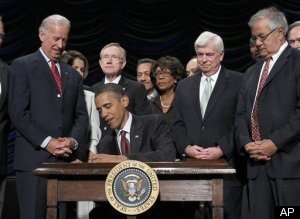
 President Obama signed into law on Wednesday a sweeping expansion of federal financial regulation, marking another — and perhaps last — major legislative victory before the midterm elections in November, which could recast the Congressional landscape.

The signature achievement — a response to the 2008 financial crisis that fundamentally alters the relationship between Wall Street and the federal officials charged with regulating it — is a culmination of two years of fierce lobbying and intense debate over how to deal with the financial excesses that tipped the nation into the worst recession since the Great Depression.

The law subjects more financial companies to federal oversight, regulates many derivatives contracts and creates a panel to detect risks as well as a consumer protection regulator. A number of the details have been left for regulators to work out, inevitably setting off complicated tangles down the road that could last for years.

Obama Financial Reform

Mr. Obama took pains to try to show how the complex legislation, with is dense pages on derivatives practices, will protect ordinary Americans.

“If you’ve ever applied for a credit card, a student loan, or a mortgage, you know the feeling of signing your name to pages of barely understandable fine print,” Mr. Obama said. “But what often happens as a result, is that many Americans are caught by hidden fees and penalties, or saddled with loans they can’t afford.”

He said the law would crack down on abusive practices in the mortgage industry, simplifying contracts and ending hidden fees and penalties, “so folks know what they’re signing.”

So what exactly is in the bill?  According to a summary in the Christian Science Monitor

A bill summary by Capitol Hill staff members includes 100 points. Here’s a shorter take, 10 points, focusing on less-publicized elements as well as some core provisions:

• A first-ever federal office focused on the insurance industry will monitor the insurance industry for systemic risk. The industry will remain regulated largely at the state level.

• FDIC deposit insurance for account-holders at banks, thrift institutions, and credit unions will be raised to $250,000 (from $100,000) retroactive to Jan. 1, 2008.

• The State Department would have to submit an “illicit minerals trade strategy” for the Congo region. Manufacturers that use minerals originating in the Democratic Republic of Congo would have to disclose measures taken to exercise due diligence on the source and chain of custody of the materials. The provision, sponsored by Sen. Sam Brownback (R) of Kansas, could affect high-tech firms like Intel and Apple.

• The bill beefs up the powers of the Securities and Exchange Commission, including extra funds for enforcement. The SEC would get new power to impose fiduriary responsibility on investment brokers. That means the brokers would have to offer advice based on the best interest of clients, not broker fees. Consumer advocates say the bill should have mandated this change, not allowed the SEC to consider it.

• New disclosure rules would apply to credit-rating firms, along with new penalties if the firms are irresponsible. In a nod to an amendment backed by Sen. Al Franken (D) of Minnesota, the bill seeks to end “shopping for ratings” by calling for the SEC to propose ways to prevent issuers of asset-backed securities from picking the firm they think will give the highest rating.

• Shareholders would get a “say on pay,” with the right to a nonbinding vote on executive pay and golden parachutes. Standards for listing on an exchange would require that compensation committees include only independent directors.

• Reforms would reshape Federal Reserve powers, including a ban on Fed bailouts targeted at specific firms (like AIG) in the future. The presidents of regional Fed banks would be selected entirely by directors representing the public, and not partly by directors representing banks that the Fed regulates.

• The bill creates a new Consumer Financial Protection Bureau to consoldiate duties now charged to various federal agencies. It would have a consumer hot line, for questions on things like mortgages, and a new office of financial literacy.

• A Financial Stability Oversight Council of top economic regulators will monitor systemwide risks. The bill summary says this group will ask the Federal Reserve to adopt “increasingly strict rules for capital, leverage, liquidity, risk management and other requirements as companies grow in size and complexity.”

• An “orderly liquidation” mechanism would allow the Federal Deposit Insurance Corp. (FDIC) to dismantle large financial companies that are on the brink of failure. Shareholders and unsecured creditors would bear losses, to end taxpayer bailouts. But the bill also allows the FDIC to shelter solvent banks from having to bear losses if there is a threat to overall US financial stability

Thank you to Barney Frank, Chris Dodd, Olympia Snowe, Susan Collins and Scott Brown and all the Democrats except Ben Nelson we have a start and reining in the runway, unregulated financial system.

Talking jobs and unemployment

Today I went to a graduation for 58 men and women – almost all over 3o – who went to a program at the local YMCA to sharpen skills and make them more competitive in the job market.  I shared an intern with several others in my agency.  It was announced that 8 or 9 had found jobs.  Not bad in this market, but not good either. 

Last week the Boston Globe ran a story about the report by the National Skills Coalition. 

The report projects that by 2016, Massachusetts will have nearly 400,000 job openings that require more than a high school diploma, but less than a four-year college degree. The report says “middle-skill” jobs will account for 38 percent of all openings.

Ranging from licensed practical nurses to computer support specialists, the jobs have median annual incomes of about $50,000 to $55,000.

The report says the state faces challenges in meeting the demand for middle-skilled workers, with only 32 percent of current employees having the credentials.

The graduation I attended was designed to train people for these middle-skill jobs.  But until the jobs are created, the graduates still need to pay the rent, the mortgage, buy food and clothes.  These are men and women who are doing the rights things and are still finding it tough to find a job.  Some of them were unemployed before entering the program and some will be unemployed after graduation.  Some may be eligible for unemployment benefits, but may have exhausted their time.  Which brings me to the unemployment benefits issue.

Let’s start with Paul Krugman.

There was a time when everyone took it for granted that unemployment insurance, which normally terminates after 26 weeks, would be extended in times of persistent joblessness. It was, most people agreed, the decent thing to do.

But that was then. Today, American workers face the worst job market since the Great Depression, with five job seekers for every job opening, with the average spell of unemployment now at 35 weeks. Yet the Senate went home for the holiday weekend without extending benefits. How was that possible?

The answer is that we’re facing a coalition of the heartless, the clueless and the confused. Nothing can be done about the first group, and probably not much about the second. But maybe it’s possible to clear up some of the confusion.

So who are the heartless?  They are Republicans and some Democrats a tiny number of whom may be acting out of principle.  They hide behind the deficit and statements from the clueless.

By the clueless I mean people like Sharron Angle, the Republican candidate for senator from Nevada, who has repeatedly insisted that the unemployed are deliberately choosing to stay jobless, so that they can keep collecting benefits. A sample remark: “You can make more money on unemployment than you can going down and getting one of those jobs that is an honest job but it doesn’t pay as much. We’ve put in so much entitlement into our government that we really have spoiled our citizenry.”

Now, I don’t have the impression that unemployed Americans are spoiled; desperate seems more like it. One doubts, however, that any amount of evidence could change Ms. Angle’s view of the world — and there are, unfortunately, a lot of people in our political class just like her.

And then Krugman tackles the misinformed.

But there are also, one hopes, at least a few political players who are honestly misinformed about what unemployment benefits do — who believe, for example, that Senator Jon Kyl, Republican of Arizona, was making sense when he declared that extending benefits would make unemployment worse, because “continuing to pay people unemployment compensation is a disincentive for them to seek new work.” So let’s talk about why that belief is dead wrong.

Do unemployment benefits reduce the incentive to seek work? Yes: workers receiving unemployment benefits aren’t quite as desperate as workers without benefits, and are likely to be slightly more choosy about accepting new jobs. The operative word here is “slightly”: recent economic research suggests that the effect of unemployment benefits on worker behavior is much weaker than was previously believed. Still, it’s a real effect when the economy is doing well.

But it’s an effect that is completely irrelevant to our current situation. When the economy is booming, and lack of sufficient willing workers is limiting growth, generous unemployment benefits may keep employment lower than it would have been otherwise. But as you may have noticed, right now the economy isn’t booming — again, there are five unemployed workers for every job opening. Cutting off benefits to the unemployed will make them even more desperate for work — but they can’t take jobs that aren’t there.

Will extending benefit add the to deficit?  Krugman tackles this one also.

But won’t extending unemployment benefits worsen the budget deficit? Yes, slightly — but as I and others have been arguing at length, penny-pinching in the midst of a severely depressed economy is no way to deal with our long-run budget problems. And penny-pinching at the expense of the unemployed is cruel as well as misguided.

But is being against extending benefits a political plus?  Not according to two new polls out today.  According to the New York Times story in the Caucus both a CBS News and a ABC News/Washington Post poll found the majority of those surveyed believed that Congress should extend benefits.

In the CBS News survey, 52 percent of respondents said Congress should extend unemployment benefits for people currently out of work, even if it meant increasing the budget deficit. Thirty-nine percent disagreed, and the rest said “it depends” or gave no opinion.

Broken down by party affiliation, about 7 in 10 Democrats said they supported an extension, while most Republicans said they opposed it. Independents were more evenly divided, with 47 percent in favor and 42 percent opposed.

The ABC News/Washington Post poll asked the question a little differently, and found even more support for an extension of unemployment benefits. The question noted that Congress had previously extended benefits because of the economic downturn, and was considering extending them again. It also presented capsules of each side of the debate, noting that supporters of the extension say it “will help those who can’t find work” while opponents say it “adds too much to the federal budget deficit.”

The result: 62 percent of respondents said Congress should approve another extension, while 36 percent said it should not. Those in favor included 80 percent of Democrats and 59 percent of independents, as well as 43 percent of Republicans.

So there doesn’t seem to be a lot of gain in opposition.

Standing with three Americans who have struggled to find work, President Obama spoke in the Rose Garden about the need to extend unemployment benefits.

The last word goes to the President.

Under pressure in an election year to reduce the unemployment rate, now at 9.5 percent, Mr. Obama also urged the Senate to approve a package of tax cuts and an expansion of lending to small businesses. “We all have to continue our efforts to do everything in our power to spur growth and hiring,” Mr. Obama said at the White House.

Mr. Obama, appearing before reporters in the Rose Garden flanked by three Americans who have had difficulty finding work, took aim at that argument. “That attitude reflects a lack of faith in the American people,” Mr. Obama said. “They’re not looking for a handout. They desperately want to work.”

Mr. Obama sharply criticized Republicans who have several times in the past month voted against bringing an unemployment extension bill to the Senate floor.

“After years of championing policies that turned a record surplus into a massive deficit, the same people who didn’t have any problem spending hundreds of billions of dollars on tax breaks for the wealthiest Americans are now saying we shouldn’t offer relief to middle-class Americans like Jim or Leslie or Denise, who really need help,” Mr. Obama said, referring to the three people who stood with him in the Rose Garden, brought to Washington by the White House to help illustrate the president’s point.

The Bill will pass this week, probably without Republican support, after we get the new temporary Senator from West Virginia, Carte Goodwin. 


Keeping the Faith

I’ve been thinking about the mid-term elections a lot recently.  With financial reform and health care reform passed, President Obama has kept two big promises.  Of course, neither bill is perfect.  But both are steps in the right direction.  So when his poll numbers go down anyway and the pundits think mid-term election disaster it is hard to keep the faith.  In this connection, I’m looking at a piece from last Sunday’s Boston Globe and Paul Krugman’s New York Times column from yesterday.

The Globe article by Joe Keohane in the Ideas section was titled “How Facts Backfire”  and the role factual information plays in a democracy.  It was pretty bleak and discouraging.

It’s one of the great assumptions underlying modern democracy that an informed citizenry is preferable to an uninformed one. “Whenever the people are well-informed, they can be trusted with their own government,” Thomas Jefferson wrote in 1789. This notion, carried down through the years, underlies everything from humble political pamphlets to presidential debates to the very notion of a free press. Mankind may be crooked timber, as Kant put it, uniquely susceptible to ignorance and misinformation, but it’s an article of faith that knowledge is the best remedy. If people are furnished with the facts, they will be clearer thinkers and better citizens. If they are ignorant, facts will enlighten them. If they are mistaken, facts will set them straight.

Maybe not. Recently, a few political scientists have begun to discover a human tendency deeply discouraging to anyone with faith in the power of information. It’s this: Facts don’t necessarily have the power to change our minds. In fact, quite the opposite. In a series of studies in 2005 and 2006, researchers at the University of Michigan found that when misinformed people, particularly political partisans, were exposed to corrected facts in news stories, they rarely changed their minds. In fact, they often became even more strongly set in their beliefs. Facts, they found, were not curing misinformation. Like an underpowered antibiotic, facts could actually make misinformation even stronger.

This bodes ill for a democracy, because most voters — the people making decisions about how the country runs — aren’t blank slates. They already have beliefs, and a set of facts lodged in their minds. The problem is that sometimes the things they think they know are objectively, provably false. And in the presence of the correct information, such people react very, very differently than the merely uninformed. Instead of changing their minds to reflect the correct information, they can entrench themselves even deeper.

“The general idea is that it’s absolutely threatening to admit you’re wrong,” says political scientist Brendan Nyhan, the lead researcher on the Michigan study. The phenomenon — known as “backfire” — is “a natural defense mechanism to avoid that cognitive dissonance.”

Paul Krugman wrote Friday about the Republicans proposed economic plan.  Basically tax cuts for the rich and nothing for the rest of us according to Krugman.

Republicans are feeling good about the midterms — so good that they’ve started saying what they really think. This week the party’s Senate leadership stopped pretending that it cares about deficits, stating explicitly that while we can’t afford to aid the unemployed or prevent mass layoffs of schoolteachers, cost is literally no object when it comes to tax cuts for the affluent

And that’s one reason — there are others — why you should fear the consequences if the G.O.P. actually does as well in November as it hopes.

For a while, leading Republicans posed as stern foes of federal red ink. Two weeks ago, in the official G.O.P. response to President Obama’s weekly radio address, Senator Saxby Chambliss devoted his entire time to the evils of government debt, “one of the most dangerous threats confronting America today.” He went on, “At some point we have to say ‘enough is enough.’ ”

But this past Monday Jon Kyl of Arizona, the second-ranking Republican in the Senate, was asked the obvious question: if deficits are so worrisome, what about the budgetary cost of extending the Bush tax cuts for the wealthy, which the Obama administration wants to let expire but Republicans want to make permanent? What should replace $650 billion or more in lost revenue over the next decade?

His answer was breathtaking: “You do need to offset the cost of increased spending. And that’s what Republicans object to. But you should never have to offset the cost of a deliberate decision to reduce tax rates on Americans.” So $30 billion in aid to the unemployed is unaffordable, but 20 times that much in tax cuts for the rich doesn’t count.

The next day, Mitch McConnell, the Senate minority leader, confirmed that Mr. Kyl was giving the official party line: “There’s no evidence whatsoever that the Bush tax cuts actually diminished revenue. They increased revenue, because of the vibrancy of these tax cuts in the economy. So I think what Senator Kyl was expressing was the view of virtually every Republican on that subject.”

The Republicans seem to be making it pretty clear that they want to go back to the old economic way.  Krugman continues

But we’re talking about voodoo economics here, so perhaps it’s not surprising that belief in the magical powers of tax cuts is a zombie doctrine: no matter how many times you kill it with facts, it just keeps coming back. And despite repeated failure in practice, it is, more than ever, the official view of the G.O.P.

Why should this scare you? On paper, solving America’s long-run fiscal problems is eminently doable: stronger cost control for Medicare plus a moderate rise in taxes would get us most of the way there. And the perception that the deficit is manageable has helped keep U.S. borrowing costs low.

But if politicians who insist that the way to reduce deficits is to cut taxes, not raise them, start winning elections again, how much faith can anyone have that we’ll do what needs to be done? Yes, we can have a fiscal crisis. But if we do, it won’t be because we’ve spent too much trying to create jobs and help the unemployed. It will be because investors have looked at our politics and concluded, with justification, that we’ve turned into a banana republic.

Krugman also looks at the facts

…But the real news here is the confirmation that Republicans remain committed to deep voodoo, the claim that cutting taxes actually increases revenues.It’s not true, of course. Ronald Reagan said that his tax cuts would reduce deficits, then presided over a near-tripling of federal debt. When Bill Clinton raised taxes on top incomes, conservatives predicted economic disaster; what actually followed was an economic boom and a remarkable swing from budget deficit to surplus. Then the Bush tax cuts came along, helping turn that surplus into a persistent deficit, even before the crash.

So the facts seem to be higher taxes on higher incomes results in lower deficits and more economic benefit for the rest of us.  But if we believe Joe Keohane, the facts don’t matter much to those that have settled beliefs.

…Most of us like to believe that our opinions have been formed over time by careful, rational consideration of facts and ideas, and that the decisions based on those opinions, therefore, have the ring of soundness and intelligence. In reality, we often base our opinions on our beliefs, which can have an uneasy relationship with facts. And rather than facts driving beliefs, our beliefs can dictate the facts we chose to accept. They can cause us to twist facts so they fit better with our preconceived notions. Worst of all, they can lead us to uncritically accept bad information just because it reinforces our beliefs. This reinforcement makes us more confident we’re right, and even less likely to listen to any new information. And then we vote.

This effect is only heightened by the information glut, which offers — alongside an unprecedented amount of good information — endless rumors, misinformation, and questionable variations on the truth. In other words, it’s never been easier for people to be wrong, and at the same time feel more certain that they’re right.

So how exactly do the Democrats combat all the Republican nonsense?  Not only the Kyl and McConnell quotes that Krugman mentions, but also statements that if the Republicans take over during the mid-terms they will repeal the health and financial reforms.  They know very well that if they try, there will be a Presidential veto and that they will not be able to keep that promise, but despite that fact, they will be believed.  Keohane discusses a number of studies and possibilities but the most immediate solution to this problem seems to be increasing self-esteem.

One avenue may involve self-esteem. Nyhan worked on one study in which he showed that people who were given a self-affirmation exercise were more likely to consider new information than people who had not. In other words, if you feel good about yourself, you’ll listen — and if you feel insecure or threatened, you won’t. This would also explain why demagogues benefit from keeping people agitated. The more threatened people feel, the less likely they are to listen to dissenting opinions, and the more easily controlled they are.

Increasing the self-esteem of the American electorate right now means creating jobs and making some radical moves on the economy.  Some of the benefits of the reforms will also begin to impact voters by fall.

The Democrats should take Eugene Robinson’s advice on Keith Olbermann’s Countdown last night. 

I mean it’s not like the Democrats don’t have something to run on this fall. So get out there and run on it.

Gene also said in a recent column in the Washington Post

One reason I’m not so confident of a Republican blowout in the fall is that while polls clearly show that the country is in an anti-incumbent mood, there’s also considerable evidence that people see the GOP as part of the problem, not part of the solution. A new Post-ABC News poll, for example, showed that 58 percent of voters have “just some” confidence, or even less, in President Obama’s leadership, and that 68 percent were similarly doubtful about the ability of congressional Democrats to lead. But 72 percent had little or no faith in congressional Republicans — which suggests to me that the GOP has work to do before its leaders start picking out new office suites in the Capitol.

Another reason for caution is that the Republican Party is out of step with the American public on so many issues. Americans want to see unemployment benefits extended. They want tougher financial regulation, complete with consumer protections. Even health-care reform, which the GOP succeeded in painting as the apocalypse, becomes more popular as the months pass and somehow the world does not end.

I have to believe that there is a large portion of the American electorate that can be swayed by facts.  And the ray of hope is in the slide that Olbermann showed with the results of the NBC/Wall Street Journal Poll which indicates that the majority would like more, not less regulation of Wall Street, big business, the health care industry and, by a big margin, the oil industry.  They won’t get that from the Republicans who want a moratorium on regulation.

The Recession Effect

Two stories in today’s papers, one in the Boston Globe and the other in the New York Times, combined with a sudden flurry of foreclosure activity at the office reminds me that the lagging  job creation numbers are not just statistics for economists and government agencies to toss around.  The effects are real and are clearly taking their tolls.

This from the Boston Globe this morning

Requests for reduced alimony and child support payments have surged, and the emotional toll of lost jobs, slashed pay, and uncertain futures appears to be driving an increase in other family problems.

“People are increasingly agitated, and it’s incredibly emotional,’’ said Paula M. Carey, chief justice of the Probate and Family Court. “They are out of work, struggling to keep their homes, and all of that takes a toll. Every day, in every court, you can see it.’’

The same economic turmoil that has prompted more families to seek judicial relief has also made courts less equipped to provide it. Steep budget cuts have left the family courts roughly 40 percent understaffed. There have been cutbacks in court-appointed guardians and probation officers who try to mediate disputes before they are brought to judges, increasing judges’ caseloads and creating delays. Financial constraints have forced more clients to represent themselves, which has tended to further slow proceedings.

You have to worry about the impact on children and teenagers.

One day last week in Courtroom 2 of Boston’s Edward W. Brooke Courthouse, more than 50 cases came before Judge Joan Armstrong – an unrelenting succession of single mothers pleading for more support, some fathers saying they can’t pay, and couples grimly agreeing their marriages were beyond repair. Some had lawyers with expensive suits and leather briefcases by their side; others stood alone. Most traded accusations. Few found common ground.

Looming over nearly every case was the heavy weight of financial distress, and parent after parent described for the judge an economic situation hanging by a thread. As the day began, stacks of thick folders were piled high on the judge’s desk, and in quick succession a mother won permanent guardianship of her daughter, a 19-year-old with Down syndrome; an elderly woman in a shawl, after gazing imploringly at the ceiling as though for guidance, won her motion to extend by a year a restraining order against her former husband; a woman requested a hearing on reducing her child support payment.

What I really fail to comprehend is the Republican position that we can’t increase the deficit to create jobs and to fund a jobs program.  Don’t they understand that putting people back to work not only helps reduce the stress on them, but also means that they help support the economy by paying taxes?  Putting funds into the Highway Trust Fund and other transportation projects as my congressman, Mike Capuano, has proposed would allow states to proceed with infrastructure programs and hire people.  The current stimulus programs are a start, but much more is needed.

More than half of the nation’s unemployed workers have borrowed money from friends or relatives since losing their jobs. An equal number have cut back on doctor visits or medical treatments because they are out of work.

Almost half have suffered from depression or anxiety. About 4 in 10 parents have noticed behavioral changes in their children that they attribute to their difficulties in finding work.

Joblessness has wreaked financial and emotional havoc on the lives of many of those out of work, according to a New York Times/CBS News poll of unemployed adults, causing major life changes, mental health issues and trouble maintaining even basic necessities.

These are the results of a new poll announced today in the New York Times.

With unemployment driving foreclosures nationwide, a quarter of those polled said they had either lost their home or been threatened with foreclosure or eviction for not paying their mortgage or rent. About a quarter, like Ms. Newton, have received food stamps. More than half said they had cut back on both luxuries and necessities in their spending. Seven in 10 rated their family’s financial situation as fairly bad or very bad.

But the impact on their lives was not limited to the difficulty in paying bills. Almost half said unemployment had led to more conflicts or arguments with family members and friends; 55 percent have suffered from insomnia.

This graphic illustrates some of the results.

And of course many of the long term unemployed can’t afford health insurance – even the COBRA payments – so they are unable to take care of the health issues resulting from the stress and anxiety creating even more stress. 

Nearly half of respondents said they did not have health insurance, with the vast majority citing job loss as a reason, a notable finding given the tug of war in Congress over a health care overhaul. The poll offered a glimpse of the potential ripple effect of having no coverage. More than half characterized the cost of basic medical care as a hardship.

I realize that the Obama administration is trying to talk banks into lending to small businesses which create jobs, but without a real public jobs program to put people to work so they can begin spending and paying taxes I am afraid that foreclosures will continue increase, domestic violence will rise,  and the overall level of violence will continue to increase.

One very interesting result of the poll was who got the blame.

In terms of casting blame for the high unemployment rate, 26 percent of unemployed adults cited former President George W. Bush; 12 percent pointed the finger at banks; 8 percent highlighted jobs going overseas and the same number blamed politicians. Only 3 percent blamed President Obama.

Those out of work were split, however, on the president’s handling of job creation, with 47 percent expressing approval and 44 percent disapproval.

The Republicans may seem to have forgotten who allowed the economic crisis to happen, but it appears that the unemployed have not.  But clearly, the Obama administration and Congress need to act quickly.

Jobs and the Recovery

Very interesting blog entry today from Floyd Norris, Chief Financial Editor of the New York Times.   We all know that the last unemployment figures showed a rise to 10.2% and that President Obama keeps trying to explain that jobs are the last thing to return after a recession.  But Norris argues that maybe things have already started to turn.

The economic reactions over the weekend to Friday’s employment report all started from the assumption that things grew much worse in October. The unemployment rate leaped to 10.2 percent from 9.8 percent. Another 190,000 jobs vanished.

Actually, none of that happened.

In reality, the government report says unemployment rates remained steady at 9.5 percent. And the number of jobs actually rose, by 80,000. And the number of jobs for college-educated Americans rose more than in any month in the last six years.

If those were the numbers in the articles, we would hear about the economy stabilizing, and talk about the Obama stimulus plan starting to have the intended effect.

Why the disparity in numbers?  Because of something called “seasonal adjustment”.

…For some reason, October is the month with the largest seasonal adjustment down in jobs. So the increase in the unemployment rate does not reflect people actually losing jobs. It reflects the belief that seasonal factors should have added more jobs than they did.

So if there were no seasonal adjustment factor, jobs would have actually increased.

Studying the unadjusted numbers provides some indication that the hiring is starting to improve for better jobs. The number of jobs for college graduates, according to the household survey, rose 755,000 in October, before seasonal adjustments. That is the third-largest increase since the government started counting those figures, in 1992. (It trails increases of 895,000 in February 2002 and 755,000 in October 2003.)

On the other hand, the number of jobs fell for those with less education. If this report does indicate that the job recession is ending, it is an end that is providing immediate benefits for the educated, not for many of the people who most need help.

So when the stimulus funding really gets out on the street, probably in the spring, employment for construction jobs should increase.  In the meanwhile, we need to make sure unemployment benefits remain available.