Impasse?! We should look at the Progressive Caucus Budget

President Obama met with the Republicans in the House yesterday.  I think Politico had the best take on the meeting.

After years of pining for more face time with the president, House Republicans  found out Wednesday that Barack Obama looks and sounds the same behind closed  doors as he does on TV.

President Obama meets with Congress. AP Photograph

President Obama meets with Congress. AP Photograph

I think they are finally learning what many of us have known for a while:  what you see is what you get with Barack Obama.  Michelle has been trying to tell everyone this for years.  So he has his line and the Republicans led by Paul Ryan have theirs.  But where does that leave the rest of  us?  How to deal in a meaningful way with the sequester and the budget?  I see two paths:  One, those affected by the cuts start putting on the pressure and two, we begin looking at alternatives to either the Republican or White House budget proposals.

On the first, the lobbying has begun.  The New York Times reports

Construction companies are lobbying the government to spare their projects from across-the-board cuts. Drug companies are pleading with the White House to use all the fees they pay to speed the approval of new medicines.

And supporters of Israel have begun a campaign to make sure the Jewish state receives the full amount of military assistance promised by the United States.

A frenzy of lobbying has been touched off by President Obama’s order to slice spending this year by $85 billion, divided equally between military and civilian programs. The cuts have created new alliances and strange bedfellows.

Hunter R. Rawlings III, a historian of ancient Greece who is the president of the Association of American Universities, joined Wesley G. Bush, the chief executive of Northrop Grumman, the maker of surveillance drones and B-2 bombers, in a news conference in which they denounced the automatic cuts known as sequestration.

Health care and education groups, advocates for poor people, and state and local officials who fought in the past for bigger budgets are now trying to minimize the pain.

How much money do you think will be spent on lobbying?  I don’t even want to begin to add it up.  What a waste of money.  But I guess some people will still have jobs.

For an alternate budget we can look at the Congressional Progressive Caucus budget proposal.    The Economic Policy Institute assisted in putting the budget together and scoring it.  Dean Baker from the Center for Economic and Policy Research calls it “A Serious Budget That the Serious People Won’t Take Seriously”.  The Progressive Caucus has been proposing budgets for a number of years now and takes the position that if their proposals had been adopted, we wouldn’t be in the mess we are in now.

So what exactly are they proposing?

Direct hire programs that create a School Improvement Corps, a Park Improvement Corps, and a Student Jobs Corps, among others.

Targeted tax incentives that spur clean energy, manufacturing, and cutting-edge technological investments in the private sector.

Widespread domestic investments including an infrastructure bank, a $556 billion surface transportation bill, and approximately $2.1 trillion in widespread domestic investment.

Ends tax cuts for the top 2% of Americans on schedule at year’s end

Extends tax relief for middle class households and the vast majority of Americans

Creates new tax brackets for millionaires and billionaires

Eliminates the tax code’s preferential treatment of capital gains and dividends

Abolishes corporate welfare for oil, gas, and coal companies

Eliminates loopholes that allow businesses to dodge their true tax liability

Calls for the adoption of the “Buffett Rule”

Creates a publicly funded federal election system that gets corporate money out of politics for good.

Provides a Making Work Pay tax credit for families struggling with high gas and food cost 2013-2015

Extends Earned Income Tax Credit, and the Child and Dependent Care Credit

Invests in programs to stave off further foreclosures to keep families in their homes

Invests in our children’s education by increasing Education, Training, and Social Services

It would also end the war in Afghanistan and do selective, not blanket cuts to the military budget.  It basically spends money to put people back to work and stabilize the economy.  This assumes that people who work pay taxes and put money back into the economy.  It also achieves deficit reduction.  All through government spending.  As Dean Baker poinst out

For those upset that the budget debate is getting ever further removed from the real world problems of an economy that is suffering from a deficit of 9 million jobs, there is good news. The Congressional Progressive Caucus (CPC) has produced a budget that is intended to make the unemployment situation better rather than worse.

The story of course is that we are still in a situation where we need the government as a source of demand in the economy. This is independent of how much we like the government or the private sector. The private sector does not expand and create jobs just because governments want it to, as is being discovered now by leaders in the United Kingdom, Greece, Italy, Spain and everywhere else where deficit reduction is now in vogue. In the current economic situation, loss of demand from the government is a loss of demand to the economy. That is why recent steps to reduce the deficit, such as the ending of the payroll tax cut (which put money in consumers’ pockets) and the sequester, will lead to slower growth and higher unemployment.

Would this happen with the adoption of the progressive budget?  I don’t know, but I know that what is going on now isn’t working either.  And what is worse, people are tuning out and shrugging their shoulders assuming nothing can be done.

Gail Collins has this fantasy.

White smoke poured from the Capitol today and crowds of onlookers broke into shouts of jubilation, crying: “We have a budget!”

Inside, where the nation’s legislators had been walled off in seclusion, the newly chosen tax-and-spending plan was garbed in the traditional brass staples for its first public appearance. Insiders said it planned to take the name of Budget for Fiscal Year 2014.

I guess that is alternative number three.  Maybe we should try sequestering Congress.

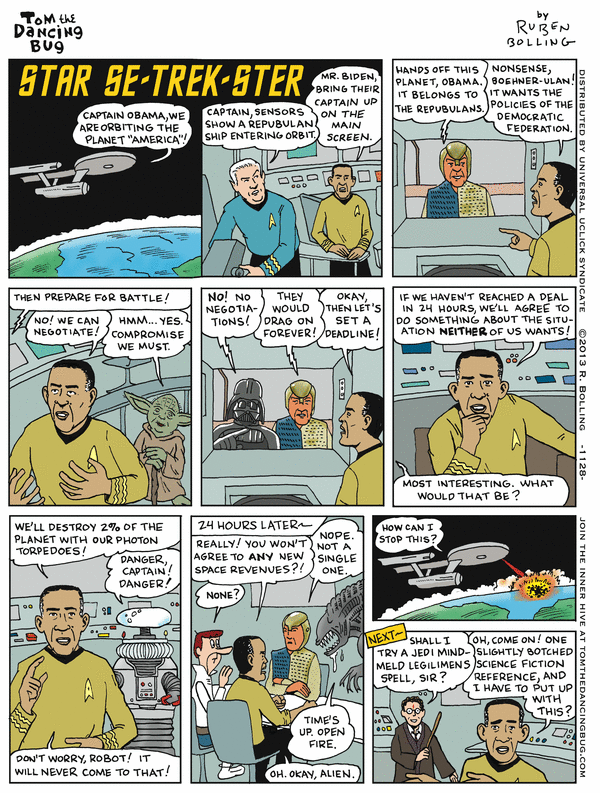
Star Trek or Star Wars

I’m a fan of the original Star Trek and of the first Star Wars trilogy.  I guess I dropped out after that, maybe moved on or something.  But putting that aside, I love this Ruben Bolling.  Sums up the cultural reference controversy and the sequester all in one.

tom 3-13-2013

OK. No one cares about the sequester

No one cares about the sequester.  Or maybe, no one knows about it.  Or maybe everyone is just tired of Congress.

Here is Mike Luckovich today with a history of our recent financial crises.

Gee.  I don't know why you think all this is my fault.

Gee. I don’t know why you think all this is my fault.

No wonder the general public doesn’t care right now.  And they probably won’t care until cuts start to hurt them.  Let’s face it:  both sides are using those old techniques of  putting forward the arguments that make the best case for their point of view.  The Republicans are right in that it won’t hurt for a little while – maybe a month or so.  And the Democrats are right that this whole exercise is unnecessary and, in the long run not helpful to recovery.

Thomas Mann and Norman Ornstein who wrote the excellent book, “It’s Even Worse Than It Looks”, have an excellent piece in today’s Washington Post titled “Five myths about the sequester”.

1. Blame Obama — the sequester was his White House’s idea.

Identifying the origins of the sequester has become a major Washington fight. Bob Woodward weighed in recently with a Washington Post op-ed making the case that the idea began in the White House. He’s right in a narrow sense, mainly because he focuses on the middle of the 2011 negotiations between Obama and Republican lawmakers. If you look before and after, a different picture emerges.

In our view, what happened is quite straightforward: In 2011, House Republican leaders used their new majority to force their priorities on the Democratically controlled Senate and the president by holding the debt limit hostage to demands for deep and immediate spending cuts. After negotiations between Obama and House Speaker John A. Boehner failed (Eric Cantor recently took credit for scuttling a deal), the parties at the eleventh hour settled on a two-part solution: immediate discretionary spending caps that would result in cuts of almost $1 trillion over 10 years; and the creation of a “supercommittee” tasked with reducing the 2012-2021 deficit by another $1.2 trillion to $1.5 trillion. If the supercommittee didn’t broker a deal, automatic spending cuts of $1.2 trillion over the next decade — the sequester — would go into effect. The sequester was designed to be so potentially destructive that the supercommittee would surely reach a deal to avert it.

The sequester’s origins can’t be blamed on one person — or one party. Republicans insisted on a trigger for automatic cuts; Jack Lew, then the White House budget director, suggested the specifics, modeled after a sequester-like mechanism Congress used in the 1980s, but with automatic tax increases added. Republicans rejected the latter but, at the time, took credit for the rest. Obama took the deal to get a debt-ceiling increase. But the president never accepted the prospect that the sequester would occur, nor did he ever agree to take tax increases off the table.

And of course no deal has been reached yet.

2. At least the automatic cuts will reduce runaway spending and begin to control the deficit.

What runaway spending? The $787 billion stimulus was a one-time expenditure that has come and gone. Under current law not including the sequester, non-defense discretionary spending as a share of the economy will shrink to a level not seen in 50 years. Defense spending grew substantially over the past decade, but that pattern has slowed and will soon end. Additional reductions must be achieved intelligently, tied to legitimate national security needs.

The annual budget deficit is projected to fall by almost 50 percent in 2013 compared with the height of the recession. Reducing the deficit over the long term requires going where the money is — boosting economic growth, controlling health-care costs and increasing revenue to handle the expense of an aging population. Deeper discretionary-spending cuts are counterproductive; immediate cuts, as Europe has made recently, could lead to a recession and bigger deficits.

I guess the Republicans want us to be like Greece after all.

And finally, one for the Democrats.

4. The cuts are so large, they will be catastrophic.

The administration has released state-by-state estimates of the sequester and highlighted the cutbacks most likely to harm or inconvenience the public. The reality is not so immediate or dramatic. The damage will accumulate in less visible ways, as irrational reductions in public spending impede economic growth and job creation; reduce investments in education, infrastructure and scientific research; and further disrupt the routines of a modern democracy. The longer the sequester remains in place, the more harm is inflicted.

So it may take a while to feel the cuts.  Maybe long enough for the Obama Administration to submit a sensible budget that everyone can agree on.  And no, I’m not smoking anything.  Just counting on mayors and governors to continue to put the pressure on Congress.

Maybe we should increase the minimum wage

Massachusetts has a minimum wage of $8/hour.  This is fifth highest among states, sixth if you count the District of Columbia.  According to the Boston Globe

Five years have elapsed since the minimum wage in Massachusetts increased in January 2008 to $8 an hour, still one of the highest wage floors in the country.

The Legislature has not voted on a minimum wage increase since 2006, when it phased in the increase over two years and overrode a veto by Governor Mitt Romney to do so.

Since then, four states, includ­ing Connecticut and ­Vermont and the District of ­Columbia have surpassed Massa­chusetts. Nevada requires employers to pay workers $8.25 an hour if they do not receive health benefits, but if health insurance is provided the minimum wage rate falls to $7.25.

California continues to pay workers a minimum of $8 an hour, and Washington has the highest minimum wage in the country at $9.19. Businesses in Connecticut must pay at least $8.25 an hour, and Vermont workers earn at least $8.60 an hour.

If Congress increases the minimum wage to $9, Massachusetts will automatically go to $9.10.  Better, but not a livable wage if you live in Boston, where rents are high.

Even with an increase we will still need the Minimum Wage Awards.

Thank you Brian McFadden.

PS.  Did you happen to notice who vetoed the Massachusetts Minimum Wage increase?

What’s up with sequestration? Or we should have issued war bonds.

When I looked up sequestration in Merriam Webster, the closest meaning I could find to what is going on with the federal budget is

2
a: a legal writ authorizing a sheriff or commissioner to take into custody the property of a defendant who is in contempt until the orders of a court are complied with
b: a deposit whereby a neutral depositary agrees to hold property in litigation and to restore it to the party to whom it is adjudged to belong
So our tax dollars are being put aside until we pay down the debt or is it cut the deficit?  Back in 2004, the Treasury Department explained the difference this way.

What is the difference between the public debt and the deficit?

The deficit is the difference between the money Government takes in, called receipts, and what the Government spends, called outlays, each year.  Receipts include the money the Government takes in from income, excise and social insurance taxes as well as fees and other income.  Outlays include all Federal spending including social security and Medicare benefits along with all other spending ranging from medical research to interest payments on the debt.  When there is a deficit, Treasury must borrow the money needed for the government to pay its bills.

We borrow the money by selling Treasury securities like T-bills, notes, Treasury Inflation-Protected securities and savings bonds to the public. Additionally, the Government Trust Funds are required by law to invest accumulated surpluses in Treasury securities. The Treasury securities issued to the public and to the Government Trust Funds (intragovernmental holdings) then become part of the total debt.

One way to think about the debt is as accumulated deficits.

So back when Bill Clinton balanced the budget, we did not run a deficit and did not accumulate more debt.

While some on the right would argue that Clinton really didn’t reduce the deficit and he ruined the economy by raising taxes, I seem to remember that things were going pretty well for the average person during the Clinton years.

When George W. came into office he said he wanted to give us taxpayers back our surplus which probably would have been OK if he hadn’t then started 2 wars which we didn’t raise taxes of any kind to pay for.  No war bonds, no special tax assessment (used by state and local governments to pay for things), no general tax increase.  Thus the red ink on the chart above.  Then came what everyone is now calling the Great Recession.  Barack Obama really had no choice but to spend money to get the economy moving again.  We can argue about some of the spending – like saving some of the banks – but much of it work out pretty well, I think.

So now we have the sequester.  This was a deal made in 2011 to keep everything from coming to a halt.  I don’t think that anyone thought at the time that there wouldn’t be another budget deal to keep the cuts from going into effect, but so far no dice.  The New York Times ran an editorial on Sunday which is the best explanation of what the cuts would mean that I have seen.  For example:

NATIONAL SECURITY Two-week furloughs for most law-enforcement personnel will reduce Coast Guard operations, including drug interdictions and aid to navigation, by 25 percent. Cutbacks in Customs agents and airport security checkpoints will “substantially increase passenger wait times,” the Homeland Security Department said, creating delays of as much as an hour at busy airports. The Border Patrol will have to reduce work hours by the equivalent of 5,000 agents a year.

AIR TRAFFIC About 10 percent of the Federal Aviation Administration’s work force of 47,000 employees will be on furlough each day, including air traffic controllers, to meet a $600 million cut. The agency says it will be forced to reduce air traffic across the country, resulting in delays and disruptions, particularly at peak travel times.

CRIMINAL JUSTICE Every F.B.I. employee will be furloughed for nearly three weeks over the course of the year, the equivalent of 7,000 employees not working each day. The cut to the F.B.I. of $550 million will reduce the number of background checks on gun buyers that the bureau can perform, and reduce response times on cyberintrusion and counterterrorism investigations.

A three-week furlough of all food safety employees will produce a shortage of meat, poultry and eggs, pushing prices higher and harming restaurants and grocers. The Agriculture Department warns that public health could be affected by the inevitable black-market sales of uninspected food.

RECREATION National parks will have shorter hours, and some will have to close camping and hiking areas. Firefighting and law enforcement will be cut back.

DEFENSE PERSONNEL Enlisted personnel are exempt from sequester reductions this year, but furloughs lasting up to 22 days will be imposed for civilian employees, who do jobs like guarding military bases, handle budgets and teach the children of service members. More than 40 percent of those employees are veterans.

The military’s health insurance program, Tricare, could have a shortfall of up to $3 billion, which could lead to denial of elective medical care for retirees and dependents of active-duty service members.

And the list goes on.

The editorial concludes

Last week, Senate Democrats produced a much better plan to replace these cuts with a mix of new tax revenues and targeted reductions. About $55 billion would be raised by imposing a minimum tax on incomes of $1 million or more and ending some business deductions, while an equal amount of spending would be reduced from targeted cuts to defense and farm subsidies.

Republicans immediately rejected the idea; the Senate minority leader, Mitch McConnell, called it “a political stunt.” Their proposal is to eliminate the defense cuts and double the ones on the domestic side, heedless of the suffering that even the existing reductions will inflict. Their refusal to consider new revenues means that on March 1, Americans will begin learning how austerity really feels.

Remember the definition of sequestration I began with?  It is a temporary thing.  The money is supposed to come back to us.  If the sequestration cuts really happen, I can bet you they won’t be temporary.  We are reaping the cost of wars most of us didn’t want and any rational solution will be held up by the same folks who did want to go to war.  We should have had war bonds.

THE VICTORY FUND COMMITTEE CAN HELP YOUR MONEY...

THE VICTORY FUND COMMITTEE CAN HELP YOUR MONEY WIN THIS WAR THROUGH INVESTMENT IN U.S. TREASURY SECURITIES SUITED TO… – NARA – 515674 (Photo credit: Wikipedia)

The President, Big Business and the Republicans

You may have noticed that the President has met more than once with various business groups and corporate leaders about fiscal and economic issues.  In today’s New York Times, Jackie Calmes has an interesting analysis.

Corporate chiefs in recent months have pleaded publicly with Republicans to raise their taxes for the sake of deficit reduction, and to raise the nation’s debt limit without a fight lest another confrontation like that in 2011 wallop the economy. But the lobbying has been to no avail. This is not their parents’ Republican Party.

In a shift over a half-century, the party base has been transplanted from the industrial Northeast and urban centers to become rooted in the South and West, in towns and rural areas. In turn, Republicans are electing more populist, antitax and antigovernment conservatives who are less supportive — and even suspicious — of appeals from big business.

The article quotes Senator Cruz

“One of the biggest lies in politics is the lie that Republicans are the party of big business,” Ted Cruz, a new senator from Texas and a Tea Party favorite, told The Wall Street Journal during his 2012 campaign. “Big business does great with big government. Big business is very happy to climb in bed with big government. Republicans are and should be the party of small business and of entrepreneurs.”

Senator Cruz

This brings me to the question, once more, as to who is actually represented by people like Senator Cruz.  OK, I get the small town and rural but what I don’t get is what exactly does he and his wing of the party want to do for those they represent.  My husband would tell me that they don’t want to do anything except blow up government.  Maybe so, but how politically popular would it be to do away with money for roads and railroads that move the farm products that are produced?  (Heard of infrastructure, Senator?)  Or the rural subsidies that provide phone and internet services?  Or the various farm subsidies?  I admit, that I’m not clear on where they are on the corporate farm versus the family farm issue.

But big business isn’t interested in blowing up the government.

Big business is so fearful of economic peril if Congress does not allow the government to keep borrowing — to pay creditors, contractors, program beneficiaries and many others — that it is nearly united in skepticism of, or outright opposition to, House Republicans’ demand that Mr. Obama first agree to equal spending cuts in benefit programs like Medicare and Medicaid.

That explains the administration’s outreach to corporate chiefs, like Monday’s conference call. Mr. Obama wants business’s support to buttress his vow that he will never again negotiate over so essential an action like he did in 2011, when the nation flirted with default and the economy suffered. Vexing Republicans, many business leaders are siding with him.

“I’m agreeing with the president — you should not be using the debt limit as a bargaining chip when it comes to how you run the country,” said David M. Cote, chief executive of Honeywell, and a Republican. “You don’t put the full faith and credit of the United States at risk.”

And the party reaction?

Some of the Republicans’ distancing from big business is a matter of political tactics — to alter their image as the party of wealth and corporate power. A writer for the conservative Weekly Standard said of the fiscal fight last month, “While big business cozies up to Obama once again, Republicans have an opportunity to enhance their reputation as the party of Main Street.”

But if we default on our debt by no raising the debt ceiling, what will happen to all those small Main Street businesses?  People with no social security, unemployment, and in the case of thousands of furloughed government workers at all levels will have no money to spend and those very businesses will be at risk.

Let’s face it.  No one “likes” government until they want or need government to do something for them then we all love government.  All those Republican’s in Congress, many from the South, who voted against Sandy relief will be crying in August and September when a storm hits the Gulf.

President Barack Obama talks with Michael G. M...

President Barack Obama talks with Michael G. Morris, right, of American Electric Power Company, and David Cote in the Cross Hall of the White House, before a dinner with CEOs, Feb. 24, 2010. (Photo credit: Wikipedia)

The Lord of the Coin or another take on the trillion dollar coin.

Ruben Bolling’s take on the magic coin.

td130111.gif

And so, once again Joe Biden causes trouble.

The trillion dollar coin explained – sort of

When I started hearing about the possibility of the treasury minting a trillion dollar coin which could end all the endless debates about the debt ceiling, I thought it was a joke.  Turns out, that is only partly true.  Here are two views of the platinum coin.

The first is Neil Irwin’s as posted on the Wonkblog.

I’ll lay out this econo-pundit’s conclusion upfront: I hate the platinum coin idea. But if there is no resolution of the debt ceiling through the legislative process, I hate some of the alternatives more.

The issue, for those who need a refresher: To avoid running into the debt ceiling in the next couple of months, the Treasury secretary could exploit a legal loophole, create a platinum coin, assign it a value of $1 trillion or some other very high number, and deposit it at the Fed, thus enabling the government to carry out its previously promised tax and spending policies without broaching the legal cap on debt issuance.

To back up a minute, it is important to understand what the debt ceiling does, and why it is problematic. Congress passes laws to spend money: This many dollars for fighter aircraft, Social Security benefits paid according to such and such formula, and so on. It passes laws to enact a tax code. And the difference between that spending and the money raised in taxes the government funds by issuing debt. But Congress also has a third constraint: An overall ceiling on how much debt the Treasury can issue. In the past, Congress has raised that ceiling to whatever it needed to be to match the previously approved taxes and spending as a matter of course.

Now, House Republicans are viewing the debt ceiling differently. They are treating the debt ceiling–and the need to raise it–as a lever through which to try to win battles over spending that they lost in previous negotiations. They want to not pass an increase to the debt ceiling unless they get some major concessions from Democrats on cutting spending—concessions that Democratic senators and the White House say are non-starters.

So the idea of the trillion dollar coin would be to put this whole impasse to rest.  Irwin goes on to explain what the coin would not do.

A couple of the widespread objections don’t hold water. So long as the Federal Reserve does its job, the platinum coin would not be inflationary. In the current ultra-low interest rate environment, the Treasury depositing a $1 trillion coin at the Fed would not affect the supply of money in the broader economy any differently from it issuing $1 trillion in Treasury bills. Nothing about the platinum coin would prevent the Fed from hiking interest rates when it sees an inflationary threat on the horizon.

That’s not to say a platinum coin gambit would be much fun for the Fed. Chairman Ben Bernanke and New York Fed president Bill Dudley would face a moment of truth, and scores of Fed lawyers would be working overtime, as the central bank had to decide whether to treat the $1 trillion coin as a legal deposit. The Fed in general hates to end up in the middle of political disputes, and this would be a highly uncomfortable spot.

On the other side is Paul Krugman who begins by explaining the whole debt ceiling business.

Where does the debt ceiling fit into all this? Actually, it doesn’t. Since Congress already determines revenue and spending, and hence the amount the Treasury needs to borrow, we shouldn’t need another vote empowering that borrowing. But for historical reasons any increase in federal debt must be approved by yet another vote. And now Republicans in the House are threatening to deny that approval unless President Obama makes major policy concessions.

It’s crucial to understand three things about this situation. First, raising the debt ceiling wouldn’t grant the president any new powers; every dollar he spent would still have to be approved by Congress. Second, if the debt ceiling isn’t raised, the president will be forced to break the law, one way or another; either he borrows funds in defiance of Congress, or he fails to spend money Congress has told him to spend.

So in reality, Congress would just have to authorize borrowing money that they have already said could be spent.  And part of the issue is that not enough people are working and paying enough taxes to create enough revenue.  In some ways you can understand the Republicans who want to set a fixed amount for a budget and then make everything fit.  No borrowing.  But then you have things like Hurricane Sandy and extra spending for the Bush wars for which no revenue was ever raised, and etc., etc. and we end up either cutting things no one wants to cut or borrowing.  Back to Krugman.

Finally, just consider the vileness of that G.O.P. threat. If we were to hit the debt ceiling, the U.S. government would end up defaulting on many of its obligations. This would have disastrous effects on financial markets, the economy, and our standing in the world. Yet Republicans are threatening to trigger this disaster unless they get spending cuts that they weren’t able to enact through normal, Constitutional means.

Republicans go wild at this analogy, but it’s unavoidable. This is exactly like someone walking into a crowded room, announcing that he has a bomb strapped to his chest, and threatening to set that bomb off unless his demands are met.

Which brings us to the coin.

Here’s how it would work: The Treasury would mint a platinum coin with a face value of $1 trillion (or many coins with smaller values; it doesn’t really matter). This coin would immediately be deposited at the Federal Reserve, which would credit the sum to the government’s account. And the government could then write checks against that account, continuing normal operations without issuing new debt.

But wouldn’t the coin trick be undignified? Yes, it would — but better to look slightly silly than to let a financial and Constitutional crisis explode.

A downgrade of the United States credit rating again will end up costing us in interest which seems to me to defeat the purpose since we will probably have to borrow more to pay extra to borrow.  Maybe enough Republicans will join with enough Democrats to raise the ceiling to a trillion dollars and we won’t need the magic coin.  This is what Irwin is hoping for.

The platinum coin gambit could be terrible for the U.S. government’s long-term standing as a premier destination for global capital. This is a moment for Republicans to take responsibility for governing and to accept the fact that their leverage is limited with control of only one house of Congress. But if the alternative truly is default, a crazy coin option may indeed be less bad than the alternatives.

What would be on the other side?  Some suggestions include the Cat in the Hat, Alfred E. Newman (both sent in to the Takeaway) and my favorite idea, Mark Twain who once said, “Suppose you were an idiot. And suppose you were a member of Congress. But I  repeat myself.”

I had been thinking about a post on the deficit, but then “The Fifth” did the work for me. Thanks, Kstreet607.

kstreet607's avatarThe Fifth Column

The Huffington Post

1.   The Deficit Has Grown Mostly Because Of The Recession

The deficit has ballooned not because of specific spending measures, but because of the recessionThe deficit more than doubled between 2008 and 2009, as the economy was in free fall, since laid-off workers paid less in taxes and needed more benefits. The deficit then shrank in 2010 and 2011.

2.   The Stimulus Cost Much Less Than Bush’s Wars, Tax Cuts

Republicans frequently have blamed the $787 billion stimulus for the national debt, but, when all government spending is taken into account, the stimulus frankly wasn’t that big. In contrast, the U.S. will have spent nearly $4 trillion on wars in the Middle East by the time those conflicts end, according to a recent report by Brown University.  The Bush tax cuts have cost nearly $1.3 trillionover 10 years.

 3.   The…

View original post 474 more words

Going over the cliff?!

The Senate is back in town with very unhappy members who would rather be kicking back at home and who can blame them.  Senator McConnell who really, really doesn’ t want to make a fool of  himself a la Boehner and Plan B, keeps asking for a proposal from the President.  I thought the President had made at least two proposals, but I guess Mitch doesn’t follow the new much.  Meanwhile the House is called back into session on Sunday night.  That is the night of December 30 a little more than 24 hours before the cliff.  So what is going on here?  Not being an economist, I can’t explain it all but I have found a couple of things this morning that have given me some things to think about as we play chicken with the deadline.

First is this handy chart from the New York Times from the Debt Reckoning blog.

It was posted last night with this explanation.

The deadline for resolving the pending fiscal crisis is less than a week away and, absent a breakthrough, spending cuts and tax increases on every income level will go into effect on Jan. 2. During their negotiations, President Obama and Speaker John A. Boehner have sought to keep tax rates at their current level for some taxpayers while letting them rise for high earners, but they have not agreed on where to set the income threshold. Mr. Obama has called for rates to go up on income above $250,000 (he later increased his offer to $400,000), Congressional Democrats have said they would agree to $500,000, and Mr. Boehner has called for a $1 million threshold.

So we aren’t talking about a lot of taxpayers here since the vast majority of us make under $250,000 in taxable income.  As I understand it, none of these proposals would impact investment income.  (Which as we have learned from Mitt Romney, is taxed differently.)  But we do pay a lot more taxes than just income tax and if we go over the cliff, these will go up.  Payroll taxes, business taxes, various tax credits like for child care, and unemployment insurance will all be affected.

The other thing I read this morning is from the Washington Post’s Wonkblog, They have put together a set of very helpful Frequently Asked Questions – with answers.

For example

What is the fiscal cliff in one sentence?

Much too much austerity, much too quickly.

And since this is Ezra Klein and company, there are a couple of helpful graphs.

On or around Jan. 1, about $500 billion in tax increases and $200 billion in spending cuts (see table 1) [ above] are scheduled to take effect. That’s equal to about four percent of GDP, which is according to the Congressional Budget Office, more than enough to throw us into a recession

Next question:  What matters most?

It’s important to recognize that the austerity crisis is a collision between deficit reduction and stimulus. The good news is that if you look at the various components of the fiscal cliff separately, you’ll see that the parts that do the most for deficit reduction do the least for the recovery, and vice versa. This suggests the possibility of “a la carte” approach to the fiscal cliff, in which we extend the most stimulative policies and wave goodbye to the most costly policies. And if you’re looking to go a la carte then here, via the Economic Policy Institute, is the menu.

I recommend that Senator McConnell take a look at this list and the chart showing the impact of various tax increase proposals, pull out his own calculator and make a proposal.  Of course given the House and Senate rules, we will probably go over the cliff before anything can be passed.