Still more on sequestration

This morning The Fix by Chris Cillizza included this interesting post by Aaron Blake.  Blake posted four great graphics explaining the impact of the sequester.  I am going to copy 2 of them here, but you should look at the entire post.

Blake explains

First up is Pew’s illustration of the year-by-year spending cuts that are included in the sequester. As you can see, the cuts start out relatively small — less than $75 billion in 2013 — but they grow to more than twice that size by 2021, for a total of more than $1 trillion.

The biggest growth in cuts over that time occurs in the interest payments, but everything except for mandatory spending cuts grow steadily over time.

And then there is this depressing news.  Sequester will not have that big of a positive impact.

There has to be a better way.  Maybe spend some money to put people back to work and let them pay taxes thus increasing revenue?  And we do have to fix the tax code so Facebook executives actually pay taxes.  And maybe we can cut programs and defense more selectively.  This won’t be as dramatic, and it might be slower, but it will hurt fewer people.

Meanwhile, members of Congress of both parties are doing their best to keep funding for their own districts.  Politico quotes Senator Lindsey Graham, an opponent of the sequester

I’m almost relishing the moment all these tough-talking guys say: ‘Can you  help me with my base?’” Sen. Lindsey Graham (R-S.C.), one of the most vocal  critics of the sequester, told POLITICO.

“When it’s somebody else’s base and district, it’s good government. When it’s  in your state or your backyard, it’s devastating,” he added.

Of course Graham’s solution is to do away with the Affordable Care Act or Obama care.  Is the momentum swinging toward a rational budget and solution?  Probably not.

What’s up with sequestration? Or we should have issued war bonds.

When I looked up sequestration in Merriam Webster, the closest meaning I could find to what is going on with the federal budget is

2
a: a legal writ authorizing a sheriff or commissioner to take into custody the property of a defendant who is in contempt until the orders of a court are complied with
b: a deposit whereby a neutral depositary agrees to hold property in litigation and to restore it to the party to whom it is adjudged to belong
So our tax dollars are being put aside until we pay down the debt or is it cut the deficit?  Back in 2004, the Treasury Department explained the difference this way.

What is the difference between the public debt and the deficit?

The deficit is the difference between the money Government takes in, called receipts, and what the Government spends, called outlays, each year.  Receipts include the money the Government takes in from income, excise and social insurance taxes as well as fees and other income.  Outlays include all Federal spending including social security and Medicare benefits along with all other spending ranging from medical research to interest payments on the debt.  When there is a deficit, Treasury must borrow the money needed for the government to pay its bills.

We borrow the money by selling Treasury securities like T-bills, notes, Treasury Inflation-Protected securities and savings bonds to the public. Additionally, the Government Trust Funds are required by law to invest accumulated surpluses in Treasury securities. The Treasury securities issued to the public and to the Government Trust Funds (intragovernmental holdings) then become part of the total debt.

One way to think about the debt is as accumulated deficits.

So back when Bill Clinton balanced the budget, we did not run a deficit and did not accumulate more debt.

While some on the right would argue that Clinton really didn’t reduce the deficit and he ruined the economy by raising taxes, I seem to remember that things were going pretty well for the average person during the Clinton years.

When George W. came into office he said he wanted to give us taxpayers back our surplus which probably would have been OK if he hadn’t then started 2 wars which we didn’t raise taxes of any kind to pay for.  No war bonds, no special tax assessment (used by state and local governments to pay for things), no general tax increase.  Thus the red ink on the chart above.  Then came what everyone is now calling the Great Recession.  Barack Obama really had no choice but to spend money to get the economy moving again.  We can argue about some of the spending – like saving some of the banks – but much of it work out pretty well, I think.

So now we have the sequester.  This was a deal made in 2011 to keep everything from coming to a halt.  I don’t think that anyone thought at the time that there wouldn’t be another budget deal to keep the cuts from going into effect, but so far no dice.  The New York Times ran an editorial on Sunday which is the best explanation of what the cuts would mean that I have seen.  For example:

NATIONAL SECURITY Two-week furloughs for most law-enforcement personnel will reduce Coast Guard operations, including drug interdictions and aid to navigation, by 25 percent. Cutbacks in Customs agents and airport security checkpoints will “substantially increase passenger wait times,” the Homeland Security Department said, creating delays of as much as an hour at busy airports. The Border Patrol will have to reduce work hours by the equivalent of 5,000 agents a year.

AIR TRAFFIC About 10 percent of the Federal Aviation Administration’s work force of 47,000 employees will be on furlough each day, including air traffic controllers, to meet a $600 million cut. The agency says it will be forced to reduce air traffic across the country, resulting in delays and disruptions, particularly at peak travel times.

CRIMINAL JUSTICE Every F.B.I. employee will be furloughed for nearly three weeks over the course of the year, the equivalent of 7,000 employees not working each day. The cut to the F.B.I. of $550 million will reduce the number of background checks on gun buyers that the bureau can perform, and reduce response times on cyberintrusion and counterterrorism investigations.

A three-week furlough of all food safety employees will produce a shortage of meat, poultry and eggs, pushing prices higher and harming restaurants and grocers. The Agriculture Department warns that public health could be affected by the inevitable black-market sales of uninspected food.

RECREATION National parks will have shorter hours, and some will have to close camping and hiking areas. Firefighting and law enforcement will be cut back.

DEFENSE PERSONNEL Enlisted personnel are exempt from sequester reductions this year, but furloughs lasting up to 22 days will be imposed for civilian employees, who do jobs like guarding military bases, handle budgets and teach the children of service members. More than 40 percent of those employees are veterans.

The military’s health insurance program, Tricare, could have a shortfall of up to $3 billion, which could lead to denial of elective medical care for retirees and dependents of active-duty service members.

And the list goes on.

The editorial concludes

Last week, Senate Democrats produced a much better plan to replace these cuts with a mix of new tax revenues and targeted reductions. About $55 billion would be raised by imposing a minimum tax on incomes of $1 million or more and ending some business deductions, while an equal amount of spending would be reduced from targeted cuts to defense and farm subsidies.

Republicans immediately rejected the idea; the Senate minority leader, Mitch McConnell, called it “a political stunt.” Their proposal is to eliminate the defense cuts and double the ones on the domestic side, heedless of the suffering that even the existing reductions will inflict. Their refusal to consider new revenues means that on March 1, Americans will begin learning how austerity really feels.

Remember the definition of sequestration I began with?  It is a temporary thing.  The money is supposed to come back to us.  If the sequestration cuts really happen, I can bet you they won’t be temporary.  We are reaping the cost of wars most of us didn’t want and any rational solution will be held up by the same folks who did want to go to war.  We should have had war bonds.

THE VICTORY FUND COMMITTEE CAN HELP YOUR MONEY...

THE VICTORY FUND COMMITTEE CAN HELP YOUR MONEY WIN THIS WAR THROUGH INVESTMENT IN U.S. TREASURY SECURITIES SUITED TO… – NARA – 515674 (Photo credit: Wikipedia)

Marco and Barack and the State of the Union

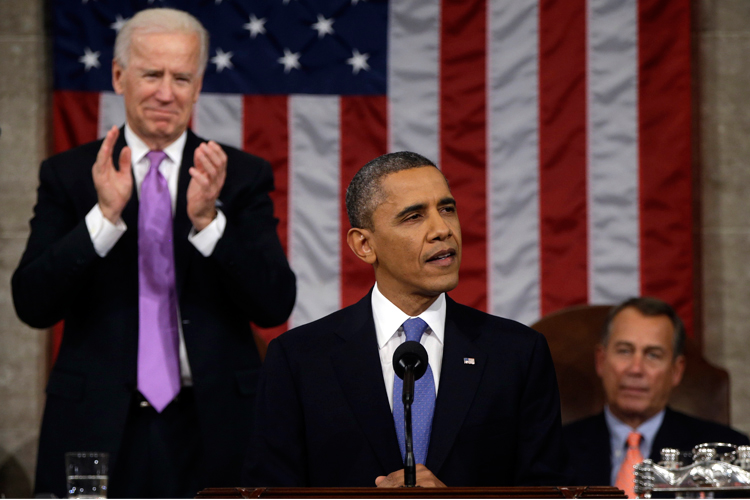
The President did not awkwardly reach for a bottle of water during his speech.  In fact, I don’t remember him drinking at all.  John Boehner, however, seemed to be sipping from his glass often.  When he wasn’t looking dour, that is.  I’ll write more about substance later, but this post is about impressions.

The best description of the Speaker is from Joan Walsh in Salon

But Boehner’s disdain was unrivaled. He also managed not to rise even for a shout-out to “wounded warriors,” or 102-year-old Deseline Victor, who waited seven hours to vote in Miami on Election Day. It was sometimes hilarious to watch him next to Vice President Joe Biden, who looked like a happy Easter Bunny with his white hair, lavender tie, pink-tinted glasses and green Newtown ribbon. Biden seemed to occasionally enjoy standing up, clapping while looking down at Boehner sulking in his chair.

This is what she means.

When John Boehner just sat there

And then we can move on to Maureen Dowd on Marco Rubio.

The ubiquitous 41-year-old — who’s on the cover of Time as “The Republican Savior” — looked as if he needed some saving himself Tuesday night as he delivered the party’s response to the State of the Union address in English (and Spanish). He seemed parched, shaky and sweaty, rubbing his face and at one point lunging off-camera to grab a bottle of water.

Oh, that water lunge.  How it will haunt poor Marco!

John Cassidy writing for the New Yorker, calls him “Water Boy”.

To be fair to Rubio, with a combination of eye contact and vigorous hand  gestures, he was doing a decent job with the tough task of delivering a lengthy  speech to a camera in an empty room. But then, for some reason—and it must have  seemed like an urgent one to him—he decided to reach for a small plastic bottle  on a nearby table and take a swig, thereby almost ducking out of the camera shot  and sending the Twitterverse into hysterics. “Uh-oh. Water gulp—really bad TV  optics,” Larry Sabato, a political science professor at the University of  Virginia, tweeted. “SNL, Colbert, Stewart…here they come.” After that  diversion, Rubio appeared to realize his error, and he looked a bit shaken. For  some reason, the camera closed in on his face, which didn’t improve things. As  the Democratic pundit Paul Begala cruelly noted on Twitter, the Senator was sporting a sheen  of sweat that inspired memories of Richard Nixon.

Meanwhile, the President looked confident and sometimes very passionate as when he mentioned the need for Congress to vote on gun safety legislation.

The Republicans looked more like their leader.

That is Paul Ryan in the center.

For right now, the President has the upper hand.  Neither Marco Rubio nor Rand Paul advanced any ideas beyond those from the last election – which they lost.  Plus they presented a bad image all around.  Maybe the Republicans are right in saying the President offered nothing new, nothing really that he didn’t talk about during the campaign, but there is a big difference:  Barack Obama won based in large measure on those ideas.  No wonder they look like four year olds being told they can’t have desert.  And poor Marco.  Only time will tell if he can overcome his reach for water.

Photographs AP/Charles Dharapak, Bill O’Leary/Post, Melina Mara/Post

What does Chuck Hagel have to do with Benghazi?

I wish someone would explain to me what someone who was not even a government official at the time has to do with Benghazi?  Is Chuck Hagel just leverage?  Believe me, the Obama Administration could show live action footage of the event as it unfolded and the Republicans still wouldn’t be happy.

According to Politico

One Armed Services Committee member, South Carolina Republican Sen. Lindsey  Graham, has made clear that he considers Benghazi and Hagel to be one issue —“no confirmation without information,” he said Sunday, threatening to block both  Hagel and CIA nominee John Brennan. Graham is demanding more details from the  administration about its response to the Benghazi attacks, particularly the  direct involvement of President Barack Obama.

And then you have James Inhofe.  Again from Politico

A spokeswoman for Sen. Jim Inhofe (R-Okla.) confirmed to POLITICO that he wanted  to drag out the confirmation process for the former Republican senator from  Nebraska.

Inhofe’s threat continued GOP brinksmanship that got under way on Sunday when  Republican aides first said that some senators might walk out of a meeting that  included a vote on Hagel. Inhofe and another top Republican on the committee,  Sen. John McCain of Arizona, both said Monday they would not walk out, but  Inhofe repeated his vow to press the battle against Hagel.

It appears very much as if the Republicans have forgotten that they are a minority in the Senate.  If Chair Senator Carl Levin calls for a committee vote, it will be along party lines which he didn’t want.  But I don’t think there will be any bipartisan agreement there.  According to the New York Times, Levin

…called Monday for a committee vote on Tuesday afternoon on the nomination of former Senator Chuck Hagel to be the next secretary of defense.

The committee action has been postponed for the past week over evolving demands from Republicans for new documentation on Mr. Hagel’s past statements, personal financial records and even a sexual harassment allegation involving two former staff members, but not Mr. Hagel himself. As action has drawn closer, Republican opponents to a former Senate Republican colleague have threatened filibusters and even a walkout from the committee.

Once Hagel’s nomination reaches the floor, vote counters believe that there will be 60 votes to break any attempt at a filibuster.  Maybe Majority Leader Reid need to reconsider his agreement with Senator McConnell since I don’t think it is going to work.

But Mr. Levin’s decision to call for a public discussion and vote, starting at 2:30 p.m. Tuesday ahead of President Obama‘s State of the Union address, indicated that the chairman still believes that Mr. Hagel has enough support to be confirmed. Committee aides say they have no indication that any Democrats or Senate independents will oppose him, putting him at 55 votes to start. Two Republican senators, Thad Cochran of Mississippi and Mike Johanns from Mr. Hagel’s home state, Nebraska, have pledged their support, and at least four Republicans have said they will oppose a filibuster.

And I still want to know what Chuck Hagel has to do with Benghazi, Senator Graham.  I think we all know that this really has to do with the fact that Hagel is not a war hawk and will figure out a way to cut the defense budget.

Photograph Brendan Hoffman for The New York Times

Stephen Lynch maybe changes his mind

Ok.  People do change their minds.  They evolve, as President Obama has said about his position on gay marriage.  But if you change your mind, you need to actually change your mind, not just kinda change it because it is politically expedient.

We have all known for years that Representative Stephen Lynch is against abortion.  He has famously referred to himself as a pro-life Democrat.  And unlike the pro-choice Republicans, the Democratic party has not run him out of town.  But, that is not a winning position outside of his Southie constituency.  He is one of them and, so far, that has been enough to keep him in Congress.  Lynch now says that abortion should be legal but rare. So today the Boston Globe ran this story

US Representative Stephen F. Lynch, who has consistently described himself as an antiabortion legislator, said Monday that he believes abortion is a constitutionally protected right and that as a US senator he would actively oppose anti­abortion nominees to the Supreme Court.

Forces on both sides of the issue charge that Lynch is shifting his stance as he tries to expand beyond his socially conservative political base in South Boston to a liberal statewide primary.

“He’s trying to have it both ways,” said Megan Amundson, executive director of NARAL Pro-Choice Massachusetts, a group backing abortion rights.

Anne Fox, president of Massachusetts Citizens for Life, the state’s leading antiabortion group, pointed out that when Lynch was representing South Boston in the state Senate, he had a 100 percent voting ­record from her group. When he ran for Congress in 2001, her group mailed out postcards urging voters to support him.

Now, Lynch is vowing to protect Roe v. Wade.

“Apparently, that’s what they think they’re supposed to do, politicians with their eyes on higher office, at least in Massachusetts,” Fox said.

It seems that no one is happy with him now.

To give Lynch some credit, he voted against Republican efforts to defund Planned Parenthood noting that the work they do helps reduce the number of abortions.

But Mr. Lynch, you need to do better than

“I don’t oppose it. I accept, I guess.” – Feb. 4, 2013, Globe interview, speaking of Roe v. Wade.

Interesting move against an opponent, Representative Ed Markey, who has been publically pro-choice since 1983.  But I think Lynch may reflect the confusion of a lot of voters.  As I said, it will be interesting.

Official congressional portrait of Stephen F. ...

Official congressional portrait of Stephen F. Lynch, member of the , in the 110th Congress. (Photo credit: Wikipedia)

Confirming Chuck Hagel

Republican Chuck Hagel, a former two-term senator from Nebraska and President Obama's choice to lead the Pentagon, testifies before the Senate Armed Services Committee during his confirmation hearing on Capitol Hill in Washington, Thursday, Jan. 31, 2013

Republican Chuck Hagel, a former two-term senator from Nebraska and President Obama’s choice to lead the Pentagon, testifies before the Senate Armed Services Committee during his confirmation hearing on Capitol Hill in Washington, Thursday, Jan. 31, 2013

Let’s just get this out of the way:  Former Senator Chuck Hagel is not perfect.  There are things that the Democrats don’t like (he may cut some of their pork, for one) and that the Republicans don’t like (he doesn’t seem to like war for example).  Hey, when both sides have some problems with you, maybe that does make you perfect!

I do think that Hagel will be confirmed at Secretary of Defense, but the vote will likely be close.  I like the nomination for exactly the examples I gave.  Hagel will have to cut the defense budget one way or another, he will have to deal with contractor abuses, and he will be very reluctant to get us into war.  And maybe he will begin a conversation within the administration about rules for drone strikes.  It seems to me that it will be useful to have to combat veterans, Kerry and Hagel, looking at issues of war and peace.

George Zornick has been followed the confirmation hearing for the Nation and has compiled his top ten ridiculous questions that were asked.  Here are some of the best.

He has divisions so first the “Please Admit You Hate America” Division

Senator James Inhofe, R-OK: The question I’d like to ask you, and you can answer for the record if you like, why do you think that the Iranian foreign ministry so strongly supports your nomination to be the secretary of defense?

“Please Pledge, Here and Now, To Start A War” Division

Senator John McCain, R-AZ: Do you think that Syrians should get the weapons they need and perhaps establish a no-fly zone? [A no-fly zone would, almost without question, quickly lead to a full-scale air war with Syria.]

It should be noted that almost everyone seemed to want to know if he would use force if necessary against Iran.

“Please Promise to Keep the Pork Flowing to my State” Division (the winners were all Democrats, two from New England, I picked Jeanne Shaheen for some gender balance.)

Senator Jeanne Shaheen, D-NH: Our four public shipyards are the backbone of our naval power. But according to the Navy there’s huge backlog of the modernization and restorations projects at our shipyards.… Will you commit to ensuring that this modernization plan is produced, and will you commit to pressing the Navy, within the fiscal constraints that I appreciate, to fully fund the improvements in the long term?

And finally we have questions that were ridiculous but “We Really Wish Hagel Would Have Answered ‘Yes’ To “Division

Senator Ted Cruz, R-TX: Senator Hagel, do you think it’s appropriate for the chief civilian leader for the US military forces to agree with the statement that both the ‘perception and the reality’ is that the United States is ‘the world’s bully’?”

All I can say is good luck Secretary Hagel.  We wish you well.

Photograph: AP Photo/J. Scott Applewhite

Hopes for Obama 2.0

I thought this was a good summary of President Obama’s first term and what we hope can be avoided.

And they are still working on it.  Just look at Mike Luckovich

The more things change the more they stay the same.  John McCain is mischaracterizing Hillary Clinton’s testimony and it looks, right now like Harry Reid is going to cave on filibuster reform after all but it is an evolving situation.

And if you want another sign that nothing has changed, John Boehner is accusing Obama of destroying the Republican party.  I think they are doing a pretty good job without the President’s help.

Collage of pictures of John Boehner crying.

Boehner Collage – Jed Lewison

The Democratic House Women of the 113th Congress

The New York Times Caucus blog has posted this picture.

Female members of the House Democratic caucus posed for a photograph on Thursday on the steps of the Capitol.

This is most of the 61 women of the Democratic House caucus.

Favoring hues of deep reds and blues, they gathered in the chilly January air, waving to old friends and greeting the new. They laughed and joked, cheekily inviting Representative Barney Frank, a departing Democrat from Massachusetts, to hop in the picture. (He politely demurred.) At one point, a young male aide to Nancy Pelosi, the House minority leader, scurried up to grab some of the members’ coats, juggling the fur and wool throw-overs in his left hand while trying to snap iPhone photos with his right.

As latecomers wandered up, the women called for the photographer to wait, pointing out the stragglers.

There will be 20 women in the Senate and 81 in the House – a record.  Debbie Wasserman Schultz is among the missing from the photograph, however.

But Representative Debbie Wasserman Schultz of Florida emerged from the House moments too late, just as the group was dispersing. However, all was not lost; the photographer took some shots of the late arrivals, and the caucus plans to Photoshop them in.

What did we do before Photoshop?  And don’t the women who did make it look wonderful?

Photograph by Mark Wilson/Getty Images

The “old” House votes on the fiscal cliff

David Jarman posted an interesting analysis of the voting on the Senate Bill to dodge the fiscal cliff in which he credits Nancy Pelosi for getting it done.  Here are some of the highlights.

Tuesday’s House vote on the fiscal cliff is one of those rare votes where you don’t get a straight party line vote like most contentious votes, but one where the House shatters into pieces and the winner is the side that reassembles the most fragments. Of course, this time it was Nancy Pelosi who did that, putting together a strange coalition of most of the Dems (minus a few defections on the caucus’s left and right flanks), plus the bulk of the establishmentarian and/or moderate Republicans (including the vote of John Boehner himself, no “moderate” but certainly “establishment”).

On the Republican side, there were 85 yes and 151 no votes (with 5 non-votes, from Ann Marie Buerkle, Dan Burton, Sam Graves, Jerry Lewis, and Ron Paul). That’s too many votes to replicate the entire list, but there was a significant geographic dichotomy here, one that seems to support the larger idea that the GOP is increasingly becoming a regional rump party.

Look at the New York Times map.  They also have the entire roll call at this link.

Map of fiscal cliff votes

Of those 85 yes votes, only 13 were Republicans from the Census-defined “southern” states, and many of those were either ones with ties to leadership (ex-NRCC chairs Tom Cole and Pete Sessions, Appropriations Chair Hal Rogers) or ones with atypical, moderate districts in Florida (Mario Diaz-Balart, Ileana Ros-Lehtinen, Bill Young). Rodney Alexander, Kevin Brady, Howard Coble, Ander Crenshaw, John Sullivan, Mac Thornberry, and Steve Womack, most of whom are also pretty establishment-flavored, round out the list.

And how did the Democrats vote?

On the Democratic side, there were 172 yes and 16 no votes (with 3 non-votes, from Pete Stark, Lynn Woolsey, and John Lewis). Within those 16, though, there seem to be two camps: Xavier Becerra, Earl Blumenauer, Peter DeFazio, Rosa DeLauro, Jim McDermott, Brad Miller, Jim Moran, and Bobby Scott (most of whom are Progressive Caucus members) voting against it from the left, and John Barrow, Jim Cooper, Jim Matheson, Mike McIntyre, Colin Peterson, Kurt Schrader, Adam Smith, and Pete Visclosky (most of whom are Blue Dogs) voting against it from the right.

It may not be that simple, though: DeFazio has in recent years been one of the likeliest members of the Progressive Caucus to stray from the party line (for example, he voted against both the Progressive budget and even the leadership budget last year); it’s increasingly hard to tell if he’s becoming more conservative or if DeFazio, always irascible, has just gotten more willing to dig his heels in on bills that feel like half-measures. Adam Smith, on the other hand, has generally been a New Democrat establishment-type player, but he might be looking to remake himself a bit with his newly configured, much more liberal district, which now contains a slice of Seattle. And Moran and Visclosky, even though Moran (who represents northern Virginia) is significantly more liberal than Visclosky, are probably coming from the same mindset, whatever that might be; they’re tight, and are some of the last remaining members of that John Murtha/Norm Dicks appropriations clique that didn’t really fit within any of the Dem caucuses.

Jarman doesn’t talk about Bobby Scott and John Lewis but both are in the Black Caucus as well as in the Progressive Caucus.  Lewis just didn’t vote, but Bobby (who I knew from back in my Virginia Days) represents a district that touches Eric Cantor’s and he might also have had the conservative white voter from his district in mind.

Jarman leaves us with this to think about

Fifteen of the GOP “yes” votes were members who, either because of defeat or retirement, won’t be coming back (Charlie Bass, Judy Biggert, Brian Bilbray, Mary Bono Mack, Bob Dold, David Dreier, Jo Ann Emerson, Elton Gallegly, Nan Hayworth, Tim Johnson, Steve LaTourette, Dan Lungren, Todd Platts, John Sullivan, and Bob Turner). Twenty end-of-the-liners, however, voted “no” (Sandy Adams, Todd Akin, Steve Austria, Rick Berg, Quico Canseco, Chip Cravaack, Jeff Flake, Frank Guinta, Connie Mack, Sue Myrick, Mike Pence, Ben Quayle, Denny Rehberg, David Rivera, Bobby Schilling, Jean Schmidt, Tim Scott, Cliff Stearns, Joe Walsh, and Allen West), though I suspect some of the more establishment-flavored names on that list would probably have been willing to offer a “yes” if the vote had looked closer than it actually was.

Tomorrow starts a new Congress so we can’t really look to this vote when we are reading the tea leaves about the upcoming fight on the debt ceiling and the budget.  There will be more Democrats – enough so Nancy Pelosi won’t need so many Republican votes (I think it may be 21, 17 with vacancies) – if John Boehner can be persuaded to bring things to the floor.

Looking back at 2012 progressively

2012 was a pretty good year for those of a progressive/liberal political point of view and Winning Progressive has compiled a good summary.  You can read the entire article here, but I’ve pulled out some of my particular favorites – in my own order of significance.

First I have to talk about Mitch McConnell who not only lost his effort to make President Obama a one-termer, but last night voted to increase taxes.  (Although since it happened after we technically went off the cliff  at midnight, he will probably spin it as a decrease.)  I think he an John Boehner were the big losers last year, not Mitt.  Mitt is done with politics, but McConnell and Boehner have to continue to try to herd their Republican members and get re-elected.

President Obama re-elected

So now to some accomplishments.

* President Obama Re-Elected With A More Diverse and Progressive Congress– The November elections saw the re-election of President Obama and the election of four new progressive U.S. Senators – Mazie Hirono (D-HI), Elizabeth Warren (D-MA), Chris Murphy (D-CT), and Tammy Baldwin (D-WI).  In addition, Joe Lieberman (I-CT) is finally leaving the Senate!  On the House side, the Democrats elected in November will be the first major party caucus in US history that is majority female and people of color.  New House progressives will include Alan Grayson (FL-09), Jared Huffman (CA-02), Dan Kildee (MI-05), Ann McLane Kuster (NH-02), Grace Meng (NY-06), Patrick Murphy (FL-18), Rick Nolan (MN-08), Mark Pocan (WI-02), Raul Ruiz (CA-36), Carol Shea-Porter (NH-01), Mark Tacano (CA-41), Hakeem Jeffries (NY-08), and Kyrsten Simena (AZ-09).  On the flip side, tea party conservatives Allen West (FL), Chip Cravaack (MN), Bobby Schilling (IL), Roscoe Bartlett (MD), Ann-Marie Buerkle (NY), Francisco Canseco (TX), and Joe Walsh (IL) were all defeat and, hopefully, will never be heard from politically again.

* LGBT Equality– 2012 was, of course, a banner year for advancing LGBT equality.  For the first time in US history, equality was supported by a majority of voters facing ballot proposals approving marriage equality in Maine, Washington, and Maryland, and refusing to ban equality in Minnesota. The first openly lesbian U.S. Senator, Tammy Baldwin (D-WI) was elected in November as were a record seven openly-gay House members.  President Obama publicly supported marriage equality, and anti-equality forces in Iowa failed in their effort to recall a state Supreme Court justice who declared that state’s ban on marriage equality unconstitutional.  In February, a federal appellate court ruled California’s anti-marriage equality Proposition 8 unconstitutional, and two federal courts in 2012 did the same with the Defense of Marriage Act.

* Health Care Reform – In a decision that surprised many commentators, the U.S. Supreme Court upheld the Patient Protection and Affordable Care Act, aka “ObamaCare.”And while the GOP-controlled House has voted at least 33 times to repeal ObamaCare, President Obama’s re-election in November virtually guarantees that will never occur.   In implementing ObamaCare, the Obama Administration, standing up to strong opposition from conservative religious organizations, finalized rules requiring that contraception be included as a preventive health service that insurance policies must cover with no co-pay.  This will help millions of women afford access to birth control and also save money by reducing unintended pregnancies.

Those are my personal big three.

Yes, there is a lot left to do and a lot that happened that I didn’t particularly think was terrific, but on the first day of a new year, we should celebrate our successes!