
The House passes still another restriction on abortion

Nancy Pelosi tweeted this picture with a quote from Representative Dent last night
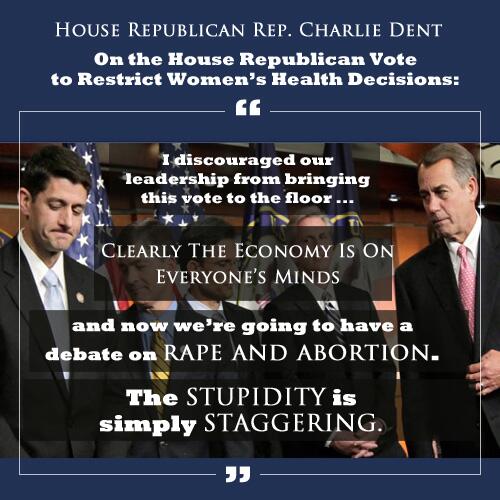
Embedded image permalink

Clearly the Republican leaders didn’t listen to Dent.  They love to have votes on abortion, birth control and, the favorite – repealing the Affordable Heath Care Act instead of actually passing measures that might also pass in the Senate and get signed into law.
The result of pandering again to their base was passage of a bill that will ban abortions after 22 weeks.  According to the New York Times story

The measure, which would ban abortion after 22 weeks of pregnancy based on the medically disputed theory that fetuses at that stage of development are capable of feeling pain, passed in a 228-to-196 vote that broke down mostly along party lines. Reflecting how little common ground the two parties share these days, just six Republicans voted against the bill; six Democrats voted for it.

“I’m not waging a war on anyone,” said Kristi Noem, Republican of South Dakota, offering a rejoinder to the Democratic assertion that Republicans have waged a war on women, a line of attack that harmed conservative candidates in 2012. “Regardless of your personal beliefs, I would hope that stopping atrocities against little babies is something we can all agree to put an end to.”

How about stopping atrocities like cutting food stamps and voting against bills that would provide health care and jobs for after this child that you have “saved” is born, Representative Noem?
But, remembering the bad press from hearings where all the legislators and all the witnesses were men discussing birth control the leadership did show they can learn something.

The tableau in the House chamber on Tuesday was intentionally far different from the scene last week at a meeting of the House Judiciary Committee at which all 19 of the Republicans arguing for and then voting to approve the bill were men. Republican leaders made sure that their female members were front and center for the debate this time.

Representative Virginia Foxx, a North Carolina conservative and Tea Party favorite, and Representative Marsha Blackburn, a longtime abortion opponent from Tennessee, were assigned to manage the floor debate. Representative Candice S. Miller of Michigan and Representative Ileana Ros-Lehtinen, one of the Republican conference’s more moderate members, controlled the gavel.

But the simple math was difficult to ignore. Only 19 of the 234 Republican House members are women. Nearly all of them spoke on Tuesday. Only three Republican men were allowed to participate in the debate. Notably, Trent Franks of Arizona, the bill’s sponsor who last week caused an uproar after claiming that instances of pregnancy after rape were “very low,” said nothing from the floor.

I think that 22 weeks is getting close to the time of viability which most see as 23 to 26 weeks.  As bills move ever closer to that line,  those of us who agree that women have a right to choose to continue the pregnancy or not will be faced with a difficult question and one that we need to be prepared to answer: where, if anywhere, should the line be drawn?

Even if Democrats believed the political upper hand was theirs as they used the issue of reproductive rights to portray their opponents yet again as hostile and indifferent to the needs of women, it was clear that the question at hand — the termination of pregnancies that are five months or more along — was an uncomfortable one.

At a news conference Tuesday morning led by Democrats who favor abortion rights, the mood quickly turned tense after two journalists tried to press the representatives about their support for late-term abortions. Representative Diana DeGette of Colorado cut off questions after being asked whether she would draw the line at legal abortion later in pregnancy. “The Supreme Court has spoken, and this bill is unconstitutional. Next question,” she said.

As medical science advances, the time limits laid out in Roe v. Wade may no longer hold.  There are medical and social costs to having a child born at 25 weeks.  In a 1997 story, the New York Times reported

”At the time of Roe vs. Wade it was around 26 weeks pregnant,” Dr. Ezra Davidson, past president of the American College of Obstetrics and Gynecology, said. ”It has come down a couple of weeks since that time.”

But many babies who survive birth at that stage have terrible problems.

”You have to temper any discussion about viability because though you may get into a 24-week period, or a 23-week period, a large portion of those infants are going to have serious disabilities,” Dr. Davidson said.

Most experts believe that the current limit of viability is 23 or 24 weeks into the normal 40-week term of pregnancy. Babies born at this stage are known as micropreemies and are extremely fragile. The typical micropreemie weighs 500 to 600 grams — slightly more than a pound — and can fit in the palm of a hand.

According to the American College of Obstetrics and Gynecology, fewer than 40 percent of infants born from 23 to 25 weeks’ gestation survive.

Moreover, Dr. William Taeusch, chief of pediatrics at San Francisco General Hospital, said: ”That’s strictly survival. That’s getting out of the hospital alive, usually at three months, at a cost of hundreds of thousands of dollars. And if you get out of the hospital alive and you haven’t had major problems, then your chances of having a normal brain are 90 percent.”

But according to the obstetrics and gynecology group, nearly 50 percent of surviving children who weigh less than 750 grams at birth experience moderate or severe disability, including blindness and cerebral palsy.

Things haven’t really changed a great deal since 1997.  This is from the Wikipedia article on fetal viability.

Fetal Viability Chart

Fetal Viability Chart

Of course, most women who don’t have late term abortions have a full term baby.  This means the mother and hopefully father need to have jobs and assistance in caring for the baby for the next 18 years – the kind of assistance the Republicans often vote against.  It means available contraception so women aren’t faced with the choice at all.  It means sex ed  beginning in middle schools that includes information on what it is like to care for a baby.  (What happened to those programs where teens had to care for a doll that was life-like and demanded diaper changes and feedings 25/7?)

I personally have problems with late term abortions that are not for medical reasons – either the mother’s or the child’s.  But I also think we should be spending what is needed to make sure those children are fed, educated and not abused.  And I understand why sometimes the decision is so late.

Jessica Valenti has column in the Nation thinking through many of these issues, but it is her conclusion that sticks with me.

Abortion is complicated, as are our lives and health—and the fact that these  choices are so complex and nuanced is precisely why we can’t legislate them.  Wishing otherwise will never 
make it so.

Putting the minimum wage in persective

Dan Wasserman of the Boston Globe explains why we need an increase in the minimum wage.

Wasserman 6-5

This needs to be a national increase.  Yes, I know.  When businesses have to pay more, they won’t hire.  But there is another side to their objection.  If they pay people more, then there will be more spending and more business and they can hire.  Plus there will be more payroll taxes paid on the larger salaries.  And more state and local taxes.  Conservatives would be happy because some folks wouldn’t need food stamps as a lot of working people do now.  Seems like a winner.

I know that some economists argue that increases always lead to higher unemployment, but a large number of small businesses already pay wages higher than the legal minimum.

Put simply, small businesses are our economy. Given that it’s still recovering, the economy needs all the help it can get to make it over the proverbial hump and flourish. Small businesses will play a key part in that journey.

Given their importance, politicians should stand up and take notice when small business owners say they strongly support a policy that has and will continue to elicit political fights of the knockdown drag-out variety, such as increasing the minimum wage. The minimum wage is a business issue that impacts a wide swath of small firms, and according to scientific opinion polling Small Business Majority released this week, two-thirds of them support increasing it and adjusting it annually to keep up with the cost of inflation.

Some have claimed that raising the minimum wage would put small firms out of business because they won’t be able to afford to pay their workers more. Our polling found a whopping 85 percent of small businesses across the country already pay their workers more than the minimum wage, though.

“You need to pay workers enough to survive. It’s in your best interest as a company because if you don’t there is nothing tying them to you.” That’s Clifton Broumand, the president of Man and Machine, a specialty computer product business in Landover, Md., who pays his workers more than the minimum wage and supports increasing it. “I want my employees to have the chance to grow and improve here. I want them to want to stay so we don’t have a lot of turnover. And I pay over minimum wage because it’s the right thing to do.”

The President proposed an increase to $9 in his State of the Union Address:  Let’s just do it.

Republican suicide in Virginia?

Having lived in Virginia for many years, I take more than a passing interest in the political scene there and this fall’s election will be a doozy!  Not quite sure what Virginia Republicans think they are doing, but unless everyone in Virginia has totally lost it, Terry McAuliffe should be the next governor.

This morning, the Washington Post has a story with 3 earlier related ones.  Here are the headlines with links:

E.W. Jackson a wild card in Va. GOP campaign  This is the main profile and biography.

Va. GOP’s E.W. Jackson: So far right he has said Democrats have ‘Antichrist’ agenda

E.W. Jackson complicates Cuccinelli bid

Va. GOP picks conservatives for fall ticket; black minister is lieutenant governor choice

So what exactly is going on in Virginia?   On May 18, the Post described the ticket this way

Thousands of Virginia Republicans on Saturday picked a slate of statewide candidates who vowed to stay true to conservative principles, resisting calls to remake the GOP message after losses in 2012.

At the top of the ticket is gubernatorial hopeful Ken Cuccinelli II, the attorney general. Known for high-profile battles against “Obamacare,” abortion and a university climate scientist, Cuccinelli stood by what detractors have called an out-of-the-mainstream agenda.

E.W. Jackson, a minister from Chesapeake, won the nomination for lieutenant governor with a full-throated appeal for limited government, traditional families and gun rights. “We will not only win an election in November, we will open the hearts and minds of our people and save this commonwealth and save this country,” said Jackson, the first African American nominated by the Virginia GOP for statewide office since 1988. [That was Doug Wilder, who won.]

For attorney general, the party nominated state Sen. Mark D. Obenshain (R-Harrisonburg), who this year successfully pushed tougher voter ID rules. “Are you ready to stop Obamacare in its tracks?” he asked the crowd in his acceptance speech, eliciting cheers.

Republican nominee for governor Ken Cuccinelli, right, is joined onstage with the other members of the ticket, including E. W. Jacksonon, second from left.

Republican nominee for governor Ken Cuccinelli, right, is joined onstage with the other members of the ticket, including E. W. Jackson, second from left.

It is as if the election last year never happened.  Mitt Romney didn’t lose.  Barack Obama never won.

But the candidate in the spotlight is Jackson.

Jackson’s improbable rise, one that has astonished Republicans far and wide, is the latest of a number of incarnations, including foster child, Marine, Harvard law school graduate and even Democrat. But the minister who is now GOP gubernatorial nominee Ken Cuccinelli II’s running mate has long used his booming voice to endear himself to conservatives.

Still, Jackson’s words — sometimes eloquent, sometimes raw, often impassioned — are causing anxiety for many Republicans as the resurfacing of his past statements about homosexuality and abortion have threatened to disrupt the campaign.

Instead of promoting their new ticket, Republicans have answered for Jackson’s once calling gays “perverted” and “sick” and saying Planned Parenthood has been “far more lethal” to blacks “than the KKK.”

Jackson has ties to Massachusetts which I didn’t know.

After a tour with the Marines, Jackson graduated with honors in 1975 from the University of Massachusetts, where he majored in philosophy. Then he graduated from Harvard Law School in 1978. He spent more than 20 years in Boston, practicing law, pastoring at New Cornerstone Exodus Church, serving as a chaplain to the Boston Fire Department, and hosting radio shows, including one called “Earl Jackson Across America.”

At one point, he was a Democrat, and he was elected to the party’s Massachusetts State Committee, where he distinguished himself with his conservative views. “I thought, ‘Wow, here’s a great potential leader,’ ” said James Roosevelt, who is a grandson of Franklin D. Roosevelt and who was then and is now legal counsel to the state Democratic organization. “Then I learned of his views, and I thought: ‘What’s he doing? This is not a leader of the Democratic Party.’ ”

Jackson became a Republican in the early 1980s, explaining that Democrats’ embrace of the gay rights movement violated his religious beliefs. In 1989, he joined the opposition to a proposal to ban discrimination against gays and lesbians in Massachusetts. “We intend to blow this bill to smithereens,” he told reporters then. “We intend to defeat this legislation and bury it so deep no one will ever find it again.”

Sorry Rev. Jackson.  We not only passed that bill, but we also have marriage equality.  I have to admit I never listen much to talk radio or to Jackson’s program.  He moved to Virginia in 1998, perhaps thinking the political climate there would be more in tuned to his views and clearly he was right about that: he is now the Republican nominee for Lt. Governor.  Jackson has also been affiliated with the Christian Coalition and the Tea Party.

“The Republicans I’m talking to are saying, ‘What the hell are they doing in Virginia?’ ” said Michael Steele, former chairman of the Republican National Committee. “Is this, ‘101 ways to lose an election’? You’re coming out of the gate with comments everyone has to explain. You’re wasting a lot of time and energy batting that back when you should be doing other things to get the guy known.”

Although unknown to many Republicans, Jackson in recent years has built a following among the most activist of Virginia’s conservatives, many of whom were delegates at the convention. But Republicans are now concerned, Steele said, that Jackson will turn off the party’s own voters. “You can’t have a situation where Republicans say, ‘You know what? I can’t have this’ and they stay home or vote for the other guy,” he said.

Added to the mix is the investigation of the current Republican governor, Bob McDonnell awkwardly headed by the current Republican Attorney General and nominee for Governor, Ken Cuccinelli who took money from the same supporter.  The New York Times has that story.

Virginia’s attorney general has appointed an outside prosecutor to investigate Gov. Bob McDonnell’s financial disclosures, in a widening scandal over a political donor who wrote a $15,000 check for the wedding of the governor’s daughter, and who was also a benefactor of the attorney general.

Kenneth T. Cuccinelli II, the attorney general, who is also the Republican candidate for governor this year, said on Wednesday that he named the outside prosecutor last November to look into Mr. McDonnell’s disclosures.

Mr. Cuccinelli said “information came to my attention” triggering the appointment of the prosecutor. His referral of the case to the Richmond commonwealth’s attorney, Mike Herring, whose role is similar to that of a district attorney, “was not a conclusion that any violation occurred,’’ Mr. Cuccinelli said in a statement.

The investigation came to light through a Freedom of Information Act request by The Richmond Times-Dispatch, which first reported it.

Mr. McDonnell and Mr. Cuccinelli, who are yoked in an awkward political alliance – the former a popular governor of a purple state and his would-be successor, a Tea Party favorite — have been swept up in controversy over their friendship with a Virginia businessman, Jonnie R. Williams Sr., who gave generously to both officials.

What a tangle!  Can Terry McAuliffe pull out a win for the Democrats?

“We’re in a deep [expletive],” said one Virginia Republican strategist. “The only good news is that the Democrats have Terry McAuliffe. It’s the only thing keeping us glued to a chance of victory.”

McAuliffe, a former Democratic National Committee chairman, has faced questions about his leadership of an electric car company and some unflattering quotes from his own memoir.

All I can say is “stay ‘tooned”.

Photograph: Steve Helber/AP

“No Drama Obama”

If I am not mistaken, that phrase first surfaced during the 2008 campaign to describe the lack of panic when Hillary Clinton won a string of smaller state primary elections.  People were panicking; the press was touting their new story about Clinton overcoming the Obama lead to take the nomination.  And Obama and his team just kept trucking along the planned path.  “No Drama Obama”.

President Obama during a news conference in the Rose Garden at the White House, May 16, 2013, in Washington, D.C.

President Obama during a news conference in the Rose Garden at the White House, May 16, 2013, in Washington, D.C.

So here are three things to ponder in light of the recent “scandals”.  The first is from an Andrew Sullivan post on the Dish.

Former Obama speechwriter Jon Favreau describes how Obama handles scandals:

The handwringers and bed wetters in the D.C. punditocracy should know that Barack Obama will never be on their timeline. He does not value being first over being right. He will not spend his presidency chasing news cycles. He will not shake up his White House staff just because of some offhand advice offered to Politico by a longtime Washingtonian or a nameless Democrat who’s desperately trying to stay relevant. And if that means Dana Milbank thinks he’s too passive; if it means that Jim VandeHei will keep calling him arrogant and petulant; if it means that Chris Matthews will whine about him not enjoying the presidency, then so be it. He’ll live.

Favreau knows him as well as anyone – and that rings true. It’s also a deep political strength. Most mortals cannot manage that no-drama glide – I sure can’t. Hillary is more easily provoked into hunkering down rather than sailing through. What troubles me, though, is not that the IRS clusterfuck and the VA backlog are signs of malevolence, but rather that they are indications of a government that doesn’t work right. And no president should glide past that.

The real issue, the one people, particularly the Republicans, may be missing is that President Obama, unlike Bill Clinton, is not all that interested in the nuts and bolts of governing.  If this is true, than Sullivan is correct:  Obama either needs to get interested or he needs to find some staffers that are interested.  I think that federal agency responsibilities have just gotten too big.  I’m not saying that we don’t need government and services, but that it may be time for a real review of whether we can cut some of the older programs or change them to be incorporated as part of newer ones.  Maybe we need another Al Gore waste in government study.  Or the President needs to step up his search for duplicate programs and add reoranizing for great efficiency.

The second is the fact the the President’s approval ratings don’t seem to be going down despite the best efforts of Darrell Issa and his friends.  Nate Silver summarizes

Political coverage over the last week has focused on a series of stories that reflect negatively on the executive branch — but President Obama’s approval ratings have held steady. As of Monday, Mr. Obama’s Gallup approval rating was 49 percent — the same as it was, on average, in April. Mr. Obama’s Rasmussen Reports approval rating was 48 percent, not much changed from an average of 50 percent in April. Mr. Obama’s approval rating in a CNN poll published on Sunday was 53 percent, little different from 51 percent in their April survey. And in a Washington Post-ABC News poll, Mr. Obama’s approval rating was 51 percent, essentially unchanged from 50 percent in April.

There are a lot of theories as to why Mr. Obama’s approval ratings have been unchanged in the wake of these controversies, which some news accounts and many of Mr. Obama’s opponents are describing as scandals. But these analyses may proceed from the wrong premise if they assume that the stories have had no impact. It could be that the controversies are, in fact, putting some downward pressure on Mr. Obama’s approval ratings — but that the losses are offset by improved voter attitudes about the economy.

Silver includes this graph.

If Silver is correct then the Republicans have to hope that one of their darts hit home or that the economy really tanks.  I’m one who is cautiously optimistic that we will have an actual budget come October making the sequester cuts go away.  If I am right, then the economy should remain in decent shape and maybe people will start hiring with the uncertainty removed.

I close with a bit of humor from Andy Borowitz who questions the ability of the no drama approach to any real scandal.

President Obama’s handling of controversies about the I.R.S., the Justice Department, and Benghazi has raised “grave doubts” about his ability to cope if he ever became involved in an actual scandal, prominent Republicans said today.

“If this is how he handles this stuff, Lord have mercy on him if he ever has to deal with a real scandal,” said newly elected Rep. Mark Sanford (R-S. Carolina). “Quite frankly, I don’t think he has what it takes.”

“The true test of a leader is this,” Rep. Sanford added. “When he gets in a fix, does he have the presence of mind to lie about his whereabouts? Sadly, I don’t think President Obama passes that test.”

No one can say that Mark Sanford’s life has been without drama!

It is fine for the President to continue without drama as long as his plan includes a hard look at the bureaucracy.

Photograph of the President: Mark Wilson/Getty Images

Taxes, taxes, taxes

Who was it that said, “Nothing is certain but death and taxes”?  They should have added tax loopholes and exemptions to that list.

Here in Massachusetts we have a Senate candidate who took at $281,000 tax credit for agreeing not to made changes to the facade of his home located in a historic district.  I don’t know how this works in other states but here local city and town councils can pass by-laws regulating historic districts.  Cohasset, the town where Gabriel Gomez lives, has a by-law on the books that says owners of homes in the historic district may not change the facades of their homes.  So Mr. Gomez basically took a tax credit for something he was prohibited from doing anyway.  Adrian Walker wrote this in the Globe this morning.

Challenged to explain, a testy Gomez set a new standard for chutzpah. He claimed that his tax break is really the fault of his opponent, Ed Markey — because in 1981, Markey voted for the law that established tax breaks for historical preservation.

OK.  So maybe taking the tax break was not illegal, but there is something about it that makes me – and it appears – other voters wonder if this is the guy we want representing us.  Plus there is the fact that most of us don’t make $281K over many years much less get to take that much off our taxes.

Walker continues

Andy Hiller of WHDH-TV cornered Gomez and asked a few questions about it, or tried to. What he got back from Gomez was this: “I don’t apologize for any success I’ve had. Absolutely not. I’m proud of everything I’ve done. I’ve worked for everything I’ve done. I’ve earned everything I’ve done.”

Gomez is an accomplished military veteran who has earned many things in his life, but he certainly didn’t earn this. Even the Internal Revenue Service has decried the historical-preservation deduction he took as a farce.

The questions about Gomez’s taxes probably haven’t ended, either.

On a financial disclosure form filed in March, Gomez said that under his separation agreement from the private equity firm Advent International, he received something called “carried interests.”

Carried interests are fees paid to equity firms and hedge funds to manage portfolios. They are taxed as capital gains, at a rate of 20 percent, rather than the top income rate of 39.5 percent.

Carried interests are fees paid to equity firms and hedge funds to manage portfolios. They are taxed as capital gains, at a rate of 20 percent, rather than the top income rate of 39.5 percent.

The carried interest rate — which costs taxpayers an estimated $1.3 billion a year — has long been the subject of dispute, with some critics arguing that this is one of the first tax loopholes lawmakers should close.

How much of Gomez’s income falls under the “carried interest” loophole is unclear from the disclosure form.

Gabriel Gomez is running as a reformer, as an outsider but as Walker points out, he already knows all the tricks.  Maybe we need someone like him to help reform the tax code – not!

Internal Revenue Service Building

Internal Revenue Service Building

Taxes are also at the heart of what the Republicans hope will be the scandal that brings down the Obama Administration if Benghazi doesn’t work out for them.  According to the New York Times this is what we know.

The Internal Revenue Service’s special scrutiny of small-government groups applying for tax-exempt status went beyond keyword hunts for organizations with “Tea Party” or “Patriot” in their names, to a more overtly ideological search for applicants seeking to “make America a better place to live” or “criticize how the country is being run,” according to part of a draft audit by the inspector general that has been given to Capitol Hill.

The head of the division on tax-exempt organizations, Lois Lerner, was briefed on the effort in June 2011, seemingly contradicting her assertion on Friday that she learned of the effort from news reports. But the audit shows that she seemed to work hard to rein in the focus on conservatives and change it to a look at any political advocacy group of any stripe.

Since last year’s elections, Republicans in Congress have struggled for traction on their legislative efforts, torn between conservatives who drove the agenda after their 2010 landslide and new voices counseling a shift in course to reflect President Obama’s re-election and the loss of Republican seats in the House and the Senate.

But the accusations of I.R.S. abuse are sure to fuel an effort that appears to be uniting dispirited Republicans and their conservative political base: investigating Mr. Obama and his administration. Republicans are pushing a portrayal of an administration overreaching its authority and punishing its enemies.

“The bottom line is they used keywords to go after conservatives,” Representative Darrell Issa of California, the chairman of the House Oversight and Government Reform Committee, said Sunday on the NBC News program “Meet the Press.” He requested the inspector general’s audit along with another Republican, Representative Jim Jordan of Ohio. As an audit, it will not find blame or refer anyone for criminal prosecution.

This all goes back to the Citizens United decision by the Supreme Count and the flood of organization, most it seems on the right to register as 501(c)4 social welfare groups.  This leaves me puzzled.  How can a group which supports political lobbying be tax exempt?  I give money to Planned Parenthood to support clinics.  I also give money for the political operations.  The first is tax exempt, the second is not.  So maybe the problem is, once again, with the tax code.  Ezra Klein explains.

Let’s try to keep two things in mind simultaneously: The IRS does need some kind of test that helps them weed out political organizations attempting to register as tax-exempt 501(c)4 social welfare groups. But that test has to be studiously, unquestionably neutral.

The story thus far seems both chilling and cheering. Employees at the agency’s Cincinnati branch did employ a test that, in effect, targeted tea party groups. Whether they meant it to be discriminatory or they simply created one that was discriminatory is in contention, but ultimately immaterial. The IRS, more so than almost any other agency, must act in ways above  reproach.

But when the Cincinnati group explained their test to IRS exempt organizations division chief Lois G. Lerner, she objected to it and it was changed. A few months later, the IRS would release new guidance that suggested scrutinizing “political action type organizations involved in limiting/expanding Government, educating on the Constitution and Bill of Rights, social economic reform movement,” and after that, “organizations with indicators of significant amounts of political  campaign intervention (raising questions as to exempt purpose and/or excess private benefit.)”

The context for all this is that after Citizens United and some related decisions, the number of groups registering as 501(c)4s doubled. Because the timing of that doubling coincided with a rise in political activism on the right rather than the left, a lot of the politicized groups attempting to register as 501(c)4s were describing their purpose in tea party terms. A popular conceit, for  instance, was that they existed to educate on the Constitution — even if the particular pedagogical method meant participating in Republican Party primaries and pressuring incumbent politicians.

In looking for that kind of language in 2010, the Cincinnati employees were attempting to create a usable shortcut. Like Willie Sutton robbing banks, they were going where the action was. But they needed a clearer test that also identified the language of the left, even if left-leaning  groups weren’t exhibiting the same surge in activism. And, frankly, it shouldn’t have been left to career employees in Cincinnati. The IRS needed clearer rules coming from the top. But the top didn’t know what to do with these 501(c)4s, in part because it feared a situation precisely like this one.

It is worth remembering an important fact here: The IRS is supposed to reject groups that are primarily political from registering as 501(c)4s. If they’re going to do  that, then they need some kind of test that helps them flag problematic applicants. And that test will have to be a bit impressionistic. It will mean taking the political rhetoric of the moment and watching for it in applications. It will require digging into the finances and activities of groups on the left and the right that seem to be political even as they’re promising their activities are primarily non-political.

If we’re not comfortable with that, then we need to either  loosen the definition of 501(c)4s or create a new designation that gives explicitly political groups the benefits of the 501(c)4s (namely, they don’t have to pay taxes and they can keep their donors anonymous). But either way, as I wrote on Friday, the only way to make sure this doesn’t keep happening is for the IRS — or the Congress and White House that control it — to make some tough decisions about 501(c)4s.

To make things look even more suspicious, Ms. Lerner appears to have been confused about the order in which events unfolded.  But, is there a scandal here?   It does not appear that any group, on the right or left has been denied 501(c)4 status.  I believe that to get 501(c)3 status which most community development groups and organizations like the Girl Scouts and the Boys and Girls clubs have one must provide a lot of information including board membership and by-laws.  The problem here is that many these new groups appear to be political organizations regardless of whether or not they claim to be educational.  I question whether any of these groups, right or left, should be tax exempt.

“Tax-exempt social-welfare groups organized under section 501(c)(4) of the Internal Revenue Code are allowed to engage in some political activity, but the primary focus of their efforts must remain promoting social welfare. That social-welfare activity can include lobbying and advocating for issues and legislation, but not outright political-campaign activity. But some of the rules leave room for IRS officials to make judgment calls and probe individual groups for further information. Organizing as such a group is desirable, not just because such entities typically don’t have to pay taxes, but also because they generally don’t have to identify their donors.” John D. McKinnon and Siobhan Hughes in The Wall Street Journal.

The odds are against Mr. Gomez being elected to the Senate and they are likely to be against the Republicans making a credible argument about the IRS, but taxes and tax exemptions are clearly land mines for anyone in politics today.  But if the Republicans are right, that is a place where the Obama Administration and I will part company.  As my Congressman Mike Capuano said today, “There’s no way in the world, I’m going to defend that. [if the accounts are true] Hell, I spent my youth vilifying the Nixon administration for doing the same thing.”

Photograph:  Reuters

Let’s Define Hypocrisy

Best summary of what is up with the Republicans and Benghazi, including a reminder from Steve Lynch of MA that the Republicans all voted to cut the embassy security budger.

h2dog's avatarDesert Dogmeh

Republicans remind us not to politicize something that they have been, and are currently, hell-bent on politicizing.

Seems fair.

Republicans lead a witch hunt on Benghazi

By Eugene Robinson,

May 09, 2013 11:31 PM EDT

The Washington Post

Those who are trying to make the Benghazi tragedy into a scandal for the Obama administration really ought to decide what story line they want to sell.

Actually, by “those” I mean Republicans, and by “the Obama administration” I mean Hillary Clinton. The only coherent purpose I can discern in all of this is to sully Clinton’s record as secretary of state in case she runs for president in 2016.

Did Clinton’s State Department fail to provide adequate security for the U.S. Consulate in Benghazi? In retrospect, obviously so. But the three diplomats who testified at the hearing gave no evidence that this failure sprang from anything other than the need to…

View original post 797 more words

How to get a functioning government

Winning Progressive had a very interesting and thoughtful post this morning by NChrissie B.

We need political fringes because that’s where most new ideas begin. Many will be bad ideas, like the House Republican Budget’s plan to turn Medicare into a voucher program. Others will be good ideas, like the financial transactions tax in the Congressional Progressive Caucus “Back to Work” Budget. As the Economic Policy Institute report noted, that tax would “raise significant revenue while dampening speculative trading and encouraging more productive investment.” It would also discourage individual investors from day-trading and other mistakes that churn their savings into brokers’ profits.

New ideas tend to start on the fringes – right and left – because the fringes don’t have to govern. Think tanks, academics, pundits, and bloggers can kick around ideas without worrying about whether the ideas are politically viable. We did that at BPI when we discussed a Guaranteed Basic Income, an idea from and still on the political fringe. We didn’t talk about whether it could pass in the House or Senate. It couldn’t, at least not soon. But it might gain traction in some form, at some point, and such discussions open our eyes to other perspectives on work, wages, and the social safety net.

I wrote in my unpublished dissertation that social movements need racial fringes to make the movement look mainstream.  NChrissie B.  is arguing that the same is true of  legislating.  The danger, however, is that the Democrats ignore their progressive or left wing while the Republicans are ruled by their right or Tea Party wing.  This is where we seem to be right now and nothing is functioning.  We need to get back to a place where there is a middle ground.  NChrissie B. uses the Overton Window as an illustration.

overton window

I’d like to see the window moved a little more to the left and I think that could happen if Harry Reid would just fix the damn filibuster rules.  I also think the Democrats (and President Obama) need to take the Progressive Caucus budget a little more seriously than they do.  It would also help if Mitch McConnell grew a backbone.

Impasse?! We should look at the Progressive Caucus Budget

President Obama met with the Republicans in the House yesterday.  I think Politico had the best take on the meeting.

After years of pining for more face time with the president, House Republicans  found out Wednesday that Barack Obama looks and sounds the same behind closed  doors as he does on TV.

President Obama meets with Congress. AP Photograph

President Obama meets with Congress. AP Photograph

I think they are finally learning what many of us have known for a while:  what you see is what you get with Barack Obama.  Michelle has been trying to tell everyone this for years.  So he has his line and the Republicans led by Paul Ryan have theirs.  But where does that leave the rest of  us?  How to deal in a meaningful way with the sequester and the budget?  I see two paths:  One, those affected by the cuts start putting on the pressure and two, we begin looking at alternatives to either the Republican or White House budget proposals.

On the first, the lobbying has begun.  The New York Times reports

Construction companies are lobbying the government to spare their projects from across-the-board cuts. Drug companies are pleading with the White House to use all the fees they pay to speed the approval of new medicines.

And supporters of Israel have begun a campaign to make sure the Jewish state receives the full amount of military assistance promised by the United States.

A frenzy of lobbying has been touched off by President Obama’s order to slice spending this year by $85 billion, divided equally between military and civilian programs. The cuts have created new alliances and strange bedfellows.

Hunter R. Rawlings III, a historian of ancient Greece who is the president of the Association of American Universities, joined Wesley G. Bush, the chief executive of Northrop Grumman, the maker of surveillance drones and B-2 bombers, in a news conference in which they denounced the automatic cuts known as sequestration.

Health care and education groups, advocates for poor people, and state and local officials who fought in the past for bigger budgets are now trying to minimize the pain.

How much money do you think will be spent on lobbying?  I don’t even want to begin to add it up.  What a waste of money.  But I guess some people will still have jobs.

For an alternate budget we can look at the Congressional Progressive Caucus budget proposal.    The Economic Policy Institute assisted in putting the budget together and scoring it.  Dean Baker from the Center for Economic and Policy Research calls it “A Serious Budget That the Serious People Won’t Take Seriously”.  The Progressive Caucus has been proposing budgets for a number of years now and takes the position that if their proposals had been adopted, we wouldn’t be in the mess we are in now.

So what exactly are they proposing?

Direct hire programs that create a School Improvement Corps, a Park Improvement Corps, and a Student Jobs Corps, among others.

Targeted tax incentives that spur clean energy, manufacturing, and cutting-edge technological investments in the private sector.

Widespread domestic investments including an infrastructure bank, a $556 billion surface transportation bill, and approximately $2.1 trillion in widespread domestic investment.

Ends tax cuts for the top 2% of Americans on schedule at year’s end

Extends tax relief for middle class households and the vast majority of Americans

Creates new tax brackets for millionaires and billionaires

Eliminates the tax code’s preferential treatment of capital gains and dividends

Abolishes corporate welfare for oil, gas, and coal companies

Eliminates loopholes that allow businesses to dodge their true tax liability

Calls for the adoption of the “Buffett Rule”

Creates a publicly funded federal election system that gets corporate money out of politics for good.

Provides a Making Work Pay tax credit for families struggling with high gas and food cost 2013-2015

Extends Earned Income Tax Credit, and the Child and Dependent Care Credit

Invests in programs to stave off further foreclosures to keep families in their homes

Invests in our children’s education by increasing Education, Training, and Social Services

It would also end the war in Afghanistan and do selective, not blanket cuts to the military budget.  It basically spends money to put people back to work and stabilize the economy.  This assumes that people who work pay taxes and put money back into the economy.  It also achieves deficit reduction.  All through government spending.  As Dean Baker poinst out

For those upset that the budget debate is getting ever further removed from the real world problems of an economy that is suffering from a deficit of 9 million jobs, there is good news. The Congressional Progressive Caucus (CPC) has produced a budget that is intended to make the unemployment situation better rather than worse.

The story of course is that we are still in a situation where we need the government as a source of demand in the economy. This is independent of how much we like the government or the private sector. The private sector does not expand and create jobs just because governments want it to, as is being discovered now by leaders in the United Kingdom, Greece, Italy, Spain and everywhere else where deficit reduction is now in vogue. In the current economic situation, loss of demand from the government is a loss of demand to the economy. That is why recent steps to reduce the deficit, such as the ending of the payroll tax cut (which put money in consumers’ pockets) and the sequester, will lead to slower growth and higher unemployment.

Would this happen with the adoption of the progressive budget?  I don’t know, but I know that what is going on now isn’t working either.  And what is worse, people are tuning out and shrugging their shoulders assuming nothing can be done.

Gail Collins has this fantasy.

White smoke poured from the Capitol today and crowds of onlookers broke into shouts of jubilation, crying: “We have a budget!”

Inside, where the nation’s legislators had been walled off in seclusion, the newly chosen tax-and-spending plan was garbed in the traditional brass staples for its first public appearance. Insiders said it planned to take the name of Budget for Fiscal Year 2014.

I guess that is alternative number three.  Maybe we should try sequestering Congress.

Star Trek or Star Wars

I’m a fan of the original Star Trek and of the first Star Wars trilogy.  I guess I dropped out after that, maybe moved on or something.  But putting that aside, I love this Ruben Bolling.  Sums up the cultural reference controversy and the sequester all in one.

tom 3-13-2013

OK. No one cares about the sequester

No one cares about the sequester.  Or maybe, no one knows about it.  Or maybe everyone is just tired of Congress.

Here is Mike Luckovich today with a history of our recent financial crises.

Gee.  I don't know why you think all this is my fault.

Gee. I don’t know why you think all this is my fault.

No wonder the general public doesn’t care right now.  And they probably won’t care until cuts start to hurt them.  Let’s face it:  both sides are using those old techniques of  putting forward the arguments that make the best case for their point of view.  The Republicans are right in that it won’t hurt for a little while – maybe a month or so.  And the Democrats are right that this whole exercise is unnecessary and, in the long run not helpful to recovery.

Thomas Mann and Norman Ornstein who wrote the excellent book, “It’s Even Worse Than It Looks”, have an excellent piece in today’s Washington Post titled “Five myths about the sequester”.

1. Blame Obama — the sequester was his White House’s idea.

Identifying the origins of the sequester has become a major Washington fight. Bob Woodward weighed in recently with a Washington Post op-ed making the case that the idea began in the White House. He’s right in a narrow sense, mainly because he focuses on the middle of the 2011 negotiations between Obama and Republican lawmakers. If you look before and after, a different picture emerges.

In our view, what happened is quite straightforward: In 2011, House Republican leaders used their new majority to force their priorities on the Democratically controlled Senate and the president by holding the debt limit hostage to demands for deep and immediate spending cuts. After negotiations between Obama and House Speaker John A. Boehner failed (Eric Cantor recently took credit for scuttling a deal), the parties at the eleventh hour settled on a two-part solution: immediate discretionary spending caps that would result in cuts of almost $1 trillion over 10 years; and the creation of a “supercommittee” tasked with reducing the 2012-2021 deficit by another $1.2 trillion to $1.5 trillion. If the supercommittee didn’t broker a deal, automatic spending cuts of $1.2 trillion over the next decade — the sequester — would go into effect. The sequester was designed to be so potentially destructive that the supercommittee would surely reach a deal to avert it.

The sequester’s origins can’t be blamed on one person — or one party. Republicans insisted on a trigger for automatic cuts; Jack Lew, then the White House budget director, suggested the specifics, modeled after a sequester-like mechanism Congress used in the 1980s, but with automatic tax increases added. Republicans rejected the latter but, at the time, took credit for the rest. Obama took the deal to get a debt-ceiling increase. But the president never accepted the prospect that the sequester would occur, nor did he ever agree to take tax increases off the table.

And of course no deal has been reached yet.

2. At least the automatic cuts will reduce runaway spending and begin to control the deficit.

What runaway spending? The $787 billion stimulus was a one-time expenditure that has come and gone. Under current law not including the sequester, non-defense discretionary spending as a share of the economy will shrink to a level not seen in 50 years. Defense spending grew substantially over the past decade, but that pattern has slowed and will soon end. Additional reductions must be achieved intelligently, tied to legitimate national security needs.

The annual budget deficit is projected to fall by almost 50 percent in 2013 compared with the height of the recession. Reducing the deficit over the long term requires going where the money is — boosting economic growth, controlling health-care costs and increasing revenue to handle the expense of an aging population. Deeper discretionary-spending cuts are counterproductive; immediate cuts, as Europe has made recently, could lead to a recession and bigger deficits.

I guess the Republicans want us to be like Greece after all.

And finally, one for the Democrats.

4. The cuts are so large, they will be catastrophic.

The administration has released state-by-state estimates of the sequester and highlighted the cutbacks most likely to harm or inconvenience the public. The reality is not so immediate or dramatic. The damage will accumulate in less visible ways, as irrational reductions in public spending impede economic growth and job creation; reduce investments in education, infrastructure and scientific research; and further disrupt the routines of a modern democracy. The longer the sequester remains in place, the more harm is inflicted.

So it may take a while to feel the cuts.  Maybe long enough for the Obama Administration to submit a sensible budget that everyone can agree on.  And no, I’m not smoking anything.  Just counting on mayors and governors to continue to put the pressure on Congress.