Women, gun violence, and domestic violence

According to the op-ed by Nicolas Kristof in last Sunday’s New York Times Review,

Sometimes there’s a perception that domestic violence is insoluble, because it’s such a complex, messy problem with women who are culprits as well as victims. Yet, in fact, this is an area where the United States has seen enormous progress.

Based on victimization surveys, it seems that violence by men against their intimate partners has fallen by almost two-thirds since 1993. Attitudes have changed as well. In 1987, only half of Americans said that it was always wrong for a man to beat his wife with a belt or stick; a decade later, 86 percent said that it was always wrong.

A generation ago, police didn’t typically get involved. “We would say, ‘don’t make us come back, or you’re both going to jail,’ ” recalled Capt. Leonard Dreyer of the DeKalb County Sheriff’s Office. In contrast, sheriff’s officers now routinely arrest the aggressor.

I have to admit that I am skeptical, but hope that his numbers are correct.  Even Kristof opens his column with ” [w]hat strikes one American woman in four and claims a life in the United States every six hours?”  A high profile case such as that of Jared Remy who killed his girlfriend, Jennifer Martel in front of their young daughter confirms that at point at which a woman makes an effort to leave a relationship is the point at which she is most likely to be killed.  Kristof himself recounts this story

American women are twice as likely to suffer domestic violence as breast cancer, and the abuse is particularly shattering because it comes from those we have loved.

“He’s the only person I’ve ever loved,” Ta’Farian, 24, said of her husband, whom she met when she was an 18-year-old college student. He gradually became violent, she says, beating her, locking her up in a closet, and destroying property.

“My family was like, ‘He’s your husband. You can’t leave him. How would you support yourself?’ ”

Still, she says, it became too much, and she called 911. Police arrested him. But she says that the day before the trial, her husband called and threatened to kill her if she testified against him, so she says that out of a mix of fear and love she refused to repeat in court what had happened. Her husband was let off, and she was convicted of false reporting of a crime.

I was still thinking about the Kristof column this morning when I read this front page story in this morning’s Boston Globe on women who buy and hold guns for men.

…As law enforcement agencies and the administration of Mayor Martin J. Walsh ponder ways to get guns off the street, they are learning that targeting the men who historically have been the primary actors in violent crimes is not enough.

They must also disrupt networks of women who buy and hold weapons for men to use.

“We are seeing women with weapons who do not have a direct role in the city’s gun violence,’’ said Jake Wark, spokesman for Suffolk County District Attorney Daniel Conley. “But they are turning up with firearms that are used in that violence.”

Debora Seifert, a special agent with the Bureau of Alcohol,  Tobacco, Firearms and Explosives in Boston, said that she has worked on cases in which women bought firearms for boyfriends who are drug dealers.

Police confiscated a shotgun and ammunition from Arianna Talbert’s Dorchester apartment last year.

“These women can go into a gun shop and buy these guns for a violent criminal,’’ said Seifert. “They can use these weapons to victimize someone in their communities.”

Jahmeilla Tresvant is facing gun charges in two cases. In one, police believe she was holding a gun for her brother

Jahmeilla Tresvant is facing gun charges in two cases. In one, police believe she was holding a gun for her brother

These guns are often hidden in apartments rented by the women and their discovery can result in eviction.

While research is scant on women’s involvement in the gun problem, studies have been clear about who is leading violence by firearms, said David Hemenway, a professor of public health at Harvard School of Public Health.

Men and teenage boys drive gun crime either as victims or perpetrators. If a woman buys a gun, Hemenway added, she is more likely to be buying it for someone who cannot legally buy a gun.

“These young females find themselves facing jail time for holding that gun,’’ said Evans [Boston Police Commissioner William Evans] in a statement.

The mindset that let Ta’Farian stay with her abusive husband is the same one that causes the young women to buy and hold guns.

In the war on illegal guns, Ruth Rollins has heard it all. She’s an advocate for women whose own son was shot and killed. Women have long been flying under radar in police sweeps for illegal guns, she said. And women have become easy prey for criminally-minded men, who are becoming savvy in avoiding arrest for gun possession by having female relatives, partners, or juveniles hold firearms for them.

Women have said they hold the guns for a variety of reasons: to get a few extra dollars, to get drugs, or simply to feel needed. The firearms are sometimes used as community guns stored in a central location, and anyone, from a wayward juvenile to a terrified young man, can have easy access to them.

“It’s no different from years ago when a woman would hold drugs for their men. They would do it for money. They would do it for love,’’ said Rollins. “Now they are holding these guns and they are doing it in the name of love.”

Kim Odom, who lost her 13-year-old son to violence, said some women feel a deep sense of commitment to their men, even the ones wrapped up in crime.

“They are of the mind-set that they are ‘ride-or-die chicks,’ ” Odom said. “These are young ladies who are willing to go all out for their boyfriends.”

This is just another kind of domestic violence.  Maybe more psychological than physical, but still domestic violence.  And like incidents of domestic violence which end either in death or injury to the woman or in which the woman ends up killing her abuser. [And yes, I do know that women can also be abuser, but men  still make up the vast majority.]

Over past year and a half Rollins and Odom have been training and educating women about the consequences of buying and stashing weapons. They urge women to make pledges to not hold or buy guns and warn them of the penalties if caught. For instance, a person who makes a straw purchase faces up to 10 years in prison under federal law, US authorities said.

Their effort, called Operation LIPSTICK, is run through Citizens for Safety, which has enlisted the help of local law enforcement and the mayor to press the issue. On Feb. 25, the group kicked off an ad campaign on the MBTA,  with placards on subway trains  declaring, “His Crime, Your Time — Holding His Gun Can Land You in Jail.”

Perhaps if we used some of the new technology that would prevent anyone but the gun purchaser from firing it, we would be able to cut down on some of the urban gun violence and some young women would be able to stay out of prison.  Massachusetts Senator Edward Markey has proposed a Smart Gun bill.  We should support it.

Photograph:  Dina Rudick/Globe Staff

Globe story:  Meghan E. Irons

Micro-housing for the homeless

Here in Boston as well as in other cities there has been a lot of talk about small apartment with lower rents for young professionals.  The Boston Globe had a story last July about the effort to drop both unit size and price.

The kitchen and living area of a 530-square-foot apartment at Factory 63 in the Innovation District (top).

The kitchen and living area of a 530-square-foot apartment at Factory 63 in the Innovation District (top).

Last month, Shen [Kairos Shen, Chief Planner for the Boston Redevelopment Authority] drafted a memo to the Zoning Board of Appeals stating that the BRA supports smaller sizes for all unit types near transit stops. In addition to 450-square-foot studios, it is also allowing one bedrooms to drop to 625 square feet from 750; and two bedrooms to 850 feet from 900 feet.

The change is a compromise with critics who have pressed the Menino administration to allow units as small as 350 square feet — known as microapartments — to help cut housing costs. So far, the administration is only allowing those units to be built in the South Boston Innovation District, where it is still testing whether they are viable and being priced at affordable levels.

“So far we’re seeing those apartments rent for $2,100, $2,200, and $2,300 a month,” Shen said. “That’s beyond what everyone expected, so we have to have a better mechanism in place to ensure that the pricing is fair.”

Boston is one of many high-cost cities immersed in a nationwide debate over minimum housing sizes. San Francisco is now allowing units as small as 220 square feet, and cities from Des Moines to Chicago to Portland, Ore., are experimenting with smaller units. In Seattle, developers are building apartments as small as 140 square feet.

Having read about these small units for young professionals, the recent New York Times story about an innovative housing solution for a group of homeless persons caught my eye.  It was  a long story in the Home and Garden section which most often features high-end renovations and not affordable housing.

On Christmas Eve, Kevin Johnson received the following gifts: a bed and mattress, a blanket and sheets, a desk and chair, a toilet and sink, towels and washcloths, toothpaste and floss, and a brand-new house.

Mr. Johnson, a 48-year-old day laborer, did not find that last item beneath the Christmas tree, although it nearly would have fit. At 144 square feet — 8 by 18 feet, or roughly the dimensions of a Chevrolet Suburban — the rental house was small. Tiny would be a better descriptor. It was just half the size of the “micro” apartments that former Mayor Michael R. Bloomberg proposed for New York City.

Quixote Village opened Dec. 24 on 2.1 acres in an industrial park near Washington’s capital.

Quixote Village opened Dec. 24 on 2.1 acres in an industrial park near Washington’s capital.

What really made the project unique was not only the size of the units but the fact that they were built for a specific group of homeless persons, Camp Quixote,  who were involved in siting and design.

Beyond its recent good fortune, the settlement was — and is — exceptional. Quixote Village, as it is now called, practices self-governance, with elected leadership and membership rules. While a nonprofit board called Panza funds and guides the project, needing help is not the same thing as being helpless. As Mr. Johnson likes to say, “I’m homeless, not stupid.”

A planning committee, including Mr. Johnson, collaborated with Garner Miller, an architect, to create the new village’s site layout and living model. Later, the plans were presented to an all-camp assembly. “Those were some of the best-run and most efficient meetings I’ve ever been involved in,” said Mr. Miller, a partner at MSGS Architects. “I would do those over a school board any day.”

The residents lobbied for a horseshoe layout rather than clusters of cottages, in order to minimize cliques. And they traded interior area for sitting porches. The social space lies outside the cottage. Or as Mr. Johnson put it, “If I don’t want to see anybody, I don’t have to.”

The size also cuts the cost of construction.

Some advantages to building small are obvious. Ginger Segel, of the nonprofit developer Community Frameworks, points to construction costs at Quixote Village of just $19,000 a unit (which included paying labor at the prevailing commercial wage). Showers, laundry and a shared kitchen have been concentrated in a community center. When you add in the cost of site preparation and the community building, the 30 finished units cost $88,000 each.

By comparison, Ms. Segel, 48, said, “I think the typical studio apartment for a homeless adult in western Washington costs between $200,000 and $250,000 to build.” In a sense, though, the difference is meaningless. Olympia and surrounding Thurston County hadn’t built any such housing for homeless adults since 2007.

The units, unlike the micro apartments built for young professionals, have no kitchens, laundry or shower facilities.  Those are housed in a community center.  Creating Quixote Village took state funding, the city donating the vacant industrial park land, and a number of churches that had worked with Camp Quixote.  The rent is,  for the most part, subsidized.

Residents wanted a horseshoe layout rather than a cluster and traded interior space for sitting porches.

Residents wanted a horseshoe layout rather than a cluster and traded interior space for sitting porches.

For some of the residents a unit at Quixote Village may turn out to model Housing First.

Jon Waddey … describes Quixote Village “not as an end, but a means.” He had been cooking in a restaurant that closed, and bottomed out in jail on a felony heroin possession.

Even after starting methadone, he was in no state to look for another job. “I had a huge beard,” he said. “I needed a place to shave and shower. I just needed a place to feel human.”

At other homeless shelters, the staff rummaged through your bags, breathalyzed you and kicked you out from morning to evening time. “It’s a horrible feeling having no place to be,” Mr. Waddey, 41, said. At a facility like that, “you’re really made to feel where you’re at.”

Of his new cottage, he said: “I absolutely love it. I have my little writing desk, my reading desk, a lovely view of the trees. In a way, that’s what I’ve always wanted.”

A few weeks after settling into Quixote Village, Mr. Waddey was starting to investigate how long it would take at the Evergreen State College to finish his long-deferred undergraduate degree. At night, he was making his way through the John le Carré BBC mini-series “Smiley’s People,” and cooking for friends in the community kitchen.

“I think cooking is one of the most fundamental things you can do,” Mr. Waddey said. “To feed people and see how happy it makes them.”

Is the Quixote Village model sustainable?  Can it be replicated?  Can the residents survive in a former industrial park with drainage problems?  It is much to early to tell, but it has at least provided 29 people shelter, community, and hope.

Photograph:  Boston micro unit John Tlumacki/Globe Staff

Photographs of Quixote Village: Jeremy Bittermann for The New York Times

Housing the homeless

Sometimes it just takes an illness in the family or a loss of job often combined with drug or alcohol abuse to make someone homeless.  Throw in the cost of rent – even for an affordable unit – and the scarcity of rental units and you have a problem with housing the homeless.

A view of the Pine Street Inn Homeless Shelter

A view of the Pine Street Inn Homeless Shelter

Each year the Department of Housing and Urban Development (HUD) requires a census of the homeless population.  This includes people living on the streets, in shelters, in motels, and anyone who, on the night of the census, is in a treatment program or hospital but has no other address.  The City of Boston does its census in December; most other localities in January.  At the end of January, the Boston Globe reported the results for Boston.

The number of men, women, and children living in shelters or on the streets in Boston continues to increase, growing 3.8 percent in 2013 over the previous year, according to an annual city tally.

The city identified 7,255 homeless people living in the city when volunteers conducted the annual homeless census last month, up from 6,992 during its 2012 count.

The census found 1,234 homeless families on the night of the survey, as well as 2,056 homeless children, the first time Boston counted more than 2,000 homeless children since the city began keeping track more than three decades ago.

That’s a lot of people.

While the raw number of homeless people in Boston continues to increase year after year, city officials stress that very few of the city’s homeless adults, just 2.5 percent, are living on the street. The number of homeless living in emergency shelters, domestic violence shelters, hospitals, and substance abuse homes saw significant increases from 2012.

The citywide census located 180 adults who were living on the street, down from 193 in 2012

This has been a very cold winter with lots of snow early.  I’ve learned that many of those 180 persons have mental health issues which make it doubtful that they would move to a shelter or accept housing.  Others prefer the streets to a crowded shelter. Boston reduced the number living on the street with a “housing first” program.  This model moves the person into housing, and then provides supportive services rather than providing services first and then shelter.  The Boston Globe explained it this way in a June 2007 story.

In the past, society’s approach to homeless people with chronic health problems such as addiction has been governed by tough love: Stay in treatment, or you don’t get the opportunity for publicly supported housing. People who could not confront their addiction, the thinking went, could not handle an apartment.

But a new approach, called “housing first,” is gathering momentum. The idea is to target the most difficult cases — the chronically homeless who make up between 10 and 20 percent of the homeless population and spend years cycling between the streets, shelters, jail cells, and emergency rooms — and give them apartments without requiring them to get sober, in the hope that having a place to live will help them address their other problems. More than 150 cities or counties around the country already have programs of some kind or plans to initiate one, and last month the Massachusetts Senate Ways and Means Committee recommended doubling the size of a small pilot program in the state. If the pilot succeeds, proponents say it could force dramatic changes in homeless policy — and a recognition that the current shelter system, built on what they call a punitive moralism, has fundamentally failed.

With money carved from various grants from the state and HUD, the Department of Neighborhood Development built or rehabbed units for people to move into.  Housing First is a collaboration between state and city agencies and several non-profits.  The stability of having a permanent place that does not required moving possession with you with a high risk of theft helps many.  It has also reduced the number of long-term stayers in shelters some of whom had been in shelters so long, they considered them home.  But there are never enough apartments.

I’m not writing this because I have a solution, far from it.  I’m writing this because we need to start thinking about housing for everyone in ways that are different from the traditional ways we think about it.  Many of us equate homeless shelters with housing for the homeless but shelters are not a long-term solution.  In a post to follow, I will talk about an experiment taking place in Washington State.

Photograph of Pine Street Inn from the Pine Street Inn website pinestreetinn.org

Maps, urban planning, and open space: the saga of Long Wharf

When I was working, I would often take a walk from the office down to Long Wharf and look out at the harbor.  There is a small open shelter and some benches at the end.  Walking with co-workers, we talked about the plan to build a restaurant and wondered how it would change the peaceful quiet that one found there.  Years passed and nothing happened which was fine with us.

A bit of background.  According the National Park Service,

Construction of Long Wharf began in 1710, though the idea of building a new wharf over the remains of the Barricado—a 2,200 foot long defensive wall/wharf of stone and wood piles that encircled the harbor—had been discussed as early as 1707. The wharf extended from the base of King Street (now State Street) and provided direct access to the commercial center of colonial Boston. By 1711 a number of warehouses had been built atop the wharf, and by 1715 the last 600 feet of wharf were completed.

In its heyday, Long Wharf was 1,586 feet in length and 54 feet wide, providing docking facilities for up to 50 vessels. In the 18th century, Boston was the leading colonial port (it would be surpassed by both New York and Philadelphia by the end of the century). Long Wharf was the nucleus of Boston’s maritime trade—by the end of the 18th century it reigned pre-eminent among Boston’s 80 wharves, handling both international and coastal trade. Its extraordinary length allowed large ships to dock and unload directly into warehouses without the use of   small boats. Because the wharf served   private merchants and the public, who could buy directly from the warehouses and stores on the wharf, it was a marketplace long before the construction of Faneuil Hall (Quincy Market) in the 1820s.

In addition to the economic importance of the wharf, it was also associated with the military history of Boston. Among the events that occurred here were the landing of British troops in 1770 to enforce the King’s laws and the evacuation of the same troops in March 1776; the landing of a vessel from Philadelphia bringing news of the signing of the Declaration of Independence; and during the Revolution, privateers and blockade runners sailed from Long Wharf and military stores were kept in its warehouses.

And today, the NPS describes Long Wharf this way

The Long Wharf and Custom House Block, a National Historic Landmark, is located at the end of State St. and east of Atlantic Ave. in Boston Harbor. The wharf buildings have been converted to residential, commercial and office spaces. On the northwest side of the wharf, a wood planked walkway is lined with benches, and at the end of Long Wharf, there is a large plaza, a covered shelter and a pink stone compass rose, which is  set into the ground. Various tour boat operators are located on the wharf and dock their vessels here.

The plans of the BRA to build a restaurant on the historic wharf may have been ended by the discovery of a National Park Service map.  The story of how the map was found is a fascinating one.

The Boston Redevelopment Authority was so close to realizing its vision of a restaurant on the tip of Long Wharf that you could almost smell the fried clams.

For nearly five years, BRA officials had fought a group of determined North End residents who had raised objections in administrative hearings and state courts.

The BRA spent close to a quarter of a million dollars on legal bills. Last year it finally won a Supreme Judicial Court decision almost certainly clearing the way for a private company to build Doc’s Long Wharf restaurant on the dramatic public space jutting into Boston Harbor.

But it seems that BRA officials, in their zeal to promote waterfront dining, failed to take into account an old map outlining the edge of Long Wharf as protected space. According to a 1980s agreement, the BRA had promised to forever preserve it for outdoor recreation.

Map of Long Wharf with the proposed restaurant marked.

Map of Long Wharf with the proposed restaurant marked.

It took a retired National Park Service employee to read an earlier Globe story, get a map from archives and bring things to a halt.

A retired National Park Service manager, reading about the controversy in the Globe, remembered the map and made a call. Sure enough, the Park Service found the 1980s map in a federal archive in Philadelphia, prompting a state judge to put the restaurant plans on hold in late December and leaving the BRA with ketchup on its face.

“The strange manner in which the [newly discovered map] came to light requires this court” to allow the map into evidence “in the interests of justice,” Suffolk Superior Court Judge Elizabeth Fahey wrote in voiding the restaurant’s state environmental permit and calling for the BRA to reapply, this time using the correct map.

But the  BRA being so convinced that no one else can ever be right seems to be pushing on.

Opponents of the proposed restaurant, many of them neighbors untrained in the law who spent countless hours preparing legal briefs to counter the BRA, said Fahey’s ruling probably settles a debate that should never have begun in the first place. “To us, discovery of the right map means we definitely should win,” said Sanjoy Mahajan, an MIT electrical engineering professor, a former neighbor of the site, and a restaurant opponent. “We think this undercuts the entire BRA case. We only wish it had come to light earlier.”

But the BRA appears determined to plow on. It requested court permission to conduct its own investigation into the map, describing it in court filings as a mere “sketch” and as a “roughly drawn rendering” made by “an unknown individual . . . allegedly found” in archives.

BRA spokeswoman Susan Elsbree said: “We are following the process in good faith, and we will get to the bottom of this. Our mission is to get people to enjoy the waterfront, and not let a few neighbors trump the public interest.”

But people do enjoy the park.  On a nice day to sit and watch the boats and the gulls while the breeze blows and it is quiet is a wonderful thing.  I understand the goal of the BRA is development, but one does not have to build everywhere.  When I was working for the City of Somerville, there was a fire and a house was destroyed.  Someone asked Mike Capuano, the Mayor at the time, what he thought should be built there.  His response, “Probably nothing.”  Somerville was, at the time, the most densely populated city in Massachusetts, if not the United States.  It needed some green space and the lot became open space.  Once does not need to build on every square inch of land.

“I don’t know what map they were using before, but I provided them with the one we have on record for that project,” Jack W. Howard, a National Park Service manager, said in an interview.

The new map, pulled from National Park Service files, shows that the proposed restaurant lies squarely within the bounds of a park financed under the federal Land and Water Conservation Fund Act. Federal law prohibits such restaurants in these federally funded parks with few exceptions. Apparently no one had previously asked the Park Service for a copy of the map.

Edward Rizzotto was a young National Park Service manager in the 1980s when a deal was struck for the federal government to provide almost $1 million to clean up the tip of the wharf. He says — and documents later uncovered by restaurant opponents bear this out — that the BRA agreed to record an easement guaranteeing it to be open space for 99 years.

“This was always intended as public open space in perpetuity,” Rizzotto, 70, said during an interview on the park site.

The park reaches into wind-swept Boston Harbor, a 35,000-square-foot plaza paved with granite flagstones, with a bronze plaque proclaiming Long Wharf Park and bearing the BRA’s  name. On one side of the site is an open air brick pavilion that provides shade for summertime picnickers.

More than 25 years passed before the BRA decided in 2006 that more people would enjoy one of the city’s premier outdoor spots if the pavilion were converted into a restaurant and tavern. Agency officials envisioned indoor and outdoor tables, live entertainment, takeout service, and food and alcohol until 1 a.m.

After years of hearings and a pile of legal briefs, a story on the restaurant battle published on the front page of the Globe on Oct. 10, 2012, caught the eye of Rizzotto, he said. He wondered why the restaurant plan had gotten so far when he recalled that the entire area was protected. Rizzotto eventually contacted Howard, the National Park Service manager, with whom he once worked. A search of the archives dredged up the one-page map now central to the case.

By then, the case had been argued before the Supreme Judicial Court but had not been decided. The map circulated among the Park Service, the Environmental Protection Department, the BRA, and restaurant opponents, but no one informed the court of its discovery. Fahey, who ruled on remaining state issues in the restaurant fight nine months after the SJC decision, noted that the BRA did not alert the SJC “that the material it was then considering may be incorrect.”

The Long Wharf area already has the Aquarium and hotels.  I hope that the end of the wharf remains the equivalent of open space.  As I learned 18 years ago, there is no need to build on every square inch of land.

Mayor Marty Walsh has called for a financial and programmatic audit of the BRA.  I hope the auditors look at this incident and ask why so much tax payer money was spent of legal fees.  Maybe it could have been spent on some new benches instead.

Map is from court filing and published in the Boston Globe.

Kids and guns

Yesterday a nine year old boy was shot by his fourteen year old brother.  It is an old story here in Boston as well as throughout the country.  After every death, officials, neighbors, clergy vow “Never again.”  But it does happen again.  And again. We don’t know exactly what happened in that apartment in Mattapan, but there are some things we need to look at and questions we need to answer.  The Boston Globe story has some of the details.

In what police described as a horrific tragedy, a 9-year-old boy was shot and killed in his family’s Mattapan apartment by his 14-year-old brother Friday morning, anguishing neighbors and prompting a plea from the city’s mayor for residents to surrender unwanted guns.

Just before noon on a school day, the older brother was playing with a gun when it fired, striking the younger boy in the chest, police said. The boy was rushed to Boston Medical Center, where he was pronounced dead.

The older boy left his Morton Street home, but was apprehended nearby still carrying the weapon police said was used to shoot his brother.

Question one:  Why weren’t the kids in school?  At least one of the schools left a message that the child was not in school, but the mother evidently wasn’t home.

Police investigating the fatal shooting of a Mattapan boy outside the Morton Street home where he was shot.

Police investigating the fatal shooting of a Mattapan boy outside the Morton Street home where he was shot.

Authorities charged the 14-year-old with unlawful gun possession and involuntary manslaughter, saying that he was handling the gun recklessly when it fired.

There was no evidence that anyone else in the home knew he had the gun, they said.

Authorities were quick to call the shooting an apparent accident, but homicide detectives continued their investigation Friday.

But was it an accident?  I’m not so sure.

Last June, police responded to the same address for a domestic violence report in which the 14-year-old allegedly slapped his younger brother in the face and threw him to the ground. His older teenage sister told police that he then pushed his mother to the ground and threatened to kill her.

In a police report on that visit, the sister stated the brother had “been very aggressive toward the family lately and that this was not the first time the police were called to their residence.”

The mother also told police that it was “not the first time” she had problems with her 14-year-old, according to the report. The older brother was charged with assault in the June incident.

Neighbors and police also said that officers had been previously called to the three-decker on Morton Street because of loud parties and, in one case, a shooting.

Question two:  Why were there no places to which the police could refer the boy?  We know that the Massachusetts Department for Children and Families is under a lot of scrutiny right now but we also know that generally the social workers are underpaid and overworked.  I expect that the independent study of DCF will show this.  DCF has refused comment on this incident.

At the scene, Mayor Martin J. Walsh called the death a tragedy and urged residents to turn in guns to police.

“A 14-year-old should not have access to a gun,” he said. “There are far too many guns in our streets.”

“I’m calling for the community to step up to the plate and report these guns. Parents, siblings — we need to get these guns off the street,” he added.

Daniel Conley, the Suffolk district attorney, said investigators would work to determine how the boy acquired the weapon.

“In the meantime, I want to make something crystal clear: If you know about an illegal firearm in this city, help us prevent another tragedy like this one,” he said.

Even my own state representative, Gloria Fox, called for tighter gun control measures.  Massachusetts already has some of the stricter laws, but this doesn’t seem to have really dealt with the problem.

Question 3:  Mayor Walsh has talked about treatment for all victims of gun and street violence.  Why didn’t he use this opportunity to call for more programs instead of asking people to turn in their weapons?

Yes, guns are a problem, but what troubles me about this incident is that there were clear warning signs.  We don’t know yet if there was any attempt at intervention, but I wonder if a nine-year old really had to die.

Photograph:  David L Ryan/Globe Staff

The state rep and domestic violence

He was convicted of two counts of domestic violence resulting from a date – or a hook-up – gone very wrong.  State Representative Carlos Henriquez was sentenced to 2 and a half years and has to serve 6 months.  This happened on January 15 and I’ve been thinking about it ever since.  Much of the debate centers around his sentence since in Massachusetts most first time offenders are told to stay away from the victim and go to a batterer’s program.  Henriquez is planning to appeal.  The Boston Globe reported

State Representative Carlos Henriquez will spend six months in prison after a jury convicted him Wednesday of holding down a woman and punching her in the chest after she refused to have sex with him.

Jurors convicted Henriquez of some of the acts of violence he was accused of, but acquitted him of others.  The lawmaker was found guilty of two counts of assault and battery, but he was acquitted of a charge that he had struck the victim in her face. Jurors also found Henriquez not guilty of witness intimidation and larceny.

Dressed in a dark suit and tie, Henriquez was without expression as Cambridge District Court Judge Michele Hogan said she was sending him to prison in part because of the serious nature of his crime and because of his refusal to accept responsibility for his actions.

“When a woman tells you she doesn’t want to have sex, that means she does not want to have sex,” Hogan said. “You don’t hit her. You don’t punch her. . . . I’m very concerned that you’re not remorseful.”

State Representative Carlos Henriquez of Dorchester looked toward the jury Wednesday.

State Representative Carlos Henriquez of Dorchester looked toward the jury Wednesday.

I have to interject here that I worked for Carlos’ mother, Sandi, for a number of years and he occasionally stopped by the office.  She is now a high-ranking official at HUD.  His late father was a community activist and very involved in the Dudley Street Neighborhood Initiative not too far from where we live.  Carlos had a promising career ahead of him but something happened.  The incident for which he was convicted occurred not too long after his father’s death and with his mother mostly in Washington, perhaps he felt adrift.  The family always appeared to be close and he lived in an apartment connected to the family house. But this does not excuse what happened.

A few days after his conviction, Farah Stockman wrote a compelling piece published in the Globe opinion section.

You know your political career is on the rocks when the evidence that is produced in your assault trial is a fake fingernail. Bright pink.

What’s the jury going to think when they see that fingernail, found in the Zipcar you drove when you picked up the 23-year-old college student who accuses you of hitting her after she refused to have sex?

Are those jurors thinking: “A Zipcar! What an ecologically conscious elected official?” Probably not.

You know your reputation as an up-and-coming politician is bound to suffer when the most compelling evidence in your favor is a series of racy messages between you and said college student, sent from your VoteforCarlos e-mail. Katherine Gonsalves picks you out of the crowd at a community meeting, and asks to interview you for a class paper. Days later, she’s asking: “Are you still coming out to play tonight?” You’re a 35-year-old man. You’re Carlos Henriquez, representing the 5th Suffolk district. You’re the son of a well-known political family. A man whose endorsements are sought in mayoral campaigns. But you answer: “For Sure. I hope you are ready.” And you spell it F-O-S-H-O. Then you misspell her name in your phone.

Five months later, she’s begging you to come over. “Babe, I miss you,” she texts. You’re too busy, making the kind of neighborhood appearances that got you elected. Late into the night, she’s still trying to get you to pick her up. She describes partying with her sister and her sister’s friends, drinking. Your response: Send the address if you want to have sex.

Monica Lewinsky, anyone?  Anthony Weiner?  Elliot Spitzer?  Or even worse, Chandra Levy who ended up dead in Rock Creek Park.  Even though someone else was convicted of her murder, suspicion ruined the a California Congressman, Gary Condit with whom she had been having an affair.  Sex and politics are a lethal combination.  Elected officials seem never to learn and in the Henriquez case, there is not only political ruin but jail time.

More from Stockman

You pick her up. You both climb into the backseat of the car. What happens next defines both of you, maybe for the rest of your lives. She tells you she can’t go home with you as she had planned because her mother caught her sneaking out of the house. You complain that she dragged you all the way over here. You argue. She pulls out a cell phone and tells you she’s recording you. Do you struggle over the phone? Steal the SIM card? Do you backhand her, punch her, and choke her — and then climb into the driver’s seat and drive into Boston, without ever giving her a chance to get out of the car?

Or did everything happen differently? We don’t know your side of the story because you never take the stand. All we know is that your defense itself is unflattering: Your lawyer says you only wanted sex, but Gonsalves wanted more, and went “Fatal Attraction’’ when she didn’t get it.

I heard the evidence at the trial and I’m still not sure exactly what happened in the car that night. Justice, at its best, is an approximation. In the end, the jury — five women and three men — had an easier time picturing Carlos Henriquez beating a young woman than that young woman making it up, bruises and all.

Carlos Henriquez is clearly guilty: if not of assault, then of really poor judgment. In court, Gonsalves looked miserable in the witness box. Henriquez looked miserable at the defense table. Once, she stole an awkward glance at him. I felt sorry for them both.

So why sentence him to jail time?  On the surface, the only difference between Henriquez and other men who are convicted of domestic violence and get sent to a batterer’s program is that he is an elected official.  Unfortunately for him, the incident comes on the heels of the Jared Remy case.  Jared Remy was in court for beating up his girlfriend and mother of his child the most recent in a series of incidence with increasing violence.  He was released and, the next day, she was dead.  I think the trial is this summer.  The DA has said that releasing him was an error.

My question is this:  why have men been let off the hook so easily in the first place?  If I am right and the Remy case served as a wake-up call to the criminal justice system, the sentence of Henriquez to jail time was fallout.  When other men are also given jail time, we will know that things are finally changing for the better.

And a final word to Carlos:  Please resign.

Photograph:  Josh Reynolds for The Boston Globe

Predicting 2014

I don’t have a crystal ball and haven’t thrown the I Ching, so I can’t really say what will happen. but Mark Bittman had an amusing column in yesterday’s New York Times about years ending in four.  Bittman seems to be of the opinion that nothing much that is good happens during such years, but we can hope that he just has a selective memory.

Bittman begins with 1944, but I’ll add 1914.  That was the year Austria-Hungary declared war on Serbia to begin World War I. On the plus side, the Panama Canal opened and the Boston Braves won the World Series.
Bittman writes

1944 Those of us who don’t remember this year are lucky; a soldier cited in Rick Atkinson’s brilliantly horrifying saga of the last two years of the war in Europe, “The Guns at Last Light,” quotes King Lear: “The worst is not, So long as we can say, ‘This is the worst.’ ” The end of the war was in sight; getting there was the trick, and millions were killed in the interval. Things have not been this bad since.

1954 If there was a golden era of United States foreign policy, it ended here, as Eisenhower warned against involvement in Vietnam while espousing the domino theory. Good: Joe McCarthy’s power began to ebb. Not good: The words “under God” were added to the Pledge of Allegiance.

1964 The last year of the baby boom was mind-blowing. In the 28 months beginning that January, Bob Dylan made five of the best albums of the era — and there were the Beatles.

Nelson Mandela was sentenced to life in prison, and Lyndon Johnson single-handedly sent everyone into a tizzy by signing the Civil Rights Act, sending more “advisers” to Vietnam, talking about bombing North Vietnam and proposing the Great Society. Huh? The first anti-Vietnam War demonstrations and draft-card burnings took place. Pot smoking officially began. (Not really, but sorta.)

1964 was also the year my husband graduated from high school.  I’ll call that a plus.

Skipping to 1994

Whoa: Not only did Nelson Mandela not spend his life in jail, but he became president. The Brady Law went into effect, and Bill Clinton signed the assault weapons ban. (It expired in 2004.) O. J. Simpson spurred a national obsession. Four bombers were convicted of the 1993 attack on the World Trade Center.

Reagan was implicated in the Iran-contra cover-up, but it seemed more important to torture the Clintons over a bad real estate investment. (Still, Paula Jones wasn’t the Republicans’ fault, was she?) Clinton fired Joycelyn Elders for discussing masturbation.

The first credit default swap was created. Nearly everyone in Rwanda became either a killer or a victim, or so it seemed. And there was that messy thing in “the former Yugoslavia.”

Netscape Navigator was released.

1994 was an important year for me.  We got married and I moved to Boston.  Thomas Menino was mayor but not yet The Mayor.

Which brings us to 2004.

2004  Barack Obama spoke at the Democratic convention and there seemed reason for hope; then John Kerry went windsurfing and W., incredibly, became president again (what were 62 million of us thinking?) several months after endorsing a constitutional amendment banning same-sex marriage, which Massachusetts had already legalized. (By 2013, even Utah is on the right side of this issue.) W. also promised to improve education and access to health care; we all know how that worked out. Lance Armstrong won his sixth Tour de France; we all know how that worked out, too.

And also in 2004, the Red Sox won the World Series for the first time in 86 years ending the mythical curse of Babe Ruth.

So, 2014.  I know what I hope for:  the Democrats retain control of the Senate and, at a minimum, creep closer to a majority in the House. I hope the ACA enrolls so many people who like their benefits that we don’t have to listen to Ted Cruz reading “green eggs and ham” again.  I hope, though it seems unlikely, that we get tax and immigration reform.  I hope that President Obama has a better year. And I hope everyone comes home safely from Afghanistan.  I wish Marty Walsh all the best as he becomes mayor and I hope that Michelle Wu gives up her crazy idea of voting for Bill Linehan for City Council president and picks Tito Jackson instead.  Most of all, I hope that all of us have a safe and healthy year.

2014

Kittie Knox: Bicycle Racer

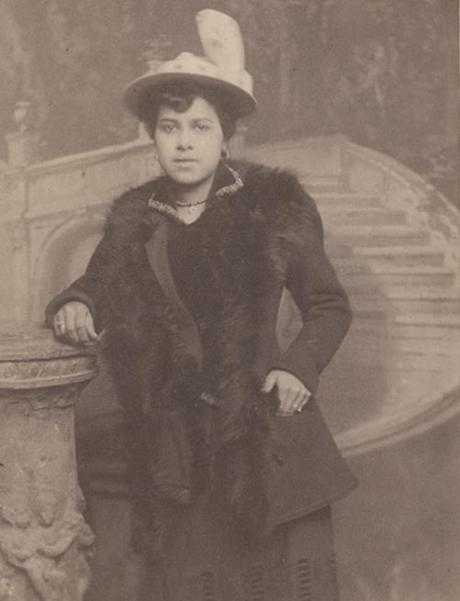
Never heard of her?  Me either until this morning when the Boston Globe carried a front page story by Dan Adams about the ceremony putting a headstone on her long forgotten grave at Mount Auburn Cemetery in Cambridge.

Kittie Knox

Kittie Knox

Knox, a seamstress born in 1874 to a free black father and a white mother, became a prominent and accomplished cyclist by the 1890s in Boston. But her mixed racial heritage raised eyebrows, as did her insistence on riding a man’s bike and wearing pantaloons of her own design instead of the long, heavy skirts prescribed by Hopkins and her ilk.

And if that weren’t enough, she excelled at the sport: Knox completed multiple 100-mile rides and placed 12th out of 50 male and female cyclists in a major national race, “far ahead of her lighter-hued sisters,” one magazine reported.

Knox had seemed doomed to obscurity. But six years ago, author Lorenz Finison stumbled across her name while researching a forthcoming book on Boston’s cycling history. Passing references to Knox in cycling books prompted Finison to search local newspaper archives for more information.

“I found an article saying she won a cycling costume contest in Waltham,” said Finison, a teacher at the Boston University School of Public Health and a cofounder of Cycling Through History, which develops bike routes between African-American heritage sites. “I thought, that’s really amazing. Why, given the racial climate of the time, would she have won a contest out there? I thought I should look into it more.”

Kittie Knox faced not only sexism but also racism.

Finison eventually unearthed a trove of stories about Knox. While many articles were preoccupied with her race and appearance — “a beautiful and buxom black bloomerite” was one reference in Referee Magazine — he learned that Knox had been a member of Boston’s only black cycling group, the Riverside Cycle Club, before joining the Boston-based National League of American Wheelman in 1893.

Knox soon found herself at the epicenter of a fight over whether blacks could join the league, he said. After a Southern faction of league leaders successfully politicked in 1894 to make the group for whites only, Knox’s appearance at the league’s 1895 national meet in Asbury Park, N.J., caused an uproar. Trouble began upon her arrival, when, rather than appease critics, “Miss Knox did a few fancy cuts in front of the clubhouse and was requested to desist,” The New York Times reported.

Then, when Knox went to register for the meet and presented her membership card, the credentials were rejected.

“[Knox’s] entrance today, in the parlor of the Asbury Park wheelmen, caused wild consternation among the ladies gathered there,” wrote a San Francisco paper, according to Finison’s manuscript. “She was politely told that she was in the wrong house. To their utter surprise she produced a league membership card and declared that no exception had ever been taken to her color by wheelmen or wheelwomen. After asserting herself to that extent, Miss Knox walked defiantly out with her wheel.”

Even after members of the Massachusetts delegation intervened to ensure her participation, successfully arguing she had been admitted before the color bar, Finison writes that anger persisted: A group of white women cyclists threatened to quit in protest; dozens walked out of a League dance when Knox partnered with a white man; a Southern paper slammed League leaders for permitting “this murky goddess of Beanville” to ride.

Don’t you love it?  “[M]urky goddess of Beanville”.  A dig at Knox’s race and at Boston.   Good for the Massachusetts delegation for standing up for her.

Much of the Globe’s coverage of early Boston cycling clubs, as cited by Finison, betrays blatantly racist and sexist attitudes common in that era. But one Globe report from  the event in 1895 at Asbury Park trumpeted Knox’s abilities, perhaps to point a finger at Southern papers that had decried her participation.

“The leaders tried to lose Knox during the eighteen mile run but she was game, and when the big crowd entered the town on the return trip she was up with the leaders, sailing with the best of them,” the Globe wrote. “She was not to be consigned to the tribe of ‘also rans,’ and today all the League members are anxious to see her. And when she appears in the street she receives more attention than a half dozen star racing men.”

Kittie Knox died in 1900 at the age of 26, but through Finison’s efforts, her family was found and she was honored on Sunday,

Three generations of Kittie Knox’s relatives attended a ceremony dedicating a new headstone at Mount Auburn Cemetery.

Three generations of Kittie Knox’s relatives attended a ceremony dedicating a new headstone at Mount Auburn Cemetery.

Another remarkable woman has been rediscovered.
Photograph:  Jim Davis/Boston Globe

Boston’s Ward 11, Precinct 1 and the next Mayor

I haven’t posted for a while for a couple of reasons:  first I was depressed by the sameness of the news and second, I had to travel to a memorial service for an uncle who passed away at 91.  But before I left town, I voted in the preliminary election for the next mayor of Boston.  Unfortunately, my preferred candidate, Charlotte Golar Richie, finished third.  The top two who will face off in November are both Irish men leading some to lament that Boston has made no progress even though it is a majority minority city.  That is true, but both Marty Walsh and John Connolly are good progressives so it isn’t all bad.  The issue for both of them will be to expand out of their normal voter bases.  This may be easier for Connolly who had votes from more parts of the City.

The Boston Sunday Globe ran an interesting story on the front page this morning about my precinct.  I know it well having represented it on the Democratic Ward Committee for a number of years and having, over the last 19 years, canvassed every house at one time or another.  11/1 is an example of a precinct in which neither Walsh or Connolly did very well

Tucked away in a quiet corner of Roxbury, the Highland Park section of Fort Hill is lined with stately brownstones, rambling gardens, and campaign signs showing political allegiances as diverse as the neighborhood’s population. Fences and yard signs still advertise support for an array of unsuccessful mayoral candidates, including Charlotte Golar Richie, John Barros, and City Councilors Mike Ross and Felix G. Arroyo.

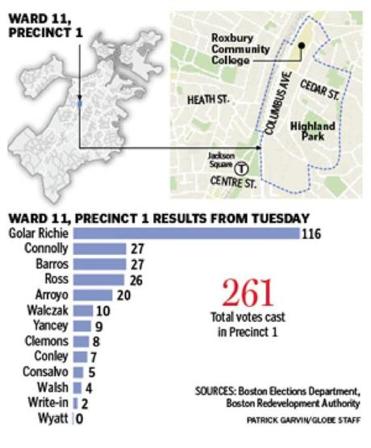
What united voters here in last week’s preliminary election was not a shared loyalty to one candidate, but a collective aversion to two — the eventual winners. Eighty-eight percent of voters in this progressive precinct backed someone other than state Representative Martin J. Walsh or Councilor at Large John R. Connolly. Located within the broad swath of Boston’s inner city where neither finalist claimed victory, Fort Hill is among the voting precincts where they had their weakest showings. Of 261 votes cast for mayor in this precinct last week, only four went to Walsh.

There are 5 adults living in my building and we had 3 yard signs:  Rob Consalvo, Charles Yancey and Charlotte Golar Richie.

Voters in Ward 11/1

Voters in Ward 11/1

Ward 11 is a pretty well racially integrated neighborhood with a high rate of owner occupancy even in the 2 family homes with rental units.

A white female neighbor, who declined to give her name, said she had voted for Golar Richie, the only woman in the race, who would have been the city’s first female mayor and first black mayor. Now, she said, “I have to decide who’s less offensive.”

That attitude itself is offensive to voters like Valerie Madden, a Connolly volunteer who had tried to get her neighbors here to rally around Connolly’s campaign.

“People would tell me frankly, ‘I like him. He’s a good candidate. But I’m not going to vote for him because he’s white,’ ” Madden said.

Madden, who is white, and whose husband is biracial, said she didn’t have the “bandwidth to chide my neighbors because I know that where they’re coming from is a place of good intentions.”

I read this as wanting to elect a mayor who is not white, not as not wanting for vote for someone white.  The precinct votes overwhelmingly for our congressman who is white, for Senators Warren and Markey and voted in large numbers for the current Mayor who is also white.  But I do understand Valerie’s frustration.  She started working for Connolly before Mayor Menino announced his retirement.

Looking at the vote totals, Charlotte took the precinct by a wide margin while finishing third overall.  It will be interesting to see who, if anyone she endorses.  If I were Connolly or Walsh, I would be seeking her help.  I’m disappointed, but console myself with the thought that we are in a time of transition.  With Tom Menino having been mayor for 20 years, who knows if the next mayor will be long tenured or serve a single term as the City gets accustomed to a mayor not named Menino.

Vote distribution in 11/1.

Vote distribution in 11/1.

Boston’s men in the news

No, I am not talking about the mayoral candidates all but one of whom is a man.  And I’m not talking about Alex Rodriquez and the Yankee who beat the Sox last night. (Maybe we shouldn’t have taunted him so much?)  I’m speaking of James “Whitey” Bulger, recently convicted felon and Larry Summers who thinks he should run the Federal Reserve.  Here is a great take on the two from cartoonist Dan Wasserman.

wise guys

Maybe I’ll go for a walk at Castle Island this week in memory of Whitey.  While I’m walking, I can send negative thought waves to President Obama about Larry.