Syria? Really?

The President, probably never believing that Assad would use chemical weapons, drew a red line.  He’s been stalling around saying he needs verification, but now he has it.  The question is what should we do now.  I think Obama is stuck.

130612_barack_obama_ap_605

The United States has a long history of failed interventions.  Vietnam was basically a civil war.  We armed the Taliban when they were our “friends”.  We actually started a civil war in Iraq by stupidly dismissing all the Baathists saying they can’t be part of any new Iraqi government.  Now we are again taking sides against the Baathist who currently rule Syria.  My big fear is that the region will explode into a Sunni v. Shia conflict and we will be seen as taking sides.

Andrew Sullivan wrote this morning

My strong view, vented last night as I absorbed this stunning collapse of nerve, is that we shouldn’t fight at all. We are damn lucky to have gotten every GI out of Iraq, and the notion of being sucked back into that region again – and to join sides in a sectarian conflict – is a betrayal of everything this president has said and stood for. It’s a slap in the face for everyone who backed him because he said he wouldn’t be another Bush or McCain or Clinton. If he intervenes in Syria, he will have no credibility left with those of us who have supported his largely sane and prudent foreign policy so far. Libya was bad enough – and look at the consequences. But Syria? And the entire Middle East? Is he out of his mind?

And can you think of a dumber war than this one?

The man who said he would never engage in a dumb war is apparently preparing to join the dumbest war since … well, Iraq.

My only hope right now is that we can somehow use our threat of intervention to maneuver some type of international peace keeping force while we try to bring both sides to a negotiating table.  And let us hope that President Obama knows to get Congress involved, gets a UN resolution and the Arab League to agree before we take any action.

Sullivan concludes

One reason I supported Obama so passionately in 2008 and 2012 was because I thought he understood this and had the spine to stand up to drama queens like McCain and armchair generals like William Jefferson Clinton. But it is beginning to appear that this president isn’t actually that strong. We voted for him … and he’s giving us Clinton’s and McCain’s foreign policy. If Cameron and Hollande want to pull another Suez, for Pete’s sake be Eisenhower – not Kennedy.

My cri de coeur is here. Don’t do it, Mr President. And don’t you dare involve us in another war without a full Congressional vote and national debate. That wouldn’t just be a mistake; it would be a betrayal.

Photograph:  AP

Whistle-blower, maybe. Hero, probably not.

I just can’t figure Edward Snowden.  The more little pieces I hear about and read about him, the more I wonder about him and his motivation.  This is why I found Jonathan Capehart’s piece so interesting.  Writing in the Washington Post’s Post Partisan blog, Capehart begins

A sidewalk encounter with a friend drove home my conflicted feelings about Edward Snowden. The national-security leaker was surely a “narcissist,” he said, but Snowden was definitely “a hero.” And the more my friend talked about the reaction to Snowden, especially that of congressional Democrats, the more angry his own reaction appeared to become. Part of me wished I could work up that much passion for this self-professed champion of government transparency. Alas, I can’t.

I feel the same way.

Edward Snowden

Edward Snowden

Snowden told the Guardian which broke the story that he wanted to go to a place where the government doesn’t spy on people.  The last time I checked, Hong Kong has a complicated legal relationship to China.  China is not exactly a country that eschews spying on citizens.  In an article about extradition the Guardian says

Hong Kong has not accepted a political defence against extradition since the handover in 1997. In the 1930s it turned down a bid by French authorities for Ho Chi Minh’s return to what was then IndoChina, in a case that went all the way to the privy council. More recently, in 1994, its courts stayed the extradition of the politician Jeffrey Kitigan to Malaysia.

Guy Goodwin-Gill QC, a leading expert on extradition at Blackstone Chambers in London, noted that the international climate had changed, with offences that previously might have qualified – such as hijacking – no longer accepted as political.

“The times are very much one of co-operation across a broad range of activities. You hardly ever find a state refusing extradition for political offences any longer,” he said.

In the case of Snowden, “you certainly see political dimensions: you have members of the US senate or House of Representatives calling him a traitor – so they are building a very good case for another state to treat this as political,” added Goodwin-Gill.

Of course, there are avenues for appeal through the courts in Hong Kong which could drag out the process for years according to some British legal experts.  It remains unclear why he went to part of China when he was professing a wish to be free of surveillance.

I have also heard that he may have misrepresented his salary to the Guardian – that it was much lower than he claimed.  Snowden also claimed that as a contractor with the NSA he had broad authority to do a lot of things that some experts question.  This is from NPR

Edward Snowden’s claim that as systems administrator for a defense contractor in Hawaii he had the authority “to wiretap anyone, from you or your accountant to a federal judge to even the president,” just isn’t plausible, says a former national security lawyer at the Justice Department and Office of the Director of National Intelligence.

Carrie Cordero, the former Justice and DNI lawyer, is now director of national securities studies at Georgetown University Law Center. She tells Steve that “the notion that this individual has the authority to go ahead and … ‘wiretap’ people is just ridiculous.”

Without discussing the details of how such surveillance programs work and the safeguards that are in place to protect privacy, Cordero says that Snowden’s claim “does not resemble anything close to what I observed within the intelligence community.”

Snowden may turn out to be a braggart who stretches the truth.  And this may damage his credibility overall.  But the bottom line for me is that he doesn’t seem to have told us anything that a lot of people didn’t know before.  Capehart again

We absolutely should know what our government is up to. And, according to The Post’s Walter Pincus, we’ve known about this for quite some time.

The legendary national-security writer cites a May 2006 USA Today story that revealed “the NSA ‘has been secretly collecting the phone call records of tens of millions of Americans, using data provided by AT&T, Verizon and BellSouth,’ attributing that information to ‘people with direct knowledge of the arrangement.’” Then there was the March 15, 2012, Wired magazine story on the new $2 billion NSA Data Center in Utah and “its ability to ‘intercept, decipher, analyze, and store vast swaths of the world’s communications as they zap down from satellites and zip through the underground and undersea cables of international, foreign, and domestic networks.’”

“Was there any follow-up in the mainstream media to [James] Bamford’s disclosure, or anything close to the concerns voiced on Capitol Hill this past week? No,” Pincus writes in Tuesday’s paper.

So where should we go from here?  I agree with Capehart’s conclusions

Still, that doesn’t mean we shouldn’t have a debate about what we now know and its appropriateness now that we know it. Eugene Robinson zeroes in on this in his Tuesday column.

The NSA, it now seems clear, is assembling an unimaginably vast trove of communications data, and the bigger it gets, the more useful it is in enabling analysts to make predictions. It’s one thing if the NSA looks for patterns in the data that suggest a nascent overseas terrorist group or an imminent attack. It’s another thing altogether if the agency observes, say, patterns that suggest the birth of the next tea party or Occupy Wall Street movement.

Is that paranoia? Then reassure me. Let’s talk about the big picture and decide, as citizens, whether we are comfortable with the direction our intelligence agencies are heading. And let’s remember that it was Snowden, not our elected officials, who opened this vital conversation.

Yes, Snowden opened this conversation. But that’s as much credit as I’m willing to give him.

That sounds about right.  Let’s see if Congress talk about this without a lot of finger-pointing and hysteria.  Should the result be changes to the Patriot Act, we can give Snowden a little piece of the credit.

Photograph: AP

Surveillance and President Obama

I look forward to my weekly email from my Congressman, Mike Capuano.  Of course, I once worked for him when he was mayor of the City of Somerville (a near Boston city) so I am used to Mike’s saying what he means and I almost always agree with him.  I am copying the entire first part of his email into this post.

mike_225x315

“U.S. Rep. Michael Capuano (D-Somerville), who voted against the Patriot Act, rallied protesters by calling the law the worst attack on freedom since the 1798 Alien and Sedition Acts.”

                                                                                                                Boston Herald

                                                                                                                September 10, 2003


The Patriot Act and Verizon


I am sure you are aware that Verizon has reportedly been ordered by the top-secret Foreign Intelligence Surveillance Court (FISA court) to turn over, “on an ongoing daily basis”, information about every customer telephone number, including landline, cell and business numbers. That information reportedly includes all numbers dialed and all calls received within the United States as well as between the United States and other countries.

As I write this newsletter, the news is filled with reports that a similar program called PRISM is in place for every major internet and email provider. The government claims they have not accessed the content of phone calls, but it seems they ARE accessing the content of emails such as videos, websites visited and more. According to reports, the PRISM program is not at this time being used on U.S. citizens.

Even if you can accept the government collecting the number and length of every call you make, are you really comfortable with them having the ability to catalogue all the YouTube videos you watch, the Netflix movies you download, or the web pages you visit? It seems that our own government has access to every phone call, email and internet search for all Americans at every minute of every day.

Like most Americans, I am absolutely outraged. But, if you’re a long time subscriber to these newsletters, you probably already knew that. You also probably know that I voted against passage of the so-called “Patriot Act” and every reauthorization since it first passed in 2001.

Before I go any further, I feel compelled to remind you that I was an early and strong supporter of President Obama.  I am still amongst the strongest Obama supporters in the House of Representatives.  Nonetheless, I cannot remain silent out of some sort of misplaced loyalty to President or party when I believe that basic American rights have been intentionally trampled.

I know we live in a dangerous world and there is work to do to prevent terrorists from harming us. But we must find a balance between giving law enforcement the tools they need to track and identify terrorists and protecting the very liberties upon which our great country was founded.

This data collection has reportedly been going on for 7 years. The length of time that this has been going on and the staggering amount of data collected on every Verizon customer amounts to an incredible overreach. Even if you’re not a Verizon customer, there is clearly reason for concern. Who really believes that Verizon is the only telecommunications company required to turn over this data?

I have always believed that we must give law enforcement the tools they need to pursue criminals. However, we can do that and still protect civil liberties.

It is time for those of us who support President Obama to speak up.  I believe he is a good man and has been a good President.  However, I think his Administration has allowed their concern for our safety to lead them down the wrong path.  If we remain silent, those who have always wished him to fail on every point stand a better chance of winning the hearts and minds of America and we will all be worse off for it.  It is possible to support President Obama and yet disagree with him on certain issues – this is one of those times.

The President has said he is glad this is out in the open and he welcomes discussion.  Instead of reacting in horror – or wishing more information would be collected, we need to talk.   I’m not sure I know where the balance is, but one thing that I learned at St. John’s College (Annapolis) is that dialog can lead to greater clarity and understanding.  So let’s talk:  To each other and to the President and your member of Congress.

Photograph from Capuano website.

Red Sox, Celtics and Pride Week in Boston

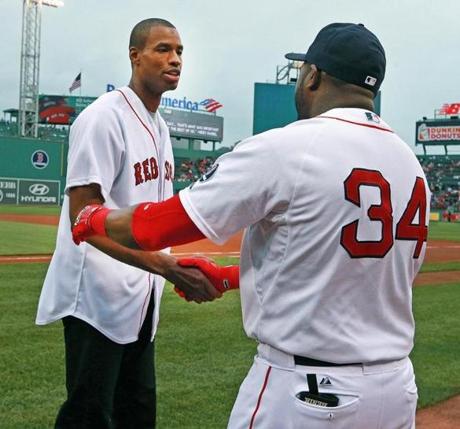
Jason Collins spent time last season with the Boston Celtics (and he might be back next season) before he came out in a now famous Sports Illustrated story.  Last night Collins helped the Red Sox celebrate Pride Night by throwing out the first pitch to Manager John Farrell.  It should be noted that managers rarely do this.

The Boston Globe ran this story from the Associate Press

The 7-foot center was greeted with a nice applause when the PA announcer read the opening of the SI article: ‘‘I’m a 34-year-old NBA center. I’m black. And I’m gay.’’

Wearing a Red Sox jersey with the No. 98 on the back, Collins threw out the first pitch to Red Sox manager John Farrell.

Red Sox slugger David Ortiz feels everyone should support each other based on how they act.

‘‘Nobody knows what is perfect and what is not,’’ Ortiz said, sitting at his locker about three hours before the game. ‘‘If you are respectful and you do what you’re supposed to do, it doesn’t matter what you are and what you come from, people should respect you and love you the same way.’’

Collins wears 98 on his jerseys to honor Matthew Shepard who was killed in 1998, a decision welcomed by Shepard’s parents.

2015 Pride Night at Fenway

2015 Pride Night at Fenway

Hey Danny and Doc, bring him back to the Celtics!

By the way, the Sox won on a walk-off 3 run homer by – David Ortiz.

Photograph Jim Davis/Globe Staff

Putting the minimum wage in persective

Dan Wasserman of the Boston Globe explains why we need an increase in the minimum wage.

Wasserman 6-5

This needs to be a national increase.  Yes, I know.  When businesses have to pay more, they won’t hire.  But there is another side to their objection.  If they pay people more, then there will be more spending and more business and they can hire.  Plus there will be more payroll taxes paid on the larger salaries.  And more state and local taxes.  Conservatives would be happy because some folks wouldn’t need food stamps as a lot of working people do now.  Seems like a winner.

I know that some economists argue that increases always lead to higher unemployment, but a large number of small businesses already pay wages higher than the legal minimum.

Put simply, small businesses are our economy. Given that it’s still recovering, the economy needs all the help it can get to make it over the proverbial hump and flourish. Small businesses will play a key part in that journey.

Given their importance, politicians should stand up and take notice when small business owners say they strongly support a policy that has and will continue to elicit political fights of the knockdown drag-out variety, such as increasing the minimum wage. The minimum wage is a business issue that impacts a wide swath of small firms, and according to scientific opinion polling Small Business Majority released this week, two-thirds of them support increasing it and adjusting it annually to keep up with the cost of inflation.

Some have claimed that raising the minimum wage would put small firms out of business because they won’t be able to afford to pay their workers more. Our polling found a whopping 85 percent of small businesses across the country already pay their workers more than the minimum wage, though.

“You need to pay workers enough to survive. It’s in your best interest as a company because if you don’t there is nothing tying them to you.” That’s Clifton Broumand, the president of Man and Machine, a specialty computer product business in Landover, Md., who pays his workers more than the minimum wage and supports increasing it. “I want my employees to have the chance to grow and improve here. I want them to want to stay so we don’t have a lot of turnover. And I pay over minimum wage because it’s the right thing to do.”

The President proposed an increase to $9 in his State of the Union Address:  Let’s just do it.

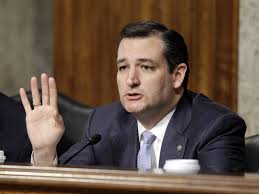
Don’t think Ted Cruz understands government

Senator Cruz has not exactly endeared himself to his fellow Senators in the short time he has been there.  Even those in his own party.  He has been entertaining in a scary kind of way.  It’s hard to believe that he was only elected last year.  I’ve thought for awhile that he didn’t understand governing – and that that is what Senators do after all – and now maybe I understand why:  He doesn’t understand the basics of government.  Here is Ezra Klein.

Texas Republican Sen. Ted Cruz knows how to deal with the Internal Revenue Service: Get rid of it!

We ought to abolish the IRS and instead move to a simple flat tax, where the average American can fill out our taxes on a postcard. Put down how much you earn. Put down a deduction for charitable contributions and home mortgage. And put down how much you owe.

OK.  But to whom should you mail the card?  And who will check the math?

That does sound simple! But what if some citizen somewhere declines to fill out the postcard? Well, I guess we need some bureaucrat that will send them a follow-up postcard making sure they got the first postcard. If they don’t fill out that postcard, we need someone who will give them a call to make sure they’re getting these postcards.

The bottom line is follow-up and enforcement.  That is one of the things that government agencies do.  Remember your civics, Senator?  The legislature (that’s the House and Senate) passes laws, the President signs them and then someone has to make sure it happens.  This is not a function of a legislative committee.  Their role is to go back and make sure that everything functions as the law intended.  If it doesn’t, you don’t then abolish the agency but you make sure it gets fixed.  But some seem to operated on the principle that is the bath water is dirty, but throw it AND the baby out together.

And Cruz’s flat tax is actually a bit more complicated than most. It includes deductions for mortgages and charitable contributions. What if everyone says they gave a million dollars to charity and own a huge home? Who’s going to check all that out? Well, some well-meaning flat-tax collection agents, I guess.

The people doing all this need to sit somewhere. The place they sit doesn’t need to be called “The Internal Revenue Service.” It can be called “The Agency of Tax Freedom.” But it is, in effect, the Internal Revenue Service.

Ted Cruz

Maybe we have finally found the bottom line for Senator Cruz and his friends.  They want the benefits that can accrue from government, but they don’t actually understand or like it.

His plan?  That a subject to a whole ‘nother post.

Photograph from Salon.com

Baseball and Justice Sotomayor or Flood v. Kuhn revisited

Anyone who loves baseball and history will love this story.  I found it on NPR reported by Nina Totenberg who covers the Supreme Court.  It is about a combination moot court and historic re-enactment.  The case is Curt Flood v. Bowie Kuhn from 1972.  Law school often do this kind of re-enactment, but this one was sponsored by the Supreme Court Historical Society.  Justice Sotomayor presided from the seat of the Chief Justice.

For those who don’t remember, the case was brought by St. Louis Cardinals great Curt Flood, who challenged baseball’s reserve clause — the provision that allowed teams to virtually own players, set salaries and conduct trades, with the players for all practical purposes never able to negotiate freely with other teams. That meant that at the time Flood brought his challenge in 1970, he was earning what was then considered a top salary of $90,000. This, for a player who had signed with the Cards at age 18, with no agent or lawyer, and who in six of the next 12 seasons batted .300 and won seven Gold Glove awards. So, when he was traded to the Philadelphia Phillies, a definitely lesser team at the time, he refused to go, and could not play for any team.

He wrote to the then-baseball commissioner, Bowie Kuhn, protesting that he was “not a piece of property to be bought and sold.” Kuhn denied his request for free agency — a concept unrecognized by baseball back then — and Flood sued, seeking to block the perpetual use of the reserve clause.

Flood lost, but baseball changed forever as the free agency system was put into place anyway.

In 1994, however, nearly two decades after the Flood decision and the ensuing changes in baseball, the owners sought to effectively nullify the free agency system, and the baseball players struck, wiping out the playoffs and the World Series. The National Labor Relations Board went to court, contending that the owners were negotiating in bad faith, and the case came before a young federal district court judge named Sonia Sotomayor.

She agreed that the owners were colluding illegally to fix salaries and granted a temporary injunction barring them from doing that. Sotomayor, a wildly dedicated Yankees fan, issued her opinion in time to allow the new baseball season to begin as scheduled on opening day, with the old baseball contract in effect. She thus earned the title, “the judge who saved baseball.”

The arguments in the re-enactment veered between history and current day baseball.

Representing Flood at the re-enactment was Stanford Law professor Pamela Karlan, a frequent Supreme Court advocate, and ironically, a former Blackmun law clerk. And representing Major League Baseball was another frequent Supreme Court advocate, Roy Englert.

Karlan opened, noting that the Supreme Court’s 1922 and 1953 decisions upholding baseball’s antitrust exemption were outliers and that the court had not permitted such an exemption for any other professional sport.

Sotomayor asked why the court should “break with tradition,” thus depriving the owners of their “reliance” on previous decisions.

Karlan shot back that if the court were to side with the owners for a third time, it would amount to something done in baseball only once before — three errors on a single play.

Sotomayor, with a straight face, opined that the court could apply another baseball rule: three strikes and you’re out.

Karlan, undaunted, replied, “I’m swinging for the fences here, your honor.”

Sotomayor is escorted onto the field by New York Yankees catcher Jorge Posada to throw out the ceremonial first pitch before the New York Yankees game against the Boston Red Sox at Yankee Stadium on Sept. 26, 2009.

The next exchange con free agency and salaries management to get in a dig at Sotomayor’s favorite Yankees.

Sotomayor asked what would happen if the court were to take away the antitrust exemption. Wouldn’t the players move around so much that fans would have no team loyalty?

No, rejoined Karlan, the owners would just have to pay the players what they are worth in order to hold on to them, and instead of year-to-year contracts that leave players with no leverage, the owners would have to negotiate longer-term contracts.

Sotomayor, in mock horror, said that if the antitrust exemption were abolished and owners could no longer collude to set player salaries at will, the Yankees might have to pay Reggie Jackson $1 million a year!

Worse, replied Karlan, would be if the Yanks paid Alex Rodriguez a quarter of a billion dollars not to play.

“I can’t imagine such a thing!” answered a shocked Sotomayor.

Next at bat were the owners.

Next up to the lectern was Roy Englert, representing the baseball commissioner and owners. He noted that some 50 bills had been introduced in Congress over the years to eliminate the antitrust exemption, and none had passed. The court, he said, should leave the question to Congress.

But Sotomayor asked, “Where are the rights of the players?” Quoting Curt Flood, she said that the baseball system was a form of “involuntary servitude” that does not exist in any other industry.

Englert replied that “these young men are making on average $28,000 … as much as Supreme Court justices.” Moreover, unlike other sports, he observed, baseball puts enormous investment into training players in the minor leagues.

The case does involve some serious legal questions, some raised by the decision written by Justice Blackmun.  It appears that Blackmun was reluctant to overturn the prior decisions, but wrote his opinion in such a was that everyone understood that baseball did in fact fall under that anti-trust laws and does engage in interstate commerce.

Justice Sotomayor concluded

‘There are Supreme Court decisions that are wrong,” she said. The court’s 1896 decision upholding segregation was wrong, and the Supreme Court was right to reverse it in 1954. But sometimes, she said, the question is not whether the decision was wrong, but whether this is the right time to overrule it.

Today, she observed, we see as “horrible” the reserve clause that deprived players of any real negotiating power. But at the time, what both sides thought they were arguing about was “the very survival of baseball.”

Republican suicide in Virginia?

Having lived in Virginia for many years, I take more than a passing interest in the political scene there and this fall’s election will be a doozy!  Not quite sure what Virginia Republicans think they are doing, but unless everyone in Virginia has totally lost it, Terry McAuliffe should be the next governor.

This morning, the Washington Post has a story with 3 earlier related ones.  Here are the headlines with links:

E.W. Jackson a wild card in Va. GOP campaign  This is the main profile and biography.

Va. GOP’s E.W. Jackson: So far right he has said Democrats have ‘Antichrist’ agenda

E.W. Jackson complicates Cuccinelli bid

Va. GOP picks conservatives for fall ticket; black minister is lieutenant governor choice

So what exactly is going on in Virginia?   On May 18, the Post described the ticket this way

Thousands of Virginia Republicans on Saturday picked a slate of statewide candidates who vowed to stay true to conservative principles, resisting calls to remake the GOP message after losses in 2012.

At the top of the ticket is gubernatorial hopeful Ken Cuccinelli II, the attorney general. Known for high-profile battles against “Obamacare,” abortion and a university climate scientist, Cuccinelli stood by what detractors have called an out-of-the-mainstream agenda.

E.W. Jackson, a minister from Chesapeake, won the nomination for lieutenant governor with a full-throated appeal for limited government, traditional families and gun rights. “We will not only win an election in November, we will open the hearts and minds of our people and save this commonwealth and save this country,” said Jackson, the first African American nominated by the Virginia GOP for statewide office since 1988. [That was Doug Wilder, who won.]

For attorney general, the party nominated state Sen. Mark D. Obenshain (R-Harrisonburg), who this year successfully pushed tougher voter ID rules. “Are you ready to stop Obamacare in its tracks?” he asked the crowd in his acceptance speech, eliciting cheers.

Republican nominee for governor Ken Cuccinelli, right, is joined onstage with the other members of the ticket, including E. W. Jacksonon, second from left.

Republican nominee for governor Ken Cuccinelli, right, is joined onstage with the other members of the ticket, including E. W. Jackson, second from left.

It is as if the election last year never happened.  Mitt Romney didn’t lose.  Barack Obama never won.

But the candidate in the spotlight is Jackson.

Jackson’s improbable rise, one that has astonished Republicans far and wide, is the latest of a number of incarnations, including foster child, Marine, Harvard law school graduate and even Democrat. But the minister who is now GOP gubernatorial nominee Ken Cuccinelli II’s running mate has long used his booming voice to endear himself to conservatives.

Still, Jackson’s words — sometimes eloquent, sometimes raw, often impassioned — are causing anxiety for many Republicans as the resurfacing of his past statements about homosexuality and abortion have threatened to disrupt the campaign.

Instead of promoting their new ticket, Republicans have answered for Jackson’s once calling gays “perverted” and “sick” and saying Planned Parenthood has been “far more lethal” to blacks “than the KKK.”

Jackson has ties to Massachusetts which I didn’t know.

After a tour with the Marines, Jackson graduated with honors in 1975 from the University of Massachusetts, where he majored in philosophy. Then he graduated from Harvard Law School in 1978. He spent more than 20 years in Boston, practicing law, pastoring at New Cornerstone Exodus Church, serving as a chaplain to the Boston Fire Department, and hosting radio shows, including one called “Earl Jackson Across America.”

At one point, he was a Democrat, and he was elected to the party’s Massachusetts State Committee, where he distinguished himself with his conservative views. “I thought, ‘Wow, here’s a great potential leader,’ ” said James Roosevelt, who is a grandson of Franklin D. Roosevelt and who was then and is now legal counsel to the state Democratic organization. “Then I learned of his views, and I thought: ‘What’s he doing? This is not a leader of the Democratic Party.’ ”

Jackson became a Republican in the early 1980s, explaining that Democrats’ embrace of the gay rights movement violated his religious beliefs. In 1989, he joined the opposition to a proposal to ban discrimination against gays and lesbians in Massachusetts. “We intend to blow this bill to smithereens,” he told reporters then. “We intend to defeat this legislation and bury it so deep no one will ever find it again.”

Sorry Rev. Jackson.  We not only passed that bill, but we also have marriage equality.  I have to admit I never listen much to talk radio or to Jackson’s program.  He moved to Virginia in 1998, perhaps thinking the political climate there would be more in tuned to his views and clearly he was right about that: he is now the Republican nominee for Lt. Governor.  Jackson has also been affiliated with the Christian Coalition and the Tea Party.

“The Republicans I’m talking to are saying, ‘What the hell are they doing in Virginia?’ ” said Michael Steele, former chairman of the Republican National Committee. “Is this, ‘101 ways to lose an election’? You’re coming out of the gate with comments everyone has to explain. You’re wasting a lot of time and energy batting that back when you should be doing other things to get the guy known.”

Although unknown to many Republicans, Jackson in recent years has built a following among the most activist of Virginia’s conservatives, many of whom were delegates at the convention. But Republicans are now concerned, Steele said, that Jackson will turn off the party’s own voters. “You can’t have a situation where Republicans say, ‘You know what? I can’t have this’ and they stay home or vote for the other guy,” he said.

Added to the mix is the investigation of the current Republican governor, Bob McDonnell awkwardly headed by the current Republican Attorney General and nominee for Governor, Ken Cuccinelli who took money from the same supporter.  The New York Times has that story.

Virginia’s attorney general has appointed an outside prosecutor to investigate Gov. Bob McDonnell’s financial disclosures, in a widening scandal over a political donor who wrote a $15,000 check for the wedding of the governor’s daughter, and who was also a benefactor of the attorney general.

Kenneth T. Cuccinelli II, the attorney general, who is also the Republican candidate for governor this year, said on Wednesday that he named the outside prosecutor last November to look into Mr. McDonnell’s disclosures.

Mr. Cuccinelli said “information came to my attention” triggering the appointment of the prosecutor. His referral of the case to the Richmond commonwealth’s attorney, Mike Herring, whose role is similar to that of a district attorney, “was not a conclusion that any violation occurred,’’ Mr. Cuccinelli said in a statement.

The investigation came to light through a Freedom of Information Act request by The Richmond Times-Dispatch, which first reported it.

Mr. McDonnell and Mr. Cuccinelli, who are yoked in an awkward political alliance – the former a popular governor of a purple state and his would-be successor, a Tea Party favorite — have been swept up in controversy over their friendship with a Virginia businessman, Jonnie R. Williams Sr., who gave generously to both officials.

What a tangle!  Can Terry McAuliffe pull out a win for the Democrats?

“We’re in a deep [expletive],” said one Virginia Republican strategist. “The only good news is that the Democrats have Terry McAuliffe. It’s the only thing keeping us glued to a chance of victory.”

McAuliffe, a former Democratic National Committee chairman, has faced questions about his leadership of an electric car company and some unflattering quotes from his own memoir.

All I can say is “stay ‘tooned”.

Photograph: Steve Helber/AP

Primary versus Exclusive

IRS building on Constitution Avenue in Washing...

IRS building on Constitution Avenue in Washington, D.C.. (Photo credit: Wikipedia)

Trust the former budget guy Lawrence O’Donnell to find this.  The part of the tax code with the definition of 503(c)4 was written in 1954 and the IRS regulation adopted in 1959.  (Think maybe we need to update the tax code?).  According to Clare Kim writing for O’Donnell’s “The Last Word”

Internal Revenue Service agents have been struggling to do their jobs–which have been made essentially impossible by an incorrect interpretation of the law that the IRS made in 1959. It was then that the IRS changed the language of the law without any authority to do so. Here is how the tax law was written in its latest update in 1954 on 501(c)(4) social welfare organizations. The 501(c)(4) designation was to apply only to: “Civic leagues or organizations not organized for profit but operated exclusively for the promotion of social welfare.”

But a 1959 interpretation guideline written by the IRS says that: ”To be operated exclusively to promote social welfare, an organization must operate primarily to further the common good and general welfare…”

My Webster’s New Collegiate Dictionary defines exclusive as excluding or having the power to exclude, the definition we are all familiar with.  Exclude is to shut out or bar from participation, consideration or inclusion.  The 1954 tax code meant that any group receiving this exemption was to only promote social welfare.  Primarily on the other hand means chief.  The question some Senators and Representatives put to IRS officials was whether exclusive and primary meant the same thing.  The IRS officials didn’t think so and neither do I.  The 1959 reg combines the two in a way that the poor folks trying to make determinations have to find confusing.

But is this all just semantics?

At his news conference, President Obama stressed the importance of enforcing clear laws. “We’re gonna have to make sure that the laws are clear so that we can have confidence that they are enforced in a fair and impartial way and there’s not too much ambiguity surrounding these laws.”

Citizens for Responsibility and Ethics in Washington (CREW) officially filed a lawsuit against the IRS for departing from statute on “exclusively” for social welfare in the code. The organization’s 17-page filing asks the IRS to simply enforce the law as written and to drop the IRS’ false interpretation of the law.

If this happens the Democratic organizations like Organizing for America will lose their exemptions just like Tea Party groups and Karl Rove.  I don’t think this a bad thing.

A little humor for a gray day

It is kind of gray and coolish today the kind of weather that makes you wish that spring would really arrive in New England, that the weather would be a little more consistently 60s and 70s.  So to cheer myself up I put up a new theme.  I’d had the old one for a few years (!) now and it was time for a change.

To go with the new theme, here are 10 Great Headlines which I have copied out of the 2013 Old Farmer’s Almanac.  They were submitted to the Almanac by S.P. of Manchester, NH.

1.  Hospitals Sued by 7 Foot Doctors

2.  Police Begin Campaign to Run Down Jaywalkers

3.  Panda Mating Fails: Veterinarian Takes Over

4.  War Dims Hope for Peace

5.  Astronaut Takes Blame for Gas in Spacecraft

6.  Juvenile Court to Try Shooting Defendant

7.  Something Went Wrong in Jet Crash

8.  New Study of Obesity Looks for Larger Test Group

9.  Cold Wave Linked to Temperatures

10.  Typhoon Rips Through Cemetery; Hundreds Dead.

Cover of the Old Farmer's Almanac.

Cover of the Old Farmer’s Almanac. (Photo credit: Wikipedia)

I was once the headline editor of my high school newspaper so I have a lot of sympathy for those who wrote these.  Which is your favorite?  I’m torn between 7 and 10.