Maps, urban planning, and open space: the saga of Long Wharf

When I was working, I would often take a walk from the office down to Long Wharf and look out at the harbor.  There is a small open shelter and some benches at the end.  Walking with co-workers, we talked about the plan to build a restaurant and wondered how it would change the peaceful quiet that one found there.  Years passed and nothing happened which was fine with us.

A bit of background.  According the National Park Service,

Construction of Long Wharf began in 1710, though the idea of building a new wharf over the remains of the Barricado—a 2,200 foot long defensive wall/wharf of stone and wood piles that encircled the harbor—had been discussed as early as 1707. The wharf extended from the base of King Street (now State Street) and provided direct access to the commercial center of colonial Boston. By 1711 a number of warehouses had been built atop the wharf, and by 1715 the last 600 feet of wharf were completed.

In its heyday, Long Wharf was 1,586 feet in length and 54 feet wide, providing docking facilities for up to 50 vessels. In the 18th century, Boston was the leading colonial port (it would be surpassed by both New York and Philadelphia by the end of the century). Long Wharf was the nucleus of Boston’s maritime trade—by the end of the 18th century it reigned pre-eminent among Boston’s 80 wharves, handling both international and coastal trade. Its extraordinary length allowed large ships to dock and unload directly into warehouses without the use of   small boats. Because the wharf served   private merchants and the public, who could buy directly from the warehouses and stores on the wharf, it was a marketplace long before the construction of Faneuil Hall (Quincy Market) in the 1820s.

In addition to the economic importance of the wharf, it was also associated with the military history of Boston. Among the events that occurred here were the landing of British troops in 1770 to enforce the King’s laws and the evacuation of the same troops in March 1776; the landing of a vessel from Philadelphia bringing news of the signing of the Declaration of Independence; and during the Revolution, privateers and blockade runners sailed from Long Wharf and military stores were kept in its warehouses.

And today, the NPS describes Long Wharf this way

The Long Wharf and Custom House Block, a National Historic Landmark, is located at the end of State St. and east of Atlantic Ave. in Boston Harbor. The wharf buildings have been converted to residential, commercial and office spaces. On the northwest side of the wharf, a wood planked walkway is lined with benches, and at the end of Long Wharf, there is a large plaza, a covered shelter and a pink stone compass rose, which is  set into the ground. Various tour boat operators are located on the wharf and dock their vessels here.

The plans of the BRA to build a restaurant on the historic wharf may have been ended by the discovery of a National Park Service map.  The story of how the map was found is a fascinating one.

The Boston Redevelopment Authority was so close to realizing its vision of a restaurant on the tip of Long Wharf that you could almost smell the fried clams.

For nearly five years, BRA officials had fought a group of determined North End residents who had raised objections in administrative hearings and state courts.

The BRA spent close to a quarter of a million dollars on legal bills. Last year it finally won a Supreme Judicial Court decision almost certainly clearing the way for a private company to build Doc’s Long Wharf restaurant on the dramatic public space jutting into Boston Harbor.

But it seems that BRA officials, in their zeal to promote waterfront dining, failed to take into account an old map outlining the edge of Long Wharf as protected space. According to a 1980s agreement, the BRA had promised to forever preserve it for outdoor recreation.

Map of Long Wharf with the proposed restaurant marked.

Map of Long Wharf with the proposed restaurant marked.

It took a retired National Park Service employee to read an earlier Globe story, get a map from archives and bring things to a halt.

A retired National Park Service manager, reading about the controversy in the Globe, remembered the map and made a call. Sure enough, the Park Service found the 1980s map in a federal archive in Philadelphia, prompting a state judge to put the restaurant plans on hold in late December and leaving the BRA with ketchup on its face.

“The strange manner in which the [newly discovered map] came to light requires this court” to allow the map into evidence “in the interests of justice,” Suffolk Superior Court Judge Elizabeth Fahey wrote in voiding the restaurant’s state environmental permit and calling for the BRA to reapply, this time using the correct map.

But the  BRA being so convinced that no one else can ever be right seems to be pushing on.

Opponents of the proposed restaurant, many of them neighbors untrained in the law who spent countless hours preparing legal briefs to counter the BRA, said Fahey’s ruling probably settles a debate that should never have begun in the first place. “To us, discovery of the right map means we definitely should win,” said Sanjoy Mahajan, an MIT electrical engineering professor, a former neighbor of the site, and a restaurant opponent. “We think this undercuts the entire BRA case. We only wish it had come to light earlier.”

But the BRA appears determined to plow on. It requested court permission to conduct its own investigation into the map, describing it in court filings as a mere “sketch” and as a “roughly drawn rendering” made by “an unknown individual . . . allegedly found” in archives.

BRA spokeswoman Susan Elsbree said: “We are following the process in good faith, and we will get to the bottom of this. Our mission is to get people to enjoy the waterfront, and not let a few neighbors trump the public interest.”

But people do enjoy the park.  On a nice day to sit and watch the boats and the gulls while the breeze blows and it is quiet is a wonderful thing.  I understand the goal of the BRA is development, but one does not have to build everywhere.  When I was working for the City of Somerville, there was a fire and a house was destroyed.  Someone asked Mike Capuano, the Mayor at the time, what he thought should be built there.  His response, “Probably nothing.”  Somerville was, at the time, the most densely populated city in Massachusetts, if not the United States.  It needed some green space and the lot became open space.  Once does not need to build on every square inch of land.

“I don’t know what map they were using before, but I provided them with the one we have on record for that project,” Jack W. Howard, a National Park Service manager, said in an interview.

The new map, pulled from National Park Service files, shows that the proposed restaurant lies squarely within the bounds of a park financed under the federal Land and Water Conservation Fund Act. Federal law prohibits such restaurants in these federally funded parks with few exceptions. Apparently no one had previously asked the Park Service for a copy of the map.

Edward Rizzotto was a young National Park Service manager in the 1980s when a deal was struck for the federal government to provide almost $1 million to clean up the tip of the wharf. He says — and documents later uncovered by restaurant opponents bear this out — that the BRA agreed to record an easement guaranteeing it to be open space for 99 years.

“This was always intended as public open space in perpetuity,” Rizzotto, 70, said during an interview on the park site.

The park reaches into wind-swept Boston Harbor, a 35,000-square-foot plaza paved with granite flagstones, with a bronze plaque proclaiming Long Wharf Park and bearing the BRA’s  name. On one side of the site is an open air brick pavilion that provides shade for summertime picnickers.

More than 25 years passed before the BRA decided in 2006 that more people would enjoy one of the city’s premier outdoor spots if the pavilion were converted into a restaurant and tavern. Agency officials envisioned indoor and outdoor tables, live entertainment, takeout service, and food and alcohol until 1 a.m.

After years of hearings and a pile of legal briefs, a story on the restaurant battle published on the front page of the Globe on Oct. 10, 2012, caught the eye of Rizzotto, he said. He wondered why the restaurant plan had gotten so far when he recalled that the entire area was protected. Rizzotto eventually contacted Howard, the National Park Service manager, with whom he once worked. A search of the archives dredged up the one-page map now central to the case.

By then, the case had been argued before the Supreme Judicial Court but had not been decided. The map circulated among the Park Service, the Environmental Protection Department, the BRA, and restaurant opponents, but no one informed the court of its discovery. Fahey, who ruled on remaining state issues in the restaurant fight nine months after the SJC decision, noted that the BRA did not alert the SJC “that the material it was then considering may be incorrect.”

The Long Wharf area already has the Aquarium and hotels.  I hope that the end of the wharf remains the equivalent of open space.  As I learned 18 years ago, there is no need to build on every square inch of land.

Mayor Marty Walsh has called for a financial and programmatic audit of the BRA.  I hope the auditors look at this incident and ask why so much tax payer money was spent of legal fees.  Maybe it could have been spent on some new benches instead.

Map is from court filing and published in the Boston Globe.

Red-tailed hawks on Fort Hill

The other day I saw a large bird perched in one of the maple trees near our back porch/balcony.  It’s a tree that many blue jays, mourning doves, cardinals and house sparrows use as a staging area before swooping down to the feeders and window boxes we keep filled with seed.  The light wasn’t too good and the bird didn’t look all that big.  The first day, we thought it was some kind of hawk, but couldn’t see the colors.  The second day, I could clearly see the white breast and dark back.  Eastern Kingbird?  Folks on the Great Backyard Bird Count Facebook page said too early in the season for a kingbird.  Maybe a Sharp-shinned hawk.

This afternoon, we saw the bird up close – like just on the other side of the kitchen window close.  It was clearly an immature Red Tailed Hawk.  We always leave our Christmas tree tied to the porch rail and it is still green and has most of its needles.  The sparrows use it for shelter.  And they needed it today!  When the Red-tail  flew by the first time, some of the 50-60 house sparrows flew away.  But when he landed on the porch, the tree held maybe 10 of them chirping away.  For about 2 minutes, my husband, Mr. Bunter (one of our cats), and I watched the poor red-tail trying to figure out how to catch one of the sparrows.  He flew from one window box to the other.  He tried to shimmy down one of the porch rail posts near the tree.  He landed on the table under the window so he could study us and the birds in the tree.

When he flew off for a second, probably to re-group, the sparrows made their escape.  When he came back, there was no more chirping in the tree.  No lunch today for Mr. Red-tail.  And later, my husband, watched 3 hawks circling the park and flying off in the direction of Jamaica Plain.

Juvenile Red Tailed Hawk

Juvenile Red Tailed Hawk

A number of years ago, a mature red-tail swooped on to the porch and grabbed a rock dove (pigeon) and proceeded to eat the entire bird while we watched.  I think he left a couple of feathers. We also had a young red-tail fly into a neighbor’s open window.  The Audubon and Animal Rescue people were called and he was rescued unhurt.

According to the Cornell Lab of Ornithology, Red-tailed Hawks are the most common kind.  One sees them circling around when you are driving along the interstates or on back roads.  But we’ve been lucky to have see two of them close up.

Photograph from the Cornell Lab of Ornithology web site, All About Birds.

Shortstops: Jeter and Bogaerts

So maybe it is premature to mention Derek Jeter and Xander Bogaerts in the same breath, but I can’t resist.  Jeter just announced that this coming season will be his last and Bogaerts is preparing for his first full season.  But there is something about them that seems to be to be so similar.  Maybe it has to do with demeanor.  Maybe it is just being Red Sox fan hopeful.  Whatever it is, I was struck by the comparison.

Derek Jeter is the Yankee that even Red Sox fans admire.  Tyler Kepner wrote in the New York Times about his retirement.

The greatest compliment we can give Derek Jeter, as he prepares to leave the grandest stage in baseball, is that he never let us down. He has made thousands of outs and hundreds of errors and finished most of his seasons without a championship. Yet he never disappointed us.

This is no small feat for the modern athlete, in an age of endless traps and temptations.

From cheating to preening to taunting — even to defensible acts, like fleeing to a new team in free agency — the hero, almost invariably, breaks our heart sometime. Not Jeter.

He grew up beside a baseball diamond in Kalamazoo, Mich., dreaming of playing shortstop for the Yankees, and that is what he has done. He has never played another position, never been anything but No. 2 for the Yankees. But this season, he announced Wednesday, will be his last.

“The one thing I always said to myself was that when baseball started to feel more like a job, it would be time to move forward,” Jeter said in a statement on Facebook, adding later: “I could not be more sure. I know it in my heart. The 2014 season will be my last year playing professional baseball.”

Derek Jeter in 2008 after breaking Lou Gehrig’s mark with his 1,270th hit at Yankee Stadium

Derek Jeter in 2008 after breaking Lou Gehrig’s mark with his 1,270th hit at Yankee Stadium

If Frank Sinatra were around, he could sing “My Way” at Jeter’s retirement.

Jeter is perhaps the most secure, self-confident player in baseball, a sharp contrast to the disgraced Alex Rodriguez, whose season-long suspension means that he will never again be teammates with Jeter. Groch [Dick Groch, the scout who signed Jeter] said he noticed these traits while scouting Jeter, who smiled under pressure and showed the leadership skills of a chief executive.

Derek Jeter always knew who he was and never acted out of character.

And what of the Red Sox rookie?  Xander Bogaerts, the kid from Aruba who speaks four languages (Dutch, English, Spanish, and Papiamento [the official language of Aruba]) also grew up playing baseball.  Even though he was called up last August, he remains eligible for rookie of the year for 2014.  Peter Abraham profiled him in today’s Boston Globe.

Xander Bogaerts took a few ground balls at third base last Friday. That ended when Red Sox manager John Farrell arrived at JetBlue Park over the weekend.

“He told me to go to shortstop and not to worry about third base,” Bogaerts said Wednesday after a lengthy workout. “I hope that means something good for me.”

As it stands today, Bogaerts is the shortstop. But that could change if the Red Sox sign Stephen Drew, who remains a free agent on the eve of spring training officially opening. Until Drew signs, Bogaerts can’t be sure exactly what role he’ll have.

“Nobody has said anything to me about it,” Bogaerts said. “It’s definitely not perfect, but I have to play baseball no matter what. I can’t worry about it too much. I’m working at shortstop every day and trying to get my reps in and get ready.”

I think the Sox need to forget Drew, even if he is a great fielder, and go with Pedroia, Middlebrooks and Bogaerts. Time to see how the kids do.

Xander Bogaerts during the ALCS vs. Detroit

Xander Bogaerts during the ALCS vs. Detroit

We will need to see how he matures but Bogaerts seems, so far, to be cast in a Jeter mold.

But with players now on the field, Sox officials have been more measured with their comments about Drew and seem ready to start the season with Bogaerts at shortstop and Will Middlebrooks at third base.

That the two arrived at camp early and have been working hard with infield coach Brian Butterfield doesn’t hurt their chances.

The 21-year-old Bogaerts is certain to make the team regardless. He hit .250 in 18 regular-season games last year before emerging as a starter in the postseason. Bogaerts started eight games in October, entering the lineup for Game 5 of the American League Championship Series and staying there.

Bogaerts was 8 for 27 (.296) in the postseason with four extra-base hits and nine runs scored. Teammates marveled at how unaffected he was by the atmosphere.

“I learned so much about the game last year, the preparation you need,” Bogaerts said. “The other teams will find your weakness right away. I need to get better at everything, especially recognizing pitches. But I know I can do it.”

Last October, Joon Lee wrote a long profile of Bogaerts for Red Sox blog, Over the Monster.  One quote stood out for me.

“I’ve always been a pretty quiet guy,” Xander said. “I don’t really go out a lot so I try to stay out of the most trouble as possible. Nothing good happens at night so that’s why it’s good to stay at home.”

Not a wild and crazy guy.  Yes, I know, Jeter didn’t exactly stay at home, but he never talked about his personal life.

Derek Jeter and Xander Bogaerts:  The past and the future?  We shall see.

Photograph:  Jeter, Barton Silverman/The New York Times

Photograph: Bogaerts, Robert Deutsch-USA TODAY

Remembering Maxine Kumin

When I read that Maxine Kumin had died, I went to the bookcase where we keep a lot of our poetry and found my copy of  Our Groundtime Here Will Be Brief .  Here is one of my favorites.  (Text from Page 71)

LATE SNOW

It’s frail, this spring snow, it’s pot cheese
packing down underfoot. It flies out of the trees
at sunrise like a flock of migrant birds.
It slips in clumps off the barn roof,
wingless angels dropped by parachute.
Inside, I hear the horses knocking
aimlessly in their warm brown lockup,
testing the four known sides of the box
as the soul must, confined under the breastbone.
Horses blowing their noses, coming awake,
shaking the sawdust bedding out of their coats.
They do not know what has fallen
out of the sky, colder than apple bloom,
since last night’s hay and oats.
They do not know how satisfactory
they look, set loose in the April sun,
nor what handsprings are turned under
my ribs with winter gone.

late snow

Maxine Kumin was a Pulitzer Prize-winning poet and once served as the consultant in poetry to the Library of Congress or Poet Laureate as the position is now know.  The New York Times obituary recounts her struggles after an accident left her with a severe spinal injury,

One of her most talked-about works of nonfiction was her memoir, “Inside the Halo and Beyond” (2000), a book born of swift, deep adversity.

An accomplished horsewoman, Ms. Kumin was training for a carriage-driving show in 1998 when her horse was spooked by a passing truck. She was thrown from the carriage, which weighed 350 pounds; the horse then pulled the carriage over her. She suffered serious internal injuries, 11 broken ribs and a broken neck.

A doctor told her afterward that 95 percent of patients with her injuries die; of those who survive, 95 percent remain quadriplegic.

Ms. Kumin spent months encased in a cervical-traction halo.

“Imagine a bird cage big enough for a large squawking parrot,” she wrote. “Imagine a human head inside the cage fastened by four titanium pins that dig into the skull. The pins are as sharp as ice picks.”

She was sustained, she later said, by her family (her daughter Judith typed the spoken words that became the memoir); by her beloved Boston Red Sox; and by the reams of poems she harbored within her. After a grueling rehabilitation, Ms. Kumin regained most of her mobility and even rode horses again, though she lived with chronic pain to the end of her life.

The New York Times also discusses her belief in the sound of poetry.

The stylistic hallmarks of her poetry include carefully calibrated rhythms; frequent, often witty use of rhyme, near-rhyme and assonance (also called vowel rhyme); and clean, unadorned diction.

Ms. Kumin was such an evangelist for the sound of poetry that she exhorted her students — she taught at Tufts, New England College, the Bread Loaf Writers’ Conference and elsewhere — to memorize 30 to 40 lines of it a week.

“The other reason, as I tell their often stunned faces, is to give them an internal library to draw on when they are taken political prisoner,” she told The Times-Picayune of New Orleans in 2000. “For many, this is an unthinkable concept; they simply do not believe in anything fervently enough to go to jail for it.”

Ms. Kumin was herself a great memorizer, and in her work one can hear the faint, benevolent echoes of the poets she drank in as a child: Gerard Manley Hopkins, A. E. Housman, Marianne Moore and others.

That’s a challenge – 30 to 40 lines of poetry a week!  Good mental exercise for those of us with aging memories.  I’ll start with “Late Snow” and maybe I will know it by April.

Photograph:  Christian Science Monitor

Kids and guns

Yesterday a nine year old boy was shot by his fourteen year old brother.  It is an old story here in Boston as well as throughout the country.  After every death, officials, neighbors, clergy vow “Never again.”  But it does happen again.  And again. We don’t know exactly what happened in that apartment in Mattapan, but there are some things we need to look at and questions we need to answer.  The Boston Globe story has some of the details.

In what police described as a horrific tragedy, a 9-year-old boy was shot and killed in his family’s Mattapan apartment by his 14-year-old brother Friday morning, anguishing neighbors and prompting a plea from the city’s mayor for residents to surrender unwanted guns.

Just before noon on a school day, the older brother was playing with a gun when it fired, striking the younger boy in the chest, police said. The boy was rushed to Boston Medical Center, where he was pronounced dead.

The older boy left his Morton Street home, but was apprehended nearby still carrying the weapon police said was used to shoot his brother.

Question one:  Why weren’t the kids in school?  At least one of the schools left a message that the child was not in school, but the mother evidently wasn’t home.

Police investigating the fatal shooting of a Mattapan boy outside the Morton Street home where he was shot.

Police investigating the fatal shooting of a Mattapan boy outside the Morton Street home where he was shot.

Authorities charged the 14-year-old with unlawful gun possession and involuntary manslaughter, saying that he was handling the gun recklessly when it fired.

There was no evidence that anyone else in the home knew he had the gun, they said.

Authorities were quick to call the shooting an apparent accident, but homicide detectives continued their investigation Friday.

But was it an accident?  I’m not so sure.

Last June, police responded to the same address for a domestic violence report in which the 14-year-old allegedly slapped his younger brother in the face and threw him to the ground. His older teenage sister told police that he then pushed his mother to the ground and threatened to kill her.

In a police report on that visit, the sister stated the brother had “been very aggressive toward the family lately and that this was not the first time the police were called to their residence.”

The mother also told police that it was “not the first time” she had problems with her 14-year-old, according to the report. The older brother was charged with assault in the June incident.

Neighbors and police also said that officers had been previously called to the three-decker on Morton Street because of loud parties and, in one case, a shooting.

Question two:  Why were there no places to which the police could refer the boy?  We know that the Massachusetts Department for Children and Families is under a lot of scrutiny right now but we also know that generally the social workers are underpaid and overworked.  I expect that the independent study of DCF will show this.  DCF has refused comment on this incident.

At the scene, Mayor Martin J. Walsh called the death a tragedy and urged residents to turn in guns to police.

“A 14-year-old should not have access to a gun,” he said. “There are far too many guns in our streets.”

“I’m calling for the community to step up to the plate and report these guns. Parents, siblings — we need to get these guns off the street,” he added.

Daniel Conley, the Suffolk district attorney, said investigators would work to determine how the boy acquired the weapon.

“In the meantime, I want to make something crystal clear: If you know about an illegal firearm in this city, help us prevent another tragedy like this one,” he said.

Even my own state representative, Gloria Fox, called for tighter gun control measures.  Massachusetts already has some of the stricter laws, but this doesn’t seem to have really dealt with the problem.

Question 3:  Mayor Walsh has talked about treatment for all victims of gun and street violence.  Why didn’t he use this opportunity to call for more programs instead of asking people to turn in their weapons?

Yes, guns are a problem, but what troubles me about this incident is that there were clear warning signs.  We don’t know yet if there was any attempt at intervention, but I wonder if a nine-year old really had to die.

Photograph:  David L Ryan/Globe Staff

Ms. G. predicts more winter

Groundhog Day.  February 2.  For some reason that groundhog in Pennsylvania gets all the press even though I’m not sure how he can predict the weather for the entire country.  But Massachusetts has Ms. G.  According to New England Cable News

Ms. G. predicts more winter.

Ms. G. predicts more winter.

Massachusetts has its own groundhog to make predictions about the weather on Groundhog Day.

Both Punxsutawney Phil and Ms. G, the Mass. groundhog, saw their shadows this year. Legend has it; this means that there will be six more weeks of winter.

“We don’t feel like Punxsutawney Phil has much sway here in Massachusetts. I mean, we wouldn’t use a weather forecaster from Pennsylvania to tell us our local weather,” said Tia Penney of a Drumlin Farm Wildlife Sanctuary.

Dozens of families gathered at the sanctuary on Sunday to witness Ms. G give her forecast. But, not everyone was happy with her prediction.

“I didn’t see the shadow and I wanted spring to be here, cause then, after spring, there is no school,” said Asia Faline, a Wellesley school student.
Blue Hill Weather Observatory says Ms. G is correct in her forecast 60% of the time.

So what is the origin of Groundhog Day?  Is there any science to it?  Today EarthSky news told us everything you always wanted to know about this important day.  Here are some of the interesting facts.

We all know the rules of Groundhog Day.  On February 2, a groundhog is said to forecast weather by looking for his shadow.  If it’s sunny out, and he sees it, we’re in for six more weeks of winter.  On the other hand, a cloudy Groundhog Day is supposed to forecast an early spring.

What you might not know is that Groundhog Day is really an astronomical holiday.  It’s an event that takes place in Earth’s orbit around the sun, as we move between the solstices and equinoxes.  In other words, Groundhog Day falls more or less midway between the December solstice and the March equinox.  Each cross-quarter day is actually a collection of dates, and various traditions celebrate various holidays at this time.  February 2 is the year’s first cross-quarter day.

In the ancient Celtic calendar, the year is also divided into quarter days (equinoxes and solstices) and cross-quarter days on a great neopagan wheel of the year.  Thus, just as February 2 is marked by the celebration of Candlemas by some Christians, such as the Roman Catholics, in contemporary paganism, this day is called Imbolc and is considered a traditional time for initiations.

The celebration of Groundhog Day came to America along with immigrants from Great Britain and Germany.  The tradition can be traced to early Christians in Europe, when a hedgehog was said to look for his shadow on Candlemas Day.

Try this old English rhyme:  If Candlemas Day be fair and bright, winter will have another flight.  But if it be dark with clouds and rain, winter is gone and will not come again.

So even though it has now turned a little cloudy here in Boston, the sun was out this morning and Ms. G. says more winter.  In fact,  I think the prediction is for snow on Wednesday.

Photograph is a still from the NECN story.

Theft of a violin – Updated

On Monday night in Milwaukee a violin was stolen.  OK.  So why are you blogging about this, you maybe wondering.  Because the violin stolen was not just any violin.  The New York Times reports

It should have been one of those nights musicians live for. Frank Almond, the concertmaster of the Milwaukee Symphony Orchestra for nearly two decades, had just closed a chamber concert in his own “Frankly Music” series with Messiaen’s hushed, eerily intense “Quartet for the End of Time.” Mr. Almond drew the graceful, ringing high notes of the finale from his prized 1715 Stradivarius violin, producing a tone so intensely focused that the audience in the Wisconsin Lutheran College’s 388-seat auditorium sat in awed silence for 20 seconds before applauding.

But the glow of the moment evaporated quickly, once Mr. Almond, 49, stepped into the college art center’s parking lot at 10:20 p.m. Monday, his violin carefully swaddled against the subzero temperatures and minus-25-degree wind chill. And as he neared his car, a figure stepped up to him and shot him with a stun gun.

It happened in a matter of seconds: Mr. Almond dropped the violin, the attacker scooped it up and jumped into a late 1980s or early ’90s maroon or burgundy minivan, where an accomplice was waiting to speed away. Edward A. Flynn, the Milwaukee police chief, said late Thursday afternoon that Mr. Almond had described the thieves as a man and a woman. Chief Flynn has given the value of the violin as “the high seven figures.” The police said earlier that the violin’s empty case had been found several miles from the hall.

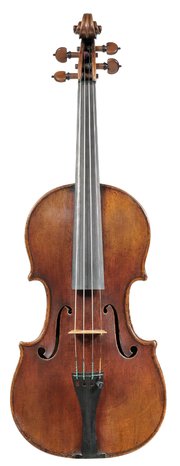
Stradivarius violin

Stradivarius violin

We read all the time about musicians and their favored instruments.  They are always transporting them around in cabs, on subways, on trains and planes.  I once saw the cellist, Yo Yo Ma, with his cello on Boston’s Red Line.  Probably the same cello he has left at least once in a cab.  My husband told me when I mentioned I was going to blog about Mr. Almond, that he once left his trumpet on the Orange Line.  Luckily someone had turned it into the MBTA lost and found.  Mr.  Almond can certainly get another high quality violin, but probably not another Strad.

What is shocking about the incident is that it was not stolen from a dressing room left unlocked or lost on some public conveyance, but that he was attacked just as if someone was going to steal his watch or wallet or ring and that it was clearly planned.

A spokeswoman for the orchestra confirmed that the instrument was insured, but said that because of the investigation, she could not provide details about the amount, or what restrictions, if any, applied to the use of the instrument. Given its prominence — high-resolution photographs of Strads are plentiful — it would be virtually impossible to sell the instrument on the open market.

“We’re not engaging in the pretense that this is just any other crime,” Chief Flynn said on Thursday. “This is an extraordinary art theft. It is just as extraordinary as if some master criminal crept into the Milwaukee Art Museum and stole several of its most valuable pieces. It’s an inordinately rare violin of unquestioned provenance, made 300 years ago and worth a lot of money. So obviously we are treating this like much more than just another mugging.”

Like the paintings stolen and never recovered from the Isabella Stewart Gardner Museum which also can’t be sold.  If they are still around, some wealthy person somewhere is enjoying them or they are lying abandoned in a basement or attic.  I hope it is the former.

…Antonio Stradivari was, by common agreement among violin fanciers, the master builder of violins, a creator of instruments with a sound that subsequent makers have been at a loss to reproduce. Fewer than 650 of Stradivari’s violins survive, and Mr. Almond’s — which was given to him on “permanent loan” by an anonymous patron in 2008 — is regarded as a particularly fine example.

Called the Lipinski Strad, after an early owner, the instrument was built in 1715, when Stradivari was in his prime. The first known owner was the composer and virtuoso violinist Giuseppe Tartini, who flourished in the early 18th century and whose “Devil’s Trill” Sonata remains one of the Baroque repertory’s great showpieces. Karol Lipinski, a Polish player who was friendly with Paganini, Liszt and Schumann, owned it in the early 19th century. It made its way to Milwaukee in 1962, in the possession of Evi Liivak, an Estonian violinist, who died in 1996. Then it dropped out of sight until the current owner offered it to Mr. Almond.

A stolen instrument is very difficult to recover.  According to the FBI, 11 violins (including 6 Strads) have been stolen since 1985; only 3 are known to have been recovered.

…In one recent case, a 1696 Stradivarius was stolen in November 2010 from Min-Jin Kym, a young South Korean violinist who was living in London, while she and a friend ate lunch at Euston Station. The violin was found in July 2013.

A more famous case was the 1713 Strad (called the Gibson) owned by the early 20th-century violinist Bronislaw Huberman. It was stolen from Huberman twice: once from a hotel room in Vienna, in 1916, and then in 1936 from his dressing room at Carnegie Hall while he was onstage playing another instrument. The violin was recovered only in 1985 (Huberman died in 1947) when a jazz violinist who had been playing it in smoky clubs all those years made a deathbed confession. It is currently owned by the violinist Joshua Bell.

We hope that the Milwaukee Strad ends up in the hands of someone who will play it and they will have listeners who will enjoy the music.

UPDATE:

The Strad recovered.

The Strad recovered.

It is reported this morning that the violin has been recovered.  The New York Times reports

A Stradivarius violin stolen last month from the concertmaster of the Milwaukee Symphony Orchestra has been recovered seemingly unharmed, the authorities in Milwaukee announced on Thursday.

The rare instrument, which dates from 1715 and has been valued at $5 million, was recovered Wednesday night, after the police searched a residence in Milwaukee, led there by one of three suspects recently arrested in the case, Edward A. Flynn, the Milwaukee chief of police, said at a news conference. Officers found the violin in a suitcase in an attic. Chief Flynn described the home as owned by a friend of a suspect, but said that person was believed to have had no knowledge of what he had been asked to store.

And arrests were made.

On Wednesday, the Milwaukee police announced they had arrested two men and a woman this week in connection with the theft. On Thursday, officials identified two of the suspects as Universal Knowledge Allah, 36, a local barber who is being accused of providing the stun gun used against Mr. Almond; and Salah Ibin Jones, 41, whom the police described as their primary suspect. The third suspect, a 32-year-old woman, was not identified but is believed to have been driving the getaway vehicle.

The police have confirmed reports that Mr. Jones was previously convicted of possessing a stolen sculpture four years after it disappeared from a Milwaukee art gallery nearly two decades ago.

“This individual has done fairly high-end art theft in the past, and the last time his plan was to keep it in a safe place for a number of years and then bring it out of hiding and do something with it,” Chief Flynn said. “So theoretically it’s plausible that might have been his plan here: to keep it off the market and out of sight for a number of years.”

Stefan Hersh, a violin expert who appraised the instrument in 2012, said he had been contacted by the F.B.I. and went to Milwaukee on Thursday to authenticate the instrument. Seeing no damage, he performed a piece by Bach on the 300-year-old Stradivarius, a private concert for the police.

I’m sure we will hear more about how the violin was found in the attic, but at least it is safe and wasn’t there long enough to be damaged.  How could they have thought that wood would survive the heat and cold there and still have value many years from now?  But luckily that didn’t happen and it will be played again.

Photograph of a Stradivarius:  Michael Darnton

Photograph of recovered violin:  Darren Hauck/Reuters

Pete Seeger at the Lincoln Memorial

I was going to write about Pete Seeger’s death, but then I realized I had already written this back in 2009.

mhasegawa's avatarFortLeft

The concert at the Lincoln Memorial was a wonderful start to the festivities.  My favorites were Garth Brooks (who knew he could do gospel?) and Pete Seeger and Bruce Springsteen leading everyone in Woody Guthrie’s This Land is My Land

I grew up with Pete Seeger both with the Weavers and as a solo.  He used to come and perform at the annual Bucks County PA Peace Fair and I recall selling him Italian Ice at least once.  John Pareles wrote in his review of the concert in the New York Times

Its penultimate song had the 89-year-old folk singer Pete Seeger, who survived being blacklisted during the McCarthy era, leading a singalong on a full-length version of Woody Guthrie’s “This Land Is Your Land,” with one of his admirers, Mr. Springsteen, by his side.

And Joanna Weiss  in the Boston Globe

But the penultimate act seemed…

View original post 225 more words

About traffic studies

Unless you’ve been in a coma or cave or maybe sequestered somewhere you’ve heard about the traffic problems on the George Washington Bridge last September.  Everyone is investigating:  A joint special committee of the New Jersey legislature, the United States Attorney for New Jersey, at least two Congressional Committees and a great many news investigative reporters.  But until subpoenas come due in a week or so and people have a chance to digest all the material that will be submitted, including listening to cell phone conversations and searching for text messages and email, there is likely to be no new information.  So in case you are suffering from bridgegate withdrawal, here is some information on traffic studies.

Trust Calvin Trillin to be on the case.  First, his poem as published in the Nation.

Fort Lee Jam   

Chris Christie insists he knew nothing at all
Re jams at the bridge lanes. Well, maybe.
But, now, those commuters are smiling. They say,
“So who’s in a bigger jam, baby?”

traffic study

And then we have his imaginary consultant’s report from the traffic study published in the New York Times Sunday Review.

FINAL REPORT OF A TRAFFIC STUDY CONDUCTED AT THE FORT LEE, N.J., APPROACH TO THE GEORGE WASHINGTON BRIDGE, SEPT. 9-12, 2013

Object of the study. The study was designed to ascertain the effect on traffic if two out of three tollbooths at the Fort Lee, N.J., approach to the George Washington Bridge were closed.

Study designer. The traffic study was designed by Duane C. Milledge, Ph.D. Dr. Milledge was most recently the designer of a traffic study submitted to the agency that operates the two bridges that cross the Missouri River near downtown Kansas City, Mo. The design for that study calls for furnishing commuters on one bridge with $20 bills and instructions to say to the toll taker, “Sorry, it’s the smallest I’ve got,” collecting no tolls on the other bridge, and observing the result. Dr. Milledge is a member of the American Association of Traffic Engineers, a contributor to Queue Quarterly, and a Republican precinct captain in Summit, N.J.

Hypotheses. The principal hypothesis of the study was that the tollbooth closings might ease traffic flow onto the bridge, due to fewer cars from Fort Lee being able to gain bridge access.

Additional benefits that might accrue if the two tollbooths were closed permanently. It was posited that the space occupied by the two tollbooths in question might more efficaciously serve the revenue-flow needs of the Port Authority of New York and New Jersey through a use other than collecting tolls — for instance, concessioning them out as a Shake Shack or a retail outlet for selling such souvenirs as George Washington Bridge coffee mugs, Springsteen memorabilia and CDs of Don Imus drive-time radio shows from the ’80s.

¶ Methodology. The methodology of the study was to shut down two out of three tollbooths and see what happened.

Interaction of researchers and commuters. The research team had no problem collecting data from individual drivers waiting to go through the one open lane, since their cars were virtually stationary. There were only 14 instances of violence directed at the survey takers, almost all of which consisted of commuters throwing coffee from travel mugs or paper cups. Fortunately, no researcher was scalded, since the drivers had been waiting so long that their coffee was cold.

…Corporal Sicola [research assistant]  found that 58 percent of the motorists in line shouted some imprecation, ranging from the sort often heard in the stress of a rush-hour subway or an overcrowded emergency room (e.g., “You people should burn in hell” or “You can take your study and stick it where the sun don’t shine”) to rare curses, presumably ethnic in origin (e.g., “May streetcars grow on the back of your throat”).

As we all know the lane closures were ended on Day 4, so a follow-up study is recommended.

Now, here is advice from Dr. Gridlock of the Washington Post on how to do an actual traffic study.

For close to three millennia— from the days of the Romans until the interstates were built — conducting a traffic study was simple, dreary work: send somebody out with a clip board to count ox carts or stage coaches or automobiles.

Did this create traffic jams on the Appian Way or Oregon Trail? Probably not.

Like everybody else who drives, Christie knows about traffic cameras. New Jersey has almost as many of them as it does cranberries,  and they outnumber the pigeons on the suddenly-controversial approaches to the George Washington Bridge.

Back in the days before he acquired a chauffeur Christie had to listen to the same radio traffic reports as the plebeians. As an observant fellow, he’s bound to have noticed that in the past decade they’ve gotten much more sophisticated.

Those cameras have helped, but a major advance has been because a company called Inrix and a few competitors take the heartbeat of traffic and supply local radio and TV stations with what they report. Inrix has a world-wide network of transponders installed in most trucks and what are called “fleet vehicles” — rental cars and delivery vans.

Those transponders provide real-time information, so your cheerful traffic reporter can tell you exactly how much traffic to expect — or where the major tie ups are — on, for example, the George Washington Bridge.

And then you can take the data collected and do some computer modeling.  Bill Baroni who was the one who tried to explain the fake alleged traffic study would have had some really nice charts to show them.  You don’t need poor Corporal Sicola!

Illustration by Peter Arkle for the New York Times

Reading series mysteries

The last few months have not been kind to my ability to blog.  Between wrist tendonitis and cataract surgery on both eyes, I haven’t been able to do much on the computer.  But now my wrist is settling down and my eyes are staring to clear.  I had intended to start back slowly but I seem to have posted quite a bit this past week.

During my absence from the computer, I have been able to read.  My big accomplishment:  reading the entire Thomas and Charlotte Pitt series by Anne Perry.  I had read a number of them before but realized that I had skipped most of the ones in the middle.  There are 26.  Thomas Pitt begins as a detective with what became the Metropolitan Police in late 19th century London.  He is the son of a gamekeeper who was educated with the master’s son – a key to his rise.  Charlotte is the middle daughter of an upper class, but not aristocratic family.  Their marriage is gradually accepted by her family. (I have to say that I never quite understood why she never had even a small dowry, but I may have missed the explanation.)  Her sister, Emily,  marries up to the aristocracy and then when her husband dies, a man who gets elected to Parliament.  Emily’s great aunt from her first marriage plays a major role in most of the books.  I’m sure you have guessed by now that these are mystery novels. The genius of Anne Perry is her ability to capture the time while often centering her stories around issues that are still current like rape and political corruption.

Having finished up with Thomas and Charlotte Pitt, I began thinking of the other series I’ve followed over the years beginning with the Nero Wolfe books by Rex Stout and Dorothy Sayers’ Peter Wimsey series and moving on to the Margaret Maron’s Deborah Knott, Victoria Thompson’s Sarah Brandt and, of course, J.D. Robb and the “in death” books.  What happens to me is that the characters become familiar friends.  One gets involved in their lives and is sad when they go away because the author dies or simply, like Sayers, decides not to write any more.  One watches children grow up and wonders how the relationship between Deborah and her stepson, Cal will evolve.  Will Eve Dallas ever have children?  How will Sarah’s relationship with Malloy impact his mother?  And people follow different writers and characters.  But some series get read primarily for the mystery.   I read all of P.D. James, but not necessarily because I wanted to know what would happen next to Adam Dalgliesh although his development has been fun to follow and it is   interesting that James has written the best follow-up to Jane Austen’s “Pride and Prejudice”: “Death Comes to Pemberly”,

So the question becomes whether or not to read anything by an author, authorized or not, who picks up the series.  I’ve never read any of the “new” Nero Wolfe’s or the continuation of Robert Parker’s Spencer series, but I have read all three of Jill Patton Walsh’s Peter Wimsey/Harriet Vane add-on’s.  I had just finished writing that sentence and stopped to think more about where this was going when Margaret Maron herself posted on Facebook.

I think that several no-longer-with-us writers have had their series continued by others with decent success — Sherlock Holmes and  Jill Paton Walsh’s entries in Sayers’ Lord Peter Wimsey saga come to mind. But rather than write more Peter-Harriet stories, I really wish that she or someone competent would use the Wimsey sons. If you recall, there were 3 of them.  Surely at least one of them inherited his parents’ detecting bug?
What series would you love to see done if you could be sure they’d be done well?
I don’t know if anyone else could do what Margaret Maron does, but if she suddenly stopped writing, I would want to see more of Deborah Knott and her family.
In the meanwhile I’ve ordered the new J.D. Robb and am looking forward to the spring and summer with a new Anne Perry as well as a new Peter Wimsey by Jill Patton Walsh.