Are starlings taking over?

According to a recent story on the BBC, the answer is “yes, they are.”

“Starlings are lean and mean. In the industry they’re often called feathered bullets,” says Michael Begier, National Coordinator for the US Department of Agriculture (USDA) Airports Wildlife Hazards Program.

“They’re a particular problem at airports because they flock in very large numbers, and compared to other birds their bodies are very dense. They are about 27% more dense than a herring gull which is a much larger bird.”

When a flock of starlings strikes an airplane the effects can be devastating. In 1960 they caused the most deadly bird strike in US aviation history

The birds flew into the engines of a plane as it took off from Boston’s Logan Airport, and it crashed into the harbour, killing 62 people on board.

Starlings also cost US agriculture an estimated $1bn (£595m) a year in damage to crops – particularly fruit trees.

They can even cause milk production to drop at dairy farms because they steal the grain being fed to cows.
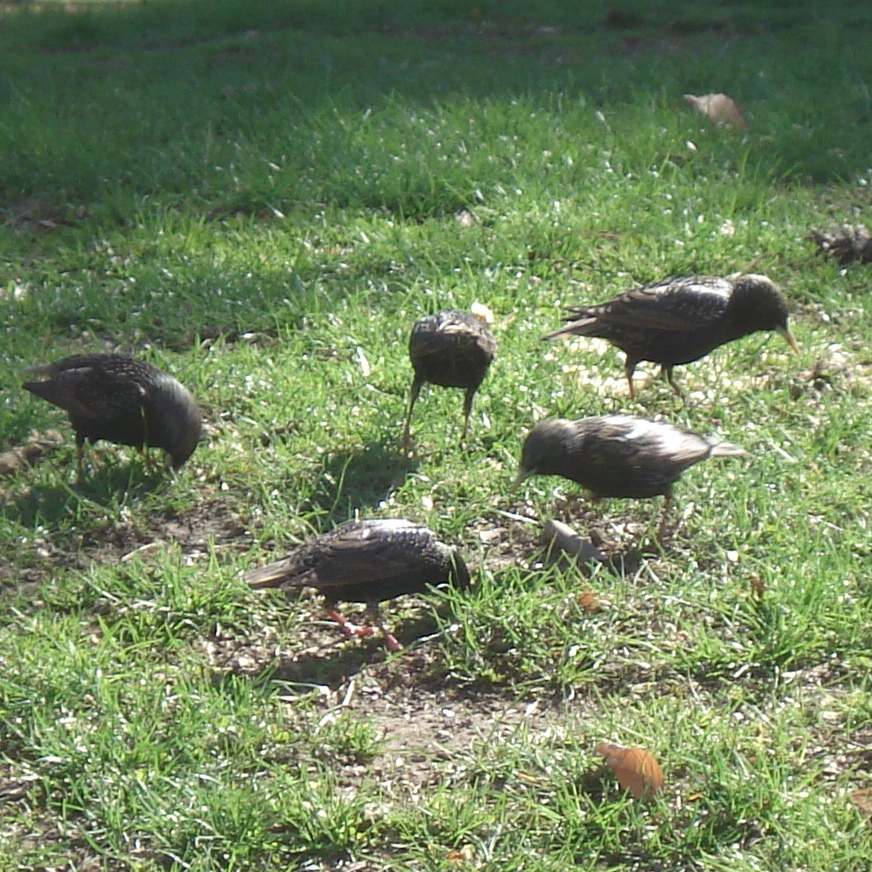
Taken on a recent visit to Central Park, NYC, these fellows are direct descendants of those first 80 to 100 first starlings.

Taken on a recent visit to Central Park, NYC, these fellows are direct descendants of those first 80 to 100 first starlings.


If you look at any bird book or website you can see that they are common all across the United States.  We have a few in our neighborhood and for many years I’ve watched from the bedroom window as a pair (probably not the same ones!) nest in an air vent in the house next door.  OK, so they are kinda mean and can be a problem but they are beautiful up close and fun to watch when they occasionally visit our feeders.  The purplish black spotted bird is technically the European Starling.  According to the Cornell Lab of Ornithology it all begins with Shakespeare.

First brought to North America by Shakespeare enthusiasts in the nineteenth century, European Starlings are now among the continent’s most numerous songbirds. They are stocky black birds with short tails, triangular wings, and long, pointed bills. Though they’re sometimes resented for their abundance and aggressiveness, they’re still dazzling birds when you get a good look. Covered in white spots during winter, they turn dark and glossy in summer. For much of the year, they wheel through the sky and mob

  • All the European Starlings in North America descended from 100 birds [the BBC says there were 80] set loose in New York’s Central Park in the early 1890s. The birds were intentionally released by a group who wanted America to have all the birds that Shakespeare ever mentioned. It took several tries, but eventually the population took off. Today, more than 200 million European Starlings range from Alaska to Mexico, and many people consider them pests.
  • Because of their recent arrival in North America, all of our starlings are closely related. Genetically, individuals from Virginia are nearly indistinguishable from starlings sampled in California, 3,000 miles away. Such little genetic variation often spells trouble for rare species, but seems to offer no ill effects to starlings so far.

So why are starlings Shakespearean?  The BBC says they are mentioned in Henry IV Part 1

Hotspur is in rebellion against the King and is thinking of ways to torment him. In Act 1 Scene III he fantasizes about teaching a starling to say “Mortimer” – one of the king’s enemies.

“Nay, I’ll have a starling shall be taught to speak nothing but Mortimer, and give it to him to keep his anger still in motion,” Shakespeare wrote.

This might actually not be so much of a fantasy as they, like the Northern Mockingbird are mimics according to the ornithologists at Cornell.

Starlings are great vocal mimics: individuals can learn the calls of up to 20 different species. Birds whose songs starlings often copy include the Eastern Wood-Pewee, Killdeer, meadowlarks, Northern Bobwhite, Wood Thrush, Red-tailed Hawk, American Robin, Northern Flicker, and many others.

So maybe Henry could have taught a starling to speak the name of Mortimer
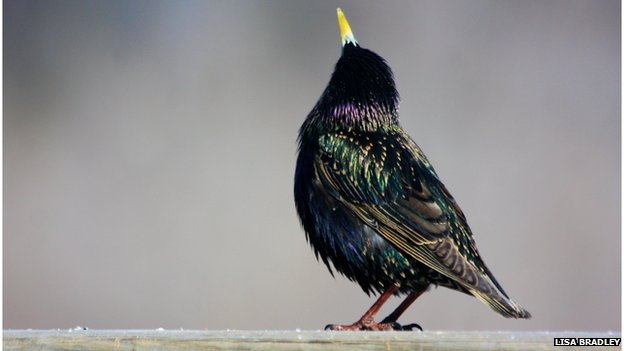
Close-up of a handsome starling

Close-up of a handsome starling

Photograph of flock:  Robert L. Wyckoff

Photograph of single starling:  Lisa Bradley for the BBC.

President Harrison’s new medical diagnosis

William Henry Harrison, the ninth president of the United States, served one month.  I learned in school that he gave a very long inaugural address, caught pneumonia, and died.  I think this is what most people know about him.  Oh, there is that slogan “Tippecanoe, and Tyler, too”.  Harrison , while governor of the Indiana Territory, commanded troops that repulsed a raid by Chief Tecumseh.  According to his biography on the White House website

…In 1801 he became Governor of the Indiana Territory, serving 12 years.

His prime task as governor was to obtain title to Indian lands so settlers could press forward into the wilderness. When the Indians retaliated, Harrison was responsible for defending the settlements.

The threat against settlers became serious in 1809. An eloquent and energetic chieftain, Tecumseh, with his religious brother, the Prophet, began to strengthen an Indian confederation to prevent further encroachment. In 1811 Harrison received permission to attack the confederacy.

While Tecumseh was away seeking more allies, Harrison led about a thousand men toward the Prophet’s town. Suddenly, before dawn on November 7, the Indians attacked his camp on Tippecanoe River. After heavy fighting, Harrison repulsed them, but suffered 190 dead and wounded.

The Battle of Tippecanoe, upon which Harrison’s fame was to rest, disrupted Tecumseh’s confederacy but failed to diminish Indian raids. By the spring of 1812, they were again terrorizing the frontier.

In the War of 1812 Harrison won more military laurels when he was given the command of the Army in the Northwest with the rank of brigadier general. At the Battle of the Thames, north of Lake Erie, on October 5, 1813, he defeated the combined British and Indian forces, and killed Tecumseh. The Indians scattered, never again to offer serious resistance in what was then called the Northwest.

Then in 1840 he won the Presidency in a close election, gave his address, took sick and died.  But of what did he actually die?  Two New York Times science reporters think they have found the answer.

But a new look at the evidence through the lens of modern epidemiology makes it far more likely that the real killer lurked elsewhere — in a fetid marsh not far from the White House.

The first clue that the pneumonia diagnosis was wrong lies in Miller’s [Thomas Miller, Harrison’s doctor] own apparent uneasiness with it. “The disease,” he wrote, “was not viewed as a case of pure pneumonia; but as this was the most palpable affection, the term pneumonia afforded a succinct and intelligible answer to the innumerable questions as to the nature of the attack.”

An 1846 map of Washington, top, shows the home (A) of William Henry Harrison, above, its water supply (B), and a field of “night soil” (C) that could have harbored deadly bacteria.

An 1846 map of Washington, top, shows the home (A) of William Henry Harrison, above, its water supply (B), and a field of “night soil” (C) that could have harbored deadly bacteria.

The conclusion:  Typhoid Fever.

In those days the nation’s capital had no sewer system. Until 1850, some sewage simply flowed onto public grounds a short distance from the White House, where it stagnated and formed a marsh; the White House water supply was just seven blocks downstream of a depository for “night soil,” hauled there each day at government expense.

That field of human excrement would have been a breeding ground for two deadly bacteria, Salmonella typhi and S. paratyphi, the causes of typhoid and paratyphoid fever — also known as enteric fever, for their devastating effect on the gastrointestinal system.

Two other antebellum presidents, James K. Polk and Zachary Taylor, developed severe gastroenteritis while living in the White House. Taylor died, while Polk recovered, only to be killed by what is thought to have been cholera a mere three months after leaving office.

Thus, the lack of a sewer system may have lead to the death of two presidents and the illness of a third.

Birds and seeds: change and diversity

Maybe it is just what seems to be a very long, cold winter (As I start writing this it is snowing again, but I hope not for long.) that is getting to me but I’m thinking this morning about natural ebbs and flows of plants and animals and the influence of man for both good and bad.

Northern Cardinal

Northern Cardinal

We participate in the Great Backyard Bird Count every year and they are reporting some preliminary findings from February’s count.

Although much more data have yet to be recorded, here are some of the trends noted so far.

  • Fewer Finches After last year’s “superflight,” this year’s GBBC reports for 10 irruptive species (mostly finches) are down considerably. This includes reports for the White-winged and Red crossbills, Common and Hoary redpolls, Pine and Evening grosbeaks, Pine Siskin, Purple Finch, Red-breasted Nuthatches, and Bohemian Waxwings. These are believed to be natural fluctuations in numbers because of variation in seed crops.
  •  Snowy Owl Invasion Continues A massive irruption of Snowy Owls into the northeastern, mid-Atlantic, and Great Lakes States of the U.S., as well as southeastern Canada, is easily seen in GBBC numbers. Preliminary results show participants reported more than 2,500 Snowy Owls in 25 states and 7 provinces of the U.S. and Canada!
  • The Polar Vortex Effect The frigid cold in many parts of North America has resulted in unusual movements of waterfowl and grebes. With the Great Lakes almost completely frozen, some species, such as the White-winged Scoter and the Long-tailed Duck, have fled the frozen lakes and stopped at inland locations where they are not usually found at this time of year.

The trends just naturally change from year to year.  But the mention of seed crops brings me to this story that caught my eye.  Seed Libraries.  I’ve heard of some companies starting to grow more variety of plants for seed and of the seed vault where seeds are being kept in case one day we need to start over, but not of seed libraries.  The Boston Globe reported

A basic principle of any library is that you return what you take out. By that standard, the new scheme at Hampshire College’s library is a roll of the dice. Since last November, librarians have been lending out packets of seeds, allowing people to plant them, and checking them back in if—and only if—the borrower manages to grow thriving plants in the meantime.

The Hampshire College project is part of a small but growing group of “seed libraries” across the country, local centers that aim to promote heirloom gardening and revive a more grass-roots approach to seed breeding.

A seed library

A seed library

The concept is pretty simple:  You check out some seeds, plant them, let some of them go to seed and then return the seeds.  But there is always the chance that you won’t get back the same variety.

“Self-pollinating” plants like beans, peas, tomatoes, and lettuce have both male and female parts in the same flower, so they tend to predictably produce seeds that grow the exact same kind of plant. But “open-pollinating” plants like squashes and corn require pollen to travel from one plant to another—and there’s a significant chance that pollen from some other variety of plant, borne by wind or insect, will get in and create an unwanted hybrid. Katie Campbell-Nelson, vegetable extension educator at the University of Massachusetts Amherst, says that one year she planted kale too close to collard greens. She saved seeds from that year’s harvest, and, “The kale I got next year was just this bitter horrible cross.”

Why is plant diversity important?  Think about the Irish Potato Famine.

The agribusiness model has given the world cheap, abundant food, but it has also reduced the variety of crops we eat to a handful of massively grow-able varieties. According to the Food and Agriculture Organization of the United Nations, 75 percent of plant genetic diversity has been lost over the last century as farmers have moved to high-yielding, genetically modified seeds. This dependence on a few kinds of plants leaves our food supply not only genetically impoverished, but also more vulnerable to blight. (Peru, which grew many varieties of potatoes, survived the potato blight much better than Ireland, which grew only one.)

One of the many reasons I’m looking forward to summer is the re-opening of local farmer’s markets and the opportunity to try new varieties.  Plant diversity is another reason to grow and buy locally.

The Polar Vortex (and who had ever heard of it before this winter) has changed the migration and winter nesting of some birds, but man also changes patterns with building, clearing for agriculture, dams, and other structures.  Factory farms lead to less diversity in what we can purchase and eat and can lead to blight requiring more pesticides and fertilizer.  This impacts every thing that eats whatever is grown this way.  I know we will never go back to the era when everything was grown on the family farm – there are just too many of us and more and more of us are living in urban areas – but being aware never hurts.

Photograph:  Northern Cardinal Ella Clem

Photograph:  Seed Library: Lesley Becker/Globe staff

Globe Story:  Kevin Hartnett

Red-tailed hawks on Fort Hill

The other day I saw a large bird perched in one of the maple trees near our back porch/balcony.  It’s a tree that many blue jays, mourning doves, cardinals and house sparrows use as a staging area before swooping down to the feeders and window boxes we keep filled with seed.  The light wasn’t too good and the bird didn’t look all that big.  The first day, we thought it was some kind of hawk, but couldn’t see the colors.  The second day, I could clearly see the white breast and dark back.  Eastern Kingbird?  Folks on the Great Backyard Bird Count Facebook page said too early in the season for a kingbird.  Maybe a Sharp-shinned hawk.

This afternoon, we saw the bird up close – like just on the other side of the kitchen window close.  It was clearly an immature Red Tailed Hawk.  We always leave our Christmas tree tied to the porch rail and it is still green and has most of its needles.  The sparrows use it for shelter.  And they needed it today!  When the Red-tail  flew by the first time, some of the 50-60 house sparrows flew away.  But when he landed on the porch, the tree held maybe 10 of them chirping away.  For about 2 minutes, my husband, Mr. Bunter (one of our cats), and I watched the poor red-tail trying to figure out how to catch one of the sparrows.  He flew from one window box to the other.  He tried to shimmy down one of the porch rail posts near the tree.  He landed on the table under the window so he could study us and the birds in the tree.

When he flew off for a second, probably to re-group, the sparrows made their escape.  When he came back, there was no more chirping in the tree.  No lunch today for Mr. Red-tail.  And later, my husband, watched 3 hawks circling the park and flying off in the direction of Jamaica Plain.

Juvenile Red Tailed Hawk

Juvenile Red Tailed Hawk

A number of years ago, a mature red-tail swooped on to the porch and grabbed a rock dove (pigeon) and proceeded to eat the entire bird while we watched.  I think he left a couple of feathers. We also had a young red-tail fly into a neighbor’s open window.  The Audubon and Animal Rescue people were called and he was rescued unhurt.

According to the Cornell Lab of Ornithology, Red-tailed Hawks are the most common kind.  One sees them circling around when you are driving along the interstates or on back roads.  But we’ve been lucky to have see two of them close up.

Photograph from the Cornell Lab of Ornithology web site, All About Birds.

Ms. G. predicts more winter

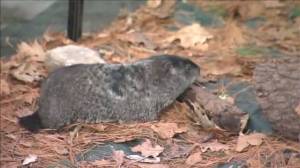
Groundhog Day.  February 2.  For some reason that groundhog in Pennsylvania gets all the press even though I’m not sure how he can predict the weather for the entire country.  But Massachusetts has Ms. G.  According to New England Cable News

Ms. G. predicts more winter.

Ms. G. predicts more winter.

Massachusetts has its own groundhog to make predictions about the weather on Groundhog Day.

Both Punxsutawney Phil and Ms. G, the Mass. groundhog, saw their shadows this year. Legend has it; this means that there will be six more weeks of winter.

“We don’t feel like Punxsutawney Phil has much sway here in Massachusetts. I mean, we wouldn’t use a weather forecaster from Pennsylvania to tell us our local weather,” said Tia Penney of a Drumlin Farm Wildlife Sanctuary.

Dozens of families gathered at the sanctuary on Sunday to witness Ms. G give her forecast. But, not everyone was happy with her prediction.

“I didn’t see the shadow and I wanted spring to be here, cause then, after spring, there is no school,” said Asia Faline, a Wellesley school student.
Blue Hill Weather Observatory says Ms. G is correct in her forecast 60% of the time.

So what is the origin of Groundhog Day?  Is there any science to it?  Today EarthSky news told us everything you always wanted to know about this important day.  Here are some of the interesting facts.

We all know the rules of Groundhog Day.  On February 2, a groundhog is said to forecast weather by looking for his shadow.  If it’s sunny out, and he sees it, we’re in for six more weeks of winter.  On the other hand, a cloudy Groundhog Day is supposed to forecast an early spring.

What you might not know is that Groundhog Day is really an astronomical holiday.  It’s an event that takes place in Earth’s orbit around the sun, as we move between the solstices and equinoxes.  In other words, Groundhog Day falls more or less midway between the December solstice and the March equinox.  Each cross-quarter day is actually a collection of dates, and various traditions celebrate various holidays at this time.  February 2 is the year’s first cross-quarter day.

In the ancient Celtic calendar, the year is also divided into quarter days (equinoxes and solstices) and cross-quarter days on a great neopagan wheel of the year.  Thus, just as February 2 is marked by the celebration of Candlemas by some Christians, such as the Roman Catholics, in contemporary paganism, this day is called Imbolc and is considered a traditional time for initiations.

The celebration of Groundhog Day came to America along with immigrants from Great Britain and Germany.  The tradition can be traced to early Christians in Europe, when a hedgehog was said to look for his shadow on Candlemas Day.

Try this old English rhyme:  If Candlemas Day be fair and bright, winter will have another flight.  But if it be dark with clouds and rain, winter is gone and will not come again.

So even though it has now turned a little cloudy here in Boston, the sun was out this morning and Ms. G. says more winter.  In fact,  I think the prediction is for snow on Wednesday.

Photograph is a still from the NECN story.

Increased violence. Another consequence of global warming?

I read a lot of mystery stories.  Old ones, new ones, ones set in times past and ones set it the future.  A common thread is it is summer and a heat wave so crime is up.  You hear this every spring from the Boston Police and the Mayor – we need to prepare for the combination of hot weather and school being out.  So is this just an urban myth?  Maybe not.  A new study to be published in the journal, Science, was summarized in Sunday’s New York Times.

But researchers are now quantifying the causal relationship between extreme climate and human conflict. Whether their focus is on small-scale interpersonal aggression or large-scale political instability, low-income or high-income societies, the year 10,000 B.C. or the present day, the overall conclusion is the same: episodes of extreme climate make people more violent toward one another.

In a paper published this month in the journal Science, we [MARSHALL BURKE, SOLOMON HSIANG and EDWARD MIGUEL] assembled 60 of the best studies on this topic from fields as diverse as archaeology, criminology, economics, geography, history, political science and psychology. Typically, these were studies that compared, in a given population, levels of violence during periods of normal climate with levels of violence during periods of extreme climate. We then combined the results from those studies that concerned modern data in a “meta-analysis,” a powerful statistical procedure that allowed us to compare and aggregate findings across the individual studies.

We found that higher temperatures and extreme rainfall led to large increases in conflict: for each one standard deviation change in climate toward warmer temperatures or more extreme rainfall, the median effect was a 14 percent increase in conflict between groups, and a 4 percent increase in conflict between individuals.

Global mean surface temperature difference fro...

Global mean surface temperature difference from the average for 1880–2009 (Photo credit: Wikipedia)

The study went beyond the present day, back to the collapse of several civilizations:  The Maya, Angkor Wat and the Akkadian in Syria.  Climate appears to have played a role in the collapse of each.

Our findings held at very high levels of statistical confidence. To illustrate the consistency of the results: of the 27 quantitative studies we looked at that examined a link between temperatures and modern conflict, all of them found that higher temperatures were associated with more violence. This sort of pattern in the results was extremely unlikely to happen by chance. (Imagine trying to get 27 “heads” in a row when flipping a coin.)

What explains the strong link between climate and conflict? Different mechanisms are most likely operating in different settings, but the two most important factors appear to be aggression and scarcity. The aggression factor is intuitively easy to understand (again, recall summer in the city), and it probably underlies the finding that anomalously hot months have significantly higher crime rates in cities in the United States. As for scarcity, the logic is only slightly more complex. In low-income countries largely dependent on agriculture — like those in much of sub-Saharan Africa and parts of Asia and Latin America — when the rains fail and temperatures scorch, crops wilt and die. This leaves many people dangerously close to the edge of survival, which can lead to social strife and even civil war.

So besides gearing up for more shootings, stabbings and homicides on the summer streets, what are the implications?  The study concludes

Our findings help us better understand both the past and the present, but they are particularly important for what they imply about the future. Many global climate models project global temperature increases of at least 3.6 degrees Fahrenheit (2 degrees Celsius) over the next half century. Our results imply that if nothing changes, this rise in temperature could amplify the rate of group conflicts like civil wars by an astonishing 50 percent in many parts of the world — a frightening possibility for a planet already awash in conflict.

Decision makers must show an understanding that climate can fundamentally shape social interactions, that these effects are already observable in today’s world and that climate’s effects on violence are likely to grow in the absence of concerted action. Our leadership must call for new and creative policy reforms designed to tackle the challenge of adapting to the sorts of climate conditions that breed conflict — for instance, through the development of more drought- and heat-resistant agricultural technologies.

As we contemplate intervention in Syria and look at the increasing and never-ending violence in Africa, we also need to ask ourselves some questions about violence here at home.  Will global warming lead to increased domestic violence?  What do we do with this knowledge and all the guns on the streets?  And will anyone pay any attention?

Beating the heat

We just finished a week or so of 90+ temperatures with high humidity in Boston without air conditioning.  We survived quite well.  It wasn’t until day 6 or 7 that I really began to suffer – that the was day there was no afternoon sea breeze.  Exhaust fans on each floor pull air through the house and smaller fans are placed in the rooms we use the most.  We are lucky to have good four-way ventilation.  Cool showers and cooking in the mornings = or not at all – also help.  (We went out once to out favorite pub so find that their air conditioning was not 100%, but it was just fine.)  I am one of those rare people that don’t like living in refrigerated air.  So I was very interested in the Boston Globe article in the Sunday Ideas Section titled “How to Live Without Air Conditioning”  In it, Leon Neyfakh  points out the life style changes that we could make so that we at least reduce our energy consumption.

Since the technology was invented in 1902, and the first window unit was brought to market in 1939, air conditioners have become ubiquitous in the United States. Today, almost 90 percent of American households have one—as do the vast majority of restaurants, stores, museums, and office buildings. During weeks like the one we’ve just had, these places are sanctuaries: To walk into one after being outside is to be reminded how sweet life can be.

But all that magic chilling comes at a cost—something most people are aware of on a personal level, because their electricity bills are so high during the summer, but not so much on a global scale, which is really where the problem lies. In China and India, air conditioning sales have reportedly been growing by 20 percent per year; around the world, air conditioning energy demand is projected to increase vastly over the next decades. According to Stan Cox, author of the 2010 book “Losing Our Cool,” air conditioning in the United States already has a global-warming impact equivalent to every US household driving an extra 10,000 miles per year.

English: Series of air conditioners at UNC-CH.

English: Series of air conditioners at UNC-CH. (Photo credit: Wikipedia)

Think about that.  And we continue to build office buildings taller and more dependent on artificial cooling.  Yes, maybe some are energy efficient and green building, but they still consume vast amounts of energy.

When experts look at A/C use in America, they immediately see a spot of illogic: We use vast amounts of energy just to let businesspeople do something they’d probably rather not do anyway. “We are probably overcooling our office buildings by 4 to 6 [degrees] F just so that office workers, particularly the males, can wear their business suits,” wrote Richard de Dear, who is head of architectural design science at the University of Sydney and a researcher on thermal comfort. “The current clothing behaviour is costing us a fortune in energy and greenhouse emissions!”

In Japan every summer, in an environmental initiative called “Cool Biz” that started in 2005, government officials encourage building managers to let temperatures climb to 82 degrees and advise employees to loosen their sartorial standards. In 2011, the government even put on a fashion show, with models catwalking in untucked polos, capri pants, and Kariyushis, a Japanese take on the Hawaiian shirt.

Here in America, it probably wouldn’t require such a hard sell. Many female workers already dress for summer weather, and would likely be delighted not to have to huddle in sweaters against the A/C. Among men, polos are already considered appropriate on casual Fridays, and it’s not hard to imagine that most would happily embrace a breezier style for the rest of the week. Instead of long pants, they could don formal shorts—a concept that has long been embraced in Bermuda, where executives can be seen attending meetings with exposed knees.

And people can do similar things at home.

Even a mid-sized building could save considerable amounts every year by operating at shorts temperature. But if modifying what we put on our bodies could help us give up extreme climate control, rethinking buildings themselves—and how we ventilate them—would go even further. Already, some of us live in homes that can be effectively cooled by opening windows in the basement and on the top floor every morning, thus taking advantage of the so-called stack effect to pull cool air up through the house and allow hot air to vent into the street. People can also try “evaporative cooling,” a modest, low-tech form of air conditioning, by hanging wet towels in the window or setting them in front of a basic electric fan.

Some of  Neyfakh’s life style suggestions like changing to a work schedule with early morning hours, a mid afternoon siesta, and late work hours are a tougher sell:  Too many people commute long distances.  But people who telecommute could try raising the temperature at home a few degrees so that they at least don’t have fried brains and the inertia that comes with it.  Also try adjusting blinds to follow the sun and plant trees.

There are some parts of life, it must be said, for which air conditioning is not just a luxury but a necessity. The Internet depends on servers that require climate control in order to not go up in flames. Modern skyscrapers depend on it, as well. If we gave up air conditioning, New England would largely be fine, at least for now, but entire swaths of the country would become uninhabitable: Summers in the Sun Belt cities and in parts of the South would be so harsh that millions of people would simply move away. We also would be unwilling to take away A/C from those most sensitive to extreme heat—namely, the sick, the very young, and the elderly.

That doesn’t mean that trying to reduce our society’s addiction to A/C is a fool’s errand. The fact is, our bodies are built to adjust to heat—it’s just that we haven’t had to lately, because we’ve become so accustomed to refrigerating ourselves when the weather gets hot. A study in which researchers surveyed 21,000 people, spread out across 160 buildings on four continents, found that “people in warmer climates were more comfortable in warmer indoor temperatures than their counterparts in cooler climate zones,” according to Richard de Dear, one of the coauthors.

The findings indicate that people actually prefer being in places where the temperature fluctuates, as long as they have some control over it. “If you have the ability to open or close a window, turn a fan on or off, change the blinds, modify your clothing—it just becomes a natural part of your day-to-day living, and you don’t build these expectations that conditions should be the same all day and all year round, which I would call ‘thermal monotony,’” said Gail Brager, an architecture professor at UC Berkeley who also worked on the study. “We not only accept—we actually prefer—a wider range of conditions that float with the natural rhythms of the outdoor climate.”

No doubt this is hard to believe, as you sit there in your air-conditioned home, happily soaking up the artificial breeze emanating from the murmuring machine in your window. But is there not something fearful about refrigerating ourselves with such vigilance? We’re not cartons of milk, after all; we will not spoil, even if we do sweat a little. In fact, by taking full advantage of the technology inside our own bodies—technology that makes it possible for us to adapt to a whole spectrum of temperatures—we might discover we’ve been missing out on a way of life that actually feels quite natural.

Everyone doesn’t have to go air conditionless as we do, but there is nothing wrong, and much to gain by not making all of our buildings so cold.  Maybe we can at least agree on a temperature like 80 or, like the Japanese, 82 and save some energy.

A Nobel Prize Winner and questions about Nagasaki

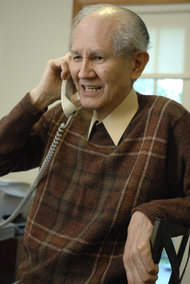
There was a very interesting profile in the New York Times Science section this week about Osamu Shimomura the Nobel Prize winning chemist.  Never heard of him?  Me either.  It was his life, not his science I found most interesting.  My mother’s family is from a small town near Hiroshima and I grew up knowing about Hiroshima and Nagasaki.

Sixty-eight years ago, Osamu Shimomura was a 16-year-old high school student working in a factory seven and a half miles from Nagasaki, Japan. Sitting down to work, a light flashed, briefly blinding him, and the pressure wave from an explosion came rolling through.

On his walk home from the factory, he was drenched with a black rain. His grandmother immediately had him bathe, most likely saving him from radiation-related illness.

Dr. Shimomura has said that he mostly doesn’t think about the bomb dropped on Nagasaki, but he recently delivered a lecture at the Los Alamos National Laboratory.  Los Alamos is the home of the Manhattan Project and the birthplace of the atomic bombs dropped on Hiroshima and Nagasaki.  The bomb was not the topic of Dr. Shimonura’s lecture.

Instead, he recounted the discovery and development of one of the most significant tools for modern biotechnology: the green fluorescent protein, or G.F.P., used widely in cell and molecular biology as a visual tracer. The discovery, which has deepened the understanding of a wide range of fundamental biological processes, brought him the Nobel Prize in Chemistry in 2008, along with Martin Chalfie and Roger Y. Tsien.

Together with my father who returned briefly from Manchuria in 1939. Front row from left: my mother Yukie, grandmother Tsuki, grandfather Kosaburo, father Chikara, younger brother Sadamu, and myself behind Sadamu, together with my uncle Eijiro Sata's family in back row.

Together with my father who returned briefly from Manchuria in 1939. Front row from left: my mother Yukie, grandmother Tsuki, grandfather Kosaburo, father Chikara, younger brother Sadamu, and myself behind Sadamu, together with my uncle Eijiro Sata’s family in back row.

In his autobiography accompanying his Nobel information, Dr. Shimomura did talk about Nagasaki.

On August 6, 1945, news reports informed us that the city of Hiroshima had been completely destroyed by a new type of bomb; we didn’t know what kind. Three days later, shortly before 11 AM, a siren sounded at the Isahaya factory, notifying us of an air raid. As usual, rather than going into a bunker, I went to the top of a nearby hill with a couple of friends and looked at the sky. We saw a single B-29 going from north to south towards Nagasaki, about 15 km away. I thought that its course was unusual. The B-29 dropped two or three parachutes and I heard sporadic gunshots. Watching carefully, I saw no people attached to the parachutes. Within a few minutes, another B-29 followed the first one, and a siren sounded the “all clear” signal. We returned to our factory building.

At the moment I sat down on my work stool, a powerful flash of light came through the small windows. We were blinded for about 30 seconds. Then, about 40 seconds after the flash, a loud sound and sudden change of air pressure followed. We were sure there was a huge explosion somewhere, but we didn’t know where. The sky was rapidly filling with dark clouds, and when I left the factory to walk home, about three miles away, a drizzling rain started. It was black rain. By the time I arrived home, my white shirt had turned gray. My grandmother quickly readied a bath for me. That bath might have saved me from the ill effects of the strong radiation that presumably existed in the black rain.    The next morning, a technical officer told us that the parachutes we had seen the day before contained measurement instruments and a transmitter. He also mentioned that there was serious damage in Nagasaki, but the details were unknown. The chief of the factory organized a rescue party. We tried to enter Nagasaki, but could not because the roads and the railroad were impassable. Later that afternoon, the railroad was opened to Michinoo, near Nagasaki station, and rescuers began to transport injured people to Isahaya and other cities.

On August 15, in a radio broadcast, Emperor Hirohito declared unconditional surrender. This was the first time that most Japanese citizens had heard the emperor’s voice. I think there was a widespread feeling of relief, and also fear for an uncertain future.    Many years passed before we had detailed information about the atomic bombs that were dropped on Hiroshima and Nagasaki. The Nagasaki bomb was a different type and far more powerful than the Hiroshima bomb. Even if the use of the Hiroshima bomb was justifiable in order to precipitate an end to the war, the bomb dropped on Nagasaki three days later was clearly a test of new arms. It cannot be justified.

It cannot be justified.  I have always had questions about Nagasaki.  Why didn’t the Emperor call for surrender immediately?  Why didn’t we wait a few more days before dropping the second bomb?

The Times story recounts others at the Los Alamos dinner raising the subject.

At a dinner, Bette Korber, a theoretical biologist at the Los Alamos National Laboratory, told of how her father had been on a troop ship preparing for the invasion of Japan. For years, she said, he had credited the decision to drop the bombs with sparing his life. Years later, however, when declassified documents reopened questions about whether the Nagasaki bomb had been necessary to end the war, he was in despair, she said.

Gary Doolen, a physicist who had been a weapon designer at the lab, said there was evidence that the second bomb had been dropped as a demonstration of American power to Russians, who were then massing troops in East Asia.

Dr. Shimomura, tall and stooped, mostly listened.

The next day he and his wife returned to the museum.

…Moments before the Nagasaki bombing, Dr. Shimomura had seen a B-29 bomber drop three parachutes. The drop had puzzled him. He would later learn that they carried instruments for data transmission and measurement.

He asked John E. Pearson, the Los Alamos physicist who had invited him to lecture, about the instruments. After some hunting they found models of the original parachute payloads.

“Some guy came up and started explaining what we were looking at,” said Dr. Pearson. “Osamu said, ‘Yes. I watched them falling.’ I don’t think I’ve ever seen anyone quite as stunned as that guy.”

I wonder what those instruments recorded.  I wonder if the information would be useful as we try to deal with other nuclear disasters.  I wonder if they were destroyed by the bomb.

Shimomura

Photograph of the family from Shimomura’s Nobel Autobiography

Photograph of Shimomura Josh Reynolds/Associated Press

The doomsday clock

My father subscribed to the Bulletin of Atomic Scientists.  As long as I can remember, I would look at the cover each month and see what time it was.  The time was not, as my father explained to me, the current time but the time the scientists thought was left before a nuclear war.  Over my childhood, I watched the clock move closer to and further away from midnight.  The clock is currently set to 5 minutes to midnight.

So I was surprised to learn that the woman who had designed the clock had died.  If I had thought about it, of course someone created the design.  I think I’ve imagined all these years that it just appeared on the cover.

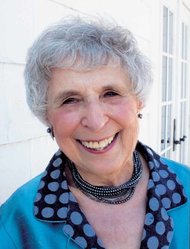
Martyl Langsdorf died at the 96.  Her obituary was in the New York Times

Mrs. Langsdorf was a painter who specialized in abstract landscapes. Her husband, Alexander Langsdorf Jr., was a physicist who had worked on the Manhattan Project developing the atomic bomb. In 1945, as preparations were being made to drop bombs on Hiroshima and Nagasaki, Dr. Langsdorf and others formed the Bulletin as debate was escalating within the group about what it had created. When the Bulletin converted from a newsletter to a magazine in 1947, Mrs. Langsdorf was hired to design the cover.

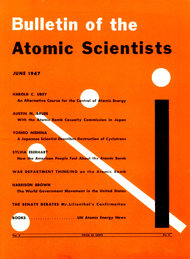
This is her 1947 cover.

1947 cover

The Times continues

Mrs. Langsdorf’s career designing magazine covers stopped and started with that first magazine issue of the Bulletin (which declared that it was 11:53 p.m.). She devoted herself instead to her artwork.

While this might be the only cover she designed, it has had a great impact.  Many know about the Doomsday Clock, but few know it came from the Bulletin of Atomic Scientist and even fewer know she was the designer.  Her clock is on their website and newsletter today.

Martyl Langsdorf

Martyl Langsdorf

Photograph from the Bulletin of Atomic Scientists

Sheep in the city

I live across the street from a city park and often say it is my front yard.  But sometimes the lawn mowing gets to me, and even worse are those horrid leaf blowers which just blow dirt around.  And small stones.  I need to get working on a campaign to ban them in Boston.  Maybe that will be my next retirement project.  But on to the sheep.

In case you missed the story, Paris is experimenting with sheep to mow lawns.  This short story from the Boston Globe caught my eye the other day.

PARIS — Will tourists soon see flocks of baahing sheep at the Eiffel Tower and bleating ewes by Notre Dame cathedral?

That could be the case, since Paris City Hall this week installed a small flock of sheep to mow the lawn at the city’s gardens, replacing gas-guzzling mowers. Four ewes — shipped in from an island off the Brittany coast — are munching the grass surrounding Paris Archives building.

‘‘I can imagine this very easily in London and New York . . . even Tokyo,’’ said ­Fabienne Giboudeaux, City Hall’s director of green spaces. ‘‘And why not have them at the Eiffel Tower?’’

Last year, two goats mowed the lawn at Tuileries, the city’s grand 17th-century gardens. A similar experiment outside Paris found that sheep droppings brought swallows back to the area. ‘‘It might sound funny, but animal lawnmowers are ecological as no gasoline is required, and cost half the price of a machine,’’ said Marcel Collet, Paris farm director. ‘‘And they’re so cute.’’

One of the Paris sheep.

One of the Paris sheep.

I read this and wondered how they keep the sheep from wandering off.  According to the Atlantic, they use an electric fence.  I guess they would have to move it around to different grazing areas as they can’t keep the entire space blocked off.  I think they should hire shepherds and a few dogs.  Give some people jobs.  They can use a portable pen at night.

As the Atlantic points out

It’s honestly a pretty sensible idea. For centuries, if not millennia, grazing animals like sheep and cows have been used both to trim and to fertilize fields. In fact, many of the oldest urban parks were originally populated by farm animals, sometimes just during the day when their owners went into to town to do business. A funny if only marginally related story about in-town grazing comes from Cambridge, Massachusetts, a former suburb of Boston that’s now very much a part of the city. Back in the early days of Harvard College, one of the perks of being a professor was that you were allowed to graze your cow in Harvard Yard. Back in 2009, retiring professor Harvey Cox actually exercised this privilege when he brought his cow Faith to school.

Actually, there shouldn’t be a lot of odor as sheep don’t do big patties like cows.  And if they hire a shepherd she can rake it up – not with a leaf blower.

I hope this catches on.  I like the thought of a couple of sheep with a shepherd on Fort Hill.  Plus it lowers noise pollution and helps with climate change and could create some jobs.

Photograph from Reuters