Marco and Barack and the State of the Union

The President did not awkwardly reach for a bottle of water during his speech.  In fact, I don’t remember him drinking at all.  John Boehner, however, seemed to be sipping from his glass often.  When he wasn’t looking dour, that is.  I’ll write more about substance later, but this post is about impressions.

The best description of the Speaker is from Joan Walsh in Salon

But Boehner’s disdain was unrivaled. He also managed not to rise even for a shout-out to “wounded warriors,” or 102-year-old Deseline Victor, who waited seven hours to vote in Miami on Election Day. It was sometimes hilarious to watch him next to Vice President Joe Biden, who looked like a happy Easter Bunny with his white hair, lavender tie, pink-tinted glasses and green Newtown ribbon. Biden seemed to occasionally enjoy standing up, clapping while looking down at Boehner sulking in his chair.

This is what she means.
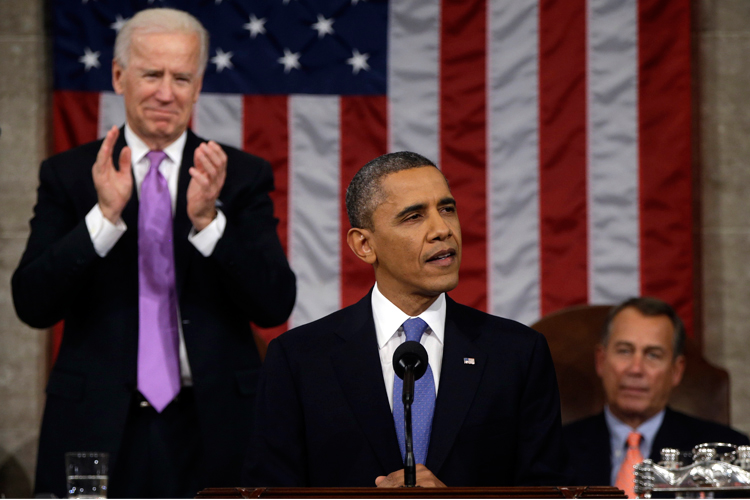
When John Boehner just sat there

And then we can move on to Maureen Dowd on Marco Rubio.

The ubiquitous 41-year-old — who’s on the cover of Time as “The Republican Savior” — looked as if he needed some saving himself Tuesday night as he delivered the party’s response to the State of the Union address in English (and Spanish). He seemed parched, shaky and sweaty, rubbing his face and at one point lunging off-camera to grab a bottle of water.

Oh, that water lunge.  How it will haunt poor Marco!

John Cassidy writing for the New Yorker, calls him “Water Boy”.

To be fair to Rubio, with a combination of eye contact and vigorous hand  gestures, he was doing a decent job with the tough task of delivering a lengthy  speech to a camera in an empty room. But then, for some reason—and it must have  seemed like an urgent one to him—he decided to reach for a small plastic bottle  on a nearby table and take a swig, thereby almost ducking out of the camera shot  and sending the Twitterverse into hysterics. “Uh-oh. Water gulp—really bad TV  optics,” Larry Sabato, a political science professor at the University of  Virginia, tweeted. “SNL, Colbert, Stewart…here they come.” After that  diversion, Rubio appeared to realize his error, and he looked a bit shaken. For  some reason, the camera closed in on his face, which didn’t improve things. As  the Democratic pundit Paul Begala cruelly noted on Twitter, the Senator was sporting a sheen  of sweat that inspired memories of Richard Nixon.

Meanwhile, the President looked confident and sometimes very passionate as when he mentioned the need for Congress to vote on gun safety legislation.

The Republicans looked more like their leader.

That is Paul Ryan in the center.

For right now, the President has the upper hand.  Neither Marco Rubio nor Rand Paul advanced any ideas beyond those from the last election – which they lost.  Plus they presented a bad image all around.  Maybe the Republicans are right in saying the President offered nothing new, nothing really that he didn’t talk about during the campaign, but there is a big difference:  Barack Obama won based in large measure on those ideas.  No wonder they look like four year olds being told they can’t have desert.  And poor Marco.  Only time will tell if he can overcome his reach for water.

Photographs AP/Charles Dharapak, Bill O’Leary/Post, Melina Mara/Post

Responses to the State of the Union Address: being picked isn’t always a good thing

Quick.  Name the four responders to President Obama’s State of the Union/Joint addresses to Congress.  (The first one is not considered to be formal State of the Union.)  Give up?  I could only remember Bobby Jindal and Bob McDonnell so I had to look them up.

2009 – Bobby Jindal in an address remembered for his Kenneth the Page imitation.  If he ever decides to run for President, this will haunt him.

English: Governor Bobby Jindal at the Republic...

English: Governor Bobby Jindal at the Republican Leadership Conference in New Orleans, Louisiana. (Photo credit: Wikipedia)

2010 – Bob McDonnell the governor of Virginia who tried to rectify Jindal’s mistakes by giving his speech in the Virginia State House before a live hand-picked audience.  And then he became known as Governor Ultrasound and his Presidential chances disappeared.

2011 – Paul Ryan.  Representative Ryan did run for higher office tied to Mitt and, as we know, they lost.  He is young and maybe can run again someday if the Tea Party ever gains firm control over the Republican Party.

2012 – Mich Daniels, governor of Indiana.  This was supposed to be a stepping stone to the Presidential nomination.  Didn’t happen.

So this year we have Marco Rubio giving the response in English and in Spanish (so we are told).  He is trying to position himself as the young, fresh face for a 2016 run for the Presidency.  I have alread heard some Republican consultants saying  he’s young and Joe Biden and Hillary Clinton are old and that is good for the Republicans.  But State of the Union responders don’t have a very good track record, so we shall see.

English: Official portrait of US Senator Marco...

English: Official portrait of US Senator Marco Rubio of Florida. (Photo credit: Wikipedia)

Go to this link to see a short video of memorable moments.

Why are we still fighting over birth control?

The Affordable Care Act aka Obamacare, included a provision for insurance to cover the cost of birth control.  After all, it has been estimated that 99% of all women use birth control at some point in their lives.  This is not just non-Catholic women.  Contraception is not cheap.  Without insurance, birth control pills can cost up to $100 a month.  Not affordable to lower income women who are also ones who can least afford to have unplanned children.  The pill is used for hormone regulation, not just birth control, a fact often ignored.

In fact, regardless of what the Pope and Cardinals and Archbishops in the United States think, Catholic women do use birth control.  I’m sorry, but no one has explained to me why a bunch of celibate men want to control women.  If you are against abortion, birth control would seem to be reasonable.  Of course, if you believe that life begins at the moment of conception, then some methods are problematic.  But we have no idea how many fertilized eggs just naturally abort, but I guess the distinction here is one is natural and the other has an artificial cause.  I should say that birth control also faces opposition from fundamentalist churches that are not Catholic.  The other thing that plays into the objection to birth control is that sex is to be reserved for marriage and for procreation.  There:   The objections to both birth control and gay marriage in one neat package.

The Obama administration has been twisting itself into knots to make sure that women who choose to use birth control have it covered under their health insurance.  The most recent proposal was outlined by the New York Times.

The Obama administration on Friday proposed yet another compromise to address strenuous objections from religious organizations about a policy requiring health insurance plans to provide free contraceptives, but the change did not end the political furor or legal fight over the issue.

The proposal could expand the number of groups that do not need to pay directly for birth control coverage, encompassing not only churches and other religious organizations, but also some religiously affiliated hospitals, universities and social service agencies. Health insurance companies would pay for the coverage.

The latest proposed change is the third in the last 15 months, all announced on Fridays, as President Obama has struggled to balance women’s rights, health care and religious liberty. Legal experts said the fight could end up in the Supreme Court

You can see the Department of Health and Human Services (HHS)  fact sheet here.

Religious groups dissatisfied with the new proposal want a broader, more explicit exemption for religious organizations and protection for secular businesses owned by people with religious objections to contraceptive coverage.

The tortured history of the rule has played out in several chapters. The Obama administration first issued standards requiring insurers to cover contraceptives for women in August 2011, less than a month after receiving recommendations to that effect from the National Academy of Sciences. In January 2012, the administration rejected a broad exemption sought by the Roman Catholic Church for insurance provided by Catholic hospitals, colleges and charities. After a firestorm of criticism from Catholic bishops and Republican lawmakers, the administration offered a possible compromise that February. But it left many questions unanswered and did not say how coverage would be provided for self-insured religious organizations.

Under the new proposal, churches and nonprofit religious organizations that object to providing birth control coverage on religious grounds would not have to pay for it.

Female employees could get free contraceptive coverage through a separate plan that would be provided by a health insurer. Institutions objecting to the coverage would not pay for the contraceptives.

Yesterday the Catholic Bishops weighed in

“The administration’s proposal maintains its inaccurate distinction among religious ministries,” said Cardinal Timothy M. Dolan of New York, the president of the United States Conference of Catholic Bishops. “It appears to offer second-class status to our first-class institutions in Catholic health care, Catholic education and Catholic charities. The Department of Health and Human Services offers what it calls an ‘accommodation,’ rather than accepting the fact that these ministries are integral to our church and worthy of the same exemption as our Catholic churches.”

The bishops’ statement, issued after they had reviewed President Obama’s proposal for six days, was more moderate and measured than their criticisms of the original rule issued by the White House early last year. Cardinal Dolan said the bishops wanted to work with the administration to find a solution.

The administration had no immediate reaction to the bishops’ statement, other than to say it was not a surprise.

One thing is clear, the Obama administration does not want to start saying the private business owners can opt out of paying for insurance that covers things they find objectionable.  What if we go from birth control to vaccinations to flu shots?

The birth control issue will end up in court and probably the Supreme Court.  For people who say they don’t want the ACA because they don’t want government controlling their health care, this the ultimate irony.  In case they haven’t noticed.  The Supreme Court is a branch of government.

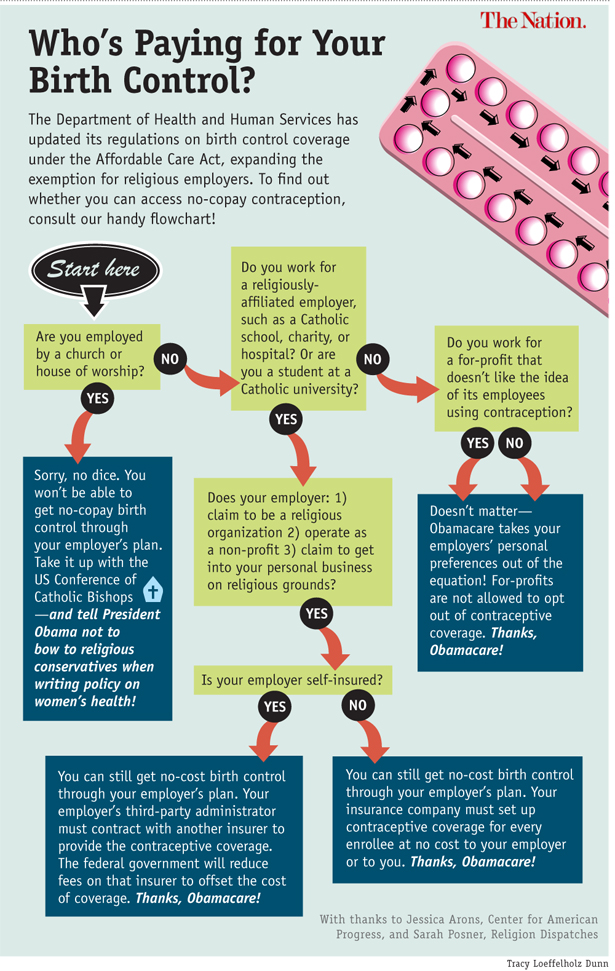
So until the courts decide, Emily Douglas at the Nation has prepared this handy chart for you.

How to pay for your bith control

I guess I sound bitter, but I thought we already had this fight 40 years ago.  Contraception is supposed to be a routine option for women’s health care.

Voting in America

We all saw the lines on television last November. A lot of us stood in them.  In Florida, in Ohio.  I saw at least a 20 minute wait on election morning as I timed a friend who went into vote while I was outside handing out Warren/Obama literature.  This was much longer than usual at my precinct.  It turns out that these are only the outward manifestations of larger problems.  President Obama has said fixing the problems is one of his priorities.  Now he can look at a couple of studies to see exactly what needs to be fixed.

Voter buttons

First the Daily Kos posted a story about the MIT study showing that black and Hispanic voters waited longer to vote than other voters.

You’d think after two hundred years (including some awkward Constitution-patching, here and there) we would finally have this “voting” thing down. Nope:

A Massachusetts Institute of Technology analysis determined that blacks and Hispanics waited nearly twice as long in line to vote on average than whites. Florida had the nation’s longest lines, at 45 minutes, followed by the District of Columbia, Maryland, South Carolina and Virginia, according to Charles Stewart III, the political science professor who conducted the analysis.

So how are states going to fix this?  Maybe by making it harder to register and then harder to vote.

…In states like Virginia, in fact, they’re still trying their level best to make sure certain people don’t have to wait in long lines to vote by making sure certain people aren’t allowed to vote at all. Newly passed legislation would:

eliminate the use of a utility bill, pay stub, bank statement, government check and Social Security card as acceptable identification that can be presented at the polls. Voters would still be able to use a voter identification card, concealed handgun permit, driver’s license and student ID card.

Well, so long as you’re still taking concealed handgun permits.

Since most of those now-banned documents are still perfectly acceptable for obtaining “real” ID’s, like drivers licenses, the possibilities for thwarting rampant voting fraud are approximately nil. The only substantive outcome is to make it ever more inconvenient for certain people (i.e. poor, elderly, and those that don’t have cars, those city-living bastards) to vote.

So I’m not sure that we can depend on states to fix their own problems.

On the heels of the MIT study comes Pew Research.  The New York Times reported on the study which looked at 17 factors.

The flaws in the American election system are deep and widespread, extending beyond isolated voting issues in a few locations and flaring up in states rich and poor, according to a major new study from the Pew Charitable Trusts.

The group ranked all 50 states based on more than 15 criteria, including wait times, lost votes and problems with absentee and provisional ballots, and the order often confounds the conventional wisdom.

In 2010, for instance, Mississippi ranked last over all. But it was preceded by two surprises: New York and California.

The project includes an interactive tool that allows rankings by individual criteria or clusters of them.

Some states, for instance, lost very few votes because of shortcomings in voting technology and voter confusion, with the best 10 reporting failure rates of 0.5 percent or less in 2008. In West Virginia, by contrast, the rate was 3.2 percent.

I hope you will click on the interactive link and look up your state.  The study covers the 2008 and 2010 elections and will be updated with 2012 data when it is available.  Massachusetts is only ranked in the middle at 64% overall which is interesting as I would have guessed it would have been higher.

The study also covered the new trend of voting by mail.

The shift to voting by mail, which now accounts for some 20 percent of all ballots cast, tends to eliminate lines. But it has also produced new problems, especially in places where mail voting has soared because the state does not require an excuse or a new ballot request for each election. Arizona and California, where voting by mail is commonplace, had among the highest rates of problems with voter registration and absentee ballots.

In 2010, California rejected absentee ballots 0.7 percent of the time, a higher rate than any other state.

Dean C. Logan, the registrar for Los Angeles County, said the rate was partly a byproduct of the popularity of voting by mail in California and partly a function of how the state defines rejected ballots. Its definition includes ballots that voters requested but that the Postal Service returned to election officials as undeliverable.

“Voter behavior is changing and evolving,” Mr. Logan said. Young people do not sign their names as consistently as older ones, he said, and mail delivery is becoming less reliable.

He also cautioned that statewide results can mask the fact that “the elections process is extremely decentralized.”

Provisional ballots are also a potential problem according to the study.

Charles Stewart III [cited also by the Daily Kos], a political scientist at the Massachusetts Institute of Technology and a Pew adviser, said that high provisional ballot rates were an important signal of potential trouble.

“Nationwide, a bit over 1 percent of voters are given a provisional ballot,” he said. “In Arizona in 2008, the rate was 6.5 percent. In the battleground state of Ohio, it was 3.6 percent. While these numbers may seem small, in a recount or election dispute, they would be huge.”

There are lots of things to consider as we look at ways to fix things.  How can people more easily register to vote?  What kind of ID, if any, should a voter have to show?  Do we vote by mail?  Online?  In person?  How many options should voters be offered?  I don’t know how many of the issues raised by the Pew study are local and how many can be federally mandated.  I believe that the federal government may have more say if the election is for a national office and is not just a state or local election.

I hope we can tackle some of these issues before 2014 and more of them before 2016.

Professor Stewart said the study should focus attention on the infrastructure of democracy.

“Among all important areas of public policy, election administration is probably the most episodic and prone to the problem of short attention spans,” he said. “What would the world be like if we only gave intense attention to education, corrections, transportation and public health problems for a one-week period every four years?”

An Oregon mail-in ballot for a special electio...

An Oregon mail-in ballot for a special election in May 2005. (Photo credit: Wikipedia)

Stephen Lynch maybe changes his mind

Ok.  People do change their minds.  They evolve, as President Obama has said about his position on gay marriage.  But if you change your mind, you need to actually change your mind, not just kinda change it because it is politically expedient.

We have all known for years that Representative Stephen Lynch is against abortion.  He has famously referred to himself as a pro-life Democrat.  And unlike the pro-choice Republicans, the Democratic party has not run him out of town.  But, that is not a winning position outside of his Southie constituency.  He is one of them and, so far, that has been enough to keep him in Congress.  Lynch now says that abortion should be legal but rare. So today the Boston Globe ran this story

US Representative Stephen F. Lynch, who has consistently described himself as an antiabortion legislator, said Monday that he believes abortion is a constitutionally protected right and that as a US senator he would actively oppose anti­abortion nominees to the Supreme Court.

Forces on both sides of the issue charge that Lynch is shifting his stance as he tries to expand beyond his socially conservative political base in South Boston to a liberal statewide primary.

“He’s trying to have it both ways,” said Megan Amundson, executive director of NARAL Pro-Choice Massachusetts, a group backing abortion rights.

Anne Fox, president of Massachusetts Citizens for Life, the state’s leading antiabortion group, pointed out that when Lynch was representing South Boston in the state Senate, he had a 100 percent voting ­record from her group. When he ran for Congress in 2001, her group mailed out postcards urging voters to support him.

Now, Lynch is vowing to protect Roe v. Wade.

“Apparently, that’s what they think they’re supposed to do, politicians with their eyes on higher office, at least in Massachusetts,” Fox said.

It seems that no one is happy with him now.

To give Lynch some credit, he voted against Republican efforts to defund Planned Parenthood noting that the work they do helps reduce the number of abortions.

But Mr. Lynch, you need to do better than

“I don’t oppose it. I accept, I guess.” – Feb. 4, 2013, Globe interview, speaking of Roe v. Wade.

Interesting move against an opponent, Representative Ed Markey, who has been publically pro-choice since 1983.  But I think Lynch may reflect the confusion of a lot of voters.  As I said, it will be interesting.

Official congressional portrait of Stephen F. ...

Official congressional portrait of Stephen F. Lynch, member of the , in the 110th Congress. (Photo credit: Wikipedia)

Women in combat

The Secretary of Defense, Leon Panetta, and the head of the Joint Chiefs, Martin Dempsey, recently signed an order to allow women to serve in combat.  Each branch of the services will now develop a timetable and guidelines for implementation.  This move will allow for official recognition of roles women are already playing.

I posted a pithy little sentence about this from Winning Progressive on my Facebook page only to set off a sometimes not completely coherent discussion among some who oppose the entire idea.  What I posted was

“Now that women can serve in combat that leaves the neo-cons as the only group that apparently can’t serve in war.” – LOLGOP

When I put the comment on Facebook, I was more interested in the neo-cons not serving than in the decision about women.  But the discussion ended up centering around women and combat.  (Sometimes I think friends on the right don’t have much sense of humor.)  Their arguments against were essentially the same ones that Kathleen Parker made in her column in the Washington Post.

The two most popular arguments for inclusion of women in combat would be valid if only they weren’t incorrect. They are: (1) Only qualified women will be included in combat units; (2) We have a volunteer military and, therefore, only those who want to serve in combat will.

Parker worries about the lowering of physical standards, she call it “gender norming” and the fact that women will now have to register for selective service so we may not have a volunteer army at some point.  Parker also seems to think that women would be able to choose whether to be in combat but men would not which would result in the kind of inequality allowing women in combat is supposed to correct.  It is my understanding that both men and women currently make some choices about what job they want after basic training and there are qualifying tests for those jobs.  But right now, women just can’t choose the jobs that have a combat designation.

So how did the decision happen in the first place?  Here is how CNN reported the story.

For Gen. Martin Dempsey, Thursday’s move to open combat units in the U.S. military to women had its roots nearly a decade ago, on the streets of Baghdad.

Dempsey took command of the Army’s 1st Armored Division in June 2003, when Iraqi insurgents were starting to target American troops with sniper fire, grenades and roadside bombs. As he prepared for a trip outside his headquarters, he took a moment to introduce himself to the crew of his Humvee.

“I slapped the turret gunner on the leg and I said, ‘Who are you?’ And she leaned down and said, I’m Amanda.’ And I said, ‘Ah, OK,’ ” Dempsey told reporters at the Pentagon.

“So, female turret-gunner protecting division commander. It’s from that point on that I realized something had changed, and it was time to do something about it.”

Thursday, Dempsey — now chairman of the Joints Chiefs of Staff — sat alongside Defense Secretary Leon Panetta as both men signed a directive that will open front-line posts to the roughly 200,000 women now serving in the active-duty military.

Panetta said the move is a bow to reality on the battlefield, where women in what are technically non-combat units already find themselves fighting alongside their male comrades.

I think that Parker and other opponents envision battlefields with opposing armies lined up to face each other.  Don’t think this happens any more.

Once we heard similar arguments opposing women in the police force.  I once had a high ranking Virginia State Trooper tell me that women were generally too short to meet what was then a height requirement (I think it was 5’9″ or 5’10”) so they couldn’t be troopers.  Why did they have a height requirement?  So they could fire over their vehicles.  When, I asked, was the last time you fired over your vehicle?  Never have, he said.

There will be a lot of fuss over physical standards and what they really need to be.  And sometimes they will be like the height requirement for Virgina troopers – just tradition.  In the end, women will serve in combat as they do now only they will get credit.  And yes, maybe women will have to register for Selective Service, but maybe we can turn that into a national service requirement for everyone to give a couple of years helping the country in some way.

With this move, we join our allies.

Several U.S. allies, including NATO members France, Canada and Germany, allow women to serve in combat posts. Earlier this month, the U.S. Army opened the 160th Special Operations Aviation Regiment to women, and it has begun recruiting female pilots and crew chiefs. The Navy put its first female officers on submarines in the past year, and certain female ground troops have been attached to combat units in Iraq and Afghanistan.

Change is hard, but we have until January 2016 to see what the actual changes will be.  See what you started, Amanda!

Illustration from the Denver Post.

One view of women in combat

Trust Matt Bors to come up with a unique view of the recent decision by the Secretary of Defense to allow women in combat.

It is the last panel we need to pay the most attention to:  Why are we still there?  And when are we really going to leave?

Why we need univeral health care

I’ve written about this before particularly when the Affordable Health Care Act (aka Obamacare) was in the works, but this is a really good example of why we need it.  Yesterday the New York Times had a long story about the hospital crisis in North Dakota.  This is the same North Dakota where we are having an oil boom and where there is no unemployment.  But there is a health care crisis.

The patients come with burns from hot water, with hands and fingers crushed by steel tongs, with injuries from chains that have whipsawed them off their feet. Ambulances carry mangled, bloodied bodies from accidents on roads packed with trucks and heavy-footed drivers.

The furious pace of oil exploration that has made North Dakota one of the healthiest economies in the country has had the opposite effect on the region’s health care providers. Swamped by uninsured laborers flocking to dangerous jobs, medical facilities in the area are sinking under skyrocketing debt, a flood of gruesome injuries and bloated business costs from the inflated economy.

These are men is mostly unskilled jobs without health insurance.

Hospitals cannot simply refuse to treat people or raise their rates. Expenses at those 12 facilities increased by 15 percent, Mr. Bertsch added, and nine of them experienced operating losses. Costs are rising to hire and retain service staff members, as hospitals compete with fast food restaurants that pay wages of about $20 an hour.

“Plain and simple, those kinds of things are not sustainable,” he said.

Many of the new patients are transient men without health insurance or a permanent address in the area. In one of the biggest drivers of the hospital debt, patients give inaccurate contact information; when the time comes to collect payment, the patients cannot be found. McKenzie County Hospital has invested in new software that will help verify the information patients give on the spot.

To their credit, public officials in North Dakota are trying to do something.

Mr. Kelly has pushed for the state, which has a surplus of more than $1 billion, to allocate money intended for the oil region specifically to health care facilities in the area. He has also asked for the state to grant low-interest loans so hospitals can borrow money for facility improvements and for the governor to convene a task force to study health care issues in the oil patch.

Aides to Gov. Jack Dalrymple say he is taking steps to bolster medical training in the state, proposing to spend $68 million on a new medical school building at the University of North Dakota and $6 million to expand the nursing program at Lake Region State College. Mr. Dalrymple, a Republican, has also increased Medicaid financing for the state’s rural hospitals.

US residents with employer-based private healt...

US residents with employer-based private health insurance, with self insurance, with Medicare or Medicaid or military health care and uninsured in Million; U.S. Census bureau: Income, Poverty, and Health Insurance Coverage in the United States: 2007 (Photo credit: Wikipedia)

If we had universal health care, every one of those men would carry a card.  If we had computerized records that were actually accessible the doctors would have a medical history.  Right now the best we can hope for is that some of them will get employer paid insurance next year as the ACA continues to be implemented.  In the meanwhile, the health care system will struggle.

The cramped housing camps where many oil workers live can add to health issues. On a recent afternoon at McKenzie County Hospital, a man limped into the emergency room complaining about a dry, red patch of skin on his leg. Dr. Gary Ramage, the hospital’s sole full-time physician, said it was a bite from a brown recluse spider, which had most likely nested under the trailer where the man lives.

But for now, Dr. Ramage, a gregarious Canadian who has worked here for 18 years, is left shouldering much of the load. Before the oil boom started a few years back, Dr. Ramage covered both the clinic and the emergency room. Now he mostly works at the clinic, while the hospital hires roving physicians to cover the emergency room. He is well known in the community, and people call him at home when they are sick. But now, he does not know many of the patients he sees.

“My work is no longer small-town work,” he said. “My work has now been transformed from that of a small family practitioner to basically an E.R. doc.”

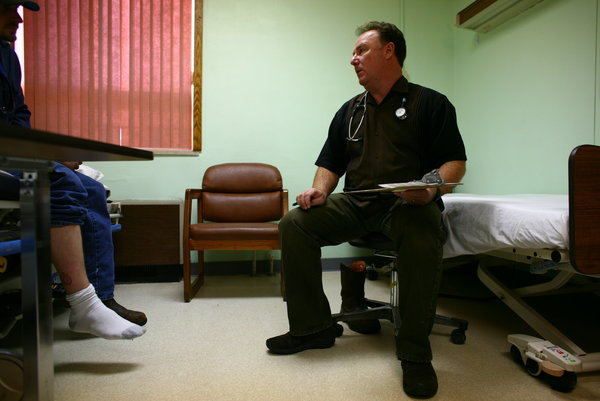
Dr. Gary Ramage treating a patient at McKenzie County Hospital in Watford City, N.D. The hospital now averages 400 emergency room visits per month.

Photograph: Matthew Staver for The New York Times

Dealing with the housing crisis: The Hong Lok example

The housing crisis in the United States is more than home sales, lending rules and interest rates.  Yes, these are important to the economy, but so is the inability of people to find safe, affordable rental housing in a place they feel comfortable.  One of the things that has happened with all the federal budget cut-backs is the reduction of federal funds to help develop affordable housing.

One of the last projects I helped get off the ground before I retired was the Hong Lok House development in Boston’s Chinatown and I was overjoyed to see it featured in today’s Boston Globe business section.

The $35 million project accomplishes the rare feat of expanding affordable housing in Chinatown at a time when luxury high-rises are popping up across the neighborhood, bringing an influx of wealthier renters.

Completion of the first phase next month will create 32 units for low-income elderly residents, who will move from the old Hong Lok building to a new one next door. The original building, which has fallen into disrepair, will be demolished to make way for another 42 units by spring 2014.

Perhaps more noteworthy than the project’s recent progress is the decadelong struggle to get it financed, which underscores the extreme difficulty of keeping housing in city neighborhoods affordable to a diverse population.

Behind the struggle is a dramatic drop in federal funding for new affordable housing.

Over the past decade, Boston’s allocation of community development block grant money has plummeted nearly 40 percent, to $15.3 million this year, and so-called Home funding has dropped 60 percent, to just $3.55 million, according to city records.

A separate US Housing and Urban Development program for low-income seniors has also been slashed about 50 percent.

That forces developers of affordable housing to rely more heavily on private lending and gifts from institutions.

Jamie Seagle, who would be the first to admit that he and I butted heads more than once, deserves the lion’s share of the credit for making this happen.  It was not only the funding that was an issue, but also building in an historic district with historic structures.   I think the agreement we were able to reach that preserved the historic facades and built units behind them were consistent with the character of the neighborhood worked for everyone.  Yes, it wasn’t easy:  many architects, federal agencies, state agencies, the neighborhood, and at least 3 City of Boston agencies had to agree.  But the fact that we could shows that the process can work.

“To create a site in Boston where you can maintain affordable housing is almost an impossibility today,” said James Seagle, president of Rogerson Communities, Hong Lok’s nonprofit developer. “What’s happening for people of lesser means is that the rents are going up, and the properties where they can obtain housing are steadily going away.”

He said the project involved a decade of legal and financial engineering that generated a three-foot sheaf of closing papers; in contrast, Rogerson’s first project 30 years ago, the 75-unit Farnsworth House in Jamaica Plain, took only 18 months and produced a slim 1½-inch binder for the closing papers.

When I retired last August our first banker’s storage box was full.

When thinking about President Obama’s Second Inaugual speech defending the role of government, one need to look no futher than project like Hong Lok which are happening all around the country.  These are public/private partnerships.

In the case of Hong Lok, developers tapped a complex patchwork of 23 funding sources, including a $17 million loan from Boston Private Bank & Trust Co., a $2 million gift from State Street Corp., and $1.4 million from the Charles H. Farnsworth Trust.

That was on top of millions of dollars provided by the state Department of Housing and Community Development and multiple city agencies.

“It used to be that you’d have three or four sources of funding; now it’s 10 or 12 and sometimes even more than that,” said Boston Mayor Thomas M. Menino. “Too many people are being forced to leave Chinatown, and this housing will create more possibilities for people who want to stay there.”

So as we head into budget negotiations, Congress and the President need to think about rental housing and how to fund it.  Yes, people like Jamie Seagle can make the current climate work and I don’t think anyone is advocating for the days when a huge percentage of any affordable housing project is federally funded, but more cuts will only hurt the people on Ruth Moy’s waiting list.

But that program alone is unable to keep up with the demand. When Hong Lok opens, for example, it will have a three- to five-year backlog of applications from people trying to get a unit. The complex will have an attractive mix of comforts, including a rooftop garden, a community center for seniors, and an expanded adult day health program.

“I don’t even want to think about it,” Ruth Moy, executive director of the Greater Boston Chinese Golden Age Center, said when asked about the demand. “We have a very long waiting list of people who want to stay in this neighborhood. But how long can they wait for affordable housing?”

Three facades conceal a building that houses newly built Hong Lok housing units

Three facades conceal a building that houses newly built Hong Lok housing units

Photograph JOSH REYNOLDS FOR THE BOSTON GLOBE

Roe v. Wade at Forty

Posted this morning on Maddow blog this new chart which includes information from an NBC/Wall Street Journal poll.

Exactly 40 years ago today, the U.S. Supreme Court issued its Roe v. Wade ruling. In a 7-2 decision, the court majority decided that Americans have a constitutional right to privacy, which includes being able to terminate an unwanted pregnancy.

I think that the Republican efforts to curtail abortion, to close clinics and to subject women who want to terminate an unwanted pregnancy are having an opposite effect than the one they want.  Kinda like voter suppression which just made people angry enough to stand in line for hours.

The high level of support for Roe comes with some underlying issues that we need to work on.  Bryce Covert just posted some interesting charts at the Nation about the economics of having an abortion.  The charts come from the Guttmacher Institute.  Here are two.

Guttmacher poor women

GuttmacherProviders

The support for keeping Roe has been steadily increasing.  Now we have to figure out how to implement the decision so it means something.