Who is Jeh Johnson?

Jeh Johnson is likely to be the next Secretary of Homeland Security.  And no, I don’t know much about him either except that he gave the Obama Administration legal advice that basically approved drone strikes and he made a speech at Oxford University in 2012 saying that the war on terror had to end at some point because no country could be perpetually at war.  Johnson has also criticized the lack of transparency about drone strikes.  The New York Times reports

…In a speech at Oxford, he looked ahead to a day when Al Qaeda was so diminished that the United States could relax its posture and end the military’s legal authority to kill and detain terrorism suspects.

“I do believe that on the present course, there will come a tipping point — a tipping point at which so many of the leaders and operatives of Al Qaeda and its affiliates have been killed or captured and the group is no longer able to attempt or launch a strategic attack against the United States,” Mr. Johnson said at the time.

But he emphasized that he was not declaring the struggle to be over, stressing the danger of Qaeda affiliates in Yemen and in North and West Africa. He also suggested that even after the armed struggle ended, there could be a need to hold some detainees legally without trial for a period of time, as happened after World War II.

Earlier in 2012, Mr. Johnson delivered a speech at Yale Law School defending the proposition that American citizens who join Al Qaeda may be lawfully targeted for killing under certain circumstances.

But he has also criticized the Obama administration for being too secretive about matters like targeted killings using drone strikes.

“The problem is that the American public is suspicious of executive power shrouded in secrecy,” Mr. Johnson said in a speech at Fordham University this year. “In the absence of an official picture of what our government is doing, and by what authority, many in the public fill the void by imagining the worst.”

During his tenure at the Defense Department, Jeh C. Johnson helped shape the Obama administration's national security policies.

During his tenure at the Defense Department, Jeh C. Johnson helped shape the Obama administration’s national security policies.

But Emily Heil has the best information on Johnson.  She reported this morning in the Washington Post “Eight Fact you didn’t know about Jeh Johnson.

– His name is pronounced “Jay.”

– He and his wife, Susan DiMarco, met as children, but started dating only after Johnson visited her dental practice. He “endured three years of dental work before she agreed to a date with him,” according to their wedding announcement in the New York Times.

– His uncle, 2d Lt Robert B. Johnson, was one of the famed Tuskegee airmen.

-During his freshman year at Morehouse College, his grade-point average was a “dismal 1.8.”

– His grandfather, Charles S. Johnson, a prominent sociologist and participant in the Harlem Renaissance, was the president of Fisk University.

– He was once a law partner of the late Ted Sorensen,  John F. Kennedy’s speechwriter. Johnson called him “one of my personal heroes.”

– He once said in an interview that in his next life, he’d like to be an “NYC subway motorman, preferably the #7 Flushing line.”

And now you can amaze your friends with what you know about Mr. Johnson.

Photograph:  Alex Wong/Getty Images

The government shutdown: a letter from Congressman Capuano

I am posting the entire weekly email newsletter I just got from my Congressman, Mike Capuano.    I am proud to say that he was my boss for several years when he was the Mayor of Somerville.

Dear Friends,

The government shutdown is in its fourth day. Speaker Boehner still refuses to bring up a clean Continuing Resolution (CR), even though it would pass Congress and be signed by the President, reopening the government.

The House has spent most of this week considering bills to partially fund the government. This process is more about appearances than responsible legislating. That’s why you’ve seen attempts to fund the National Park Service so tourist attractions can reopen but not the Transportation Department. The Senate and President have both rejected this path. I’m not sure where or when this all ends. It’s certainly true that this battle is about the Affordable Care Act (ACA) and the obsession many Republicans have with sabotaging it. I think there’s more to it though.

This is also about one of the fundamental principles of our government, the idea of majority rule. The importance of that principle is vividly on display here and it’s one worth protecting.

The ACA was signed into law in 2010 after months and months of substantive and at times contentious debate. Since Republicans regained control of the House in 2010, there have been 42 attempts to repeal, defund or gut the law. Each time the effort has accomplished essentially nothing. As I noted earlier this week, Mitt Romney ran on a promise to repeal “Obamacare”. He lost the election. House Democrats got more votes than House Republicans and Democrats retained control of the Senate. The ACA was even declared constitutional by the Supreme Court.

Despite all of that, a small percentage of the House Republican Caucus refuses to accept the will of the majority, democratically expressed. They shut the government down because they can’t accept it. The ACA is the law of the land, affirmed by the results of a national election and a Supreme Court ruling. More and more moderate Republicans are speaking out on the need for a clean CR. Unfortunately there aren’t enough of those moderate voices and the extremists in the House continue to drown them out.

Imagine what our government would look like if more Members refused to respect the principle of majority rule and insisted on getting their way without regard for the consequences. It wouldn’t be 17 years between government shutdowns, that’s for sure.

I believe that this battle is also about the role that government should play in our lives. Do we want to provide some help to those less fortunate in the form of nutrition assistance or home heating aid? Do we want to help our states build world class roads, bridges and subway systems? Do we want to attract cutting edge research that results in medical advances? All of that takes an investment of federal dollars.

What has been happening over the past couple years is a steady and steep reduction in federal spending. That often gets lost in the din but numbers don’t lie. In two years, a total deficit reduction of almost $2.4 trillion has been achieved. In 2011, the Budget Control Act placed a cap on discretionary spending at $1.066 trillion for fiscal year 2014. That cap has been ignored by the House, with much deeper cuts going into effect as a result of sequestration.

Here are just a couple examples of how those cuts have impacted some important programs. In the past year, funding for the National Institutes of Health has been cut by $1.6 billion. Funding for Head Start has been cut by $400 million.

Earlier this year, the Senate passed a budget that proposed spending $1.058 trillion for fiscal year 2014. Under the clean CR proposed in the Senate in order to reopen the government, that spending is cut to $986 billion. This is much closer to the Republican proposal than the Senate’s.

In terms of cutting spending, Republicans don’t seem to recognize that they are gaining significant ground. The CR that many of them say they won’t support includes deep cuts to discretionary programming.

More votes are expected in the House tomorrow and the schedule for next week is unclear. Thanks for your calls and emails of support. I appreciate all of them.

Best,

Mike

English: Official Congressional portrait for C...

English: Official Congressional portrait for Congressman Mike Capuano. (Photo credit: Wikipedia)

Trying to made sense of it all

I think I may be ready to retreat to my cocoon to read trashy books and watch baseball and reruns of NCIS before my head explodes from trying to make sense of what is going on out there.

Yesterday, Boston Globe columnist Adrian Walker had a little anecdote from my Congressperson, Mike Capuano.

…Capuano said he was in an airport last weekend flying home from Washington when a TSA screener stopped him and said, “You really need to cut our taxes!” Capuano was incredulous to hear that from a federal employee, though he probably shouldn’t have been.

“I asked him, ‘Do you know taxes pay your salary?’ ” Capuano said with a laugh.

I wish I knew what the silly TSA screener said then.  It is an example of how divorced from reality so many people are.  Maybe we should expand the shut down to include furloughs for half of the screeners.  This would cut flights so many of the members of Congress would have trouble getting home.  I don’t think this would be a bad thing.  Maybe if they stayed in Washington more, they would figure out how to talk to each other informally over a beer.  That could only help.  Maybe some of them would get a grip on reality.

As I was getting ready to write this, I Googled  both “Republican Alternate Reality” and “Republican Alternate Universe”.  Turns out people have been writing about the topic for a number of years now.  It is one thing to talk sans facts, but another to act.  And what is happening now is the action that they have all wanted:  a government shutdown.  I think they are hoping that a few weeks without government will show people they can live without it.  Maybe a good plan except that there are already Republicans complaining that monuments in Washington are closed so veterans can’t visit them.  Duh!

Back in August 2012 (2012 not 2013), Michael Cohen wrote a piece in the Guardian about the Presidential campaign.  If you recall, they had a slogan “You didn’t build that”.

On 17 July, President Barack Obama spoke at a campaign rally in Roanoke, Virginia. It was a typical event for an incumbent president who is seeking a second term. In his remarks, he offered his vision of government’s role in spurring entrepreneurship and creating jobs in the United States:

“If you were successful, somebody along the line gave you some help. There was a great teacher somewhere in your life. Somebody helped to create this unbelievable American system that we have that allowed you to thrive. Somebody invested in roads and bridges. If you’ve got a business – you didn’t build that. Somebody else made that happen. The internet didn’t get invented on its own. Government research created the internet so that all the companies could make money off the internet.”

This is all fairly boilerplate rhetoric – a basic recitation of how Democrats view the role of government and its interplay with the private sector. But in this statement, there was one phrase that Republicans have grabbed on to like a famished dog with a new bone:

“You didn’t build that.”

That single phrase, taken out of context by Republicans, has become the GOP’s symbol of Obama’s supposed contempt for the free market and entrepreneurship, and for his socialist assault on America.

The Affordable Care Act is a prime example of government overreach and socialism even though it is built on private insurance companies.

“You didn’t build that” became “We built that”

And so, the Republicans made “We built that” the theme of Tuesday’s convention proceedings. Speaker after speaker hammered on this theme, accusing Obama of disrespecting small business. But they did so with almost a wilful sense of hypocrisy. For example, Delaware lieutenant governor candidate Sher Valenzuela attacked Obama for the line despite the fact that, just a few months ago, she gave a detailed speech to a business group about how they could do a better job getting government contracts.

Cohen goes on to detail a number of instances where the speakers at the Republican Convention ignored facts and concludes

But all of this is at pace with a conservative worldview that considers government to be nothing more than malevolent interference with the smooth operation of the private sector – except when it’s not. “Jobs don’t come from government,” said Texas Senate candidate Ted Cruz last night, a view that basically sums up GOP economic thinking. But if you listened to Republican governors on Tuesday, you might have found yourself surprised to discover that, in their states, the government has played an oddly integral role in spurring job creation. If you listened to Mary Fallin, governor of Oklahoma, extol the virtues of the energy industry in her state and bemoan “more government, bigger spending and more regulation”, you might never know that the oil and gas industry is deeply reliant on – and spends millions lobbying for – tax breaks from the federal government.

One can believe that government should play a less direct role in the workings of the private economy – clearly, this is a defensible notion. But to listen to Republicans harping on Obama’s “you didn’t build that” line is to hear a party that views “government” in the most simplistic imaginable terms. This isn’t a governing philosophy; it’s a caricature of how the economy actually works.

To be sure, it’s hardly unusual for political rhetoric to take liberties with the truth, or to stretch an argument to breaking-point, but with Republicans today, the issues runs much deeper. Very simply, the way they talk about what the federal government does or should do, and about the role of spending, taxation and regulation, is more than just a compendium of lies: it describes an alternate reality.

In the GOP’s defense: at least they can argue they built that.

So now they have shutdown the federal government which was a goal all along.  They built it.  And in their alternate universe, President Obama and the Democratic congressional leadership should negotiate with them.  Nancy Pelosi has tried to explain what she calls “regular order”:  The Senate passes a bill.  Then the House passes one.  Then there is a conference committee.  Budget bills were passed back in March, but the House declined to appoint members to a conference committee.  Contrary to what some members of Congress seem to believe there are rules and conventions as to how to proceed.

Gail Collins has a response in the New York Times.

On Wednesday, House Republicans pushed to refund bits and pieces of the government that the members particularly like, such as veterans and the National Guard. Also anything that lends itself to a dramatic press conference, such as national parks and cancer treatment for children. Since the House proposals are never going anywhere in the Senate, there’s a limit to what you want to know about what went on during the debate. Let’s summarize:

Democrats: “Meaningless political theater!”

Republicans: “Come to the table!”

Coming to the table has now replaced strangling Obamacare as the most popular G.O.P. war cry. There is a longstanding political rule that when all else fails, you demand more talking. If you’re running for office against a guy who’s got 70 percent in the polls, it’s time to call for a debate. If you’re already having four debates, it’s time to call for six.

“Why don’t we sit down and have a conference committee about how we’re going to fund the federal government?” demanded Representative Ander Crenshaw of Florida. Republicans have posed this question a lot, and it would be an excellent one if they were not the same folks who have spent the last half-year refusing to sit down and have a conference committee about the federal budget.
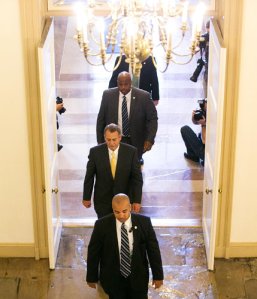
Representative John A. Boehner, the House speaker, arrived at the Capitol on Thursday with his security personnel on the third day of the government shutdown.

Representative John A. Boehner, the House speaker, arrived at the Capitol on Thursday with his security personnel on the third day of the government shutdown.

I’ll give the final word on reality to Elizabeth Kolbert in her New Yorker posted this morning.

…Shuttering the government is a dumb idea under pretty much any circumstances. Still, the objections that Republicans in Congress raise to the health-care law might be worth considering if they bore any relationship to the law in question. Rarely do they.

Some lawmakers’ comments have been so off the wall that they defy parody. A few months ago, for example, Representative Michele Bachmann announced on the House floor that Obamacare needed to be repealed “before it literally kills women, kills children, kills senior citizens.”

“Let’s not do that,” she added helpfully. “Let’s love people.”

“All of this would be funny,” President Obama noted the other day, after bringing up the Bachmann line, “if it weren’t so crazy.”

The crazy list goes on and on. As the economist Paul Krugman has repeatedly pointed out in his Times column, congressional Republicans these days seem to think that they can override not just the laws of physics but also the rules of arithmetic. They insist that the federal budget is so bloated it could easily be cut by hundreds of billions of dollars. But when a transportation bill was drafted this summer that would have actually reduced spending, they refused to vote for it. (The bill had to be pulled from the floor.) It’s hard to cut the federal budget if you’re not willing to reduce the amount of money the government spends. “What Republicans really want to do,” Krugman wrote recently, is “repeal reality.”

It’s been so long since reality has made much of a difference on Capitol Hill that it sometimes seems it genuinely has been repealed. But the thing you can always count on with reality is that it has staying power.

I hope I can hold out until reality and fact make a comeback.

Photograph: Doug Mills/The New York Times

President Obama and leadership

Like many of his supporters I am frustrated at times by what appears to be indecision on the President’s part.  You have to admit that he can take a long time to make a decision while speculation dominates the media and the blogs as to what he will do.  Look at the still to be announced appointment to be Chair of the Federal Reserve.  But when I get frustrated I tell myself that he is playing a long game.  Farah Stockman had an interesting op-ed in the Boston Globe today explaining better than I could the Obama style of leadership.

I am going to quote most of it because I can’t figure out where to cut it (and because one can’t read it from the link without a Globe subscription) and it isn’t that long..

Before we start hand-wringing over the gridlock in our domestic affairs, let’s savor the good news on the international front: Last week, after years of paralysis, the UN Security Council mandated the destruction of chemical weapons in Syria and endorsed a political transition plan that might finally sweep Syrian President Bashar Assad aside.

And after years of Iran’s refusal to talk seriously about its nuclear program, Iran’s new president, Hassan Rouhani, announced that he wants to resolve the issue in 12 months. He and President Obama even spoke on the phone, the first such contact since the 1970s.

Of course, we’re still a long way from solving those two problems. But we’re on a far better path than we were three weeks ago. Back then, we were on the verge of launching a unilateral military strike that would have inflamed the situation in Syria and hurt our chances of getting a nuclear deal with Iran. So how did that no-win situation in Syria turn into something positive? And what does this bizarre chapter in US diplomacy tell us about the nature of leadership itself?

Recall that Obama announced that he had made a decision to strike. Then he asked Congress to give its blessing. Those moves allowed time for Americans to debate, with the whole world watching. Moscow, Tehran, and Damascus were forced to contemplate the possibility of a US strike. The uncertainty of what would happen next weighed on them more heavily than a knee-jerk cruise missile. In the end, the threat of US military action proved more powerful than the action itself. Our adversaries finally agreed to a diplomatic solution that they had refused in the past.

Of course, Obama got called a lot of names for the delay that made that outcome possible: “weakling,” “ditherer-in-chief,” and— nastiest of all, in some corners —  “community organizer.” I must admit that I thought he was crazy for going to Congress, which often seems more eager to tar and feather him than to approve of anything he wants.

But political theorist Dennis Thompson, co-author of the book “Why Deliberative Democracy?” says Obama’s moves mirrored a style of leadership Thompson taught at Harvard. Thompson believes that, in a true democracy, a leader ought to explain the reasoning behind the course of action he or she wants to take. But in the end, wherever possible, the group itself should debate it and have the final word.

It stands to reason that a country that believes in democracy should have faith that a decision debated openly by a group will usually produce a better outcome than a decision one man makes alone. So, why then were some Americans so infuriated that Obama took the issue to Congress?

“It is as if we expect decisions of war and peace to be made by the president rather than society as a whole,” said Archon Fung, another Harvard professor who has studied the virtues of “deliberative democracy.” “Decisions about when to use military force . . . involve killing as a state act. If any decision should be made democratically, it’s this one.”

Peter Levine, a professor at Tufts University, sees the public reaction as a sign of the times. Americans have grown less interested in the public deliberations that that make democracies work. Participation on juries and PTA meetings are at an all-time low, he said. Voters expect their elected leaders to solve their problems. Debates over the best way to go about it are seen as a sign of failure or weakness.

“Our system is supposed to be deliberative,” Levine said. “But we live in a profoundly anti-deliberative moment.”

So maybe this episode says as much about us as it does about our leader. We like John Wayne presidents, saviors who rescue us with their quick trigger fingers. We don’t like leaders who admit uncertainty, who ask us to help choose between imperfect options. But, at the end of the day, the Syria debate taught us that when Americans deliberate as a people, we can come up with a better outcome. It’s a lesson we shouldn’t forget.

President Obama is certainly not John Wayne, but he is the leader of a democracy.  We need to remember this when we get frustrated.

Increased violence. Another consequence of global warming?

I read a lot of mystery stories.  Old ones, new ones, ones set in times past and ones set it the future.  A common thread is it is summer and a heat wave so crime is up.  You hear this every spring from the Boston Police and the Mayor – we need to prepare for the combination of hot weather and school being out.  So is this just an urban myth?  Maybe not.  A new study to be published in the journal, Science, was summarized in Sunday’s New York Times.

But researchers are now quantifying the causal relationship between extreme climate and human conflict. Whether their focus is on small-scale interpersonal aggression or large-scale political instability, low-income or high-income societies, the year 10,000 B.C. or the present day, the overall conclusion is the same: episodes of extreme climate make people more violent toward one another.

In a paper published this month in the journal Science, we [MARSHALL BURKE, SOLOMON HSIANG and EDWARD MIGUEL] assembled 60 of the best studies on this topic from fields as diverse as archaeology, criminology, economics, geography, history, political science and psychology. Typically, these were studies that compared, in a given population, levels of violence during periods of normal climate with levels of violence during periods of extreme climate. We then combined the results from those studies that concerned modern data in a “meta-analysis,” a powerful statistical procedure that allowed us to compare and aggregate findings across the individual studies.

We found that higher temperatures and extreme rainfall led to large increases in conflict: for each one standard deviation change in climate toward warmer temperatures or more extreme rainfall, the median effect was a 14 percent increase in conflict between groups, and a 4 percent increase in conflict between individuals.

Global mean surface temperature difference fro...

Global mean surface temperature difference from the average for 1880–2009 (Photo credit: Wikipedia)

The study went beyond the present day, back to the collapse of several civilizations:  The Maya, Angkor Wat and the Akkadian in Syria.  Climate appears to have played a role in the collapse of each.

Our findings held at very high levels of statistical confidence. To illustrate the consistency of the results: of the 27 quantitative studies we looked at that examined a link between temperatures and modern conflict, all of them found that higher temperatures were associated with more violence. This sort of pattern in the results was extremely unlikely to happen by chance. (Imagine trying to get 27 “heads” in a row when flipping a coin.)

What explains the strong link between climate and conflict? Different mechanisms are most likely operating in different settings, but the two most important factors appear to be aggression and scarcity. The aggression factor is intuitively easy to understand (again, recall summer in the city), and it probably underlies the finding that anomalously hot months have significantly higher crime rates in cities in the United States. As for scarcity, the logic is only slightly more complex. In low-income countries largely dependent on agriculture — like those in much of sub-Saharan Africa and parts of Asia and Latin America — when the rains fail and temperatures scorch, crops wilt and die. This leaves many people dangerously close to the edge of survival, which can lead to social strife and even civil war.

So besides gearing up for more shootings, stabbings and homicides on the summer streets, what are the implications?  The study concludes

Our findings help us better understand both the past and the present, but they are particularly important for what they imply about the future. Many global climate models project global temperature increases of at least 3.6 degrees Fahrenheit (2 degrees Celsius) over the next half century. Our results imply that if nothing changes, this rise in temperature could amplify the rate of group conflicts like civil wars by an astonishing 50 percent in many parts of the world — a frightening possibility for a planet already awash in conflict.

Decision makers must show an understanding that climate can fundamentally shape social interactions, that these effects are already observable in today’s world and that climate’s effects on violence are likely to grow in the absence of concerted action. Our leadership must call for new and creative policy reforms designed to tackle the challenge of adapting to the sorts of climate conditions that breed conflict — for instance, through the development of more drought- and heat-resistant agricultural technologies.

As we contemplate intervention in Syria and look at the increasing and never-ending violence in Africa, we also need to ask ourselves some questions about violence here at home.  Will global warming lead to increased domestic violence?  What do we do with this knowledge and all the guns on the streets?  And will anyone pay any attention?

The burden of domestic violence

The news hit Boston like a bombshell:  Jerry Remy‘s son was arrested for murder.  Jerry Remy is the former Red Sox second baseman and long time Sox television commentator.  He is the President of Red Sox Nation.  We have seen him through cancer, depression and a recent reoccurrence – a minor one he told us.  When he is not broadcasting games, we miss him.  So hearing that Jared Remy had been involved in a domestic violence incident that resulted in the stabbing to death of his girlfriend and mother of his child was shocking.

All the facts are not in, but there was a violent incident two days before that resulted in injury and a court appearance for Jared Remy the next day.  Jennifer Martel, for reasons that we really don’t know, did not appear to ask for a retraining order and, even though Massachusetts law allows for it, the district attorney did not request one.  Jared Remy has a history of violence.  A little over 24 hours later, Martel was dead.  She had been stabbed to death on the patio of their home.  Some neighbors tried to intervene and one of them was also injured.

The DA and the state attorney general are both investigating and looking into changes that might prevent similar incidents in the future.

Everyone is wondering why Martel didn’t just leave, but the question I want to ask is why is it always the woman who has to leave?  I’ve been on task forces, on the board of the Richmond, VA. YWCA, and executive director of a women’s commission.  I have supported shelters and hot line and assisted women to leave home and go to a safe place.  I ran a Clothesline Project.  Everyone in the field knows that the most dangerous time for a woman is when she is getting ready to leave her abuser, but we still expect her to be the one who leaves.  When there are school aged children, they are often put in different schools.  The woman is separated often separated from her friends and support system and so are the children.  She bears the burden, not her abuser.  (And yes, men can also be abused.  Gays and lesbians can abuse their partners and spouses.  But the vast majority of those suffering abuse are women.)  Martel’s family says she was also making plans to leave.

Friends and relatives said Martel, 27, an aspiring teacher who worked at a nearby Market Basket to provide for her daughter, had been trying to extricate herself from what she told them had become an abusive relationship with Remy, the son of famed Boston Red Sox player and broadcaster Jerry Remy.

“I talked to her on Wednesday; she said she was planning her escape,” said Patty Martel, who on Friday was driving from her home in Virginia to Massachusetts. “It started off she was very happy with him, but, as time went on, he showed his true colors, and it got worse and worse.”

Right after the murder of Jennifer Martel, I read a story in the New York Times about a new kind of law.  If someone makes too many calls to 911, the law can require the landlord to evict.

The police had warned Lakisha Briggs: one more altercation at her rented row house here, one more call to 911, and they would force her landlord to evict her.

They could do so under the town’s “nuisance property” ordinance, a law intended to protect neighborhoods from seriously disruptive households. Officials can invoke the measure and pressure landlords to act if the police have been called to a rental home three times within four months.

So she faced a fearful dilemma, Ms. Briggs recalled, when her volatile boyfriend showed up last summer, fresh out of a jail stint for their previous fight, and demanded to move in.

“I had no choice but to let him stay,” said Ms. Briggs, 34, a certified nursing assistant, even though, she said in an interview, she worried about the safety of her 3-year-old daughter as well as her own.

“If I called the police to get him out of my house, I’d get evicted,” she said. “If I physically tried to remove him, somebody would call 911 and I’d be evicted.”

This may be an unintended consequence of a law designed to help landlords with squatter and drug dealers, but the burden often falls on women who are victims of domestic violence.

“These laws threaten citizens’ fundamental right to call on the police for help,” said Matthew Desmond, a sociologist at Harvard.

In a study of citations issued to landlords in Milwaukee, conducted with Nicol Valdez of Columbia University, Mr. Desmond found that domestic violence was involved in nearly one-third of the cases and that rentals in largely black areas were disproportionately singled out.

Legal experts say the laws can give tenants the lasting stain of an eviction record without due process.

In a federal lawsuit being watched by legal aid groups elsewhere, Ms. Briggs has challenged the Norristown ordinance as unconstitutional.

She did so after her fears were realized.

In June 2012, days after her ex-boyfriend, Wilbert Bennett, moved into her house in this struggling town northwest of Philadelphia, he started another drunken, late-night argument. Then came his most violent attack yet: an assault with a broken ashtray that left a gash on her head and a four-inch stab wound in her neck.

Before she passed out, Ms. Briggs begged her neighbor not to call 911 because of the eviction threat, according to the suit, which is being argued by the American Civil Liberties Union.

The neighbor called anyway. Ms. Briggs was taken by helicopter to Philadelphia for emergency treatment. Mr. Bennett is now serving a sentence of one to two years for aggravated assault.

The town says she never got a restraining order.  What if she had gotten one when the boyfriend got out of jail?  In all likelihood he would have come around anyway and she would have had to call 911.

I don’t pretend to know what the answer is, but we need to figure out how to deal with men like Wilbert Bennett and Jared Remy.  Putting them in jail is not the entire answer.  That may well work for a while, but they will get out and often turn up again.   There are a few programs for men, but they are very few.  Some prisons have anger management classes which may work for some.  But as long as we continue to think of ending the abuse as the woman’s responsibility, we will never think of any new solutions.

A death from domestic violence leaves families shattered and children anchorless and what happened with Jennifer Martel and Jared Remy is not an exception.

A cautionary tale

Some Republicans want to pass a comprehensive immigration bill and some voted to do so in the Senate.  And now two of them, Marco Rubio and Lindsey Graham, will likely have challengers from the Tea Party wing.  Which brings me to the cautionary tale.  They should read some history and look at what happened to the Federalist Party.  They could begin by reading the very interesting piece in yesterday’s New York Times by James Traub.

Tea Partyers often style themselves as disciples of Thomas Jefferson, the high apostle of limited government. But by taking the ramparts against immigration, the movement is following a trajectory that looks less like the glorious arc of Jefferson’s Republican Party than the suicidal path of Jefferson’s great rivals, the long-forgotten Federalists, who also refused to accept the inexorable changes of American demography.

The Federalists began as the faction that supported the new Constitution, with its “federal” framework, rather than the existing model of a loose “confederation” of states. They were the national party, claiming to represent the interests of the entire country.

Culturally, however, they were identified with the ancient stock of New England and the mid-Atlantic, as the other major party at the time, the Jeffersonian Republicans (no relation to today’s Republicans), were with the South.

John Quincy Adams portrait. "John Quincy ...

John Quincy Adams portrait. “John Quincy Adams”. Metropolitan Museum of Art . . Retrieved September 4, 2009 . (Photo credit: Wikipedia)

And then came the Louisiana Purchase.

“The people of the East can not reconcile their habits, views and interests with those of the South and West,” declared Thomas Pickering, a leading Massachusetts Federalist.

Every Federalist in Congress save John Quincy Adams voted against the Louisiana Purchase. Adams, too, saw that New England, the cradle of the revolution, had become a small part of a new nation. Change “being found in nature,” he wrote stoically, “cannot be resisted.”

But resist is precisely what the Federalists did. Fearing that Irish, English and German newcomers would vote for the Jeffersonian Republicans, they argued — unsuccessfully — for excluding immigrants from voting or holding office, and pushed to extend the period of naturalization from 5 to 14 years.

They even thought about separating New England from the rest of the country.

,,,in the fall of 1814, the Federalists convened the Hartford Convention to vote on whether to stay in or out of the Union. By then even the hotheads realized how little support they had, and the movement collapsed. And the Federalists, now scorned as an anti-national party, collapsed as well.

Contrast that defiance with Jefferson’s Republicans, who stood for decentralized government and the interests of yeoman farmers, primarily in the coastal South.

They ruled the country from 1801 to 1825, when they were unseated by Adams — who, after splitting with the Federalists, had joined with a breakaway Republican faction.

In response, Jefferson’s descendants, known as the Old Radicals, did exactly what the Federalists would not do: they joined up with the new Americans, many of them immigrants, who were settling the country opened up by the Louisiana Purchase.

Their standard-bearer in 1828, Andrew Jackson, favored tariffs and “internal improvements” like roads and canals, the big-government programs of the day. The new party, known first as the Democratic-Republicans, and then simply as the Democrats, thrashed Adams that year. (Adams’s party, the National Republicans, gave way to the Whigs, which in turn evolved into the modern Republican Party.)

Will the Republicans disappear like the Federalists?  Traub doesn’t think so.  But hey are, like the Federalists, on the wrong side of history.

Urban sprawl, transportation, and poverty

I’ve been thinking since I read Paul Krugman’s column “Stranded by Sprawl” about successful urban areas and public transportation.  I lived for a number of years in Richmond, VA and for part of that time I didn’t drive or have a car.  After I acquired a car, I realized how limited my world was without one.  There were many places I couldn’t get to without driving and even if there was a bus, service was often erratic and infrequent.  I don’t know if thing have changed since I left twenty years ago, but I know that the counties surrounding the City of Richmond were where the new office parks and shopping malls were springing up.  I was lucky because I did live within easy walking distance of a nice shopping area with restaurants and some stores so I could leave the car behind when I met friends for breakfast or dinner.  But I didn’t live near any of the “projects” or poor areas which were pretty segregated back then.

One of my first memories of my Boston move was one of my new neighbors lamenting that the view from the back of the houses on our street was marred by looking down at the roofs of a large public housing project.  In fact, there are actually four projects within easy walking distance.  After I went to work for the Housing Authority I learned that public housing developments were scattered through the city neighborhoods.  The BHA takes pains in trying to maintain the grounds of each (with limited resources) so they don’t become a blight on the neighborhoods and several have been totally redesigned and no longer have the dead end streets which only serve to isolate residents.  Contrast this with the Atlanta described by Krugman

When the researchers looked for factors that correlate with low or high social mobility, they found, perhaps surprisingly, little direct role for race, one obvious candidate. They did find a significant correlation with the existing level of inequality: “areas with a smaller middle class had lower rates of upward mobility.” This matches what we find in international comparisons, where relatively equal societies like Sweden have much higher mobility than highly unequal America. But they also found a significant negative correlation between residential segregation — different social classes living far apart — and the ability of the poor to rise.

And in Atlanta poor and rich neighborhoods are far apart because, basically, everything is far apart; Atlanta is the Sultan of Sprawl, even more spread out than other major Sun Belt cities. This would make an effective public transportation system nearly impossible to operate even if politicians were willing to pay for it, which they aren’t. As a result, disadvantaged workers often find themselves stranded; there may be jobs available somewhere, but they literally can’t get there.

Is Detroit in trouble because its land area is too big?  I don’t know.  Detroit is 138 square miles with a population today of around 700,000 people.  Boston is 48 square miles with a population about 50,000 people smaller. In Boston, we gripe about the public transportation all the time and worry that some neighborhoods that are more affluent have better service, but we are always working on it.  I haven’t read anything about public transportation in Detroit:  It is the Motor City.

Boton T

Back to Krugman

The apparent inverse relationship between sprawl and social mobility obviously reinforces the case for “smart growth” urban strategies, which try to promote compact centers with access to public transit. But it also bears on a larger debate about what is happening to American society. I know I’m not the only person who read the Times article on the new study and immediately thought, “William Julius Wilson.”

A quarter-century ago Mr. Wilson, a distinguished sociologist, famously argued that the postwar movement of employment out of city centers to the suburbs dealt African-American families, concentrated in those city centers, a heavy blow, removing economic opportunity just as the civil rights movement was finally ending explicit discrimination. And he further argued that social phenomena such as the prevalence of single mothers, often cited as causes of lagging black performance, were actually effects — that is, the family was being undermined by the absence of good jobs.

My worry about Boston is that it will become more and more like Manhattan where only the well-off and the very poor can afford to live.  Jobs, particularly tech jobs, are moving back into the city and near suburbs from further out along the outer ring highways.  Will we end up with a shrinking middle?

These days, you hear less than you used to about alleged African-American social dysfunction, because traditional families have become much weaker among working-class whites, too. Why? Well, rising inequality and the general hollowing out of the job market are probably the main culprits. But the new research on social mobility suggests that sprawl — not just the movement of jobs out of the city, but their movement out of reach of many less-affluent residents of the suburbs, too — is also playing a role.

What’s to be done?  More investment in infrastructure in places like Atlanta and Los Angeles.  More investment in light rail systems.  More investment in maintenance of what we have for cities like Boston, Chicago and New York.  Unfortunately this is another thing in which the House Republicans are not interested.

The Next Fed Chair? Not Larry Summers.

Why would the President want to appoint someone who once opined that women were not good at science?  The man who was hired to end the economic crisis, but likely contributed to its making.  I’ve been thinking about how to approach this for a few days now and then I saw two pieces by Shirley Leung in the Boston Globe Business Section.  I think she says exactly what I wanted to say.  In the first, she discusses Larry Summers.

No need to hold back here: Larry Summers as the next Fed chairman?

Worst idea ever.

Summers, by all accounts, is a brilliant economist, one of the best of his generation. He is also someone who is confident, and, in times of crises, may be the adult in the room that he supposedly said the Obama administration didn’t have when the economy collapsed.

But he lacks one critical trait I like in my Fed chairmen: He’s not boring.

Summers is far from bland. He is arrogant and a lightning rod and would carry so much baggage he couldn’t fit it on the shuttle to Washington.

Do we need a Fed Chair that is all about Larry Summers?  I think not.

In his book “Confidence Men,” about the Obama White House’s handling of the economic crisis, former Wall Street Journal reporter Ron Suskind paints Summers as brilliant but overconfident and prone to unnecessary battles. “As he has aged, he has grown less troubled by being uninformed,” Suskind wrote.

That’s not what you want in a Fed chairman. The nation’s top central banker must manage the economy primarily by raising or lowering interest rates and must build consensus to do so. He must work with six other Fed governors and 12 regional Fed bank presidents. Imagine what would have happened if the Fed board was split over what to do with the economy in 2008? What would that have done to the markets?

“I know Larry very well. He is a smart guy,” said Allan Meltzer, a Carnegie Mellon professor who has written the definitive history on the Fed. “But the skills that are required for that job are not just brilliance, they are ability to manage compromise. He doesn’t do that well.”

This is to say nothing about how he ran Harvard.  When he left, they picked Drew Faust, a women who was his opposite in many important ways.

So, who should be the next Fed Chair?  How about a woman?  Senator Elizabeth Warren and Shirley Leung are backing Janet Yellen.

English: Official picture of Janet Yellen from...

English: Official picture of Janet Yellen from FRBSF web site. http://www.frbsf.org/federalreserve/people/officers/yellen.html (Photo credit: Wikipedia)

Just as forcefully as folks are coming out against Summers, there is a campaign mounting to promote Janet Yellen, Ben Bernanke’s number two.

Unlike Summers, Yellen has significant monetary policy experience. She has been the vice chair of the Fed board of governors since 2010, and prior to that she ran the San Francisco Federal Reserve bank for six years. She has been involved in the Fed’s quantitative easing strategy, hatched during the Great Recession to keep money flowing and the US economy alive.

And unlike Summers, she is sufficiently boring, a key trait we want in someone running our central bank.

If Yellen got the nod, she would break the glass ceiling at the Fed, becoming the first woman at the top. She already has some high profile endorsements from New York Times columnist Paul Krugman and former FDIC chair and UMass-Amherst professor Sheila Bair.

Bair, in a blog posted on Fortune earlier this week, argues that Yellen is the most qualified candidate, but the financial world’s old-boy network is trying to derail her candidacy:

“So why isn’t she a shoo-in? The ‘whispering’ campaign against her among industry types has been deafening. ‘Doesn’t understand markets.’ Translation: She may not bail us out if we get into trouble again. ‘Not assertive enough.’ Translation: She won’t stand up for us against the populists who want more regulation. ‘Lacks gravitas.’ Translation: She doesn’t show up very often in the financial media.”

I guess we haven’t come far enough for the Wall Street guys to be comfortable with a woman.

Bair also takes a whack at Summers. “Unlike Larry Summers, Tim Geithner, and other Bob Rubin minions frequently mentioned in the financial press as potential Bernanke successors, she was not part of the deregulatory cabal that got us into the 2008 financial crisis. In fact, she had a solid record as a bank regulator at the San Francisco Fed and was one of the few in the Fed system to sound the alarm on the risks of subprime mortgages in 2007.”

Others are also rallying behind Yellen. Senator Elizabeth Warren of Massachusetts on Friday confirmed that she has signed a letter Senate Democrats are circulating and plan to deliver to President Obama calling on him to nominate Yellen because “she is the best person for this job.” As early as Monday, activists, including women’s advocacy groups NOW and Ultraviolet plan to send a letter to Obama and Senate majority leader Harry Reid to support Yellen’s candidacy and oppose Summers’. When he ran Harvard, Summers set off a firestorm when he suggested women lacked the same “intrinsic aptitude” for science as men.

The President recently said he was not going to make a decision until fall, so we have time to make sure he appoints the best qualified person who, in this case is a woman.  Not Larry Summers.

The real danger: The FISA Court

Congress and the President can say all they want to that everything about the surveillance is approved by the FISA Court.  OK.  But what do we know about this secret court?  Some revelations this past weekend by the Wall Street Journal and the New York Times tell us a great deal that I, for one, didn’t know.  For example, did you know that Chief Justice John Roberts was in charge?

The Ezra Klein/Evan Soltas Wonkblog had a great summary this morning.

The laws we live by aren’t just the bills Congress passes and the president signs. It’s what the courts decide those bills actually mean.

We’re used to that. The Affordable Care Act, for instance, says that states that don’t accept the Medicaid expansion lose all their Medicaid money. The Supreme Court decided that went too far. The law might still say that if you read the underlying bill, but it no longer means that. Now states can reject the Medicaid expansion without jeopardizing the rest of their Medicaid money — and many are.

But here’s the thing: When judges make the laws, Congress can always go back and remake the laws. The changes the court makes are public, and so is their reasoning. Both the voters and Congress know what the court has done, and can choose to revisit it.

Well, usually.

The Foreign Intelligence Surveillance Court (FISA court) that governs the national surveillance state is also remaking the law. But it’s remaking the law in secret. The public has no opportunity to weigh in, and Congress can’t really make changes, because few know what the court is deciding, and almost no one can discuss the decisions without endangering themselves.

So that’s a real Catch 22.

Surveillance types make a distinction between secrecy of laws, secrecy of procedures and secrecy of operations. The expectation is that the laws that empower or limit the government’s surveillance powers are always public. The programs built atop those laws are often secret. And the individual operations are almost always secret. As long as the public knows about and agreed to the law, the thinking goes, it’s okay for the government to build a secret surveillance architecture atop it.

But the FISA court is, in effect, breaking the first link in that chain. The public no longer knows about the law itself, and most of Congress may not know, either. The courts have remade the law, but they’ve done so secretly, without public comment or review.

These rules have been remade in a court where the government is the only witness, and there’s no possibility for appeal, and all 11 judges were chosen by Chief Justice John Roberts, and 10 of the 11 judges were Republican appointees to the federal bench. This is not a court like any other court in the United States save for the secrecy. It’s a court pretty much unlike any other in the United States.

When asked who watches over the National Security Agency’s surveillance efforts, the administration says that the FISA courts do. Trite as it may be, that leads to the age-old question: Well, then who watches over the watchers?

The answer would be to rewrite the law but how does one do that with a dysfunctional Congress and a law with impacts that no one can discuss without violating it?  As I said, a Catch-22.  But there is a proposal by Senator Jeff Merkley of Oregon and a bi-partisan group of other senators to end some of the secrecy.

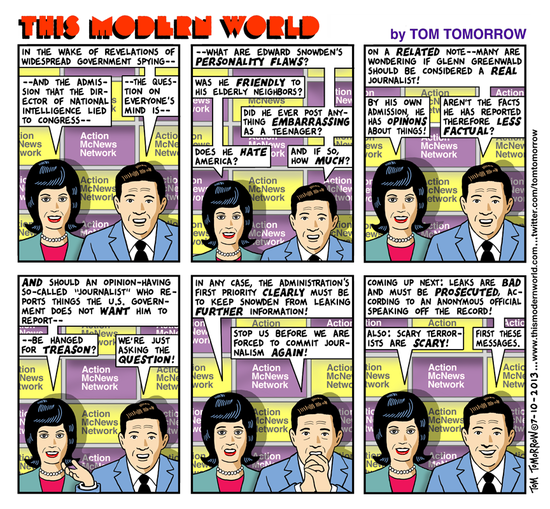
We should be discussing ways to rein in the FISA Court and modify the Patriot Act.  Forget Edward Snowden.  He can stay at the Moscow airport or get smuggled to South American.  Fixing the law is what is important.

Let me end with Tom Tomorrow.

This Modern World

This Modern World