The Supremes, Judge Posner, and gay marriage

The news late last week that the Supreme Court would hear an appeal from the Sixth Circuit ruling upholding bans on same-sex marriage in Ohio, Michigan, Kentucky, and Tennessee brought to mind the Seventh Circuit ruling last fall written by Judge Posner.  Mark Joseph Stern writing in Slate noted that suddenly there was a “race” among judges to …”write the one marriage equality opinion that history will remember.”  But Stern wrote

Thursday’s ruling by 7th Circuit Judge Richard Posner, which struck down Indiana’s and Wisconsin’s gay marriage bans, is a different beast altogether. In his opinion, Posner does not sound like a man aiming to have his words etched in the history books or praised by future generations. Rather, he sounds like a man who has listened to all the arguments against gay marriage, analyzed them cautiously and thoroughly, and found himself absolutely disgusted by their sophistry and rank bigotry. The opinion is a masterpiece of wit and logic that doesn’t call attention to—indeed, doesn’t seem to care about—its own brilliance. Posner is not writing for Justice Anthony Kennedy, or for judges of the future, or even for gay people of the present. He is writing, very clearly, for himself.

Ironically, by writing an opinion so fixated on the facts at hand, Posner may have actually written the one gay marriage ruling that the Supreme Court takes to heart.Other, more legacy-minded judges have attempted to sketch out a revised framework for constitutional marriage equality, granting gay people heightened judicial scrutiny and declaring marriage a fundamental right. But Posner isn’t interested in making new law: The statutes before him are so irrational, so senseless and unreasonable, that they’re noxious to the U.S. Constitution under almost anyinterpretation of the equal protection clause.

I spent time this morning reading Judge Poster’s opinion.  It is readable and understandable even by non-lawyers.  He takes each argument made by Indiana and then Wisconsin against same-sex marriage one at a time and uses precedent, social science, and history to demolish them.  Posner sets out to answer four questions.

Does the challenged practice involve discrimination, rooted in a history of prejudice, against some identifiable group of persons, resulting in unequal treatment harmful to them?

Is the unequal treatment based on some immutable or at least tenacious characteristic of the people discriminated against (biological, such as skin color, or a deep psychological commitment, as religious belief often is, both types being distinct from characteristics that are easy for a person to change, such as the length of his or her fingernails)? The characteristic must be one that isn’t relevant to a person’s ability to participate in society.

Does the discrimination, even if based on an immutable characteristic, nevertheless confer an important offsetting benefit on society as a whole?

Though it does confer an offsetting benefit, is the discriminatory policy overinclusive because the benefit it confers on society could be achieved in a way less harmful to the discriminated-against group, or underinclusive because the government’s purported rationale for the policy implies that it should equally apply to other groups as well?

Throughout his decision, Judge Posner concentrates on children and marriage.  The same persons who argue against same-sex marriage are often the same persons who argue that the state needs to encourage heterosexual marriage to provide stability to children.

Our pair of cases is rich in detail but ultimately straight- forward to decide. The challenged laws discriminate against a minority defined by an immutable characteristic, and the only rationale that the states put forth with any conviction— that same-sex couples and their children don’t need marriage because same-sex couples can’t produce children, intended or unintended—is so full of holes that it cannot be taken seriously. To the extent that children are better off in families in which the parents are married, they are better off whether they are raised by their biological parents or by adoptive parents. The discrimination against same-sex couples is irrational, and therefore unconstitutional even if the discrimination is not subjected to heightened scrutiny, which is why we can largely elide the more complex analysis found in more closely balanced equal-protection cases.

In Indiana a same-sex couple can adopt while in Wisconsin, one member of a same-sex couple can adopt.  So the logical conclusion is that marriage is just as important for same-sex couples with children as for heterosexual couples with families.  And he points out that those who say that same-sex marriage will some how erode or damage heterosexual marriage need only to look at the 10 year history in Massachusetts to see that there is no impact at all.

Judge Posner’s decision is full of “zingers” most aimed with impatience at irrational argument.  But he also takes aim at Justice Scalia citing his dissent in Lawrence v. Texas which struck down laws against sodomy.

…But Justice Scalia, in a dissenting opinion in Lawrence, 539 U.S. at 586, joined by Chief Justice Rehnquist and Justice Thomas, thought not. He wrote that “principle and logic” would require the Court, given its decision in Lawrence, to hold that there is a constitutional right to same-sex marriage. Id. at 605.

In the end, Judge Posner can find no rational argument against same-sex marriage.

Pete Prete with Equality Beyond Gender waved a Marriage Pride flag attached to an American flag outside the Supreme Court in Washington on Friday.

Pete Prete with Equality Beyond Gender waved a Marriage Pride flag attached to an American flag outside the Supreme Court in Washington on Friday.

The Supreme Court will hear arguments on two questions:  The right to marry and the right to have out-of-state marriages recognized.  Because there are four states in the appeal with four different questions, the Supreme Court in accepting the appeals wrote the questions they will try to answer.  Some in the legal community were alarmed, but the New York Times quotes Harvard Law professor, Lawrence Tribe

“The court’s order represents good housekeeping,” said Laurence H. Tribe, a law professor at Harvard.

But Professor Tribe also voiced a small note of caution.

“The rephrased questions,” he said, “technically leave open a middle path along which the court would prevent states from discriminating against same-sex couples lawfully married in their home states without requiring any state to take the affirmative step of issuing its own marriage licenses to same-sex couples.”

I haven’t seen the appeal documents, but if the arguments are anything like those from Indiana and Wisconsin and I assume they are as those are the arguments being made nationally, the Supreme Court need to look no further than Judge Posner’s decision for answers and require the right to marry in all states.  And, after all, Justice Scalia has already concluded that once sodomy laws are found unconstitutional, same-sex marriage must follow.  I predict a 7-2 decision in favor of the right to marry.  We will see in June if I am correct.

Photograph:  Jabin Botsford/The New York Times

Ebola, the flu and other health risks

I just got my flu shot.  I get one every year.  While it might not keep me from getting sick this winter, in all likelihood it will keep me from getting really sick.  I just hope that everyone else I interact with has also gotten a flu shot.

Frank Bruni wrote about this in this morning’s New York Times.

During the 2013-2014 flu season, according to the Centers for Disease Control and Prevention, only 46 percent of Americans received vaccinations against influenza, even though it kills about 3,000 people in this country in a good year, nearly 50,000 in a bad one.

These are deaths by a familiar assassin. Many of them could have been prevented. So why aren’t we in a lather over that? Why fixate on remote threats that we feel we can’t control when there are immediate ones that we simply don’t bother to?

On matters exotic, we’re rapt. On matters quotidian, which are nonetheless matters of life and death, we’re cavalier. Tens of thousands of Americans die in car crashes annually, and according to a federal analysis from 2012, more than half of them weren’t wearing seatbelts.

I think part of the reason people are so panicked about Ebola is because so far the medical community in the United States seems very inept at treating it and, particularly, in preventing its spread.  Amy Davidson’s piece “Amber Vinson’s Airplane Ride” in the New Yorker is particularly instructive.

Amber Vinson called the Centers for Disease Control, on Monday, to say that she had a temperature of 99.5 degrees and planned to get on a commercial flight from Cleveland to Dallas; should she? Vinson, a nurse, had cared for Thomas Eric Duncan, a patient with Ebola, in Dallas—she had put a catheter in him and been in close contact when he was vomiting and in the throes of diarrhea. The day before Vinson made her call, one of her colleagues, Nina Pham, had tested positive for Ebola. There was, supposedly, a system in place for monitoring Duncan’s contacts. And yet, as the C.D.C. confirmed late on Wednesday, the official Vinson spoke to cleared her to fly. Vinson got on Frontier Airlines Flight 1143, with a hundred a thirty-two other passengers. She landed in Dallas at 8:16 P.M.. The next morning, her fever was worse; around midnight, she tested positive for Ebola.

There is much that is seriously wrong here. The first is that Pham and Vinson, who are both in their twenties, were so exposed. Their hospital, Texas Health Presbyterian, sent Duncan home the first time he showed up in the emergency room, with a fever and pain and the information that he’d just been in Liberia. But it’s also emerging that, in the first days after he was admitted for the second time, on September 28th—with his family saying that they thought he had Ebola, and all the full-blown symptoms on display, but as yet no laboratory test confirming it—he was not properly isolated, according to records obtained by the Associated Press. The nurses caring for him had to improvise their own protection.

Tom Frieden, the director of the C.D.C., addresses the media on the Ebola case, on October 5th.

Tom Frieden, the director of the C.D.C., addresses the media on the Ebola case, on October 5th.

Thomas Frieden, the head of the CDC, has said they should have had people there to help them “do it right”, but then someone from his own agency told Amber Vinson it was OK for her to fly.  And we are left to wonder who is in charge and if anyone knows what they are doing.  If President Obama wants to do something to help regain public confidence that the health care system here can deal effectively with Ebola, maybe Mr. Frieden’s departure would be a good start.

Amy Davidson writes

Frieden himself represents an even bigger problem. His account of how Vinson got on the plane, related in the conference call on Wednesday, was at least evasive and, depending on what he knew and what exactly Vinson was told, may have been worse. He was asked three different ways if Vinson had been told not to fly, and each time dodged the question in a way that left the impression that Vinson was some sort of rogue nurse who just got it into her head that she could fly wherever she wanted. He talked about her “self-monitoring,” and that she “should not have travelled, should not have been allowed to travel by plane or any public transport”—without mentioning that his agency was who allowed it.

It is things like this, and the lack of protocols at Texas Health Presbyterian, that create fear, probably unwarranted, among the American public that there will be a major outbreak of Ebola here.

As Bruni says

I’m not dismissing the horror of Ebola, a full-blown crisis in Africa that should command the whole world’s assistance. And Ebola in the United States certainly warrants concern. We’re still searching for definitive answers about transmission and prevention.

But Americans already have such answers about a host of other, greater perils to our health, and we’d be wiser to reacquaint ourselves with those, and recommit to heeding them, than to worry about our imminent exposure to Ebola.

So, use seat belts, get a flu shot, get your kids vaccinated, don’t use your cell phone while driving and use sunscreen.  And try not to worry about getting Ebola.

 Photograph by  KEVIN C. COX/GETTY

Like a speeding locomotive

That’s the image that comes to mind when I think of how quickly things have moved when it comes to marriage equality.  It has only been 10 years since same-sex marriage became legal in Massachusetts.  And only a few years longer that that since Vermont adopted civil unions.  For a while I was keeping track and blogging every time a state was added, but I just couldn’t keep up – or keep track.  Now Federal benefits are available to all legally married couples regardless of the state in which they reside and the Supreme Court is letting stand Appeals Court decisions ruling prohibitions unconstitutional.

According to a post in the Washington Post’s “The Fix”, most gay Americans now live in states with marriage equality.

As the map of where gay marriage is legal has shifted and changed over the past few years, we’ve tracked a harder-to-measure component of the new laws: How many gay Americans live in states that allow them to marry.

In June, we anticipated that the tipping point was imminent. Based on data from Gallup surveys in 2012, a higher percentage of the country’s gay population already lived in gay-marriage-legal states than the population on the whole. With Monday’s Supreme Court non-decision, the percentage of gay Americans and Americans on the whole living in states where gay marriage is legal topped 50 percent.

Gay Marriage map

I am unclear as to how Gallup determined the percentage of person living in a state who were gay or lesbian, but given the way Gallup polls, I assume it is by self-reporting in response to a question.  According to the Fix, marriage equality has arrived in states with a lower population of gay residents.

So what happens next is anyone’s guess but with the growing numbers of same-sex marriages, I’m not sure how a Supreme Court ruling to the contrary could be implemented without chaos.  A more likely scenario is a decision like the one in Loving v. Virginia.  When the Court finally ruled on interracial marriage, the majority of states already allowed such unions.

This does not mean that the opposition will not fight on.  A story in the New York Times today reported that

Leading opponents of same-sex marriage vowed on Wednesday to push ahead with their legal fight, noting that several federal appeals courts had not yet ruled on the issue and that the Supreme Court could still decide to leave it up to the states.

Even as the list of states authorizing same-sex marriage swells, the opponents noted Justice Anthony M. Kennedy’s order on Wednesday totemporarily block a federal appeals court ruling striking down the marriage restrictions in Idaho. The temporary order came as a surprise to many advocates on both sides of the issue, since the Supreme Court on Monday had allowed similar decisions from three other appeals courts to take effect.

“The marriage battle will continue,” said Jim Campbell, a senior legal counsel at Alliance Defending Freedom, a Christian legal group that has defended marriage restrictions in several states.

Opponents seem determined that each state should have a right to define its marriage laws, but that just doesn’t seem likely to me given the Loving decision as a precedent.

“If the liberals on the court had the votes to declare same-sex marriage a constitutional right, why didn’t they take any of the cases on offer Monday?” asked Brian Brown, the president of the National Organization for Marriage.

“That gives hope that the Supreme Court will not launch another Roe v. Wade,” Mr. Brown said, referring to the 1973 decision legalizing abortion nationwide.

Mr. Brown also rejected the argument that, once same-sex marriages had been allowed in many states, the law could not be rolled back if the voters wanted to do so.

But most legal experts drew the opposite conclusion from Monday’s action.

“We know, from the court’s willingness Monday to allow all these marriages to go forward,” that opponents of same-sex marriage “are virtually guaranteed to lose” before the current Supreme Court, said Michael C. Dorf, a constitutional expert at Cornell Law School.

In the meanwhile, I have friends getting married, both same-sex and opposite sex.  I also have friends in both categories who have or are getting divorced.  All people want is to live their own lives and to have the legal protections due them.  I think the opposition needs to get out of the way of the speeding locomotive.

Map:  The Washington Post


The People’s House

Julia Pierson, head of the Secret Service, testified before Congress yesterday on the security lapses that resulted in a fence jumper making it into the White House and then into the East Room.  But Omar Gonzalez in just one in a long line of uninvited guests.  Anyone remember the couple that got through security into a state dinner?  Peter Baker had a nice history of the uninvited in the New York Times.

Long before the latest fence jumper captured international attention by getting as far as the East Room, the history of White House security breaches was vast and varied. One intruder in a white karate outfit carried in a knife hidden in a Bible. A stranger slipped in to watch a movie with President Franklin D. Roosevelt. And a pilot crashed his Cessna into the mansion.

Theodore Roosevelt once agreed to see a man who identified himself as “Mr. John Smith” and insisted he had an appointment, even though the president did not recognize him. But after talking with him for a bit, Mr. Roosevelt quickly changed his mind. “Take this crank out of here,” he ordered an usher. In the man’s back pocket, it turned out, was a large-caliber pistol.

Pierson herself pointed out

…that before the most recent incident, 16 people had jumped the White House fence over the last five years, six of them this year alone. Many of them do not seem intent on harming the president, but are eager to draw attention to some issue or cause. One this year was a toddler who had slipped through the fence.

We seen to want the impossible.  We want our President and his family to be safe, but accessible.  And for much of our history, the President and the White House have been much more accessible than they are today.

During World War II, Franklin Roosevelt had just finished watching a movie when the lights came on and he discovered a stranger standing nearby. His predecessor, Herbert Hoover, came downstairs for dinner one night to find a man in the Blue Room who said he was just a sightseer. On another occasion, Mr. Hoover was having dinner with a movie producer in the State Dining Room when an intruder marched up, demanding an appointment.

During Ronald Reagan’s second inauguration, a man followed the Marine Band into the White House and wandered around for 15 minutes before being discovered. And of course, President Obama found himself with a couple of extra guests for a State Dinner in 2009, when the party crashers Tareq and Michaele Salahi managed to get past White House aides and the Secret Service even though they were not on an invitation list.

There have been shots fired (so far without hitting anyone) and President Tyler had stones thrown at him by an intruder in the White House garden.  But more disturbing are the aircraft that manage to penetrate the White House airspace.

A helicopter stolen from nearby Fort Meade by an Army private landed on the South Lawn of the White House in 1974.

A helicopter stolen from nearby Fort Meade by an Army private landed on the South Lawn of the White House in 1974.

With all the ground protection, several men have tried to pierce the White House perimeter by air. An Army private stole a helicopter from Fort Meade in 1974 and flew it to the White House, where he landed on the South Lawn, took off again and then returned. Secret Service officers eventually opened fire on the chopper, forcing it down. The private survived and was sentenced to a year in prison. That same year, a failed businessman tried to hijack a Delta passenger jet at Baltimore-Washington International Airport with a plan to crash it into the White House, but was shot by the police while in the cockpit before takeoff.

In 1994, an unlicensed pilot who had spent an evening drinking and smoking crack cocaine stole a Cessna 150L and crashed it on the South Lawn in the middle of the night. The plane skidded across the ground, smashed into a magnolia tree and eventually came to a halt against the wall of the mansion. The pilot was killed, but the building was not seriously damaged and Mr. Clinton was not at home at the time.

President Andrew Jackson famously called the White House “the People’s House” but in the current climate, protection and screening would seem to be most important.  Perhaps President Obama should take satirist Andy Borowitz seriously.

President Barack Obama has decided to move his family into a full-service doorman building in Washington, D.C., saying that “it just makes more sense right now.”

“It really will work better for us,” Obama said in a press conference Tuesday morning. “In addition to the doorman, there’s a guy at the front desk, and, if anyone comes to see you, the desk guy will call up to your apartment first to make sure it’s O.K.”

 Photograph:  Charles Tasnadi/Associated Press

A few thoughts from Professor Krugman on unemployment and my own on the mid-term election

One of the issues in the mid-term elections is the failure of the economy to fully recover.  Having watched bits and pieces of the new Ken Burns series on the Roosevelts  I see some parallels between FDR and President Obama.  Both Presidents saw the economy begin to slow after showing good signs of recovery. In FDR’s case it actually fell back into recession.  The mistake in both cases is, at least in part, the failure to continue to fund government programs to create jobs,  to end the programs too quickly.  FDR came to understand this; Barack Obama always did.  But the current Congress doesn’t seem to get it.

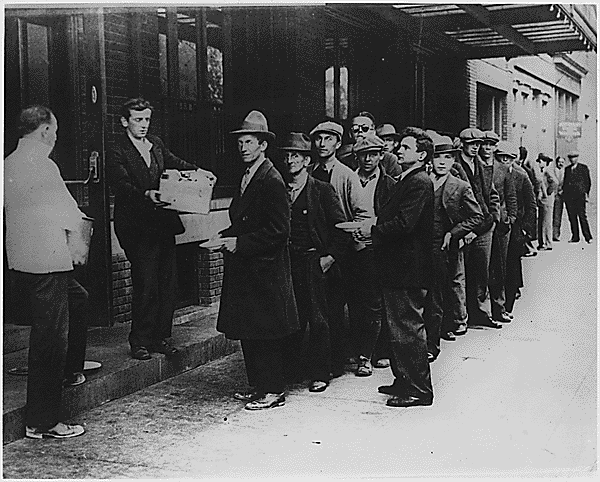
Breadlines: long line of people waiting to be fed: New York City: in the absence of substantial government relief programs during 1932, free food was distributed with private funds in some urban centers to large numbers of the unemployed. (Circa February 1932)

Breadlines: long line of people waiting to be fed: New York City: in the absence of substantial government relief programs during 1932, free food was distributed with private funds in some urban centers to large numbers of the unemployed. (Circa February 1932)

At the end of my work life I got to administer some of the stimulus funding.  What I saw was not the direct creation of a huge number jobs with government  funding, but many jobs created as the result of the opening of a new business, new hotel, or new housing.  Those employed persons paid taxes which helped bolster the economy.  If the benefits of having people employed are obvious to an economic novice like me,  I don’t understand why the Republicans in Congress don’t want to fund infrastructure projects.  Road and bridge repairs, creating a grid that can tie in with alternative energy sources, construction of affordable housing:  these are just a few of the types of projects that can be government funded and that can create jobs.  While construction jobs may disappear, the infrastructure created will result in new opportunities.

Paul Krugman’s recent column helps me understand a little what may be going on.  He begins

Last week John Boehner, the speaker of the House, explained to an audience at the American Enterprise Institute what’s holding back employment in America: laziness. People, he said, have “this idea” that “I really don’t have to work. I don’t really want to do this. I think I’d rather just sit around.” Holy 47 percent, Batman!

People are just lazy.  Krugman continues

First things first: I don’t know how many people realize just how successful the campaign against any kind of relief for those who can’t find jobs has been. But it’s a striking picture. The job market has improved lately, but there are still almost three million Americans who have been out of work for more than six months, the usual maximum duration of unemployment insurance. That’s nearly three times the pre-recession total. Yet extended benefits for the long-term unemployed have been eliminated — and in some states the duration of benefits has been slashed even further.

The result is that most of the unemployed have been cut off. Only 26 percent of jobless Americans are receiving any kind of unemployment benefit, the lowest level in many decades. The total value of unemployment benefits is less than 0.25 percent of G.D.P., half what it was in 2003, when the unemployment rate was roughly the same as it is now. It’s not hyperbole to say that America has abandoned its out-of-work citizens.

If unemployment is too costly, then any kind of jobs program must cost way too much.

…My question for today is instead one of psychology and politics: Why is there so much animus against the unemployed, such a strong conviction that they’re getting away with something, at a time when they’re actually being treated with unprecedented harshness?

Is it race? That’s always a hypothesis worth considering in American politics. It’s true that most of the unemployed are white, and they make up an even larger share of those receiving unemployment benefits. But conservatives may not know this, treating the unemployed as part of a vaguely defined, dark-skinned crowd of “takers.”

My guess, however, is that it’s mainly about the closed information loop of the modern right. In a nation where the Republican base gets what it thinks are facts from Fox News and Rush Limbaugh, where the party’s elite gets what it imagines to be policy analysis from the American Enterprise Institute or the Heritage Foundation, the right lives in its own intellectual universe, aware of neither the reality of unemployment nor what life is like for the jobless. You might think that personal experience — almost everyone has acquaintances or relatives who can’t find work — would still break through, but apparently not.

The bottom line:  If you are still unemployed or if you are poor it is your own fault.  Besides, those people live in a world far from the world of Fox News.

I hope that people think about the state of the semi-recovered economy when they vote and that they vote for candidates who can learn from the lessons of the Depression, will vote some funding for jobs programs and not worry so much about the deficit which is shrinking.  They should instead worry about our infrastructure which is failing.  If they fix that, they may find people aren’t lazy, they just need jobs.

 Photograph:  Picture from the Franklin D. Roosevelt Library, courtesy of the National Archives and Records Administration

Police departments and racial diversity

Back in the dark ages, that is the early to mid-1980s, I worked on a study for then Virginia Governor Charles Robb.  He wanted to know several things including how we could recruit more African-Americans and women to the State Police and how, once we hired them, they could be retained.  I can’t recall that we came up with anything one wouldn’t have expected including things like more training for command in diversity issues.  I do remember one black trooper I interviewed had an idea on how to recruit people.  He suggested that he be made part of the Governor’s security detail which would provide lots of visibility.  I told the Governor and the next thing I knew, the trooper was thanking me when we ran into each other on the Capitol grounds.  I have no idea if his presence helped recruit more blacks to the ranks or not but it did provide some visibility and I remember that the Capitol Police then hired several black officers.

So my little story took place in 1983.  This morning’s New York Times has some very interesting charts on large Metropolitan police departments and the differences between their racial compositions and those of the towns they serve.

In hundreds of police departments across the country, the percentage of whites on the force is more than 30 percentage points higher than in the communities they serve, according to an analysis of a government survey of police departments. Minorities make up a quarter of police forces, according to the 2007 survey, the most recent comprehensive data available. Experts say that diversity in the police force increases a department’s credibility with its community. “Even if police officers of whatever race enforce the law in relatively the same way, there is a huge image problem with a department that is so out of sync with the racial composition of the local population,” said Ronald Weitzer, a sociologist at George Washington University. Listed below are local police departments from 15 metropolitan areas, sorted so that departments with the largest percentage-point differences of white officers to white residents are at the top.

We clearly have a long way to go.  I wonder if part of the recruitment problem is the sheer number of young black and Hispanic men who have conviction records.  Perhaps we should look into that.

th

I was interested to see that Boston (+18) and Somerville (+15) were doing pretty well.  Those are two of the police departments I’ve worked with in the recent past.  Other departments should take a look at this chart and talk to some of the successful agencies – and I don’t mean towns that have a small gap because the population of the town itself is mostly white – and learn from what they have done.

Incidents like the shooting in Ferguson don’t happen in a vacuum.  Look up a town near you and ask questions if you don’t like what you see.


As a footnote:  While I was looking to a picture to add, I was surprised at the number of stock photographs showing police in riot gear and/or arresting someone, often a black male.  Just another part of the problem.

Photograph:  how2becomeanfbiagent.com

The politics of macho

In 1992 when he was running for President in a tight Democratic primary race, Bill Clinton rushed back to Arkansas where he was governor to preside over the execution of Ricky Ray Rector.  According to a New York Times article at the time

Mr. Rector, 40 years old, was convicted in November 1982 and sentenced to die for the 1981 shooting death of Police Officer Bob Martin in Conway, Ark. He was also convicted of another murder that occurred two days earlier….

After shooting Officer Martin, Mr. Rector turned the gun on himself, destroying part of his brain. His lawyers said that even though he could speak, his mental capacities were so impaired that he did not know what death is or understand that the people he shot are not still alive.

“He is, in the vernacular, a zombie,” said Jeff Rosenzweig, a lawyer for Mr. Rector before the execution. “His execution would be remembered as a disgrace to the state.”

Mr. Rosenzweig said Mr. Clinton was harshly criticized as being soft on crime in 1980, when he was defeated by Frank White, his Republican opponent, in his first re-election bid. Mr. Clinton defeated Mr. White two years later and has been re-elected three more times.

Bill Clinton needed to show that a Democrat could be just as tough on crime as any Republican.

Oklahoma Governor Mary Fallin

Oklahoma Governor Mary Fallin

Twenty-two years later we have Oklahoma governor, Mary Fallin, threatening to defy the Oklahoma Supreme Court while her allies in the legislature start to impeach justices.  Why?  Because they wanted to proceed with two executions.

States like Oklahoma have tried to protect drug companies by passing laws prohibiting the disclosure of what’s in their lethal injections. But attorneys have argued that state secrecy about what’s in those lethal injections violates the ban on “cruel and unusual punishment,” and some courts have agreed, including a court in Oklahoma that blocked Lockett’s execution. When the state Supreme Court backed the lower court, Fallin said she would defy it, insisting the court only had authority over civil, not criminal matters. Then the court shamefully reversed itself, after a state legislator promised to impeach the justices for staying the executions. Fallin forged ahead with the killing of Lockett and Charles Warner.

Now she is investigating what happened.  I think we know already.  Mary Fallin was so anxious to prove her toughness that she abandoned all good sense and tried to execute Clayton Lockett.  We all know how that worked out.

Then there is the critique of President Obama’s foreign policy from those who seek more military intervention in places like Ukraine and Syria.  The President has his own ideas as reported in the New York Times

On a day in which he announced new sanctions against Russia for its continued threats to Ukraine, Mr. Obama said his foreign policy was based on a workmanlike tending to American priorities that might lack the high drama of a wartime presidency but also avoided ruinous mistakes.

“You hit singles, you hit doubles; every once in a while we may be able to hit a home run,” Mr. Obama said at a news conference with Mr. Aquino. “But we steadily advance the interests of the American people and our partnership with folks around the world.”

He was mocked in some circles with it being characterized as the “Ichiro” foreign policy after Ichiro Suzuki, the former Seattle Mariner and now New York Yankee who has made a very successful career out of hitting singles.  It shows that one doesn’t always have to hit home runs; home run hitters tend to strike out a lot.

Mr. Obama offered this trip as Exhibit A for the virtues of an incremental approach: He nudged along trade negotiations with Japan, consoled a bereaved ally in South Korea, cultivated ties with a once-hostile Malaysia and signed a modest defense agreement with the Philippines.

“Why is it that everybody is so eager to use military force,” Mr. Obama said, “after we’ve just gone through a decade of war at enormous cost to our troops and to our budget. And what is it exactly that these critics think would have been accomplished?”

I was hoping that the era of macho politics was fading, but now, it seems that women governors need prove themselves just a tough as a man.  No one is saying that Clayton Lockett is a wonderful man who doesn’t deserve punishment, but perhaps Mary Fallin should take a page out of the President’s book and slow down.  Mr. Lockett wasn’t going anywhere and neither are the other inmates on Oklahoma’s death row.

Photograph: AP/Cliff Owen


Some random thoughts about Cliven Bundy

I’m with Jon Stewart:  I just don’t get it.  Here is a man who doesn’t recognize the United States government, but runs around with an American flag.  He thinks slavery was a fine institution, much better I guess than getting welfare, but Mr. Bundy doesn’t seem to realize that by grazing his cattle for free, he has been getting welfare for years.  Talk about welfare cheats!

And ya gotta love all those national political figures now in retreat.  I guess they were initially moved by the pictures of all those armed men prepared to put the women up front so they would die first.  But then came the comments about “Negroes”.   Dana Milbank had a great list of retreaters and their comments in his recent Washington Post column. 

Nevada cattle rancher Cliven Bundy knows how to start a stampede.

After Bundy, who became a right-wing hero for his refusal to acknowledge the authority of the federal government, wondered aloud about whether “Negro” people were “better off as slaves,” conservative figures who had celebrated his cause rushed to distance themselves from him.

Sen. Rand Paul (R-Ky.), who had condemned the federal government’s attempt to enforce court orders against Bundy: “Offensive.”

Sen. Dean Heller (R-Nev.), who had declared Bundy’s followers “patriots”: “Appalling and racist.”

And Sean Hannity, who had led a Fox News campaign that made a hero of Bundy: “Beyond repugnant.”

But Bundy’s daughter is still defending him.  According to Mother Jones

Bundy defended his initial comments on Thursday saying, “If they think I’m racist, they’re totally wrong…Again, I’m wondering are they better off under the old system of slavery or are they better off under the welfare slavery that they’re under now. You know, I’m not saying one way or the other.” And on Friday morning, he told CNN that he didn’t see a problem with using terms like “Negro” or “boy” for black people. “If those people cannot take those kind of words and not be (offended), then Martin Luther King hasn’t got his job done yet,” he told anchor Chris Cuomo.

Meanwhile, Bundy’s daughter, Shiree Bundy Cox, is striking back at conservatives who have turned tail on Bundy, especially Hannity. In a Facebook post Thursday night, she accused Hannity of abandoning her father and pandering to ratings. Here’s a snippet:

I’m sure most of you have heard the news about my dad being called a racist. Wow! The media loves to take things out of context don’t they? First off I’d just like to say that my dad has never been the most eloquent speaking person. Like someone said, he’s a Moses who needs an Aaron to speak for him. This is true. Second, however, is that the media has turned this into a circus side show. It’s like their trying to throw us off the real subject. Why was this ever even brought up? What does this have to do with land rights issues? Sean Hannity was all for reporting the happenings at the Bundy Ranch until this popped up. I wonder if someone hoped it would be that way…By the way, I think Mr. Hannity is more worried about his ratings than he really is about what my dad said. If he supports a supposed racist, what will that do to his ratings? He’s already lost his #1 spot on Fox.

If Shiree wants to understand the connection between land rights, race and taxes, Dana Milbank can explain it to her.

In general terms, Bundy’s notion of state supremacy — “I don’t recognize the United States government as even existing” — is a variant of states’-rights claims that go back to the Civil War and were revived in the segregationists’ opposition to civil rights laws. Because the federal government has been the protector of minority rights, states’ rights have long been used to justify discrimination.

Specifically, the Southern Poverty Law Center, which tracks anti-government and hate groups, says that Bundy’s sentiments align closely with those of the “Posse Comitatus” movement, founded by William Potter Gale in the 1970s. That movement based its anti-tax position — and its belief in the primacy of county and state authority over the federal government — on a belief that the levers of national power were controlled by Jewish bankers. “Most of the ideas that bolster positions like Cliven’s that the federal government doesn’t exist come from Posse Comitatus ideology,” the SPLC’s Ryan Lenz argues. And that ideology is rooted in bigotry.

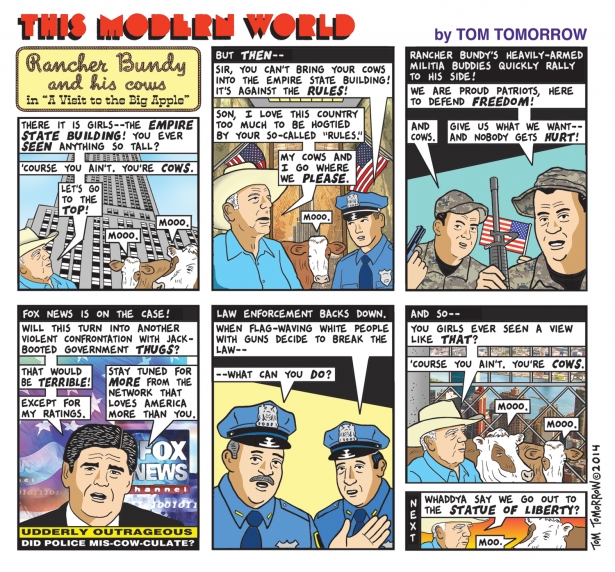
I’m not sure how this will get resolved without violence, but if no action is taken I’m afraid that the discussion will pivot again into a questioning President Obama’s “manhood” for not fighting.  This will really obscure the issues.  In the meanwhile, we have Tom Tomorrow.

TT and Bundy


Solving the pay equity problem: Not that easy

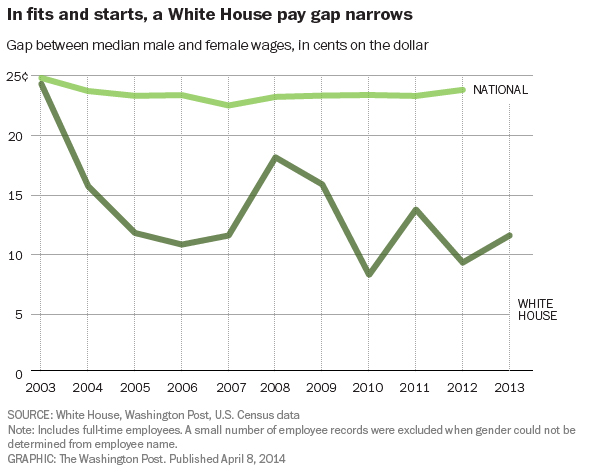
white-house-wage-gapIs the gender gap in wages a myth or is it as the President said yesterday just math?  If a company pays, as does the White House and most other government agencies, equally for the same job, why is there still a gap in total pay?  Is that as Christina Hoff Summers would argue, not a wage gap since the cause is that women are in different job?  Christopher Ingraham wrote in the Washington Post

The American Enterprise Institute caught the White House flat-footed yesterday with its finding that female White House workers earned roughly 88 cents to the dollar compared to male employees. This came the day before two high-profile executive orders aimed at narrowing the gender wage gap among federal contractors.

When asked about the discrepancy by reporters, spokesman Jay Carney said that those figures are based on the total of all staff jobs, and that women tend to fill more lower-paying positions than men. When you break it out by position, “men and women in equivalent roles here earn equivalent salaries,” Carney said. Incidentally, this is the pretty much the same argument that AEI scholar Christina Hoff Summers makes to argue that the gender wage gap is a myth.

Human Resource people (of which I was once one) would say it is all about classifying jobs.  There is an endless debate about what jobs require more skills, more effort, more responsibility.  Is the woman who comes to help your sick mother as a home health aide worth less than the man who manages the local convenience store? (Neither gets paid very well.)  Is a pre-school teacher worth less than the CEO of Facebook?  Ok.  I can hear people saying that I’m comparing apples and oranges, but these are the kind of things we need to consider as we look at not only the gender issues but also at low wage jobs generally.  If you look at the Washington Post chart, you can see that the national wage gap is pretty constant, but the general trend of the White House gap is down.

There are really several problems at work here.  First is the failure to pay women an equivalent wage for the same work done by a man.  This may be deliberate or the women may simply be given a different job title and classification.  The second is what the Institute for Women’s Policy Research calls occupational segregation.

Pay equity may also be impacted by other more subtle factors than workplace discrimination. IWPR’s research shows that, irrespective of the level of qualification, jobs predominantly done by women pay less on average than jobs predominantly done by men. Women have made tremendous strides during the last few decades by moving into jobs and occupations previously done almost exclusively by men, yet during the last decade there has been very little further progress in the gender integration of work. This persistent occupational segregation is a significant contributor to the lack of significant progress in closing the wage gap.

The third problem is one that speaks mainly to women in the private sector at high levels:  Women appear to be less willing to ask for more in salary negotiations.  While this is unimportant and insignificant, more women are hurt by the first two problems.

In the late 1970s I was working as a research analyst for the Virginia State Equal Opportunity Office.  We got a complaint from a woman professor at a state college who suspected that she was being paid less than a male colleague who started around the same time as she did.  They were, I think, both coming up for tenure.  This was the age before editable spreadsheets were common, but I managed to make a chart showing hire dates, educational levels, teaching load and teaching evaluations among other factors I can’t remember now for that department.  When laid out, it became very clear that the women, including the complainant were being paid less.  This set off a request for an analysis of the entire school as well as requests from several other state colleges and universities.  I ended up teaching people from the schools how to do this themselves since there was no way I could tackle such a large project on my own.  Problems were corrected, but I don’t recall that we ever compared  salary levels at the Department of Physics (probably mostly men) to the School of Nursing (mostly women).

I tell this story for two reasons.  One, the problem and issue has been around a long, long, time.  And second, I think we need to look harder at occupational segregation and, if we can’t totally solve that, we need to look at how we, as a society, value what we call “women’s work.”  In the end, that is the only way to cure the pay equity problem.


As the dust settles

on the first enrollment period of the new Affordable Care Act, we are learning that a lot more people than a lot of people predicted have signed up for insurance.  President Obama is claiming 7.1 million people signed up on the health insurance exchanges – along with unknown numbers of others who signed up directly with insurance companies.  There was a claim yesterday that 90% of the enrollees had actually paid a first premium, a crucial step to being able to actually use the insurance.  We all know that there will be hassles when people go to their medical provider, when insurance cards don’t arrive in the mail, when someone with expanded Medicaid goes to a doctor who doesn’t accept that plan, but then, there have always been hassles with health insurance.  This will be nothing new.  What will be new is the massive number of new people suddenly looking for a provider.  Adjustments will have to be made all around.

But the biggest losers as of this morning would seem to be the opponents of the ACA or Obamacare as they call it.  Here is Dan Wasserman’s cartoon from this morning’s Boston Globe.

obamacare wasserman


And then there is this story from Politico.

Back in the fall, conservatives seized on the flubbed Obamacare rollout as proof that President Barack Obama’s brand of liberalism doesn’t work.

Now, the law’s opponents aren’t about to say that critique was wrong — but they’ve lost the best evidence they had.

On Tuesday, Obamacare sign-ups passed 7 million, six months after the launch of a federal website that could barely sign up anybody. There are still a lot of questions about how solid that figure is, but the idea that the law could even come close to the original goal after such a disastrous start would have been laughable even a few weeks ago.

That’s left the critics questioning the early numbers or changing the subject. It’s a reminder that the attacks on the website were more than complaints about technology, but a proxy for a much deeper argument about what government should do and what it can’t do

But the Republicans do seem to be suffering from a compulsion disorder.  Here is Representative Paul Ryan quoted in the Politico story

And House Budget Committee Chairman Paul Ryan, who on the same day released a budget plan that would repeal the law, wasn’t fazed by the enrollment news.

“I think Obamacare is a slow-rolling fiasco. I think it’s a Pyrrhic victory,” the Wisconsin lawmaker said during a conference call with reporters Tuesday, at the same time that Obama was giving his victory speech in the Rose Garden.

But it was so much easier when they could just say the federal government can’t tie its own shoelaces. Now, they have to acknowledge that the government fixed the problem — and enrollment came roaring back.

Louisiana Governor Bobby Jindal is set to release his health care plan – I guess he is running for President.  According to the Washington Post

Louisiana Gov. Bobby Jindal will announce Wednesday a plan to repeal and replace President Obama’s health-care law, an effort by the Republican to insert himself into the increasingly competitive early maneuvering for his party’s presidential nomination.

In his 26-page plan, Jindal lays out a lengthy critique of the health law — which he refers to throughout as “Obamacare” — and reiterates his belief that it needs to be entirely done away with. In its place, he sets forth a bevy of ideas that have run through conservative thought for years, in some cases renaming them and in other cases suggesting new variations on old themes.

These themes appear to include giving those on Medicare a subsidy to buy private insurance and giving Medicaid money to the states to provide whatever care they decide on.  I have a feeling that this every-state-for-itself  idea will be proven to be a real problem as people in states that didn’t accept the expanded Medicare under the ACA are faced with citizens who won’t understand why Uncle Charlie can get health insurance subsidies and they can’t.  I don’t think this is a plan people will go for – especially after they get a feel for what is covered under ACA – but at least Jindal has something.

President Obama’s poll numbers are creeping up.  Democrats running for re-election would do well to be cautious about running away from the ACA, and optimistic me says that Nate Silver might just be wrong this time with is prediction that the Republicans have the edge in the mid-terms.  It won’t be easy for the Democrats:  They have to turn out their base in larger numbers than is usual for a mid-term, but it can be done.  Nate did favor Duke which lost in the first round of the NCAA men’s basketball tournament.