
New England, St. John’s College and the War of 1812

What do you know about the War of 1812?  If you live in Boston, you know about the U.S.S. Constitution capturing the HMS Guerriere  early in the war.  If you live near the Great Lakes you know about Captain Oliver Perry and the Battle of Lake Erie.  Everyone knows about the Fort McHenry and the writing of the “Star-Spangled Banner” as well as Andrew Jackson and the Battle of New Orleans.  And who can forget Dolley Madison saving the portrait of George Washington,  But do you know why the war was fought in the first place?

In the Sunday Boston Globe, Ted Widmer had a long piece in the Ideas section titled “The silent bicentennial:  In 1814, the US experienced everything you’d want to forget about a war.  Which is exactly why we should be thinking about it now.”  Although written from a New England perspective, Widmer has a number of interesting observations surprisingly relevant to national politics today.

After the fact, it was hard to remember exactly why war had broken out at all. The American Revolution had established the United States as an independent nation, but relations with England remained vexed—many Americans resented the motherland for its condescension, but also valued the memory of a shared heritage. In the years leading up to 1812, American tempers began to flare over the many ways the British conveyed their lack of respect for the upstart country, forcing American sailors to work on their ships and encouraging Indians to attack settlers in the interior.

Though serious at times, these irritants did not add up to grounds for war. England was America’s principal commercial partner, and wielded the greatest navy on earth. To anyone who participated in the maritime economy—as most of New England did—it was the height of folly to risk everything over a few insults.

Yet rhetoric, so easy to dish out, can be hard to take back. Driven by exuberant talk from Western and Southern politicians, Congress proposed a war measure in June 1812. New England and New York voted overwhelmingly against it, but it passed the Senate 19 to 13, and on that wobbly basis, the United States lurched into war. Its rationale was vague; its goals (which included some hope of gaining territory in Canada and Florida) were not entirely selfless; and it never resembled the kind of homegrown cause that had united the Colonists in 1775. On village greens around New England, church bells tolled in mourning.

Wars that are declared badly are often fought badly, and it soon became apparent that the United States was ill-prepared to wage a war against the world’s preeminent military power, whose troops had been toughened by years of fighting against Napoleon. The Republicans clamoring for war had balked at paying taxes, and voted down efforts to build up the Navy. Debt tripled. The War Department could never raise an army to even half the strength it sought, and had to resort to only 10,000 soldiers, who enlisted for a single year.

The young “War Hawks” in Congress were better at speeches than fighting. Henry Clay promised that he could conquer Canada with Kentucky militia; in the end, Kentucky only furnished 400 men. Among the many delusions was a belief that Canadians would surrender as soon as Americans appeared. They did not—in fact, many Canadians were former New Englanders who fought just as courageously as their cousins did, and to this day, memories of defeating the American invaders are as important to Canadians as Lexington and Concord are to Americans.

Sound kinda familiar?

It seems that despite voting against declaring war, New England ended up providing much of the money and manpower including Captain Perry and the Constitution.

Washington was burned and the “Star-Spangled Banner” written in late summer and early fall of 1814.  But New England was tired and was looking for ways out.

Thoughout the fall, gloom settled around New England. In Boston, many leading citizens became furious at a stupid war going badly and began to threaten action. The Boston Gazette wrote, “If James Madison is not out of office, a new form of government will be in operation in the eastern section of the Union.” Madison was hanged in effigy in Augusta, Maine. Huge rallies filled Faneuil Hall. The Massachusetts House voted 406 to 240 to denounce the war as “awful” and “revolting.” The governor of Massachusetts, Caleb Strong, sent out secret feelers to his counterpart in Halifax. A new kind of flag was occasionally seen around New England, with five stars and five stripes—the five states of New England (Maine was then a district of Massachusetts). Throughout the interior, town meetings expressed deep feelings against the war—in much the same way that earlier generations had protested British tyranny. From these currents came a call for the New England states to convene a meeting at Hartford to consider options. The Hartford Convention began in December 1814, and to its credit, stopped short of any activity that might have led to New England breaking away from the United States. But it was a close call.

Another New Englander, John Quincy Adams, negotiated the Treaty of Ghent signed in December 1814 ending the war.  Andrew Jackson didn’t hear about the Treaty until after the Battle of New Orleans.  Just think, with modern communications, Jackson might not have become a hero and might not have become a two-term president.  The war also had other unforeseen consequences.

The war had other unexpected legacies as well. Abraham Lincoln would later cite the heroism of African-American soldiers at New Orleans as an important precedent for allowing them to fight for the Union cause. Native Americans, on the other hand, were the clear losers of a conflict that did not produce much victory for anyone. Without the British to protect them, they were helpless before the relentless advance of settlers across the continent. That is not the most triumphant note for an anniversary reflection to end on. But how else do we commemorate a near-defeat, a conflict with an ally, and New England’s flirtation with secession? Perhaps by acknowledging the fragility of history itself, the fickleness of the forces that separate “victory” from “defeat,” and the many possible results in between.

Cover of sheet music for "The Star-Spangled Banner", transcribed for piano by Ch. Voss, Philadelphia: G. Andre & Co., 1862

Cover of sheet music for “The Star-Spangled Banner”, transcribed for piano by Ch. Voss, Philadelphia: G. Andre & Co., 1862


My class at St. John’s College in Annapolis will be holding its 45th reunion in September.  Francis Scott Key was an alumni and we will be marking his anniversary by singing his anthem and setting of some fireworks.  But I’ll also be thinking of the War of 1812 and unintended consequences.


Solving the pay equity problem: Not that easy

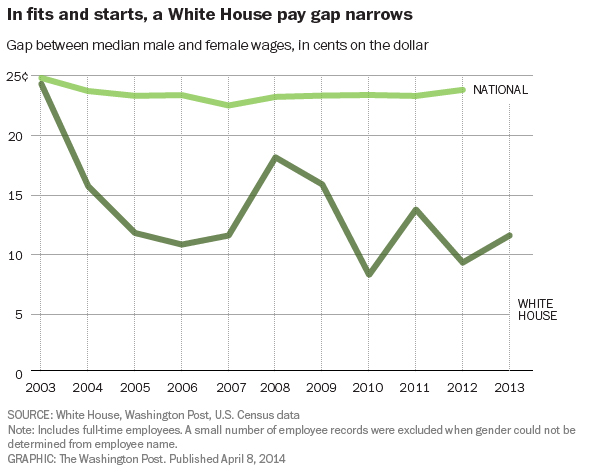
white-house-wage-gapIs the gender gap in wages a myth or is it as the President said yesterday just math?  If a company pays, as does the White House and most other government agencies, equally for the same job, why is there still a gap in total pay?  Is that as Christina Hoff Summers would argue, not a wage gap since the cause is that women are in different job?  Christopher Ingraham wrote in the Washington Post

The American Enterprise Institute caught the White House flat-footed yesterday with its finding that female White House workers earned roughly 88 cents to the dollar compared to male employees. This came the day before two high-profile executive orders aimed at narrowing the gender wage gap among federal contractors.

When asked about the discrepancy by reporters, spokesman Jay Carney said that those figures are based on the total of all staff jobs, and that women tend to fill more lower-paying positions than men. When you break it out by position, “men and women in equivalent roles here earn equivalent salaries,” Carney said. Incidentally, this is the pretty much the same argument that AEI scholar Christina Hoff Summers makes to argue that the gender wage gap is a myth.

Human Resource people (of which I was once one) would say it is all about classifying jobs.  There is an endless debate about what jobs require more skills, more effort, more responsibility.  Is the woman who comes to help your sick mother as a home health aide worth less than the man who manages the local convenience store? (Neither gets paid very well.)  Is a pre-school teacher worth less than the CEO of Facebook?  Ok.  I can hear people saying that I’m comparing apples and oranges, but these are the kind of things we need to consider as we look at not only the gender issues but also at low wage jobs generally.  If you look at the Washington Post chart, you can see that the national wage gap is pretty constant, but the general trend of the White House gap is down.

There are really several problems at work here.  First is the failure to pay women an equivalent wage for the same work done by a man.  This may be deliberate or the women may simply be given a different job title and classification.  The second is what the Institute for Women’s Policy Research calls occupational segregation.

Pay equity may also be impacted by other more subtle factors than workplace discrimination. IWPR’s research shows that, irrespective of the level of qualification, jobs predominantly done by women pay less on average than jobs predominantly done by men. Women have made tremendous strides during the last few decades by moving into jobs and occupations previously done almost exclusively by men, yet during the last decade there has been very little further progress in the gender integration of work. This persistent occupational segregation is a significant contributor to the lack of significant progress in closing the wage gap.

The third problem is one that speaks mainly to women in the private sector at high levels:  Women appear to be less willing to ask for more in salary negotiations.  While this is unimportant and insignificant, more women are hurt by the first two problems.

In the late 1970s I was working as a research analyst for the Virginia State Equal Opportunity Office.  We got a complaint from a woman professor at a state college who suspected that she was being paid less than a male colleague who started around the same time as she did.  They were, I think, both coming up for tenure.  This was the age before editable spreadsheets were common, but I managed to make a chart showing hire dates, educational levels, teaching load and teaching evaluations among other factors I can’t remember now for that department.  When laid out, it became very clear that the women, including the complainant were being paid less.  This set off a request for an analysis of the entire school as well as requests from several other state colleges and universities.  I ended up teaching people from the schools how to do this themselves since there was no way I could tackle such a large project on my own.  Problems were corrected, but I don’t recall that we ever compared  salary levels at the Department of Physics (probably mostly men) to the School of Nursing (mostly women).

I tell this story for two reasons.  One, the problem and issue has been around a long, long, time.  And second, I think we need to look harder at occupational segregation and, if we can’t totally solve that, we need to look at how we, as a society, value what we call “women’s work.”  In the end, that is the only way to cure the pay equity problem.


As the dust settles

on the first enrollment period of the new Affordable Care Act, we are learning that a lot more people than a lot of people predicted have signed up for insurance.  President Obama is claiming 7.1 million people signed up on the health insurance exchanges – along with unknown numbers of others who signed up directly with insurance companies.  There was a claim yesterday that 90% of the enrollees had actually paid a first premium, a crucial step to being able to actually use the insurance.  We all know that there will be hassles when people go to their medical provider, when insurance cards don’t arrive in the mail, when someone with expanded Medicaid goes to a doctor who doesn’t accept that plan, but then, there have always been hassles with health insurance.  This will be nothing new.  What will be new is the massive number of new people suddenly looking for a provider.  Adjustments will have to be made all around.

But the biggest losers as of this morning would seem to be the opponents of the ACA or Obamacare as they call it.  Here is Dan Wasserman’s cartoon from this morning’s Boston Globe.

obamacare wasserman


And then there is this story from Politico.

Back in the fall, conservatives seized on the flubbed Obamacare rollout as proof that President Barack Obama’s brand of liberalism doesn’t work.

Now, the law’s opponents aren’t about to say that critique was wrong — but they’ve lost the best evidence they had.

On Tuesday, Obamacare sign-ups passed 7 million, six months after the launch of a federal website that could barely sign up anybody. There are still a lot of questions about how solid that figure is, but the idea that the law could even come close to the original goal after such a disastrous start would have been laughable even a few weeks ago.

That’s left the critics questioning the early numbers or changing the subject. It’s a reminder that the attacks on the website were more than complaints about technology, but a proxy for a much deeper argument about what government should do and what it can’t do

But the Republicans do seem to be suffering from a compulsion disorder.  Here is Representative Paul Ryan quoted in the Politico story

And House Budget Committee Chairman Paul Ryan, who on the same day released a budget plan that would repeal the law, wasn’t fazed by the enrollment news.

“I think Obamacare is a slow-rolling fiasco. I think it’s a Pyrrhic victory,” the Wisconsin lawmaker said during a conference call with reporters Tuesday, at the same time that Obama was giving his victory speech in the Rose Garden.

But it was so much easier when they could just say the federal government can’t tie its own shoelaces. Now, they have to acknowledge that the government fixed the problem — and enrollment came roaring back.

Louisiana Governor Bobby Jindal is set to release his health care plan – I guess he is running for President.  According to the Washington Post

Louisiana Gov. Bobby Jindal will announce Wednesday a plan to repeal and replace President Obama’s health-care law, an effort by the Republican to insert himself into the increasingly competitive early maneuvering for his party’s presidential nomination.

In his 26-page plan, Jindal lays out a lengthy critique of the health law — which he refers to throughout as “Obamacare” — and reiterates his belief that it needs to be entirely done away with. In its place, he sets forth a bevy of ideas that have run through conservative thought for years, in some cases renaming them and in other cases suggesting new variations on old themes.

These themes appear to include giving those on Medicare a subsidy to buy private insurance and giving Medicaid money to the states to provide whatever care they decide on.  I have a feeling that this every-state-for-itself  idea will be proven to be a real problem as people in states that didn’t accept the expanded Medicare under the ACA are faced with citizens who won’t understand why Uncle Charlie can get health insurance subsidies and they can’t.  I don’t think this is a plan people will go for – especially after they get a feel for what is covered under ACA – but at least Jindal has something.

President Obama’s poll numbers are creeping up.  Democrats running for re-election would do well to be cautious about running away from the ACA, and optimistic me says that Nate Silver might just be wrong this time with is prediction that the Republicans have the edge in the mid-terms.  It won’t be easy for the Democrats:  They have to turn out their base in larger numbers than is usual for a mid-term, but it can be done.  Nate did favor Duke which lost in the first round of the NCAA men’s basketball tournament.

Random thoughts on the state of the world on the first day of spring

Today, the first day of spring, is warmish outside.  I think it actually broke 50!  We had a few hours of sun, but now it is mostly cloudy.  I finally purchased John Grisham’s “Sycamore Row”.  I had been resisting but succumbed because I loved “A Time to Kill” and I ended up getting 45% off the cover price.  Don’t know if a new Grisham is a sign of spring or not, but I’m going to take it as one.

It is hard for me to concentrate on much the last few days.  There is just too much news! Between the missing Malaysian airliner, Crimea, and worrying about the Democrats retaining Congress in the fall, things are pretty depressing even for someone who tends to be an optimist.

Unfortunately, I think that time ran out a long time ago for the passengers on the airliner and now all we can do is watch as the world tries to locate the remains of the plane and the black box.  While everyone points out that they did eventually find the Air France plane that went down in the Atlantic, it was very difficult even though we had a much better of idea of where it went down.  I see the families on television and wonder what I would feel if I just didn’t know what happened.  At this point one almost has to treat it as a forensic mystery to be solved.

I don’t think we are on the verge of a war over Russia and the Crimea, but I do think that things will be difficult internationally for a while.  This will affect negotiations in Iran and Syria as well as people in the Ukraine and Crimea.  But the ultimate losers may be the Crimeans.  David M. Herszenhorn had an article in the New York Times yesterday which pointed out that the troubles there may just be starting.

Many A.T.M.s in this sun-dappled seaside resort city in Crimea, and across the region, have been empty in recent days, with little white “transaction denied” slips piling up around them. Banks that do have cash have been imposing severe restrictions on withdrawals.

All flights, other than those to or from Moscow, remain canceled in what could become the norm if the dispute over Crimea’s political status drags on, a chilling prospect just a month before tourist season begins in a place beloved as a vacation playground since czarist times.

He points out that Ukraine could cut off electricity and water supplies and that there is no direct overland route between Crimea and Russia.  The story ends with this

Some Crimeans said they were already feeling the financial sting from political instability.

As crowds in the cities of Simferopol and Sevastopol held raucous celebrations well into Monday morning after the vote, here in Yalta, Ihor B., the owner of a small travel business, went to bed with a growing sense of dread: The roughly two dozen bookings that he had received since the start of the year had all disappeared.

“I got 10 requests from Germany, and 10 assignments from Ukrainian agencies for Western tourists; a couple of requests from Dutch tourists and cruise ships,” said Mr. B, who asked that his last name not be used for fear of reprisal by the new Russian government. “At the moment, all of them, absolutely all of them, are canceled.”

In the same issue of the Times was a long cautionary story about South Ossetia which was liberated from Georgia five years ago.  But things have moved on and South Ossetia is not doing very well.

When Russia invaded Georgia, repelling a Georgian attack on South Ossetia and taking control of the separatist enclaves of South Ossetia and Abkhazia, it seemed most unlikely that the Kremlin was thinking about long-term consequences.

As in Crimea, the war was presented to Russians as a humanitarian effort to protect its citizens, and more broadly as a challenge to encirclement by the United States, which was aligned with Georgia. Television stations gave the intervention blanket coverage, and it was wildly popular in Russia, lifting the approval ratings of Dmitri A. Medvedev to the highest point of his presidency.

The aftermath of recognition, however, has presented Russia with a long series of headaches. This week, economists have warned repeatedly that Crimea, if it is absorbed, will prove a serious drag on Russia’s budget, but their arguments have been drowned out in the roar of public support for annexation.

Aleksei V. Malashenko, an analyst at the Carnegie Moscow Center, said Russian officials “will be shocked” with the challenges they face when trying to manage Crimea — reviving its economy, distributing money and influence among its ethnic groups, and trying to control the corruption that accompanies all big Russian projects. And, judging from precedent, the public’s euphoria will fade, he said.

“I think that in Russia, the majority of the society forgot about Ossetia, and if it weren’t for the Olympics, the majority of the society would also forget about Abkhazia,” Mr. Malashenko said. “Of course, Crimea is not Ossetia. But anyway, the popularity of Crimeans, and the Crimean tragedy, will be forgotten in a year.”

So maybe we don’t need to do anything except some sanctions and make sure that Russia and Putin’s next move is not to march into eastern Ukraine.  Forget John McCain’s mockery and advice.

As for domestic politics, I recalled Andrew Sullivan’s March 13th blog entry on The Dish. The Boring, Relentless Advance Of Obama’s Agenda.  To read the entire piece one has to subscribe [which I would encourage you to do], but here is his conclusion.

…One side is theater – and often rather compelling theater, if you like your news blonde, buxom and propagandized. The other side is boring, relentless implementation. At any one time, you can be forgiven for thinking that the theatrics have worked. The botched roll-out of healthcare.gov, to take an obvious example, created a spectacular weapon for the GOP to hurl back at the president. But since then, in undemonstrative fashion, the Obama peeps have rather impressively fixed the site’s problems and signed up millions more to the program. As the numbers tick up, the forces of inertia – always paramount in healthcare reform – will kick in in defense of Obamacare, and not against it. Again, the pattern is great Republican political theater, followed by steady and relentless Democratic advance.

Until the theater really does create a new majority around Republican policies and a Republican candidate, Obama has the edge. Which is to say: he has had that edge now for nearly six years. Even if he loses the entire Congress this fall, he has a veto. And then, all he has to do is find a successor able to entrench his legacy and the final meep-meep is upon us. And that, perhaps, is how best to see Clinton. She may not have the stomach for eight years in the White House, and the barrage of bullshit she will have to endure. But if you see her as being to Barack Obama what George H.W. Bush was to Reagan, four years could easily be enough. At which point, the GOP may finally have to abandon theater for government, and performance art for coalition-building.

Plus, it is spring.

Mutts by Patrick McDonnell

Mutts by Patrick McDonnell

St. Patrick’s Day 2014

I’m not quite sure I understand the whole controversy about openly gay persons marching in a St. Patrick’s Day parade.  The parade is just a celebration of heritage and the Irish are just as diverse as any other group.  Boston’s old Mayor, Tom Menino, simply didn’t march in the South Boston parade because of the restriction, upheld by a Supreme Court decision, that the parade organizers could choose who they wanted to march.  But new Boston Mayor Marty Walsh is, along with U. S. Representative Stephen Lynch, doing his best to broker a compromise that would allow Mass Equality to march with a banner.  I think the parade organizers that include a fellow called Wacko Hurley fear that their parade would turn into another gay pride march if they let any LGBT groups march.  Presumably, the LGBT community knows the difference: March is not June.  Plus, there is a picture from the 1992 parade, pre-Supreme Court decision,  that shows there is nothing to fear.

The parade is only a couple of days away, and Mayor Walsh is making one last try.  Most Boston and Massachusetts state-wide elected officials have already announced they are not going to march.  I think the only exception is Nick Collins, the State Representative from South Boston.

The 1992 South Boston parade after a court order.

The 1992 South Boston parade after a court order.

Kevin Cullen has a wonderful column in today’s Boston Globe about the Boston and New York City parades.

So Marty Walsh, God love ’im, is going to make one last-ditch effort to hammer out a compromise so gay people can march openly in Sunday’s parade in Southie.

As they say in the Irish-speaking Gaeltacht, from where Marty’s parents are from, “Beir bua agus beannacht.” Look it up.

Down here in New York, where its St. Patrick’s Day parade is older than the Declaration of Independence and lasts anywhere from six to seven hours, there’s the same standoff, with organizers refusing to let gay people march with banners that identify themselves as gay.

Mayor Bill de Blasio, as the Irish say, couldn’t be arsed when it comes to forging compromise. He boycotted the parade when he was the city’s public advocate. He’s not going to start marching now.

De Blasio’s predecessor, Michael Bloomberg, of the Medford [MA] Bloombergs, marched in the parade but de Blasio is about as different from Bloomberg as the Irish are from Irish-Americans.

De Blasio, who grew up in Cambridge, is married to a black woman and has biracial kids, so he’s not really into exclusion. But neither is he into cozying up to the New York Irish, who were in the corner of de Blasio’s primary opponent, Christine Quinn, who was the city council president.

The irony in this — and it wouldn’t be Irish if there weren’t irony — is that Quinn is openly gay. Which means, even when she led the city council delegation in the parade she wasn’t allowed to identify herself as being gay.

So the New York Irish wanted to elect an openly gay mayor but wouldn’t let her march in the parade as openly gay.

And people in New York think we’re nuts?

Mayor Walsh, on the other hand, had support from both the gay community and South Boston so he’s kinda caught in the middle.  But he has said that if he can’t work a compromise, he won’t march.

Linda Dorcena Forry

Linda Dorcena Forry

Boston also has this breakfast before the parade.  Politicians come and roast each other and try to sing Irish songs.  Last May I wrote about South Boston and the election of Linda Dorcena Forry.  I predicted that she would bring some life back to the St. Patrick’s Day Breakfast.  Dorcena Forry is Hatian American married to an Irish man.  The City Councilor from South Boston tried to wrest control, but tradition prevailed:  The State Senator who represents Southie hosts the breakfast.  So Bill Linehan is taking his ball and going to Ireland for the day.  I hope he realizes that this will make him the butt of a lot of jokes.  Whatever.Linda is doing her best to live up to my prediction.  First she announced that the Dropkick Murphy’s, Boston’s very popular Irish punk group, would perform.  Then the Boston Globe had news today of  her most recent announcement about the breakfast.

State Senator Linda Dorcena Forry’s groundbreaking debut as the first woman, first Haitian-American, and first Dorchester resident to host the storied St. Patrick’s Day breakfast on Sunday is apparently drawing some international attention.

Dorcena Forry announced Thursday that Enda Kenny — Ireland’s prime minister, or taoiseach — has agreed to attend the ribald political roast in South Boston.

The visit by a sitting head of state is a coup for Dorcena Forry, who promised to raise the profile of a breakfast that in recent years seemed to have lost some of its star power.

“I am honored that Taoiseach Kenny will join us for this year’s breakfast,” Dorcena Forry said. “I have had the pleasure of meeting the taoiseach during his previous visits to Boston. His attendance at the breakfast is a wonderful affirmation of the deep bonds of friendship between Boston and Ireland.”

No word on whether President Obama will be appearing either on tape or by live feed, but I wouldn’t be surprised.  The Prime Minister is not marching in the parade.

The times are rapidly changing.  Boston Beer Company (think Sam Adams) just announced they have pulled their parade sponsorship.  Wacko and his veterans group are doing a great job of killing the parade.  Meanwhile, the breakfast thrives.  Is there a lesson here?

Photograph of GLIB marching:  Marilyn Humphries

Anita Hill and Sandra Fluke: Does 20 years really make a difference?

Tonight while I was surfing around looking for updates on the Malaysian jet still missing somewhere between Malaysia and Vietnam – or perhaps somewhere else – I happened upon a long story in the New York Times about the new documentary about Anita Hill.  Sheryl Gay Stolberg’s review of the movie is actually a long profile of Hill.  I’m very happy that Hill allowed the documentary to be made because it means that a whole new generation of young men and women will be introduced to a remarkable person.

Back then there was no social media, no Facebook, no Twitter but the word still spread quickly among women that someone was about to accuse a nominee for the United States Supreme Court of sexual harassment.  No one knew exactly who she was, but we knew this was going to be important.  I was in Washington, D.C. that day at a meeting, but I remember sitting in a bar that afternoon with several other women all of us transfixed by what was happening on the television.  I was astounded that none of the men, and the Judiciary Committee was all white men, had any clue.  Stolberg puts it this way

“I think this event changed the course of her life and gave her a public mission that she took on,” said Fred Lawrence, the Brandeis president and a Yale Law School classmate of Ms. Hill’s. “It’s not a duty that she volunteered for, but I think she understood that the circumstances had put her in a unique role, and gave her a voice.”

The hearings were a surreal spectacle, as senators prodded an obviously uncomfortable Ms. Hill through awkward testimony about penis size, pubic hair and a pornographic film star known as Long Dong Silver — shocking public discourse at the time. When the hearings ended, Ms. Hill returned to teaching commercial law at the University of Oklahoma, trying, as she says in the film, to find “a new normal.” It proved difficult.

Ms. Hill at the hearings.

Ms. Hill at the hearings.

And I think every women who watched the hearings remembers that electric blue suit.

There were thousands of letters of support, but also death threats, threats to her job. Conservative state lawmakers wanted her fired; fortunately, she had tenure. Even years later, she felt “a discomfort,” she said. One dean confided that he had tired of hearing colleagues at other schools remark, “Isn’t that where Anita Hill is?”

In Washington, her testimony reverberated. Sexual harassment claims shot up. “Our phones were ringing off the hook with people willing to come forward who had been suffering in silence,” said Marcia D. Greenberger, founder and co-president of the National Women’s Law Center in Washington, where Ms. Hill serves on its board.

Congress passed a law allowing victims of sex discrimination to sue for damages, just as victims of racial discrimination could. Waves of women began seeking public office. In 1991, there were two female senators. Today there are 20.

Clarence Thomas was confirmed even though, as Hill puts it

“I believe in my heart that he shouldn’t have been confirmed,” she said in a recent interview, acknowledging that it irritates her to see Justice Thomas on the court. “I believe that the information I provided was clear, it was verifiable, it was confirmed by contemporaneous witnesses that I had talked with. And I think what people don’t understand is that it does go to his ability to be a fair and impartial judge.”

And there are still those who believe she made the whole story up. Then I started thinking about a more recent woman’s experience with Congress. This is from a story in the Daily Beast.

Rep. Darrell Issa’s Thursday hearing went off the rails early. “What I want to know,” demanded Rep. Carolyn Maloney, D-NY, as she looked at the all-male panel of clerics before her, “is, where are the women?”

The hearing, titled “Lines Crossed: Separation of Church and State. Has the Obama Administration Trampled on Freedom of Religion and Freedom of Conscience,” was about religious freedom, Issa said, but it took place against the backdrop of a national controversy regarding the White House’s mandate that all employers provide birth control as part of their insurance plans.

As it happens, there was one woman present prepared to testify on the issue of birth control. Sandra Fluke, a 30-year-old Georgetown University Law School student, had been contacted earlier in the week by committee minority leaders after Democrats saw a video of her speaking about the mandate at the National Press Club on February 9.

Sandra Fluke

Sandra Fluke

Congress had a woman to ask the question, but the panel was all men.  Fluke went on to testify at an informal hearing arranged by Democratic women.  The Huffington Post described it this way

This week she received almost rock-star treatment as the lone witness at an unofficial Democratic-sponsored hearing. While the rest of the Capitol was mostly empty, Democratic leader Nancy Pelosi, three other Democrats and dozens of mainly young women supporters crowded into a House office building room to applaud Fluke as she spoke of the importance of reproductive health care to women.

Prominently displayed by Rep. Carolyn Maloney, D-N.Y., was a photo of five religious leaders, all men and all appearing at the invitation of the Republican majority, testifying last week with Fluke visible in the background, sitting in the visitors’ section.

Democrats pounced on that image of a hearing discussing contraceptive rights being dominated by men while the one person Democrats had asked to appear on the witness stand, a woman, was turned away. Pelosi, D-Calif., said they had since heard from 300,000 people urging that women’s voices be heard on the issue.

“We almost ought to thank the chairman for the lack of judgment he had,” in denying a seat to Fluke, Pelosi said.

Committee chairman Darrell Issa, R-Calif., had said at last week’s hearing that the panel’s focus was on whether the administration policy was a violation of religious freedom. He said at the time that Fluke, invited by Democrats in her capacity as former head of Georgetown Law Students for Reproductive Justice, was not qualified to speak on the religious rights question.

“I’m an American woman who uses contraceptives,” Fluke said, when asked Thursday by Rep. Elijah Cummings, D-Md., about her qualifications to speak on the issue.

So maybe we have made progress in the years since Anita Hill.  Some Republican men don’t seemed to have learned much, but there were plenty of woman and men in Congress who wanted to hear Fluke’s testimony.  And we can thank Anita Hill for her part in making change happen.

Photograph of Anita Hill: American Film Foundation

Photograph of Sandra Fluke:  Getty Images

Daily Beast story: Matthew DeLucca

Huffington Post story: Jim Abrams

Women, gun violence, and domestic violence

According to the op-ed by Nicolas Kristof in last Sunday’s New York Times Review,

Sometimes there’s a perception that domestic violence is insoluble, because it’s such a complex, messy problem with women who are culprits as well as victims. Yet, in fact, this is an area where the United States has seen enormous progress.

Based on victimization surveys, it seems that violence by men against their intimate partners has fallen by almost two-thirds since 1993. Attitudes have changed as well. In 1987, only half of Americans said that it was always wrong for a man to beat his wife with a belt or stick; a decade later, 86 percent said that it was always wrong.

A generation ago, police didn’t typically get involved. “We would say, ‘don’t make us come back, or you’re both going to jail,’ ” recalled Capt. Leonard Dreyer of the DeKalb County Sheriff’s Office. In contrast, sheriff’s officers now routinely arrest the aggressor.

I have to admit that I am skeptical, but hope that his numbers are correct.  Even Kristof opens his column with ” [w]hat strikes one American woman in four and claims a life in the United States every six hours?”  A high profile case such as that of Jared Remy who killed his girlfriend, Jennifer Martel in front of their young daughter confirms that at point at which a woman makes an effort to leave a relationship is the point at which she is most likely to be killed.  Kristof himself recounts this story

American women are twice as likely to suffer domestic violence as breast cancer, and the abuse is particularly shattering because it comes from those we have loved.

“He’s the only person I’ve ever loved,” Ta’Farian, 24, said of her husband, whom she met when she was an 18-year-old college student. He gradually became violent, she says, beating her, locking her up in a closet, and destroying property.

“My family was like, ‘He’s your husband. You can’t leave him. How would you support yourself?’ ”

Still, she says, it became too much, and she called 911. Police arrested him. But she says that the day before the trial, her husband called and threatened to kill her if she testified against him, so she says that out of a mix of fear and love she refused to repeat in court what had happened. Her husband was let off, and she was convicted of false reporting of a crime.

I was still thinking about the Kristof column this morning when I read this front page story in this morning’s Boston Globe on women who buy and hold guns for men.

…As law enforcement agencies and the administration of Mayor Martin J. Walsh ponder ways to get guns off the street, they are learning that targeting the men who historically have been the primary actors in violent crimes is not enough.

They must also disrupt networks of women who buy and hold weapons for men to use.

“We are seeing women with weapons who do not have a direct role in the city’s gun violence,’’ said Jake Wark, spokesman for Suffolk County District Attorney Daniel Conley. “But they are turning up with firearms that are used in that violence.”

Debora Seifert, a special agent with the Bureau of Alcohol,  Tobacco, Firearms and Explosives in Boston, said that she has worked on cases in which women bought firearms for boyfriends who are drug dealers.

Police confiscated a shotgun and ammunition from Arianna Talbert’s Dorchester apartment last year.

“These women can go into a gun shop and buy these guns for a violent criminal,’’ said Seifert. “They can use these weapons to victimize someone in their communities.”

Jahmeilla Tresvant is facing gun charges in two cases. In one, police believe she was holding a gun for her brother

Jahmeilla Tresvant is facing gun charges in two cases. In one, police believe she was holding a gun for her brother

These guns are often hidden in apartments rented by the women and their discovery can result in eviction.

While research is scant on women’s involvement in the gun problem, studies have been clear about who is leading violence by firearms, said David Hemenway, a professor of public health at Harvard School of Public Health.

Men and teenage boys drive gun crime either as victims or perpetrators. If a woman buys a gun, Hemenway added, she is more likely to be buying it for someone who cannot legally buy a gun.

“These young females find themselves facing jail time for holding that gun,’’ said Evans [Boston Police Commissioner William Evans] in a statement.

The mindset that let Ta’Farian stay with her abusive husband is the same one that causes the young women to buy and hold guns.

In the war on illegal guns, Ruth Rollins has heard it all. She’s an advocate for women whose own son was shot and killed. Women have long been flying under radar in police sweeps for illegal guns, she said. And women have become easy prey for criminally-minded men, who are becoming savvy in avoiding arrest for gun possession by having female relatives, partners, or juveniles hold firearms for them.

Women have said they hold the guns for a variety of reasons: to get a few extra dollars, to get drugs, or simply to feel needed. The firearms are sometimes used as community guns stored in a central location, and anyone, from a wayward juvenile to a terrified young man, can have easy access to them.

“It’s no different from years ago when a woman would hold drugs for their men. They would do it for money. They would do it for love,’’ said Rollins. “Now they are holding these guns and they are doing it in the name of love.”

Kim Odom, who lost her 13-year-old son to violence, said some women feel a deep sense of commitment to their men, even the ones wrapped up in crime.

“They are of the mind-set that they are ‘ride-or-die chicks,’ ” Odom said. “These are young ladies who are willing to go all out for their boyfriends.”

This is just another kind of domestic violence.  Maybe more psychological than physical, but still domestic violence.  And like incidents of domestic violence which end either in death or injury to the woman or in which the woman ends up killing her abuser. [And yes, I do know that women can also be abuser, but men  still make up the vast majority.]

Over past year and a half Rollins and Odom have been training and educating women about the consequences of buying and stashing weapons. They urge women to make pledges to not hold or buy guns and warn them of the penalties if caught. For instance, a person who makes a straw purchase faces up to 10 years in prison under federal law, US authorities said.

Their effort, called Operation LIPSTICK, is run through Citizens for Safety, which has enlisted the help of local law enforcement and the mayor to press the issue. On Feb. 25, the group kicked off an ad campaign on the MBTA,  with placards on subway trains  declaring, “His Crime, Your Time — Holding His Gun Can Land You in Jail.”

Perhaps if we used some of the new technology that would prevent anyone but the gun purchaser from firing it, we would be able to cut down on some of the urban gun violence and some young women would be able to stay out of prison.  Massachusetts Senator Edward Markey has proposed a Smart Gun bill.  We should support it.

Photograph:  Dina Rudick/Globe Staff

Globe story:  Meghan E. Irons

About those bitcoins…

Toothfairy

Is this the future?  And what are bitcoins anyway?

According to an article in the Washington Post

Bitcoin is an online currency that allows people to make one-to-one transactions, buy goods and services and exchange money across borders without involving banks, credit card issuers or other third parties. As a result, this exotic new form of money has become popular with libertarians as well as tech enthusiasts, speculators — and criminals. Bitcoins are basically lines of computer code that are digitally signed each time they travel from one owner to the next.

One has only to look how money has changed over time: wampum, coins, precious metals, paper and electronic transactions to name of few of the forms, to realize that a bitcoin or something like it would be the next evolution.  The bitcoin has been hovering around the edges of my consciousness for a while, but then I read about Hiawatha Bray’s using the new bitcoin ATM at Boston’s South Station.

The ATM at Boston’s South Station snatched the money from my hand and didn’t even give me a receipt. But my smartphone’s green glow let me know I had just invested $5 in the world’s most controversial, questionable, and exciting new currency, the bitcoin.

The machine, which is the first of its kind in Boston, was officially plugged in Wednesday morning — right next to Pinkberry — and began spewing bitcoins, virtually.

“You can think of it as Internet cash,” said Chris Yim, cofounder of Liberty Teller, the Boston company that operates the new bitcoin ATM. “This is just a more secure way of buying things online.”

The five-year-old currency is not backed by any central government, but can be spent just like dollars in a small but increasing number of places, including some local restaurants and the popular online retailer Overstock.com.

Bitcoins are stored by users in so-called digital wallets, and each coin has a unique online address. Transactions are managed by thousands of computers linked in a worldwide network, helping to ensure their integrity.

There is also the benefit of privacy. While purchases are shared with the entire network, creating a permanent record, users don’t have to personally identify themselves — the same way someone handing over cash at a register doesn’t have to provide the clerk with a name. The hackers who stole millions of credit card numbers from Target during the holiday season would have a much tougher time cracking the bitcoin code.

OK.  Sounds interesting.  If you are worried about your credit card information being stolen at Target, while making an online purchase, or even buying fries at McDonalds you might want to switch to cash for face to face transactions.  But then you can get your pocketpicked, your purse stolen or left behind and you can’t cancel cash as you can a credit card.  Bitcoins may be the future answer.

Bitcoin’s promise of anonymity has proved attractive to criminals. It was the favorite currency of the now defunct outlaw website Silk Road, a global trading post for illegal drugs and worse. But now much of the bitcoin action comes from legitimate — and greedy — financial speculators. They have helped drive the value of a single bitcoin from a few dollars in 2011 to as high as $1,242 in November. Since then, it has plummeted, and as of Wednesday the price was about $630.

Unfortunately, your new currency may be worth less than you thought, thanks to the rapidly shifting value of bitcoin. Last week I spent $100  for 144 millibits. Ten minutes later it was worth only $97.61.

Kind of like stocks which fluctuate in value.  But since it is like cash, it would be difficult to know exactly how much money you have to spend.

And then this happened.  Mt. Gox, one of the big names in the bitcoin world collapsed and filed for bankruptcy.  The Washington Post explains

It’s not entirely clear what happened to the Tokyo-based exchange, which has sometimes been criticized for poor security. It suffered a crippling theft in 2011, and several experts have since accused the exchange of ignoring warnings about a software glitch which could enable hackers to silently drain the business of its bitcoins. The glitch was recently fixed, but not before Mt. Gox imposed a ban on bitcoin withdrawals, feeding speculation that the exchange was out of money.

Those fears appear to have been confirmed late Monday when bitcoin enthusiast Ryan Selkis posted an 11-page-long “Crisis Strategy Draft” allegedly leaked by a Mt. Gox insider. The draft appeared to show the exchange secretly trying to grapple with the loss of more than 740,000 bitcoins over several years — a titanic sum several times the value of its assets.

Some people are said to have lost all their money.  American prosecutors are looking into the bitcoin world.  According to the New York Times

…American prosecutors are stepping up their inquiries. Prosecutors in the United States have issued subpoenas to several other digital currency companies, including Mt. Gox and the Internet Credit Union, based in New Brunswick, N.J., and one in Japan, said several other people briefed on the matter.

Prosecutors hope to better understand how money is transferred in the digital realm and converted from dollars to Bitcoin. The people briefed on the matter said they would not be surprised if authorities subpoena other companies and institutions involved in money transfers.

It remains to be seen if all of this will mean the end to the bitcoin or if it is just a hiccup.  One thing is pretty certain however – eventually there will be an electronic currency.  Which bring us back to the little girl who got bitcoins from the toothfairy and Hiawatha Bray who are both still looking for someplace to spend them.

But most consumers aren’t ready for bitcoin. They’re frightened by a currency whose value can fluctuate wildly from hour to hour. Besides, what can they buy with it? Few retailers accept bitcoins, even though they could save a fortune on credit and debit card fees and offer customers greater security.

South Station’s ATM will certainly thrill passing geeks, but it’s the nearby merchants who will really decide the fate of virtual money. When I can spend my freshly purchased bitcoins at the yogurt stand next door, I’ll become a true believer.

Cartoon:  Dan Wasserman for the Boston Globe

The state of health care reform

As everyone knows, the rollout of the Affordable Care Act has been pretty bumpy what with website problems, Congress not providing funding for getting the word out, and states refusing expanded Medicaid even if it is free money.  There have been surprises also.  The red state of Kentucky with a Democratic Governor, Steve Beshear, is running a successful program.  Connecticut has an online program that it is thinking of selling to other states.  Massachusetts with the original universal health care program hired the same folks that messed up the federal website resulting in problem after problem resulting in a backlog in processing paper applications.

In the meanwhile, the Congressional Republicans would still like to either eliminate or defund the ACA, but as Greg Sargent wrote recently in the Washington Post people are beginning to move away from supporting those actions.

Obamacare is a disaster for Democrats, and a certain winner for Republicans. That’s what we keep hearing, anyway.

So why does it look as if the percentage of Americans who favor repeal may have actually shrunk since its rollout problems began?

That’s what the February tracking poll for the Kaiser Family Foundation suggests. To be sure, the new poll finds that opinion of the law is more negative than positive: 47 percent of Americans view the law unfavorably, while 35 percent view it favorably (though opinions have improved a bit since October).

But unfavorable views have not translated into support for the GOP position of repeal; indeed the repeal position may have lost ground since the October rollout problems, while a clear majority favors keeping and improving the law.

Some Kaiser survey results

Some Kaiser survey results

I think most people, including President Obama, would say that the ACA could be improved.  Any piece of legislation of that scope is going to have parts that don’t work well or have unintended consequences which need fixing.  And they need fixing in a systematic way and not just on the fly through delays and exceptions as the administration has been trying to do.  The poll results show support for making fixes.

The poll shows that 48 percent want to keep and improve the law, and another eight percent want to keep it as is — for a total of 56 percent who want to keep it. (50 percent of independents want to keep and fix.)

Meanwhile, 19 percent want to repeal the law and not replace it, while 12 percent want to repeal and replace with a GOP alternative — totaling 31 percent.

Back in October Kaiser found that 37 percent want repeal/replace or just repeal, versus 47 percent who want to keep/expand it. There was a temporary spike for repeal in December, at the height of the problems; now it appears to be back down to below where it was.

In fairness, the wording is not directly parallel. The new poll offers respondents the option of keep and improve, while the October poll offered folks keep or expand. But this underscores the point: When people are offered keep and improve — the Dem stance — support for keeping the law grows.

Paul Krugman pointed out in his last New York Times column that Republican attempts to find horror stories have so far not really succeeded.

Remember the “death tax”? The estate tax is quite literally a millionaire’s tax — a tax that affects only a tiny minority of the population, and is mostly paid by a handful of very wealthy heirs. Nonetheless, right-wingers have successfully convinced many voters that the tax is a cruel burden on ordinary Americans — that all across the nation small businesses and family farms are being broken up to pay crushing estate tax liabilities.

You might think that such heart-wrenching cases are actually quite rare, but you’d be wrong: they aren’t rare; they’re nonexistent. In particular, nobody has ever come up with a real modern example of a family farm sold to meet estate taxes. The whole “death tax” campaign has rested on eliciting human sympathy for purely imaginary victims.

And now they’re trying a similar campaign against health reform.

Krugman cites the Response to the State of the Union Address.

 In the official G.O.P. response to the State of the Union address, Representative Cathy McMorris Rodgers alluded to the case of “Bette in Spokane,” who supposedly lost her good health insurance coverage and was forced to pay nearly $700 more a month in premiums. Local reporters located the real Bette, and found that the story was completely misleading: her original policy provided very little protection, and she could get a much better plan for much less than the claimed cost.

Louisiana is running ads about people losing health care insurance with actors.

In Michigan, Americans for Prosperity is running an ad that does feature a real person. But is she telling a real story? In the ad, Julia Boonstra, who is suffering from leukemia, declares that her insurance has been canceled, that the new policy will have unaffordable out-of-pocket costs, and that “If I do not receive my medication, I will die.” But Glenn Kessler of The Washington Post tried to check the facts, and learned that thanks to lower premiums she will almost surely save nearly as much if not more than she will be paying in higher out-of-pocket costs. A spokesman for Americans for Prosperity responded to questions about the numbers with bluster and double-talk — this is about “a real person suffering from blood cancer, not some neat and tidy White House PowerPoint.”

Even supporters of health reform are somewhat surprised by the right’s apparent inability to come up with real cases of hardship. Surely there must be some people somewhere actually being hurt by a reform that affects millions of Americans. Why can’t the right find these people and exploit them?

The most likely answer is that the true losers from Obamacare generally aren’t very sympathetic. For the most part, they’re either very affluent people affected by the special taxes that help finance reform, or at least moderately well-off young men in very good health who can no longer buy cheap, minimalist plans. Neither group would play well in tear-jerker ads.

There is about a month left to sign-up before one has to pay a tax penalty for not having coverage for 2014.  The last number reported was 4 million sign-ups.  A priority:  Get the young and healthy to sign-up.

.

.

Chart from Kaiser via the Washington Post

Picture of buttons from sites.tufts.edu

Micro-housing for the homeless

Here in Boston as well as in other cities there has been a lot of talk about small apartment with lower rents for young professionals.  The Boston Globe had a story last July about the effort to drop both unit size and price.

The kitchen and living area of a 530-square-foot apartment at Factory 63 in the Innovation District (top).

The kitchen and living area of a 530-square-foot apartment at Factory 63 in the Innovation District (top).

Last month, Shen [Kairos Shen, Chief Planner for the Boston Redevelopment Authority] drafted a memo to the Zoning Board of Appeals stating that the BRA supports smaller sizes for all unit types near transit stops. In addition to 450-square-foot studios, it is also allowing one bedrooms to drop to 625 square feet from 750; and two bedrooms to 850 feet from 900 feet.

The change is a compromise with critics who have pressed the Menino administration to allow units as small as 350 square feet — known as microapartments — to help cut housing costs. So far, the administration is only allowing those units to be built in the South Boston Innovation District, where it is still testing whether they are viable and being priced at affordable levels.

“So far we’re seeing those apartments rent for $2,100, $2,200, and $2,300 a month,” Shen said. “That’s beyond what everyone expected, so we have to have a better mechanism in place to ensure that the pricing is fair.”

Boston is one of many high-cost cities immersed in a nationwide debate over minimum housing sizes. San Francisco is now allowing units as small as 220 square feet, and cities from Des Moines to Chicago to Portland, Ore., are experimenting with smaller units. In Seattle, developers are building apartments as small as 140 square feet.

Having read about these small units for young professionals, the recent New York Times story about an innovative housing solution for a group of homeless persons caught my eye.  It was  a long story in the Home and Garden section which most often features high-end renovations and not affordable housing.

On Christmas Eve, Kevin Johnson received the following gifts: a bed and mattress, a blanket and sheets, a desk and chair, a toilet and sink, towels and washcloths, toothpaste and floss, and a brand-new house.

Mr. Johnson, a 48-year-old day laborer, did not find that last item beneath the Christmas tree, although it nearly would have fit. At 144 square feet — 8 by 18 feet, or roughly the dimensions of a Chevrolet Suburban — the rental house was small. Tiny would be a better descriptor. It was just half the size of the “micro” apartments that former Mayor Michael R. Bloomberg proposed for New York City.

Quixote Village opened Dec. 24 on 2.1 acres in an industrial park near Washington’s capital.

Quixote Village opened Dec. 24 on 2.1 acres in an industrial park near Washington’s capital.

What really made the project unique was not only the size of the units but the fact that they were built for a specific group of homeless persons, Camp Quixote,  who were involved in siting and design.

Beyond its recent good fortune, the settlement was — and is — exceptional. Quixote Village, as it is now called, practices self-governance, with elected leadership and membership rules. While a nonprofit board called Panza funds and guides the project, needing help is not the same thing as being helpless. As Mr. Johnson likes to say, “I’m homeless, not stupid.”

A planning committee, including Mr. Johnson, collaborated with Garner Miller, an architect, to create the new village’s site layout and living model. Later, the plans were presented to an all-camp assembly. “Those were some of the best-run and most efficient meetings I’ve ever been involved in,” said Mr. Miller, a partner at MSGS Architects. “I would do those over a school board any day.”

The residents lobbied for a horseshoe layout rather than clusters of cottages, in order to minimize cliques. And they traded interior area for sitting porches. The social space lies outside the cottage. Or as Mr. Johnson put it, “If I don’t want to see anybody, I don’t have to.”

The size also cuts the cost of construction.

Some advantages to building small are obvious. Ginger Segel, of the nonprofit developer Community Frameworks, points to construction costs at Quixote Village of just $19,000 a unit (which included paying labor at the prevailing commercial wage). Showers, laundry and a shared kitchen have been concentrated in a community center. When you add in the cost of site preparation and the community building, the 30 finished units cost $88,000 each.

By comparison, Ms. Segel, 48, said, “I think the typical studio apartment for a homeless adult in western Washington costs between $200,000 and $250,000 to build.” In a sense, though, the difference is meaningless. Olympia and surrounding Thurston County hadn’t built any such housing for homeless adults since 2007.

The units, unlike the micro apartments built for young professionals, have no kitchens, laundry or shower facilities.  Those are housed in a community center.  Creating Quixote Village took state funding, the city donating the vacant industrial park land, and a number of churches that had worked with Camp Quixote.  The rent is,  for the most part, subsidized.

Residents wanted a horseshoe layout rather than a cluster and traded interior space for sitting porches.

Residents wanted a horseshoe layout rather than a cluster and traded interior space for sitting porches.

For some of the residents a unit at Quixote Village may turn out to model Housing First.

Jon Waddey … describes Quixote Village “not as an end, but a means.” He had been cooking in a restaurant that closed, and bottomed out in jail on a felony heroin possession.

Even after starting methadone, he was in no state to look for another job. “I had a huge beard,” he said. “I needed a place to shave and shower. I just needed a place to feel human.”

At other homeless shelters, the staff rummaged through your bags, breathalyzed you and kicked you out from morning to evening time. “It’s a horrible feeling having no place to be,” Mr. Waddey, 41, said. At a facility like that, “you’re really made to feel where you’re at.”

Of his new cottage, he said: “I absolutely love it. I have my little writing desk, my reading desk, a lovely view of the trees. In a way, that’s what I’ve always wanted.”

A few weeks after settling into Quixote Village, Mr. Waddey was starting to investigate how long it would take at the Evergreen State College to finish his long-deferred undergraduate degree. At night, he was making his way through the John le Carré BBC mini-series “Smiley’s People,” and cooking for friends in the community kitchen.

“I think cooking is one of the most fundamental things you can do,” Mr. Waddey said. “To feed people and see how happy it makes them.”

Is the Quixote Village model sustainable?  Can it be replicated?  Can the residents survive in a former industrial park with drainage problems?  It is much to early to tell, but it has at least provided 29 people shelter, community, and hope.

Photograph:  Boston micro unit John Tlumacki/Globe Staff

Photographs of Quixote Village: Jeremy Bittermann for The New York Times