Democracy at the local level

Last year I attended the reunion of the Class of 1970 at St. John’s College in Annapolis, MD.  (That was the class I actually graduated with even though I am technically 1969.)  Our seminar reading was Democracy in America by de Tocqueville.  A lively discussion ensued one topic being whether the de Tocqueville vision of what we in the 1960s called participatory democracy still survives.  I argued that I thought it did survive at least in New England and particularly in Vermont.  For example, Brattleboro where I live, has citizen committees for everything from planning to finance to trees.  And, yes, while there are sometimes problems in finding sufficient people to serve, I believe committees eventually find volunteers.  Some committees are appointed by the elected Selectboard, while others are appointed at Town Meeting.

Every town in Vermont has town meeting on the first Tuesday of March.  Most towns have an open meeting with all town residents.  Budgets are approved and important issues are discussed and voted on.  These are de Tocqueville’s farmers conducting business.  Here is the link to a nice explanation done for middle school students.  Brattleboro is a little different.  On the first Tuesday, which is a holiday, we vote for people who will represent us at town meeting as well as for other local offices like Select Board, School Board, Lister, and Constable.  All the elected representatives meet several weeks later at Brattleboro’s Town meeting.

I decided to run for Town Meeting Representative, got 14 people (you need 10) to sign my nominating petition and got elected with a respectable number of votes.  Town Meeting this year was divided into two meetings.  The first was on a single question of authorizing the Selectboard to take money allocated for renovations at the current police station and, instead, purchase a building in a new location and move the police station.  I voted “no” because I was opposed to moving an essential government service out of downtown, and we lost big.  There is some move to do a town wide referendum on the question, but I don’t know if that will succeed.  My feeling is that my side lost and we just need to get on with it for the sake of the police officers.

The second meeting was yesterday and was a more traditional town meeting.  We arrived at 8:30 and adjourned about 4:30 with an hour for lunch.  (Unlike smaller towns, we have no pot luck, but a high school club sold us stuff for breakfast and lunch to raise money for a trip to Costa Rico.)  There were 30 articles on the agenda beginning with appointment of the Town Clerk (no controversy there) and accepting the audit reports for the Town and for the Town Schools.  We elected people to the Capital Grant Review, Library, and Finance Committees (I got on that one.)  And then a motion was made to raise the compensation of the Selectboard members. They currently get $3,000 a year with the Chair getting $5,000.  Interesting questions were asked during the discussion including whether increasing the compensation would attract people to run who could not afford to volunteer and whether paying the Selectboard more would change the character of the government from volunteer to professional.  The motion that finally passed was to have the Finance Committee study the matter.  I can see what I will be doing this year!  Interestingly we did decide to raise the Town School Board member pay from $2,000 to $3,000 and the chair from $3,000 to $5,000 to make them the same as the Selectboard.

We voted for modest sums to support a variety of local human service non profits and for tax relief for others.  I don’t think any of those votes were unanimous.  And we approved after much discussion, the town budget and school budgets for the next year.  I am more familiar with general government budgets than with school ones, but the town budget is very lean.

Finally we passed two non-binding resolutions:  First, to eliminate fees for activities at the Senior Center and second, to designate the second Monday in October, Indigenous People’s Day.

20160319__p_REF-L-TownMeeting-0319~5_500

All in all a very interesting day.  I heard a lot of concern about poverty in Brattleboro.  I think the number of children who qualify for free lunch – 62% – shocked a lot of people.  (According to the 2010 Census, the median income for a household in the town was $31,997, and the median income for a family was $44,267.)  I can see this becoming more of a topic for discussion at future town meetings.

We heard a plea for civility at the start and other than some mutterings and calls for points of order when one representative in particular spoke, that request was answered.  I think that if he attended any of the town meetings I’ve read about in the local paper for have friends who attended, de Tocqueville would have no trouble recognizing his democracy in America.

Photograph:  Chris Mayes, Brattleboro Reformer.

My Supreme Court Fantasy

One of my friends asked if she would go to hell because she was glad that Antonin Scalia was dead.  I have mixed feelings.  First, I’m very sad for his family as sudden death is always difficult.  On the other hand, I am happy he is no longer a factor on the Supreme Court.  Justice Ruth Bader Ginsberg wrote on the the nicest tributes I’ve seen.  This is from Vox.

So it’s no surprise that of all the tributes to Justice Scalia, who died Saturday of an apparent heart attack at the age of 79, Justice Ginsburg’s is uniquely moving. It’s a tribute to Scalia as an interlocutor, a fellow opera lover — including a reference to the opera Scalia/Ginsburg: A (Gentle) Parody of Operatic Proportionswhich debuted in 2015 — and a “best buddy.”

Toward the end of the opera Scalia/Ginsburg, tenor Scalia and soprano Ginsburg sing a duet: ‘We are different, we are one,’ different in our interpretation of written texts, one in our reverence for the Constitution and the institution we serve. From our years together at the D.C. Circuit, we were best buddies. We disagreed now and then, but when I wrote for the Court and received a Scalia dissent, the opinion ultimately released was notably better than my initial circulation. Justice Scalia nailed all the weak spots—the ‘applesauce’ and ‘argle bargle’—and gave me just what I needed to strengthen the majority opinion. He was a jurist of captivating brilliance and wit, with a rare talent to make even the most sober judge laugh. The press referred to his ‘energetic fervor,’ ‘astringent intellect,’ ‘peppery prose,’ ‘acumen,’ and ‘affability,’ all apt descriptions. He was eminently quotable, his pungent opinions so clearly stated that his words never slipped from the reader’s grasp.

Justice Scalia once described as the peak of his days on the bench an evening at the Opera Ball when he joined two Washington National Opera tenors at the piano for a medley of songs. He called it the famous Three Tenors performance. He was, indeed, a magnificent performer. It was my great good fortune to have known him as working colleague and treasured friend.

So my fantasy is imagining Justices Ginsburg, Sotomayor, and Kagan joined by a Justice Amy Klobuchar.  What a quartet that would be!

Patrick Condon writes in the Minneapolis Star Tribune

U.S. Sen. Amy Klobuchar is likely to mix it up in the coming political brawl in Washington around replacing Supreme Court Justice Antonin Scalia, and not just because her own name has again surfaced as a potential high court nominee.

Klobuchar

Klobuchar sits on the Senate Judiciary Committee.  This can be a plus because she has worked with all the Republican members.

Obama said late Saturday that he intends to try to fill the vacancy “in due time.” It is already shaping up to be an epic battle as Obama has been handed the rare chance to swing the ideological balance of the court, where Scalia served as one of the most reliably conservative voices in the 5-4 majority.

As Republicans who control the U.S. Senate vow to block Obama, the president will look for judiciary committee allies like Klobuchar and Franken. But Klobuchar, an attorney and a former elected prosecutor, may first be considered as a prospect.

“I think there’s a bunch of reasons she makes sense,” said Norman Ornstein, an expert on Congress and U.S. politics at Washington’s American Enterprise Institute, who was touting Klobuchar’s case on Twitter over the weekend. “I think there’s a substantive argument for her, and a political argument for her.”

Ornstein said by choosing a U.S. senator, Obama could make it a harder for Senate Republicans to block a trusted colleague for the entirety of 2016. And he suggested it might be a good time to reverse the recent presidential trend of only picking judges.

“There was a long tradition of selecting people who had been in public life, gone through elections and served in legislatures or executive office,” Ornstein said.
 Chief Justice Earl Warren and retired Justice Sandra Day O’Conner are two examples cited.
President Obama may ultimately decide that Klobuchar is too political an appointment and we don’t know if she would even be interested, but I can dream of the Mighty Four on the Supreme Court.
Photograph:  Twitter.com

What is being a feminist all about?

I’ve got credentials.  I was a delegate from Virginia to the First National Women’s Conference held in Houston in 1977.  I shepherded one of the early pay equity cases – a professor at Old Dominion University who was being paid less than her colleague with similar degrees and experience – to a successful conclusion.  I worked to make marital rape a crime and to ratify  the Equal Rights Amendment in the Virginia legislature.  The first successfully, the second not.  I’m the same age as Hillary Clinton.  And I am very disappointed in how her campaign somehow feels entitled to my vote.  Some how I lose my standing as a feminist if I support Bernie Sanders.  She seems to have migrated a long way from her wonderful speech in Beijing.

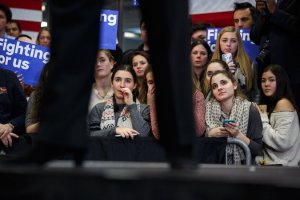
Women listening to Hillary Clinton at a campaign event in New Hampshire

Women listening to Hillary Clinton at a campaign event in New Hampshire

I was trying to figure out how to write about this when I read Frank Bruni’s column this morning in the New York Times.  I think he was hit the nail on the head.  He begins

I’m 51. My health is decent. And while my mother died young, there’s longevity elsewhere in the family tree.

I could live to see an openly gay presidential candidate with a real chance of victory.

Will there be a “special place in hell” for me if I, as a gay man, don’t support him or her?

I can guess Madeleine Albright’s answer. She more or less told women that they’re damned if they’re not on Hillary Clinton’s team.

I’m still trying to get my head around that — and around Gloria Steinem’s breathtakingly demeaning assertion that young women who back Bernie Sanders are in thrall to pheromones, not ideas or idealism, and angling to score dates with the young bucks in the Sanders brigade.

I could substitute Asian American for gay and ask the same question.

There’s a weird strain of thought swirling around Clinton’s campaign: that we should vote for her because she’s a woman. Or that she’s inoculated from certain flaws or accusations by dint of gender. Or that, at the least, there’s an onus on forward-looking people who care about gender inequality to promote her candidacy.

I care about gender inequality, and I don’t buy it. It’s bad logic. It’s even worse strategy. People don’t vote out of shame. They vote out of hope.

Perhaps that was among the lessons of Clinton’s defeat in New Hampshire on Tuesday, where she lost to Sanders among all women by at least seven percentage points, according to exit polling, and among women under 30 by more than 60 points.

Somehow we got from the positive nature of a woman running for President to what must seem like a bunch of old women scolding young ones for supporting – gasp -a man instead.

Clinton’s gender indeed matters. Just as you couldn’t properly evaluate Obama’s arc without factoring in race, you can’t see her accurately without recognizing that she’s a woman of her time, with all the attendant obstacles, hurts, compromises and tenacity.

That informs — and, ideally, illuminates — her perspective. And her presidency would carry a powerful, constructive symbolism that can’t and shouldn’t be ignored.

But those are considerations among many, many others in taking her measure and in casting a vote. To focus only or primarily on them is more reductive than respectful, and to tell women in particular what kind of politics they should practice is the antithesis of feminism, which advocates independence and choices.

We’re all complicated people voting for complicated people. We’re not census subgroups falling in line.

I’ll go to the barricades for that imagined gay candidate if he or she has talents I trust, positions I respect and a character I admire. If not, I’ll probably go elsewhere, because being gay won’t be the sum of that person, just as womanhood isn’t where Clinton begins and ends.

I will be voting for her in November should she be the Democratic nominee, but I will never quite admire either Madeline Albright or Gloria Steinham in quite the same way as I did before.

Photograph:   Richard Perry/The New York Times

Hillary and Bernie

I woke up this morning to pundits talking about the debate last night as if it had been a boxing match.  As a friend posted on Facebook that is not what he saw.  Me either.  What he and I saw were two smart, articulate people who both want to be President.  Yes, they each had good moments and not so good ones, but if you are a Democrat you can be proud that you have a choice between two people who can talk about issues without mudslinging and with no name calling.  As my husband pointed out, either of then could stand up to questioning during British Prime Minister Question Time without embarrassment.  Can the Republicans say the same?

Senator Bernie Sanders and Hillary Clinton met for a debate at the University of New Hampshire on Thursday night.

Senator Bernie Sanders and Hillary Clinton met for a debate at the University of New Hampshire on Thursday night.

Politico published a list of the “11 most important moments”.  I think it is good list and tells us more than the stories with headlines like “Clinton and Sanders get ugly.”  No, they didn’t.  Passionate, yes.  And don’t you want some passion from people seeking your vote?

Politico’s first moment

“A very artful smear”
In one of her most energetic salvos of the campaign, Clinton ripped Sanders for “attacks” and “insinuation” suggesting that anyone who takes campaign contributions has been “bought.”

“If you’ve got something to say, say it directly, but you will not find that I ever changed a view or a vote because of any donation I ever received, and I have stood up and I have represented my constituents to the best of my ability,” she said, calling on Sanders to “end a very artful smear that you and your campaign have been carrying out.”

An incredulous Sanders, shaking his head attempted to respond, but Clinton continued talking over him.

I’m waiting for someone to find an instance where Hillary changed.  If there is one, it will come from the press not from a negative Sanders super pac ad because he doesn’t have one.

One thing I like about Bernie is that he learns.  He doesn’t have to change his views very often (gun control was not discussed last night), but he is learning how to broaden his appeal.

Sanders makes pitch to African Americans on Flint
Sanders and Clinton largely agreed that urgent and overwhelming action must be taken to fix the crisis of contaminated water in Flint, Mich. But Sanders harnessed the issue to hone his pitch to African Americans, who have largely overlooked his candidacy and favored Clinton, despite his repeated overtures.

Sanders said he wondered whether, if Flint were “a white suburban community, what kind of response there would have been.”

“Flint, Michigan is a poor community, it is disproportionately African American and minority and what has happened there is absolutely unacceptable,” he said.

Bernie is moving past his Black Lives Matter moment and past his long history of working for civil rights and learning to articulate contemporaneous connections is a more natural matter.  The upcoming debate in Flint should be interesting as Bernie is much tougher on Michigan state officials and the EPA than Clinton.

The last Politico moment I am going to cite is the discussion of the death penalty.

Debating the death penalty
It was a genuine distinction. Clinton outlined her support for the death penalty, arguing that it should be allowed in extremely rare circumstances but only if a state meets “the highest standards of evidentiary proof.” She cited the Oklahoma City bombing as an example of a crime heinous enough to warrant the death penalty.

Sanders argued that the death penalty had often been applied to innocent people, and despite “barbaric acts out there” he doesn’t believe in the death penalty. “In a world of so much violence, I just don’t believe that government itself should be part of the killing,” He said. “So when somebody commits any of these terrible crimes that we’ve seen, you lock ’em up and you toss away the key.”

My takeaways:  Hillary needs to figure out how to respond to the questions about Goldman Sachs and other contributions from financial issues.  Bernie needs to work on foreign policy since he was not Secretary of State but his answer to the question from Chuck Todd as to which of these countries is the biggest threat:  Russia, North Korea, or Iran was surprising and his rational well thought out.  Sanders picked North Korea because an isolated dictator has a nuclear weapon.

I’m voting for Bernie when Vermont has its primary on March 1 because I think someone needs to talk about the future in a big way and because I admire that he is running his campaign as a model of how one can run without big money in the age of Citizens United.  Plus he’s from Vermont.  But Democrats can be proud of their candidates regardless of which they support.  The New York Times quoted Mia Farrow “Now if they could just split the gig — Bernie would cover domestic, Hillary on foreign policy.”   I think a lot of people could agree with her.

Photograph:  Todd Heisler/The New York Times


Thoughts and questions about reparations

You have to admire Ta-Nehisi Coates for his persistence is getting the discussion started.  In 2014, Coates wrote a long piece in the Atlantic Magazine titled “The Case for Reparations”.  He generated a lot of buzz back then and we are still talking about it almost two years later.  If you haven’t read it, you probably should if you have any interest in race in America.

My parents were incarcerated into “relocation” camps during World War II because of their race.

In 1988, President Reagan signed the Civil Liberties Act to compensate more than 100,000 people of Japanese descent who were incarcerated in internment camps during World War II. The legislation offered a formal apology and paid out $20,000 in compensation to each surviving victim. The law won congressional approval only after a decade-long campaign by the Japanese-American community.

Reparations were easily determined in this instance.  There was a list of everyone who was in a camp regardless of age.  Those who had died in the meanwhile got nothing and their estates and heirs got nothing.  My parents, uncles, and aunts got checks.  But the money was not enough to cover what had been lost, but was more of a token giving the apology some weight.

Coates has recently taken Vermont Senator and Presidential candidate Bernie Sanders to task for not supporting reparations.

What candidates name themselves is generally believed to be important. Many Sanders supporters, for instance, correctly point out that Clinton handprints are all over America’s sprawling carceral state. I agree with them and have said so at length. Voters, and black voters particularly, should never forget that Bill Clinton passed arguably the most immoral “anti-crime” bill in American history, and that Hillary Clinton aided its passage through her  invocation of the super-predator myth. A defense of Clinton rooted in the claim that “Jeb Bush held the same position” would not be exculpatory. (“Law and order conservative embraces law and order” would surprise no one.) That is because the anger over the Clintons’ actions isn’t simply based on their having been wrong, but on their craven embrace of law and order Republicanism in the Democratic Party’s name.

One does not find anything as damaging as the carceral state in the Sanders platform, but the dissonance between name and action is the same. Sanders’s basic approach is to ameliorate the effects of racism through broad, mostly class-based policies—doubling the minimum wage, offering single-payer health-care, delivering free higher education. This is the same “A rising tide lifts all boats” thinking that has dominated Democratic anti-racist policy for a generation. Sanders proposes to intensify this approach. But Sanders’s actual approach is really no different than President Obama’s. I have repeatedly stated my problem with the “rising tide” philosophy when embraced by Obama and liberals in general. (See hereherehere, and here.) Again, briefly, treating a racist injury solely with class-based remedies is like treating a gun-shot wound solely with bandages. The bandages help, but they will not suffice.

To a certain extent Coates is correct.  Whether one uses the rising tide image or sticks with trickle down, programs begun in the 1960s like affirmative action and various anti-discrimination laws in employment and housing have helped but have not come close to solving the problem that black Americans are more likely to be poor than white Americans.  No one can deny that slaves, former slaves, and their present day descendents have not suffered every form of economic discriminations one can think of because they have.  The question is are reparations a good solution.

Bernie

Conor Friedersdorf provided some speculative reasons why Bernie Sanders is right in not embracing reparations in his recent piece in the Atlantic.

Perhaps Sanders just thinks reparations are bad policy on the merits. There are many plausible reasons that a principled radical might come to that conclusion (though it isn’t entirely clear to me that Sanders is that radical even on matters of class).

Perhaps he is convinced that the highest incarnation of justice is a government that redistributes resources toward its citizens based wholly on their need, and doesn’t want to shift the Overton Window toward any model that is predicated on dessert beyond need, or that would redistribute wealth from poor to rich in some instances.

That seems consistent with principled socialism.

Perhaps when Sanders says that reparations would be divisive, he doesn’t mean that they would damage his campaign or the Democratic coalition by dividing its supporters––the plausible interpretation that Ta-Nehisi argued against in his critiques––but that it would divide Americans of different races against one another in a manner likely to cause more harm to vulnerable minority groups than good, or necessitate a divisive process of bureaucrats defining who qualifies as black.

The Overton Window referred to above is a media pundit term meaning the range of discourse the public is willing to accept.

When I commented on a friends Facebook page during a discussion of reparations that I thought it would be difficult if not impossible to figure out who was owed, another friend commented that maybe that was what Coates was trying to do – get us to talk about the issue.  If that was his aim, to move or enlarge the Overton Window, then he has succeeded.

I have a question for Sanders.  Why not take up Coates’ call to support a study?

…For the past 25 years, Congressman John Conyers Jr., who represents the Detroit area, has marked every session of Congress by introducing a bill calling for a congressional study of slavery and its lingering effects as well as recommendations for “appropriate remedies.”

A country curious about how reparations might actually work has an easy solution in Conyers’s bill, now called HR 40, the Commission to Study Reparation Proposals for African Americans Act. We would support this bill, submit the question to study, and then assess the possible solutions. But we are not interested.

Perhaps rather than demand reparations now we, Coates included, should push Congress – and all of the Democratic Presidential candidates to support HR 40.   Let’s keep talking about this.

Photograph:  huffingtonpost.com


Guns and public health

There are too many guns in the United States.

Last October Christopher Ingraham wrote in the Washington Post’s Wonkblog

It’s tough to know exactly how many guns we have in the United States. Most estimates of the number of guns in the U.S. use federal tallies of the firearms manufactured, imported and exported by U.S. gunmakers. A 2012 Congressional Research Service report published exactly one month before the Sandy Hook school shooting put the number of civilian firearms at 242 million in 1996, 259 million in 2000, and 310 million as of 2009.

If that 310 million number is correct, it means that the first year of Barack Obama’s presidency was an inflection point: It marked the first time that the number of firearms in circulation surpassed the total U.S. population.

It is clear that the Obama years have been a boon to gun manufacturers regardless of whether the number of guns is 245 million, 270 million, or 300 million.

guns

Do they keep us safe?  Some gun owners point to falling homicide rates, but there are studies showing that places with few guns have lower rates.  Ingraham writes

It’s important to note that even as the number of guns has increased since the early-to-mid-90s, the per-capita gun homicide rate has fallen by nearly half over the same time period. On the other hand, it’s also true that when you make comparisons between states and countries, you see that places with more guns have more gun homicides, as research from the Harvard School of Public Health shows.

These two seemingly unreconcilable facts form the factual basis for much of the contemporary gun policy debate. Defenders of gun rights can point to falling homicide rates and rising gun numbers and argue that the solution to gun violence is more guns. Gun control advocates, meanwhile, can point out the correlations between gun ownership and gun crime and push for tighter restrictions on gun ownership.

Ingraham concludes

Is there a way to reconcile these divisions? It’s hard to tell. I keep coming back to this quote, from the Economist earlier this year in response to the Charleston massacre.

Those who live in America, or visit it, might do best to regard [mass shootings] the way one regards air pollution in China: an endemic local health hazard which, for deep-rooted cultural, social, economic and political reasons, the country is incapable of addressing.

Which brings me to Margaret Talbot’s comment in the January 18 issues of The New Yorker.  Talbot writes about President Obama’s Executive Order on background checks.

Last week at the White House, as President Obama announced a set of executive actions aimed at blunting gun violence, he seemed anything but numb. He wept as he invoked the first graders killed at Sandy Hook Elementary School, in Newtown, Connecticut—a response for which some gun advocates mocked him. He quoted Martin Luther King, Jr.,’s words about the “fierce urgency of now.” But he also acknowledged the numbness that can overcome people in the face of one mass shooting after another. That numbness puts proponents of unfettered gun rights at an advantage. People can easily start thinking of gun violence as something native to America’s angry, intractable soul—the armed, anti-federalist takeover of wildlife-refuge buildings in Oregon this month seemed like proof. And when, time and again, Congress thwarts gun reforms that are supported by majorities of Americans it can be hard to imagine that the status quo will ever change.

If numbness benefits gun-rights absolutists, uninformed numbness might serve them even better. In 1993, The New England Journal of Medicine published a study showing that “keeping a gun in the home was strongly and independently associated with an increased risk of homicide” in that home. The researchers had been funded by the C.D.C.’s National Center for Injury Prevention, and the N.R.A. responded by trying to get the prevention center defunded. It didn’t succeed, but, in 1996, Congress amended an appropriations bill to the effect that “none of the funds made available for injury prevention and control at the Centers for Disease Control and Prevention may be used to advocate or promote gun control.” It was a little like saying that no research on the health effects of smoking should be interpretable as anti-smoking. Congress also removed $2.6 million from the C.D.C.’s budget—the precise amount that had gone to the prevention center’s research—and then restored it, earmarked for an entirely different purpose. As a result, one of the study’s authors said in a public-radio interview last spring, “many, many people stopped doing gun research.”

With gun research, maybe we could have safer weapons as we have safer cars.  Maybe we would better understand the dangers of gun ownership.  Maybe we wouldn’t have to read about the six year old who finds Daddy’s gun and kills his two year old sister.

Jay Dickey, the Republican representative and N.R.A. member from Arkansas who sponsored the amendment, came to regret it. Dismayed by the continuing toll of gun violence, he was eventually persuaded that firearm deaths could be reduced without violating the Second Amendment. He now believes that research on gun violence can help prevent it, much as similar work on highway safety resulted in innovations like seat belts, air bags, highway dividers, and minimum drinking ages, and prevented hundreds of thousands of traffic deaths. In December, in a letter to Mike Thompson, the chairman of the House Democrats’ Gun Violence Prevention Task Force, Dickey wrote, “Research could have been continued on gun violence without infringing on the rights of gun owners, in the same fashion that the highway industry continued its research without eliminating the automobile.” He added, “We should slowly but methodically fund such research until a solution is reached. Doing nothing is no longer an acceptable solution.”

Talbot cites a recent study (not government funded) comparing the repeal of a permit and background check law in Missouri and the initiation of more stringent laws in Connecticut:  Gun homicides dropped around 40% in Connecticut and rose by a similar percentage in Missouri.

Those opposed to background checks, bans on weapons with large capacity magazine, or even trigger locks often say that the issue is one of mental health not guns.  I think our national obsession with guns IS the mental health issue.  They are a public health issue.  Talbot concludes

In part, Obama is trying to reframe the gun discussion not as a Second Amendment issue but as one of public health. This approach acknowledges that, while we can’t eliminate gun crime, we can reduce it, and that doing something is better than fatalistically doing nothing.

Photograph:  M&R Glasgow/Flickr


G. K Chesterton, Jane Austen and Mr. Wickham

In his collection of essays, “Come to Think of It” published in 1930 we find this little gem On Jane Austen in the General Election.  I’m not interested in what Chesterton writes about how political commentators are using – or misusing – Austen to argue about the New Woman as much as I am in his observations about George Wickham.  When my husband handed be a print-out of the short essay, I was just finished with my annual re-reading of Pride and Prejudice.  This includes re-reading the novel, watching the Colin Frith/Masterpiece Theater adaptation, and more recently, re-reading the P.D. James sequel, Death Comes to Pemberley, so everything was fresh in my mind.

For anyone who has not read Pride and Prejudice or seen one of the many adaptations, there is a kind of love triangle between the heroine, Elizabeth Bennett; the handsome, wealthy, brooding Fitzwilliam Darcy; and the charming, handsome, impoverished George Wickham.  Darcy is private and quiet; Wickham, open and talkative.  When we, and Elizabeth, first meet the men, Wickham is the more attractive.  Made more so, perhaps, by the fact that Mr. Darcy, proud and aloof, publicly refuses to acknowledge Mr. Wickham.

Wickham

It is Wickham’s explanation that Chesterton writes about.

….A writer in a leading daily paper, in the course of a highly optimistic account of the new attitude of woman to men, as it would appear in the General Election, made the remark that a modern girl would see through the insincerity of Mr. Wickham, in Pride and Prejudice, in five minutes.

Now this is a highly interesting instance of the sort of injustice done to Jane Austen.  The crowd, (I fear the considerable crowd) of those who read that newspaper and do not read that author will certainly go away with the idea that Mr Wickham was some sort of florid and vulgar imposter like Mr. Mantalini. [Mantalini, a character in Dicken’s Nicholas Nickerby, is a handsome man who lives off his wife and eventually ruins her.  Also described as a gigolo.]  But Jane Austen was a much more shrewd and solid psychologist than that.  She did not make Elizabeth Bennett to be a person easily deceived, and she did not make her deceiver a vulgar imposter.  Mr. Wickham was one of those very formidable people who tell lies by telling the truth.

Wickham tells Elizabeth the part of the story that puts Darcy in the wrong.  She has no reason not to believe him and neither do we until we learn the rest of the story from Mr. Darcy himself.  As the story unfolds we learn that while Wickham may not be vulgar, he has a lot in common with the gigolo, Mantalini.  But I digress.

Chesterton, thinking of the General Election, views Wickham as the perfect politician.

….For Mr. Wickham was, or is, exactly the sort of man who does make a success of political elections….And he owes his success to two qualities, both exhibited in the novel in which he figures.  First, the talent for telling a lie by telling half of the truth.  And second, the art of telling a lie not loudly and offensively, but with an appearance of gentlemanly and graceful regret.

George Wickham as the perfect member of Parliament and perfect politician.  I love it!  Maybe the problem with politics today is there are not enough George Wickhams.

Photograph is a still of Adrian Lukis as George Wickham in the 1995 BBC/Masterpiece Theater version of Pride and Prejudice.


Scandal in the Vermont legislature, Part 2

Senator Norman McAllister has been suspended from the Vermont Senate.  The vote, which was not on party lines, was 20 to 10. My Senators split, one for and one against.

Vermont Public Radio reported

For the first time in its history, the Vermont Senate has suspended one of its own members.

Senate Majority Leader Philip Baruth introduced the resolution.

“The situation we face today is an ugly one. No other word for it,” Baruth said. “It’s hard to imagine a more uncomfortable discussion and yet today’s debate is crucial to our future as a Senate,” adding that the “number and nature of felony charges against [McAllister] require us to suspend him.”

Baruth said that suspension was a step short of outright expulsion, and that it preserves the presumption of innocence McAllister should be afforded.

But Baruth said the Senate can’t allow McAllister to retain legislative powers he’s alleged to have abused so grossly. McAllister’s alleged victims include a 21-year-old Statehouse intern he paid to assist him in Montpelier.

At any place of business in Vermont, Baruth said, “no one would dream of allowing a manager who has been criminally accused of assaulting his assistant to remain in place.”

Those opposed to suspension argued that there were no rules in the Senate to cover the situation and that the Senate should let the criminal justice system work.

Rutland Sen. Peg Flory, however, said the Senate was overstepping its authority by preventing an elected official from carrying out his official duties. So long as McAllister is suspended, Flory said, Franklin County voters will lack representation in the Senate.

“We make the law. We don’t interpret it; we don’t enforce it,” Flory said.

Flory opposed the resolution because she said it violated the legal principle that a person is innocent until proven guilty.

“To step on that and say because somebody has been charged we are going to remove them just goes against every grain in my body,” Flory said.

Flory, a Republican, wasn’t alone in her opposition to the resolution. Windsor County Democrat Richard McCormack said the Senate ought not involve itself in matters of criminal law.

In the end, the arguments for suspension won out.

Back in December, after the rules committee had voted to recommend suspension, one of McAllister’s constituents, Sue Prent, wrote:

Mr. McAllister says he thinks his constituents will sue the Senate on his behalf, for being deprived of representation.

Is he kidding us? Any and all of his constituents with whom I am familiar (of every political stripe) wanted him gone as soon as the content of his confessional conversations with the victims became known.

A more likely scenario is that some of those same constituents, fed up with Mr. McAllister’s refusal to accept responsibility for his appetites and voluntarily step down from the Senate, will be motivated to sue Mr. McAllister for depriving them of legitimate representation in the face of conclusive evidence that he, at the very least, has grossly violated community standards.

After putting his colleagues and voters though the ordeal of deciding to suspend him (even the other Senator from Franklin County voted yes), McAllister has said he is thinking of resigning so a replacement can be appointed.

Unfortunately, the sad story of Vermont State Senator Norman McAllister is far from over.


Scandal in the Vermont legislature

The Vermont legislature opened yesterday.  There are many pressing issues:  school reform, how to pay for expanded Medicaid, the drug epidemic, and legalizing marijuana.  But overriding everything is what to do about Senator Norman McAllister.

McAllister is accused of raping an intern last session and of a long duration “rent for sex” scheme.  It is alleged that he let women maintain housing and jobs on his farm in Franklin County in exchange for sex.  All of this came to light as the session was ending last year.  The Burlington Free Press reported the story last May.

Prosecutors allege Sen. Norman H. McAllister, R-Franklin, over a period of several years sexually assaulted two women who were his tenants and employees, and that he attempted to solicit a third woman. That woman called police this week, launching a fast-moving investigation that by Friday was reverberating throughout the state capital of Montpelier.

The allegations, explained in sometimes graphic detail in court papers, shocked the governor and McAllister’s Statehouse colleagues, several of whom witnessed his arrest outside the Capitol on Thursday evening.

At that point, I think everyone was prepared for him to resign.  The Governor, a Democrat, would appoint his replacement.  I should say here that relations between the Democrats, Republicans, and Progressives here are not as divided and acrimonious as they are nationally probably because we are a small state and civility is important if any governing is to happen.  The Governor might even have appointed a Republican.

Sen. Norman McAllister, R-Franklin, returns to his seat in the Senate on the opening day of the Legislature.

Sen. Norman McAllister, R-Franklin, returns to his seat in the Senate on the opening day of the Legislature.

But Senator McAllister has not resigned.  The Legislative rules have nothing to cover this kind of situation.  Over the summer, there was some talk of expulsion, but the rules committee recommended suspension instead.  McAllister, denying the allegations, is fighting the suspension.  He says he is innocent and the criminal trial will prove it.  The trial is scheduled to begin in February.  That means he is going to miss part of the session in any case.

This is where I am of two minds.  He has been duly elected and I’ve read and heard nothing about any move from his constituents to recall him.  A suspension would leave them short one Senator to represent Franklin County.  (There are only 30 senators, statewide.)  On the other hand, if any other public employee were accused of these crimes, they would have been suspended back last May.  No police officer, firefighter, social worker, or RMV worker would be on the job today.  I think a lot of his fellow legislators are facing the same quandary.  The eight of the nine Senate Republicans caucused yesterday.  McAllister defended himself and they came to no conclusion except to urge him to resign.

Is an elected legislator a public employee?  In some sense, yes.  They are paid with taxpayer money.  On the other hand, they are “hired” by election.  Neither of my state senators have commented on the situation nor has my representative.  If I had to vote this afternoon, I’m not sure what I would do so I haven’t talked to any of them.  All three are women and I wonder if they, like me, have difficulty separating the alleged crime from what action to take.  Would it be easier if McAllister had embezzled money or falsified his tax returns?

Part 2 of this story, after the vote.

Photograph:  Roger Crowley/VTDigger


American Terrorists

Try this exercise.  Yesterday morning I thought about terror attacks here in the United States and as the day went on I wrote them down.  I ended up with two lists:  One of Muslim perpetrators, one of white males.  Guess which is longer.  The lists are in no particular order and are by place not shooter.

Muslim Killer:

-Boston Marathon Bombing (one US Citizen, one green card)

-Fort Hood Shooting (US Citizen)

-Chattanooga Recruiter Shooting (US Citizen)

– San Bernardino (one US Citizen, one legal resident)

– World Trade Center


White Male Killer:

– Charleston AME Church

– Oregon Community College

– Aurora, CO movie theater

– Atlanta Olympics (plus his other bombings)

– Colorado Planned Parenthood

– Unibomber

-Murrah Federal Building

-Lafayette, LA movie theater

– Gabby Giffords and others

– Sandy Hook Elementary School

-Columbine

-California McDonald’s

-Texas Tower

– Boston, MA Planned Parenthood


These lists are not the result of any research except to see which Muslim perpetrators were citizens and to confirm the race of the shooters when I wasn’t sure.  I know I haven’t remembered all the incidents as there have been too many.  Some who read this may not remember some of them like the Texas Tower sniper as they are not recent, but I remember them.  I have not included the SDS/WeatherUnderground incidents as I believe the only people killed were the bombers themselves.

Do your own list.  Let me know what I have forgotten.

And most of all, remember this list when Donald Trump and others start talking about excluding Muslims.  Many of the Muslims involved were citizens.  Do you think the way we talk about their religion had anything to do with their becoming violent?Remember who actually dominates these lists.  I am not saying there is no danger from Islamic extremists, but I am saying that our own disaffected white men are also a danger.  Our culture perpetuates violence.  We need make the guns and ammunition less available not scapegoat a particular group and stir up hatred.

Mourners near the Charleston AME Church.

Mourners near the Charleston AME Church.

Photograph:  Travis Dove for The New York Times