The Senate Chaplain Speaks

Maybe you didn’t realize that the Senate and the House each have a chaplain.  If you are a C-SPAN junky you might have seen them open each daily session.  The Senate website has a brief description of the office and history.

Throughout the years, the United States Senate has honored the historic separation of Church and State, but not the separation of God and State. The first Senate, meeting in New York City on April 25, 1789, elected the Right Reverend Samuel Provost, the Episcopal Bishop of New York, as its first Chaplain. During the past two hundred and seven years, all sessions of the Senate have been opened with prayer, strongly affirming the Senate’s faith in God as Sovereign Lord of our Nation. The role of the Chaplain as spiritual advisor and counselor has expanded over the years from a part-time position to a full-time job as one of the Officers of the Senate.  The Office of the Chaplain is nonpartisan, nonpolitical, and nonsectarian.

But the current Senate Chaplain, Barry C. Black, has begun to make news with what the New York Times called “our daily Senate scolding.”

The disapproval comes from angry constituents, baffled party elders and colleagues on the other side of the Capitol. But nowhere have senators found criticism more personal or immediate than right inside their own chamber every morning when the chaplain delivers the opening prayer.

“Save us from the madness,” the chaplain, a Seventh-day Adventist, former Navy rear admiral and collector of brightly colored bow ties named Barry C. Black, said one day late last week as he warmed up into what became an epic ministerial scolding.

“We acknowledge our transgressions, our shortcomings, our smugness, our selfishness and our pride,” he went on, his baritone voice filling the room. “Deliver us from the hypocrisy of attempting to sound reasonable while being unreasonable.”

In case you were wondering, Chaplain Black was selected in 2003 by then Majority Leader, Republican Bill Frist.  He says of his politics

“I use a biblical perspective to decide my beliefs about various issues,” Mr. Black said in an interview in his office suite on the third floor of the Capitol. “Let’s just say I’m liberal on some and conservative on others. But it’s obvious the Bible condemns some things in a very forceful and overt way, and I would go along with that condemnation.”

But back to some of his recent prayers.

During his prayer on Friday, the day after officers from the United States Capitol Police shot and killed a woman who had used her car as a battering ram, Mr. Black noted that the officers were not being paid because of the government shutdown.

Then he turned his attention back to the senators. “Remove from them that stubborn pride which imagines itself to be above and beyond criticism,” he said. “Forgive them the blunders they have committed.”

Senator Harry Reid, the pugnacious majority leader who has called his Republican adversaries anarchists, rumps and hostage takers, took note. As Mr. Black spoke, Mr. Reid, whose head was bowed low in prayer, broke his concentration and looked straight up at the chaplain.

“Following the suggestion in the prayer of Admiral Black,” the majority leader said after the invocation, seeming genuinely contrite, “I think we’ve all here in the Senate kind of lost the aura of Robert Byrd,” one of the historical giants of the Senate, who prized gentility and compromise.

Senate Chaplain Barry Black

Senate Chaplain Barry Black

Chaplain Black is a federal employee who is not being paid during the shutdown.  He is also one of the few adults in the Senate chamber.

Mr. Black, who is the first black Senate chaplain as well as its first Seventh-day Adventist, grew up in public housing in Baltimore, an experience he draws on in his sermons and writings, including a 2006 autobiography, “From the Hood to the Hill.”

In his role as chaplain, a position that has existed since 1789, he acts as a sounding board, spiritual adviser and ethical counselor to members of the Senate. When he prays each day, he said, he recites the names of all 100 senators and their spouses, reading them from a laminated index card.

It is not uncommon for him to have 125 people at his Bible study gatherings or 20 to 30 senators at his weekly prayer breakfast. He officiates weddings for Senate staff members. He performs hospital visitations. And he has been at the side of senators when they have died, most recently Daniel K. Inouye of Hawaii in December.

The Senate is lucky to have him and maybe they need to pay more attention to what he is saying.

“I remember once talking about self-inflicted wounds — that captured the imagination of some of our lawmakers,” he said. “Remember, my prayer is the first thing they hear every day. I have the opportunity, really, to frame the day in a special way.”

His words lately may be pointed, but his tone is always steady and calm.

“May they remember that all that is necessary for unintended catastrophic consequences is for good people to do nothing,” he said the day of the shutdown deadline.

“Unless you empower our lawmakers,” he prayed another day, “they can comprehend their duty but not perform it.”

Senators, hear Chaplain Black.  Be adults.

Photograph:  Drew Angerer for The New York Times

The government shutdown: a letter from Congressman Capuano

I am posting the entire weekly email newsletter I just got from my Congressman, Mike Capuano.    I am proud to say that he was my boss for several years when he was the Mayor of Somerville.

Dear Friends,

The government shutdown is in its fourth day. Speaker Boehner still refuses to bring up a clean Continuing Resolution (CR), even though it would pass Congress and be signed by the President, reopening the government.

The House has spent most of this week considering bills to partially fund the government. This process is more about appearances than responsible legislating. That’s why you’ve seen attempts to fund the National Park Service so tourist attractions can reopen but not the Transportation Department. The Senate and President have both rejected this path. I’m not sure where or when this all ends. It’s certainly true that this battle is about the Affordable Care Act (ACA) and the obsession many Republicans have with sabotaging it. I think there’s more to it though.

This is also about one of the fundamental principles of our government, the idea of majority rule. The importance of that principle is vividly on display here and it’s one worth protecting.

The ACA was signed into law in 2010 after months and months of substantive and at times contentious debate. Since Republicans regained control of the House in 2010, there have been 42 attempts to repeal, defund or gut the law. Each time the effort has accomplished essentially nothing. As I noted earlier this week, Mitt Romney ran on a promise to repeal “Obamacare”. He lost the election. House Democrats got more votes than House Republicans and Democrats retained control of the Senate. The ACA was even declared constitutional by the Supreme Court.

Despite all of that, a small percentage of the House Republican Caucus refuses to accept the will of the majority, democratically expressed. They shut the government down because they can’t accept it. The ACA is the law of the land, affirmed by the results of a national election and a Supreme Court ruling. More and more moderate Republicans are speaking out on the need for a clean CR. Unfortunately there aren’t enough of those moderate voices and the extremists in the House continue to drown them out.

Imagine what our government would look like if more Members refused to respect the principle of majority rule and insisted on getting their way without regard for the consequences. It wouldn’t be 17 years between government shutdowns, that’s for sure.

I believe that this battle is also about the role that government should play in our lives. Do we want to provide some help to those less fortunate in the form of nutrition assistance or home heating aid? Do we want to help our states build world class roads, bridges and subway systems? Do we want to attract cutting edge research that results in medical advances? All of that takes an investment of federal dollars.

What has been happening over the past couple years is a steady and steep reduction in federal spending. That often gets lost in the din but numbers don’t lie. In two years, a total deficit reduction of almost $2.4 trillion has been achieved. In 2011, the Budget Control Act placed a cap on discretionary spending at $1.066 trillion for fiscal year 2014. That cap has been ignored by the House, with much deeper cuts going into effect as a result of sequestration.

Here are just a couple examples of how those cuts have impacted some important programs. In the past year, funding for the National Institutes of Health has been cut by $1.6 billion. Funding for Head Start has been cut by $400 million.

Earlier this year, the Senate passed a budget that proposed spending $1.058 trillion for fiscal year 2014. Under the clean CR proposed in the Senate in order to reopen the government, that spending is cut to $986 billion. This is much closer to the Republican proposal than the Senate’s.

In terms of cutting spending, Republicans don’t seem to recognize that they are gaining significant ground. The CR that many of them say they won’t support includes deep cuts to discretionary programming.

More votes are expected in the House tomorrow and the schedule for next week is unclear. Thanks for your calls and emails of support. I appreciate all of them.

Best,

Mike

English: Official Congressional portrait for C...

English: Official Congressional portrait for Congressman Mike Capuano. (Photo credit: Wikipedia)

Cartoonists view the government shutdown

We need to keep a sense of humor about things so we can survive this Republican tantrum.  Here is my contribution.

Dan Wasserman from the Boston Glove.

101toon_wasserman


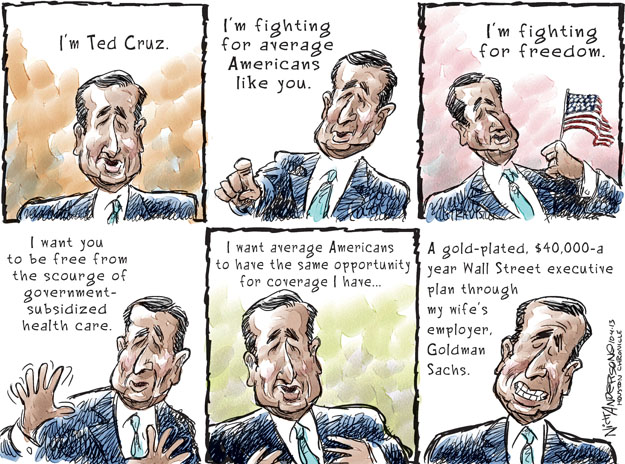
Nick Anderson on Ted Cruz.

Anderson on Cruz


Carlson on Infant nutrition.

Carlson


The new axis of evil?

luckovich

Trying to made sense of it all

I think I may be ready to retreat to my cocoon to read trashy books and watch baseball and reruns of NCIS before my head explodes from trying to make sense of what is going on out there.

Yesterday, Boston Globe columnist Adrian Walker had a little anecdote from my Congressperson, Mike Capuano.

…Capuano said he was in an airport last weekend flying home from Washington when a TSA screener stopped him and said, “You really need to cut our taxes!” Capuano was incredulous to hear that from a federal employee, though he probably shouldn’t have been.

“I asked him, ‘Do you know taxes pay your salary?’ ” Capuano said with a laugh.

I wish I knew what the silly TSA screener said then.  It is an example of how divorced from reality so many people are.  Maybe we should expand the shut down to include furloughs for half of the screeners.  This would cut flights so many of the members of Congress would have trouble getting home.  I don’t think this would be a bad thing.  Maybe if they stayed in Washington more, they would figure out how to talk to each other informally over a beer.  That could only help.  Maybe some of them would get a grip on reality.

As I was getting ready to write this, I Googled  both “Republican Alternate Reality” and “Republican Alternate Universe”.  Turns out people have been writing about the topic for a number of years now.  It is one thing to talk sans facts, but another to act.  And what is happening now is the action that they have all wanted:  a government shutdown.  I think they are hoping that a few weeks without government will show people they can live without it.  Maybe a good plan except that there are already Republicans complaining that monuments in Washington are closed so veterans can’t visit them.  Duh!

Back in August 2012 (2012 not 2013), Michael Cohen wrote a piece in the Guardian about the Presidential campaign.  If you recall, they had a slogan “You didn’t build that”.

On 17 July, President Barack Obama spoke at a campaign rally in Roanoke, Virginia. It was a typical event for an incumbent president who is seeking a second term. In his remarks, he offered his vision of government’s role in spurring entrepreneurship and creating jobs in the United States:

“If you were successful, somebody along the line gave you some help. There was a great teacher somewhere in your life. Somebody helped to create this unbelievable American system that we have that allowed you to thrive. Somebody invested in roads and bridges. If you’ve got a business – you didn’t build that. Somebody else made that happen. The internet didn’t get invented on its own. Government research created the internet so that all the companies could make money off the internet.”

This is all fairly boilerplate rhetoric – a basic recitation of how Democrats view the role of government and its interplay with the private sector. But in this statement, there was one phrase that Republicans have grabbed on to like a famished dog with a new bone:

“You didn’t build that.”

That single phrase, taken out of context by Republicans, has become the GOP’s symbol of Obama’s supposed contempt for the free market and entrepreneurship, and for his socialist assault on America.

The Affordable Care Act is a prime example of government overreach and socialism even though it is built on private insurance companies.

“You didn’t build that” became “We built that”

And so, the Republicans made “We built that” the theme of Tuesday’s convention proceedings. Speaker after speaker hammered on this theme, accusing Obama of disrespecting small business. But they did so with almost a wilful sense of hypocrisy. For example, Delaware lieutenant governor candidate Sher Valenzuela attacked Obama for the line despite the fact that, just a few months ago, she gave a detailed speech to a business group about how they could do a better job getting government contracts.

Cohen goes on to detail a number of instances where the speakers at the Republican Convention ignored facts and concludes

But all of this is at pace with a conservative worldview that considers government to be nothing more than malevolent interference with the smooth operation of the private sector – except when it’s not. “Jobs don’t come from government,” said Texas Senate candidate Ted Cruz last night, a view that basically sums up GOP economic thinking. But if you listened to Republican governors on Tuesday, you might have found yourself surprised to discover that, in their states, the government has played an oddly integral role in spurring job creation. If you listened to Mary Fallin, governor of Oklahoma, extol the virtues of the energy industry in her state and bemoan “more government, bigger spending and more regulation”, you might never know that the oil and gas industry is deeply reliant on – and spends millions lobbying for – tax breaks from the federal government.

One can believe that government should play a less direct role in the workings of the private economy – clearly, this is a defensible notion. But to listen to Republicans harping on Obama’s “you didn’t build that” line is to hear a party that views “government” in the most simplistic imaginable terms. This isn’t a governing philosophy; it’s a caricature of how the economy actually works.

To be sure, it’s hardly unusual for political rhetoric to take liberties with the truth, or to stretch an argument to breaking-point, but with Republicans today, the issues runs much deeper. Very simply, the way they talk about what the federal government does or should do, and about the role of spending, taxation and regulation, is more than just a compendium of lies: it describes an alternate reality.

In the GOP’s defense: at least they can argue they built that.

So now they have shutdown the federal government which was a goal all along.  They built it.  And in their alternate universe, President Obama and the Democratic congressional leadership should negotiate with them.  Nancy Pelosi has tried to explain what she calls “regular order”:  The Senate passes a bill.  Then the House passes one.  Then there is a conference committee.  Budget bills were passed back in March, but the House declined to appoint members to a conference committee.  Contrary to what some members of Congress seem to believe there are rules and conventions as to how to proceed.

Gail Collins has a response in the New York Times.

On Wednesday, House Republicans pushed to refund bits and pieces of the government that the members particularly like, such as veterans and the National Guard. Also anything that lends itself to a dramatic press conference, such as national parks and cancer treatment for children. Since the House proposals are never going anywhere in the Senate, there’s a limit to what you want to know about what went on during the debate. Let’s summarize:

Democrats: “Meaningless political theater!”

Republicans: “Come to the table!”

Coming to the table has now replaced strangling Obamacare as the most popular G.O.P. war cry. There is a longstanding political rule that when all else fails, you demand more talking. If you’re running for office against a guy who’s got 70 percent in the polls, it’s time to call for a debate. If you’re already having four debates, it’s time to call for six.

“Why don’t we sit down and have a conference committee about how we’re going to fund the federal government?” demanded Representative Ander Crenshaw of Florida. Republicans have posed this question a lot, and it would be an excellent one if they were not the same folks who have spent the last half-year refusing to sit down and have a conference committee about the federal budget.

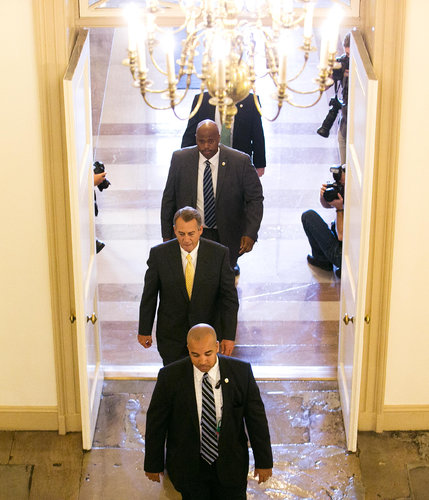
Representative John A. Boehner, the House speaker, arrived at the Capitol on Thursday with his security personnel on the third day of the government shutdown.

Representative John A. Boehner, the House speaker, arrived at the Capitol on Thursday with his security personnel on the third day of the government shutdown.

I’ll give the final word on reality to Elizabeth Kolbert in her New Yorker posted this morning.

…Shuttering the government is a dumb idea under pretty much any circumstances. Still, the objections that Republicans in Congress raise to the health-care law might be worth considering if they bore any relationship to the law in question. Rarely do they.

Some lawmakers’ comments have been so off the wall that they defy parody. A few months ago, for example, Representative Michele Bachmann announced on the House floor that Obamacare needed to be repealed “before it literally kills women, kills children, kills senior citizens.”

“Let’s not do that,” she added helpfully. “Let’s love people.”

“All of this would be funny,” President Obama noted the other day, after bringing up the Bachmann line, “if it weren’t so crazy.”

The crazy list goes on and on. As the economist Paul Krugman has repeatedly pointed out in his Times column, congressional Republicans these days seem to think that they can override not just the laws of physics but also the rules of arithmetic. They insist that the federal budget is so bloated it could easily be cut by hundreds of billions of dollars. But when a transportation bill was drafted this summer that would have actually reduced spending, they refused to vote for it. (The bill had to be pulled from the floor.) It’s hard to cut the federal budget if you’re not willing to reduce the amount of money the government spends. “What Republicans really want to do,” Krugman wrote recently, is “repeal reality.”

It’s been so long since reality has made much of a difference on Capitol Hill that it sometimes seems it genuinely has been repealed. But the thing you can always count on with reality is that it has staying power.

I hope I can hold out until reality and fact make a comeback.

Photograph: Doug Mills/The New York Times

President Obama and leadership

Like many of his supporters I am frustrated at times by what appears to be indecision on the President’s part.  You have to admit that he can take a long time to make a decision while speculation dominates the media and the blogs as to what he will do.  Look at the still to be announced appointment to be Chair of the Federal Reserve.  But when I get frustrated I tell myself that he is playing a long game.  Farah Stockman had an interesting op-ed in the Boston Globe today explaining better than I could the Obama style of leadership.

I am going to quote most of it because I can’t figure out where to cut it (and because one can’t read it from the link without a Globe subscription) and it isn’t that long..

Before we start hand-wringing over the gridlock in our domestic affairs, let’s savor the good news on the international front: Last week, after years of paralysis, the UN Security Council mandated the destruction of chemical weapons in Syria and endorsed a political transition plan that might finally sweep Syrian President Bashar Assad aside.

And after years of Iran’s refusal to talk seriously about its nuclear program, Iran’s new president, Hassan Rouhani, announced that he wants to resolve the issue in 12 months. He and President Obama even spoke on the phone, the first such contact since the 1970s.

Of course, we’re still a long way from solving those two problems. But we’re on a far better path than we were three weeks ago. Back then, we were on the verge of launching a unilateral military strike that would have inflamed the situation in Syria and hurt our chances of getting a nuclear deal with Iran. So how did that no-win situation in Syria turn into something positive? And what does this bizarre chapter in US diplomacy tell us about the nature of leadership itself?

Recall that Obama announced that he had made a decision to strike. Then he asked Congress to give its blessing. Those moves allowed time for Americans to debate, with the whole world watching. Moscow, Tehran, and Damascus were forced to contemplate the possibility of a US strike. The uncertainty of what would happen next weighed on them more heavily than a knee-jerk cruise missile. In the end, the threat of US military action proved more powerful than the action itself. Our adversaries finally agreed to a diplomatic solution that they had refused in the past.

Of course, Obama got called a lot of names for the delay that made that outcome possible: “weakling,” “ditherer-in-chief,” and— nastiest of all, in some corners —  “community organizer.” I must admit that I thought he was crazy for going to Congress, which often seems more eager to tar and feather him than to approve of anything he wants.

But political theorist Dennis Thompson, co-author of the book “Why Deliberative Democracy?” says Obama’s moves mirrored a style of leadership Thompson taught at Harvard. Thompson believes that, in a true democracy, a leader ought to explain the reasoning behind the course of action he or she wants to take. But in the end, wherever possible, the group itself should debate it and have the final word.

It stands to reason that a country that believes in democracy should have faith that a decision debated openly by a group will usually produce a better outcome than a decision one man makes alone. So, why then were some Americans so infuriated that Obama took the issue to Congress?

“It is as if we expect decisions of war and peace to be made by the president rather than society as a whole,” said Archon Fung, another Harvard professor who has studied the virtues of “deliberative democracy.” “Decisions about when to use military force . . . involve killing as a state act. If any decision should be made democratically, it’s this one.”

Peter Levine, a professor at Tufts University, sees the public reaction as a sign of the times. Americans have grown less interested in the public deliberations that that make democracies work. Participation on juries and PTA meetings are at an all-time low, he said. Voters expect their elected leaders to solve their problems. Debates over the best way to go about it are seen as a sign of failure or weakness.

“Our system is supposed to be deliberative,” Levine said. “But we live in a profoundly anti-deliberative moment.”

So maybe this episode says as much about us as it does about our leader. We like John Wayne presidents, saviors who rescue us with their quick trigger fingers. We don’t like leaders who admit uncertainty, who ask us to help choose between imperfect options. But, at the end of the day, the Syria debate taught us that when Americans deliberate as a people, we can come up with a better outcome. It’s a lesson we shouldn’t forget.

President Obama is certainly not John Wayne, but he is the leader of a democracy.  We need to remember this when we get frustrated.

Boston’s Ward 11, Precinct 1 and the next Mayor

I haven’t posted for a while for a couple of reasons:  first I was depressed by the sameness of the news and second, I had to travel to a memorial service for an uncle who passed away at 91.  But before I left town, I voted in the preliminary election for the next mayor of Boston.  Unfortunately, my preferred candidate, Charlotte Golar Richie, finished third.  The top two who will face off in November are both Irish men leading some to lament that Boston has made no progress even though it is a majority minority city.  That is true, but both Marty Walsh and John Connolly are good progressives so it isn’t all bad.  The issue for both of them will be to expand out of their normal voter bases.  This may be easier for Connolly who had votes from more parts of the City.

The Boston Sunday Globe ran an interesting story on the front page this morning about my precinct.  I know it well having represented it on the Democratic Ward Committee for a number of years and having, over the last 19 years, canvassed every house at one time or another.  11/1 is an example of a precinct in which neither Walsh or Connolly did very well

Tucked away in a quiet corner of Roxbury, the Highland Park section of Fort Hill is lined with stately brownstones, rambling gardens, and campaign signs showing political allegiances as diverse as the neighborhood’s population. Fences and yard signs still advertise support for an array of unsuccessful mayoral candidates, including Charlotte Golar Richie, John Barros, and City Councilors Mike Ross and Felix G. Arroyo.

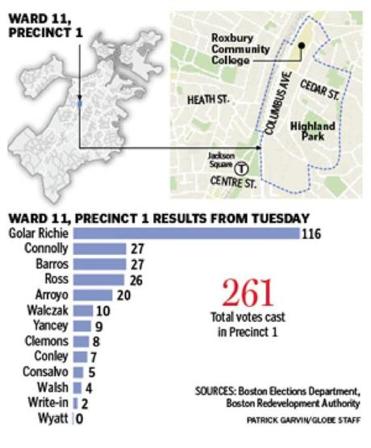
What united voters here in last week’s preliminary election was not a shared loyalty to one candidate, but a collective aversion to two — the eventual winners. Eighty-eight percent of voters in this progressive precinct backed someone other than state Representative Martin J. Walsh or Councilor at Large John R. Connolly. Located within the broad swath of Boston’s inner city where neither finalist claimed victory, Fort Hill is among the voting precincts where they had their weakest showings. Of 261 votes cast for mayor in this precinct last week, only four went to Walsh.

There are 5 adults living in my building and we had 3 yard signs:  Rob Consalvo, Charles Yancey and Charlotte Golar Richie.

Voters in Ward 11/1

Voters in Ward 11/1

Ward 11 is a pretty well racially integrated neighborhood with a high rate of owner occupancy even in the 2 family homes with rental units.

A white female neighbor, who declined to give her name, said she had voted for Golar Richie, the only woman in the race, who would have been the city’s first female mayor and first black mayor. Now, she said, “I have to decide who’s less offensive.”

That attitude itself is offensive to voters like Valerie Madden, a Connolly volunteer who had tried to get her neighbors here to rally around Connolly’s campaign.

“People would tell me frankly, ‘I like him. He’s a good candidate. But I’m not going to vote for him because he’s white,’ ” Madden said.

Madden, who is white, and whose husband is biracial, said she didn’t have the “bandwidth to chide my neighbors because I know that where they’re coming from is a place of good intentions.”

I read this as wanting to elect a mayor who is not white, not as not wanting for vote for someone white.  The precinct votes overwhelmingly for our congressman who is white, for Senators Warren and Markey and voted in large numbers for the current Mayor who is also white.  But I do understand Valerie’s frustration.  She started working for Connolly before Mayor Menino announced his retirement.

Looking at the vote totals, Charlotte took the precinct by a wide margin while finishing third overall.  It will be interesting to see who, if anyone she endorses.  If I were Connolly or Walsh, I would be seeking her help.  I’m disappointed, but console myself with the thought that we are in a time of transition.  With Tom Menino having been mayor for 20 years, who knows if the next mayor will be long tenured or serve a single term as the City gets accustomed to a mayor not named Menino.

Vote distribution in 11/1.

Vote distribution in 11/1.

Dorothy in Iraq…or is it Afganistan? Or maybe Syria or Lybia?

It may work out that because he needed to save face, President Putin is going to end up saving President Obama and the Congress from a collision that neither can win – and saving us from another war as a bonus.  As I write this, it appears that Putin’s proposal to put Syria’s chemical weapons under international control will be coming before the Security Council.  Our Congress is very good at stalling so waiting for the Security Council to act should not be a problem and we may actually get a peaceful resolution.

While we wait, we can enjoy Tom Tomorrow’s updated Dorothy back from Oz.

Tom and Dorothy

Thank you, Ruben Bolling.

(Click picture to enlarge.)

More politics, race and South Boston

Earlier this year I wrote about Linda Dorcena Forry, the Haitian American who won the special state Senate election to represent South Boston and parts of Dorchester.  I know Linda and I assumed that she would do a great job and win over any reluctant Southie constituents by sheer force of her personality if not her voting record.  Someone, I think it was Jim Braude on Boston Public Radio, said that she lights up a room when she walks into it.  So Dorcena Forry gets elected and you would think that would be it.  You would be wrong.  There is the small matter of St. Patrick’s Day.

For many decades there have been two events marking the holiday in Boston.  First, there is a breakfast at which Boston and Massachusetts political figures tell bad jokes and try to sing.  It was once just a small event, but now it gets TV coverage.  I think it has gone downhill the last few years, maybe since the William Bulger/Stephen Lynch hosting days ended.  Second, there is a parade.  This is a huge event, also televised.  It is notable for the drinking that takes place among those watching and for the fact that few politicians march.  They don’t march because the breakfast tuckers them out, but because the organizers do not allow LGBT groups to participate.  (I should note here that both events are organized by private non-profits and that my husband has marched in the parade as a 000000000paying gig.)  These events are an opportunity for South Boston to shine and celebrate.  Everyone is Irish at these events.  Or so we all thought.

Yesterday we woke up to this front page news. 

Southie St. Patrick’s Day breakfast slugfest begins early

Emcee struggle raises questions of tradition

What was this about?   Last year’s temporary host, William Linehan, the city councilor from South Boston, was making noises that he was not going to give up his hosting.  Linda Dorcena Forry who by longstanding tradition should be the next host was, ahem, not Irish you see.  The Boston Globe explains

The battle is over who has the rightful claim to host the event. Call it the Southie version of Game of Thrones.

For generations, the breakfast — which is essentially a political roast — has been hosted by the sitting senator in the First Suffolk Senate district. And since the 1940s, that office has been held by an Irish-American man from South Boston — from John Powers to Joe Moakley to Billy Bulger to Stephen Lynch to Jack Hart.

The neighborhood’s stranglehold on the office was so pronounced that it was referred to as the “Southie seat,” even though it also includes much of Dorchester, Mattapan, and a piece of Hyde Park.

But in May, Linda Dorcena-Forry, a Haitian-American woman from Dorchester, won that Senate seat after narrowly defeating Nick Collins, a young state representative from South Boston, in the Democratic primary.

Everyone had something to say.

William M. Bulger, the former senator who transformed the event into the made-for-television spectacle that it is today, took over hosting duties from then-senator Joe Moakley while Bulger was still a state representative. But in a phone interview this week, Bulger said “that’s mostly because I was such a ham, and Moakley finally said, ‘You want to take this thing over?’ ”

But Bulger went on to support Dorcena-Forry’s thinking, saying that “it has always been the understanding that it was the state senator that was the host.”

US Representative Stephen Lynch, who succeeded Bulger as state senator and breakfast host in 1997, also supported the idea that Dorcena-Forry should host.

“I believe the sitting state Senator has always served as host,” Lynch said in a statement. “As our new Senator, Linda should be the host, and I am happy to lend her my expertise and any assistance I can provide.”

Linehan and his supporters also weighed in.

“It’s never been stated anywhere that it has to be the state senator,” Linehan said. “It’s a cultural thing. There has never been anyone who hosted it who does not live in South Boston, but there have been people who have hosted it who were not the state senator.”

and the last host who was a state senator?

But Jack Hart, the last of the sitting senators to host the event, took a different approach. He said the election of Dorcena-Forry ushered in an “unprecedented time,” and he said he hoped that Linehan and Dorcena-Forry could sit down and work out a compromise. “There are no rules. There’s no rule book to go by regarding who hosts the thing.”

He said he did not hand over the duties to Linehan; he simply left politics, and later got a call from Linehan saying that as the ranking South Boston elected official, he wanted to host, and asked for Hart’s advice on how to do it.

Representative Nick Collins who lost to Dorcena Forry agreed with Linehan leading some to accuse them of trying to revive the racial divisions of the past.

For her part, Dorcena Forry believed she should be host and pointed out

“The sitting senator has always hosted, and you don’t have to be Irish to do it,” Forry said in a phone interview. “I believe that everyone is Irish on St. Patrick’s Day. Everyone’s celebrating Irish culture. You don’t have to be 100 percent Irish.”

Dorcena-Forry argues that she is no stranger to the Irish-American community. She is married to Bill Forry, an Irish-American who is editor of the Dorchester Reporter.

“I have four bi-racial children — Irish-American and black. I’ve been to Ireland four times. We celebrate the culture in my house. My two oldest sons were baptized in St. Augustine’s chapel in South Boston. I’m not just a random black woman who has this seat.”

Linda Dorcena Forry

Linda Dorcena Forry

I think that everyone realized that they were in tricky political waters which could rapidly become dangerous.  Dorcena Forry wants to win re-election next year.  Bill Linehan is facing Suzanne Lee, a Chinese American woman who narrowly lost last time, this fall.  (The South Boston council district includes Chinatown and what people would call “downtown” Boston, so it is not really a Southie seat.)  So this morning the headline read

After backlash, St. Patrick’s roast dispute is over

Dorcena Forry to host fest as councilor relents

The resolution followed mounting criticism of Linehan’s refusal to allow Dorcena Forry to host the event, as officials from the governor to the mayor to the mayoral candidates said she was the rightful emcee.

The controversy shined an uncomfortable spotlight, at least momentarily, on racial tensions that many hoped Boston had left behind. It touched a raw nerve from the halls of the State House to the walking paths of Castle Island.

Many who live in South Boston will be unhappy because Linda Dorcena Forry is not only Irish but has dark skin, but most won’t really care.  But for politicians – particularly the white men running for Mayor this fall – it was important.  They mostly lined up to support Dorcena Forry.

“It will be different, but Boston is changing, South Boston is changing,” Mayor Thomas M. Menino said after a ribbon-cutting in Faneuil Hall. “Let’s have a change in leadership over there, and let’s have Linda Dorcena Forry be the mistress of ceremonies.”

And so she will be.  By next March, it is possible that there will be Councilor Lee and the Mayor of Boston will be black or Hispanic.  Boston is changing fast and Southie has to change also.  Maybe I’ll watch the breakfast next year:  All the folks running for Governor will be putting in an appearance.

Photograph: Jonathan Wiggs/Globe staff/file

Gay rights and the Supremes

Justice Antonin Scalia has made it clear that he is, at best, uncomfortable with the series of decisions made by the Supreme Court on gay rights.  Soon after the decisions last June on DOMA and Prop 8,  Asawin Suebaeug wrote an article for Mother Jones in which the best and worst parts of his dissents were highlighted. 

Justice Antonin Scalia is not a big fan of gay sex, gay marriage, or gay anything. His dissent to Wednesday’s decision on United States v. Windsor, in which the Supreme Court ruled, 5-4, that legally married same-sex couples should get the same federal benefits as straight ones, shows as much. (The high court’s ruling invalidates a provision of the Defense of Marriage Act that barred same-sex couples from receiving health, tax, and retirement benefits.) In a nutshell, Scalia’s dissent focuses on the court’s prime purpose and power, and he is aghast that the majority assumed the power to shoot down DOMA. (To read the seven worst things Scalia has said or written about homosexuality, click here.)

And Andy Borowitz has made a cottage industry out of zinging him including “Scalia Arrested Trying to Burn Down the Supreme Court”.

WASHINGTON (The Borowitz Report)—In a shocking end to an illustrious legal career, police arrested Justice Antonin Scalia today as he attempted to set the Supreme Court building ablaze.

Justice Scalia, who had seemed calm and composed during the announcement of two major rulings this morning, was spotted by police minutes later outside the building, carrying a book of matches and a gallon of kerosene.

Back at the Supreme Court, Justice Scalia’s colleagues said they hoped he would get the help he needed, except for Justice Clarence Thomas, who said nothing.

Meanwhile  Justice Ruth Bader Ginsburg celebrated the marriage of a long time friend to another man while Justice Anthony Kennedy who wrote the decision on DOMA is being celebrated himself.

Justice Kennedy was a guest at an event in San Francisco featuring the Gay Men’s Chorus and speeches thanking him for his DOMA decision as well as his two previous decisions expanding gay rights.  The New York Times reported

The San Francisco Gay Men’s Chorus sang “Give ’Em Hope” for a revered and in some ways surprising guest who shared a California stage with them last month: Justice Anthony M. Kennedy.

Justice Kennedy was in San Francisco for an American Bar Association meeting, but he was also there to be celebrated by the men on the risers behind him. In remarks from the stage, San Francisco’s mayor, Edwin M. Lee, thanked the justice “for upholding the Constitution and justice for all” in his majority opinion in June in United States v. Windsor, a major gay rights victory.

“Freedom is always a work in progress,” Justice Kennedy said in his own remarks, making clear that there was more work to be done.

Justice Ginsburg performs an historic marriage ceremony.

Justice Ginsburg performs an historic marriage ceremony.

justice Ginsburg became the first Supreme to officiate at a gay wedding.

Ginsburg officiated Saturday at the marriage of Kennedy Center President Michael Kaiser and John Roberts, a government economist.

“Michael Kaiser is a friend and someone I much admire,” Ginsburg said in a written statement Friday. “That is why I am officiating at his wedding.”

“I think it will be one more statement that people who love each other and want to live together should be able to enjoy the blessings and the strife in the marriage relationship,” Ginsburg told The Washington Post in an interview.

“It won’t be long before there will be another” performed by a justice. She has another ceremony planned for September.

Kaiser told The Associated Press that he asked Ginsburg to officiate because she is a longtime friend.

So at least two, and if we take Justice Ginsburg at her word, three Supreme Court Justices moving forward with the times.

Has anyone else noted that one of those getting married was John Roberts?  Wonder what the Chief Justice thinks about that?
Photograph:  Margo Schulman/Kennedy Center

Increased violence. Another consequence of global warming?

I read a lot of mystery stories.  Old ones, new ones, ones set in times past and ones set it the future.  A common thread is it is summer and a heat wave so crime is up.  You hear this every spring from the Boston Police and the Mayor – we need to prepare for the combination of hot weather and school being out.  So is this just an urban myth?  Maybe not.  A new study to be published in the journal, Science, was summarized in Sunday’s New York Times.

But researchers are now quantifying the causal relationship between extreme climate and human conflict. Whether their focus is on small-scale interpersonal aggression or large-scale political instability, low-income or high-income societies, the year 10,000 B.C. or the present day, the overall conclusion is the same: episodes of extreme climate make people more violent toward one another.

In a paper published this month in the journal Science, we [MARSHALL BURKE, SOLOMON HSIANG and EDWARD MIGUEL] assembled 60 of the best studies on this topic from fields as diverse as archaeology, criminology, economics, geography, history, political science and psychology. Typically, these were studies that compared, in a given population, levels of violence during periods of normal climate with levels of violence during periods of extreme climate. We then combined the results from those studies that concerned modern data in a “meta-analysis,” a powerful statistical procedure that allowed us to compare and aggregate findings across the individual studies.

We found that higher temperatures and extreme rainfall led to large increases in conflict: for each one standard deviation change in climate toward warmer temperatures or more extreme rainfall, the median effect was a 14 percent increase in conflict between groups, and a 4 percent increase in conflict between individuals.

Global mean surface temperature difference fro...

Global mean surface temperature difference from the average for 1880–2009 (Photo credit: Wikipedia)

The study went beyond the present day, back to the collapse of several civilizations:  The Maya, Angkor Wat and the Akkadian in Syria.  Climate appears to have played a role in the collapse of each.

Our findings held at very high levels of statistical confidence. To illustrate the consistency of the results: of the 27 quantitative studies we looked at that examined a link between temperatures and modern conflict, all of them found that higher temperatures were associated with more violence. This sort of pattern in the results was extremely unlikely to happen by chance. (Imagine trying to get 27 “heads” in a row when flipping a coin.)

What explains the strong link between climate and conflict? Different mechanisms are most likely operating in different settings, but the two most important factors appear to be aggression and scarcity. The aggression factor is intuitively easy to understand (again, recall summer in the city), and it probably underlies the finding that anomalously hot months have significantly higher crime rates in cities in the United States. As for scarcity, the logic is only slightly more complex. In low-income countries largely dependent on agriculture — like those in much of sub-Saharan Africa and parts of Asia and Latin America — when the rains fail and temperatures scorch, crops wilt and die. This leaves many people dangerously close to the edge of survival, which can lead to social strife and even civil war.

So besides gearing up for more shootings, stabbings and homicides on the summer streets, what are the implications?  The study concludes

Our findings help us better understand both the past and the present, but they are particularly important for what they imply about the future. Many global climate models project global temperature increases of at least 3.6 degrees Fahrenheit (2 degrees Celsius) over the next half century. Our results imply that if nothing changes, this rise in temperature could amplify the rate of group conflicts like civil wars by an astonishing 50 percent in many parts of the world — a frightening possibility for a planet already awash in conflict.

Decision makers must show an understanding that climate can fundamentally shape social interactions, that these effects are already observable in today’s world and that climate’s effects on violence are likely to grow in the absence of concerted action. Our leadership must call for new and creative policy reforms designed to tackle the challenge of adapting to the sorts of climate conditions that breed conflict — for instance, through the development of more drought- and heat-resistant agricultural technologies.

As we contemplate intervention in Syria and look at the increasing and never-ending violence in Africa, we also need to ask ourselves some questions about violence here at home.  Will global warming lead to increased domestic violence?  What do we do with this knowledge and all the guns on the streets?  And will anyone pay any attention?