Predicting 2014

I don’t have a crystal ball and haven’t thrown the I Ching, so I can’t really say what will happen. but Mark Bittman had an amusing column in yesterday’s New York Times about years ending in four.  Bittman seems to be of the opinion that nothing much that is good happens during such years, but we can hope that he just has a selective memory.

Bittman begins with 1944, but I’ll add 1914.  That was the year Austria-Hungary declared war on Serbia to begin World War I. On the plus side, the Panama Canal opened and the Boston Braves won the World Series.
Bittman writes

1944 Those of us who don’t remember this year are lucky; a soldier cited in Rick Atkinson’s brilliantly horrifying saga of the last two years of the war in Europe, “The Guns at Last Light,” quotes King Lear: “The worst is not, So long as we can say, ‘This is the worst.’ ” The end of the war was in sight; getting there was the trick, and millions were killed in the interval. Things have not been this bad since.

1954 If there was a golden era of United States foreign policy, it ended here, as Eisenhower warned against involvement in Vietnam while espousing the domino theory. Good: Joe McCarthy’s power began to ebb. Not good: The words “under God” were added to the Pledge of Allegiance.

1964 The last year of the baby boom was mind-blowing. In the 28 months beginning that January, Bob Dylan made five of the best albums of the era — and there were the Beatles.

Nelson Mandela was sentenced to life in prison, and Lyndon Johnson single-handedly sent everyone into a tizzy by signing the Civil Rights Act, sending more “advisers” to Vietnam, talking about bombing North Vietnam and proposing the Great Society. Huh? The first anti-Vietnam War demonstrations and draft-card burnings took place. Pot smoking officially began. (Not really, but sorta.)

1964 was also the year my husband graduated from high school.  I’ll call that a plus.

Skipping to 1994

Whoa: Not only did Nelson Mandela not spend his life in jail, but he became president. The Brady Law went into effect, and Bill Clinton signed the assault weapons ban. (It expired in 2004.) O. J. Simpson spurred a national obsession. Four bombers were convicted of the 1993 attack on the World Trade Center.

Reagan was implicated in the Iran-contra cover-up, but it seemed more important to torture the Clintons over a bad real estate investment. (Still, Paula Jones wasn’t the Republicans’ fault, was she?) Clinton fired Joycelyn Elders for discussing masturbation.

The first credit default swap was created. Nearly everyone in Rwanda became either a killer or a victim, or so it seemed. And there was that messy thing in “the former Yugoslavia.”

Netscape Navigator was released.

1994 was an important year for me.  We got married and I moved to Boston.  Thomas Menino was mayor but not yet The Mayor.

Which brings us to 2004.

2004  Barack Obama spoke at the Democratic convention and there seemed reason for hope; then John Kerry went windsurfing and W., incredibly, became president again (what were 62 million of us thinking?) several months after endorsing a constitutional amendment banning same-sex marriage, which Massachusetts had already legalized. (By 2013, even Utah is on the right side of this issue.) W. also promised to improve education and access to health care; we all know how that worked out. Lance Armstrong won his sixth Tour de France; we all know how that worked out, too.

And also in 2004, the Red Sox won the World Series for the first time in 86 years ending the mythical curse of Babe Ruth.

So, 2014.  I know what I hope for:  the Democrats retain control of the Senate and, at a minimum, creep closer to a majority in the House. I hope the ACA enrolls so many people who like their benefits that we don’t have to listen to Ted Cruz reading “green eggs and ham” again.  I hope, though it seems unlikely, that we get tax and immigration reform.  I hope that President Obama has a better year. And I hope everyone comes home safely from Afghanistan.  I wish Marty Walsh all the best as he becomes mayor and I hope that Michelle Wu gives up her crazy idea of voting for Bill Linehan for City Council president and picks Tito Jackson instead.  Most of all, I hope that all of us have a safe and healthy year.

2014

Can we cure Congressional dysfunction?

The pundits are dissecting the results of the local and state elections and speculating on what, if any, effect they will have on the 2014 mid-terms and the 2016 Presidential election.  There is plenty of time for that.  I want to talk about the current dysfunction in Congress.

George Packer posted an interesting comment in the New Yorker yesterday.  His Daily Comment began

Going to cast a vote Tuesday, less than three weeks after the government shutdown and the near-default, put me in a sour mood. Usually, I exercise the franchise in a state of embarrassing, heart-swelling affection for the imperfect republic, my under-informed fellow-citizens, confused poll workers, even the dubious names on the ballot. But yesterday, with the gross malpractice of elected officials in Washington still fresh in mind, I walked to the local polling place thinking about some of the stupidities of our democracy, grouping them into two categories: necessary and unnecessary.

His list of unnecessary traditions includes the filibuster.  While the Senate is slightly more functional than the House, the idea that every piece of legislations needs 60 votes to pass needs to be changed before that morphs into a new “tradition”.

The filibuster is an unnecessary stupidity. Senators speak reverently of the filibuster as if it were inscribed in the Preamble to the Constitution, but it’s nowhere in our founding documents. The Senate created the rule almost by accident, in 1806, and for around the next hundred and seventy years used it sparingly, until self-restraint began to disappear from the upper chamber. It has almost no positive effect—try to think of the last time a truly terrible bill was prevented from being stampeded into law by the Senate’s failure to pass a cloture vote. Rampant abuse has exposed the filibuster as an anti-democratic tool of the defeated minority to thwart the will of the elected majority.

Some senators keep making noises about reforming, if not abolishing, the filibuster—most recently last month, when two Obama Administration nominees were blocked by Senate Republicans. But it never happens, and I don’t think it ever will happen, which only shows the profound conservatism of our democratic system. We’re stuck with necessary stupidities because trying to eliminate them would do more damage than it’s worth, but why are we stuck with so many unnecessary stupidities?

While we are talking about traditions, what about the tradition that an president’s nominees get approved absent clear evidence of criminal past, lack of qualifications, or some moral issue.  The putting a “hold” on a nominee, sometimes almost at random, because the Senator wants something else to happen, is an other tradition we don’t need.  At least the Senate has managed to pass Immigration Reform, a non-sequester budget, and the Employment Non-discrimination Act (ENDA).  There seems to be little hope for ENDA or Immigration Reform in the House.

IVoted

Packer goes on to cite the New York Times columnist, Joe Nocera on what we might do to fix some of the dysfunction.  Nocera’s suggestions include moving election day to the weekend, term limits for the Supreme Court, and an end to gerrymandering.

Move elections to the weekend. Do you know why elections fall on a Tuesday in early November? I didn’t either. According to a group called Why Tuesday?, it goes back to the 1840s, when “farmers needed a day to get to the county seat, a day to vote, and a day to get back, without interfering with the three days of worship.” Today, of course, casting your ballot on a Tuesday is an impediment: lines in urban areas are long, people have to get to work, etc. It is especially difficult for blue-collar workers — a k a Democratic voters — who don’t have the same wiggle room as white-collar employees.

Chris Rock — yes, Chris Rock — has been quoted as saying that this is the reason Election Day remains on Tuesday. “They don’t want you to vote,” he said in 2008. “If they did, they wouldn’t have it on a Tuesday.” Even if you aren’t conspiratorially minded, you have to admit that moving elections to the weekend makes a ridiculous amount of sense.

Moving election day is a solution, but we could also expand early voting and explore voting by computer and mail.  Most of all we need to do away with the absurd new ID laws where there is no evidence of widespread fraud which so far no one in Florida, Texas, North Carolina and other states has produced.  Why have ID laws when we could just prosecute anyone who tries to vote illegally?

Nocera also proposes terms limits for the Supreme Court.

 Somewhat to my surprise, most of the experts I spoke to were against Congressional term limits. Norman Ornstein, the resident scholar at the American Enterprise Institute, believes that the unintended consequences of term limits would outweigh the benefits. (He cited, among other things, the likelihood that “they come to office thinking about their next job.”)

Instead, Ornstein proposes term limits for Supreme Court justices. If he could wave his magic wand, he would give the justices one 18-year term, and he would stagger them, so that a new justice joined the court — while another departed — every two years. Ornstein likes this idea, in part, because presidents would be willing to nominate older justices; now, the emphasis is on younger nominees who can remain on the court, and influence American society, for decades. I like the idea because nothing fuels partisan politics like a Supreme Court nomination. If the parties knew there would be a new nominee every two years, it might lessen the stakes just a bit, and bleed some of the anger out of politics.

I’m not sure about this, but it is interesting to contemplate.

The next suggestion, open primaries, is something we have in Boston for municipal elections.  I should note that very few candidates here identify as Republicans (I think there was one running for Mayor), but that shouldn’t hold true for most places.

Why are so many extremist Republicans being elected to Congress? A large part of the reason is that highly motivated, extremist voters dominate the current Republican primary system. Mickey Edwards, the former congressman who is now at the Aspen Institute, wrote a book last year called “The Parties Versus The People: How to Turn Republicans and Democrats Into Americans.” At the top of his list of reforms is open primaries — which would allow anybody to vote for any candidate. Indeed, California has already adopted an open primary system, in which the top two vote-getters run against each other in the general election — even if they are from the same party. As Adam Nagourney wrote in The Times a few weeks ago, this reform is one of the reasons California’s Legislature has become less partisan and more productive. Chances are good that the same reform at the federal level would produce the same result.

California also provides an example that could reduce, if not end, gerrymandering.

As a tool to entrench the party in power, few maneuvers can beat gerrymandering. It’s another reason that the Tea Party Republicans can pursue an agenda that most citizens disagree with: thanks to gerrymandering, their districts could not be safer. Here, again, California offers a better model. It has a 14-person commission made up of five Democrats, five Republicans and four people unaffiliated with either party. In 2011, the new commission redrew lines in a way that broadened the diversity of many districts. That is exactly what should happen everywhere.

Nocera talks about bringing back small donors.  I think this will take a Congressional change to modify or repeal Citizens United.

Many of these suggestions have to be implemented on the state/local level, but we should start talking about them now.  Change comes slowly because of “tradition” and people wanting to retain power, but unless something changes we are going to sink further and further into dysfunction.

Election Day in Boston: Will the unions rule?

Since my pick for Mayor, Charlotte Golar Richie is not in the final, I will vote for Marty Walsh.  Some of the reasons are in Kevin Cullen’s column in today’s Boston Globe.  [Warning:  This is a subscriber link so I will quote more of it than I normally would.]

Mercifully, the campaign for mayor of Boston is over, and while I have no idea who will emerge the winner at the polls, I am quite certain who lost most in this race: union workers.

If there was a message, both explicit and subliminal, in all the debates and some of the news coverage, it’s that the city’s unions and unions in general are peopled by greedy, unreasonable, insatiable Bolsheviks who would gladly make Boston go the way of Detroit as long as they can get Bunker Hill Day off.

Funny, but I don’t know union workers who think like that, but then I’m in the tank.

My father was able to raise a family, and my mother was able to be a stay-at-home mom, because he belonged to a union. I belong to a union, and at one point, for reasons that remain a mystery, was elected president of the editorial workers at the Boston Herald back when Ronald Reagan became the darling of free marketeers everywhere by busting up the air traffic controllers union.

I grew up in a union household.  We were taught not to cross picket lines.  I joined SEIU 888 when I had the opportunity and helped negotiate one contract with the City of Boston.  I’m with Kevin.

With all due respect to Tommy Nee from the patrolman’s association and Richie Paris of Local 718 of the firefighters, if they think they had it hard with Tommy Menino’s minions, try negotiating a contract with the union-busting lawyers Rupert Murdoch flew in and sicced on us at Herald Square back in the day. I was just a kid and naively suggested to one of those Armani-clad lawyers my earnest wish that we could agree to add a dental plan because many of my members didn’t earn enough to get their cavities filled. He looked down his glasses at me and sniffed, “Maybe they should get a second job.”

That’s exactly the attitude of McDonald’s and Walmart and any number of corporations that pay their leaders millions and their workers so little that they have to get a second job or, in many cases, file for government assistance. Taxpayers subsidize corporations that pay their people off in the dark.

“Look,” Tommy Nee was saying, “unions built this country. They built this city. And right now union members make up a big chunk of the middle class in Boston. But they are stereotyped and disparaged in a way that would be considered deeply unfair if you were talking about any other group.”

I’m not sure that people know that if you work for the City you have to live in the City for at least the first ten years of your employment, but if you are priced out of the housing market, it can get tough.

The Globe and the Herald editorial pages can’t agree on what time it is, but they agree on the danger of electing a mayor who is a union activist.

It’s perfectly legitimate to ask if Marty Walsh would be beholden to unions, especially given the amount of money that unions have given his campaign, but both candidates should have been asked just as often if they’d be beholden to developers or law firms or any number of other monied interests.

The emphasis on the threat that unions pose to the future of the city left many union workers wishing they were only half as powerful as their critics believe them to be.

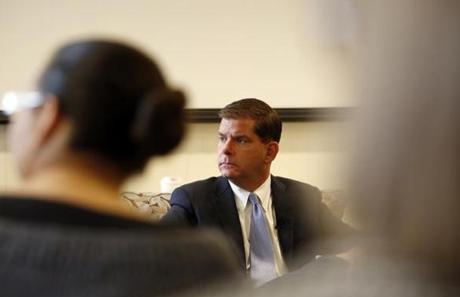
Martin J. Walsh at a Central Boston Elder Services meeting Thursday in Roxbury,

Martin J. Walsh at a Central Boston Elder Services meeting Thursday in Roxbury,

But I’m not just voting for Walsh because he is a union man.  I like his proposal to re-do the Boston Redevelopment Authority and what he has said about changes to education. There is also evidence from his time in the state legislature that he knows how to built coalitions.

I don’t know if Walsh can win, but I think he is the best man to make changes that will transition the City from the Menino Era.

Photograph:  Jessica Rinaldi For The Boston Globe

Healthcare confusion

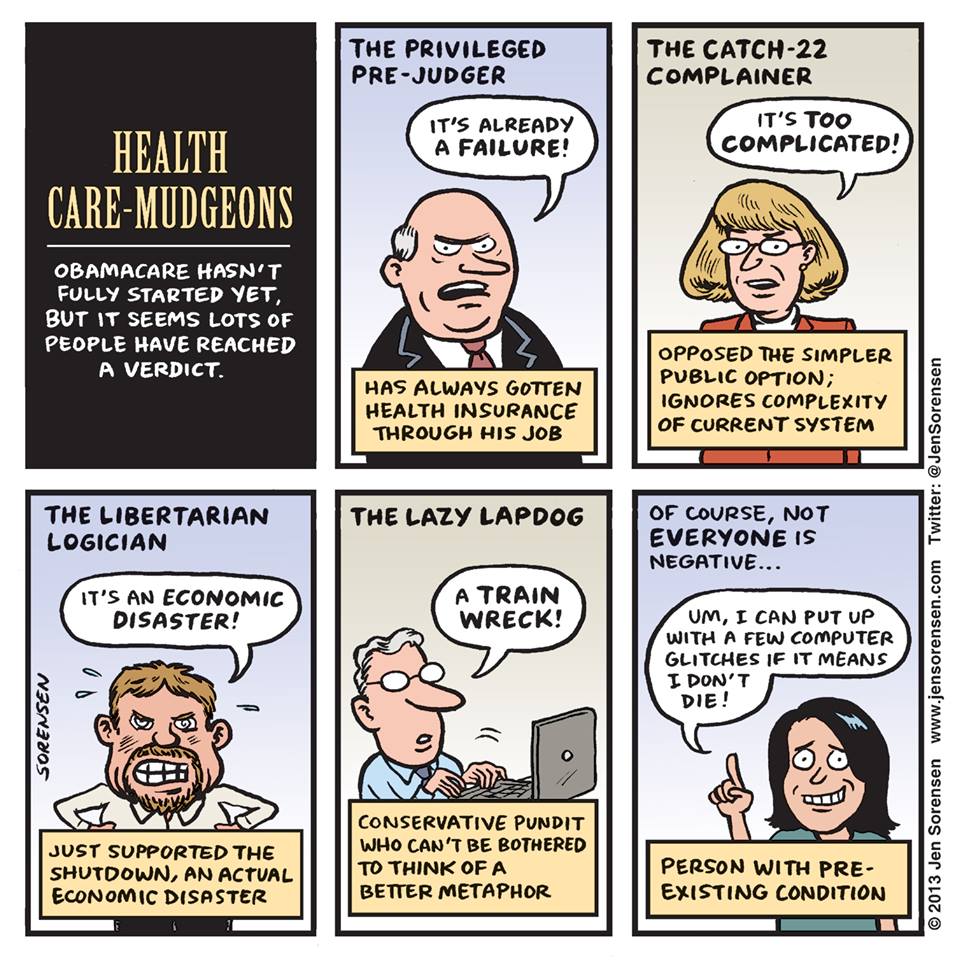
Let’s start with Jen Sorensen

Jen Sorenson

A lot of people are confused about what the Affordable Care Act does and don’t seem to realize that their insurance will actually come from a combination of Medicaid (or Medicare (for those who qualify) and a private insurer or just from a private insurer.  This is  the kind of insurance many got (I understand there are fewer offered these days) when they retired and got Medicare Advantage from a private insurer through their former employer as I do.  My retiree’s Medicare Advantage is partly subsidized by the City of Boston but I pay a monthly premium just as I pay a monthly premium for Medicare.  The ACA changes none of this for me.  And it changes nothing about employees who get qualified plans through their employers.  But to hear some of the Republicans carry on you would think that some staffer from the Department of Health and Human Services – or maybe Kathleen Sebelius herself will be performing medical exams.

As Gail Collins explained in her New York Times column today

The Democrats are depressed. The Republicans enjoy pointing out that the Obamacare rollout has been a mess. But they obviously can’t pretend to be upset that people are finding it hard to sign up for a program their party wanted to kill, eviscerate and stomp into tiny pieces, which would then be fed to a tank of ravenous eels.

Well, actually, they can.

“I haven’t heard one of you apologize to the American public,” Representative David McKinley of West Virginia sternly told government contractors who had worked on the HealthCare.gov Web site. McKinley’s party recently shut down everything from the national parks to preschool programs, while costing the economy an estimated $24 billion. Nobody apologized. Perhaps they’ll write a note this weekend.

“I’m damned angry that I and 700,000 Texans I represent have been misled, misled and misled,” said Representative Pete Olson. The only thing that could conceivably make Olson angrier would be if the Obamacare site was working so well that Texans could get health insurance as easily as they can order a chrome scarf holder from Amazon.com.

I thought these guys would be happy that people couldn’t get insurance and that the whole enterprise was a flop.  But maybe it is just the technical failures with the website that they don’t like.  I’m very confused.  As Andy Borowitz posted ” I guess once the Obamacare website is fixed the Republicans will be totally on board.”

But I don’t think the news will be good in the long run for the Republicans who want to repeal the ACA even if access to the sign-up website gets fixed.  This post from Sarah Kliff on Ezra Klein’s Wonkblog is likely just the start.

More than 330,000 people have managed to get deep enough into new government health insurance Web sites to learn how much financial assistance they will receive purchasing coverage, the Internal Revenue Service said Saturday.

That figure is arguably the most robust measure released to date by the Obama administration of how many Americans are successfully applying for financial help in purchasing a private insurance plan.

Calculations of financial assistance is a step that follows filing an application and tells applicants how much of a tax credit–if any–they can use to purchase a private health plan. This figure does not include shoppers who were found to likely qualify for Medicaid earlier in the shopping process.

The IRS said it has also received and responded to more than 1.3 million requests from the marketplace for personal data used to apply for Affordable Care Act programs, such as household income and family size.

The IRS said it is currently receiving about 80,000 such data requests each day. It is one of about a half-dozen agencies that send information to a federal data hub, along with the Department of Homeland Security and the Social Security Administration.

“Our IT systems are working well and providing both the historical tax data and the computation service accurately and quickly through the government’s data hub,” IRS spokesman Terry Lemons said. “The requests are being processed within seconds.”

This federal data hub determines eligibility for premium tax credits for the 36 states using the federal insurance marketplace and also for some, but not all, of the state-based exchanges. California, for example, opted to use its own technology to determine who qualifies for which programs.

The federal data hub was built by the contracting firm QSSI. The Obama administration announced Friday that QSSI would take on a new role as HealthCare.gov’s general contractor, overseeing efforts to fix the Web sites’ problems.

HealthCare.gov pings this federal data hub to verify a consumer’s identity and also when shoppers indicate in their applications that they would like to apply for financial assistance with coverage. Health and Human Services has said that, as of Thursday, 700,000 applications have been filed through the federal and state insurance exchanges.

People were slow to sign up when Massachusetts rolled out Romeycare and now there is close to universal coverage.  ACA sign-up, despite the problems is going even faster.

mass_enrollment_blue

The more things change…

the more they stay the same.  I’m reading “The Mansion of Happiness” by Jill Lepore, a collection of essays arranged so they comprise a history of life and death which is the book’s subtitle.  Lepore is an historian and essayist.  (We heard her lecture on her newest book about Jane Franklin and my husband came home and ordered all of his books.)  One chapter is titled Mr. Marriage.  In it, Lepore recounts a number of things including the history of marriage counseling and the history of eugenics.  I bet you didn’t know they were connected; I certainly didn’t.

Cover of "Can This Marriage Be Saved?"

Cover of Can This Marriage Be Saved?

When I was a kid, my mother used to subscribe to the Ladies Home Journal and I would read “Can this Marriage Be Saved?”.  I wonder how many of my generation got some of their ideas about marriage from reading this feature.  In any case, Paul Popenoe who wrote the column was the father of marriage counseling.  He was also a leader in the movement to sterilize the “unfit” to prevent them from having children.  Lepore writes, ” He considered marriage counseling the flip side of compulsory vasectomy and tubal ligation:  sterilize the unfit; urge the fit to marry.”  The early eugenicists  were influenced by Darwin and the theory of evolution.  If one could breed better plants and livestock, why not better people?

Lepore writes

…In the United States, what come to be called social Darwinism provided conservatives with an arsenal of arguments in favor of laissez-faire economic policies, against social welfare programs, and in support of Jim Crow. “The Negro”, it was argued, was “nearer to the anthropoid or pre-human ancestry of men” than any other race, a living missing link; only slavery had prevented the extinction of the black American; if not for the peculiar institution, natural selection would have led to the death of the entire race.

I guess they ignored the fact that many, likely most, African-Americans had a white ancestor in the family tree.  No matter, Paul Popenoe thought about 10% of the population should be sterilized.  This would have been determined in part by the IQ test that was relatively new at the time and, of course, by race. In 1918, Popenoe wrote a book with Rosewell Hill Johnson titled “Applied Eugenics”.

Popenoe and Johnson deemed miscegenation “biologically wrong” because “the Negro lacks in his germ-plasm excellence of some qualities which the white races possess. For poverty, Popenoe and Johnson blamed the poor, citing a study reporting that 55 percent of  retarded children belonged to the laboring class.  The solution to want was to sterilize the needy.  Following Terman [Lewis M.], Popenoe and Johnson opposed old-age pensions, minimum-wage legislation, and child-labor laws: by helping the biologically and mentally unfit, these programs perpetuated a poor gene pool, just as slavery had protected blacks from extinction.

Echoes of the eugenicists can be heard in the current efforts of certain members of the Republican party who only wanted to fund programs they liked during the recent government shutdown.  And the intense dislike, maybe hatred isn’t too strong a word, of President Obama perhaps isn’t just because he is black, but because he is the product of a an African father and white mother.  You hear it in the effort to defund the Affordable Heath Care Act.  As my husband pointed out when I was reading Lepore and ranting, Ron Paul stated during a Republican Presidential debate the if someone couldn’t afford care or didn’t have a policy that would be their own responsibility.  (Going back to the transcript, Paul didn’t actually say that person should be left to die, but that nonprofits like churches would help after the hospital provided medical care, that having health insurance should be a private decision, and provision of health care should not be a governmental responsibility.  Actually, given the current state of the economy and the finances of nonprofits these day, it is the equivalent of letting someone die.)

I will listen to the arguments in the upcoming budget fight with great interest and I bet I will hear more echoes of Paul Popenoe.  The more things change…

Who is Jeh Johnson?

Jeh Johnson is likely to be the next Secretary of Homeland Security.  And no, I don’t know much about him either except that he gave the Obama Administration legal advice that basically approved drone strikes and he made a speech at Oxford University in 2012 saying that the war on terror had to end at some point because no country could be perpetually at war.  Johnson has also criticized the lack of transparency about drone strikes.  The New York Times reports

…In a speech at Oxford, he looked ahead to a day when Al Qaeda was so diminished that the United States could relax its posture and end the military’s legal authority to kill and detain terrorism suspects.

“I do believe that on the present course, there will come a tipping point — a tipping point at which so many of the leaders and operatives of Al Qaeda and its affiliates have been killed or captured and the group is no longer able to attempt or launch a strategic attack against the United States,” Mr. Johnson said at the time.

But he emphasized that he was not declaring the struggle to be over, stressing the danger of Qaeda affiliates in Yemen and in North and West Africa. He also suggested that even after the armed struggle ended, there could be a need to hold some detainees legally without trial for a period of time, as happened after World War II.

Earlier in 2012, Mr. Johnson delivered a speech at Yale Law School defending the proposition that American citizens who join Al Qaeda may be lawfully targeted for killing under certain circumstances.

But he has also criticized the Obama administration for being too secretive about matters like targeted killings using drone strikes.

“The problem is that the American public is suspicious of executive power shrouded in secrecy,” Mr. Johnson said in a speech at Fordham University this year. “In the absence of an official picture of what our government is doing, and by what authority, many in the public fill the void by imagining the worst.”

During his tenure at the Defense Department, Jeh C. Johnson helped shape the Obama administration's national security policies.

During his tenure at the Defense Department, Jeh C. Johnson helped shape the Obama administration’s national security policies.

But Emily Heil has the best information on Johnson.  She reported this morning in the Washington Post “Eight Fact you didn’t know about Jeh Johnson.

– His name is pronounced “Jay.”

– He and his wife, Susan DiMarco, met as children, but started dating only after Johnson visited her dental practice. He “endured three years of dental work before she agreed to a date with him,” according to their wedding announcement in the New York Times.

– His uncle, 2d Lt Robert B. Johnson, was one of the famed Tuskegee airmen.

-During his freshman year at Morehouse College, his grade-point average was a “dismal 1.8.”

– His grandfather, Charles S. Johnson, a prominent sociologist and participant in the Harlem Renaissance, was the president of Fisk University.

– He was once a law partner of the late Ted Sorensen,  John F. Kennedy’s speechwriter. Johnson called him “one of my personal heroes.”

– He once said in an interview that in his next life, he’d like to be an “NYC subway motorman, preferably the #7 Flushing line.”

And now you can amaze your friends with what you know about Mr. Johnson.

Photograph:  Alex Wong/Getty Images

Winners and losers

Not talking about baseball today but about  the 16 day drive toward the fiscal cliff.   One of my favorite commentators, Ana Marie Cox, has compiled a list that you can see in its entirety here in the Guardian.  You can agree with her or not about her choices, but she gives us some things to think about.  Here are my favorites among Cox’s choices.

Winners

Ted Cruz

Ted Cruz. The punchline for a thousand Twitter humorists and the lead for most of the many stories about GOP dysfunction, Cruz is laughing in that whiny way of his all the way to the campaign war chest. He raised over $1m in the third quarter that ended 1 October, before the shutdown, half of it through the new “Ted Cruz Victory Committee” formed last year specifically to benefit from Cruz’s “defund Obamacare” petition. Cruz’s floor speech before the Senate vote seemed to imply that the fundraising was continuing at that pace; he referred to the “millions of millions [sic] of American people rising up across this country, over two million people signing a national petition to defund Obamacare”. The online petition is also an email harvesting gambit from the Senate Conservative Fund, the PAC that helped bring Cruz to Washington in the first place.

Harry Reid

Harry Reid. The former pugilist only won a technical knockout, but that’s probably the way the Senate majority leader likes it. That Reid’s compact and focused rage held Democrats together and in chorus was obvious from the outside. Senator Dick Durbin’s insinuation that we will “never know, you will never know, how much he put in to accomplish this” only ups the suspicions about the incredible power Reid wields.

Speaker Pelosi

Nancy Pelosi. Drudge called it, naming the Democratic congresswoman from California the once and future Speaker of the House. In other words, Matt Drudge thinks the Democrats have a serious chance of winning back the House of Representatives in the 2014 midterms. Or, you know, he could have been trolling us.

John McCain

John McCain. The septuagenarian’s bipolar relationship with the media started on the upswing with his early ridicule of Cruz (though now Cruz wears “wackobird” as a badge of honor). With the threat of a shutdown, the love affair really flared back up. McCain gave both earnest indictments of the strategy and exasperated quips. He dusted off the chestnut that congressional popularity is down to “paid staffers and blood relatives” and declared sarcastically of the GOP, “We’re livin’ the dream.”

And now the

Losers

majority rule

Majority rule. While the fundamental principle of democracy seems to have survived the 16-day crisis, the fact of the shutdown and the tiny minority of congressmen that created it, the Tea Party Republicans of the House have nonetheless managed to poke serious holes in the constitution they hold so dear. Presumably, the second amendment was left unscathed.

economic principles

Economic principles. People who didn’t even know what the debt limit was last month now think it’s some kind of conspiracy. Even as the US dodged a bullet this time – though suffering the collateral damage of further credit-rating downgrades – one can’t help feeling that we haven’t heard the last of the GOP’s new caucus of “debt default skeptics”.

apples and oranges

“False equivalence” reporting. James Fallows at the Atlantic documented some of the worst offenders and as “it’s everybody’s fault” became a Republican talking point, many media critics joined him in denouncing the faux-even-handedness as actually putting a finger on the scale. The “serious people” trope (as in, “serious people are above partisan bickering”) popularized by op-ed writers such as Michael Kinsley and Ron Fournier became especially ridiculous as the crisis wore on. Kinsley’s column beseeching Obama to “give in” to Republicans “for the sake of the country” (“media will no doubt call Obama weak”!) should be taught as a cautionary example against this desire to be “taken seriously”.

gop logo

The GOP. I mean, really.

This effort has only cost us an estimated 24 Billion dollars (and counting) and there is no saying that it won’t happen again in January.  It drives me nuts that the President is blamed by many while Ted Cruz used me – and everyone else who pays taxes and needs government services – to raise money for his 2016 Presidential bid.  But the silver lining is that if the Democrats get to work, it looks like they can hold on to the Senate and take back the House.  And then John Boehner will really have something to cry about.

Moving toward the cliff

Yesterday I had lunch with a friend, a federal employee, who is not working because of the shutdown.  She can’t check her work email or phone messages and fears the backlog of problems that awaits her when she does get back to work.  She said the only way she was fortunate was that she was not one of the essential employees who had to work anyway.  We speculated on how people will get to work if October moves to November and people’s monthly transit passes run out.  Will they be expected to shell out money they don’t have to get to a job they aren’t paid for?  All her friends can do is to buy her lunch.  Fast forward 24 hours and we still have no deal.  Even if the Senate comes up with a solution it is not clear if 1) the House will even vote on it and 2) if they do, if this is just another short term postponement.  All my friend hopes is that the next deadline is past the holidays and that there is back pay.

I was trying to find some humor in the whole situation, but find that I actually feel very sorry for John Boehner.  John Cassidy posted this for the New Yorker.

Give the Republicans on Capitol Hill one thing: they don’t leave a job half done. Evidently disturbed by polls showing Congress with a single-digit approval rating, they appear intent on driving it to zero.

What other explanation can there be for Tuesday’s farcical maneuvers, which saw the House Republican leadership try and fail to seize the initiative in the debt-ceiling standoff from the Senate, in the process humiliating Speaker Boehner yet again. By the end of the day, facing renewed opposition from some of his own members, Boehner had dropped his efforts to pass a bill that would have ended the shutdown and raised the debt ceiling until February, but one with more riders than an agreement that Mitch McConnell, the Republican leader in the Senate, and Harry Reid, the Democratic leader, have been working on.

From the point of view of the country, that’s good news. Overnight, officials representing McConnell and Reid were rushing to complete their negotiations, which were called off on Tuesday after Boehner’s unwise intervention. As it stands now, the Senate agreement would reportedly fund the government until January 15th and raise the debt ceiling until February 7th, with the only concession from the Democrats being an agreement to toughen up the policing of eligibility requirements for obtaining federal subsidies to buy health insurance under the Affordable Care Act.

Boehner is in a box.  He can’t control his own party caucus and can’t turn to Democratic votes because then he would lose his Speakership.  If the country goes into default, he will likely lose it anyway.

Once the Senate passes a bill and sends it to the House, the Speaker will face the unenviable choice of allowing it to pass with Democratic support or exercising the nuclear option of forcing a default. Having already ruled out this second option in public comments, there were reports on Tuesday night that Boehner was prepared to bring the Senate bill to the floor, which would probably insure its passage. That wouldn’t end the budget crisis—it’s never-ending—but it would put off the next showdown until the new year, whilst ensuring that the Republican ultras had gained almost precisely nothing for their willingness to shut down the government and raise the prospect of a debt default. (In another development on Tuesday, Fitch, one of the big ratings agencies, placed U.S. government debt on watch for a potential downgrade, saying that “the prolonged negotiations over raising the debt ceiling (following the episode in August 2011), risks undermining confidence in the role of the U.S. dollar as the preeminent global reserve currency by casting doubt over the full faith and credit of the U.S.”)

From the point of view of the Republican Party, things have been going from bad to worse. With the party divided, its poll ratings tanking fast, and its leadership unwilling to risk an actual default, it has been clear for some time that it was in a losing position. The discussions in the past few days have been about the terms of surrender, with the White House and Reid pressing for something close to an unconditional capitulation.

So here are a few cartoons to weep at as we proceed at a Senate’s slow pace, to the edge.

From Tony Auth

From Tony Auth

Tom Toles

Tom Toles

Signe Wilkerson

Signe Wilkerson

And Wilkerson, again.

Wilkinson2

Can we hope that there are still some adults who won’t drive us over the edge?

Can we send David Ortiz to the budget negotiations?

It has been a discouraging last few days with the only real bright spot being Friday (and then we went back Saturday) at Symphony Hall with the Boston Symphony Orchestra. We wanted to hear Thomas Ades, Polaris a second time and Friday night the BSO did not do Franck’s Symphony in D Minor which my husband loves.   But we came home Saturday night to no budget/debt ceiling deal and the Red Sox striking out, also.  I often tune in to some of the Sunday news shows, but couldn’t stand to hear any more Republican Congresspersons who have no clue about what the debt ceiling is much less understand any thing about the economy.  One of my friends posted this on Facebook the other day

Despite their lofty status in managing American affairs, it appears to me that few Congresspersons have any meaningful understanding of how their chronic politicization of economic policies substantially degrades, perhaps permanently, the dollar’s status as the global reserve currency. Evidence of the dollar’s decline to a commodity status is increasingly apparent. In time, every American will feel a crippling pain that no amount of political negotiating can cure.

Given this state of things, I retreated to a game of Civilization V where I could control, more or less, my own universe until after Sunday dinner when the Red Sox could take over.  But, after watching strike out after strike out with Clay Buchholz pitching sooo very slowly while getting slammed around in the sixth, I retreated.  I woke up just before 6 am this morning having just had a dream that I woke up and the Sox had come back.  I turned on the radio, I found that is was true!

Peter Abraham explains

In what has been a season full of memorable late-inning victories at Fenway Park, the Red Sox saved the best for when they needed it the most in Game 2 of the American League Championship Series Sunday night.

Trailing by four runs against the Detroit Tigers, the Sox tied the game on a grand slam by David Ortiz in the eighth inning then won it, 6-5, when Jarrod Saltalamacchia singled to drive in Jonny Gomes in the ninth.

The remarkable victory had the players chasing Saltalamacchia across the outfield and the sellout crowd of 38,029 chanting “Let’s Go Red Sox!” as they left Fenway.

“When you back us into a wall, you either do two things: cave or fight. We’re gonna fight,” Dustin Pedroia said.

That wall was hard to get over. The Sox had scored one run through the 16 innings in the series, going 3 for 51 at the plate with 30 strikeouts. Detroit starter Max Scherzer allowed one run on two hits over seven innings and struck out 13.

And then.

Will Middlebrooks doubled to left field off Jose Veras to start the rally. Then Jacoby Ellsbury drew a walk off Drew Smyly.

Al Albuquerque was next out of the Detroit bullpen. He struck out Shane Victorino for the second out, but Pedroia singled to right. Third base coach Brian Butterfield held Middlebrooks, wanting to make sure Ortiz got his chance.

Ortiz swung at the first pitch, a changeup away, and was strong enough to pull it into the Red Sox bullpen in right field for his first career postseason grand slam and the fourth in Red Sox history.

Right fielder Torii Hunter tumbled over the wall trying to make a catch as Boston police officer Steve Horgan raised his arms in joy. Bullpen catcher Mani Martinez, who was warming up Koji Uehara, casually turned and caught the ball.

It was bedlam at Fenway and the crowd kept cheering until Ortiz emerged from the dugout and tipped his helmet to them.

“My idea wasn’t to go out and hit a grand slam,” Ortiz said. “If I was telling you about thinking about hitting a grand slam, I’d be lying to you now.”

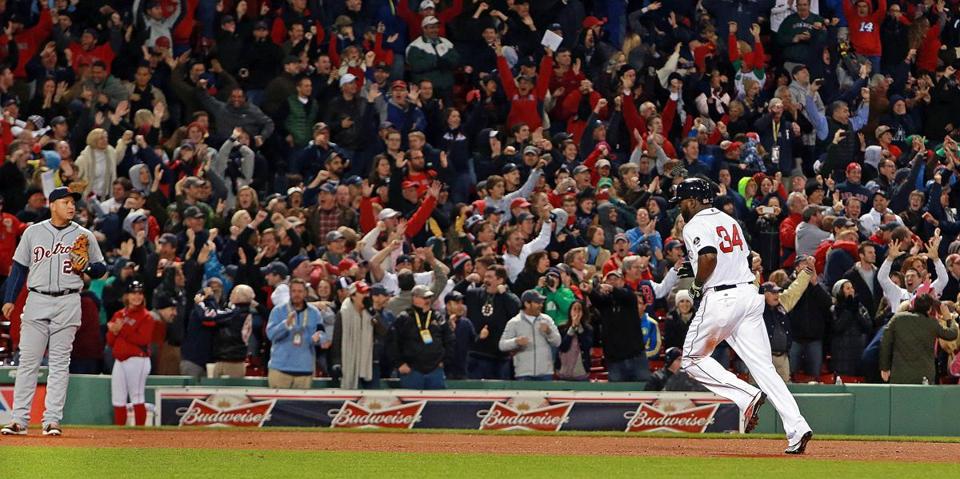
A hero of postseasons past, David Ortiz rounds third base — as the Tigers’ Miguel Cabrera looks on — to a standing ovation after his grand slam in the eighth inning tied Game 2 at 5.

A hero of postseasons past, David Ortiz rounds third base — as the Tigers’ Miguel Cabrera looks on — to a standing ovation after his grand slam in the eighth inning tied Game 2 at 5.

Gotta love David.

There was still a game to win. After Uehara retired the Tigers in order, Gomes was again the catalyst.

He reached on an infield single off Rick Porcello and took second on a throwing error by shortstop Jose Iglesias, the former Sox player known for his defensive skills.

“No is not an option for this team,” Gomes said. “Once I got on second, I was going to do anything I could to score.”

Gomes advanced on a wild pitch and scored when Saltalamacchia singled to left field.

“I felt good,” Saltalamacchia said. “Trying to hit the ball up the middle and take your chance.”

It was the 12th walkoff win of the season for the Red Sox.

So now we have something to watch on the highlight reels other than strike out after strike out.  There is joy in Mudville after all.  The Red Sox head for Detroit to face Justin Verlander, still another one of the Tigers’ great pitchers.  Let’s end this with something to ponder.  My husband heard Verlander ask this question:  If a pitch grazes a Red Sox’s beard, did he get hit by the pitch?

Now if only someone would hit a grand slam on the budget and knock out Ted Cruz and his friends.

Photograph:  Jim Davis/Globe Staff

The myth of small businesses and healthcare

One of the favorite talking points of the Republicans who oppose the Affordable Care Act (ACA) is that it will kill job growth and hurt small businesses.  Quite honestly, I think that their government shutdown which they admit is largely about defunding/delaying/repealing the ACA is doing a fine job of doing both.  Forget what they think “Obamacare” will do.  But in the current issue of the New Yorker, James Surowiecki takes on the myth, at that, according to him, is what it is, that the ACA will do horrible, terrible, no good things to the economy.

The G.O.P.’s case hinges on the employer mandate, which requires companies with fifty or more full-time employees to provide health insurance. It also regulates the kind of insurance that companies can offer: insurance has to cover at least sixty per cent of costs, and premiums can’t be more than 9.5 per cent of employees’ income. Companies that don’t offer insurance will pay a penalty. Republicans argue that this will hurt companies’ profits, forcing them to stop hiring and to cut workers’ hours, in order to stay below the fifty-employee threshold.

How much of this is true?

The story is guaranteed to feed the fears of small-business owners. But the overwhelming majority of American businesses—ninety-six per cent—have fewer than fifty employees. The employer mandate doesn’t touch them. And more than ninety per cent of the companies above that threshold already offer health insurance. Only three per cent are in the zone (between forty and seventy-five employees) where the threshold will be an issue. Even if these firms get more cautious about hiring—and there’s little evidence that they will—the impact on the economy would be small.

Meanwhile, the likely benefits of Obamacare for small businesses are enormous. To begin with, it’ll make it easier for people to start their own companies—which has always been a risky proposition in the U.S., because you couldn’t be sure of finding affordable health insurance. As John Arensmeyer, who heads the advocacy group Small Business Majority, and is himself a former small-business owner, told me, “In the U.S., we pride ourselves on our entrepreneurial spirit, but we’ve had this bizarre disincentive in the system that’s kept people from starting new businesses.” Purely for the sake of health insurance, people stay in jobs they aren’t suited to—a phenomenon that economists call “job lock.” “With the new law, job lock goes away,” Arensmeyer said. “Anyone who wants to start a business can do so independent of the health-care costs.” Studies show that people who are freed from job lock (for instance, when they start qualifying for Medicare) are more likely to undertake something entrepreneurial, and one recent study projects that Obamacare could enable 1.5 million people to become self-employed.

English: This is a diagram depicting the perce...

English: This is a diagram depicting the percentage in US who have no health insurance by age. (Photo credit: Wikipedia)

Remember that large employers get tax incentives to provide health insurance.  The ACA will actually do the same for small businesses.

Obamacare changes all this. It provides tax credits to smaller businesses that want to insure their employees. And it requires “community rating” for small businesses, just as it does for individuals, sharply restricting insurers’ ability to charge a company more because it has employees with higher health costs. And small-business exchanges will in effect allow companies to pool their risks to get better rates. “You’re really taking the benefits that big companies enjoy, and letting small businesses tap into that,” Arensmeyer said. This may lower costs, and it will insure that small businesses can hire the best person for a job rather than worry about health issues.

Surowiecki ends his short piece with this kicker.

The U.S. likes to think of itself as friendly to small businesses. But, as a 2009 study by the economists John Schmitt and Nathan Lane documented, our small-business sector is among the smallest in the developed world, and has one of the lowest rates of self-employment. One reason is that we’ve never had anything like national health insurance. In a saner world, changing this would be a reform that the “party of small business” would celebrate.

So it seems that implementation of the ACA with small business health insurance exchanges will actually help lead to more job growth.