The “gang of six” plan and the debt ceiling

In case you are wondering what it is, the New York Times has published a summary.  It is really a budget and deficit reduction plan and not something to raise the debt ceiling which still has to be done.  And time is running out.

A couple of interesting comments about the plan on Politico’s Arena.

First from Jeff Smith, professor at the New School and former Missouri State Senator:

The one real piece missing from this entire conversation? The piece that would make the numbers work and dramatically reduce the pain?

Comprehensive immigration reform. That’s right. There’s only one pool of 15 million people begging to be able to pay more into the system, and this country has spent the last several years fighting to make sure they can’t.

We need to get over our xenophobia, give them a path to citizenship, and let them start paying in to the system at regular rates in regular intervals. The nation’s immigrant population tilts much younger than the native-born population and is predominantly in the workforce, and would reverse the trend of a rising retiree-to-worker ratio, thereby shoring up both major entitlement programs

The immigrants would pay taxes, pay into social security, and Medicare.

Bernie Sanders (D-VT) points out

While the spending cuts for programs that working people desperately depend upon are enforced by specific spending caps, there is no such enforcement or clarity regarding the $1.1 trillion to be raised in revenue over 10 years.

What happens if that revenue target is not reached? There is no language that deals with that. Where does the revenue come from? That very important issue is kicked to the tax writing committees with no guarantee that hundreds of billions of dollars in new revenue will not come from the pockets of low- and moderate-income Americans. While nobody knows for certain what provisions might be adopted, there is reason to expect that some of the areas that the House and Senate will be looking at include the home mortgage deduction for middle-class families, taxes on health care benefits, and increased taxes on retirement programs such as 401(k)s and IRAs. In other words, while there is a reasonable degree of specificity in terms of cuts there is only vagueness in terms of revenue.

But Dean Baker from the Center for Economic and Policy Research asks the questions I’ve been wondering about:  What is wrong with the deficit at a time when we have no jobs and isn’t there a solution besides massive budget cutting?

The arithmetic is clear as day. The United States does not now, nor will it in the near future, face a serious problem meeting its debt obligations. It had a debt to GDP ratio of 116 percent after World War II. The baseline projections have it getting to 90 percent by 2021. 116 percent is much larger than 90 percent. (The difference will be more than $5 trillion in 2021.) This should be understandable even to a 6-figure Washington policy wonk or budget reporter.

Other countries had and have much higher ratios of debt to GDP and still face no problem paying their bills. In Japan, the ratio of debt to GDP is more than 220 percent, yet private investors are willing to lend the country money long-term at interest rates of less than 1.5 percent. Of course investors are also willing to put their money on the line in the U.S., lending us money long-term at interest rates close to 3.0 percent. So the people who actually have money on the line are saying as clearly as they can that the debt is not a serious problem.

Furthermore, there are many ways to deal with the debt that do not require attacking ordinary workers, who have been the victims of Wall Street greed and economic mismanagement by the deficit hawks. (People like Kent Conrad held positions of responsibility in the years of the build-up of the housing bubble, but were so utterly incompetent they either did not see it or recognize its danger.)

We could just have the Fed hold $3 trillion in government debt indefinitely. It would then refund more than $1 trillion in interest payments to the Treasury over the next decade. The inflationary impact of the additional reserves could be offset by raising bank reserve requirements. What could be more simple and costless than this mechanism? But the Gang of Six would rather cut Social Security and Medicare.

We could follow the example of England and impose a financial speculation on trades of stock, futures, options, credit default swaps and other financial instruments. This could raise more than $1. 5 trillion over the next decade. But the Gang of Six would rather cut Social Security and Medicare.

It is my understanding that we didn’t have a debt ceiling until World War I and that no many countries have one so why not do away with our?  Politico had this piece about that from Moody’s a few weeks ago.

The United States should do away with the debt ceiling altogether to bring greater certainty to investors in U.S. Treasury bonds, Moody’s suggested Monday.

With the August 2 deadline for raising the debt ceiling barely more than two weeks away, the bond-rating agency issued a report Monday noting that the U.S. is one of just a few countries that has a statutory borrowing limit and saying that the limit creates “periodic uncertainty” for investors, Reuters reported.

Rather than continuing to use the debt ceiling in an effort to keep U.S. borrowing down, the government should look toward Chile, Moody’s suggested. There, “the level of deficits is constrained by a ‘fiscal rule,’ which means the rise in debt is constrained though not technically limited.” Chile is considered to be Latin America’s most fiscally sound country.

And, the report noted, it’s not like the debt ceiling has been effective in keeping U.S. debt down: Congress has in the past raised it often and has not linked it to spending levels.

So the bottom line is that the Gang of Six plan may be a place to start talking budget and deficit reduction, but we should do something about the debt ceiling first – like abolish it.


Tax breaks and the debt/budget crisis

Feeling hot and kinda pessimistic this evening.  I feel as if the progressive forces are fighting windmills and I worry that President Obama will cave in with dire consequences. 

Here is a very interesting chart posted by Chris Bowers on the Daily Kos this afternoon.

Class Warfare

If these numbers are accurate, and I believe they are,  it is interesting how they match up.  We don’t really have to do much to keep programs running. 

In the meanwhile Politico reports

Turning right with a vengeance, Republicans will bring to the House floor Tuesday a newly revised debt-ceiling bill that is remarkable for its total absence of compromise at this late date, two weeks before the threat of default.

Final revisions made Friday submerge conservative demands to reduce all federal spending to 18 percent of gross domestic product — a target that threatened to split the GOP by requiring far deeper cuts than even the party’s April budget. But Republican congressional leaders still want a 10-year, $1.8 trillion cut from nondefense appropriations and have added a balanced-budget constitutional amendment that so restricts future tax legislation that even President Ronald Reagan might have opposed it in the 1980s.

Indeed, much of the deficit-reduction legislation signed by Reagan would not qualify under the new tea-party-driven standards. And even the famed Reagan-Tip O’Neill Social Security compromise — which raised payroll taxes — passed the House in 1983 well short of the 290 votes that would be required under the constitutional amendments being promoted by the GOP.

One of the more interesting aspects of this fight centers around the battle between Eric Cantor and John Boehner for control of the Republican House.  If Cantor wins, it may drive the more moderate Republicans toward the Democrats.  But it doesn’t appear at this point that the Tea Party Republicans really care about reelection – and perhaps they don’t even care if Obama wins reelection.

House Majority Leader Eric Cantor of Virginia, right, stands with House Speaker John Boehner of Ohio on Capitol Hill in Washington. | AP Photo

Paul Krugman has an interesting take of the Republicans.

Let’s talk for a minute about what Republican leaders are rejecting.

President Obama has made it clear that he’s willing to sign on to a deficit-reduction deal that consists overwhelmingly of spending cuts, and includes draconian cuts in key social programs, up to and including a rise in the age of Medicare eligibility. These are extraordinary concessions. As The Times’s Nate Silver points out, the president has offered deals that are far to the right of what the average American voter prefers — in fact, if anything, they’re a bit to the right of what the average Republican voter prefers!

Yet Republicans are saying no. Indeed, they’re threatening to force a U.S. default, and create an economic crisis, unless they get a completely one-sided deal. And this was entirely predictable.

First of all, the modern G.O.P. fundamentally does not accept the legitimacy of a Democratic presidency — any Democratic presidency. We saw that under Bill Clinton, and we saw it again as soon as Mr. Obama took office.

As a result, Republicans are automatically against anything the president wants, even if they have supported similar proposals in the past. Mitt Romney’s health care plan became a tyrannical assault on American freedom when put in place by that man in the White House. And the same logic applies to the proposed debt deals.

Put it this way: If a Republican president had managed to extract the kind of concessions on Medicare and Social Security that Mr. Obama is offering, it would have been considered a conservative triumph. But when those concessions come attached to minor increases in revenue, and more important, when they come from a Democratic president, the proposals become unacceptable plans to tax the life out of the U.S. economy.

Which brings me to the culpability of those who are only now facing up to the G.O.P.’s craziness.

Here’s the point: those within the G.O.P. who had misgivings about the embrace of tax-cut fanaticism might have made a stronger stand if there had been any indication that such fanaticism came with a price, if outsiders had been willing to condemn those who took irresponsible positions.

But there has been no such price. Mr. Bush squandered the surplus of the late Clinton years, yet prominent pundits pretend that the two parties share equal blame for our debt problems. Paul Ryan, the chairman of the House Budget Committee, proposed a supposed deficit-reduction plan that included huge tax cuts for corporations and the wealthy, then received an award for fiscal responsibility.

So there has been no pressure on the G.O.P. to show any kind of responsibility, or even rationality — and sure enough, it has gone off the deep end. If you’re surprised, that means that you were part of the problem.

It was fun for a while to watch Boehner herding the Republican cats and watching the infighting, but now it is time for moderate Republicans to join the Democrats and show some common sense.


The War Powers Act


So, who needs permisson for what?  What should a woman have to do to have an abortion?  Should the President live in South Dakota or Kansas and have to follow those rules to declare war.  I think the President should notify Congress (which he hasn’t).  As Congressman Mike Capuano explained

Article I, section 8 of the Constitution, and the War Powers Act of 1973, states that unless a crisis threatening our security requires immediate action, only Congress may authorize the use of force. I firmly believe that the Constitution entrusts Congress – not the President acting alone – to decide when to put U.S. troops in harm’s way. The President has not yet fulfilled his obligation to seek Congress’ approval to continue military operations in Libya.This decision was not easy, but I feel very strongly about this matter and I don’t expect that the Administration will decide to seek Congressional approval at this point. I also want to make it very clear that my concerns go beyond one President and one war. In fact, I am more concerned about future Presidents who may wish to bring this country to war based on insufficient facts. There is no more important matter than war and peace, and the Constitution is very clear on this matter. I appeared on CNN earlier week to talk about the lawsuit; you may watch the interview here: http://inthearena.blogs.cnn.com/2011/06/15/capuano-u-s-action-in-libya-illegal/.


td110624.gif

But I’m not sure that  Mike was  envisioning this!  Maybe it is time to rethink the War Powers Act to meet the current day defition of war.  Maybe it should include actions taken as part of a NATO or UN mandate.  Maybe it should include actions with no “boots on the ground.”  War has changed since the 1970’s.  Let’s think about this.

Leaving Afghanistan

Last night, President Obama announced that 10,000 American soldiers will leave Afghanistan by the end of the year with about 20,00 more gone by the end of next summer.  This leaves about 70,000.  These will in the President’s own words,  “…continue coming home at a steady pace as Afghan security forces move into the lead.  Our mission will change from combat to support.  By 2014, this process of transition will be complete, and the Afghan people will be responsible for their own security. ”  OK then.  But why wait until 2014?  Do we expect things to be any different by then?  Or are our troops in Afghanistan there to stabilize the border with Pakistan?  Can’t really tell.

Soldiers watch Obama's speech from Afghanistan.

           (AP Photo of Soldiers in Afghanistan watching the speech)

According to my rudimentary math, we are going to take a year to move out 30,000 soldiers and it appears that the President’s “steady pace” is 30,000 a year. (70,000 over 30 months.)  I think the Russians left faster but they were on the same continent and I think we can say they were in retreat while we are claiming, if not victory, than mission accomplished. 

Here is link to a graphic from the New York Times about troop levels.

Meanwhile it looks as if we will be working on a political solution.  An excellent idea, but why are we waiting until next May to “shape the next phase of this transition”?  Is NATO too busy?  Maybe bombing Libya.?

If Afghanistan is the “good” fight, we still have about 47,000 troops in Iraq, the “bad war”.  They are all coming home beginning this summer.  According to this story in the Huffington Post

The United States has been in Iraq since 2003, and there are currently about 47,000 U.S. troops still in the country. Withdrawal, set to seriously go into effect by late summer, involves not only removing U.S. forces, but also pulling 63,000 contractors, closing 100 bases and getting rid of one million pieces of equipment.

This is supposed to happen by the end of this year.  I point this out in part to show that withdrawing more that 30,000 troops a year is logistically possible and in part to provide some good news.

Almost everyone seems to want us to stop fighting in the entire region (the Middle East and Northern Africa).  Even the United States Conference of Mayors wants money spent on our own infrastructure and deficit reduction.  And my only quarrel with the President is timing.

I think no one will be happy with this speech.  Those that want us to stay and fight will be unhappy that we are actually starting to leave.  Those that want us to leave will be unhappy with the pace of withdrawal.  And those of us who want to use the money elsewhere will find that we are still going to be spending money in Afghanistan for a long time to come.

As Eugene Robinson said

I doubt the speech will please either hawks or doves. From his frankly uninspiring, let’s-all-eat-our-peas delivery, I have to doubt whether the president even pleased himself.

2012 Budget Talk

There are three budget proposals on the table that have been made public:  The President’s, Paul Ryan’s, and the Progressive Caucus.  So far all the talk is on Ryan’s cutting of Medicare.  It has defined the Republican politics.  Newt Gingrich found that out.  As I understand the President’s proposal it uses the 2008 budget as a baseline – a baseline we are already below. But no one is talking much about the Progressive budget.

The Progressive and Ryan budgets are good symbols of the world views currently held by many on the two sides.  The Democrats being democrats are not as monolithic and many will object to the severe defense cuts in the Progressive budget, but it seems to me that these proposals can be the end points that let everyone meet in the middle.

The National Priorities Project compares the two proposals.

  Congressional Progressive Caucus People’s Budget Rep. Ryan’s The Path to Prosperity
     
Underlying Philosophy Strengthens role of government in reducing income inequality and providing social safety net. Reduces deficit through combination of increased revenues and reductions in spending Relies on private sector to spur economic growth and employment using a trickle down approach. Reduces deficit solely through spending cuts
     
Revenues Shifts tax burden towards higher income earners and corporations Decreases taxes for wealthy and corporations
Individual Taxes Allows for the expiration of Bush era tax cuts Maintains the Bush era tax cuts
  Reverts highest individual tax brackets to 36% and 39.6% from 33% and 35% Cuts the top individual tax rate to 25% from 35%
  Enacts new tax brackets for high income earners (45%-49% for $1 million – $1 billion range Consolidates the current six tax brackets
  Taxes capital gains and dividends as ordinary income Eliminates $800 billion in tax increases imposed by the Patient Protection and Affordable Care Act
  Limits tax benefit of itemized deductions to 28%  
  Enacts progressive estate tax in which larger estates pay higher tax rates  
Corporate Taxes Imposes financial transaction tax on derivatives and speculative financial products Reduces corporate tax rate to 25% from 35%
  Repeals tax deductions and preferences for oil, natural gas and coal producers Eliminates loopholes and deductions that allow some corporations to pay no tax
  Taxes US corporate foreign income as it is earned instead of as dividend  
  Imposes tax equal to 0.15% of covered liabilities for banks with more than $50 billion in assets  
     
Investment Emphasizes public investment as engine for job creation and economic growth Believes that public investment crowds out private investment
  Rebuilds infrastructure – highways, railways, National Infrastructure Bank  
  Funds highway construction through increase in Gasoline Tax of 25 cents  
     
Health Care and Social Safety Net Maintains government role in providing vital public services and programs Limits government provision of social programs
  Maintains Medicare reimbursement rates for doctors Privatizes Medicare starting in 2022 for new beneficiaries
  Establishes public health care option in health care exchanges starting in 2014 Repeals Patient Protection and Affordable Care Act
  Negotiates drug prices with pharmaceutical companies Raises age of Medicare eligibility to 67 from 65
  Increases Social Security benefits based on higher employee contributions Converts Medicaid into block grants to the states
  Raises Social Security contribution limits, including employer contributions for high earners Converts SNAP (food stamps) into block grant to the states. Requires recipients to work or get job training
    Reduces Pell grants to 2008 levels
    Imposes time limits and work requirements for recipients of federal housing assistance (Section 8)
     
Defense Makes significant cuts in annual defense spending and ends the wars in Iraq and Afghanistan in FY2012 Largely exempts the military from spending cuts
Funding for Security Generates $2.3 trillion in savings compared to the CBO baseline over the FY2012-2021 period Provides real growth for “security” in each year through 2021, totaling $214 billion in new spending
Annual Pentagon Spending Reduces DoD baseline budget by $692.2 billion over 10 years compared to CBO, or $816.7 billion compared to the Obama Pentagon spending plan Reduces DoD waste by $178 billion. Reinvests $100 billion of this into key combat capabilities and uses $78 billion to reduce the deficit
Overseas Contingency Operations (Iraq & Afghanistan) Provides $161.4 billion for “Overseas Contingency Operations” (OCO) in FY2012 and withdraws U.S. forces from Iraq and Afghanistan. Provides no funding for OCO starting in FY2013, saving $1.6 trillion between 2013-2021 compared to the CBO baseline Continues Iraq and Afghanistan wars and provides $117.8 billion in FY2012. Anticipates over $1 trillion in savings from reduced costs of the “Global War on Terror” over the next decade by using the Pentagon’s $50 billion annual “placeholder” for OCO costs
     
Government Maintains size and role of government Reduces size and scope of government
  Provides percentage increases for discretionary programs Reduces size of government to 20% of GDP by 2015 and 15% of GDP by 2050
    Reduces non-security discretionary spending to pre-2008 levels
    Reduces public sector employment by 10% through attrition by 2014
    Institutes government pay freeze through 2015
    Increases federal employee contributions to retirement
    Privatizes Fannie Mae and Freddie Mac
    Decreases regulation of the energy industry
    Establishes a binding cap on total spending as a percentage of the economy
    Requires any increase in debt levels to be accompanied by spending reductions

I couldn’t find a chart that adds the President’s budget proposal, but here is a short summary.

Key Budget Facts

  • The Budget includes more than $1 trillion in deficit reduction – two-thirds of it from cuts — and puts the nation on a path toward fiscal sustainability so that by the middle of the decade, the government will be paying for what it spends and debt will no longer be increasing as a share of the economy.
  • The President meets his pledge to cut the deficit he inherited in half by the end of his first term.
  • Five-year non-security discretionary spending freeze will reduce the deficit by over $400 billion over the next decade and bring this spending to the lowest level since President Eisenhower sat in the Oval Office.
  • 10-year Deficit Reduction:  $1.1 trillion, excluding war savings and not extending 2001 and 2003 tax cuts for high-income earners. Two-thirds are from spending cuts.
  • 2011 Projected Deficit: $1.645 trillion, 10.9 percent of GDP; 2012 Projected Deficit: $1.101 trillion, 7.0 percent of GDP; 2015 Projected Deficit: $607 billion, 3.2 percent of GDP; 2017 Projected Deficit: $627 billion, 3.0 percent of GDP

The budget itself is composed of proposals made by federal agencies under guidelines from the White House budget folks, but it seems to be a timid version of the Progressive Budget.

The choices are pretty clear.  And the news this week – increased unemployment and no job creation – has everyone saying it is bad news for the President.  But with the layoffs of public employees is it surprising that unemployment is rising?  Wasn’t keeping the Bush tax cuts supposed to create jobs?  Where exactly are all these jobs?  The Republicans are all about not raising taxes on anyone and cutting the size of government and government benefits.  They don’t care about the widening gap between rich and poor but seem to be perfectly happy to accept tax payer paid benefits.   Like Congressman Woodall. (R- GA) who thinks we should all be self reliant except for him.

The bottom line:  We have two visions of American and the one that wins will determine our future.

Martin Luther King, Jr., Barack Obama and the State of the Union

At the 41st Annual Martin Luther King, Jr. Memorial Breakfast in Boston, Melissa Harris-Perry asked us to remember the picture of King with President Lyndon Johnson and to superimpose President Obama on one of the men.  After a brief pause to let us think about it, she said that if we had made King Obama we had picked the wrong person, that Obama was President just as Johnson had been. 

President Lyndon B. Johnson and Rev. Dr. Marti...

Image via Wikipedia

While, as Harris-Perry pointed out there are a number of parallels that can be drawn between King and Obama.   “Both men are brilliant orators, both had a unique ability to capture the American political imagination … and both endured harsh criticism.”  And I will add, both are Nobel Peace Prize winners.

Using King’s book Where Do We Go From Here: Chaos or Community, she pointed out

It was a period of backlash,” she said. “We were being told it was all moving too fast.

It is easy to behave as if Martin King was beloved in a bipartisan manner across races and communities — but that is not the reality of Dr. King..

But the primary difference is the King was an activist seeking change from the outside while Obama is the President who has to govern the country as a whole while still trying to move us toward a more progressive society and trying stay above the chaos.

Meanwhile we have the shootings in Arizona, Michelle Bachman giving a Tea Party response to the State of the Union Address (in addition to the Republican resonse), and new Tea Party Republicans pushing the more moderate Republicans in Congress into taking up legislation that I feel certain that Speaker Boehner does not view as in the parties best interest.  We can only hope that the chaos remains in the Republican Party and that incidents like Arizona do not spread.  Maybe the Republicans will lose the Tea Party Republicans to a third party.  Wouldn’t that be interesting?

Nate Silver posted a response to the recent polls the other day on Fivethirtyeight,

With the Democrats still in control of the Senate and Barack Obama in the White House, there is little that the new Republican majority in the House of Representatives can do before 2013 to enact legislation. The health care overhaul will not be repealed, and social welfare programs will not be cut — at least, not unless Mr. Obama wants them to be, or until a Republican occupies the White House.

What the Republicans can do now, though, is use their leverage over the budget process. On spending matters, Congress is compelled to act every year merely to maintain the status quo. Sooner or later — perhaps over raising the federal debt ceiling, perhaps over authorizing funds to put Mr. Obama’s health care overhaul into effect — there is likely to be a showdown between the House Republican leaders and the president.

The most recent precedent is a favorable one for Mr. Obama: the 1995 government shutdown. The public largely blamed Republicans for the mess rather than Bill Clinton, whose standing rose as a result; he went on to win re-election the following year.

He goes on the point out the parallels in the polls while remaining cautious about 2012.

Mr. Obama’s approval rating has risen a few points in recent weeks, and is now at roughly 50 percent in the average poll. Mr. Clinton’s approval rating was at 54 percent in November 1995, just before the shutdown began, according to both Gallup and Washington Post surveys.

A Pew poll conducted in October 1995, meanwhile, found that 36 percent of respondents approved of the job that Republican leaders in Congress were doing. The figure right now is the same, according to an AP-GfK poll, or a bit lower at 30 percent, according to Quinnipiac; both surveys were released last week.

Surveys conducted before the 1995 shutdown found that the public largely viewed Mr. Clinton as capable of compromise, but not the Republicans. Similarly, in this week’s NBC/Wall Street Journal poll, 55 percent said they expected the Republicans to be too inflexible in negotiations with President Obama, but only 26 percent said they expected that of Mr. Obama.

We have to remember, however, that President Obama is not Bill Clinton.  While we may have chacterized President Clinton as “the first Black President”, he was still a white man.  His alleged crimes were sexual, not racial.  We have to remember that a segment of the country will never accept Barack Obama as president because of his skin color.

President Obama’s recent moves have been toward the center, toward business, with the hope of creating enough jobs to win re-election.  I understand why he is not pushing more of a social agenda right now.  I think he did that, and did it well during the recent lame duck session.  He needs to put himself and the Democratic Party in a position to keep the Senate and the Presidency and to take back the House.  We need to remember, as Melissa Harris-Perry reminded us that the man in the picture is the President and not the activist.

Why the Democrats didn’t have a chance

The Democrats never had a chance at overcoming the non- facts repeated over and over by the Republican-Tea Party coalition.  Tom the Dancing Bug explains.

td101105.gif

If you don’t see Ruben Bolling regularly, check him out.  There is a new one every week.

I find it interesting that, like the infamous Joe the Plumber, Americans worry about what happens to the rich because they may be rich themselves someday.  It is an ingrained part of our national psyche.  Perhaps the President compromise on the tax cuts should be raising the middle class cut from $250,000 to $400,000 or thereabouts.  And we need to work on the tax code if people are making that much as a business and still filling on their personal tax returns.  We probably need some kind of small corporation category for filing added to the tax code. 

The discussion in the Lame Duck Congress should be interesting since the Republican Tea Party did run on reducing the deficit and keeping the tax cuts for those making over the $250,000.  I want to see their math as it seems keeping the cuts for the very top earners adds to the deficit without helping to pay it down.  This will be high on the agenda when Congress returns to session On November 15.  It should be fun.

Misinformation and the disappearance of moderate Republican

Long title without an obvious connection.  I was reading John Nichols in the Nation about Australian politics and their equivalent of the old moderate Republican which he calls an endangered species followed by an opinion piece in Politico about the disinformation age by Neal Gabler.  Thinking about it I realized that the two were related.  The demise of the moderate Republican has destroyed the ability of Democrats and Republicans to have a conversation in a civil facts and it now threatens the ability of either party to govern.

Nichols writes

Growing up in Middle West in the latter half of the 20th century, I was surrounded by moderate Republicans of the old “Main Street” school—former Ilowa Congressman Jim Leach, former Minnesota Governor Arne Carlson, former Illinois Senator Chuck Percy and former Illinois Congressman John Anderson, former Wisconsin Governor Warren Knowles and former Wisconsin Congressman Bill Steiger—all of whom embraced environmental, civil rights and clean government principles that made them worthy competitors with the Democrats at election time and worthy governing partners when the voting was done.

The suggestion that Leach, Steiger, Percy or Anderson might find a place in today’s Republican Party would provoke laughter in anyone familiar with the contemporary definition of the term “tea party.” Like the great modern Republicans of the recent past: former President Dwight Eisenhower, former Vice President Nelson Rockefeller, former New York City Mayor John Lindsay, former Massachusetts Senator Ed Brooke, former Connecticut Senator Lowell Weicker and dozens of other national leaders, the Midwest’s moderate Republicans would be about as likely to secure a Republican nomination these days as Barack Obama. (In point of fact, Obama’s governing style, with its emphasis on compromise and seeking private-sector solutions rather than classic governmental fixes, owes more to the moderate Republican tradition than to the liberal Democratic model of a Franklin Roosevelt.) 

He contrasts the situation with Australia.

In Australia, I’ve appeared with Malcolm Bligh Turnbull, the former leader of the conservative opposition party that’s roughly equivalent to the American Republicans. (They’re called “Liberals.” But that’s a reference to the traditional European term for fans of free markets and limited regulation.)

Turnbull, a former journalist who made millions in business, is enthusiastic about the private sector and more than willing to score government bureaucracy. But he is not a cookie-cutter conservative. A genuine “republican,” he wants to cut Australia’s last ties to the British Commonwealth and make the country a republic. A convert to Catholicism, he breaks with the church to support reproductive rights and stem cell research. He backs gay and lesbian rights. He’s concerned about climate change. A tech-savvy blogger who reads the ancient Greeks on his Kindle, he’s in the thick of Australia’s debate about how to build a state-of-the-art national broadband system.

Nichols points out that Turnbull is in the same mold as David Cameron, the new prime minister of England who is partnering with the Liberal Party.  I thought it a strange coalition, but is it different from Everett Dirksen working with Lyndon Johnson to pass legislation?  Probably not.

[I think Dirksen is the man in glasses to the right of Johnson in the picture]

 So how have we lost the ability to have a civil dialogue?  The internet and blogs like this one.  Fox News and MSNBC.  The fall of the non-partisan television news program.  The decline in newspaper readership.  Or all of the above.

Gabler writes

The recent Pew Research Center poll revealed that 18 percent of respondents believe President Barack Obama is a Muslim, and a whopping 43 percent are unsure exactly what religion he practices. This is disheartening on many levels — not least that it illustrates an astonishing degree of ignorance.

It is unlikely, however, that Americans are dumber now than they were, say, 25 years ago. With more of us attending college, we might even be smarter. But higher education rates and easier access to information have been undermined by what amounts to a vast and insidious revolutionary force — a kind of anti-Enlightenment in which facts yield to rumor, reason to uninformed opinion and objectivity to proudly declared subjectivity.

We swim in a limitless sea of misinformation, even disinformation, without much inclination to separate truth from fiction.

Is this a flaw in the American character, this inability to recognize the truth?  Gabler reaches back to de Tocqueville and his observation that Americans believe that they are all equal.  Some how truth has become a tool of the elite.

Daniel Moynihan famously said that everyone is entitled to his own opinion but not his own facts. Well, Moynihan spoke too soon. From the political shoutfests on TV and radio to the endless drone of sports radio callers to the millions of vanity blogs, opinion has rapidly become fact.

The idea that there is such a thing as verifiable truth — such as Obama being a Christian — is increasingly seen as elitist. It’s as if truth were yet another scheme by the powerful to impose their will on everyone else.

This overzealous sense of democracy has been encouraged by the right-wing, which has a stake in taking on science and evidence because these things are often likely to betray the tenets of their beliefs. Senate Minority Leader Mitch McConnell (R-Ky.) offered one example of informational demagoguery on NBC’s “Meet the Press” Sunday, saying “I take the president at his word” that he is a Christian.

So why is the Republican leadership so anxious to appear unintelligent and unable to stand up to the facts?  Is that why the moderate Republican is an endangered species?  Gabler believes that we are entering a post-Enlightenment era.

Steven Colbert has jokingly snarled that facts are liberal. The problem for the right is that facts are stubborn, so when you disagree with them — whether it is global warming or evolution or the effect of tax cuts on economic growth — you want to substitute your own “facts” for the allegedly objective ones.

Indeed, of the multitude of ways that President George W. Bush changed America, this may have been the most important. He helped legitimize the idea of individual truth. In doing so, he became the first president to challenge the old Enlightenment foundation on which this country was established.

Nichols points out

What makes Turnbull most like the American moderate Republicans of old is his style. When we shared the platform at the Walkley Foundation’s forum on election coverage, he was confident, not arrogant. His wit was quick and cutting. He refused to dumb things down and he knew how to charm an audience that might not have liked his party but did like him.

“He refused to dumb things down….”  And that is still another issue.  When you have your own facts, you don’t have to think too hard or work to uncover the truth.  You don’t have to plow though any real investigative reporting or read anything that isn’t on your favorite internet site (one that agrees with you, of course).  You can reduce complex issues to slogans.

It is a rainy night here in Boston and I’m feeling pessimistic, but sometimes it is very hard to think we aren’t entering a dark age when along comes this breaking news:   Former moderate Republican Senator Chuck Hagel has endorsed the liberal Democratic Senate candidate in Pennsylvania, Joe Sestak.  Do you suppose that the moderate Republicans might just save the Democratic party since they don’t seem to have a place in the Republican Party?


The case for ending tax cuts

This week Kenneth Feinberg announced the list of banks that took tax payer money while paying our huge bonuses.  On NPR, John Ydstie reported that

In the fall of 2008, with the financial system on the verge of collapse, 17 large banks that were being propped up by taxpayers doled out $1.6 billion in bonuses.

On Friday, the Obama administration’s pay czar, Kenneth Feinberg, passed judgment.

According to Feinberg, “…many were over $10 million per individual.”

And what exactly have these individuals done with their bonuses?  Have they created jobs?  I don’t think so.

Which brings me to the tax cut which is looming as the next hot potato for the Democrats and for President Obama.  We all remember the conversation the President had with Joe the Plumber during the campaign during which Obama, who clearly thought he was talking with someone rational, tried to explain that he was not going to raise taxes on the middle class.

The New York Times reports

Democratic leaders, including Mr. Obama, say they are intent on letting the tax cuts for the wealthy expire as scheduled at the end of this year. But they have pledged to continue the lower tax rates for individuals earning less than $200,000 and families earning less than $250,000 — what Democrats call the middle class.

Most Republicans want to extend the tax cuts for everyone, and some Democrats agree, saying it would be unwise to raise taxes on anyone while the economy remains weak. If no action is taken, taxes on income, dividends, capital gains and estates would all rise.

We do not buy into the theory that because the economy is still recovering, extending tax cuts for the highest earners is a necessary or effective policy response,” said Gene Sperling, counselor to Mr. Geithner.

“While we are supporting measures like small-business lending and tax cuts to spark growth,” Mr. Sperling added, “it is also important to show the world that we are following through on our commitment to long-term fiscal discipline.”

Senator Bernie Sanders of Vermont makes the case for the change in the Nation.

The American people are hurting. As a result of the greed, recklessness and illegal behavior on Wall Street, millions of Americans have lost their jobs, homes, life savings and their ability to get a higher education. Today, some 22 percent of our children live in poverty, and millions more have become dependent on food stamps for their food.

And while the Great Wall Street Recession has devastated the middle class, the truth is that working families have been experiencing a decline for decades. During the Bush years alone, from 2000-2008, median family income dropped by nearly $2,200 and millions lost their health insurance. Today, because of stagnating wages and higher costs for basic necessities, the average two-wage-earner family has less disposable income than a one-wage-earner family did a generation ago. The average American today is underpaid, overworked and stressed out as to what the future will bring for his or her children. For many, the American dream has become a nightmare.

 But, not everybody is hurting. While the middle class disappears and poverty increases the wealthiest people in our country are not only doing extremely well, they are using their wealth and political power to protect and expand their very privileged status at the expense of everyone else. This upper-crust of extremely wealthy families are hell-bent on destroying the democratic vision of a strong middle-class which has made the United States the envy of the world. In its place they are determined to create an oligarchy in which a small number of families control the economic and political life of our country.

The New York Times story points out how difficult changing the tax policy will be as it will involve many different element.

Congress must also wrestle with the estate tax, which lapsed last year but will automatically be reinstated effectively at a 55 percent rate on Jan. 1 for estates larger than $1 million. Lawmakers must also deal with an array of other provisions, including tax rates on dividends and capital gains, and the Alternative Minimum Tax, which has been adjusted annually to prevent millions of middle-class families from paying higher tax bills. The child tax credit would also be reduced.

So what should the strategy be?

Negotiations are expected to start in the Senate, where it is hardest for Democrats to advance legislation because of Republican filibusters. But some Democrats say a fallback plan would be to have their larger majority in the House approve a continuation of the lower rates just for the middle class right before the election, almost daring Republicans to oppose them.

In that case, Democrats say, Republicans who opposed the bill would be blocking a tax cut for more than 95 percent of Americans to defend tax cuts for a relatively few wealthy households. Republicans are readying an arsenal of economic data to portray the Democrats as endangering the precarious recovery and harming small-business owners, some of whom are taxed at the top personal income tax rates.

But some lawmakers, including Mr. Wyden, [Senator from Oregon] say the deficit concerns and the attention on the debt commission could help forge a deal: a short-term continuation of the tax cuts for the middle class, and perhaps some new tax breaks for businesses, that would buy lawmakers time to undertake a broad overhaul of the tax code in the next Congress.

It will be interesting to see if a change for the middle class can be made before the election and even more interesting to see what the National Commission on Fiscal Responsibility and Reform reports in December.

I am not an economist, but won’t the revenue generated by increasing taxes on wealthy individuals and corporations making over a certain amount – or that off shore their jobs-  help the deficit?   And I wonder if some are not actually paying more on their unemployment than those bankers are on their bonuses?

The Frank-Dodd Financial Reform Bill

Helene Cooper writes in the New York Times this afternoon

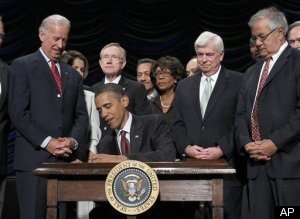
 President Obama signed into law on Wednesday a sweeping expansion of federal financial regulation, marking another — and perhaps last — major legislative victory before the midterm elections in November, which could recast the Congressional landscape.

The signature achievement — a response to the 2008 financial crisis that fundamentally alters the relationship between Wall Street and the federal officials charged with regulating it — is a culmination of two years of fierce lobbying and intense debate over how to deal with the financial excesses that tipped the nation into the worst recession since the Great Depression.

The law subjects more financial companies to federal oversight, regulates many derivatives contracts and creates a panel to detect risks as well as a consumer protection regulator. A number of the details have been left for regulators to work out, inevitably setting off complicated tangles down the road that could last for years.

Obama Financial Reform

Mr. Obama took pains to try to show how the complex legislation, with is dense pages on derivatives practices, will protect ordinary Americans.

“If you’ve ever applied for a credit card, a student loan, or a mortgage, you know the feeling of signing your name to pages of barely understandable fine print,” Mr. Obama said. “But what often happens as a result, is that many Americans are caught by hidden fees and penalties, or saddled with loans they can’t afford.”

He said the law would crack down on abusive practices in the mortgage industry, simplifying contracts and ending hidden fees and penalties, “so folks know what they’re signing.”

So what exactly is in the bill?  According to a summary in the Christian Science Monitor

A bill summary by Capitol Hill staff members includes 100 points. Here’s a shorter take, 10 points, focusing on less-publicized elements as well as some core provisions:

• A first-ever federal office focused on the insurance industry will monitor the insurance industry for systemic risk. The industry will remain regulated largely at the state level.

• FDIC deposit insurance for account-holders at banks, thrift institutions, and credit unions will be raised to $250,000 (from $100,000) retroactive to Jan. 1, 2008.

• The State Department would have to submit an “illicit minerals trade strategy” for the Congo region. Manufacturers that use minerals originating in the Democratic Republic of Congo would have to disclose measures taken to exercise due diligence on the source and chain of custody of the materials. The provision, sponsored by Sen. Sam Brownback (R) of Kansas, could affect high-tech firms like Intel and Apple.

• The bill beefs up the powers of the Securities and Exchange Commission, including extra funds for enforcement. The SEC would get new power to impose fiduriary responsibility on investment brokers. That means the brokers would have to offer advice based on the best interest of clients, not broker fees. Consumer advocates say the bill should have mandated this change, not allowed the SEC to consider it.

• New disclosure rules would apply to credit-rating firms, along with new penalties if the firms are irresponsible. In a nod to an amendment backed by Sen. Al Franken (D) of Minnesota, the bill seeks to end “shopping for ratings” by calling for the SEC to propose ways to prevent issuers of asset-backed securities from picking the firm they think will give the highest rating.

• Shareholders would get a “say on pay,” with the right to a nonbinding vote on executive pay and golden parachutes. Standards for listing on an exchange would require that compensation committees include only independent directors.

• Reforms would reshape Federal Reserve powers, including a ban on Fed bailouts targeted at specific firms (like AIG) in the future. The presidents of regional Fed banks would be selected entirely by directors representing the public, and not partly by directors representing banks that the Fed regulates.

• The bill creates a new Consumer Financial Protection Bureau to consoldiate duties now charged to various federal agencies. It would have a consumer hot line, for questions on things like mortgages, and a new office of financial literacy.

• A Financial Stability Oversight Council of top economic regulators will monitor systemwide risks. The bill summary says this group will ask the Federal Reserve to adopt “increasingly strict rules for capital, leverage, liquidity, risk management and other requirements as companies grow in size and complexity.”

• An “orderly liquidation” mechanism would allow the Federal Deposit Insurance Corp. (FDIC) to dismantle large financial companies that are on the brink of failure. Shareholders and unsecured creditors would bear losses, to end taxpayer bailouts. But the bill also allows the FDIC to shelter solvent banks from having to bear losses if there is a threat to overall US financial stability

Thank you to Barney Frank, Chris Dodd, Olympia Snowe, Susan Collins and Scott Brown and all the Democrats except Ben Nelson we have a start and reining in the runway, unregulated financial system.