The real danger: The FISA Court

Congress and the President can say all they want to that everything about the surveillance is approved by the FISA Court.  OK.  But what do we know about this secret court?  Some revelations this past weekend by the Wall Street Journal and the New York Times tell us a great deal that I, for one, didn’t know.  For example, did you know that Chief Justice John Roberts was in charge?

The Ezra Klein/Evan Soltas Wonkblog had a great summary this morning.

The laws we live by aren’t just the bills Congress passes and the president signs. It’s what the courts decide those bills actually mean.

We’re used to that. The Affordable Care Act, for instance, says that states that don’t accept the Medicaid expansion lose all their Medicaid money. The Supreme Court decided that went too far. The law might still say that if you read the underlying bill, but it no longer means that. Now states can reject the Medicaid expansion without jeopardizing the rest of their Medicaid money — and many are.

But here’s the thing: When judges make the laws, Congress can always go back and remake the laws. The changes the court makes are public, and so is their reasoning. Both the voters and Congress know what the court has done, and can choose to revisit it.

Well, usually.

The Foreign Intelligence Surveillance Court (FISA court) that governs the national surveillance state is also remaking the law. But it’s remaking the law in secret. The public has no opportunity to weigh in, and Congress can’t really make changes, because few know what the court is deciding, and almost no one can discuss the decisions without endangering themselves.

So that’s a real Catch 22.

Surveillance types make a distinction between secrecy of laws, secrecy of procedures and secrecy of operations. The expectation is that the laws that empower or limit the government’s surveillance powers are always public. The programs built atop those laws are often secret. And the individual operations are almost always secret. As long as the public knows about and agreed to the law, the thinking goes, it’s okay for the government to build a secret surveillance architecture atop it.

But the FISA court is, in effect, breaking the first link in that chain. The public no longer knows about the law itself, and most of Congress may not know, either. The courts have remade the law, but they’ve done so secretly, without public comment or review.

These rules have been remade in a court where the government is the only witness, and there’s no possibility for appeal, and all 11 judges were chosen by Chief Justice John Roberts, and 10 of the 11 judges were Republican appointees to the federal bench. This is not a court like any other court in the United States save for the secrecy. It’s a court pretty much unlike any other in the United States.

When asked who watches over the National Security Agency’s surveillance efforts, the administration says that the FISA courts do. Trite as it may be, that leads to the age-old question: Well, then who watches over the watchers?

The answer would be to rewrite the law but how does one do that with a dysfunctional Congress and a law with impacts that no one can discuss without violating it?  As I said, a Catch-22.  But there is a proposal by Senator Jeff Merkley of Oregon and a bi-partisan group of other senators to end some of the secrecy.

We should be discussing ways to rein in the FISA Court and modify the Patriot Act.  Forget Edward Snowden.  He can stay at the Moscow airport or get smuggled to South American.  Fixing the law is what is important.

Let me end with Tom Tomorrow.
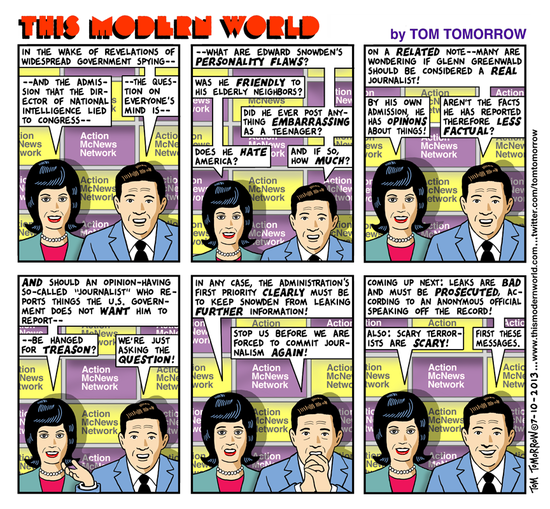
This Modern World

This Modern World

Republican gerrymandering

With the Supreme Court saying that Section 4 of the voting rights act needs a do over thus making Section 5 void, many of us are not happy.  The odds of Congress coming up with a new formula are pretty slim.  But, all may not be lost.

We know that the Republican controlled state houses used the 2010 Census to draw districts that allowed them to hold on to the House last year.  This despite Section 4 in at least some of those states.  This morning, Politico.com published a story by Alex Isenstadt in which he points out that this gerrymandering may have unintended consequences for them.

No one disputes Republicans used the once-a-decade redistricting process to  lock in their House majority — almost certainly through 2014 and possibly until  the next round of line-drawing in 2020.

But the party could pay a steep price for that dominance.

Some top GOP strategists and candidates warn that the ruby red districts the  party drew itself into are pushing House Republicans further to the right —  narrowing the party’s appeal at a time when some GOP leaders say its future  rests on the opposite happening. If you’re looking for a root cause of the  recurring drama within the House Republican Conference — from the surprise  meltdown on the farm bill to the looming showdown over immigration reform — the  increasingly conservative makeup of those districts is a good place to start.

Opposition to immigration reform by the Tea Party.

Opposition to immigration reform by the Tea Party.

These gerrymandered districts are also less diverse.

Gerrymandering and partisanship, of course, aren’t new phenomena in the  House. But the post-2010 redistricting process driven by GOP-controlled state  legislatures — Republicans wielded line-drawing power in nearly five times as  many districts as Democrats — produced significantly more districts that are  overwhelmingly conservative.

Of the 234 House Republicans, just four now represent districts that favor  Democrats, according to data compiled by The Cook Political Report. That’s down  from the 22 Republicans who resided in Democratic-friendly seats following the  2010 midterms, prior to the line-drawing.

They’re also serving districts that are increasingly white. After  redistricting and the 2012 election, according to The Cook Political Report, the  average Republican congressional district went from 73 percent white to 75  percent white. And even as Hispanics have emerged as America’s fastest-growing  demographic group, only about one-tenth of Republicans represent districts where  the Latino population is 25 percent or higher.

My Ezra Klein Wonkbook email this morning pointed out

The conventional wisdom around Washington these days is that the Republican Party needs to pass immigration reform if it’s going to survive. But remember: House Republicans aren’t the same thing as “the Republican Party.” And they probably don’t need to pass immigration reform to keep their majority. In fact, passing  immigration reform — at least with a path to citizenship — might put them in more danger. Two figures from Janet Hook in the Wall Street Journal show why.

First, “only 38 of the House’s 234 Republicans, or 16%, represent districts in which Latinos account for 20% or more of the population.”

Second, “only 28 Republican-held districts are considered even remotely at risk of being contested by a Democratic challenger, according to the nonpartisan Cook  Political Report.”

So for about 200 of the House’s Republicans, a primary challenge by conservatives angry over “amnesty” is probably a more realistic threat than defeat at the hands of angry Hispanic voters, or even angry Democrats. “Our guys actually do primary over immigration,” a top House Republican aide who wants to get immigration done told me.

Of course, that leaves some 34 Republicans who have reason to fear a Democratic challenge. And  it leaves dozens who privately support immigration reform and don’t have much to fear from either Democratic or Republican challengers.

So the Republican House members mostly represent people like themselves and need to become more conservative, not less, to keep their seats.  We aren’t talking just about immigration reform here, but a whole range of issues.  It also explains why the House’s favorite vote is to repeal the Affordable Care Act.

What does all this mean for Democratic chances to take back the House in the next election?  Isenstadt writes

New York Rep. Steve Israel, chairman of the Democratic Congressional Campaign  Committee, argued that Republicans in moderate suburban and exurban areas will  find themselves under increasing pressure in the months leading up to the  midterms.

“The problem for many Republicans in these specific districts is that if  they’re less partisan, they face a primary from the right. If they protect  themselves from a primary by being more partisan, they’re in trouble in the  general election,” Israel said. “They’re getting squeezed. We’re going to make  sure that hole is very small.”

The question is:  Are there enough of those districts for the Democrats to take the House?

It would appear that much of what is holding up legislation in the House are internal Republican fights.

When House Republicans have rallied behind legislation, it’s often been for  something deeply conservative. Two weeks ago, Republicans passed a measure that  would ban abortions after the 20th week of pregnancy. Just six GOP members  opposed the bill, including two because it didn’t go far enough.

To the conservatives, softening the GOP’s positions isn’t what’s going to  save the party in the long run.

“Political success doesn’t come from moderation,” said Arizona Rep. David  Schweikert, a Republican who opposed the farm bill and supported the  anti-abortion measure. “It’s from having principles and articulating them in a  forthright fashion.”

Schweikert, who represents a conservative Scottsdale-area district that Mitt  Romney carried with nearly 60 percent of the vote, called the Senate immigration  bill a “nonstarter.” His district is 12 percent Hispanic.

The bottom line is that so-called national Republican leaders who currently do not hold elective office along with some governors and Senators who have to run statewide campaigns can call for the party to moderate positions all they want.  The House has hitched its horse to some very conservative ideals so Republican members can get re-elected.  In the long run, this is probably good for the Democrats.

Photograph:  AP

Markey v. Gomez: The Massachusetts Senate Race

With a few days left to go, this race is officially a snoozer.  Ed Markey is a fine Representative and will make a fine Senator but somehow I can’t work up any enthusiasm.  You know, if you read this blog with any regularity, that I am a campaigner and it is a measure of something that I haven’t done much of anything for Ed except throw him a few bucks and vote in the primary where he was unopposed.  I think the race would have been a lot more exciting if someone like Mike Capuano were running, but too late for that.  Maybe we should just feel sorry for these guys since after the Elizabeth Warren – Scott Brown tussle almost anything would seem dull.  This is the assessment of the race from the Daily Kos Election update for June 21.

MA-Sen: Gabriel Gomez has gotten some “next Scott Brown” hype, to the extent that he’s a moderate Republican who’s a fresh face and running in a Massachusetts Senate special election (which will be held next Tuesday) against a charisma-challenged Democrat. However, there’s one important element that seems missing: the ability to mount a late surge and actually win the race, at least if the newest public poll is any indication. UMass Lowell, on behalf of the Boston Herald, gives Ed Markey his biggest lead of any pollster who’s looked at the race so far: among likely voters, Markey leads Gomez 56-36 (and 53-32 among all registered voters). This is the pollster’s first look at the race since the primary; they did poll the general way back in early March, and found an almost identical margin (47-28 for Markey).

Most pollsters have shown a closer race, usually in the high single digits, although the last couple public polls (from UNH for the Boston Globe, and from Harper Polling) both had it in the low teens; only one recent poll (a Suffolk poll with a 17-point margin in early May) had anything similar to this one.   And then there’s the GOP internal pollsters, who continue to see the race within low single digits; the most recent of these came out Thursday from McLaughlin, with Markey up 47-44. That follows a McLaughlin poll from two weeks ago with Markey up 45-44 (on behalf of donor John Jordan), in addition to two OnMessage polls directly on behalf of Gomez, one from less than a week ago with Markey up 47-40, and one from early May with Markey up 46-43. It’s not clear what the GOP hopes to gain from constantly leaking those polls, since most observers know that leaked internal polls usually overstate support for their candidate and none of these best-case-scenarios still manage to have Gomez winning.   The 47-44 topline is all that McLaughlin leaked to Politico, but Dave Weigel seems to have gotten his hands on the crosstabs, which show Gomez’s favorables falling from 48/27 to 41/35, while Markey’s are up a little, from 42/42 to 47/40. Again, not a sign of progress for Gomez, though maybe the GOP thinks the toplines are enough to convince donors that it’s not entirely a lost cause. (Although donations at this point would probably arrive too late to do anything other than last-minute GOTV.)

As for the original Scott Brown, the ex-Senator had publicly said that he was willing to campaign for Gomez as his schedule permitted, but so far he hasn’t done anything (apparently impeded by his busy dual careers of lobbying and appearing as a Fox News analyst). Well, he is finally popping up: he’ll be appearing at a rally with Gomez on Monday night, the night before the election. Is it really a case of a busy schedule, or just not wanting to let Gomez’s likely loss appear to be a referendum on Brown himself (especially considering that he may still get in to the Massachusetts gubernatorial race… or the New Hampshire Senate race)?

And if you’ve gotten the impression that Massachusetts voters are responding to the Ed Markey vs. Gabriel Gomez special election with a collective yawn, now we’ve gotten some quantitative proof. Absentee ballot requests are down significantly from the 2010 special election that elected Scott Brown; only 49.7K ballots have been requested, compared with 63.6K at the comparable point in 2010. The absentee ballot application deadline is on Monday, one day before the election.

This photo provided by WGBH shows U.S. Senate candidates, Republican Gabriel Gomez, left, and Democratic U.S. Rep. Edward Markey, right before a debate moderated by R.D. Sahl, center, Tuesday at WGBH studios in Boston. (THE ASSOCIATED PRESS)

This photo provided by WGBH shows U.S. Senate candidates, Republican Gabriel Gomez, left, and Democratic U.S. Rep. Edward Markey, right before a debate moderated by R.D. Sahl, center, Tuesday at WGBH studios in Boston. (THE ASSOCIATED PRESS)

I won’t be home on Tuesday so I’ve already voted absentee – for Markey.

As an aside:  I believe this is my 600th post.  When I started posting in July 2008, it was as a lark.  I write mostly for myself about what interests me which sometimes interests others.  I’ve had periods of inactivity and have a small, but faithful  following.    If you read FortLeft, thank you!

Syria? Really?

The President, probably never believing that Assad would use chemical weapons, drew a red line.  He’s been stalling around saying he needs verification, but now he has it.  The question is what should we do now.  I think Obama is stuck.

130612_barack_obama_ap_605

The United States has a long history of failed interventions.  Vietnam was basically a civil war.  We armed the Taliban when they were our “friends”.  We actually started a civil war in Iraq by stupidly dismissing all the Baathists saying they can’t be part of any new Iraqi government.  Now we are again taking sides against the Baathist who currently rule Syria.  My big fear is that the region will explode into a Sunni v. Shia conflict and we will be seen as taking sides.

Andrew Sullivan wrote this morning

My strong view, vented last night as I absorbed this stunning collapse of nerve, is that we shouldn’t fight at all. We are damn lucky to have gotten every GI out of Iraq, and the notion of being sucked back into that region again – and to join sides in a sectarian conflict – is a betrayal of everything this president has said and stood for. It’s a slap in the face for everyone who backed him because he said he wouldn’t be another Bush or McCain or Clinton. If he intervenes in Syria, he will have no credibility left with those of us who have supported his largely sane and prudent foreign policy so far. Libya was bad enough – and look at the consequences. But Syria? And the entire Middle East? Is he out of his mind?

And can you think of a dumber war than this one?

The man who said he would never engage in a dumb war is apparently preparing to join the dumbest war since … well, Iraq.

My only hope right now is that we can somehow use our threat of intervention to maneuver some type of international peace keeping force while we try to bring both sides to a negotiating table.  And let us hope that President Obama knows to get Congress involved, gets a UN resolution and the Arab League to agree before we take any action.

Sullivan concludes

One reason I supported Obama so passionately in 2008 and 2012 was because I thought he understood this and had the spine to stand up to drama queens like McCain and armchair generals like William Jefferson Clinton. But it is beginning to appear that this president isn’t actually that strong. We voted for him … and he’s giving us Clinton’s and McCain’s foreign policy. If Cameron and Hollande want to pull another Suez, for Pete’s sake be Eisenhower – not Kennedy.

My cri de coeur is here. Don’t do it, Mr President. And don’t you dare involve us in another war without a full Congressional vote and national debate. That wouldn’t just be a mistake; it would be a betrayal.

Photograph:  AP

Whistle-blower, maybe. Hero, probably not.

I just can’t figure Edward Snowden.  The more little pieces I hear about and read about him, the more I wonder about him and his motivation.  This is why I found Jonathan Capehart’s piece so interesting.  Writing in the Washington Post’s Post Partisan blog, Capehart begins

A sidewalk encounter with a friend drove home my conflicted feelings about Edward Snowden. The national-security leaker was surely a “narcissist,” he said, but Snowden was definitely “a hero.” And the more my friend talked about the reaction to Snowden, especially that of congressional Democrats, the more angry his own reaction appeared to become. Part of me wished I could work up that much passion for this self-professed champion of government transparency. Alas, I can’t.

I feel the same way.

Edward Snowden

Edward Snowden

Snowden told the Guardian which broke the story that he wanted to go to a place where the government doesn’t spy on people.  The last time I checked, Hong Kong has a complicated legal relationship to China.  China is not exactly a country that eschews spying on citizens.  In an article about extradition the Guardian says

Hong Kong has not accepted a political defence against extradition since the handover in 1997. In the 1930s it turned down a bid by French authorities for Ho Chi Minh’s return to what was then IndoChina, in a case that went all the way to the privy council. More recently, in 1994, its courts stayed the extradition of the politician Jeffrey Kitigan to Malaysia.

Guy Goodwin-Gill QC, a leading expert on extradition at Blackstone Chambers in London, noted that the international climate had changed, with offences that previously might have qualified – such as hijacking – no longer accepted as political.

“The times are very much one of co-operation across a broad range of activities. You hardly ever find a state refusing extradition for political offences any longer,” he said.

In the case of Snowden, “you certainly see political dimensions: you have members of the US senate or House of Representatives calling him a traitor – so they are building a very good case for another state to treat this as political,” added Goodwin-Gill.

Of course, there are avenues for appeal through the courts in Hong Kong which could drag out the process for years according to some British legal experts.  It remains unclear why he went to part of China when he was professing a wish to be free of surveillance.

I have also heard that he may have misrepresented his salary to the Guardian – that it was much lower than he claimed.  Snowden also claimed that as a contractor with the NSA he had broad authority to do a lot of things that some experts question.  This is from NPR

Edward Snowden’s claim that as systems administrator for a defense contractor in Hawaii he had the authority “to wiretap anyone, from you or your accountant to a federal judge to even the president,” just isn’t plausible, says a former national security lawyer at the Justice Department and Office of the Director of National Intelligence.

Carrie Cordero, the former Justice and DNI lawyer, is now director of national securities studies at Georgetown University Law Center. She tells Steve that “the notion that this individual has the authority to go ahead and … ‘wiretap’ people is just ridiculous.”

Without discussing the details of how such surveillance programs work and the safeguards that are in place to protect privacy, Cordero says that Snowden’s claim “does not resemble anything close to what I observed within the intelligence community.”

Snowden may turn out to be a braggart who stretches the truth.  And this may damage his credibility overall.  But the bottom line for me is that he doesn’t seem to have told us anything that a lot of people didn’t know before.  Capehart again

We absolutely should know what our government is up to. And, according to The Post’s Walter Pincus, we’ve known about this for quite some time.

The legendary national-security writer cites a May 2006 USA Today story that revealed “the NSA ‘has been secretly collecting the phone call records of tens of millions of Americans, using data provided by AT&T, Verizon and BellSouth,’ attributing that information to ‘people with direct knowledge of the arrangement.’” Then there was the March 15, 2012, Wired magazine story on the new $2 billion NSA Data Center in Utah and “its ability to ‘intercept, decipher, analyze, and store vast swaths of the world’s communications as they zap down from satellites and zip through the underground and undersea cables of international, foreign, and domestic networks.’”

“Was there any follow-up in the mainstream media to [James] Bamford’s disclosure, or anything close to the concerns voiced on Capitol Hill this past week? No,” Pincus writes in Tuesday’s paper.

So where should we go from here?  I agree with Capehart’s conclusions

Still, that doesn’t mean we shouldn’t have a debate about what we now know and its appropriateness now that we know it. Eugene Robinson zeroes in on this in his Tuesday column.

The NSA, it now seems clear, is assembling an unimaginably vast trove of communications data, and the bigger it gets, the more useful it is in enabling analysts to make predictions. It’s one thing if the NSA looks for patterns in the data that suggest a nascent overseas terrorist group or an imminent attack. It’s another thing altogether if the agency observes, say, patterns that suggest the birth of the next tea party or Occupy Wall Street movement.

Is that paranoia? Then reassure me. Let’s talk about the big picture and decide, as citizens, whether we are comfortable with the direction our intelligence agencies are heading. And let’s remember that it was Snowden, not our elected officials, who opened this vital conversation.

Yes, Snowden opened this conversation. But that’s as much credit as I’m willing to give him.

That sounds about right.  Let’s see if Congress talk about this without a lot of finger-pointing and hysteria.  Should the result be changes to the Patriot Act, we can give Snowden a little piece of the credit.

Photograph: AP

Surveillance and President Obama

I look forward to my weekly email from my Congressman, Mike Capuano.  Of course, I once worked for him when he was mayor of the City of Somerville (a near Boston city) so I am used to Mike’s saying what he means and I almost always agree with him.  I am copying the entire first part of his email into this post.

mike_225x315

“U.S. Rep. Michael Capuano (D-Somerville), who voted against the Patriot Act, rallied protesters by calling the law the worst attack on freedom since the 1798 Alien and Sedition Acts.”

                                                                                                                Boston Herald

                                                                                                                September 10, 2003


The Patriot Act and Verizon


I am sure you are aware that Verizon has reportedly been ordered by the top-secret Foreign Intelligence Surveillance Court (FISA court) to turn over, “on an ongoing daily basis”, information about every customer telephone number, including landline, cell and business numbers. That information reportedly includes all numbers dialed and all calls received within the United States as well as between the United States and other countries.

As I write this newsletter, the news is filled with reports that a similar program called PRISM is in place for every major internet and email provider. The government claims they have not accessed the content of phone calls, but it seems they ARE accessing the content of emails such as videos, websites visited and more. According to reports, the PRISM program is not at this time being used on U.S. citizens.

Even if you can accept the government collecting the number and length of every call you make, are you really comfortable with them having the ability to catalogue all the YouTube videos you watch, the Netflix movies you download, or the web pages you visit? It seems that our own government has access to every phone call, email and internet search for all Americans at every minute of every day.

Like most Americans, I am absolutely outraged. But, if you’re a long time subscriber to these newsletters, you probably already knew that. You also probably know that I voted against passage of the so-called “Patriot Act” and every reauthorization since it first passed in 2001.

Before I go any further, I feel compelled to remind you that I was an early and strong supporter of President Obama.  I am still amongst the strongest Obama supporters in the House of Representatives.  Nonetheless, I cannot remain silent out of some sort of misplaced loyalty to President or party when I believe that basic American rights have been intentionally trampled.

I know we live in a dangerous world and there is work to do to prevent terrorists from harming us. But we must find a balance between giving law enforcement the tools they need to track and identify terrorists and protecting the very liberties upon which our great country was founded.

This data collection has reportedly been going on for 7 years. The length of time that this has been going on and the staggering amount of data collected on every Verizon customer amounts to an incredible overreach. Even if you’re not a Verizon customer, there is clearly reason for concern. Who really believes that Verizon is the only telecommunications company required to turn over this data?

I have always believed that we must give law enforcement the tools they need to pursue criminals. However, we can do that and still protect civil liberties.

It is time for those of us who support President Obama to speak up.  I believe he is a good man and has been a good President.  However, I think his Administration has allowed their concern for our safety to lead them down the wrong path.  If we remain silent, those who have always wished him to fail on every point stand a better chance of winning the hearts and minds of America and we will all be worse off for it.  It is possible to support President Obama and yet disagree with him on certain issues – this is one of those times.

The President has said he is glad this is out in the open and he welcomes discussion.  Instead of reacting in horror – or wishing more information would be collected, we need to talk.   I’m not sure I know where the balance is, but one thing that I learned at St. John’s College (Annapolis) is that dialog can lead to greater clarity and understanding.  So let’s talk:  To each other and to the President and your member of Congress.

Photograph from Capuano website.

Putting the minimum wage in persective

Dan Wasserman of the Boston Globe explains why we need an increase in the minimum wage.

Wasserman 6-5

This needs to be a national increase.  Yes, I know.  When businesses have to pay more, they won’t hire.  But there is another side to their objection.  If they pay people more, then there will be more spending and more business and they can hire.  Plus there will be more payroll taxes paid on the larger salaries.  And more state and local taxes.  Conservatives would be happy because some folks wouldn’t need food stamps as a lot of working people do now.  Seems like a winner.

I know that some economists argue that increases always lead to higher unemployment, but a large number of small businesses already pay wages higher than the legal minimum.

Put simply, small businesses are our economy. Given that it’s still recovering, the economy needs all the help it can get to make it over the proverbial hump and flourish. Small businesses will play a key part in that journey.

Given their importance, politicians should stand up and take notice when small business owners say they strongly support a policy that has and will continue to elicit political fights of the knockdown drag-out variety, such as increasing the minimum wage. The minimum wage is a business issue that impacts a wide swath of small firms, and according to scientific opinion polling Small Business Majority released this week, two-thirds of them support increasing it and adjusting it annually to keep up with the cost of inflation.

Some have claimed that raising the minimum wage would put small firms out of business because they won’t be able to afford to pay their workers more. Our polling found a whopping 85 percent of small businesses across the country already pay their workers more than the minimum wage, though.

“You need to pay workers enough to survive. It’s in your best interest as a company because if you don’t there is nothing tying them to you.” That’s Clifton Broumand, the president of Man and Machine, a specialty computer product business in Landover, Md., who pays his workers more than the minimum wage and supports increasing it. “I want my employees to have the chance to grow and improve here. I want them to want to stay so we don’t have a lot of turnover. And I pay over minimum wage because it’s the right thing to do.”

The President proposed an increase to $9 in his State of the Union Address:  Let’s just do it.

Don’t think Ted Cruz understands government

Senator Cruz has not exactly endeared himself to his fellow Senators in the short time he has been there.  Even those in his own party.  He has been entertaining in a scary kind of way.  It’s hard to believe that he was only elected last year.  I’ve thought for awhile that he didn’t understand governing – and that that is what Senators do after all – and now maybe I understand why:  He doesn’t understand the basics of government.  Here is Ezra Klein.

Texas Republican Sen. Ted Cruz knows how to deal with the Internal Revenue Service: Get rid of it!

We ought to abolish the IRS and instead move to a simple flat tax, where the average American can fill out our taxes on a postcard. Put down how much you earn. Put down a deduction for charitable contributions and home mortgage. And put down how much you owe.

OK.  But to whom should you mail the card?  And who will check the math?

That does sound simple! But what if some citizen somewhere declines to fill out the postcard? Well, I guess we need some bureaucrat that will send them a follow-up postcard making sure they got the first postcard. If they don’t fill out that postcard, we need someone who will give them a call to make sure they’re getting these postcards.

The bottom line is follow-up and enforcement.  That is one of the things that government agencies do.  Remember your civics, Senator?  The legislature (that’s the House and Senate) passes laws, the President signs them and then someone has to make sure it happens.  This is not a function of a legislative committee.  Their role is to go back and make sure that everything functions as the law intended.  If it doesn’t, you don’t then abolish the agency but you make sure it gets fixed.  But some seem to operated on the principle that is the bath water is dirty, but throw it AND the baby out together.

And Cruz’s flat tax is actually a bit more complicated than most. It includes deductions for mortgages and charitable contributions. What if everyone says they gave a million dollars to charity and own a huge home? Who’s going to check all that out? Well, some well-meaning flat-tax collection agents, I guess.

The people doing all this need to sit somewhere. The place they sit doesn’t need to be called “The Internal Revenue Service.” It can be called “The Agency of Tax Freedom.” But it is, in effect, the Internal Revenue Service.

Ted Cruz

Maybe we have finally found the bottom line for Senator Cruz and his friends.  They want the benefits that can accrue from government, but they don’t actually understand or like it.

His plan?  That a subject to a whole ‘nother post.

Photograph from Salon.com

Primary versus Exclusive

IRS building on Constitution Avenue in Washing...

IRS building on Constitution Avenue in Washington, D.C.. (Photo credit: Wikipedia)

Trust the former budget guy Lawrence O’Donnell to find this.  The part of the tax code with the definition of 503(c)4 was written in 1954 and the IRS regulation adopted in 1959.  (Think maybe we need to update the tax code?).  According to Clare Kim writing for O’Donnell’s “The Last Word”

Internal Revenue Service agents have been struggling to do their jobs–which have been made essentially impossible by an incorrect interpretation of the law that the IRS made in 1959. It was then that the IRS changed the language of the law without any authority to do so. Here is how the tax law was written in its latest update in 1954 on 501(c)(4) social welfare organizations. The 501(c)(4) designation was to apply only to: “Civic leagues or organizations not organized for profit but operated exclusively for the promotion of social welfare.”

But a 1959 interpretation guideline written by the IRS says that: ”To be operated exclusively to promote social welfare, an organization must operate primarily to further the common good and general welfare…”

My Webster’s New Collegiate Dictionary defines exclusive as excluding or having the power to exclude, the definition we are all familiar with.  Exclude is to shut out or bar from participation, consideration or inclusion.  The 1954 tax code meant that any group receiving this exemption was to only promote social welfare.  Primarily on the other hand means chief.  The question some Senators and Representatives put to IRS officials was whether exclusive and primary meant the same thing.  The IRS officials didn’t think so and neither do I.  The 1959 reg combines the two in a way that the poor folks trying to make determinations have to find confusing.

But is this all just semantics?

At his news conference, President Obama stressed the importance of enforcing clear laws. “We’re gonna have to make sure that the laws are clear so that we can have confidence that they are enforced in a fair and impartial way and there’s not too much ambiguity surrounding these laws.”

Citizens for Responsibility and Ethics in Washington (CREW) officially filed a lawsuit against the IRS for departing from statute on “exclusively” for social welfare in the code. The organization’s 17-page filing asks the IRS to simply enforce the law as written and to drop the IRS’ false interpretation of the law.

If this happens the Democratic organizations like Organizing for America will lose their exemptions just like Tea Party groups and Karl Rove.  I don’t think this a bad thing.

Leaks, national security and the press

Every administration on every level of government worries about leaks.  Mayors worry about information on a big new construction project or policy initiative getting out too soon.  Presidents worry about national security.  Members of legislatures worry about a stand on an issue leaking before it can be “properly framed.”  Actually all politicians worry about that.  Look at VP Biden “leaking” his position on gay marriage.  I’ve been suspected of being a leaker because I knew reporters – and I’ve helped look for leaks.   I also believe in a free press, but as with any freedom, limits are needed.  The question is where that line should be.

Do you understand what the AP scandal is all about?  I have to admit that until I read this piece by Jack Shafer of Reuters, I really didn’t.  I don’t think the press did a good job of trying to explain their own story.  Did you know that the leak had to do with the underwear bomber?  I didn’t.  Never heard or saw that and I follow the news pretty closely.

Shafer writes

Journalists gasp and growl whenever prosecutors issue lawful subpoenas ordering them to divulge their confidential sources or to turn over potential evidence, such as notes, video outtakes or other records. It’s an attack on the First Amendment, It’s an attack on the First Amendment, It’s an attack on the First Amendment, journalists and their lawyers chant. Those chants were heard this week, as it was revealed that Department of Justice prosecutors had seized two months’ worth of records from 20 office, home and cell phone lines used by Associated Press journalists in their investigation into the Yemen underwear-bomber leaks.

First Amendment radicals — I count myself among them — resist any and all such intrusions: You can’t very well have a free press if every unpublished act of journalism can be co-opted by cops, prosecutors and defense attorneys. First Amendment attorney Floyd Abrams speaks for most journalists when he denounces the “breathtaking scope” of the AP subpoenas. But the press’s reflexive protests can prevent it from seeing the story in full, which I think is the case in the current leaks investigation.

,,,

The Obama administration has already used the Espionage Act to prosecute more government officials for leaking than all of his predecessors put together, but we shouldn’t automatically lump its pursuit of the underwear-bomb leaker in with those cases. Perhaps this investigation is chasing an extra-extraordinary leak, and the underwear-bomber leak is but one of the drops.

I have to point out here that the Republicans in Congress have pushed the administration to find leakers and, I fear, have caused the Democrats and President Obama to catch their paranoia.

Attorney General Eric Holder has overseen more leak investigations under Obama than were pursued under Bush

Attorney General Eric Holder has overseen more leak investigations under Obama than were pursued under Bush

Shafer continues

The AP story that has so infuriated the government described the breakup of an al Qaeda in the Arabian Peninsula plot to place an underwear bomber on board a U.S.-bound airliner. Published on the afternoon of May 7, 2012, the story patted itself on the back for having heeded the White House and CIA requests to not publish the previous week, when the AP first learned of the operation. The AP states in the article that it published only after being told by “officials” that the original “concerns were allayed.” In a chronology published in today’s Washington Post, we’re told that the CIA was no longer resisting publication of the AP story on the day it hit the wire (Monday) and that the White House was planning to “announce the successful counterterrorism operation that Tuesday.”

That may be the case, but the government was still incensed by the leak. In fact, it appears that officials were livid. As my Reuters colleagues Mark Hosenball and Tabassum Zakaria reported last night, the government found the leak so threatening that it opened a leak investigation before the AP ran its story.

Now, what would make the Obama administration so furious? My guess is it wasn’t the substance of the AP story that has exasperated the government but that the AP found a source or sources that spilled information about an ongoing intelligence operation and that even grander leaks might surge into the press corps’ rain barrels.

At the risk of making the Department of Justice’s argument for it, a leak once sprung can turn into a gusher as the original leakers keep talking and new ones join them, or as the government attempts to explain itself, or as others in the government begin to speak out of turn. From what I can tell, all of the above happened after the AP story appeared.

So there you have it.  It was not the particular leak, but the fact that there was a leaker that could potentially leak again.  As Shafer points out when there is a leak there is also the problem of government officials saying too much and, in effect becoming leakers.  What happened here was the existence of a double agent got out, mostly because of what government officials said in trying to explain the original AP story.   Shafer summarizes the trail and concludes

To begin with, the perpetrators of a successful double-agent operation against al Qaeda in the Arabian Peninsula would not want to brag about their coup for years. Presumably, al Qaeda in the Arabian Peninsula will now use the press reports to walk the dog back to determine whose misplaced trust allowed the agent to penetrate it. That will make the next operation more difficult. Other intelligence operations — and we can assume they are up and running — may also become compromised as the press reports give al Qaeda in the Arabian Peninsula new clues.

Likewise, the next time the CIA or foreign intelligence agency tries to recruit a double agent, the candidate will judge his handlers wretched secret keepers, regard the assignment a death mission and seek employment elsewhere.

Last, the leaks of information — including those from the lips of Brennan, Clarke and King — signal to potential allies that America can’t be trusted with secrets. “Leaks related to national security can put people at risk,” as Obama put it today in a news conference.

The ultimate audience for the leaks investigation may not be domestic but foreign. Obviously, the government wants to root out the secretspillers. But a country can’t expect foreign intelligence agencies to cooperate if it blows cover of such an operation. I’d wager that the investigations have only begun.

None of this means we should go rooting around people’s cell phone and email records without some protection.  In his reaction to the scandal, President Obama called for Congress to enact an updated media shield law which would replace the Justice Department’s internal regulations (which I think they actually didn’t follow).  Wouldn’t it be interesting for Congress to take some proactive steps instead of just investigating?

Photograph: Alex Wong/Getty Images