Syria? Really?

The President, probably never believing that Assad would use chemical weapons, drew a red line.  He’s been stalling around saying he needs verification, but now he has it.  The question is what should we do now.  I think Obama is stuck.

130612_barack_obama_ap_605

The United States has a long history of failed interventions.  Vietnam was basically a civil war.  We armed the Taliban when they were our “friends”.  We actually started a civil war in Iraq by stupidly dismissing all the Baathists saying they can’t be part of any new Iraqi government.  Now we are again taking sides against the Baathist who currently rule Syria.  My big fear is that the region will explode into a Sunni v. Shia conflict and we will be seen as taking sides.

Andrew Sullivan wrote this morning

My strong view, vented last night as I absorbed this stunning collapse of nerve, is that we shouldn’t fight at all. We are damn lucky to have gotten every GI out of Iraq, and the notion of being sucked back into that region again – and to join sides in a sectarian conflict – is a betrayal of everything this president has said and stood for. It’s a slap in the face for everyone who backed him because he said he wouldn’t be another Bush or McCain or Clinton. If he intervenes in Syria, he will have no credibility left with those of us who have supported his largely sane and prudent foreign policy so far. Libya was bad enough – and look at the consequences. But Syria? And the entire Middle East? Is he out of his mind?

And can you think of a dumber war than this one?

The man who said he would never engage in a dumb war is apparently preparing to join the dumbest war since … well, Iraq.

My only hope right now is that we can somehow use our threat of intervention to maneuver some type of international peace keeping force while we try to bring both sides to a negotiating table.  And let us hope that President Obama knows to get Congress involved, gets a UN resolution and the Arab League to agree before we take any action.

Sullivan concludes

One reason I supported Obama so passionately in 2008 and 2012 was because I thought he understood this and had the spine to stand up to drama queens like McCain and armchair generals like William Jefferson Clinton. But it is beginning to appear that this president isn’t actually that strong. We voted for him … and he’s giving us Clinton’s and McCain’s foreign policy. If Cameron and Hollande want to pull another Suez, for Pete’s sake be Eisenhower – not Kennedy.

My cri de coeur is here. Don’t do it, Mr President. And don’t you dare involve us in another war without a full Congressional vote and national debate. That wouldn’t just be a mistake; it would be a betrayal.

Photograph:  AP

A Nobel Prize Winner and questions about Nagasaki

There was a very interesting profile in the New York Times Science section this week about Osamu Shimomura the Nobel Prize winning chemist.  Never heard of him?  Me either.  It was his life, not his science I found most interesting.  My mother’s family is from a small town near Hiroshima and I grew up knowing about Hiroshima and Nagasaki.

Sixty-eight years ago, Osamu Shimomura was a 16-year-old high school student working in a factory seven and a half miles from Nagasaki, Japan. Sitting down to work, a light flashed, briefly blinding him, and the pressure wave from an explosion came rolling through.

On his walk home from the factory, he was drenched with a black rain. His grandmother immediately had him bathe, most likely saving him from radiation-related illness.

Dr. Shimomura has said that he mostly doesn’t think about the bomb dropped on Nagasaki, but he recently delivered a lecture at the Los Alamos National Laboratory.  Los Alamos is the home of the Manhattan Project and the birthplace of the atomic bombs dropped on Hiroshima and Nagasaki.  The bomb was not the topic of Dr. Shimonura’s lecture.

Instead, he recounted the discovery and development of one of the most significant tools for modern biotechnology: the green fluorescent protein, or G.F.P., used widely in cell and molecular biology as a visual tracer. The discovery, which has deepened the understanding of a wide range of fundamental biological processes, brought him the Nobel Prize in Chemistry in 2008, along with Martin Chalfie and Roger Y. Tsien.
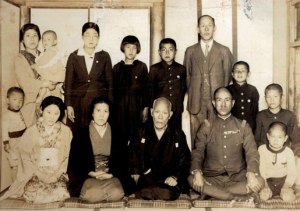
Together with my father who returned briefly from Manchuria in 1939. Front row from left: my mother Yukie, grandmother Tsuki, grandfather Kosaburo, father Chikara, younger brother Sadamu, and myself behind Sadamu, together with my uncle Eijiro Sata's family in back row.

Together with my father who returned briefly from Manchuria in 1939. Front row from left: my mother Yukie, grandmother Tsuki, grandfather Kosaburo, father Chikara, younger brother Sadamu, and myself behind Sadamu, together with my uncle Eijiro Sata’s family in back row.

In his autobiography accompanying his Nobel information, Dr. Shimomura did talk about Nagasaki.

On August 6, 1945, news reports informed us that the city of Hiroshima had been completely destroyed by a new type of bomb; we didn’t know what kind. Three days later, shortly before 11 AM, a siren sounded at the Isahaya factory, notifying us of an air raid. As usual, rather than going into a bunker, I went to the top of a nearby hill with a couple of friends and looked at the sky. We saw a single B-29 going from north to south towards Nagasaki, about 15 km away. I thought that its course was unusual. The B-29 dropped two or three parachutes and I heard sporadic gunshots. Watching carefully, I saw no people attached to the parachutes. Within a few minutes, another B-29 followed the first one, and a siren sounded the “all clear” signal. We returned to our factory building.

At the moment I sat down on my work stool, a powerful flash of light came through the small windows. We were blinded for about 30 seconds. Then, about 40 seconds after the flash, a loud sound and sudden change of air pressure followed. We were sure there was a huge explosion somewhere, but we didn’t know where. The sky was rapidly filling with dark clouds, and when I left the factory to walk home, about three miles away, a drizzling rain started. It was black rain. By the time I arrived home, my white shirt had turned gray. My grandmother quickly readied a bath for me. That bath might have saved me from the ill effects of the strong radiation that presumably existed in the black rain.    The next morning, a technical officer told us that the parachutes we had seen the day before contained measurement instruments and a transmitter. He also mentioned that there was serious damage in Nagasaki, but the details were unknown. The chief of the factory organized a rescue party. We tried to enter Nagasaki, but could not because the roads and the railroad were impassable. Later that afternoon, the railroad was opened to Michinoo, near Nagasaki station, and rescuers began to transport injured people to Isahaya and other cities.

On August 15, in a radio broadcast, Emperor Hirohito declared unconditional surrender. This was the first time that most Japanese citizens had heard the emperor’s voice. I think there was a widespread feeling of relief, and also fear for an uncertain future.    Many years passed before we had detailed information about the atomic bombs that were dropped on Hiroshima and Nagasaki. The Nagasaki bomb was a different type and far more powerful than the Hiroshima bomb. Even if the use of the Hiroshima bomb was justifiable in order to precipitate an end to the war, the bomb dropped on Nagasaki three days later was clearly a test of new arms. It cannot be justified.

It cannot be justified.  I have always had questions about Nagasaki.  Why didn’t the Emperor call for surrender immediately?  Why didn’t we wait a few more days before dropping the second bomb?

The Times story recounts others at the Los Alamos dinner raising the subject.

At a dinner, Bette Korber, a theoretical biologist at the Los Alamos National Laboratory, told of how her father had been on a troop ship preparing for the invasion of Japan. For years, she said, he had credited the decision to drop the bombs with sparing his life. Years later, however, when declassified documents reopened questions about whether the Nagasaki bomb had been necessary to end the war, he was in despair, she said.

Gary Doolen, a physicist who had been a weapon designer at the lab, said there was evidence that the second bomb had been dropped as a demonstration of American power to Russians, who were then massing troops in East Asia.

Dr. Shimomura, tall and stooped, mostly listened.

The next day he and his wife returned to the museum.

…Moments before the Nagasaki bombing, Dr. Shimomura had seen a B-29 bomber drop three parachutes. The drop had puzzled him. He would later learn that they carried instruments for data transmission and measurement.

He asked John E. Pearson, the Los Alamos physicist who had invited him to lecture, about the instruments. After some hunting they found models of the original parachute payloads.

“Some guy came up and started explaining what we were looking at,” said Dr. Pearson. “Osamu said, ‘Yes. I watched them falling.’ I don’t think I’ve ever seen anyone quite as stunned as that guy.”

I wonder what those instruments recorded.  I wonder if the information would be useful as we try to deal with other nuclear disasters.  I wonder if they were destroyed by the bomb.
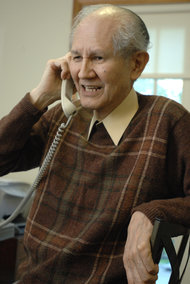
Shimomura

Photograph of the family from Shimomura’s Nobel Autobiography

Photograph of Shimomura Josh Reynolds/Associated Press

Just Sayin’…

As we who lived through those times know, they were very difficult and people made a lot of strange choices. But I will assume that Mr. LaPierre was NOT protesting the war with his requested deferrment.

kstreet607's avatarThe Fifth Column

H/t: The Platzner Post

Memo:  With full knowledge that FaceBook has a way of exaggerating claims, I researched this and found that the term “mental condition” was indeed a slight exaggeration.  Here’s what I found.

View original post

Women in combat

The Secretary of Defense, Leon Panetta, and the head of the Joint Chiefs, Martin Dempsey, recently signed an order to allow women to serve in combat.  Each branch of the services will now develop a timetable and guidelines for implementation.  This move will allow for official recognition of roles women are already playing.

I posted a pithy little sentence about this from Winning Progressive on my Facebook page only to set off a sometimes not completely coherent discussion among some who oppose the entire idea.  What I posted was

“Now that women can serve in combat that leaves the neo-cons as the only group that apparently can’t serve in war.” – LOLGOP

When I put the comment on Facebook, I was more interested in the neo-cons not serving than in the decision about women.  But the discussion ended up centering around women and combat.  (Sometimes I think friends on the right don’t have much sense of humor.)  Their arguments against were essentially the same ones that Kathleen Parker made in her column in the Washington Post.

The two most popular arguments for inclusion of women in combat would be valid if only they weren’t incorrect. They are: (1) Only qualified women will be included in combat units; (2) We have a volunteer military and, therefore, only those who want to serve in combat will.

Parker worries about the lowering of physical standards, she call it “gender norming” and the fact that women will now have to register for selective service so we may not have a volunteer army at some point.  Parker also seems to think that women would be able to choose whether to be in combat but men would not which would result in the kind of inequality allowing women in combat is supposed to correct.  It is my understanding that both men and women currently make some choices about what job they want after basic training and there are qualifying tests for those jobs.  But right now, women just can’t choose the jobs that have a combat designation.

So how did the decision happen in the first place?  Here is how CNN reported the story.

For Gen. Martin Dempsey, Thursday’s move to open combat units in the U.S. military to women had its roots nearly a decade ago, on the streets of Baghdad.

Dempsey took command of the Army’s 1st Armored Division in June 2003, when Iraqi insurgents were starting to target American troops with sniper fire, grenades and roadside bombs. As he prepared for a trip outside his headquarters, he took a moment to introduce himself to the crew of his Humvee.

“I slapped the turret gunner on the leg and I said, ‘Who are you?’ And she leaned down and said, I’m Amanda.’ And I said, ‘Ah, OK,’ ” Dempsey told reporters at the Pentagon.

“So, female turret-gunner protecting division commander. It’s from that point on that I realized something had changed, and it was time to do something about it.”

Thursday, Dempsey — now chairman of the Joints Chiefs of Staff — sat alongside Defense Secretary Leon Panetta as both men signed a directive that will open front-line posts to the roughly 200,000 women now serving in the active-duty military.

Panetta said the move is a bow to reality on the battlefield, where women in what are technically non-combat units already find themselves fighting alongside their male comrades.

I think that Parker and other opponents envision battlefields with opposing armies lined up to face each other.  Don’t think this happens any more.

Once we heard similar arguments opposing women in the police force.  I once had a high ranking Virginia State Trooper tell me that women were generally too short to meet what was then a height requirement (I think it was 5’9″ or 5’10”) so they couldn’t be troopers.  Why did they have a height requirement?  So they could fire over their vehicles.  When, I asked, was the last time you fired over your vehicle?  Never have, he said.

There will be a lot of fuss over physical standards and what they really need to be.  And sometimes they will be like the height requirement for Virgina troopers – just tradition.  In the end, women will serve in combat as they do now only they will get credit.  And yes, maybe women will have to register for Selective Service, but maybe we can turn that into a national service requirement for everyone to give a couple of years helping the country in some way.

With this move, we join our allies.

Several U.S. allies, including NATO members France, Canada and Germany, allow women to serve in combat posts. Earlier this month, the U.S. Army opened the 160th Special Operations Aviation Regiment to women, and it has begun recruiting female pilots and crew chiefs. The Navy put its first female officers on submarines in the past year, and certain female ground troops have been attached to combat units in Iraq and Afghanistan.

Change is hard, but we have until January 2016 to see what the actual changes will be.  See what you started, Amanda!

Illustration from the Denver Post.