Remembering Maxine Kumin

When I read that Maxine Kumin had died, I went to the bookcase where we keep a lot of our poetry and found my copy of  Our Groundtime Here Will Be Brief .  Here is one of my favorites.  (Text from Page 71)

LATE SNOW

It’s frail, this spring snow, it’s pot cheese
packing down underfoot. It flies out of the trees
at sunrise like a flock of migrant birds.
It slips in clumps off the barn roof,
wingless angels dropped by parachute.
Inside, I hear the horses knocking
aimlessly in their warm brown lockup,
testing the four known sides of the box
as the soul must, confined under the breastbone.
Horses blowing their noses, coming awake,
shaking the sawdust bedding out of their coats.
They do not know what has fallen
out of the sky, colder than apple bloom,
since last night’s hay and oats.
They do not know how satisfactory
they look, set loose in the April sun,
nor what handsprings are turned under
my ribs with winter gone.

late snow

Maxine Kumin was a Pulitzer Prize-winning poet and once served as the consultant in poetry to the Library of Congress or Poet Laureate as the position is now know.  The New York Times obituary recounts her struggles after an accident left her with a severe spinal injury,

One of her most talked-about works of nonfiction was her memoir, “Inside the Halo and Beyond” (2000), a book born of swift, deep adversity.

An accomplished horsewoman, Ms. Kumin was training for a carriage-driving show in 1998 when her horse was spooked by a passing truck. She was thrown from the carriage, which weighed 350 pounds; the horse then pulled the carriage over her. She suffered serious internal injuries, 11 broken ribs and a broken neck.

A doctor told her afterward that 95 percent of patients with her injuries die; of those who survive, 95 percent remain quadriplegic.

Ms. Kumin spent months encased in a cervical-traction halo.

“Imagine a bird cage big enough for a large squawking parrot,” she wrote. “Imagine a human head inside the cage fastened by four titanium pins that dig into the skull. The pins are as sharp as ice picks.”

She was sustained, she later said, by her family (her daughter Judith typed the spoken words that became the memoir); by her beloved Boston Red Sox; and by the reams of poems she harbored within her. After a grueling rehabilitation, Ms. Kumin regained most of her mobility and even rode horses again, though she lived with chronic pain to the end of her life.

The New York Times also discusses her belief in the sound of poetry.

The stylistic hallmarks of her poetry include carefully calibrated rhythms; frequent, often witty use of rhyme, near-rhyme and assonance (also called vowel rhyme); and clean, unadorned diction.

Ms. Kumin was such an evangelist for the sound of poetry that she exhorted her students — she taught at Tufts, New England College, the Bread Loaf Writers’ Conference and elsewhere — to memorize 30 to 40 lines of it a week.

“The other reason, as I tell their often stunned faces, is to give them an internal library to draw on when they are taken political prisoner,” she told The Times-Picayune of New Orleans in 2000. “For many, this is an unthinkable concept; they simply do not believe in anything fervently enough to go to jail for it.”

Ms. Kumin was herself a great memorizer, and in her work one can hear the faint, benevolent echoes of the poets she drank in as a child: Gerard Manley Hopkins, A. E. Housman, Marianne Moore and others.

That’s a challenge – 30 to 40 lines of poetry a week!  Good mental exercise for those of us with aging memories.  I’ll start with “Late Snow” and maybe I will know it by April.

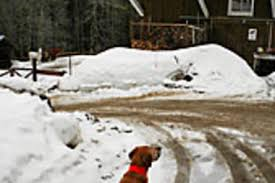
Photograph:  Christian Science Monitor

Ms. G. predicts more winter

Groundhog Day.  February 2.  For some reason that groundhog in Pennsylvania gets all the press even though I’m not sure how he can predict the weather for the entire country.  But Massachusetts has Ms. G.  According to New England Cable News

Ms. G. predicts more winter.

Ms. G. predicts more winter.

Massachusetts has its own groundhog to make predictions about the weather on Groundhog Day.

Both Punxsutawney Phil and Ms. G, the Mass. groundhog, saw their shadows this year. Legend has it; this means that there will be six more weeks of winter.

“We don’t feel like Punxsutawney Phil has much sway here in Massachusetts. I mean, we wouldn’t use a weather forecaster from Pennsylvania to tell us our local weather,” said Tia Penney of a Drumlin Farm Wildlife Sanctuary.

Dozens of families gathered at the sanctuary on Sunday to witness Ms. G give her forecast. But, not everyone was happy with her prediction.

“I didn’t see the shadow and I wanted spring to be here, cause then, after spring, there is no school,” said Asia Faline, a Wellesley school student.
Blue Hill Weather Observatory says Ms. G is correct in her forecast 60% of the time.

So what is the origin of Groundhog Day?  Is there any science to it?  Today EarthSky news told us everything you always wanted to know about this important day.  Here are some of the interesting facts.

We all know the rules of Groundhog Day.  On February 2, a groundhog is said to forecast weather by looking for his shadow.  If it’s sunny out, and he sees it, we’re in for six more weeks of winter.  On the other hand, a cloudy Groundhog Day is supposed to forecast an early spring.

What you might not know is that Groundhog Day is really an astronomical holiday.  It’s an event that takes place in Earth’s orbit around the sun, as we move between the solstices and equinoxes.  In other words, Groundhog Day falls more or less midway between the December solstice and the March equinox.  Each cross-quarter day is actually a collection of dates, and various traditions celebrate various holidays at this time.  February 2 is the year’s first cross-quarter day.

In the ancient Celtic calendar, the year is also divided into quarter days (equinoxes and solstices) and cross-quarter days on a great neopagan wheel of the year.  Thus, just as February 2 is marked by the celebration of Candlemas by some Christians, such as the Roman Catholics, in contemporary paganism, this day is called Imbolc and is considered a traditional time for initiations.

The celebration of Groundhog Day came to America along with immigrants from Great Britain and Germany.  The tradition can be traced to early Christians in Europe, when a hedgehog was said to look for his shadow on Candlemas Day.

Try this old English rhyme:  If Candlemas Day be fair and bright, winter will have another flight.  But if it be dark with clouds and rain, winter is gone and will not come again.

So even though it has now turned a little cloudy here in Boston, the sun was out this morning and Ms. G. says more winter.  In fact,  I think the prediction is for snow on Wednesday.

Photograph is a still from the NECN story.

Theft of a violin – Updated

On Monday night in Milwaukee a violin was stolen.  OK.  So why are you blogging about this, you maybe wondering.  Because the violin stolen was not just any violin.  The New York Times reports

It should have been one of those nights musicians live for. Frank Almond, the concertmaster of the Milwaukee Symphony Orchestra for nearly two decades, had just closed a chamber concert in his own “Frankly Music” series with Messiaen’s hushed, eerily intense “Quartet for the End of Time.” Mr. Almond drew the graceful, ringing high notes of the finale from his prized 1715 Stradivarius violin, producing a tone so intensely focused that the audience in the Wisconsin Lutheran College’s 388-seat auditorium sat in awed silence for 20 seconds before applauding.

But the glow of the moment evaporated quickly, once Mr. Almond, 49, stepped into the college art center’s parking lot at 10:20 p.m. Monday, his violin carefully swaddled against the subzero temperatures and minus-25-degree wind chill. And as he neared his car, a figure stepped up to him and shot him with a stun gun.

It happened in a matter of seconds: Mr. Almond dropped the violin, the attacker scooped it up and jumped into a late 1980s or early ’90s maroon or burgundy minivan, where an accomplice was waiting to speed away. Edward A. Flynn, the Milwaukee police chief, said late Thursday afternoon that Mr. Almond had described the thieves as a man and a woman. Chief Flynn has given the value of the violin as “the high seven figures.” The police said earlier that the violin’s empty case had been found several miles from the hall.
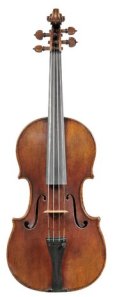
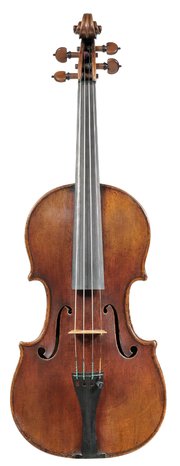
Stradivarius violin

Stradivarius violin

We read all the time about musicians and their favored instruments.  They are always transporting them around in cabs, on subways, on trains and planes.  I once saw the cellist, Yo Yo Ma, with his cello on Boston’s Red Line.  Probably the same cello he has left at least once in a cab.  My husband told me when I mentioned I was going to blog about Mr. Almond, that he once left his trumpet on the Orange Line.  Luckily someone had turned it into the MBTA lost and found.  Mr.  Almond can certainly get another high quality violin, but probably not another Strad.

What is shocking about the incident is that it was not stolen from a dressing room left unlocked or lost on some public conveyance, but that he was attacked just as if someone was going to steal his watch or wallet or ring and that it was clearly planned.

A spokeswoman for the orchestra confirmed that the instrument was insured, but said that because of the investigation, she could not provide details about the amount, or what restrictions, if any, applied to the use of the instrument. Given its prominence — high-resolution photographs of Strads are plentiful — it would be virtually impossible to sell the instrument on the open market.

“We’re not engaging in the pretense that this is just any other crime,” Chief Flynn said on Thursday. “This is an extraordinary art theft. It is just as extraordinary as if some master criminal crept into the Milwaukee Art Museum and stole several of its most valuable pieces. It’s an inordinately rare violin of unquestioned provenance, made 300 years ago and worth a lot of money. So obviously we are treating this like much more than just another mugging.”

Like the paintings stolen and never recovered from the Isabella Stewart Gardner Museum which also can’t be sold.  If they are still around, some wealthy person somewhere is enjoying them or they are lying abandoned in a basement or attic.  I hope it is the former.

…Antonio Stradivari was, by common agreement among violin fanciers, the master builder of violins, a creator of instruments with a sound that subsequent makers have been at a loss to reproduce. Fewer than 650 of Stradivari’s violins survive, and Mr. Almond’s — which was given to him on “permanent loan” by an anonymous patron in 2008 — is regarded as a particularly fine example.

Called the Lipinski Strad, after an early owner, the instrument was built in 1715, when Stradivari was in his prime. The first known owner was the composer and virtuoso violinist Giuseppe Tartini, who flourished in the early 18th century and whose “Devil’s Trill” Sonata remains one of the Baroque repertory’s great showpieces. Karol Lipinski, a Polish player who was friendly with Paganini, Liszt and Schumann, owned it in the early 19th century. It made its way to Milwaukee in 1962, in the possession of Evi Liivak, an Estonian violinist, who died in 1996. Then it dropped out of sight until the current owner offered it to Mr. Almond.

A stolen instrument is very difficult to recover.  According to the FBI, 11 violins (including 6 Strads) have been stolen since 1985; only 3 are known to have been recovered.

…In one recent case, a 1696 Stradivarius was stolen in November 2010 from Min-Jin Kym, a young South Korean violinist who was living in London, while she and a friend ate lunch at Euston Station. The violin was found in July 2013.

A more famous case was the 1713 Strad (called the Gibson) owned by the early 20th-century violinist Bronislaw Huberman. It was stolen from Huberman twice: once from a hotel room in Vienna, in 1916, and then in 1936 from his dressing room at Carnegie Hall while he was onstage playing another instrument. The violin was recovered only in 1985 (Huberman died in 1947) when a jazz violinist who had been playing it in smoky clubs all those years made a deathbed confession. It is currently owned by the violinist Joshua Bell.

We hope that the Milwaukee Strad ends up in the hands of someone who will play it and they will have listeners who will enjoy the music.

UPDATE:

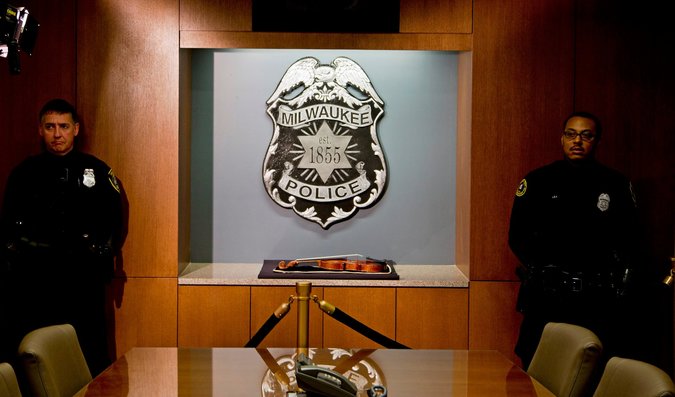
The Strad recovered.

The Strad recovered.

It is reported this morning that the violin has been recovered.  The New York Times reports

A Stradivarius violin stolen last month from the concertmaster of the Milwaukee Symphony Orchestra has been recovered seemingly unharmed, the authorities in Milwaukee announced on Thursday.

The rare instrument, which dates from 1715 and has been valued at $5 million, was recovered Wednesday night, after the police searched a residence in Milwaukee, led there by one of three suspects recently arrested in the case, Edward A. Flynn, the Milwaukee chief of police, said at a news conference. Officers found the violin in a suitcase in an attic. Chief Flynn described the home as owned by a friend of a suspect, but said that person was believed to have had no knowledge of what he had been asked to store.

And arrests were made.

On Wednesday, the Milwaukee police announced they had arrested two men and a woman this week in connection with the theft. On Thursday, officials identified two of the suspects as Universal Knowledge Allah, 36, a local barber who is being accused of providing the stun gun used against Mr. Almond; and Salah Ibin Jones, 41, whom the police described as their primary suspect. The third suspect, a 32-year-old woman, was not identified but is believed to have been driving the getaway vehicle.

The police have confirmed reports that Mr. Jones was previously convicted of possessing a stolen sculpture four years after it disappeared from a Milwaukee art gallery nearly two decades ago.

“This individual has done fairly high-end art theft in the past, and the last time his plan was to keep it in a safe place for a number of years and then bring it out of hiding and do something with it,” Chief Flynn said. “So theoretically it’s plausible that might have been his plan here: to keep it off the market and out of sight for a number of years.”

Stefan Hersh, a violin expert who appraised the instrument in 2012, said he had been contacted by the F.B.I. and went to Milwaukee on Thursday to authenticate the instrument. Seeing no damage, he performed a piece by Bach on the 300-year-old Stradivarius, a private concert for the police.

I’m sure we will hear more about how the violin was found in the attic, but at least it is safe and wasn’t there long enough to be damaged.  How could they have thought that wood would survive the heat and cold there and still have value many years from now?  But luckily that didn’t happen and it will be played again.

Photograph of a Stradivarius:  Michael Darnton

Photograph of recovered violin:  Darren Hauck/Reuters
About traffic studies

Unless you’ve been in a coma or cave or maybe sequestered somewhere you’ve heard about the traffic problems on the George Washington Bridge last September.  Everyone is investigating:  A joint special committee of the New Jersey legislature, the United States Attorney for New Jersey, at least two Congressional Committees and a great many news investigative reporters.  But until subpoenas come due in a week or so and people have a chance to digest all the material that will be submitted, including listening to cell phone conversations and searching for text messages and email, there is likely to be no new information.  So in case you are suffering from bridgegate withdrawal, here is some information on traffic studies.

Trust Calvin Trillin to be on the case.  First, his poem as published in the Nation.

Fort Lee Jam   

Chris Christie insists he knew nothing at all
Re jams at the bridge lanes. Well, maybe.
But, now, those commuters are smiling. They say,
“So who’s in a bigger jam, baby?”

traffic study

And then we have his imaginary consultant’s report from the traffic study published in the New York Times Sunday Review.

FINAL REPORT OF A TRAFFIC STUDY CONDUCTED AT THE FORT LEE, N.J., APPROACH TO THE GEORGE WASHINGTON BRIDGE, SEPT. 9-12, 2013

Object of the study. The study was designed to ascertain the effect on traffic if two out of three tollbooths at the Fort Lee, N.J., approach to the George Washington Bridge were closed.

Study designer. The traffic study was designed by Duane C. Milledge, Ph.D. Dr. Milledge was most recently the designer of a traffic study submitted to the agency that operates the two bridges that cross the Missouri River near downtown Kansas City, Mo. The design for that study calls for furnishing commuters on one bridge with $20 bills and instructions to say to the toll taker, “Sorry, it’s the smallest I’ve got,” collecting no tolls on the other bridge, and observing the result. Dr. Milledge is a member of the American Association of Traffic Engineers, a contributor to Queue Quarterly, and a Republican precinct captain in Summit, N.J.

Hypotheses. The principal hypothesis of the study was that the tollbooth closings might ease traffic flow onto the bridge, due to fewer cars from Fort Lee being able to gain bridge access.

Additional benefits that might accrue if the two tollbooths were closed permanently. It was posited that the space occupied by the two tollbooths in question might more efficaciously serve the revenue-flow needs of the Port Authority of New York and New Jersey through a use other than collecting tolls — for instance, concessioning them out as a Shake Shack or a retail outlet for selling such souvenirs as George Washington Bridge coffee mugs, Springsteen memorabilia and CDs of Don Imus drive-time radio shows from the ’80s.

¶ Methodology. The methodology of the study was to shut down two out of three tollbooths and see what happened.

Interaction of researchers and commuters. The research team had no problem collecting data from individual drivers waiting to go through the one open lane, since their cars were virtually stationary. There were only 14 instances of violence directed at the survey takers, almost all of which consisted of commuters throwing coffee from travel mugs or paper cups. Fortunately, no researcher was scalded, since the drivers had been waiting so long that their coffee was cold.

…Corporal Sicola [research assistant]  found that 58 percent of the motorists in line shouted some imprecation, ranging from the sort often heard in the stress of a rush-hour subway or an overcrowded emergency room (e.g., “You people should burn in hell” or “You can take your study and stick it where the sun don’t shine”) to rare curses, presumably ethnic in origin (e.g., “May streetcars grow on the back of your throat”).

As we all know the lane closures were ended on Day 4, so a follow-up study is recommended.

Now, here is advice from Dr. Gridlock of the Washington Post on how to do an actual traffic study.

For close to three millennia— from the days of the Romans until the interstates were built — conducting a traffic study was simple, dreary work: send somebody out with a clip board to count ox carts or stage coaches or automobiles.

Did this create traffic jams on the Appian Way or Oregon Trail? Probably not.

Like everybody else who drives, Christie knows about traffic cameras. New Jersey has almost as many of them as it does cranberries,  and they outnumber the pigeons on the suddenly-controversial approaches to the George Washington Bridge.

Back in the days before he acquired a chauffeur Christie had to listen to the same radio traffic reports as the plebeians. As an observant fellow, he’s bound to have noticed that in the past decade they’ve gotten much more sophisticated.

Those cameras have helped, but a major advance has been because a company called Inrix and a few competitors take the heartbeat of traffic and supply local radio and TV stations with what they report. Inrix has a world-wide network of transponders installed in most trucks and what are called “fleet vehicles” — rental cars and delivery vans.

Those transponders provide real-time information, so your cheerful traffic reporter can tell you exactly how much traffic to expect — or where the major tie ups are — on, for example, the George Washington Bridge.

And then you can take the data collected and do some computer modeling.  Bill Baroni who was the one who tried to explain the fake alleged traffic study would have had some really nice charts to show them.  You don’t need poor Corporal Sicola!

Illustration by Peter Arkle for the New York Times

Reading series mysteries

The last few months have not been kind to my ability to blog.  Between wrist tendonitis and cataract surgery on both eyes, I haven’t been able to do much on the computer.  But now my wrist is settling down and my eyes are staring to clear.  I had intended to start back slowly but I seem to have posted quite a bit this past week.

During my absence from the computer, I have been able to read.  My big accomplishment:  reading the entire Thomas and Charlotte Pitt series by Anne Perry.  I had read a number of them before but realized that I had skipped most of the ones in the middle.  There are 26.  Thomas Pitt begins as a detective with what became the Metropolitan Police in late 19th century London.  He is the son of a gamekeeper who was educated with the master’s son – a key to his rise.  Charlotte is the middle daughter of an upper class, but not aristocratic family.  Their marriage is gradually accepted by her family. (I have to say that I never quite understood why she never had even a small dowry, but I may have missed the explanation.)  Her sister, Emily,  marries up to the aristocracy and then when her husband dies, a man who gets elected to Parliament.  Emily’s great aunt from her first marriage plays a major role in most of the books.  I’m sure you have guessed by now that these are mystery novels. The genius of Anne Perry is her ability to capture the time while often centering her stories around issues that are still current like rape and political corruption.

Having finished up with Thomas and Charlotte Pitt, I began thinking of the other series I’ve followed over the years beginning with the Nero Wolfe books by Rex Stout and Dorothy Sayers’ Peter Wimsey series and moving on to the Margaret Maron’s Deborah Knott, Victoria Thompson’s Sarah Brandt and, of course, J.D. Robb and the “in death” books.  What happens to me is that the characters become familiar friends.  One gets involved in their lives and is sad when they go away because the author dies or simply, like Sayers, decides not to write any more.  One watches children grow up and wonders how the relationship between Deborah and her stepson, Cal will evolve.  Will Eve Dallas ever have children?  How will Sarah’s relationship with Malloy impact his mother?  And people follow different writers and characters.  But some series get read primarily for the mystery.   I read all of P.D. James, but not necessarily because I wanted to know what would happen next to Adam Dalgliesh although his development has been fun to follow and it is   interesting that James has written the best follow-up to Jane Austen’s “Pride and Prejudice”: “Death Comes to Pemberly”,

So the question becomes whether or not to read anything by an author, authorized or not, who picks up the series.  I’ve never read any of the “new” Nero Wolfe’s or the continuation of Robert Parker’s Spencer series, but I have read all three of Jill Patton Walsh’s Peter Wimsey/Harriet Vane add-on’s.  I had just finished writing that sentence and stopped to think more about where this was going when Margaret Maron herself posted on Facebook.

I think that several no-longer-with-us writers have had their series continued by others with decent success — Sherlock Holmes and  Jill Paton Walsh’s entries in Sayers’ Lord Peter Wimsey saga come to mind. But rather than write more Peter-Harriet stories, I really wish that she or someone competent would use the Wimsey sons. If you recall, there were 3 of them.  Surely at least one of them inherited his parents’ detecting bug?
What series would you love to see done if you could be sure they’d be done well?
I don’t know if anyone else could do what Margaret Maron does, but if she suddenly stopped writing, I would want to see more of Deborah Knott and her family.
In the meanwhile I’ve ordered the new J.D. Robb and am looking forward to the spring and summer with a new Anne Perry as well as a new Peter Wimsey by Jill Patton Walsh.

The perpetual war on women

I’m baffled.  When a political party loses a large, important demographic in an election, I would think that they would change tactics so the same thing doesn’t happen again.  I’m not saying they necessarily need to give up a favored policy position but certainly they could maybe talk about something different.  They could follow the example of Pope Francis.  The Pope is certainly not going to change the Catholic Church position on abortion or ordination of women, but he doesn’t want those kind of issues to be the focus of Church teaching. I refer, of course, to the Republican Party.

I think that all of them need to go back and take Biology 101 again because starting with Todd Akin, they really don’t know how the reproductive system works.  The latest is from Mike Huckabee.  The Nation has provided the full quote via Yahoo! News.

Here are Huckabee’s comments in full, provided by Yahoo! News’s Chris Moody:

I think it’s time for Republicans to no longer accept listening to Democrats talk about a war on women. Because the fact is, the Republicans don’t have a war on women. They have a war for women. For them to be empowered; to be something other than victims of their gender. Women I know are outraged that Democrats think that women are nothing more than helpless and hopeless creatures whose only goal in life is to have a government provide for them birth control medication. Women I know are smart, educated, intelligent, capable of doing anything anyone else can do. Our party stands for the recognition of the equality of women and the capacity of women. That’s not a war on them, it’s a war for them. And if the Democrats want to insult the women of America by making them believe that they are helpless without Uncle Sugar coming in and providing for them a prescription each month for birth control because they cannot control their libido or their reproductive system without the help of the government, then so be it, let’s take that discussion all across America because women are far more than Democrats have made them to be. And women across America have to stand up and say, Enough of that nonsense.

Maybe he should stick to playing the guitar.

Maybe he should stick to playing the guitar.

While his remarks are somewhat muddy and unclear I think the gist is that the Democrats are paternalistic.  Sorry, Mike, but I think that it is the Republicans who are paternalistic.  They assume that women don’t understand about birth control, abortion, and their own bodies.  Otherwise, why would they need to have a doctor do a vaginal ultrasound and explain to them about fetal development.  But I think that Gail Collins had the best response.

Say what? Basically, Huckabee seems to be telling us that the Republican Party will not insult women by suggesting the federal government should require health insurance policies to include birth control pills in the prescription drug coverage.

He appears confident that women will find that an attractive proposition.

Huckabee was at a meeting of the Republican National Committee that was supposed to be pondering ways to close the gender gap. Instead, he laid bare a fact that the party has always tried desperately to hide — that its anti-abortion agenda is also frequently anti-contraception.

Back in 2011, Mississippi voted down a referendum that would define life as beginning at conception.  One reason it failed was because women came to understand that passage might outlaw certain kinds of contraception.  Women, as Collins points out, believe that the right to control their own reproductive schedules was long since established.  Most women find the idea that this might not be so beyond imagination.

Once upon a time, Republicans took the lead when it came to helping women get access to birth control. Now, the whole party is hostage to an anti-abortion movement that harbors a wide-ranging contempt for sex outside of marriage, combined with a strong streak of opposition to any form of artificial birth control, even for married couples.

“What does that make her? It makes her a slut, right?” Rush Limbaugh said of Sandra Fluke, the law student who was lobbying for inclusion of contraceptives in health care plans. However garbled his language, Huckabee’s control-their-libido harks back to the same mind-set.

This is a super political strategy. Let’s target all the voters who waited until they were married and then practiced the rhythm method.

The Republican party continues to be tone deaf when it comes to women’s health.

And there was no backtracking after the “Uncle Sugar” speech. In fact, Huckabee sent an email to his supporters replaying his remarks. Then he asked for a donation.

Photograph from Wikipedia.

Nadal and Federer, Borg and McEnroe

In June 2009, I wrote a post about Rafael Nadal as a role model for young athletes.  It began

I’ve just come back from visiting my mother a 90 year old tennis fanantic.  I picked up last week’s New York Times Magazine and there, on the cover, is Rafael Nadal, the curremt number one in men’s tennis and as well as the current heartthrob for women.  I look at Nadal and Federer as Borg and McEnroe:  Borg was the pin-up but they could both play tennis.

Yesterday I watched the semifinal of the Australian Open between Nadal and Federer and was reminded again of all those great Borg/McEnroe matches.   Bjorn Borg and John McEnroe last played each other in 2011 at a charity event.  The New York Times reported

They were like oil and water during their heyday three decades ago, but John McEnroe, the brassy New Yorker, and Bjorn Borg, the cool Swede, are the best of friends now. Such good friends that Borg agreed to fly to New York to play McEnroe on Thursday in a charity match on Randalls Island.

Bjorn Borg, at left, and John McEnroe at a charity match on Randall's Island in New York.  July 2011

Bjorn Borg, at left, and John McEnroe at a charity match on Randall’s Island in New York. July 2011

True to form, McEnroe won many of his points at the net, while Borg favored backhand slices and a strong serve. McEnroe, who had played a doubles match before taking on Borg, was in character, slamming his racket against a baseboard and holding his hands on his hips after losing several points.

But when their match ended in front a crowd that included the former Mayor David N. Dinkins, they hugged at center court. The result, they said, was less important than their friendship and their efforts to promote tennis.

Borg and McEnroe, of course, are best known for their epic 18-16 tie-breaker in the fourth set of the final match at Wimbledon in 1980, which Borg eventually won. McEnroe won the next year, ending Borg’s five-year championship run at the event. By 1983, Borg retired; McEnroe followed him a few years later.

But for those few years, they played great tennis and provided a contrast in styles that came to characterize their generation. Borg, the quiet gentleman, was a link to the game’s more patrician roots, which were fading. McEnroe, an argumentative finger-pointer, typified a new era when athletes were more openly blunt and out for money.

According to the ATP, Borg and McEnroe played 14 times and 7-7.

This is where Nadal and Federer are a bit different.  After yesterday, they had played 33 times; Nadal had won 23.  The Guardian reported

Rafael Nadal will have to beat Swiss players back to back to win his second Australian Open on Sunday, and may have a slightly tougher time of it against Stanislas Wawrinka than he did in a curiously uneven semi-final against Roger Federer on Friday.

The world No1 took two hours and 23 minutes to win 7-6, 6-3, 6-3 – his 23rd victory over the Swiss, in 33 matches, moving him to within a win of drawing alongside Pete Sampras on 14 slam titles – and three behind Federer. Sampras was in the audience at the Rod Laver Arena, the first time he saw them play each other live.

“I never thought about 13 grand slams, or 14 either,” Nadal said. “I need to keep playing great to win this title. Stan’s serve is huge, and he is hitting the ball very hard. I will try to play the same as I did tonight. When I play with Roger, it’s a very special feeling. We play a lot of times for important things in our career. He’s a really great champion, and it’s an honour to play him. We played some tough rallies in the first set, he was playing some very aggressive tennis. I think tonight I played my best tennis of the tournament. After missing last year, it is very emotional for me to be back on this court.”

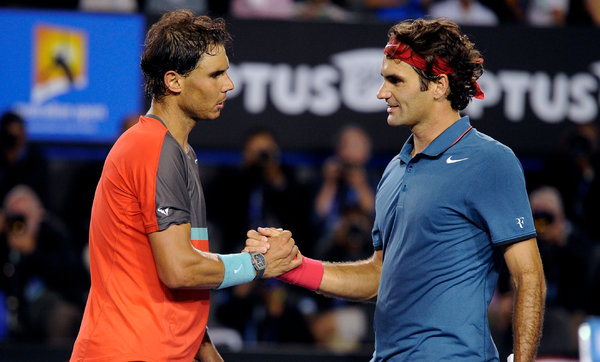
Rafael Nadal, left, shaking Roger Federer's hand after their match. The Nadal-Federer rivalry ranks among the most compelling and the most lopsided in tennis history.

Rafael Nadal, left, shaking Roger Federer’s hand after their match. The Nadal-Federer rivalry ranks among the most compelling and the most lopsided in tennis history.

The first set, won by Nadal in a tie breaker, was classic.  Both men were asked why Nadal wins so often.  The New York Times summarizes

Nadal would be content with never answering another question about his ability to turn any version of Federer — the invincible Federer, the injured, the best, the greatest — into just another guy. But he took one Friday anyway. His answer was a roundabout route to “it is what it is.”

“The real thing is I played a lot of times against him,” Nadal said. “And a lot of times I played great against him.”

And Federer

It was more difficult for Federer to explain why he struggled so with Nadal. He tried. To play Nadal, he said, was different from playing Djokovic or Murray. To beat Nadal, Federer could not play the way he wanted. He needed to be more aggressive, to hit at sharper angles, to take more risks.

His explanation was more fact than excuse. Nadal makes Federer play like someone else.

“I enjoy playing against him,” Federer said, a comment that all but begged for a lie-detector test.

Pete Sampras watched them live for the first time.

…Earlier in the day, Sampras gave a long, thoughtful, conflicted answer about the greatest-of-all-time debate.

Some decades, he said, seemed to have one player who stood above the rest. There was Rod Laver. There was Sampras, although of himself he said only, “I certainly had my moments.” Now, there is Federer and Nadal, greatness squared, and while Federer is 32 and Nadal is 27, their respective careers have overlapped for years — and much of their primes have, too.

“Let’s just appreciate what we’re watching,” Sampras said. “These are two of the greatest players of all time, playing in the same decade. It’s one for the ages.”

That it is, an era-defining rivalry, must-watch TV, every time the two of them take to the court. Even if one of them, the left-handed baseline bully, the Spaniard who answers to Rafa, now seems to win most every match that matters.

And my mother would have enjoyed every minute of yesterday’s match.

Photograph of Borg and McEnroe:  Barton Silverman/The New York Times

Photograph of Nadal and Federer:  Andrew Brownbill/Associated Press

Robert Livingston: forgotten man of the Revolution

A couple of days ago, I read a story in the New York Times about the discovery of a draft of a letter written in July 1775 to the British people from the American revolutionaries that was a last ditch effort at reconciliation.  While the name Robert Livingston rang a faint bell, I did not remember learning anything about a letter back to England.

According to the Times story

It was lying in a drawer in the attic, a 12-page document that was not just forgotten but misfiled. Somehow it had made its way into a folder with colonial-era doctor’s bills that someone in the 1970s decreed was worthless and should be thrown away.

Luckily, no one did. For when Emilie Gruchow opened the folder last summer and separated it from the doctor’s bills, she recognized it as a one-of-a-kind document.

Ms. Gruchow, an archivist at the Morris-Jumel Mansion, was an intern at the museum in Upper Manhattan when she made her discovery. The mansion served as George Washington’s headquarters during the Revolutionary War. She realized the document was the draft of an urgent plea for reconciliation from the Continental Congress. It was addressed to the people of Britain, not King George III and his government, and began by mentioning “the tender ties which bind us to each other” and “the glorious achievements of our common ancestors.”

The letter, which Ms. Gruchow found last summer, was written in 1775 by the New York jurist Robert R. Livingston.

The letter, which Ms. Gruchow found last summer, was written in 1775 by the New York jurist Robert R. Livingston.

A little searching led me to Yale University’s Avalon Project and the discovery that there had been two letters:  one to the King and one to the “FRIENDS, COUNTRYMEN, AND BRETHREN!”.  Both were from the Continental Congress.  The letter to the King does not list all of the colonists grievances, but mentions them more generally.

We shall decline the ungrateful task of describing the irksome variety of artifices, practiced by many of your Majesty’s Ministers, the delusive presences, fruitless terrors, and unavailing severities, that have, from time to time, been dealt out by them, in their attempts to execute this impolitic plan, or of traceing, thro’a series of years past, the progress of the unhappy differences between Great Britain and these colonies, which have flowed from this fatal source.

The open letter to the British people is a precursor to the Declaration of Independence with a list of grievances.  For example this mention of Boston

We could wish to go no further, and, not to wound the Ear of Humanity, leave untold those rigorous Acts of Oppression, which are daily exercised in the Town of Boston, did we not hope, that by disclaiming their Deeds and punishing the Perpetrators, you would shortly vindicate the Honour of the British Name, and re-establish the violated Laws of Justice.

That once populous, nourishing and commercial Town is now garrisoned by an Army sent not to protect, but to enslave its Inhabitants. The civil (government is overturned, and a military Despotism erected upon its Ruins. Without Law, without Right, Powers are assumed unknown to the Constitution. Private Property is unjustly invaded. The Inhabitants, daily subjected to the Licentiousness of the Soldiery, are forbid to remove in Defiance of their natural Rights, in Violation of the most solemn Compacts. Or if, after long and wearisome Solicitation, a Pass is procured, their Edects are detained, and even those who are most favoured, have no Alternative but Poverty or Slavery. The Distress of many thousand People, wantonly deprived of the Necessaries of Life, is a Subject, on which we would not wish to enlarge.

Became

He has kept among us, in times of peace, Standing Armies without the Consent of our legislatures.

and

For Quartering large bodies of armed troops among us:

as well as

He has plundered our seas, ravaged our Coasts, burnt our towns, and destroyed the lives of our people.

Robert Livingston

Robert Livingston

Which brings us to Mr. Livingston.  According to the Times

Until Ms. Gruchow found it, only the final, printed version from July 1775 had been known to exist. She consulted with Michael D. Hattem, a teaching fellow and research assistant on The Papers of Benjamin Franklin at Yale. He analyzed the handwriting on the yellowed pages of the manuscript and did textual analysis that led to an unexpected conclusion: The document was written by Robert R. Livingston, a prominent New York jurist who had been on the fence about whether to support independence for the colonies.

The following year, Congress tapped Livingston to draft the Declaration of Independence along with Thomas Jefferson, John Adams, Benjamin Franklin and Roger Sherman.

Curiously, Mr. Livingston (1746-1813) did not actually sign the Declaration because he was recalled to New York before he could do so.  I’ve searched, but could find no reason for his recall.  He did go on to administer the oath of office to George Washington and, under the Jefferson administration, to help negotiate the Louisiana Purchase.  And now we know that it is his list in a letter to the British people which likely inspired the list in the Declaration of Independence.

Photograph of Document: Suzanne DeChillo/The New York Times

Predicting 2014

I don’t have a crystal ball and haven’t thrown the I Ching, so I can’t really say what will happen. but Mark Bittman had an amusing column in yesterday’s New York Times about years ending in four.  Bittman seems to be of the opinion that nothing much that is good happens during such years, but we can hope that he just has a selective memory.

Bittman begins with 1944, but I’ll add 1914.  That was the year Austria-Hungary declared war on Serbia to begin World War I. On the plus side, the Panama Canal opened and the Boston Braves won the World Series.
Bittman writes

1944 Those of us who don’t remember this year are lucky; a soldier cited in Rick Atkinson’s brilliantly horrifying saga of the last two years of the war in Europe, “The Guns at Last Light,” quotes King Lear: “The worst is not, So long as we can say, ‘This is the worst.’ ” The end of the war was in sight; getting there was the trick, and millions were killed in the interval. Things have not been this bad since.

1954 If there was a golden era of United States foreign policy, it ended here, as Eisenhower warned against involvement in Vietnam while espousing the domino theory. Good: Joe McCarthy’s power began to ebb. Not good: The words “under God” were added to the Pledge of Allegiance.

1964 The last year of the baby boom was mind-blowing. In the 28 months beginning that January, Bob Dylan made five of the best albums of the era — and there were the Beatles.

Nelson Mandela was sentenced to life in prison, and Lyndon Johnson single-handedly sent everyone into a tizzy by signing the Civil Rights Act, sending more “advisers” to Vietnam, talking about bombing North Vietnam and proposing the Great Society. Huh? The first anti-Vietnam War demonstrations and draft-card burnings took place. Pot smoking officially began. (Not really, but sorta.)

1964 was also the year my husband graduated from high school.  I’ll call that a plus.

Skipping to 1994

Whoa: Not only did Nelson Mandela not spend his life in jail, but he became president. The Brady Law went into effect, and Bill Clinton signed the assault weapons ban. (It expired in 2004.) O. J. Simpson spurred a national obsession. Four bombers were convicted of the 1993 attack on the World Trade Center.

Reagan was implicated in the Iran-contra cover-up, but it seemed more important to torture the Clintons over a bad real estate investment. (Still, Paula Jones wasn’t the Republicans’ fault, was she?) Clinton fired Joycelyn Elders for discussing masturbation.

The first credit default swap was created. Nearly everyone in Rwanda became either a killer or a victim, or so it seemed. And there was that messy thing in “the former Yugoslavia.”

Netscape Navigator was released.

1994 was an important year for me.  We got married and I moved to Boston.  Thomas Menino was mayor but not yet The Mayor.

Which brings us to 2004.

2004  Barack Obama spoke at the Democratic convention and there seemed reason for hope; then John Kerry went windsurfing and W., incredibly, became president again (what were 62 million of us thinking?) several months after endorsing a constitutional amendment banning same-sex marriage, which Massachusetts had already legalized. (By 2013, even Utah is on the right side of this issue.) W. also promised to improve education and access to health care; we all know how that worked out. Lance Armstrong won his sixth Tour de France; we all know how that worked out, too.

And also in 2004, the Red Sox won the World Series for the first time in 86 years ending the mythical curse of Babe Ruth.

So, 2014.  I know what I hope for:  the Democrats retain control of the Senate and, at a minimum, creep closer to a majority in the House. I hope the ACA enrolls so many people who like their benefits that we don’t have to listen to Ted Cruz reading “green eggs and ham” again.  I hope, though it seems unlikely, that we get tax and immigration reform.  I hope that President Obama has a better year. And I hope everyone comes home safely from Afghanistan.  I wish Marty Walsh all the best as he becomes mayor and I hope that Michelle Wu gives up her crazy idea of voting for Bill Linehan for City Council president and picks Tito Jackson instead.  Most of all, I hope that all of us have a safe and healthy year.

2014