Snow: It seems to be a theme these days

I’m sitting here working on this post and snow is falling.  We are only supposed to get a couple of inches before it turns to freezing rain.  That should make lovely driving.  But snow seems to be on people’s minds.  How much snow will we get?  Will the ski season be a good one?  And how will climate change impact snow?

Mark Vanhoenaker wrote an opinion piece in the New York Times Review yesterday.  He began

SNOW was my first love. From November’s first flakes and the season’s first blizzard, to unexpected midnight dustings and late March blasts, snow fell frequently and happily on my childhood in western Massachusetts. I never complained about the unshoveled, post-blizzard darkness of my paper route, nor about scrambling over icy drifts en route to school. In the evenings I read in front of our wood stove, captivated by thoughts of Narnia’s endless winter.

Snow gives us a new world. It gives us (not least) a day off to contemplate it. Snow bestows silence: deep snowfalls “spread their peace,” said Saint-Exupéry. Above all, snow gives meaning to the great indoors. Thoreau wrote that in winter, “warmth stands for all virtue.”

But, he wonders, will snow go away?

Fortunately, despite worries about a warming planet, no one is predicting the end of snow anytime soon. Some cold places will see more snow, because warmer air can carry more moisture. In the Northern Hemisphere, snow coverage this past December was the greatest since records began in 1966, Rutgers University’s Global Snow Lab reported. But Dr. David Robinson, a climatologist at Rutgers, warns that year-to-year fluctuations and regional differences can deceive casual observers. In general, he says, there has been an “overall decline in snowfall.”

Other studies echo that conclusion. The United States Global Change Research Program’s recently released draft National Climate Assessment reports that “Overall snow cover has decreased in the Northern Hemisphere, due in part to higher temperatures that shorten the time snow spends on the ground.” The report also notes a decline in the frequency of very snowy winters and in snow accumulations in the American West, and said we can expect more rainstorms “in previously snow-dominated settings.” A recent study by the Natural Resources Defense Council warns that without action on climate change, the snow season in the Northeast will be halved by 2100.

That is a long time off and maybe it won’t happen.  Yes, I think that there use to be a lot more of the white stuff.  The first couple of years after I moved to Boston the snowfall total was measured by Robert Parish.  Then one year a few years ago, it was Shaq O’Neal.  We seem to like to measure by Boston Celtic centers.  But  then I saw Zippy this morning.

Zippy snow

I started thinking about the biggest snowstorm I can remember from my New Jersey childhood and it may be the one from the mid-1950’s.  If Bill Griffith and I are remembering the same storm, it would have still been snowing when they came out of the Museum because the March 1958 storm dropped 11.7 inches on Central Park over several days.

We were living on a small New Jersey farm outside of Philadelphia.  It snowed from March 19 through the 21st.  There wasn’t a lot of warning and it kept snowing and drifting.  I think you could call it a blizzard.  We lost power at some point and it stayed off for at least a week.  The road near our farm looked a little like this.

We did have a small generator and ran the heat and various appliances separately.  I know we had to run the big freezer in the basement often enough to keep things frozen.  We had lots of meat and frozen vegetables.  I think after it stopped snowing, my father may have grilled outside.

We had drifts like this.

There was a path to the chicken house my father and grandfather tried to keep shoveled because the chicken had to be fed and watered.  I think we used the old well and hauled up water in buckets once it stopped snowing.

Looking back is romantic, but I’m sure we were cold, tired of makeshift meals and a little bored.  I still like snow.

Photographs from Google Images of the March 1958 storm

That Lady in Red

I think Rachel Maddow and I were feeling the same level of comfort/discomfort and curiosity about Michelle Obama’s dress the night of the Inauguration.  I say this because when she announced the designer as Jason Wu she said something like “I know you want to know” and then giggled a little.  Plus I think both of us were dying of anticipation before Mrs. Obama appeared.  But this morning I read Amy Davidson’s piece about the dress in the New Yorker and the light went on.  Her dress that night and what she wears in public are a political statement and she understands that.

Then there she was, the First Lady in red.

We only got a glimpse before Obama started dancing with his wife, getting in  the way of our view of the dress, but it was clear that she had  succeeded—gathered halter straps, v-shaped back, and all. The worst one could  say was that it was a little flouncy and not as striking as the  dress that Naeem Khan designed for the India state dinner. And then a  greater revelation: Was a journalist ever as unabashedly excited about anything  as CNN’s Alina Cho was about Michelle’s “extraordinary decision” to turn to the  same designer twice—Jason Wu, who had, as an unknown, designed her dress for the  first inaugural. Then, as now, Wu was surprised; the First Lady had a number of  possibilities assembled, whether out of indecision or arranged as decoys. She  had managed to suppress leaks without putting anyone in jail.

Inaugural dresses  are not just casual cultural relics; not for any First Lady, and especially not  for Michelle Obama. If her husband is a transformational figure, so is she. The  dress worn to a first inaugural goes to the Smithsonian, and the one worn to a  second goes to the National Archives. This is unfortunate for Hillary Clinton,  since  the dress she wore in 1993 was less nice than 1997’s, and represented a low  from which the inaugural gown has only slowly made the steep ascent back. It involved  purple lace, and otherwise defies description. (Clinton wore a pants suit on  Monday.) Looking at that dress now makes one wonder about the nineties—or about  how long the eighties lingered. It was worse than the dress that Rosalynn  Carter recycled from a Georgia gubernatorial inaugural ball in 1977: that  one has some retro appeal, a bit of Leia in Cloud City. Laura  Bush, in red lace and then moony sparkles, wasn’t awful, but that’s all.

The dress that Michelle Obama wore last night represented the full return of the  inaugural gown from the realm of oddity—from being the high-necked, political  version of whatever Cher or Jennifer Lopez wear to the Oscars. Her 2009 dress  looked too much like a lesser, puffier version of Nancy  Reagan’s, in 1981, to be a redeemer of the form. (In the spirit of  bipartisanship, Nancy looked great.)

michelle-dress.jpg

And this is why the dress – and everything she wears is political.

And so Michelle Obama’s inaugural dress is an important subject. To disagree  is to dismiss the idea that politics involves theatre. But that is just for a  start: fashion is also a field (and a business) that matters, and one that has  reacted to the First Lady as a force rather than just as a customer. This is why  the choice of Wu was a surprise, and, in some quarters, a disappointment:  Shouldn’t someone else get a chance to attract investors? At the same time,  there was, in the fashion press, something of a thrill at the definitiveness of  it all: she believed in fashion, and she was committed.

Although it can be harder to talk about—if easier to feel—there is also the  question of how she has confronted images of black women in American culture.  Her first term was so successful that, unless one is a regular viewer of Fox  News or a listener of Rush Limbaugh’s show—which still give her regular doses of  hate—one could forget the resistance to having her in the White House. When her  husband ran for President in 2008, there were barely veiled insinuations about  whether the role of First Lady was really right for her—whether she was too  angry, or could really feel comfortable. (One suspects that a sense of the  pressures on her may explain why she is not taken to task as much as she might  be for the price of these clothes.) Once, when she wore a red dress to a state  dinner, she was accused of sympathizing with Communist China. Michelle might  have responded to that, as many women in similar, if less prominent, situations  do, by being flawlessly proper—some unchallenged idea of ladylike, wearing  dresses and suits and jewelry indistinguishable from Cindy McCain’s or Ann  Romney’s. Or she could have affected dowdiness until getting to the point where,  as Justice  Sotomayor put it, ““They just can’t fire me over the earrings anymore.”

Not being a fashionista, when I saw the red dress, I thought she was flaunting victory.  That the color was celebratory and rightly so.  And she looked fabulous!  But I’m still not sure about the bangs.

Civil Rights and President Obama: the Second Inaugural Address

“We, the people, declare today that the most evident of truths — that all of us are created equal — is the star that guides us still, just as it guided our forebears through Seneca Falls and Selma and Stonewall,”

Inaugural Addresses, particularly second addresses are not generally remembered.  There is John F. Kennedy’s “Ask Not” address and there is Lincoln’s Second address.  You could throw in Franklin D. Roosevelt’s Second.

Lincoln said these now famous words

With malice toward none, with charity for all, with firmness in the right as God gives us to see the right, let us strive on to finish the work we are in, to bind up the nation’s wounds, to care for him who shall have borne the battle and for his widow and his orphan, to do all which may achieve and cherish a just and lasting peace among ourselves and with all nations.

FDR noted the 150th anniversary of the Constitutional Convention and spoke about the role of government.

“We of the Republic sensed the truth that democratic government has innate capacity to protect its people against disasters once considered inevitable, to solve problems once considered unsolvable. We would not admit that we could not find a way to master economic epidemics just as, after centuries of fatalistic suffering, we had found a way to master epidemics of disease. We refused to leave the problems of our common welfare to be solved by the winds of chance and the hurricanes of disaster.”

and pointed out that success would be judged not by adding wealth to those who already had wealth but whether it could

“provide enough for those who [had] too little.”

Add to the great second inaugural speeches of Roosevelt and Lincoln, Barack Obama’s.

John Nichols writing in the Nation said Obama’s speech “charts the arc of history that bends toward justice.”  The President took on  the unfinished business of civil rights – in equal pay for women, voting rights for minorities, and equal rights for gay and lesbian Americans.  He said

It is now our generation’s task to carry on what those pioneers began, for our journey is not complete until our wives, our mothers and daughters can earn a living equal to their efforts.

Our journey is not complete until our gay brothers and sisters are treated like anyone else under the law, for if we are truly created equal, then surely the love we commit to one another must be equal, as well.

Our journey is not complete until no citizen is forced to wait for hours to exercise the right to vote.

Our journey is not complete until we find a better way to welcome the striving, hopeful immigrants who still see America as a land of opportunity, until bright young students and engineers are enlisted in our workforce rather than expelled from our country.

Our journey is not complete until all our children, from the streets of Detroit to the hills of Appalachia to the quiet lanes of Newtown, know that they are cared for and cherished and always safe from harm.

That is our generation’s task, to make these works, these rights, these values of life and liberty and the pursuit of happiness real for every American.

He echoed FDR

“We do not believe that in this country, freedom is reserved for the lucky, or happiness for the few,”

I think the speech showed that second terms can liberate and that his second term will see him push unapologetically for an agenda that includes everyone – even Republicans if they choose to listen.

Photographs: Chang W. Lee/The New York Times and Doug Mills/The New York Times

44 Presidential drinks

I plan to open a bottle of champagne today and start celebrating early and I guess I’m not the only one.  I heard a story on NPR yesterday about Jim Hewes the bartender at the Willard Hotel Bar who has researched presidential history and created 44 drinks for our 44 Presidents.  I went looking for the complete list and found it on a Washington Post GOG blog.  So here, courtesy of NPR and the Post are some of those 44 drinks.

The Post points out

Hewes has certainly done his homework. Franklin D. Roosevelt represented by a Plymouth Gin Martini (the first drink he mixed up after the end of Prohibition), while James Garfield’s tipple is a Dewars Scotch, since industrialist Andrew Carnegie sent Garfield a case of Dewars to celebrate his inauguration.

Some of the list is based on conjecture: We don’t really know if Warren Harding ever drank a Seven and Seven, for example, though the mix of Canadian Whiskey and 7-Up was popular in his day. But it’s a fun and delicious trip through the history of drinking in America.

Hewes has even made some non alcoholic drinks for the teetotalers among our Presidents.

43. George W. Bush: Diet cola with a slice of lemon

Light and crisp, able to keep even the busiest Chief Executive, active, alert, and awake.

39. Jimmy Carter: Alcohol-Free Sparkling Wine

Served, much to the dismay of the fourth estate, throughout his four years in the White House.

30. Calvin Coolidge: Cranberry juice and soda

A gentle New England tonic to fortify one’s Puritan constitution.

19. Rutherford B. Hayes: Orange Blossom

Washington’s pressmen spiked the oranges with gin at the tea-totalling Hayes inaugural in 1877.

Jim Hewes of the Willard’s Round Robin Bar distills presidental history into 44 cocktails on his special inauguration menu. (Bill O’Leary/The Post)

Jim Hewes of the Willard’s Round Robin Bar distills presidental history into 44 cocktails on his special inauguration menu. (Bill O’Leary/The Post)

Is this the Coolidge cranberry with lime?  It looks like it might be. However I am much more interested in Cleveland, Madison  and Reagan who served champagne – or the California sparkling. Or in FDR or JFK who drank martinis.  FDR made his with Plymouth gin the way my husband makes mine. Some of the drinks sound pretty bad like James Monroe’s Sherry Cobbler.

According to NPR

The Round Robin Bar in the Willard Hotel is just a stone’s throw from the White House. Bartender Jim Hewes has been serving up drinks there for nearly 30 years.

“I’ve served presidents prior to their going to the White House and after,” he tells Jacki Lyden, host of weekends on All Things Considered, including Presidents Reagan, Ford and both Bushes.

The original Willard Hotel was built in the 19th Century. Abraham Lincoln slept there the night before his inauguration, and President Ulysses S. Grant would enjoy a drink and a cigar in the lobby.

So what about 44?  A blue drink, of course.

44. Barack Obama: Blue Hawaiian

Combines the president’s penchant for aged Tequila and the cool blue waters of the Pacific. Features aged Tequila, Curacao and fresh lime juice.

NPR provides the recipe

Serves One

Patron Silver Tequila, (2 oz.) Blue Curacao (1/2 oz.), lime juice (2 oz.)

-Muddle 3 lime wedges with tequila

-Add ice, Curacao and lime juice

-Shake and strain over crushed ice

-Garnish with a wheel of lime and pineapple

Washington, D.C., bartender Jim Hewes distills presidential history into cocktails.

So today we either celebrate or drown our sorrows.  Look at the complete list published by the Post and pick a drink.

Thank you, Jim Hewes!

Photograph Hewes at the bar Liz Baker/NPR

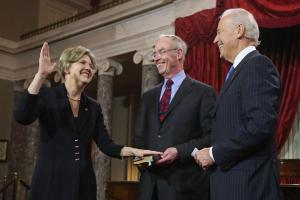
Elizabeth Warren, United States Senator

The day we’ve been waiting for.  This picture is from one of her three swearing-ins.  All the Senators get sworn in together and then they get sworn in individually by Vice President, Joe Biden.  Her third, which I plan to attend will be here in Boston, just down the street from me, on Saturday.  Justice Elena Kagan will do the honors.

Elizabeth Warren being sworn in by Vice President Joe Biden

Elizabeth Warren being sworn in by Vice President Joe Biden

The Boston Globe reports

Elizabeth Warren arrived at the Capitol on Thursday morning carrying a black L.L. Bean backpack in the manner of a student in one of her former Harvard classes. Inside was her treasured, tattered King James Bible, used since third grade and chosen for her Senate swearing-in.

“I know people come with big fancy family Bibles,” Warren said in an interview before her induction. “Mine’s a little more modest.”

As she waited, the first woman elected to the Senate from Massachusetts mused about the moment.

“This chair, this particular Senate seat, was held by John Quincy Adams, Daniel Webster, [Charles] Sumner — and of course Senator [Edward M.] Kennedy for half a century,” Warren said. “Men of principle, men who fought hard for the people of the Commonwealth of Massachusetts and for this country.”

All of us who worked for her election – and those who didn’t – should wish her well.  She has history to live up to and we know she will join the list as a great Senator.

[And I just realized I forgot to mention Bruce Mann, Warren’s husband, in the caption to the picture.]

Photograph Chip Somadevilla / Getty Images

Beate Sirota Gordon and women’s rights in Japan

After the surrender of Japan at the end of the Second World War, General Douglas MacArthur was placed in command of the U.S. Occupation forces and the rebuilding of Japan.  Part of the rebuilding was to write a Constitution.  On his staff was a young 22 year old woman, Beate Sirota.  Sirota was the only woman assigned to the group to write the draft.  And as the only woman, she was assigned the sections dealing with women’s rights, sections responsible for the modern role of women in Japan today.  Beate Sirota Gordon died on Sunday at 89.  Her obituary was in today’s New York Times.  Her story is fascinating.

The daughter of Leo Sirota and the former Augustine Horenstein, Beate (pronounced bay-AH-tay) Sirota was born on Oct. 25, 1923, in Vienna, where her parents had settled.

When she was 5, her father was invited to teach at the Imperial Academy of Music in Tokyo, and the family moved there for a planned six-month stay. Mr. Sirota soon became revered in Japan as a performer and teacher, and they wound up living in Tokyo for more than a decade.

Beate was educated at a German school in Tokyo and, from the mid-1930s on, after the school became far too Nazified for her parents’ liking, at the American School in Japan. In 1939, shortly before her 16th birthday, she left for Mills College in Oakland, Calif. Her parents remained in Japan.

In December 1941, after the attack on Pearl Harbor, it became impossible to contact Japan. Beate had no word from her parents, and no money.

Sirota used her considerable language skills to get work listening to Japanese radio while completing work on her degree at Mills.  She did not know if her parents were alive.

For American civilians, travel to Japan was all but impossible. She went to Washington, where she secured a job as an interpreter on General MacArthur’s staff. Arriving in a devastated Tokyo on Christmas Eve 1945, she went immediately to her family’s house. Where it had stood was only a single charred pillar.

She eventually found her parents, who had been interned in the countryside and were malnourished. She took them to Tokyo, where she nursed them while continuing her work for General MacArthur.

She was assigned to the committee drafting the Constitution.

She had seen women’s lives firsthand during the 10 years she lived in Japan, and urgently wanted to improve their status.

“Japanese women were historically treated like chattel; they were property to be bought and sold on a whim,” Ms. Gordon told The Dallas Morning News in 1999. “Women had no rights whatsoever.”

Commandeering a jeep at the start of that week in February, she visited the libraries in Tokyo that were still standing, borrowing copies of as many different countries’ constitutions as she could. She steeped herself in them and, after seven days of little sleep, wound up drafting two articles of the proposed Japanese Constitution.

The two articles she wrote gave Japanese women rights that American women were not, and are still not Constitutionally guaranteed.

One, Article 14, said in part, “All of the people are equal under the law and there shall be no discrimination in political, economic or social relations because of race, creed, sex, social status or family origin.”

The other, Article 24, gave women protections in areas including “choice of spouse, property rights, inheritance, choice of domicile, divorce and other matters.”

Beate Sirota Gordon in 1947, the year the Japanese Constitution took effect.

It set a basis for a better, a more equal society,” Carol Gluck, a professor of Japanese history at Columbia University, said Monday in a telephone interview. “By just writing those things into the Constitution — our Constitution doesn’t have any of those things — Beate Gordon intervened at a critical moment. And what kind of 22-year-old gets to write a constitution?”

Obviously an extraordinary one.  And as if putting women’s rights into the Japanese Constitution were not enough,  she went on to a career with first the Japan Society and then the Asia Society bring exhibits and performers to the United States.  As a child, I probably saw some of the exhibits and performances for which she was responsible since our family often drove up to New York City to view special exhibits or attend performances (particularly Kabuki).

Ms. Gordon was awarded the Order of the Sacred Treasure, a high honor bestowed by the Japanese government, in 1998. But perhaps the greatest accolade she received came from Japanese women themselves.

“They always want their picture taken with me,” Ms. Gordon told ABC News in 1999. “They always want to shake my hand. They always tell me how grateful they are.”

What life to celebrate!

Nancy wins again

John Boehner as Majority Leader has, so far, appointed one woman to chair a House committee.  All both men and women are white.  The lone woman, Candice Miller, will head the Administration Committee.  In contrast, Nancy Pelosi has announced that she is appointing three women to be the ranking minority member on Appropriations, Finance, and Rules.

Politico reports

Rep. Nita Lowey — Bronx-born, Jewish and Mount Holyoke-educated — was tapped  to be the ranking Democrat on the House Appropriations Committee on Tuesday,  making her the highest-ranking woman in the history of that once hidebound  Southern male enclave that famously resisted hiring even female secretaries for decades.

The 75-year-old New Yorker will succeed retiring Rep. Norm Dicks (D-Wash.) in  the new Congress just as Rep. Maxine Waters (D-Calif.) will move into the  ranking spot on the House  Financial Services Committee, replacing Rep. Barney Frank (D-Mass.).  Together with Rep. Louise Slaughter (D-N.Y.) in the Rules Committee, they pose a  remarkable trio for Democrats: women leading the opposition party in three of  the House’s five most exclusive committees.

Two white women and one African American.  When you have power over money and rules, you begin to have real influence.

And the vote to appoint Representative Lowey was between two women.

Among the top committee posts voted on Tuesday by the Democratic Steering and  Policy Committee, Appropriations was the only real contest. Lowey had to first  get around another woman, Rep. Marcy Kaptur (D-Ohio), who enjoys more seniority  on the panel but less of a following in the party.

In a secret ballot, the New Yorker prevailed easily, 36-10, and by prior  arrangement, the two lawmakers had agreed not to contest the outcome in the full  caucus. Seeing the handwriting on the wall, Kaptur joked beforehand of being the  Toledo Mud Hens vs. the New York Yankees: “I’m just happy to be in the league,” she told reporters.

Unfortunately, there are not enough Republican women in Congress for them to compete for a position.  I don’t expect the picture to change as long as the Republicans continue to hold such anti-women positions.

Nita Lowey is shown at a news conference. | AP Photo

AP photograph of Representative Lowey.

What do Lincoln and Obama have in common?

We all know that both are from Illinois, but did you know that both were elected on November 6?

Abraham Lincoln was first elected on November 6, 1860.  Barack Obama was elected to his second term yesterday, November 6, 1012.

When my husband mentioned this yesterday, I thought this was another good omen and it, like the 7/Eleven, Nickelodeon, and Scholastic polls was correct.

From This Day in History

Abraham Lincoln is elected the 16th president of the United States over a deeply divided Democratic Party, becoming the first Republican to win the presidency. Lincoln received only 40 percent of the popular vote but handily defeated the three other candidates: Southern Democrat John C. Breckinridge, Constitutional Union candidate John Bell, and Northern Democrat Stephen Douglas, a U.S. senator for Illinois.