Chief Justice Roberts, voting rights and statistics

During the oral arguments for Shelby County v. Holder, Chief Justice John Roberts quoted some statistics that, according to his interpretation, showed the turnout ratio of minority voters to white voters was worse in Massachusetts than in any other state.  This prompted a quick response from the Massachusetts election officials and a more measured one from Nate Silver on FiveThirtyEight.  As the Chief Justice may be learning, statistics are tricky things.

The day after the remarks by the Chief Justice the Globe headline was

Chief justice blasted over Mass. voting ‘cheap shot’

Talk about feeling insulted!  The nerve to compare us to Mississippi!

“Do you know which state has the worst ratio of white voter turnout to African-American voter turnout?” Roberts asked Donald Verrilli Jr., solicitor general for the Department of Justice, during Wednesday’s arguments.

“I do not know that,” Verrilli answered.

“Massachusetts,” Roberts responded, adding that even Mississippi has a narrower gap.

Roberts later asked if Verrilli knew which state has the greatest disparity in registration. Again, Roberts said it was Massachusetts.

The problem is, Roberts is woefully wrong on those points, according to Massachusetts Secretary of State William F. Galvin, who on Thursday branded Roberts’s assertion a slur and made a declaration of his own. “I’m calling him out,” Galvin said.

Galvin was not alone in his view. Academics and Massachusetts politicians said that Roberts appeared to be misguided. A Supreme Court spokeswoman declined to offer supporting evidence of ­Roberts’s view, referring a ­reporter to the court transcript.

On Thursday,  Galvin tried to set the record straight. “We have one of the highest voter registrations in the country,” he said, “so this whole effort to make a cheap-shot point at Massachusetts is deceptive.”

Map of Section 5 Covered Jurisdictions

Map of Section 5 Covered Jurisdictions (Photo credit: Wikipedia)

So what’s going on here?  Trust Nate Silver to explain.

Section 5 of the Voting Rights Act, which is being challenged by Shelby County, Ala., in the case before the court, requires that certain states, counties and townships with a history of racial discrimination get approval (or “pre-clearance”) from the Department of Justice before making changes to their voting laws. But Chief Justice Roberts said that Mississippi, which is covered by Section 5, has the best ratio of African-American to white turnout, while Massachusetts, which is not covered, has the worst, he said.

Chief Justice Roberts’s statistics appear to come from data compiled in 2004 by the Census Bureau, which polls Americans about their voting behavior as part of its Current Population Survey. In 2004, according to the Census Bureau’s survey, the turnout rate among white voting-aged citizens was 60.2 percent in Mississippi, while the turnout rate among African-Americans was higher, 66.8 percent. In Massachusetts, conversely, the Census Bureau reported the white turnout rate at 72.0 percent but the black turnout rate at just 46.5 percent.

As much as it pleases me to see statistical data introduced in the Supreme Court, the act of citing statistical factoids is not the same thing as drawing sound inferences from them. If I were the lawyer defending the Voting Rights Act, I would have responded with two queries to Chief Justice Roberts. First, are Mississippi and Massachusetts representative of a broader trend: do states covered by Section 5 in fact have higher rates of black turnout on a consistent basis? And second, what if anything does this demonstrate about the efficacy of the Voting Rights Act?

Turns out that the Current Population Survey has a very high margin of error.

One reason to be suspicious of the representativeness of Mississippi and Massachusetts is the high margin of error associated with these calculations, as noted by Nina Totenberg of NPR.

Like other polls, the Current Population Survey is subject to sampling error, a result of collecting data among a random subsample of the population rather than everyone in the state. In states like Massachusetts that have low African-American populations, the margin of error can be especially high: it was plus-or-minus 9.6 percentage points in estimating the black turnout rate in 2004, according to the Census Bureau. Even in Mississippi, which has a larger black population, the margin of error was 5.2 percentage points.

The other problem is that the Chief Justice was using 2004 figures when the 2010 numbers had a lower margin of error.  So what, if any thing can we conclude.

In the chart below, I have aggregated the 2004 turnout data into two groups of states, based on whether or not they are covered by Section 5. (I ignore states like New York where some counties are subject to Section 5 but others are not.) In the states covered by Section 5, the black turnout rate was 59.2 percent in 2004, while it was 60.8 percent in the states that are not subject to it. The ratio of white-to-black was 1.09 in the states covered by Section 5, but 1.12 in the states that are not covered by it. These differences are not large enough to be meaningful in either a statistical or a practical sense.

So did Chief Justice Roberts misconstrue the data? If he meant to suggest that states covered by Section 5 consistently have better black turnout rates than those that aren’t covered by the statute, then his claim is especially dubious. However, the evidence does support the more modest claim that black turnout is no worse in states covered by Section 5. There don’t seem to be consistent differences in turnout rates based on whether states are covered by Section 5 or not.

The bigger potential flaw with Chief Justice Roberts’s argument is not with the statistics he cites but with the conclusion he draws from them.

And here what Silver thinks we should be asking.

…the fact that black turnout rates are now roughly as high in states covered by Section 5 might be taken as evidence that the Voting Rights Act has been effective. There were huge regional differences in black turnout rates in the early 1960s, before the Voting Rights Act was passed. (In the 1964 election, for example, nonwhite turnout was about 45 percent in the South, but close to 70 percent elsewhere in the country.) These differences have largely evaporated now.

How much of this is because of the Voting Rights Act, as opposed to other voter protections that have been adopted since that time, or other societal changes? And even if the Voting Rights Act has been important in facilitating the changes, how many of the gains might be lost if the Section 5 requirements were dropped now?

To put it nicely, the Chief Justice is using correct statistics to come to not only the incorrect conclusion, but also to ask the wrong questions.  Silver concludes

These are difficult questions that the Supreme Court faces. They are questions of causality – and as any good lawyer knows, establishing a chain of causality is often the most difficult chore in a case.

Statistical analysis can inform the answers if applied thoughtfully. But statistics can obscure the truth when they become divorced from the historical, legal and logical context of a case.

We can only hope that some law clerk at the Supreme Court reads FiveThirtyEight and talks to enough Justices.  Given all the shenanigans going on in Section 5 covered and not covered states on voting rules, now is not the time to over turn this modest brake insuring voting rights.

Official 2005 photo of Chief Justice John G. R...

Official 2005 photo of Chief Justice John G. Roberts (Photo credit: Wikipedia)

The end-of-life decision

I’m sure that everyone has heard the tape of the 911 call or read the transcript.  An unidentified nurse at an independent living facility refused to do CRP on a resident who had collapsed.  The resident. 87 year old, Lorraine Bayless, collapsed in a dining room.  The New York Times published the transcript of part of the call

“She’s going to die if we don’t get this started. Do you understand?” the 911 dispatcher asked.

“I understand,” the nurse said. “But I cannot have our other citizens who don’t know CPR do it.”

“Is there anyone that’s willing to help this lady and not let her die?” the exasperated dispatcher said a bit later.

“Um, not at this time,” the nurse replied.

For me the most shocking part of this story is not that no CPR was performed, but that the nurse in question evidently thought she was following company policy.  The Boston Globe story elaborates

During the dramatic 7-minute, 16-second call, dispatcher Tracey Halvorson urged the nurse, who has not been identified, to start CPR. The nurse declined, citing company policy.

‘‘I understand if your boss is telling you, you can’t do it,’’ the dispatcher said. ‘‘But . . . as a human being . . .  you know, is there anybody that’s willing to help this lady and not let her die?’’

‘‘Not at this time,’’ the nurse answered.

Halvorson assured the nurse that Glenwood couldn’t be sued if anything went wrong in attempts to resuscitate the resident, saying the local emergency medical system ‘‘takes the liability for this call.’’

Later in the call, Halvorson asked, ‘‘Is there a gardener? Any staff, anyone who doesn’t work for you? Anywhere? Can we flag someone down in the street and get them to help this lady? Can we flag a stranger down? I bet a stranger would help her.’’

Now comes the firestorm and many, many questions.  Did Ms. Bayless have a DNR on file and did staff know about it?  Even if the independent living facility was “just housing”, don’t people just have an ordinary responsibility to each other to help and not just let someone die?  What was the policy really?  And were there other residents there who saw all this happening?

Like many people of my age, I am very familiar with this type of facility since my mother lived in one for many years.  Yes, she owned her own unit for most of those years and had a kitchen but she also was required to pay for one meal a day in a common dining room.  This is a common practice to help prevent isolation.  The facility also provided recreational activities including exercise classes, trips, a bus to go shopping and a nurse on site.  My mother had a DNR, but I’m not sure who knew about it until she moved into the assisted living section of the facility.  There all the staff knew.  Somehow I cannot begin to imagine that one of the staff in the dining room would not have started CPR if someone collapsed and started breathing.  My mother once choked and a wait staff member did the Heimlich on her.  And I saw other medical emergencies in which staff intervened even while waiting for the EMT’s to arrive.

So what went wrong here?  The NYT article points out the CPR can hurt frail elders more than it can help them.

In one study conducted in King County, Wash., where a surveillance system tracks every out-of-hospital cardiac arrest, University of Washington researchers found that only 9.4 percent of octogenarians and 4.4 percent of nonagenarians survived after CPR, compared with 19.4 percent of younger patients.

In another study of 2,600 out-of-hospital cardiac arrests over four and a half years in Oakland County, Mich., only 3.3 percent of patients over age 80 who received CPR survived to discharge from the hospital.

Even when older people survive CPR, the consequences can be deleterious: broken ribs and fractured sternums, punctures of the lungs or liver, vomit in the lungs and significant pain. Those who argue for CPR in the elderly say these complications, while serious, are preferable to death. Others say quality of life can be, and often is, terribly degraded.

Ms. Bayless’ family has expressed peace of mind with the decision saying that their mother wanted to go quickly, without intervention and given the potential consequences, I can understand their point of view.  But given that fact, why was there no DNR order on file?

Meanwhile everyone is investigating the need for clearer policies, the need for possible legislation and even the possibility of a criminal case.  According to the Globe

…the case has alarmed police, lawmakers, and advocates for the elderly. The Assisted Living Federation of America, the nation’s largest trade group for such centers, said Tuesday that even if facilities have policies saying employees don’t perform CPR, they should cooperate if asked by 911 dispatchers.

‘‘It was a complete tragedy,’’ said Maribeth Bersani, senior vice president of the trade group. “Our members are now looking at their policies to make sure they are clear.’’

Bakersfield police were trying to determine whether a crime was committed when the nurse refused to assist the 911 dispatcher.

And lawmakers are pledging an investigation.

‘‘This is a wakeup call,’’ said Assemblywoman Mariko Yamada, chair of the California Assembly Aging and Long-term Care Committee. ‘‘I’m sorry it took a tragedy like this to bring it to our attention.’’

For me the bottom line is this from the New York Times

There is another lesson here as well, much broader in scope, about what people owe each other in emergencies of this kind. Whether or not we have medical training, “all of us have a duty to respond to people in life-threatening situations,” said Dale Jamieson, director of the Center for Bioethics at New York University. “This is a general ethical commitment we have to each other as part of living in society.”

The main gate of Glenwood Gardens, a retirement community in Bakersfield, Calif., where an elderly woman died after a nurse refused to perform CPR

The main gate of Glenwood Gardens, a retirement community in Bakersfield, Calif., where an elderly woman died after a nurse refused to perform CPR

What develops from this incident will impact all of us boomers as we age.  And for younger people, this might be your parent.

Why are we still fighting over birth control?

The Affordable Care Act aka Obamacare, included a provision for insurance to cover the cost of birth control.  After all, it has been estimated that 99% of all women use birth control at some point in their lives.  This is not just non-Catholic women.  Contraception is not cheap.  Without insurance, birth control pills can cost up to $100 a month.  Not affordable to lower income women who are also ones who can least afford to have unplanned children.  The pill is used for hormone regulation, not just birth control, a fact often ignored.

In fact, regardless of what the Pope and Cardinals and Archbishops in the United States think, Catholic women do use birth control.  I’m sorry, but no one has explained to me why a bunch of celibate men want to control women.  If you are against abortion, birth control would seem to be reasonable.  Of course, if you believe that life begins at the moment of conception, then some methods are problematic.  But we have no idea how many fertilized eggs just naturally abort, but I guess the distinction here is one is natural and the other has an artificial cause.  I should say that birth control also faces opposition from fundamentalist churches that are not Catholic.  The other thing that plays into the objection to birth control is that sex is to be reserved for marriage and for procreation.  There:   The objections to both birth control and gay marriage in one neat package.

The Obama administration has been twisting itself into knots to make sure that women who choose to use birth control have it covered under their health insurance.  The most recent proposal was outlined by the New York Times.

The Obama administration on Friday proposed yet another compromise to address strenuous objections from religious organizations about a policy requiring health insurance plans to provide free contraceptives, but the change did not end the political furor or legal fight over the issue.

The proposal could expand the number of groups that do not need to pay directly for birth control coverage, encompassing not only churches and other religious organizations, but also some religiously affiliated hospitals, universities and social service agencies. Health insurance companies would pay for the coverage.

The latest proposed change is the third in the last 15 months, all announced on Fridays, as President Obama has struggled to balance women’s rights, health care and religious liberty. Legal experts said the fight could end up in the Supreme Court

You can see the Department of Health and Human Services (HHS)  fact sheet here.

Religious groups dissatisfied with the new proposal want a broader, more explicit exemption for religious organizations and protection for secular businesses owned by people with religious objections to contraceptive coverage.

The tortured history of the rule has played out in several chapters. The Obama administration first issued standards requiring insurers to cover contraceptives for women in August 2011, less than a month after receiving recommendations to that effect from the National Academy of Sciences. In January 2012, the administration rejected a broad exemption sought by the Roman Catholic Church for insurance provided by Catholic hospitals, colleges and charities. After a firestorm of criticism from Catholic bishops and Republican lawmakers, the administration offered a possible compromise that February. But it left many questions unanswered and did not say how coverage would be provided for self-insured religious organizations.

Under the new proposal, churches and nonprofit religious organizations that object to providing birth control coverage on religious grounds would not have to pay for it.

Female employees could get free contraceptive coverage through a separate plan that would be provided by a health insurer. Institutions objecting to the coverage would not pay for the contraceptives.

Yesterday the Catholic Bishops weighed in

“The administration’s proposal maintains its inaccurate distinction among religious ministries,” said Cardinal Timothy M. Dolan of New York, the president of the United States Conference of Catholic Bishops. “It appears to offer second-class status to our first-class institutions in Catholic health care, Catholic education and Catholic charities. The Department of Health and Human Services offers what it calls an ‘accommodation,’ rather than accepting the fact that these ministries are integral to our church and worthy of the same exemption as our Catholic churches.”

The bishops’ statement, issued after they had reviewed President Obama’s proposal for six days, was more moderate and measured than their criticisms of the original rule issued by the White House early last year. Cardinal Dolan said the bishops wanted to work with the administration to find a solution.

The administration had no immediate reaction to the bishops’ statement, other than to say it was not a surprise.

One thing is clear, the Obama administration does not want to start saying the private business owners can opt out of paying for insurance that covers things they find objectionable.  What if we go from birth control to vaccinations to flu shots?

The birth control issue will end up in court and probably the Supreme Court.  For people who say they don’t want the ACA because they don’t want government controlling their health care, this the ultimate irony.  In case they haven’t noticed.  The Supreme Court is a branch of government.

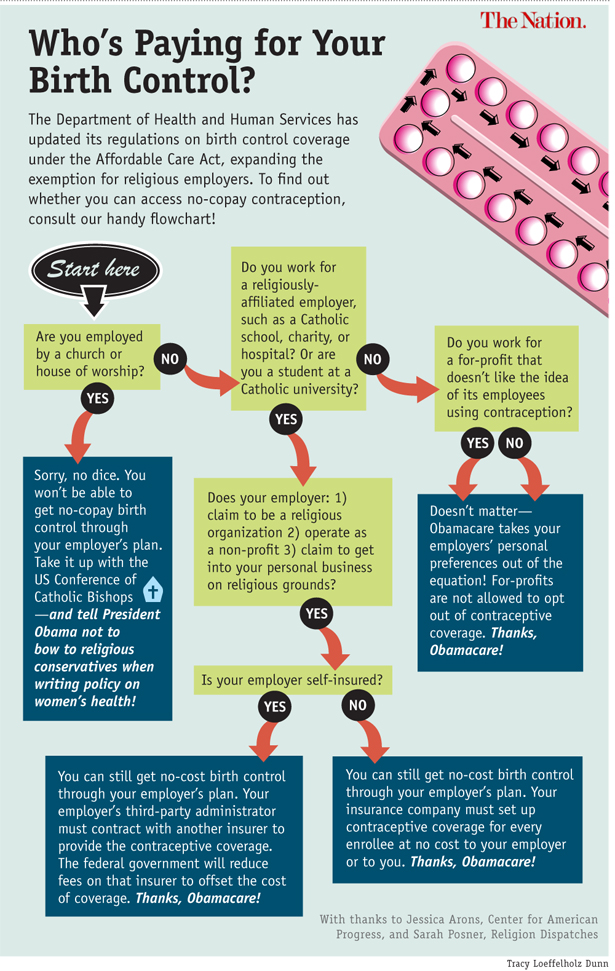
So until the courts decide, Emily Douglas at the Nation has prepared this handy chart for you.

How to pay for your bith control

I guess I sound bitter, but I thought we already had this fight 40 years ago.  Contraception is supposed to be a routine option for women’s health care.

Voting in America

We all saw the lines on television last November. A lot of us stood in them.  In Florida, in Ohio.  I saw at least a 20 minute wait on election morning as I timed a friend who went into vote while I was outside handing out Warren/Obama literature.  This was much longer than usual at my precinct.  It turns out that these are only the outward manifestations of larger problems.  President Obama has said fixing the problems is one of his priorities.  Now he can look at a couple of studies to see exactly what needs to be fixed.

Voter buttons

First the Daily Kos posted a story about the MIT study showing that black and Hispanic voters waited longer to vote than other voters.

You’d think after two hundred years (including some awkward Constitution-patching, here and there) we would finally have this “voting” thing down. Nope:

A Massachusetts Institute of Technology analysis determined that blacks and Hispanics waited nearly twice as long in line to vote on average than whites. Florida had the nation’s longest lines, at 45 minutes, followed by the District of Columbia, Maryland, South Carolina and Virginia, according to Charles Stewart III, the political science professor who conducted the analysis.

So how are states going to fix this?  Maybe by making it harder to register and then harder to vote.

…In states like Virginia, in fact, they’re still trying their level best to make sure certain people don’t have to wait in long lines to vote by making sure certain people aren’t allowed to vote at all. Newly passed legislation would:

eliminate the use of a utility bill, pay stub, bank statement, government check and Social Security card as acceptable identification that can be presented at the polls. Voters would still be able to use a voter identification card, concealed handgun permit, driver’s license and student ID card.

Well, so long as you’re still taking concealed handgun permits.

Since most of those now-banned documents are still perfectly acceptable for obtaining “real” ID’s, like drivers licenses, the possibilities for thwarting rampant voting fraud are approximately nil. The only substantive outcome is to make it ever more inconvenient for certain people (i.e. poor, elderly, and those that don’t have cars, those city-living bastards) to vote.

So I’m not sure that we can depend on states to fix their own problems.

On the heels of the MIT study comes Pew Research.  The New York Times reported on the study which looked at 17 factors.

The flaws in the American election system are deep and widespread, extending beyond isolated voting issues in a few locations and flaring up in states rich and poor, according to a major new study from the Pew Charitable Trusts.

The group ranked all 50 states based on more than 15 criteria, including wait times, lost votes and problems with absentee and provisional ballots, and the order often confounds the conventional wisdom.

In 2010, for instance, Mississippi ranked last over all. But it was preceded by two surprises: New York and California.

The project includes an interactive tool that allows rankings by individual criteria or clusters of them.

Some states, for instance, lost very few votes because of shortcomings in voting technology and voter confusion, with the best 10 reporting failure rates of 0.5 percent or less in 2008. In West Virginia, by contrast, the rate was 3.2 percent.

I hope you will click on the interactive link and look up your state.  The study covers the 2008 and 2010 elections and will be updated with 2012 data when it is available.  Massachusetts is only ranked in the middle at 64% overall which is interesting as I would have guessed it would have been higher.

The study also covered the new trend of voting by mail.

The shift to voting by mail, which now accounts for some 20 percent of all ballots cast, tends to eliminate lines. But it has also produced new problems, especially in places where mail voting has soared because the state does not require an excuse or a new ballot request for each election. Arizona and California, where voting by mail is commonplace, had among the highest rates of problems with voter registration and absentee ballots.

In 2010, California rejected absentee ballots 0.7 percent of the time, a higher rate than any other state.

Dean C. Logan, the registrar for Los Angeles County, said the rate was partly a byproduct of the popularity of voting by mail in California and partly a function of how the state defines rejected ballots. Its definition includes ballots that voters requested but that the Postal Service returned to election officials as undeliverable.

“Voter behavior is changing and evolving,” Mr. Logan said. Young people do not sign their names as consistently as older ones, he said, and mail delivery is becoming less reliable.

He also cautioned that statewide results can mask the fact that “the elections process is extremely decentralized.”

Provisional ballots are also a potential problem according to the study.

Charles Stewart III [cited also by the Daily Kos], a political scientist at the Massachusetts Institute of Technology and a Pew adviser, said that high provisional ballot rates were an important signal of potential trouble.

“Nationwide, a bit over 1 percent of voters are given a provisional ballot,” he said. “In Arizona in 2008, the rate was 6.5 percent. In the battleground state of Ohio, it was 3.6 percent. While these numbers may seem small, in a recount or election dispute, they would be huge.”

There are lots of things to consider as we look at ways to fix things.  How can people more easily register to vote?  What kind of ID, if any, should a voter have to show?  Do we vote by mail?  Online?  In person?  How many options should voters be offered?  I don’t know how many of the issues raised by the Pew study are local and how many can be federally mandated.  I believe that the federal government may have more say if the election is for a national office and is not just a state or local election.

I hope we can tackle some of these issues before 2014 and more of them before 2016.

Professor Stewart said the study should focus attention on the infrastructure of democracy.

“Among all important areas of public policy, election administration is probably the most episodic and prone to the problem of short attention spans,” he said. “What would the world be like if we only gave intense attention to education, corrections, transportation and public health problems for a one-week period every four years?”

An Oregon mail-in ballot for a special electio...

An Oregon mail-in ballot for a special election in May 2005. (Photo credit: Wikipedia)

The French debate gay marriage

The French Parliament has approved gay marriage.

I started reading the article, The French Debate Gay Marriage, in Their Fashion, from Sunday’s New York Times thinking I wouldn’t learn much.  Wrong.  Turns out some of the ambivalence about gay marriage has to do with ambivalence about marriage generally.

“After May ’68, if you were modern, you didn’t get married,” said Frédéric Martel, organizer of the Rond-Point event and author of the new book, “Global Gay: How the Gay Revolution is Changing the World.” “Now we’re at a moment when we are all a bit hysterical about marriage — gay marriage. But this is really a conservative movement, about stability in society and being good parents and protecting children and becoming rather ordinary.”

Seventy percent of the French do not think it is important for couples living together to get married, according to an Insee poll in 2012. Fewer than four marriages for every 1,000 citizens were performed in France in 2011, compared with nearly eight in 1970.

The civil solidarity pact legislation, which was intended to give gay couples many of the rights of marriage, has been used overwhelmingly by straight couples as a kind of “marriage light.” It is so popular as an alternative to marriage that in 2010, there were four civil unions for every five marriages.

And then there are feminist concerns.

Some feminist lesbians think a change in the law is retrograde. In Elle, the historian Marie-Josèphe Bonnet called marriage an “instrument of domination” and same-sex marriage a project of gay men, not lesbians.

“We want to be able to exist socially as women, without being a mother or ‘the wife of,’ ” she said. Asked why she didn’t mobilize lesbians against the law, she said, “No one can be opposed to equality.”

Plus the fact that the French President, Francois Hollande, has never married.

Mr. Hollande, who made passage of the same-sex law a campaign promise, is a model for unmarrieds. He never married Ségolène Royal, the mother of his four children; she called herself “a free woman” and marriage a “bourgeois institution” when she ran unsuccessfully for president in 2007. There is no indication he intends to marry Ms. Trierweiler.

Valerie Trierweiler supports gay marriage.

When Valérie Trierweiler, the partner of France’s president, François Hollande, announced that if the law came into effect she would attend the wedding of two gay friends, Bernard Debré, a center-right deputy, wrote on his blog that she had no right to enter the debate. “She’s just the mistress of the French president,” he said.

The French support marriage but aren’t so sure about adoption by same sex couples.

While 63 percent of the French favor same-sex marriage, according to a poll by the French Institute of Public Opinion released last Saturday, 49 percent favor the right of same-sex married couples to adopt. There is less support for legalizing artificially induced pregnancies for gay couples. And some liberals and feminists consider surrogate motherhood an exploitation of poor working women by the rich.

“It introduces the notion of the child as merchandise,” the historian Max Gallo said on France Culture radio last Sunday. “You rent a belly and buy the product.”

The concerns of the French who are generally supportive are very different from those of Americans.  Here it is viewed as a matter of equality and civil rights. Here in the United States, we, for the most part, still believe in marriage.  We got past the era when it was an institution of our parents.

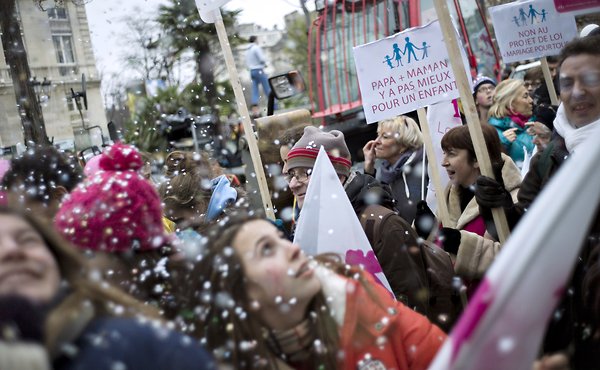
But the views of the opposition are pretty much the same in both countries.  The New York Times reported on an anti-gay marriage rally held in January.

“Nobody expected this two or three months ago,” said Frigide Barjot, a flamboyant comedian leading the protest. At the rally, she read out a letter to Mr. Hollande asking him to withdraw the draft bill and hold an extended public debate.

Strongly backed by the Catholic Church hierarchy, Ms. Barjot and groups working with her mobilized churchgoing families and political conservatives as well as some Muslims, evangelicals and even homosexuals opposed to gay marriage to protest.

“The French are tolerant, but they are deeply attached to the family and the defense of children,” said Daniel Liechti, vice president of the National Council of French Evangelicals, which urged its members to join the march.

Opponents of gay marriage and adoption, including most faith leaders in France, have argued that the reform would create psychological and social problems for children, which they believe should trump the desire for equal rights for gay adults.

Sounds familiar.

Protesters in Paris opposing gay marriage.

I think both sides will find out what we have already learned in Massachusetts:  The sky won’t fall.

Photograph:  Marriage for all Gonzalo Fuentes/Reuters

Photograph:  Protesters Getty Images.

Stephen Lynch maybe changes his mind

Ok.  People do change their minds.  They evolve, as President Obama has said about his position on gay marriage.  But if you change your mind, you need to actually change your mind, not just kinda change it because it is politically expedient.

We have all known for years that Representative Stephen Lynch is against abortion.  He has famously referred to himself as a pro-life Democrat.  And unlike the pro-choice Republicans, the Democratic party has not run him out of town.  But, that is not a winning position outside of his Southie constituency.  He is one of them and, so far, that has been enough to keep him in Congress.  Lynch now says that abortion should be legal but rare. So today the Boston Globe ran this story

US Representative Stephen F. Lynch, who has consistently described himself as an antiabortion legislator, said Monday that he believes abortion is a constitutionally protected right and that as a US senator he would actively oppose anti­abortion nominees to the Supreme Court.

Forces on both sides of the issue charge that Lynch is shifting his stance as he tries to expand beyond his socially conservative political base in South Boston to a liberal statewide primary.

“He’s trying to have it both ways,” said Megan Amundson, executive director of NARAL Pro-Choice Massachusetts, a group backing abortion rights.

Anne Fox, president of Massachusetts Citizens for Life, the state’s leading antiabortion group, pointed out that when Lynch was representing South Boston in the state Senate, he had a 100 percent voting ­record from her group. When he ran for Congress in 2001, her group mailed out postcards urging voters to support him.

Now, Lynch is vowing to protect Roe v. Wade.

“Apparently, that’s what they think they’re supposed to do, politicians with their eyes on higher office, at least in Massachusetts,” Fox said.

It seems that no one is happy with him now.

To give Lynch some credit, he voted against Republican efforts to defund Planned Parenthood noting that the work they do helps reduce the number of abortions.

But Mr. Lynch, you need to do better than

“I don’t oppose it. I accept, I guess.” – Feb. 4, 2013, Globe interview, speaking of Roe v. Wade.

Interesting move against an opponent, Representative Ed Markey, who has been publically pro-choice since 1983.  But I think Lynch may reflect the confusion of a lot of voters.  As I said, it will be interesting.

Official congressional portrait of Stephen F. ...

Official congressional portrait of Stephen F. Lynch, member of the , in the 110th Congress. (Photo credit: Wikipedia)

Women in combat

The Secretary of Defense, Leon Panetta, and the head of the Joint Chiefs, Martin Dempsey, recently signed an order to allow women to serve in combat.  Each branch of the services will now develop a timetable and guidelines for implementation.  This move will allow for official recognition of roles women are already playing.

I posted a pithy little sentence about this from Winning Progressive on my Facebook page only to set off a sometimes not completely coherent discussion among some who oppose the entire idea.  What I posted was

“Now that women can serve in combat that leaves the neo-cons as the only group that apparently can’t serve in war.” – LOLGOP

When I put the comment on Facebook, I was more interested in the neo-cons not serving than in the decision about women.  But the discussion ended up centering around women and combat.  (Sometimes I think friends on the right don’t have much sense of humor.)  Their arguments against were essentially the same ones that Kathleen Parker made in her column in the Washington Post.

The two most popular arguments for inclusion of women in combat would be valid if only they weren’t incorrect. They are: (1) Only qualified women will be included in combat units; (2) We have a volunteer military and, therefore, only those who want to serve in combat will.

Parker worries about the lowering of physical standards, she call it “gender norming” and the fact that women will now have to register for selective service so we may not have a volunteer army at some point.  Parker also seems to think that women would be able to choose whether to be in combat but men would not which would result in the kind of inequality allowing women in combat is supposed to correct.  It is my understanding that both men and women currently make some choices about what job they want after basic training and there are qualifying tests for those jobs.  But right now, women just can’t choose the jobs that have a combat designation.

So how did the decision happen in the first place?  Here is how CNN reported the story.

For Gen. Martin Dempsey, Thursday’s move to open combat units in the U.S. military to women had its roots nearly a decade ago, on the streets of Baghdad.

Dempsey took command of the Army’s 1st Armored Division in June 2003, when Iraqi insurgents were starting to target American troops with sniper fire, grenades and roadside bombs. As he prepared for a trip outside his headquarters, he took a moment to introduce himself to the crew of his Humvee.

“I slapped the turret gunner on the leg and I said, ‘Who are you?’ And she leaned down and said, I’m Amanda.’ And I said, ‘Ah, OK,’ ” Dempsey told reporters at the Pentagon.

“So, female turret-gunner protecting division commander. It’s from that point on that I realized something had changed, and it was time to do something about it.”

Thursday, Dempsey — now chairman of the Joints Chiefs of Staff — sat alongside Defense Secretary Leon Panetta as both men signed a directive that will open front-line posts to the roughly 200,000 women now serving in the active-duty military.

Panetta said the move is a bow to reality on the battlefield, where women in what are technically non-combat units already find themselves fighting alongside their male comrades.

I think that Parker and other opponents envision battlefields with opposing armies lined up to face each other.  Don’t think this happens any more.

Once we heard similar arguments opposing women in the police force.  I once had a high ranking Virginia State Trooper tell me that women were generally too short to meet what was then a height requirement (I think it was 5’9″ or 5’10”) so they couldn’t be troopers.  Why did they have a height requirement?  So they could fire over their vehicles.  When, I asked, was the last time you fired over your vehicle?  Never have, he said.

There will be a lot of fuss over physical standards and what they really need to be.  And sometimes they will be like the height requirement for Virgina troopers – just tradition.  In the end, women will serve in combat as they do now only they will get credit.  And yes, maybe women will have to register for Selective Service, but maybe we can turn that into a national service requirement for everyone to give a couple of years helping the country in some way.

With this move, we join our allies.

Several U.S. allies, including NATO members France, Canada and Germany, allow women to serve in combat posts. Earlier this month, the U.S. Army opened the 160th Special Operations Aviation Regiment to women, and it has begun recruiting female pilots and crew chiefs. The Navy put its first female officers on submarines in the past year, and certain female ground troops have been attached to combat units in Iraq and Afghanistan.

Change is hard, but we have until January 2016 to see what the actual changes will be.  See what you started, Amanda!

Illustration from the Denver Post.

Last meals

Julie Green is an associate professor of art at Oregon State University.  She has also painted at least 500 plates – white with cobalt blue – depicting the last meals requested and eaten by executed prisoners.  It is a grim reminder of our record of state killing but is, at the same time, a record of individuality.  Kirk Johnson wrote in a New York Times story

Julie Green has painted their stories — fittingly enough, on plates, in cobalt-blue paint fired to permanence — along with hundreds of other such chiaroscuro tales of food and death and choice, in a decade-long project she calls “The Last Supper.”

That the world knows what a condemned person was served — indeed, that such information is often part of the narrative of the execution itself, posted on Web sites and in news articles from the prison — is what initially caught Professor Green’s attention.

“The meals were so personal, they humanized death row for me,” she said.

But as she worked — spending six months of each year on the project, and making about 50 plates a year — she came to see the choice of last meal as a window into the soul in an hour of crisis, and also into the strange rituals society has attached to the ultimate punishment.

When I worked for the Virginia Department of Corrections, we all disliked executions.  I would stay up and watch the news until it was over.  Word would circulate about the last meal.  This is why I found Green’s project at once astounding and wonderful.  These men and a few women may have done horrible things.  Some might be innocent.  Others made terrible mistakes, but they are people.

The number of executions has declined in the United States in recent years, from a modern-era high of 98 in 1999 to 43 in 2012. Texas, which has put more people to death than any other state since capital punishment was restored in 1976 by the United States Supreme Court, stopped offering special last meals to the condemned in 2011. But the number of Professor Green’s plates keeps growing: She plans to continue painting as long as there is a death penalty.

Some of the paintings are inspired by long-ago executions, described in news clippings — like the plates she did about two black boys, ages 15 and 16, sent to the electric chair in Mississippi in 1947 on murder charges. They were given fried chicken and watermelon, the records show. Whether they requested that meal is unknown, Professor Green said, but it was dutifully recorded, and so those images — so fraught with racial baggage — went onto plates.

The last meal is one of the very few things over which the condemned has control and the choices show who they are.

But where some critics might see an unduly sympathetic portrait of people convicted of heinous crimes, David Huff, the executive director of the Arts Center in Corvallis, said he saw humanity with all its flaws and foibles. “I don’t think it excuses actions,” he said. “They may have done really bad things.”

“But regardless of what you think about it, you have to accept that these are people,” he added. “They were actual people with likes and dislikes — liking pizza and Coke, or shrimp.”

You can see a slide show of sixteen plated by clicking here.

Photographs Leah Nash

Roe v. Wade at Forty

Posted this morning on Maddow blog this new chart which includes information from an NBC/Wall Street Journal poll.

Exactly 40 years ago today, the U.S. Supreme Court issued its Roe v. Wade ruling. In a 7-2 decision, the court majority decided that Americans have a constitutional right to privacy, which includes being able to terminate an unwanted pregnancy.

I think that the Republican efforts to curtail abortion, to close clinics and to subject women who want to terminate an unwanted pregnancy are having an opposite effect than the one they want.  Kinda like voter suppression which just made people angry enough to stand in line for hours.

The high level of support for Roe comes with some underlying issues that we need to work on.  Bryce Covert just posted some interesting charts at the Nation about the economics of having an abortion.  The charts come from the Guttmacher Institute.  Here are two.

Guttmacher poor women

GuttmacherProviders

The support for keeping Roe has been steadily increasing.  Now we have to figure out how to implement the decision so it means something.

Civil Rights and President Obama: the Second Inaugural Address

“We, the people, declare today that the most evident of truths — that all of us are created equal — is the star that guides us still, just as it guided our forebears through Seneca Falls and Selma and Stonewall,”

Inaugural Addresses, particularly second addresses are not generally remembered.  There is John F. Kennedy’s “Ask Not” address and there is Lincoln’s Second address.  You could throw in Franklin D. Roosevelt’s Second.

Lincoln said these now famous words

With malice toward none, with charity for all, with firmness in the right as God gives us to see the right, let us strive on to finish the work we are in, to bind up the nation’s wounds, to care for him who shall have borne the battle and for his widow and his orphan, to do all which may achieve and cherish a just and lasting peace among ourselves and with all nations.

FDR noted the 150th anniversary of the Constitutional Convention and spoke about the role of government.

“We of the Republic sensed the truth that democratic government has innate capacity to protect its people against disasters once considered inevitable, to solve problems once considered unsolvable. We would not admit that we could not find a way to master economic epidemics just as, after centuries of fatalistic suffering, we had found a way to master epidemics of disease. We refused to leave the problems of our common welfare to be solved by the winds of chance and the hurricanes of disaster.”

and pointed out that success would be judged not by adding wealth to those who already had wealth but whether it could

“provide enough for those who [had] too little.”

Add to the great second inaugural speeches of Roosevelt and Lincoln, Barack Obama’s.

John Nichols writing in the Nation said Obama’s speech “charts the arc of history that bends toward justice.”  The President took on  the unfinished business of civil rights – in equal pay for women, voting rights for minorities, and equal rights for gay and lesbian Americans.  He said

It is now our generation’s task to carry on what those pioneers began, for our journey is not complete until our wives, our mothers and daughters can earn a living equal to their efforts.

Our journey is not complete until our gay brothers and sisters are treated like anyone else under the law, for if we are truly created equal, then surely the love we commit to one another must be equal, as well.

Our journey is not complete until no citizen is forced to wait for hours to exercise the right to vote.

Our journey is not complete until we find a better way to welcome the striving, hopeful immigrants who still see America as a land of opportunity, until bright young students and engineers are enlisted in our workforce rather than expelled from our country.

Our journey is not complete until all our children, from the streets of Detroit to the hills of Appalachia to the quiet lanes of Newtown, know that they are cared for and cherished and always safe from harm.

That is our generation’s task, to make these works, these rights, these values of life and liberty and the pursuit of happiness real for every American.

He echoed FDR

“We do not believe that in this country, freedom is reserved for the lucky, or happiness for the few,”

I think the speech showed that second terms can liberate and that his second term will see him push unapologetically for an agenda that includes everyone – even Republicans if they choose to listen.

Photographs: Chang W. Lee/The New York Times and Doug Mills/The New York Times