The President, Big Business and the Republicans

You may have noticed that the President has met more than once with various business groups and corporate leaders about fiscal and economic issues.  In today’s New York Times, Jackie Calmes has an interesting analysis.

Corporate chiefs in recent months have pleaded publicly with Republicans to raise their taxes for the sake of deficit reduction, and to raise the nation’s debt limit without a fight lest another confrontation like that in 2011 wallop the economy. But the lobbying has been to no avail. This is not their parents’ Republican Party.

In a shift over a half-century, the party base has been transplanted from the industrial Northeast and urban centers to become rooted in the South and West, in towns and rural areas. In turn, Republicans are electing more populist, antitax and antigovernment conservatives who are less supportive — and even suspicious — of appeals from big business.

The article quotes Senator Cruz

“One of the biggest lies in politics is the lie that Republicans are the party of big business,” Ted Cruz, a new senator from Texas and a Tea Party favorite, told The Wall Street Journal during his 2012 campaign. “Big business does great with big government. Big business is very happy to climb in bed with big government. Republicans are and should be the party of small business and of entrepreneurs.”

Senator Cruz

This brings me to the question, once more, as to who is actually represented by people like Senator Cruz.  OK, I get the small town and rural but what I don’t get is what exactly does he and his wing of the party want to do for those they represent.  My husband would tell me that they don’t want to do anything except blow up government.  Maybe so, but how politically popular would it be to do away with money for roads and railroads that move the farm products that are produced?  (Heard of infrastructure, Senator?)  Or the rural subsidies that provide phone and internet services?  Or the various farm subsidies?  I admit, that I’m not clear on where they are on the corporate farm versus the family farm issue.

But big business isn’t interested in blowing up the government.

Big business is so fearful of economic peril if Congress does not allow the government to keep borrowing — to pay creditors, contractors, program beneficiaries and many others — that it is nearly united in skepticism of, or outright opposition to, House Republicans’ demand that Mr. Obama first agree to equal spending cuts in benefit programs like Medicare and Medicaid.

That explains the administration’s outreach to corporate chiefs, like Monday’s conference call. Mr. Obama wants business’s support to buttress his vow that he will never again negotiate over so essential an action like he did in 2011, when the nation flirted with default and the economy suffered. Vexing Republicans, many business leaders are siding with him.

“I’m agreeing with the president — you should not be using the debt limit as a bargaining chip when it comes to how you run the country,” said David M. Cote, chief executive of Honeywell, and a Republican. “You don’t put the full faith and credit of the United States at risk.”

And the party reaction?

Some of the Republicans’ distancing from big business is a matter of political tactics — to alter their image as the party of wealth and corporate power. A writer for the conservative Weekly Standard said of the fiscal fight last month, “While big business cozies up to Obama once again, Republicans have an opportunity to enhance their reputation as the party of Main Street.”

But if we default on our debt by no raising the debt ceiling, what will happen to all those small Main Street businesses?  People with no social security, unemployment, and in the case of thousands of furloughed government workers at all levels will have no money to spend and those very businesses will be at risk.

Let’s face it.  No one “likes” government until they want or need government to do something for them then we all love government.  All those Republican’s in Congress, many from the South, who voted against Sandy relief will be crying in August and September when a storm hits the Gulf.

President Barack Obama talks with Michael G. M...

President Barack Obama talks with Michael G. Morris, right, of American Electric Power Company, and David Cote in the Cross Hall of the White House, before a dinner with CEOs, Feb. 24, 2010. (Photo credit: Wikipedia)

Clarence Speaks – and makes news

It has been seven years or so since Justice Clarence Thomas has said word at  Supreme Court during oral arguments so when he spoke, he made the news.  But he still hasn’t asked a question, so that streak is intact, and we aren’t really sure what he said.

According to the Washington Post

Thomas seemed to be making a lighthearted joke about lawyers trained at his alma mater, Yale Law School, or its rival, Harvard; the Ivy League is a common Thomas target. But several justices were speaking and laughing at the time, and Thomas’s exact comments apparently are lost to history.

Too bad.  This is what we have for a transcript.

Monday’s case was from Louisiana, and the question was whether years-long delays in funding lawyers for an indigent man facing the death penalty violated his right to a speedy trial.

Jonathan Boyer’s lawyer, Richard Bourke of New Orleans, said the delay meant that Boyer did not have lawyers competent to handle a complicated murder case that brought the prospect of the death penalty.

Justice Antonin Scalia, however, suggested that Boyer did have qualified lawyers. Didn’t one of them go to Yale? he asked Carla S. Sigler, the Louisiana assistant district attorney in the case.

She did, Sigler said. And didn’t another attend Harvard? Scalia asked. Yes, again, Sigler said.

“Son of a gun,” Scalia said.

Thomas was among the justices — all nine attended either Harvard or Yale — who either laughed or made side comments at that point.

All that appears in the transcript is Thomas saying, “Well — he did not — ”

It seems likely that the rest of the sentence was along the lines of “have competent counsel.” Sigler, smiling, replied: “I would refute that, Justice Thomas.”

Sotomayor, a Yale graduate, then asked Sigler what was enough to make a lawyer constitutionally adequate.

“Is it anybody who’s graduated from Harvard and Yale?”

More laughter.

“Or even just passed the bar?” Sotomayor asked.

“Or LSU law,” Sigler said, referring to Louisiana State University.

Thomas famously does not believe that the Justices should be asking pesky questions during oral argument believing that it is the time that the lawyers for each side should lay out their cases.  Other Justices don’t agree.

None of his colleagues, conservative or liberal, share such a view. They believe that the lawyers make their case in briefs filed with the court, and that oral arguments are the chance for the justices to challenge their theories and make them respond to their opponents’ arguments.

Makes me wonder if he reads any of the briefs.  He doesn’t have to because Justice Scalia is around to tell him how to vote.

English: The United States Supreme Court, the ...

English: The United States Supreme Court, the highest court in the United States, in 2009. Top row (left to right): Associate Justice Samuel A. Alito, Associate Justice Ruth Bader Ginsburg, Associate Justice Stephen G. Breyer, and Associate Justice Sonia Sotomayor. Bottom row (left to right): Associate Justice Anthony M. Kennedy, Associate Justice John Paul Stevens, Chief Justice John G. Roberts, Associate Justice Antonin G. Scalia, and Associate Justice Clarence Thomas. (Photo credit: Wikipedia)

The Lord of the Coin or another take on the trillion dollar coin.

Ruben Bolling’s take on the magic coin.

td130111.gif

And so, once again Joe Biden causes trouble.

The trillion dollar coin explained – sort of

When I started hearing about the possibility of the treasury minting a trillion dollar coin which could end all the endless debates about the debt ceiling, I thought it was a joke.  Turns out, that is only partly true.  Here are two views of the platinum coin.

The first is Neil Irwin’s as posted on the Wonkblog.

I’ll lay out this econo-pundit’s conclusion upfront: I hate the platinum coin idea. But if there is no resolution of the debt ceiling through the legislative process, I hate some of the alternatives more.

The issue, for those who need a refresher: To avoid running into the debt ceiling in the next couple of months, the Treasury secretary could exploit a legal loophole, create a platinum coin, assign it a value of $1 trillion or some other very high number, and deposit it at the Fed, thus enabling the government to carry out its previously promised tax and spending policies without broaching the legal cap on debt issuance.

To back up a minute, it is important to understand what the debt ceiling does, and why it is problematic. Congress passes laws to spend money: This many dollars for fighter aircraft, Social Security benefits paid according to such and such formula, and so on. It passes laws to enact a tax code. And the difference between that spending and the money raised in taxes the government funds by issuing debt. But Congress also has a third constraint: An overall ceiling on how much debt the Treasury can issue. In the past, Congress has raised that ceiling to whatever it needed to be to match the previously approved taxes and spending as a matter of course.

Now, House Republicans are viewing the debt ceiling differently. They are treating the debt ceiling–and the need to raise it–as a lever through which to try to win battles over spending that they lost in previous negotiations. They want to not pass an increase to the debt ceiling unless they get some major concessions from Democrats on cutting spending—concessions that Democratic senators and the White House say are non-starters.

So the idea of the trillion dollar coin would be to put this whole impasse to rest.  Irwin goes on to explain what the coin would not do.

A couple of the widespread objections don’t hold water. So long as the Federal Reserve does its job, the platinum coin would not be inflationary. In the current ultra-low interest rate environment, the Treasury depositing a $1 trillion coin at the Fed would not affect the supply of money in the broader economy any differently from it issuing $1 trillion in Treasury bills. Nothing about the platinum coin would prevent the Fed from hiking interest rates when it sees an inflationary threat on the horizon.

That’s not to say a platinum coin gambit would be much fun for the Fed. Chairman Ben Bernanke and New York Fed president Bill Dudley would face a moment of truth, and scores of Fed lawyers would be working overtime, as the central bank had to decide whether to treat the $1 trillion coin as a legal deposit. The Fed in general hates to end up in the middle of political disputes, and this would be a highly uncomfortable spot.

On the other side is Paul Krugman who begins by explaining the whole debt ceiling business.

Where does the debt ceiling fit into all this? Actually, it doesn’t. Since Congress already determines revenue and spending, and hence the amount the Treasury needs to borrow, we shouldn’t need another vote empowering that borrowing. But for historical reasons any increase in federal debt must be approved by yet another vote. And now Republicans in the House are threatening to deny that approval unless President Obama makes major policy concessions.

It’s crucial to understand three things about this situation. First, raising the debt ceiling wouldn’t grant the president any new powers; every dollar he spent would still have to be approved by Congress. Second, if the debt ceiling isn’t raised, the president will be forced to break the law, one way or another; either he borrows funds in defiance of Congress, or he fails to spend money Congress has told him to spend.

So in reality, Congress would just have to authorize borrowing money that they have already said could be spent.  And part of the issue is that not enough people are working and paying enough taxes to create enough revenue.  In some ways you can understand the Republicans who want to set a fixed amount for a budget and then make everything fit.  No borrowing.  But then you have things like Hurricane Sandy and extra spending for the Bush wars for which no revenue was ever raised, and etc., etc. and we end up either cutting things no one wants to cut or borrowing.  Back to Krugman.

Finally, just consider the vileness of that G.O.P. threat. If we were to hit the debt ceiling, the U.S. government would end up defaulting on many of its obligations. This would have disastrous effects on financial markets, the economy, and our standing in the world. Yet Republicans are threatening to trigger this disaster unless they get spending cuts that they weren’t able to enact through normal, Constitutional means.

Republicans go wild at this analogy, but it’s unavoidable. This is exactly like someone walking into a crowded room, announcing that he has a bomb strapped to his chest, and threatening to set that bomb off unless his demands are met.

Which brings us to the coin.

Here’s how it would work: The Treasury would mint a platinum coin with a face value of $1 trillion (or many coins with smaller values; it doesn’t really matter). This coin would immediately be deposited at the Federal Reserve, which would credit the sum to the government’s account. And the government could then write checks against that account, continuing normal operations without issuing new debt.

But wouldn’t the coin trick be undignified? Yes, it would — but better to look slightly silly than to let a financial and Constitutional crisis explode.

A downgrade of the United States credit rating again will end up costing us in interest which seems to me to defeat the purpose since we will probably have to borrow more to pay extra to borrow.  Maybe enough Republicans will join with enough Democrats to raise the ceiling to a trillion dollars and we won’t need the magic coin.  This is what Irwin is hoping for.

The platinum coin gambit could be terrible for the U.S. government’s long-term standing as a premier destination for global capital. This is a moment for Republicans to take responsibility for governing and to accept the fact that their leverage is limited with control of only one house of Congress. But if the alternative truly is default, a crazy coin option may indeed be less bad than the alternatives.

What would be on the other side?  Some suggestions include the Cat in the Hat, Alfred E. Newman (both sent in to the Takeaway) and my favorite idea, Mark Twain who once said, “Suppose you were an idiot. And suppose you were a member of Congress. But I  repeat myself.”

Jack Lew, Secretary of the Treasury UPDATED

If Jack Lew is confirmed, we have a great thing to look forward to according to Ezra Klein.

The Treasurer signs our money.  This is Lew’s signature.

lew sig

I can’t wait to get my first bills signed by him.

But as Klein cautions

Obviously, that would turn American currency into the best money
ever. Unfortunately  there’s always the chance that Lew could ruin everything by
making his signature less, well, loopy. That’s what the fun destroyer Timothy
Geithner didwhen he became treasury secretary.

We can only hope that Mr. Lew is true to himself and we have great money for the next four years.  Don’t change your signature, Mr. Lew!


UPDATED:

President Obama had this today about his signature

“I had never noticed Jack’s signature” until media coverage of the looping letters on Wednesday, Obama said at the East Room ceremony where he announced his nomination of Lew. “I considered rescinding my offer to appoint him.”

Obama said he’s asked Lew to “make at least one letter legible in order to not debase our currency should he be confirmed as secretary of the Treasury.”


Bipartisan detente

No.  I’m not talking about Congress where even the nomination of  a former Republican Senator to be Secretary of Defense, can’t bring Republicans and Democrats together.  I’m talking about the American Prospect and the American Conservative magazines.

The headline to the short article in the New York Times reads:

Magazines on Left and Right Unite to Share Office Space

The financial crisis did not bring bipartisanship to Congress, but a difficult media environment may have brought that spirit to two political standard-bearers.

In need of cash and with extra space on its hands, the liberal magazine The American Prospect decided to sublet part of its Washington offices. The American Conservative, tired of working from Arlington, Va., was looking for a new location. When the publishers Jay Harris of The Prospect and Wick Allison of The Conservative were getting lunch in August, they put two and two together.

A six-month lease was soon signed. The self-described bastion of “traditional conservatism” moved in with the self-described “liberal, progressive, lefty” on Dec. 27.

It is tough times for magazines who now maintain print and on-line presence.

What they lack in ideological viewpoint, the two nonprofit monthlies make up for in an independent, establishment-bucking mind-set. Each has faced the sort of downsizing that has become all too common in the print world.

The American Conservative, founded in 2002 by Pat Buchanan, ran biweekly before it went out of print for six weeks in 2009 and returned as a monthly magazine. It has a circulation of 8,000. The American Prospect, in print since 1990, announced to its staff in April that if the magazine could not find $500,000 in financing, it would close altogether by the end of May.  With help from good publicity from Prospect alumni and a few large donors — and by shrinking its staff by four — the bimonthly magazine has endured. The publication has combined paid print and digital circulation of nearly 45,000. The Conservative’s seven staff members will share the white-walled, blue-carpeted 12th floor of 1710 Rhode Island Avenue with The Prospect’s fund-raising and advertising departments. They must share a conference room, a potential source of conflict, though Mr. Harris says it could be a site for events the magazines co-host.

Could this be a model of some kind for Congress?  A bipartisan caucus?  Of course, the Senate women already have something like this when they get together, I believe, monthly but then as Susan Collins, a Republican Senator said recently, ” If women were in charge, we wouldn’t be heading at breakneck speed toward the looming ‘fiscal cliff.'”

The hall of fame, drugs, and baseball

The question being asked by many as we wait for the votes to be announced tomorrow is will any one be elected to baseball’s Hall of Fame this year?  I am of two minds about the whole performance enhancing drug business.  Should we be looking at records before and after and, if the before record is Hall worthy go ahead and elect them?  Or should drug use be a total disqualifier?  And what of people we suspect but have never been caught?

I have seen detailed analyses of the records of Barry Bonds, Sammy Sosa and Roger Clemens.  I think they were so caught up in the idea of being ball players they did what they thought they had to to prolong their careers – at least that is true of Roger.  Should they not get into the Hall because they were stupid and lacked character?  The first person elected was Ty Cobb with his reputation for dirty play and racism.

Back in December, Bob Ryan wrote in the Boston Globe

I am in possession of the toxic ballot.

It is the Hall of Fame ballot voting members of the Baseball Writers Association of America (BBWAA) have dreaded for the last five years. Our feet are finally being held to the bonfire. How will we as a body judge the candidacy of the all-time home run leader, the only man to win seven Cy Young Awards, and a man with 609 career home runs who is the only person to homer 60 times or more in three seasons?

Absent, shall we say, a complicating factor, Barry Bonds, Roger Clemens, and Sammy Sosa would be ultra-mortal locks. Based on the numbers, there wouldn’t be the slightest hesitation in checking the box next to their names.

For years I have been saying, publicly and privately, that some day I may wake up and decide that all this agonizing over how to judge admitted or strongly suspected PED users is fruitless, that there was a period of time in baseball’s recent history when juiced pitchers threw to juiced batters and we will never know how many PED-aided home runs would have landed on the warning track or how many fewer strikeouts someone would have had if the people in question had been clean. I might acknowledge that it is an impossible task to act as judge and jury, that I should simply let them all in and not worry about the ethical question posed by the use of PEDs in athletic competition.

I, for one, just can’t do it. Some day, maybe. Or maybe not. I’ve got 15 years to decide what to do with the Toxic Trio.

I know this much: They’re not getting in, at least not this year. Steroid-tinged Mark McGwire­ has had six chances and he’s actually going backward, peaking with 23.7 percent of the vote (75 percent is needed for election) in 2010. Last year, he slipped to 19.5. Admitted user Rafael Palmeiro, he of the 3,020 hits and 569 home runs, got 11 percent of the vote two years ago and 12.6 last year. There will be no need for either to prepare an acceptance speech.

But we’re all curious to see what the vote will be. I’m betting that Bonds and Clemens will come up with something between 40 and 50 percent of the vote, while Sosa will be lucky to crack double figures.

Ryan believes that no one will be elected this year, a opinion echoed by Tyler Kepner of the New York Times.  Kepner points out that a player needs 75% of the ballots which even in year untainted by PED’s is hard.

Historically, this has not been easy. In 1971, when Yogi Berra made his debut on the ballot, he collected only two-thirds of the vote. That’s right — 118 of 360 writers did not vote for Berra as soon as they had the chance. Fifteen players on that 1971 ballot eventually made it to Cooperstown, but that year, the voters could not reach a three-quarters consensus on any of them.

Since then, only one other writers’ ballot has produced no new inductees. That was in 1996, when Phil Niekro, Tony Perez and Don Sutton got more than 60 percent but less than 75. They and three others from that ballot — Ron Santo, Jim Rice and Bruce Sutter — eventually elbowed through the crowd and into the Hall.

So who else is on the ballot?  One of my all time favorites, Dale Murphy.  I first saw him play for the Richmond Braves when he was a catcher.  Bob Ryan writes

This is it for Murphy, Year 15. His son, Chad, has created a petition and has bombarded voters with e-mails. Murphy is a rare back-to-back MVP (1982-83) with 398 career homers. He made an admirable transition from catcher to five-time Gold Glove center fielder. But he has never passed the Hall of Fame I-know-one-when-I-see-one Smell Test, his vote percentage ranging from a low of 8.5 in Year 6 to last year’s high of 14.5. It’s not going to happen.

Curt Shilling is also on there.  When I can put aside my distaste for his politics and for his hypocrisy – belief in smaller government while seeking lots of government economic development money from Massachusetts and then getting it from Rhode Island – he could pitch and if I had a vote would check him off.

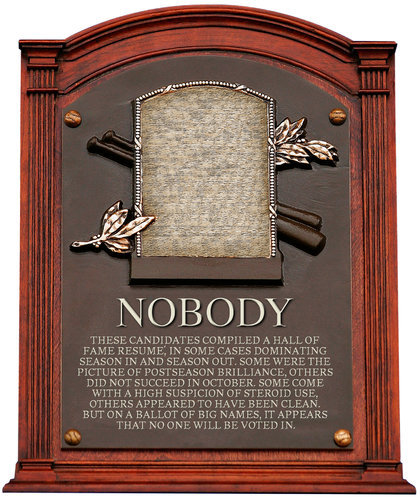
But it is likely that no one will break th 75% barrier and the plaque will look like this.

We will find out tomorrow.

Illustration by Sam Manchester/The New York Times

I had been thinking about a post on the deficit, but then “The Fifth” did the work for me. Thanks, Kstreet607.

kstreet607's avatarThe Fifth Column

The Huffington Post

1.   The Deficit Has Grown Mostly Because Of The Recession

The deficit has ballooned not because of specific spending measures, but because of the recessionThe deficit more than doubled between 2008 and 2009, as the economy was in free fall, since laid-off workers paid less in taxes and needed more benefits. The deficit then shrank in 2010 and 2011.

2.   The Stimulus Cost Much Less Than Bush’s Wars, Tax Cuts

Republicans frequently have blamed the $787 billion stimulus for the national debt, but, when all government spending is taken into account, the stimulus frankly wasn’t that big. In contrast, the U.S. will have spent nearly $4 trillion on wars in the Middle East by the time those conflicts end, according to a recent report by Brown University.  The Bush tax cuts have cost nearly $1.3 trillionover 10 years.

 3.   The…

View original post 474 more words

Elizabeth Warren, United States Senator

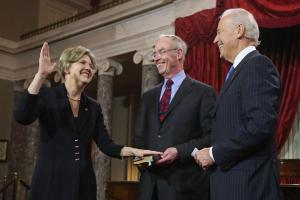
The day we’ve been waiting for.  This picture is from one of her three swearing-ins.  All the Senators get sworn in together and then they get sworn in individually by Vice President, Joe Biden.  Her third, which I plan to attend will be here in Boston, just down the street from me, on Saturday.  Justice Elena Kagan will do the honors.

Elizabeth Warren being sworn in by Vice President Joe Biden

Elizabeth Warren being sworn in by Vice President Joe Biden

The Boston Globe reports

Elizabeth Warren arrived at the Capitol on Thursday morning carrying a black L.L. Bean backpack in the manner of a student in one of her former Harvard classes. Inside was her treasured, tattered King James Bible, used since third grade and chosen for her Senate swearing-in.

“I know people come with big fancy family Bibles,” Warren said in an interview before her induction. “Mine’s a little more modest.”

As she waited, the first woman elected to the Senate from Massachusetts mused about the moment.

“This chair, this particular Senate seat, was held by John Quincy Adams, Daniel Webster, [Charles] Sumner — and of course Senator [Edward M.] Kennedy for half a century,” Warren said. “Men of principle, men who fought hard for the people of the Commonwealth of Massachusetts and for this country.”

All of us who worked for her election – and those who didn’t – should wish her well.  She has history to live up to and we know she will join the list as a great Senator.

[And I just realized I forgot to mention Bruce Mann, Warren’s husband, in the caption to the picture.]

Photograph Chip Somadevilla / Getty Images

The Democratic House Women of the 113th Congress

The New York Times Caucus blog has posted this picture.

Female members of the House Democratic caucus posed for a photograph on Thursday on the steps of the Capitol.

This is most of the 61 women of the Democratic House caucus.

Favoring hues of deep reds and blues, they gathered in the chilly January air, waving to old friends and greeting the new. They laughed and joked, cheekily inviting Representative Barney Frank, a departing Democrat from Massachusetts, to hop in the picture. (He politely demurred.) At one point, a young male aide to Nancy Pelosi, the House minority leader, scurried up to grab some of the members’ coats, juggling the fur and wool throw-overs in his left hand while trying to snap iPhone photos with his right.

As latecomers wandered up, the women called for the photographer to wait, pointing out the stragglers.

There will be 20 women in the Senate and 81 in the House – a record.  Debbie Wasserman Schultz is among the missing from the photograph, however.

But Representative Debbie Wasserman Schultz of Florida emerged from the House moments too late, just as the group was dispersing. However, all was not lost; the photographer took some shots of the late arrivals, and the caucus plans to Photoshop them in.

What did we do before Photoshop?  And don’t the women who did make it look wonderful?

Photograph by Mark Wilson/Getty Images