Voting rights: 2013

This Brian McFadden cartoon seemed appropriate for posting as people are Marching on Washington for Jobs and Freedom once again.

mcfadden voting

Justice Ruth Bader Ginsberg has it right in her dissent from the recent decision:  Why would we want to do away with something that is working?

What’s next? Impeachment!

I sense there is a growing level of frustration among Republican members of Congress.  Their opposition to immigration reform is not playing well with either the public or Republican party elders.  Same for their desire to shut down government to prevent the Affordable Care Act/Obamacare from full implementation.  Some of them have been hammered at town hall meetings and the videos are posted all over YouTube.  The deficit is actually shrinking.  Republican governors like Rick Perry are reversing themselves and asking for Medicaid funds.  And the President and his administration are doing the best they can given that no proposal will pass the House.  So what is left for them.  Impeach Obama!

Steve Breen wrote on MaddowBlog

When fringe figures like Rep. Kerry Bentivolio (R-Mich.) talk about impeaching President Obama without cause, it’s a mild curiosity. When U.S. senators push the same idea, it’s more alarming.

“I think those are serious things, but we’re in serious times,” said Oklahoma Sen. Tom Coburn during a town hall in his home state. “And I don’t have the legal background to know if that rises to ‘high crimes and misdemeanors,’ but I think you’re getting perilously close.”

The remark came after an attendee called the Obama administration “lawless” and asked, “who is responsible for enforcing [Obama’s] constitutional responsibilities?”

Coburn apparently has given this a fair amount of thought, telling constituents, “What you have to do is you have to establish the criteria that would qualify for proceedings against the president, and that’s called impeachment. That’s not something you take lightly, and you have to use a historical precedent of what that means.” He added that he believes “there’s some intended violation of the law in this administration.”

Official portrait of Tom Coburn, U.S. Senator.

Official portrait of Tom Coburn, U.S. Senator. (Photo credit: Wikipedia)

But what violation?

And what, pray tell, has the president done that Coburn perceives as possible “high crimes”? In keeping with the recent trend, the Oklahoma Republican never got around to explaining what the grounds for impeachment would be. Coburn mentioned that he’d heard a rumor about the Department of Homeland Security choosing to “ignore” background checks for immigrants, but he did not elaborate.

Meanwhile Sam Stein tweeted David Axelrod’s reaction

“that was his considered legal opinion as an obstetrician”

Maybe it is just wishful thinking on my part, but I think that Americans still want government to fix roads and bridges, regulate our food, water, drugs and financial institutions, and help those you are in need.  Sure, we all wish for new, creative solutions to some of the problems that seem intractable, but on the whole I think Americans just wish that Congress would actually work with the President instead of just voting “no”.  But the fact that even Mitch McConnell has a challenger from the right in the Republican Primary does not make this seem possible.

I’ll give the last word to Steve Breen

And finally, for every Beltway pundit who proclaims with a tear in their eye, “Washington would be more effective if Obama showed leadership by reaching out to Republicans, schmoozing them, and offering to work cooperatively with his critics,” I hope they’re paying very close attention to current events. It is, as a practical matter, awfully difficult for a president to work constructively with radicalized lawmakers who refuse to compromise and cherish the idea of impeachment without cause.

Just so we’re clear, I don’t really expect Republicans to pursue this in a serious way, and my coverage on the issue is intended more as a “look how silly this is” than a “look at this threat to our constitutional system of government.” If for no other reason, GOP lawmakers wouldn’t try impeaching the president because they’d risk motivating the Democratic base to show up in the 2014 midterms.

That said, the recent talk about impeachment is nevertheless unnerving.

The world loses two jazz greats

One played the piano and hosted a wonderful radio show; the other was a writer who wrote about jazz and blues (among many other things) and whose prose style was said to reflect those musical styles.  Marion McPartland was 95; Albert Murray, 97.

Marion McPartland was a white English woman in the world of American jazz first coming to New York in 1964.  Her New York Times obituary quotes the critic Leonard Feather

“Oh, she’ll never make it: she’s English, white and a woman.”

Mr. Feather, she [McPartland] added, “always used to tell me it was a joke, but I don’t think he meant it as a joke.”

Little did he know.  After many several years  of touring with her husband, Jimmy McPartland’s group, she struck out on her own.

The bare-bones accompaniment of bass and drums was always Ms. McPartland’s preferred format, but she also appeared in concert with symphony orchestras, and in 1996 she recorded an album of her own compositions, “Silent Pool,” on which she was accompanied by a string orchestra.
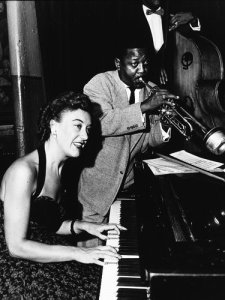
Marian McPartland, who became an articulate spokeswoman for jazz, and the jazz trumpeter Roy Eldridge around the 1950s.

Marian McPartland, who became an articulate spokeswoman for jazz, and the jazz trumpeter Roy Eldridge around the 1950s.

But what she will most be remembered for in the United States is “Piano Jazz”.

Ms. McPartland’s contributions to jazz were not limited to her piano playing. An enthusiastic and articulate spokeswoman for the music, she lectured at schools and colleges and wrote for Down Beat, Melody Maker and other publications. (A collection of her essays, “All in Good Time,” was published in 1987 and reissued in 2003.) Most notably, for more than 30 years her “Piano Jazz” was one of the most popular jazz shows ever on the radio.

The show, produced by South Carolina’s public radio network, made its debut on NPR in 1978. The format was simple: an informal interview interspersed with extemporaneous duets.

“I didn’t have any idea I’d be good at something like this,” Ms. McPartland told The Associated Press in 2000. “I certainly never thought people would know me because of my voice.” But she proved a natural.

As its title suggests, “Marian McPartland’s Piano Jazz” was originally a show about piano players. But the guest list came to include vocalists, among them Mel Tormé, Tony Bennett and even Willie Nelson and Elvis Costello, as well as trumpeters, saxophonists and other instrumentalists.

I listened on the radio and in recent years often streamed it though headphones at work.  She was understated in her interview style and never got too tangled in the technical aspects of the music she and her guest were performing.  Her voice was instantly recognizable.

In her last years Ms. McPartland received numerous honors. She was named a National Endowment for the Arts Jazz Master in 2000, given a lifetime achievement Grammy Award in 2004, inducted into the National Radio Hall of Fame in 2007 and named a member of the Order of the British Empire in 2010.

And she continued playing almost to the end. Reviewing her appearance at Dizzy’s Club Coca-Cola in Manhattan the night before her 90th birthday in 2008, Nate Chinen wrote in The Times, “Ms. McPartland still has her pellucid touch and her careful yet comfortable style.”

Albert Murray was not a musician.  In fact he was about as different from Marion McPartland as one could be.  Murray was black (a term he disliked), he was born in the segregated American south, and he was an academic.  The New York Times said in his obituary

As blacks fought in the streets for civil rights, black integrationists and black nationalists dueled in the academy and in books and essays. And Mr. Murray was in the middle of the debate, along with writers and artists including James Baldwin, Richard Wright, Romare Bearden and his good friend Ralph Ellison.

One of his boldest challenges was directed toward a new black nationalist movement that was gathering force in the late 1960s, drawing support from the Black Panthers and the Nation of Islam, and finding advocates on university faculties and among alienated young blacks who believed that they could never achieve true equality in the United States.

With a freewheeling prose style influenced by jazz and the blues — Duke Ellington called him “the unsquarest man I know” — Mr. Murray challenged conventional assumptions about art, race and American identity in books like the essay collection “Stomping the Blues” and the memoir “South to a Very Old Place.” He gave further expression to those views in a series of autobiographical novels, starting with “Train Whistle Guitar” in 1974.

Mr. Murray insisted that integration was necessary, inescapable and the only path forward for the country. And to those — blacks and whites alike — who would have isolated “black culture” from the American mainstream, he answered that it couldn’t be done. To him the currents of the black experience — expressed in language and music and rooted in slavery — run through American culture, blending with European and American Indian traditions and helping to give it its very shape and sound.

“The United States is not a nation of black and white people,” Mr. Murray wrote. “Any fool can see that white people are not really white, and that black people are not black.” America, he maintained, “even in its most rigidly segregated precincts,” was a “nation of multicolored people,” or Omni-Americans: “part Yankee, part backwoodsman and Indian — and part Negro.”

Albert Murray in his home in Harlem in 1998

Albert Murray in his home in Harlem in 1998

He wrote often about blues and jazz as part of the American culture.

In Mr. Murray’s view, the essential bond between American culture and what he called Negro culture is the shared embrace of a “blues aesthetic,” which he said permeated the works of black musicians, writers and artists and was being increasingly adopted by whites. To Mr. Murray, the blues were “the genuine legacy of slavery,” Laura Ciolkowski, a professor of literature now at Columbia University, wrote in The New York Times Book Review in 2002.

“For him,” she wrote, “blues music, with its demands for improvisation, resilience and creativity, is at the heart of American identity.”

In “Stomping the Blues” (1976), he argued that the essence of the blues was the tension between the woe expressed in its lyrics and the joy infusing its melodies. He saw the blues, and jazz, as an uplifting response to misery.

“The blues is not the creation of a crushed-spirited people,” Mr. Murray said years later. “It is the product of a forward-looking, upward-striving people.”

He next began a long collaboration with Count Basie on his autobiography, “Good Morning Blues,” which was published in 1985, a year after Basie’s death. Along with the writer Stanley Crouch and the trumpeter Wynton Marsalis, Mr. Murray was actively involved in the creation of Jazz at Lincoln Center, the institution’s first permanent jazz program.

Murray tried to help us understand that our American culture is not purely one thing or another, but a mix.  That mix is what makes us different from any other country in the world.

I couldn’t find any mention of a meeting between McPartland and Murray, but I can’t imagine that they never met.  I hope they are with the other jazz and blues performers and critics gone before them talking and improvising.

Photograph of Marion McPartland:  Bob Parent/Getty Images

Photograph of Albert Murray:  Suzanne Mapes/Associated Press

The burden of domestic violence

The news hit Boston like a bombshell:  Jerry Remy‘s son was arrested for murder.  Jerry Remy is the former Red Sox second baseman and long time Sox television commentator.  He is the President of Red Sox Nation.  We have seen him through cancer, depression and a recent reoccurrence – a minor one he told us.  When he is not broadcasting games, we miss him.  So hearing that Jared Remy had been involved in a domestic violence incident that resulted in the stabbing to death of his girlfriend and mother of his child was shocking.

All the facts are not in, but there was a violent incident two days before that resulted in injury and a court appearance for Jared Remy the next day.  Jennifer Martel, for reasons that we really don’t know, did not appear to ask for a retraining order and, even though Massachusetts law allows for it, the district attorney did not request one.  Jared Remy has a history of violence.  A little over 24 hours later, Martel was dead.  She had been stabbed to death on the patio of their home.  Some neighbors tried to intervene and one of them was also injured.

The DA and the state attorney general are both investigating and looking into changes that might prevent similar incidents in the future.

Everyone is wondering why Martel didn’t just leave, but the question I want to ask is why is it always the woman who has to leave?  I’ve been on task forces, on the board of the Richmond, VA. YWCA, and executive director of a women’s commission.  I have supported shelters and hot line and assisted women to leave home and go to a safe place.  I ran a Clothesline Project.  Everyone in the field knows that the most dangerous time for a woman is when she is getting ready to leave her abuser, but we still expect her to be the one who leaves.  When there are school aged children, they are often put in different schools.  The woman is separated often separated from her friends and support system and so are the children.  She bears the burden, not her abuser.  (And yes, men can also be abused.  Gays and lesbians can abuse their partners and spouses.  But the vast majority of those suffering abuse are women.)  Martel’s family says she was also making plans to leave.

Friends and relatives said Martel, 27, an aspiring teacher who worked at a nearby Market Basket to provide for her daughter, had been trying to extricate herself from what she told them had become an abusive relationship with Remy, the son of famed Boston Red Sox player and broadcaster Jerry Remy.

“I talked to her on Wednesday; she said she was planning her escape,” said Patty Martel, who on Friday was driving from her home in Virginia to Massachusetts. “It started off she was very happy with him, but, as time went on, he showed his true colors, and it got worse and worse.”

Right after the murder of Jennifer Martel, I read a story in the New York Times about a new kind of law.  If someone makes too many calls to 911, the law can require the landlord to evict.

The police had warned Lakisha Briggs: one more altercation at her rented row house here, one more call to 911, and they would force her landlord to evict her.

They could do so under the town’s “nuisance property” ordinance, a law intended to protect neighborhoods from seriously disruptive households. Officials can invoke the measure and pressure landlords to act if the police have been called to a rental home three times within four months.

So she faced a fearful dilemma, Ms. Briggs recalled, when her volatile boyfriend showed up last summer, fresh out of a jail stint for their previous fight, and demanded to move in.

“I had no choice but to let him stay,” said Ms. Briggs, 34, a certified nursing assistant, even though, she said in an interview, she worried about the safety of her 3-year-old daughter as well as her own.

“If I called the police to get him out of my house, I’d get evicted,” she said. “If I physically tried to remove him, somebody would call 911 and I’d be evicted.”

This may be an unintended consequence of a law designed to help landlords with squatter and drug dealers, but the burden often falls on women who are victims of domestic violence.

“These laws threaten citizens’ fundamental right to call on the police for help,” said Matthew Desmond, a sociologist at Harvard.

In a study of citations issued to landlords in Milwaukee, conducted with Nicol Valdez of Columbia University, Mr. Desmond found that domestic violence was involved in nearly one-third of the cases and that rentals in largely black areas were disproportionately singled out.

Legal experts say the laws can give tenants the lasting stain of an eviction record without due process.

In a federal lawsuit being watched by legal aid groups elsewhere, Ms. Briggs has challenged the Norristown ordinance as unconstitutional.

She did so after her fears were realized.

In June 2012, days after her ex-boyfriend, Wilbert Bennett, moved into her house in this struggling town northwest of Philadelphia, he started another drunken, late-night argument. Then came his most violent attack yet: an assault with a broken ashtray that left a gash on her head and a four-inch stab wound in her neck.

Before she passed out, Ms. Briggs begged her neighbor not to call 911 because of the eviction threat, according to the suit, which is being argued by the American Civil Liberties Union.

The neighbor called anyway. Ms. Briggs was taken by helicopter to Philadelphia for emergency treatment. Mr. Bennett is now serving a sentence of one to two years for aggravated assault.

The town says she never got a restraining order.  What if she had gotten one when the boyfriend got out of jail?  In all likelihood he would have come around anyway and she would have had to call 911.

I don’t pretend to know what the answer is, but we need to figure out how to deal with men like Wilbert Bennett and Jared Remy.  Putting them in jail is not the entire answer.  That may well work for a while, but they will get out and often turn up again.   There are a few programs for men, but they are very few.  Some prisons have anger management classes which may work for some.  But as long as we continue to think of ending the abuse as the woman’s responsibility, we will never think of any new solutions.

A death from domestic violence leaves families shattered and children anchorless and what happened with Jennifer Martel and Jared Remy is not an exception.

Boston’s men in the news

No, I am not talking about the mayoral candidates all but one of whom is a man.  And I’m not talking about Alex Rodriquez and the Yankee who beat the Sox last night. (Maybe we shouldn’t have taunted him so much?)  I’m speaking of James “Whitey” Bulger, recently convicted felon and Larry Summers who thinks he should run the Federal Reserve.  Here is a great take on the two from cartoonist Dan Wasserman.

wise guys

Maybe I’ll go for a walk at Castle Island this week in memory of Whitey.  While I’m walking, I can send negative thought waves to President Obama about Larry.

Richard the Third – still controversial – updated

King Richard III was a polarizing figure during and after his brief reign over England and he continues to generate controversy still.

You may remember that his bones were found in a Leicester parking lot last year and confirmed to be his earlier this year.  The discovery and my subsequent re-reading of Josephine Tey’s “The Daughter of Time” were subjects for several posts.  Now Leicester and York are in court fighting over where to bury his bones.  The New York Times story appeared yesterday.

As if 500 years of ignominy lying in a grave hastily dug after his defeat in battle were not enough, King Richard III now faces a new battle in the English courts over which of two cities, Leicester or York, will be his final resting place.

A high court judge in London, Charles Haddon-Cave, ruled on Friday that a group backing York’s case, called the Plantagenet Alliance and involving several distant relatives of the slain monarch, could take legal action against the government and the University of Leicester.

The university has laid plans for Richard’s reinterment in Leicester based on a government license that authorized the dig that found the remains. The license specified that the university should decide where the dead king’s remains, if found, should be reburied.

The skeleton of King Richard III was unearthed beneath a municipal parking lot late last year.

The skeleton of King Richard III was unearthed beneath a municipal parking lot late last year.

The plans for a tomb in the near-by Leicester Cathedral and a visitor center began shortly after the remains were discovered.

But in the case heard in London, York’s champions argued that Leicester was never more than a waypoint for Richard on his last night before the Battle of Bosworth Field on Aug. 22, 1485, 20 miles from Leicester. They contend that the slain king’s ancestral home, and the place he had designated as his preferred burial place, was York. They have described Leicester’s haste to lay permanent claim to Richard as a “hijack,” prompting some in the Leicester camp to retort, tartly, that king or not, it is a case of “finders keepers.”

The link with York was underscored by no less an authority than Shakespeare, who began his play “Richard III” with a monologue in which the future king, speaking as the Duke of Gloucester before the tortuous events that would make him monarch, speaks of his older brother, Edward IV, in one of the playwright’s most quoted lines, as a Yorkist. “Now is the winter of our discontent/Made glorious summer by this son of York,” Richard says, before laying out the treacherous schemes that form the webbing of Shakespeare’s work.

It is all quite wonderful.  Maybe the War of the Roses will begin again.

In his ruling on Friday, Judge Haddon-Cave urged Leicester and York to settle the case out of court and to not renew the animosities that drove the 15th-century period known as the Wars of the Roses, between two rival branches of the Plantagenet dynasty, the houses of York and Lancaster. The hostilities ended with Richard’s defeat at Bosworth Field, which gave rise to the Tudor kings under the Bosworth victor, Henry Tudor, who became Henry VII.

“In my view, it would be unseemly, undignified and unedifying to have a legal tussle over these royal remains,” the judge said, appealing to the two sides to avoid engaging in a “Wars of the Roses, Part 2.”

He added that it was inevitable that the question of Richard’s final burial place should arouse “intense, widespread and legitimate public interest” since it involved “the remains of a king of England of considerable historical significance, who died fighting a battle which brought to an end a civil war which divided this country.”

It will be interesting to see where Richard ends up.  Maybe he can be buried in London in Westminster Abbey as a compromise.  And according to the BBC, there are seven other kings (well, six kings and a ruler) whose burial places are unknown.  They are:  Alfred the Great, Harold II, Henry I, Stephen, Edward V, Oliver Cromwell, and James II.  Some one needs to get to work!

UPDATE:  The New York Times reported on May 24, 1014

A British court ruled on Friday​ that King Richard III should be ​re​buried in a cathedral in Leicester,​ the city​ where his remains were found in a parking lot two years ago. The ruling was a defeat for the king’s descendants​ who wanted his remains to be reburied in York,​ arguing that he had spent ​much of his life there. But archaeologists who discovered the king’s remains decided to keep the body in Leicester, a decision backed by Britain’s Justice Ministry. The judges said, ​”There were no public law grounds for the court interfering with the decisions in question.”

Photograph: Getty Images

The joy of Latin

I took four years of Latin in high school.  My teacher was Kenneth Sheridan who was related to the Civil War General Sheridan.  The highlight of my four years was translating parts of John F. Kennedy’s Inaugural Address into Latin my Senior year as my project.  I don’t remember a great deal of Latin today, but I can read and figure out a little Spanish, French and some Italian because of my Latin.  My high school didn’t participate in Junior Classical League and looking back now, I wonder why.  I think it would have been fun.  At least the Massachusetts folks had fun this year.  They didn’t make the news, but they were the topic of a column by Lawrence Harmon in yesterday’s Boston Globe.

Jeffrey Dubuisson, 17, is rattling off the names of the rulers of the Roman Empire in chronological order as he munches on pizza (derived from the Latin verb pinsere, to pound) at Papa Gino’s in Cleary Square. He speaks with authority on the satirical writings of Juvenal and the epic poetry of Vergil. Boston’s public school system is doing something right.

Jeffrey Dubuisson

Jeffrey Dubuisson

Dubuisson, an incoming senior at Boston Latin Academy, is fresh from Las Vegas where he and three teammates won the national title in the advanced division of the classics competition hosted by the National Junior Classical League. There is no higher honor for players of Certamen, a form of intellectual combat requiring rapid recall of facts about the culture, peoples, and languages of ancient Rome and Greece. After years of falling short to Virginia, Florida, and other powerhouses, a Massachusetts team finally has taken its rightful place in the Pantheon of high school brainiacs,

Dubuisson, who lives in Hyde Park, can trace his interest in the classics back to a day in eighth grade at Boston Latin Academy when he was fretting about his D-plus average in Latin. Legendary Latin teacher Janet Fillion [also my neighbor, friend, and cat sitter] urged him to attend Certamen practice as a way to earn extra credit.

“I went to save my grades and ended up loving it,’’ said Dubuisson, whose friends refer to him in the third person as “the Latin dude.’’

I don’t care much if it is music, art, theater, Latin, a sport or science that turns a kid on to school.  I think we’ve move too much into testing and getting “practical” skills to make school fun.  Harmon points out

In Massachusetts, only 42 schools host chapters of the National Junior Classical League. In Boston, only two of the city’s schools — Latin Academy and Boston Latin — offer Latin. Introducing the subject at the city’s middle schools — even for an hour or two a week — could provide students with needed structure and stimulation. Boston’s mayoral candidates are talking about the qualities they want to see in the next school superintendent. An educator who appreciates the importance of the classics belongs on that list.

The students who went to the JCL Convention and won were

…immigrants or children of immigrants from Haiti, China, Albania, and India. Dubuisson is the go-to player for literature, history, and derivatives. Christopher Liao, an incoming junior at Boston Latin School, specializes in translation. Joana Jankulla, an incoming senior at Latin Academy, excels in Latin grammar and mythology. And Meghana Vagwala, an incoming senior at the Advanced Math and Science Academy Charter School in Marlborough, specializes in mythology, quotations, and figures of speech.

We don’t need to be cutting activities in schools, we need to be adding them.  School should be fun and every child should find the thing that makes them smile like Jeffrey Dubuisson, the Latin Dude.

Photograph provided to the Globe by Jeffrey Dubuisson.

The 1963 March on Washington for Jobs and Freedom: My memories

Fifty years ago I was a sixteen year old high school student living in New Jersey.  My parents were community activists and very politically involved.  My mother and several of her friends decided to go to Washington for the march and took me and several of my high school friends.  I know there was some discussion about whether the march would turn violent and some calls were made (and long distance was a big deal back then) to my uncle who lived in D.C.  He must have reassured them and said that he had signed up to make sandwiches to give out to people who didn’t bring their own.  I remember being impressed because he was still a bachelor and, as far as I knew, wasn’t much of a cook.

So we kids were allowed to go along.  I remember the bus ride as long and the bathrooms at the Maryland House really horrible.  When we got to Washington, we asked to go off on our own and set off with a thermos jug of ice water (No bottles of water back then, just a jug and paper cups)  and some bags of oranges and peanut butter and jelly (they wouldn’t spoil in the hot weather) and set off.  It was an interesting little group:  me (Japanese American), at least one African American girlfriend, and several white American boys.  We wormed our way toward the front of where the march was to start instead of going to the end.  I remember people shouting and seeing the folks from the famous picture of the front of the march go by.  We fell in behind them.  I later learned that some people had already started marching and the dignitaries were trying to catch up.

Baez and Dylan

Baez and Dylan

Once we got to the Lincoln Memorial, we first found a spot to sit near some trees, but we soon moved closer to the Reflecting Pool so we could see better.  As it got hotter, and it was very hot,  we joined many by putting our feet in the pool.  We were pretty close to the front, close enough to see Joan Baez and Bob Dylan as well as Marion Anderson and Mahalia Jackson.  We heard rumors that President Kennedy was going to come join us.

I’ll be honest and say that there were a lot, a huge number, of speeches.  I don’t remember very many of them, to be honest.  I know that I was excited to hear and see Myrlie Evers, Rosa Parks and Daisy Bates as part of a tribute to women of the Movement.  But the speech that I remember best was not the famous one given by Martin Luther King, Jr.  The one I remember most clearly was given by John Lewis.   I think that was because he was with the Southern Student Non-Violent Coordinating Committee and I had met SNCC organizers.  Also he was young and had been arrested many times.  I had no idea at the time the speech was given that it had been censored, but it was still the most militant speech given that day.  He ended

To those who have said, “Be patient and wait,” we must say that we  cannot be patient. We do not want our freedom gradually but we want to  be free now.

We are tired. We are tired of being beat by policemen. We are tired of  seeing our people locked up in jail over and over again, and then you  holler “Be patient.” How long can we be patient? We want our freedom and  we want it now.

We do not want to go to jail, but we will go to jail if this is the  price we must pay for love, brotherhood and true peace. I appeal to all  of you to get into this great revolution that is sweeping this nation.  Get in and stay in the streets of every city, every village and hamlet  of this nation until true freedom comes, until a revolution is complete.  We must get in this revolution and complete the revolution. In the Delta  of Mississippi, in Southwest Georgia, in the Black Belt of Alabama, in  Harlem, in Chicago, Detroit, Philadelphia and all over this nation the  black masses are on a march for jobs and freedom.

John Lewis at the Lincoln Memorial, 1963

John Lewis at the Lincoln Memorial, 1963

They’re talking about slow down and stop. We will not stop. All of the  forces of Eastland, Barnett, Wallace, and Thurmond will not stop this  revolution. If we do not get meaningful legislation out of this  Congress, the time will come when we will not confine our march into  Washington. We will march through the South, through the streets of  Jackson, through the streets of Danville, through the streets of  Cambridge, through the streets of Birmingham. But we will march with the  spirit of love and with the spirit of dignity that we have shown here  today.

By the forces of our demands, our determination and our numbers, we  shall send a desegregated South into a thousand pieces, put them  together in the image of God and Democracy. We must say wake up America,  wake up! For we cannot stop, and we will not and cannot be patient.

I still carry that image in my mind.  A young black man thundering, “We want our freedom and we want it now.”   But if he had included words he had wanted to include it is likely that the microphone would have been cut off.  The original text included

I want to know, which side is the federal government on?

The revolution is at hand, and we must free ourselves of the chains of  political and economic slavery. The nonviolent revolution is saying, “We  will not wait for the courts to act, for we have been waiting for  hundreds of years. We will not wait for the President, the Justice  Department, nor Congress, but we will take matters into our own hands  and create a source of power, outside of any national structure, that  could and would assure us a victory.”

At sixteen those words would have sounded so much better than “I have a dream.”

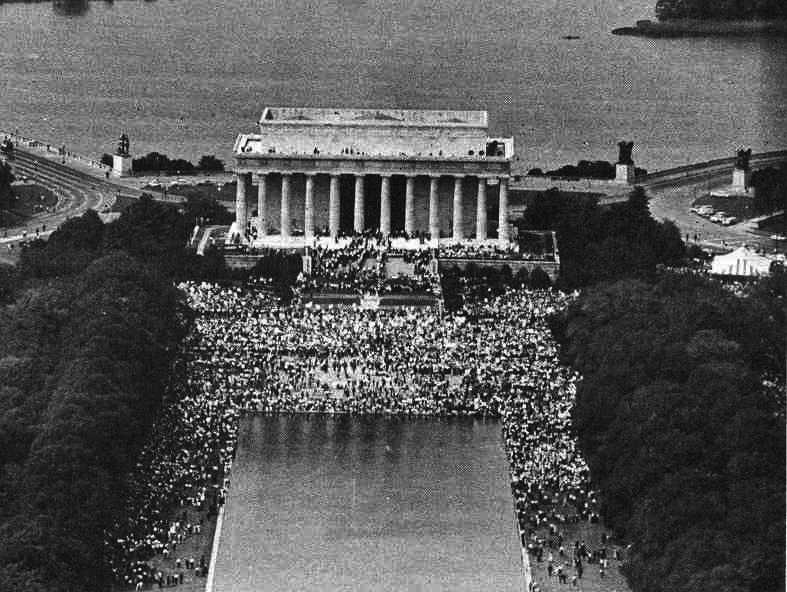
View of the Lincoln Memorial

View of the Lincoln Memorial

I think this was taken relatively early in the day.  My friends and I were at the pool on the left, not too far back and for all I remember, we might already have been there when this was taken.

It was a long ride back to New Jersey and it turned out that I had heat exhaustion, but it was worth it to have been part of history.

There were about 250,000 people there and probably many more will claim that they were there, but I really was.  It was my first large demonstration, but by the time the War in Vietnam was winding down, I was a veteran at these events.  I’m not planning on attending the 50th Anniversary March this year, but I will be there in spirit.

Photograph:  Baez and Dylan uncredited from Wikipedia

Photograph:  John Lewis  Bettmann/ Corbis

Photograph:  Lincoln Memorial  Miles Hodges, Kingsacademy.com

A cautionary tale

Some Republicans want to pass a comprehensive immigration bill and some voted to do so in the Senate.  And now two of them, Marco Rubio and Lindsey Graham, will likely have challengers from the Tea Party wing.  Which brings me to the cautionary tale.  They should read some history and look at what happened to the Federalist Party.  They could begin by reading the very interesting piece in yesterday’s New York Times by James Traub.

Tea Partyers often style themselves as disciples of Thomas Jefferson, the high apostle of limited government. But by taking the ramparts against immigration, the movement is following a trajectory that looks less like the glorious arc of Jefferson’s Republican Party than the suicidal path of Jefferson’s great rivals, the long-forgotten Federalists, who also refused to accept the inexorable changes of American demography.

The Federalists began as the faction that supported the new Constitution, with its “federal” framework, rather than the existing model of a loose “confederation” of states. They were the national party, claiming to represent the interests of the entire country.

Culturally, however, they were identified with the ancient stock of New England and the mid-Atlantic, as the other major party at the time, the Jeffersonian Republicans (no relation to today’s Republicans), were with the South.

John Quincy Adams portrait. "John Quincy ...

John Quincy Adams portrait. “John Quincy Adams”. Metropolitan Museum of Art . . Retrieved September 4, 2009 . (Photo credit: Wikipedia)

And then came the Louisiana Purchase.

“The people of the East can not reconcile their habits, views and interests with those of the South and West,” declared Thomas Pickering, a leading Massachusetts Federalist.

Every Federalist in Congress save John Quincy Adams voted against the Louisiana Purchase. Adams, too, saw that New England, the cradle of the revolution, had become a small part of a new nation. Change “being found in nature,” he wrote stoically, “cannot be resisted.”

But resist is precisely what the Federalists did. Fearing that Irish, English and German newcomers would vote for the Jeffersonian Republicans, they argued — unsuccessfully — for excluding immigrants from voting or holding office, and pushed to extend the period of naturalization from 5 to 14 years.

They even thought about separating New England from the rest of the country.

,,,in the fall of 1814, the Federalists convened the Hartford Convention to vote on whether to stay in or out of the Union. By then even the hotheads realized how little support they had, and the movement collapsed. And the Federalists, now scorned as an anti-national party, collapsed as well.

Contrast that defiance with Jefferson’s Republicans, who stood for decentralized government and the interests of yeoman farmers, primarily in the coastal South.

They ruled the country from 1801 to 1825, when they were unseated by Adams — who, after splitting with the Federalists, had joined with a breakaway Republican faction.

In response, Jefferson’s descendants, known as the Old Radicals, did exactly what the Federalists would not do: they joined up with the new Americans, many of them immigrants, who were settling the country opened up by the Louisiana Purchase.

Their standard-bearer in 1828, Andrew Jackson, favored tariffs and “internal improvements” like roads and canals, the big-government programs of the day. The new party, known first as the Democratic-Republicans, and then simply as the Democrats, thrashed Adams that year. (Adams’s party, the National Republicans, gave way to the Whigs, which in turn evolved into the modern Republican Party.)

Will the Republicans disappear like the Federalists?  Traub doesn’t think so.  But hey are, like the Federalists, on the wrong side of history.

The daughters of Nancy Pelosi

I’ve always thought Nancy Pelosi was one tough woman.  She would never have allowed her caucus to do to her what is happening to John Boehner and she knows how to count her votes.  I remember watching C-SPAN during the votes for health care – that was a cliff hanger – but I knew that before it came to the follower Speaker Pelosi had counted her votes.  Maybe it would be close, but it would pass.  I don’t know if she will want to stick around long enough for the Democrats to take back the majority again, but she has women coming up behind her.  I’m not talking members of Congress here like Patty Murray and Tammy Duckworth,  to name only two of many, but at the state and local level.

I was reminded of this by a story in the Daily Beast yesterday.    What first caught my eye was that one of the pictures is of my former boss and current Boston Mayoral candidate, Charlotte Golar Richie.

Dem WomenCharlotte is in the upper left.

The story by Patricia Murphy begins

They’re fierce, they’re fearless, and they’re shaking up races and state houses across the country. Meet the new breed of Democratic women who make no apologies for themselves, their beliefs, or their party.

The article says this about Charlotte

In 2000 The Boston Globe wrote, “People who matter in politics predict that Charlotte Golar Richie will be the first black mayor of Boston.” Thirteen years later the former adviser to Mayor Tom Menino and Gov. Deval Patrick, onetime state legislator, and nonprofit executive is finally making a run at the Globe’s prediction in a crowded Democratic field. At a recent campaign rally, she danced herself onto the stage and told the crowd, “If you really want to make change, you can’t be sitting on the sidelines, people! You’ve got to be in it to win it. And I’m in it.” As for the chance to be the first woman to run the city, Golar Richie said, “Women in politics have been dutiful followers. Now it’s my turn. It’s our turn.”

As with the two others in the top row with her, Alison Lundergan Grimes and Wendy Davis,  Charlotte is in a tough race.  Actually Davis hasn’t said yet if she is running for re-election as Texas state rep or will run for governor, but Lundergan Grimes is taking on Mitch McConnell in Kentucky.

Like Christine Quinn who is running for mayor in New York City (bottom right), Charlotte is the woman in a race for with a lot of the candidates – all men.  Wouldn’t it be wonderful if New York and Boston both elect their first women mayors this year?  Nancy Pelosi will be proud and the Republicans who like to rail against her will have lost again.