What’s next? Impeachment!

I sense there is a growing level of frustration among Republican members of Congress.  Their opposition to immigration reform is not playing well with either the public or Republican party elders.  Same for their desire to shut down government to prevent the Affordable Care Act/Obamacare from full implementation.  Some of them have been hammered at town hall meetings and the videos are posted all over YouTube.  The deficit is actually shrinking.  Republican governors like Rick Perry are reversing themselves and asking for Medicaid funds.  And the President and his administration are doing the best they can given that no proposal will pass the House.  So what is left for them.  Impeach Obama!

Steve Breen wrote on MaddowBlog

When fringe figures like Rep. Kerry Bentivolio (R-Mich.) talk about impeaching President Obama without cause, it’s a mild curiosity. When U.S. senators push the same idea, it’s more alarming.

“I think those are serious things, but we’re in serious times,” said Oklahoma Sen. Tom Coburn during a town hall in his home state. “And I don’t have the legal background to know if that rises to ‘high crimes and misdemeanors,’ but I think you’re getting perilously close.”

The remark came after an attendee called the Obama administration “lawless” and asked, “who is responsible for enforcing [Obama’s] constitutional responsibilities?”

Coburn apparently has given this a fair amount of thought, telling constituents, “What you have to do is you have to establish the criteria that would qualify for proceedings against the president, and that’s called impeachment. That’s not something you take lightly, and you have to use a historical precedent of what that means.” He added that he believes “there’s some intended violation of the law in this administration.”

Official portrait of Tom Coburn, U.S. Senator.

Official portrait of Tom Coburn, U.S. Senator. (Photo credit: Wikipedia)

But what violation?

And what, pray tell, has the president done that Coburn perceives as possible “high crimes”? In keeping with the recent trend, the Oklahoma Republican never got around to explaining what the grounds for impeachment would be. Coburn mentioned that he’d heard a rumor about the Department of Homeland Security choosing to “ignore” background checks for immigrants, but he did not elaborate.

Meanwhile Sam Stein tweeted David Axelrod’s reaction

“that was his considered legal opinion as an obstetrician”

Maybe it is just wishful thinking on my part, but I think that Americans still want government to fix roads and bridges, regulate our food, water, drugs and financial institutions, and help those you are in need.  Sure, we all wish for new, creative solutions to some of the problems that seem intractable, but on the whole I think Americans just wish that Congress would actually work with the President instead of just voting “no”.  But the fact that even Mitch McConnell has a challenger from the right in the Republican Primary does not make this seem possible.

I’ll give the last word to Steve Breen

And finally, for every Beltway pundit who proclaims with a tear in their eye, “Washington would be more effective if Obama showed leadership by reaching out to Republicans, schmoozing them, and offering to work cooperatively with his critics,” I hope they’re paying very close attention to current events. It is, as a practical matter, awfully difficult for a president to work constructively with radicalized lawmakers who refuse to compromise and cherish the idea of impeachment without cause.

Just so we’re clear, I don’t really expect Republicans to pursue this in a serious way, and my coverage on the issue is intended more as a “look how silly this is” than a “look at this threat to our constitutional system of government.” If for no other reason, GOP lawmakers wouldn’t try impeaching the president because they’d risk motivating the Democratic base to show up in the 2014 midterms.

That said, the recent talk about impeachment is nevertheless unnerving.

A cautionary tale

Some Republicans want to pass a comprehensive immigration bill and some voted to do so in the Senate.  And now two of them, Marco Rubio and Lindsey Graham, will likely have challengers from the Tea Party wing.  Which brings me to the cautionary tale.  They should read some history and look at what happened to the Federalist Party.  They could begin by reading the very interesting piece in yesterday’s New York Times by James Traub.

Tea Partyers often style themselves as disciples of Thomas Jefferson, the high apostle of limited government. But by taking the ramparts against immigration, the movement is following a trajectory that looks less like the glorious arc of Jefferson’s Republican Party than the suicidal path of Jefferson’s great rivals, the long-forgotten Federalists, who also refused to accept the inexorable changes of American demography.

The Federalists began as the faction that supported the new Constitution, with its “federal” framework, rather than the existing model of a loose “confederation” of states. They were the national party, claiming to represent the interests of the entire country.

Culturally, however, they were identified with the ancient stock of New England and the mid-Atlantic, as the other major party at the time, the Jeffersonian Republicans (no relation to today’s Republicans), were with the South.

John Quincy Adams portrait. "John Quincy ...

John Quincy Adams portrait. “John Quincy Adams”. Metropolitan Museum of Art . . Retrieved September 4, 2009 . (Photo credit: Wikipedia)

And then came the Louisiana Purchase.

“The people of the East can not reconcile their habits, views and interests with those of the South and West,” declared Thomas Pickering, a leading Massachusetts Federalist.

Every Federalist in Congress save John Quincy Adams voted against the Louisiana Purchase. Adams, too, saw that New England, the cradle of the revolution, had become a small part of a new nation. Change “being found in nature,” he wrote stoically, “cannot be resisted.”

But resist is precisely what the Federalists did. Fearing that Irish, English and German newcomers would vote for the Jeffersonian Republicans, they argued — unsuccessfully — for excluding immigrants from voting or holding office, and pushed to extend the period of naturalization from 5 to 14 years.

They even thought about separating New England from the rest of the country.

,,,in the fall of 1814, the Federalists convened the Hartford Convention to vote on whether to stay in or out of the Union. By then even the hotheads realized how little support they had, and the movement collapsed. And the Federalists, now scorned as an anti-national party, collapsed as well.

Contrast that defiance with Jefferson’s Republicans, who stood for decentralized government and the interests of yeoman farmers, primarily in the coastal South.

They ruled the country from 1801 to 1825, when they were unseated by Adams — who, after splitting with the Federalists, had joined with a breakaway Republican faction.

In response, Jefferson’s descendants, known as the Old Radicals, did exactly what the Federalists would not do: they joined up with the new Americans, many of them immigrants, who were settling the country opened up by the Louisiana Purchase.

Their standard-bearer in 1828, Andrew Jackson, favored tariffs and “internal improvements” like roads and canals, the big-government programs of the day. The new party, known first as the Democratic-Republicans, and then simply as the Democrats, thrashed Adams that year. (Adams’s party, the National Republicans, gave way to the Whigs, which in turn evolved into the modern Republican Party.)

Will the Republicans disappear like the Federalists?  Traub doesn’t think so.  But hey are, like the Federalists, on the wrong side of history.

On the opposite sides of the Civil Rights struggle: Lindy Boggs and Robert Byrd, Jr.

This week has brought notice of the death of two political figures from the past:  Lindy Boggs and Harry Byrd, Jr.  Both in their late 90s and had been out of office and out of the news for a number of years.  But it is notable that although of similar age and from the south, they were opposites when it came to civil rights.

Lindy Boggs was the window of House Speaker Hale Boggs who died in a plane crash in Alaska.  I remember when this happened in 1972,  I was moving out of my student movement phase and beginning to take an interest in electoral politics. Boggs ran to replace him following a tradition of widows taking over for their politician husbands.   Boggs, however, was different.  She went on to serve nine terms in Congress (several of them representing a majority black district) and become a champion of women’s rights and civil rights while representing Louisiana.  The New York Times describes some of her legislative efforts.

Mrs. Boggs during her Congressional campaign in 1973

Mrs. Boggs during her Congressional campaign in 1973

The velvet Southern charm she had absorbed growing up on two Louisiana plantations was her not-so-secret weapon.

She displayed it early in her first term when the House banking committee was composing an amendment to a lending bill banning discrimination on the basis of race, age or veteran status. She added the words “sex or marital status,” ran to a copying machine and made a copy for each member.

In her memoir she recalled saying: “Knowing the members composing this committee as well as I do, I’m sure it was just an oversight that we didn’t have ‘sex’ or ‘marital status’ included. I’ve taken care of that, and I trust it meets with the committee’s approval.”

Thus was sex discrimination prohibited by the Equal Credit Opportunity Act of 1974.

I always loved that story.

Mrs. Boggs used her membership on the Appropriations Committee to push for other women’s economic concerns, like equal pay for government jobs and equal access to government business contracts. She became a champion of historic preservation and port development, flood control and housing in her New Orleans district.

Mrs. Boggs championed racial justice at a time when doing so invited the resentment if not hostility of most Southern whites. She saw the growing civil rights movement as necessary to the political reform movement of the 1940s and ’50s.

“You couldn’t want to reverse the injustices of the political system and not include the blacks and the poor; it was just obvious,” she said in 1990.

While her husband was in office, she supported civil rights legislation as well as Head Start and antipoverty programs. As the president of two organizations of Congressional wives, she saw to it that each group was racially integrated.

She has been honored by the House with the naming, in 1991, of the Lindy Claiborne Boggs Congressional Women’s Reading Room.  She was 97 when she died.

At the other end of the civil rights spectrum is Harry Byrd, Jr., the long time Senator from Virginia, and not to be confused with Robert Byrd of West Virginia.  When I moved to Virginia in 1965, Byrd was my Senator.  He had just been appointed to replace his father who had died.  The Byrd Machine ruled Virginia Democratic State politics at the time and both Byrds worked hard to maintain segregation in Virginia schools.  The New York Times writes

Even as a middle-aged man, Mr. Byrd was often called “Little Harry” or “Young Harry.” By the 1920s, his father, Harry F. Byrd Sr., had built a formidable Democratic political machine in Virginia that eventually elected him governor and then to the Senate, where he served from 1933 until his resignation in 1965. (Like his son, Harry Sr. was initially appointed to the Senate to fill a vacancy, after the resignation of Claude A. Swanson.)

The elder Mr. Byrd was a conservative Democrat who served for 11 years as chairman of the Senate Finance Committee. He also supported “massive resistance,” the name given to Virginia’s opposition to public school desegregation in the late 1950s. The son, who was serving in the State Senate at the time, helped develop the policy, which included closing some schools for several years rather than integrate them.

Harry F. Byrd  in 1965, when he was appointed to his father’s seat

Harry F. Byrd in 1965, when he was appointed to his father’s seat

Moorestown, N.J. where I was living as a teenager was one of the northern towns that hosted African-American high school seniors so they would have a chance to get diplomas and go to college.  I went to a number of social activities that were hosted for them, but never, much to my regret, got to know any of them well enough to stay in touch.

Although the Byrd machine began coming apart amid the fractured politics of the 1960s, it held together long enough to get Gov. Albertis S. Harrison Jr., a longtime supporter of the family, to appoint Harry Jr. to his father’s seat in 1965. The following year Mr. Byrd won a special election to complete his father’s term. By 1970, with blacks voting in larger numbers and urban labor unions supporting more liberal candidates, Mr. Byrd faced a potentially challenging Democratic primary in pursuit of his first full term. That March, saying he was unwilling to sign a party oath to support the Democratic nominee in the 1972 presidential election, particularly since the candidate was not yet known, he announced that he would become an independent.

If the decision seemed striking given his family history, it was also prudent. Taking votes from his Democratic and Republican opponents, he won easily that November. Mr. Byrd had dropped his party affiliation but essentially kept his voters, his politics and much of his power.

I don’t think he could have supported either George McGovern or Hubert Humphrey so he made the correct choice.  Byrd, however,  continued to caucus with the Democrats.  There is one more shameful incident I remember.

In the late 1970s, President Jimmy Carter asked Mr. Byrd to form judicial commissions to name black and female candidates for Virginia’s federal courts. In 1980, after Mr. Byrd’s commissions had named only white men, none of whom were judges, President Carter nominated James E. Sheffield, a black state court judge. Mr. Byrd vowed to fight his Senate confirmation and did so successfully.

I remember Judge Sheffield’s rejection well.  The only reason for his failure to be confirmed was race.

Senator Byrd was a bigot throughout his public life.  He did not run for re-election in 1982 by which time I think he would have lost as new young Democrats were winning office like Charles Robb who became governor in then.  And people like me who were taking over the Virginia Democratic Party.  Byrd’s time was thankfully passing.

He was 98 when he died.

Photographs:  United Press International

Urban sprawl, transportation, and poverty

I’ve been thinking since I read Paul Krugman’s column “Stranded by Sprawl” about successful urban areas and public transportation.  I lived for a number of years in Richmond, VA and for part of that time I didn’t drive or have a car.  After I acquired a car, I realized how limited my world was without one.  There were many places I couldn’t get to without driving and even if there was a bus, service was often erratic and infrequent.  I don’t know if thing have changed since I left twenty years ago, but I know that the counties surrounding the City of Richmond were where the new office parks and shopping malls were springing up.  I was lucky because I did live within easy walking distance of a nice shopping area with restaurants and some stores so I could leave the car behind when I met friends for breakfast or dinner.  But I didn’t live near any of the “projects” or poor areas which were pretty segregated back then.

One of my first memories of my Boston move was one of my new neighbors lamenting that the view from the back of the houses on our street was marred by looking down at the roofs of a large public housing project.  In fact, there are actually four projects within easy walking distance.  After I went to work for the Housing Authority I learned that public housing developments were scattered through the city neighborhoods.  The BHA takes pains in trying to maintain the grounds of each (with limited resources) so they don’t become a blight on the neighborhoods and several have been totally redesigned and no longer have the dead end streets which only serve to isolate residents.  Contrast this with the Atlanta described by Krugman

When the researchers looked for factors that correlate with low or high social mobility, they found, perhaps surprisingly, little direct role for race, one obvious candidate. They did find a significant correlation with the existing level of inequality: “areas with a smaller middle class had lower rates of upward mobility.” This matches what we find in international comparisons, where relatively equal societies like Sweden have much higher mobility than highly unequal America. But they also found a significant negative correlation between residential segregation — different social classes living far apart — and the ability of the poor to rise.

And in Atlanta poor and rich neighborhoods are far apart because, basically, everything is far apart; Atlanta is the Sultan of Sprawl, even more spread out than other major Sun Belt cities. This would make an effective public transportation system nearly impossible to operate even if politicians were willing to pay for it, which they aren’t. As a result, disadvantaged workers often find themselves stranded; there may be jobs available somewhere, but they literally can’t get there.

Is Detroit in trouble because its land area is too big?  I don’t know.  Detroit is 138 square miles with a population today of around 700,000 people.  Boston is 48 square miles with a population about 50,000 people smaller. In Boston, we gripe about the public transportation all the time and worry that some neighborhoods that are more affluent have better service, but we are always working on it.  I haven’t read anything about public transportation in Detroit:  It is the Motor City.

Boton T

Back to Krugman

The apparent inverse relationship between sprawl and social mobility obviously reinforces the case for “smart growth” urban strategies, which try to promote compact centers with access to public transit. But it also bears on a larger debate about what is happening to American society. I know I’m not the only person who read the Times article on the new study and immediately thought, “William Julius Wilson.”

A quarter-century ago Mr. Wilson, a distinguished sociologist, famously argued that the postwar movement of employment out of city centers to the suburbs dealt African-American families, concentrated in those city centers, a heavy blow, removing economic opportunity just as the civil rights movement was finally ending explicit discrimination. And he further argued that social phenomena such as the prevalence of single mothers, often cited as causes of lagging black performance, were actually effects — that is, the family was being undermined by the absence of good jobs.

My worry about Boston is that it will become more and more like Manhattan where only the well-off and the very poor can afford to live.  Jobs, particularly tech jobs, are moving back into the city and near suburbs from further out along the outer ring highways.  Will we end up with a shrinking middle?

These days, you hear less than you used to about alleged African-American social dysfunction, because traditional families have become much weaker among working-class whites, too. Why? Well, rising inequality and the general hollowing out of the job market are probably the main culprits. But the new research on social mobility suggests that sprawl — not just the movement of jobs out of the city, but their movement out of reach of many less-affluent residents of the suburbs, too — is also playing a role.

What’s to be done?  More investment in infrastructure in places like Atlanta and Los Angeles.  More investment in light rail systems.  More investment in maintenance of what we have for cities like Boston, Chicago and New York.  Unfortunately this is another thing in which the House Republicans are not interested.

The Next Fed Chair? Not Larry Summers.

Why would the President want to appoint someone who once opined that women were not good at science?  The man who was hired to end the economic crisis, but likely contributed to its making.  I’ve been thinking about how to approach this for a few days now and then I saw two pieces by Shirley Leung in the Boston Globe Business Section.  I think she says exactly what I wanted to say.  In the first, she discusses Larry Summers.

No need to hold back here: Larry Summers as the next Fed chairman?

Worst idea ever.

Summers, by all accounts, is a brilliant economist, one of the best of his generation. He is also someone who is confident, and, in times of crises, may be the adult in the room that he supposedly said the Obama administration didn’t have when the economy collapsed.

But he lacks one critical trait I like in my Fed chairmen: He’s not boring.

Summers is far from bland. He is arrogant and a lightning rod and would carry so much baggage he couldn’t fit it on the shuttle to Washington.

Do we need a Fed Chair that is all about Larry Summers?  I think not.

In his book “Confidence Men,” about the Obama White House’s handling of the economic crisis, former Wall Street Journal reporter Ron Suskind paints Summers as brilliant but overconfident and prone to unnecessary battles. “As he has aged, he has grown less troubled by being uninformed,” Suskind wrote.

That’s not what you want in a Fed chairman. The nation’s top central banker must manage the economy primarily by raising or lowering interest rates and must build consensus to do so. He must work with six other Fed governors and 12 regional Fed bank presidents. Imagine what would have happened if the Fed board was split over what to do with the economy in 2008? What would that have done to the markets?

“I know Larry very well. He is a smart guy,” said Allan Meltzer, a Carnegie Mellon professor who has written the definitive history on the Fed. “But the skills that are required for that job are not just brilliance, they are ability to manage compromise. He doesn’t do that well.”

This is to say nothing about how he ran Harvard.  When he left, they picked Drew Faust, a women who was his opposite in many important ways.

So, who should be the next Fed Chair?  How about a woman?  Senator Elizabeth Warren and Shirley Leung are backing Janet Yellen.

English: Official picture of Janet Yellen from...

English: Official picture of Janet Yellen from FRBSF web site. http://www.frbsf.org/federalreserve/people/officers/yellen.html (Photo credit: Wikipedia)

Just as forcefully as folks are coming out against Summers, there is a campaign mounting to promote Janet Yellen, Ben Bernanke’s number two.

Unlike Summers, Yellen has significant monetary policy experience. She has been the vice chair of the Fed board of governors since 2010, and prior to that she ran the San Francisco Federal Reserve bank for six years. She has been involved in the Fed’s quantitative easing strategy, hatched during the Great Recession to keep money flowing and the US economy alive.

And unlike Summers, she is sufficiently boring, a key trait we want in someone running our central bank.

If Yellen got the nod, she would break the glass ceiling at the Fed, becoming the first woman at the top. She already has some high profile endorsements from New York Times columnist Paul Krugman and former FDIC chair and UMass-Amherst professor Sheila Bair.

Bair, in a blog posted on Fortune earlier this week, argues that Yellen is the most qualified candidate, but the financial world’s old-boy network is trying to derail her candidacy:

“So why isn’t she a shoo-in? The ‘whispering’ campaign against her among industry types has been deafening. ‘Doesn’t understand markets.’ Translation: She may not bail us out if we get into trouble again. ‘Not assertive enough.’ Translation: She won’t stand up for us against the populists who want more regulation. ‘Lacks gravitas.’ Translation: She doesn’t show up very often in the financial media.”

I guess we haven’t come far enough for the Wall Street guys to be comfortable with a woman.

Bair also takes a whack at Summers. “Unlike Larry Summers, Tim Geithner, and other Bob Rubin minions frequently mentioned in the financial press as potential Bernanke successors, she was not part of the deregulatory cabal that got us into the 2008 financial crisis. In fact, she had a solid record as a bank regulator at the San Francisco Fed and was one of the few in the Fed system to sound the alarm on the risks of subprime mortgages in 2007.”

Others are also rallying behind Yellen. Senator Elizabeth Warren of Massachusetts on Friday confirmed that she has signed a letter Senate Democrats are circulating and plan to deliver to President Obama calling on him to nominate Yellen because “she is the best person for this job.” As early as Monday, activists, including women’s advocacy groups NOW and Ultraviolet plan to send a letter to Obama and Senate majority leader Harry Reid to support Yellen’s candidacy and oppose Summers’. When he ran Harvard, Summers set off a firestorm when he suggested women lacked the same “intrinsic aptitude” for science as men.

The President recently said he was not going to make a decision until fall, so we have time to make sure he appoints the best qualified person who, in this case is a woman.  Not Larry Summers.

Republicans try to attract women

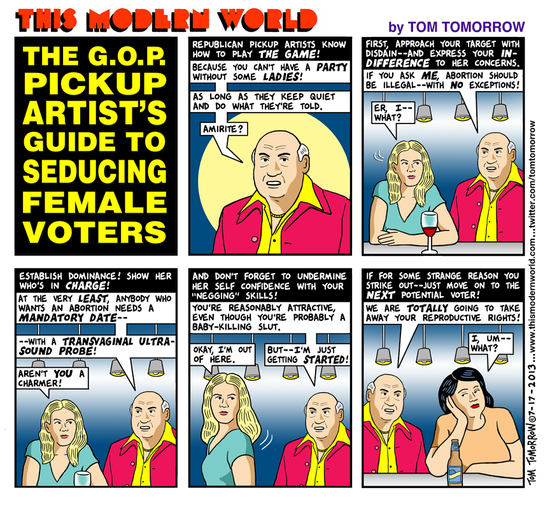
I was getting ready to call it a night as my head is swimming with a half written post about Trayvon Martin when I saw the new Tom Tomorrow cartoon.  It really needs no explanation.

TMW2013-07-17color  Great pick up lines.  I’m sure that women voters will be flocking to them in droves.

More nails in the Republican coffin?

For a number of years now, I have watched part of the Republican party that has as its main, if not sole, purpose, to dismantle government.  They called the Democrats bluff with the sequester which so far has appeared to have little effect.  Who cares if a military base can’t afford fireworks or if the Blue Angels can’t afford to do a fly over?  In the big scheme of things, those are pretty unimportant.  But now more and more federal workers are being furloughed.  For example, local HUD (Housing and Urban Development) offices are closing for five Fridays in July and August.  That is 5 Fridays that staff will not be paid.  This is money that won’t be spent on a vacation or for car repairs or for food and clothing – all things that add to the economy.  (Here is an interesting website that tracks furloughs.)  And while a number of agencies have figured out ways to avoid furloughs, many workers will still be affected – still more if Congress can’t manage to pass a budget for the fiscal year that begins in October.  The loss of incomes will slowly begin to mount.

But it isn’t just the failure to produce a budget.  A recent New York Times editorial summed up the issue quite neatly.  They called it a refusal to govern.

On two crucial issues this week, the extremists who dominate the Republican majority in the House of Representatives made it clear how little interest they have in the future prosperity of their country, or its reputation for fairness and decency.

The two issues are immigration reform and the removal of the food stamp program for the House agriculture bill.

These actions show how far the House has retreated from the national mainstream into a cave of indifference and ignorance. House members don’t want to know that millions of Americans remain hungry (in an economy held back by their own austerity ideology), and they don’t want to deal with the desperation of immigrant families who want nothing more than a chance to work and feed themselves without fear of deportation.

On both issues, in fact, many House Republicans are proudly asserting that they will stand in the way of any attempts to conduct a conference with the Senate. That might, after all, lead to a compromise.

And it isn’t just in the House.

Few things sum up the attitude of the current crop of Republicans in Washington than their loathing of conference committees. On issue after issue, they have passed radical bills and then refused to negotiate. On Thursday, for example, Senate Republicans refused for the 16th time to allow the Democratic Senate budget to be negotiated with its dangerously stingy counterpart in the House.

On immigration, House members fear a conference with the Senate would add back the pathway to citizenship that they consider a giveaway to undesirable non-English speakers. The eventual House border bills “should not be handed to a conference committee so that they can be reconciled with the Senate bill,” wrote Representative Tom Cotton of Arkansas in The Wall Street Journal on Thursday. Instead, he and others say, the Senate should be forced to take up whatever the House produces.

Senate Minority Leader Mitch McConnell may believe that ending the filibuster with a majority vote will spell the end of the Senate and cause Harry Reid to be remembered “as the worst leader of the Senate ever”, but in my opinion, the continuous use of the filibuster has already come close to destroying the Senate.  Everything should not require 60 votes.

The New York Times editorial ends with this

A refusal to even to sit at a bargaining table is another way of refusing to govern. The nation’s founders created two chambers for a reason, but Republicans, in their blind fury to harm the least fortunate, are forgetting even those fundamental national values.

From left, Representatives Tim Murphy, Mark Sanford, Cathy McMorris Rodgers and Sean P. Duffy, all Republicans, after the House approved an agriculture bill.

From left, Representatives Tim Murphy, Mark Sanford, Cathy McMorris Rodgers and Sean P. Duffy, all Republicans, after the House approved an agriculture bill.

This is why the most recent Quinnipiac poll shows that while 53% felt the President was doing too little to compromise with Congress, a whopping 68% felt the Republicans leaders in Congress were doing to little to compromise with the President.  And everyone thinks Congress is dysfunctional blaming both parties.

There is something called the greater good and I think many in Congress, particularly Republicans, have forgotten that ideal.

Photograph: Christopher Gregory/The New York Times

The real danger: The FISA Court

Congress and the President can say all they want to that everything about the surveillance is approved by the FISA Court.  OK.  But what do we know about this secret court?  Some revelations this past weekend by the Wall Street Journal and the New York Times tell us a great deal that I, for one, didn’t know.  For example, did you know that Chief Justice John Roberts was in charge?

The Ezra Klein/Evan Soltas Wonkblog had a great summary this morning.

The laws we live by aren’t just the bills Congress passes and the president signs. It’s what the courts decide those bills actually mean.

We’re used to that. The Affordable Care Act, for instance, says that states that don’t accept the Medicaid expansion lose all their Medicaid money. The Supreme Court decided that went too far. The law might still say that if you read the underlying bill, but it no longer means that. Now states can reject the Medicaid expansion without jeopardizing the rest of their Medicaid money — and many are.

But here’s the thing: When judges make the laws, Congress can always go back and remake the laws. The changes the court makes are public, and so is their reasoning. Both the voters and Congress know what the court has done, and can choose to revisit it.

Well, usually.

The Foreign Intelligence Surveillance Court (FISA court) that governs the national surveillance state is also remaking the law. But it’s remaking the law in secret. The public has no opportunity to weigh in, and Congress can’t really make changes, because few know what the court is deciding, and almost no one can discuss the decisions without endangering themselves.

So that’s a real Catch 22.

Surveillance types make a distinction between secrecy of laws, secrecy of procedures and secrecy of operations. The expectation is that the laws that empower or limit the government’s surveillance powers are always public. The programs built atop those laws are often secret. And the individual operations are almost always secret. As long as the public knows about and agreed to the law, the thinking goes, it’s okay for the government to build a secret surveillance architecture atop it.

But the FISA court is, in effect, breaking the first link in that chain. The public no longer knows about the law itself, and most of Congress may not know, either. The courts have remade the law, but they’ve done so secretly, without public comment or review.

These rules have been remade in a court where the government is the only witness, and there’s no possibility for appeal, and all 11 judges were chosen by Chief Justice John Roberts, and 10 of the 11 judges were Republican appointees to the federal bench. This is not a court like any other court in the United States save for the secrecy. It’s a court pretty much unlike any other in the United States.

When asked who watches over the National Security Agency’s surveillance efforts, the administration says that the FISA courts do. Trite as it may be, that leads to the age-old question: Well, then who watches over the watchers?

The answer would be to rewrite the law but how does one do that with a dysfunctional Congress and a law with impacts that no one can discuss without violating it?  As I said, a Catch-22.  But there is a proposal by Senator Jeff Merkley of Oregon and a bi-partisan group of other senators to end some of the secrecy.

We should be discussing ways to rein in the FISA Court and modify the Patriot Act.  Forget Edward Snowden.  He can stay at the Moscow airport or get smuggled to South American.  Fixing the law is what is important.

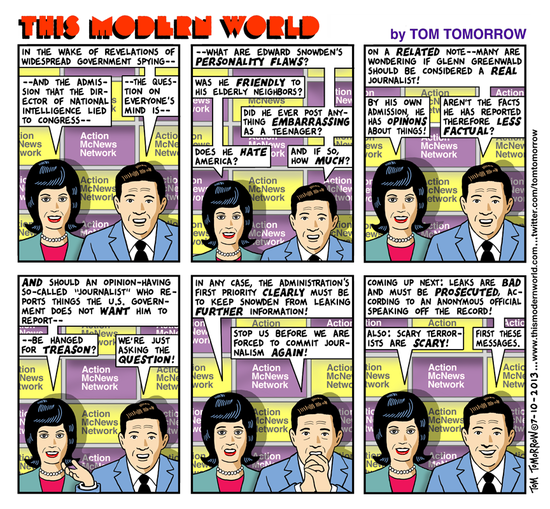
Let me end with Tom Tomorrow.

This Modern World

This Modern World

Republican gerrymandering

With the Supreme Court saying that Section 4 of the voting rights act needs a do over thus making Section 5 void, many of us are not happy.  The odds of Congress coming up with a new formula are pretty slim.  But, all may not be lost.

We know that the Republican controlled state houses used the 2010 Census to draw districts that allowed them to hold on to the House last year.  This despite Section 4 in at least some of those states.  This morning, Politico.com published a story by Alex Isenstadt in which he points out that this gerrymandering may have unintended consequences for them.

No one disputes Republicans used the once-a-decade redistricting process to  lock in their House majority — almost certainly through 2014 and possibly until  the next round of line-drawing in 2020.

But the party could pay a steep price for that dominance.

Some top GOP strategists and candidates warn that the ruby red districts the  party drew itself into are pushing House Republicans further to the right —  narrowing the party’s appeal at a time when some GOP leaders say its future  rests on the opposite happening. If you’re looking for a root cause of the  recurring drama within the House Republican Conference — from the surprise  meltdown on the farm bill to the looming showdown over immigration reform — the  increasingly conservative makeup of those districts is a good place to start.

Opposition to immigration reform by the Tea Party.

Opposition to immigration reform by the Tea Party.

These gerrymandered districts are also less diverse.

Gerrymandering and partisanship, of course, aren’t new phenomena in the  House. But the post-2010 redistricting process driven by GOP-controlled state  legislatures — Republicans wielded line-drawing power in nearly five times as  many districts as Democrats — produced significantly more districts that are  overwhelmingly conservative.

Of the 234 House Republicans, just four now represent districts that favor  Democrats, according to data compiled by The Cook Political Report. That’s down  from the 22 Republicans who resided in Democratic-friendly seats following the  2010 midterms, prior to the line-drawing.

They’re also serving districts that are increasingly white. After  redistricting and the 2012 election, according to The Cook Political Report, the  average Republican congressional district went from 73 percent white to 75  percent white. And even as Hispanics have emerged as America’s fastest-growing  demographic group, only about one-tenth of Republicans represent districts where  the Latino population is 25 percent or higher.

My Ezra Klein Wonkbook email this morning pointed out

The conventional wisdom around Washington these days is that the Republican Party needs to pass immigration reform if it’s going to survive. But remember: House Republicans aren’t the same thing as “the Republican Party.” And they probably don’t need to pass immigration reform to keep their majority. In fact, passing  immigration reform — at least with a path to citizenship — might put them in more danger. Two figures from Janet Hook in the Wall Street Journal show why.

First, “only 38 of the House’s 234 Republicans, or 16%, represent districts in which Latinos account for 20% or more of the population.”

Second, “only 28 Republican-held districts are considered even remotely at risk of being contested by a Democratic challenger, according to the nonpartisan Cook  Political Report.”

So for about 200 of the House’s Republicans, a primary challenge by conservatives angry over “amnesty” is probably a more realistic threat than defeat at the hands of angry Hispanic voters, or even angry Democrats. “Our guys actually do primary over immigration,” a top House Republican aide who wants to get immigration done told me.

Of course, that leaves some 34 Republicans who have reason to fear a Democratic challenge. And  it leaves dozens who privately support immigration reform and don’t have much to fear from either Democratic or Republican challengers.

So the Republican House members mostly represent people like themselves and need to become more conservative, not less, to keep their seats.  We aren’t talking just about immigration reform here, but a whole range of issues.  It also explains why the House’s favorite vote is to repeal the Affordable Care Act.

What does all this mean for Democratic chances to take back the House in the next election?  Isenstadt writes

New York Rep. Steve Israel, chairman of the Democratic Congressional Campaign  Committee, argued that Republicans in moderate suburban and exurban areas will  find themselves under increasing pressure in the months leading up to the  midterms.

“The problem for many Republicans in these specific districts is that if  they’re less partisan, they face a primary from the right. If they protect  themselves from a primary by being more partisan, they’re in trouble in the  general election,” Israel said. “They’re getting squeezed. We’re going to make  sure that hole is very small.”

The question is:  Are there enough of those districts for the Democrats to take the House?

It would appear that much of what is holding up legislation in the House are internal Republican fights.

When House Republicans have rallied behind legislation, it’s often been for  something deeply conservative. Two weeks ago, Republicans passed a measure that  would ban abortions after the 20th week of pregnancy. Just six GOP members  opposed the bill, including two because it didn’t go far enough.

To the conservatives, softening the GOP’s positions isn’t what’s going to  save the party in the long run.

“Political success doesn’t come from moderation,” said Arizona Rep. David  Schweikert, a Republican who opposed the farm bill and supported the  anti-abortion measure. “It’s from having principles and articulating them in a  forthright fashion.”

Schweikert, who represents a conservative Scottsdale-area district that Mitt  Romney carried with nearly 60 percent of the vote, called the Senate immigration  bill a “nonstarter.” His district is 12 percent Hispanic.

The bottom line is that so-called national Republican leaders who currently do not hold elective office along with some governors and Senators who have to run statewide campaigns can call for the party to moderate positions all they want.  The House has hitched its horse to some very conservative ideals so Republican members can get re-elected.  In the long run, this is probably good for the Democrats.

Photograph:  AP

Someone has always been watching

The June 24th issue of the New Yorker has an excellent short history of privacy and surveillance by Jill Lepore.  You should try to read the entire article either online (I can’t remember what rules the New Yorker has about access) or get a copy of the magazine.  For my purposes today, I am going to concentrate on the story of Giuseppe Mazzini.  Never heard of him before?  Me either, but his story is instructive.

An extraordinary fuss about eavesdropping started in the spring of 1844, when Giuseppe Mazzini, an Italian exile in London, became convinced that the British government was opening his mail. Mazzini, a revolutionary who’d been thrown in jail in Genoa, imprisoned in Savona, sentenced to death in absentia, and arrested in Paris, was plotting the unification of the kingdoms of Italy and the founding of an Italian republic. He suspected that, in London, he’d been the victim of what he called “post-office espionage”: he believed that the Home Secretary, Sir James Graham, had ordered his mail to be opened, at the request of the Austrian Ambassador, who, like many people, feared what Mazzini hoped—that an insurrection in Italy would spark a series of revolutions across Europe. Mazzini knew how to find out: he put poppy seeds, strands of hair, and grains of sand into envelopes, sealed the envelopes with wax, and sent them, by post, to himself. When the letters arrived—still sealed—they contained no poppy seeds, no hair, and no grains of sand. Mazzini then had his friend Thomas Duncombe, a Member of Parliament, submit a petition to the House of Commons. Duncombe wanted to know if Graham really had ordered the opening of Mazzini’s mail. Was the British government in the business of prying into people’s private correspondence? Graham said the answer to that question was a secret.

Sound familiar?

Questions raised this month about surveillance conducted by the National Security Agency have been met, so far, with much the same response that Duncombe got from Graham in 1844: the program is classified. (This, a secret secret, is known as a double secret.) Luckily, old secrets aren’t secret; old secrets are history. The Mazzini affair, as the historian David Vincent argued in “The Culture of Secrecy,” led to “the first modern attack on official secrecy.” It stirred a public uproar, and eventually the House of Commons appointed a Committee of Secrecy “to inquire into the State of the Law in respect of the Detaining and Opening of Letters at the General Post-office, and into the Mode under which the Authority given for such Detaining and Opening has been exercised.” In August of 1844, the committee issued a hundred-and-sixteen-page report on the goings on at the post office. Fascinating to historians, it must have bored Parliament silly. It includes a history of the delivery of the mail, back to the sixteenth century. (The committee members had “showed so much antiquarian research,” Lord John Russell remarked, that he was surprised they hadn’t gone all the way back to “the case of Hamlet, Prince of Denmark, who opened the letters which had been committed to his charge, and got Rosencrantz and Guildenstern put to death instead of himself.”)

The report revealed that Mazzini’s mail had indeed been opened and that there existed something called the Secret Department of the Post Office. Warrants had been issued for reading the mail of the king’s subjects for centuries. Before Mazzini and the poppy seeds, the practice was scarcely questioned. It was not, however, widespread. “The general average of Warrants issued during the present century, does not much exceed 8 a-year,” the investigation revealed. “This number would comprehend, on an average, the Letters of about 16 persons annually.” The Committee of Secrecy was relieved to report that rumors that the Secret Department of the Post Office had, at times, sent “entire mail-bags” to the Home Office were false: “None but separate Letters or Packets are ever sent.”

“Secresy is an instrument of conspiracy,” Jeremy Bentham argued, in an essay called “Of Publicity,” first published in 1843, a year before the Mazzini affair. “It ought not, therefore, to be the system of a regular government.” By “publicity,” Bentham meant what is now usually called transparency, or openness. “Without publicity, no good is permanent: under the auspices of publicity, no evil can continue.”

In 1844, during the parliamentary debate that followed the report issued by the Committee of Secrecy, some members, believing, with Bentham, that publicity is the enemy of secrecy, suggested that it was fine for the government to open people’s mail, as long as the recipients of the mail were notified that it had been read. (Disraeli said that he would be only too happy to hand over his mail to the Home Office: “They may open all my letters, provided they answer them.”) In “Letter-Opening at the Post-Office,” Mazzini revealed just how much the debate had been informed by Bentham’s arguments about publicity. Diplomats might have their secrets, he granted, but postmen? “Why, who are these men who treat as enemies their fellow subjects of the realm?” he asked. “For public servants, we want responsibility and responsibility cannot be obtained without publicity. Secrecy is but another word for fear. MYSTERY was the name of the beast in the revelations. The great monster by which was typified all the civil and ecclesiastical corruptions of the earth, had on its forehead a name written and that name was MYSTERY.”

There is a delicate balance between privacy and surveillance.  Is it  OK for the government to collect all the metadata but not look at content without a warrant so long as we know that is what is happening?  And who keeps an eye on the FISA court?

In 1890, two Boston lawyers, Samuel Warren and Louis Brandeis, published an article in the Harvard Law Review called “The Right to Privacy.” Warren was a Boston Brahmin, but Brandeis’s parents were Eastern Europeans who had supported a failed uprising in Austria in 1848—the very revolution that, four years before, had been anticipated by the Austrian Ambassador who persuaded the British Home Secretary to read Giuseppe Mazzini’s mail. The suppression of the uprising had been followed by a wave of anti-Semitism, leading to the Brandeis family’s decision to emigrate to the United States. Louis Brandeis was born in Kentucky in 1856. In the eighteen-seventies, he and Warren were classmates at Harvard Law School (Brandeis helped found the Harvard Law Review); after graduation, they opened a law firm together. Warren married Mabel Bayard, a senator’s daughter, in 1883. As the legal scholar Amy Gajda has shown, nearly sixty articles of gossip about the Warren-Bayard family appeared in newspapers between 1882 and 1890—including front-page stories, two weeks apart, about the funerals of Mrs. Warren’s mother and sister. Warren was infuriated. His household had been violated; his family’s privacy, like a letter, had been purloined. (A great many ideas about privacy have to do with hiding women and families.)

In “The Right to Privacy,” Warren and Brandeis argued that there exists a legal right to be let alone—a right that had never been defined before. Their essay lies at the heart of every legal decision that has been made about privacy ever since. The right to privacy, as they understood it, is a function of history, a consequence of modernity. Privacy, they argued, hadn’t always been necessary; it had become necessary—because of the shifting meaning and nature of publicity. By the end of the nineteenth century, publicity, which for Bentham had meant transparency (the opposite of secrecy), had come to mean the attention of the press (the opposite of privacy). Making public the deliberations of Congress was a public good; making public the names of mourners at Mrs. Warren’s mother’s funeral was not. (The same distinction informed the debate that resulted, in the eighteen-eighties and nineties, in the adoption of the secret ballot. Citizens vote in private; legislative votes are public.)

But with blogs, Facebook, Twitter and other new media, those of us who post and tweet want people to read what we say and when we do so we should be aware that we are being public.  Email, however, is the new version of writing a letter and the government reading email is like reading Mazzini’s mail.  There is a very fine line between collecting email records and looking at content and many wonder if we can actually trust the government to honor the distinction.  With cell phones and GPS, our whereabouts can also be tracked. (I’m a fan of NCIS and love the way McGee can locate the bad guys – and sometimes the good ones – using a cell phone number.)  It seems that we are beginning, if we haven’t already, accepted that a lot of our private lives are now public because we put them out there.  We are not like the Warren family who did not want a list of the mourners at a funeral made public.

It is likely that someone has always been watching and it is clear that we still haven’t figured out that troublesome line between public and private.

Here is an old New Yorker cartoon from around 1973.

Bugging