Official end to California’s Prop 8

I woke up this morning to this news from the New York Times

Gay Couples Who Sued in California Are Married

Kris Perry and Sandy Stier, who have been together for more than 15 years and have four sons, were married at San Francisco City Hall by Attorney General Kamala Harris on Friday.

Kris Perry and Sandy Stier, who have been together for more than 15 years and have four sons, were married at San Francisco City Hall by Attorney General Kamala Harris on Friday.

The two couples who sued to overturn California’s ban on same-sex marriage were married late Friday afternoon, just hours after the United States Court of Appeals for the Ninth Circuit, in San Francisco, lifted the stay that had been in place.

The court had stopped same-sex marriages while the case wound its way through the Supreme Court, which issued its decision to clear the path for same-sex marriages in California on Wednesday.

Attorney General Kamala Harris rushed to San Francisco City Hall within minutes of the ruling to perform the wedding for Kris Perry and Sandy Stier, who have been together for more than 15 years and have four sons.

And in LA

Mayor Antonio R. Villaraigosa of Los Angeles, on his last workday in office, officiated at the Friday evening wedding of Paul Katami and Jeffrey Zarrillo, the two other plaintiffs in the case. Until Friday afternoon, they had no idea when their marriage could take place.

“Nobody really knew; that’s what our lawyers are there for. We don’t really care about any of that at this point, but we’re on our way to see the mayor,” Mr. Zarrillo told KCRW, a public radio station in Los Angeles.

The pair were stuck in traffic en route from their home to the county office to obtain their marriage license and then to City Hall downtown. But by 6:30 they walked in front of dozens of television cameras, kissed Mayor Villaraigosa and were pronounced married.

“Your relationship is an inspiration to us all,” Mr. Villaraigosa said. “Today, your wait is finally over.”

“Equal feels different,” Mr. Katami said. Mr. Zarrillo added, “Equal feels good.”

The Ninth Circuit acted with unusual speed.

Many legal experts and advocates had expected the court to wait for an official decision from the Supreme Court, as is the normal practice. But after the initial ruling was issued on Wednesday, Ms. Harris urged the Circuit Court to act immediately and said she would ensure that all counties in the state were prepared to issue licenses to same-sex couples.

Just after 3 p.m. Friday, the three-judge panel issued a one-sentence ruling lifting the stay on a district judge’s injunction to not enforce the ban on same-sex marriages.

Gov. Jerry Brown issued a statement late Friday afternoon saying that he had directed the state’s Department of Health to notify all 58 counties in the state that “same-sex marriage is now legal in California and that marriage licenses must be issued to same-sex couples immediately.”

I know there had been some confusion about the impact of the Supreme Court decision.  Some thought it would only apply to the plaintiff, but since the District and Appeals courts had already ruled Prop 8 unconstitutional it turns out that only the stay had to be lifted.

From Massachusetts:  Welcome to Marriage Equality, California!  And an aside to the opponents – don’t worry, the sky will not fall.  This is number 13.  Which state will be next?

Photograph:  Jim Wilson/The New York Times

Someone has always been watching

The June 24th issue of the New Yorker has an excellent short history of privacy and surveillance by Jill Lepore.  You should try to read the entire article either online (I can’t remember what rules the New Yorker has about access) or get a copy of the magazine.  For my purposes today, I am going to concentrate on the story of Giuseppe Mazzini.  Never heard of him before?  Me either, but his story is instructive.

An extraordinary fuss about eavesdropping started in the spring of 1844, when Giuseppe Mazzini, an Italian exile in London, became convinced that the British government was opening his mail. Mazzini, a revolutionary who’d been thrown in jail in Genoa, imprisoned in Savona, sentenced to death in absentia, and arrested in Paris, was plotting the unification of the kingdoms of Italy and the founding of an Italian republic. He suspected that, in London, he’d been the victim of what he called “post-office espionage”: he believed that the Home Secretary, Sir James Graham, had ordered his mail to be opened, at the request of the Austrian Ambassador, who, like many people, feared what Mazzini hoped—that an insurrection in Italy would spark a series of revolutions across Europe. Mazzini knew how to find out: he put poppy seeds, strands of hair, and grains of sand into envelopes, sealed the envelopes with wax, and sent them, by post, to himself. When the letters arrived—still sealed—they contained no poppy seeds, no hair, and no grains of sand. Mazzini then had his friend Thomas Duncombe, a Member of Parliament, submit a petition to the House of Commons. Duncombe wanted to know if Graham really had ordered the opening of Mazzini’s mail. Was the British government in the business of prying into people’s private correspondence? Graham said the answer to that question was a secret.

Sound familiar?

Questions raised this month about surveillance conducted by the National Security Agency have been met, so far, with much the same response that Duncombe got from Graham in 1844: the program is classified. (This, a secret secret, is known as a double secret.) Luckily, old secrets aren’t secret; old secrets are history. The Mazzini affair, as the historian David Vincent argued in “The Culture of Secrecy,” led to “the first modern attack on official secrecy.” It stirred a public uproar, and eventually the House of Commons appointed a Committee of Secrecy “to inquire into the State of the Law in respect of the Detaining and Opening of Letters at the General Post-office, and into the Mode under which the Authority given for such Detaining and Opening has been exercised.” In August of 1844, the committee issued a hundred-and-sixteen-page report on the goings on at the post office. Fascinating to historians, it must have bored Parliament silly. It includes a history of the delivery of the mail, back to the sixteenth century. (The committee members had “showed so much antiquarian research,” Lord John Russell remarked, that he was surprised they hadn’t gone all the way back to “the case of Hamlet, Prince of Denmark, who opened the letters which had been committed to his charge, and got Rosencrantz and Guildenstern put to death instead of himself.”)

The report revealed that Mazzini’s mail had indeed been opened and that there existed something called the Secret Department of the Post Office. Warrants had been issued for reading the mail of the king’s subjects for centuries. Before Mazzini and the poppy seeds, the practice was scarcely questioned. It was not, however, widespread. “The general average of Warrants issued during the present century, does not much exceed 8 a-year,” the investigation revealed. “This number would comprehend, on an average, the Letters of about 16 persons annually.” The Committee of Secrecy was relieved to report that rumors that the Secret Department of the Post Office had, at times, sent “entire mail-bags” to the Home Office were false: “None but separate Letters or Packets are ever sent.”

“Secresy is an instrument of conspiracy,” Jeremy Bentham argued, in an essay called “Of Publicity,” first published in 1843, a year before the Mazzini affair. “It ought not, therefore, to be the system of a regular government.” By “publicity,” Bentham meant what is now usually called transparency, or openness. “Without publicity, no good is permanent: under the auspices of publicity, no evil can continue.”

In 1844, during the parliamentary debate that followed the report issued by the Committee of Secrecy, some members, believing, with Bentham, that publicity is the enemy of secrecy, suggested that it was fine for the government to open people’s mail, as long as the recipients of the mail were notified that it had been read. (Disraeli said that he would be only too happy to hand over his mail to the Home Office: “They may open all my letters, provided they answer them.”) In “Letter-Opening at the Post-Office,” Mazzini revealed just how much the debate had been informed by Bentham’s arguments about publicity. Diplomats might have their secrets, he granted, but postmen? “Why, who are these men who treat as enemies their fellow subjects of the realm?” he asked. “For public servants, we want responsibility and responsibility cannot be obtained without publicity. Secrecy is but another word for fear. MYSTERY was the name of the beast in the revelations. The great monster by which was typified all the civil and ecclesiastical corruptions of the earth, had on its forehead a name written and that name was MYSTERY.”

There is a delicate balance between privacy and surveillance.  Is it  OK for the government to collect all the metadata but not look at content without a warrant so long as we know that is what is happening?  And who keeps an eye on the FISA court?

In 1890, two Boston lawyers, Samuel Warren and Louis Brandeis, published an article in the Harvard Law Review called “The Right to Privacy.” Warren was a Boston Brahmin, but Brandeis’s parents were Eastern Europeans who had supported a failed uprising in Austria in 1848—the very revolution that, four years before, had been anticipated by the Austrian Ambassador who persuaded the British Home Secretary to read Giuseppe Mazzini’s mail. The suppression of the uprising had been followed by a wave of anti-Semitism, leading to the Brandeis family’s decision to emigrate to the United States. Louis Brandeis was born in Kentucky in 1856. In the eighteen-seventies, he and Warren were classmates at Harvard Law School (Brandeis helped found the Harvard Law Review); after graduation, they opened a law firm together. Warren married Mabel Bayard, a senator’s daughter, in 1883. As the legal scholar Amy Gajda has shown, nearly sixty articles of gossip about the Warren-Bayard family appeared in newspapers between 1882 and 1890—including front-page stories, two weeks apart, about the funerals of Mrs. Warren’s mother and sister. Warren was infuriated. His household had been violated; his family’s privacy, like a letter, had been purloined. (A great many ideas about privacy have to do with hiding women and families.)

In “The Right to Privacy,” Warren and Brandeis argued that there exists a legal right to be let alone—a right that had never been defined before. Their essay lies at the heart of every legal decision that has been made about privacy ever since. The right to privacy, as they understood it, is a function of history, a consequence of modernity. Privacy, they argued, hadn’t always been necessary; it had become necessary—because of the shifting meaning and nature of publicity. By the end of the nineteenth century, publicity, which for Bentham had meant transparency (the opposite of secrecy), had come to mean the attention of the press (the opposite of privacy). Making public the deliberations of Congress was a public good; making public the names of mourners at Mrs. Warren’s mother’s funeral was not. (The same distinction informed the debate that resulted, in the eighteen-eighties and nineties, in the adoption of the secret ballot. Citizens vote in private; legislative votes are public.)

But with blogs, Facebook, Twitter and other new media, those of us who post and tweet want people to read what we say and when we do so we should be aware that we are being public.  Email, however, is the new version of writing a letter and the government reading email is like reading Mazzini’s mail.  There is a very fine line between collecting email records and looking at content and many wonder if we can actually trust the government to honor the distinction.  With cell phones and GPS, our whereabouts can also be tracked. (I’m a fan of NCIS and love the way McGee can locate the bad guys – and sometimes the good ones – using a cell phone number.)  It seems that we are beginning, if we haven’t already, accepted that a lot of our private lives are now public because we put them out there.  We are not like the Warren family who did not want a list of the mourners at a funeral made public.

It is likely that someone has always been watching and it is clear that we still haven’t figured out that troublesome line between public and private.

Here is an old New Yorker cartoon from around 1973.

Bugging

The House passes still another restriction on abortion

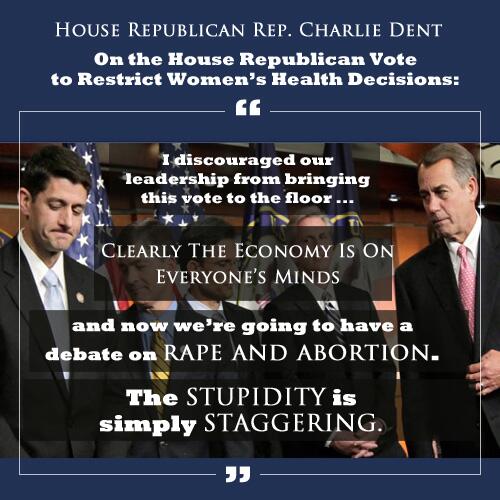
Nancy Pelosi tweeted this picture with a quote from Representative Dent last night

Embedded image permalink

Clearly the Republican leaders didn’t listen to Dent.  They love to have votes on abortion, birth control and, the favorite – repealing the Affordable Heath Care Act instead of actually passing measures that might also pass in the Senate and get signed into law.
The result of pandering again to their base was passage of a bill that will ban abortions after 22 weeks.  According to the New York Times story

The measure, which would ban abortion after 22 weeks of pregnancy based on the medically disputed theory that fetuses at that stage of development are capable of feeling pain, passed in a 228-to-196 vote that broke down mostly along party lines. Reflecting how little common ground the two parties share these days, just six Republicans voted against the bill; six Democrats voted for it.

“I’m not waging a war on anyone,” said Kristi Noem, Republican of South Dakota, offering a rejoinder to the Democratic assertion that Republicans have waged a war on women, a line of attack that harmed conservative candidates in 2012. “Regardless of your personal beliefs, I would hope that stopping atrocities against little babies is something we can all agree to put an end to.”

How about stopping atrocities like cutting food stamps and voting against bills that would provide health care and jobs for after this child that you have “saved” is born, Representative Noem?
But, remembering the bad press from hearings where all the legislators and all the witnesses were men discussing birth control the leadership did show they can learn something.

The tableau in the House chamber on Tuesday was intentionally far different from the scene last week at a meeting of the House Judiciary Committee at which all 19 of the Republicans arguing for and then voting to approve the bill were men. Republican leaders made sure that their female members were front and center for the debate this time.

Representative Virginia Foxx, a North Carolina conservative and Tea Party favorite, and Representative Marsha Blackburn, a longtime abortion opponent from Tennessee, were assigned to manage the floor debate. Representative Candice S. Miller of Michigan and Representative Ileana Ros-Lehtinen, one of the Republican conference’s more moderate members, controlled the gavel.

But the simple math was difficult to ignore. Only 19 of the 234 Republican House members are women. Nearly all of them spoke on Tuesday. Only three Republican men were allowed to participate in the debate. Notably, Trent Franks of Arizona, the bill’s sponsor who last week caused an uproar after claiming that instances of pregnancy after rape were “very low,” said nothing from the floor.

I think that 22 weeks is getting close to the time of viability which most see as 23 to 26 weeks.  As bills move ever closer to that line,  those of us who agree that women have a right to choose to continue the pregnancy or not will be faced with a difficult question and one that we need to be prepared to answer: where, if anywhere, should the line be drawn?

Even if Democrats believed the political upper hand was theirs as they used the issue of reproductive rights to portray their opponents yet again as hostile and indifferent to the needs of women, it was clear that the question at hand — the termination of pregnancies that are five months or more along — was an uncomfortable one.

At a news conference Tuesday morning led by Democrats who favor abortion rights, the mood quickly turned tense after two journalists tried to press the representatives about their support for late-term abortions. Representative Diana DeGette of Colorado cut off questions after being asked whether she would draw the line at legal abortion later in pregnancy. “The Supreme Court has spoken, and this bill is unconstitutional. Next question,” she said.

As medical science advances, the time limits laid out in Roe v. Wade may no longer hold.  There are medical and social costs to having a child born at 25 weeks.  In a 1997 story, the New York Times reported

”At the time of Roe vs. Wade it was around 26 weeks pregnant,” Dr. Ezra Davidson, past president of the American College of Obstetrics and Gynecology, said. ”It has come down a couple of weeks since that time.”

But many babies who survive birth at that stage have terrible problems.

”You have to temper any discussion about viability because though you may get into a 24-week period, or a 23-week period, a large portion of those infants are going to have serious disabilities,” Dr. Davidson said.

Most experts believe that the current limit of viability is 23 or 24 weeks into the normal 40-week term of pregnancy. Babies born at this stage are known as micropreemies and are extremely fragile. The typical micropreemie weighs 500 to 600 grams — slightly more than a pound — and can fit in the palm of a hand.

According to the American College of Obstetrics and Gynecology, fewer than 40 percent of infants born from 23 to 25 weeks’ gestation survive.

Moreover, Dr. William Taeusch, chief of pediatrics at San Francisco General Hospital, said: ”That’s strictly survival. That’s getting out of the hospital alive, usually at three months, at a cost of hundreds of thousands of dollars. And if you get out of the hospital alive and you haven’t had major problems, then your chances of having a normal brain are 90 percent.”

But according to the obstetrics and gynecology group, nearly 50 percent of surviving children who weigh less than 750 grams at birth experience moderate or severe disability, including blindness and cerebral palsy.

Things haven’t really changed a great deal since 1997.  This is from the Wikipedia article on fetal viability.

Fetal Viability Chart

Fetal Viability Chart

Of course, most women who don’t have late term abortions have a full term baby.  This means the mother and hopefully father need to have jobs and assistance in caring for the baby for the next 18 years – the kind of assistance the Republicans often vote against.  It means available contraception so women aren’t faced with the choice at all.  It means sex ed  beginning in middle schools that includes information on what it is like to care for a baby.  (What happened to those programs where teens had to care for a doll that was life-like and demanded diaper changes and feedings 25/7?)

I personally have problems with late term abortions that are not for medical reasons – either the mother’s or the child’s.  But I also think we should be spending what is needed to make sure those children are fed, educated and not abused.  And I understand why sometimes the decision is so late.

Jessica Valenti has column in the Nation thinking through many of these issues, but it is her conclusion that sticks with me.

Abortion is complicated, as are our lives and health—and the fact that these  choices are so complex and nuanced is precisely why we can’t legislate them.  Wishing otherwise will never 
make it so.

Syria? Really?

The President, probably never believing that Assad would use chemical weapons, drew a red line.  He’s been stalling around saying he needs verification, but now he has it.  The question is what should we do now.  I think Obama is stuck.

130612_barack_obama_ap_605

The United States has a long history of failed interventions.  Vietnam was basically a civil war.  We armed the Taliban when they were our “friends”.  We actually started a civil war in Iraq by stupidly dismissing all the Baathists saying they can’t be part of any new Iraqi government.  Now we are again taking sides against the Baathist who currently rule Syria.  My big fear is that the region will explode into a Sunni v. Shia conflict and we will be seen as taking sides.

Andrew Sullivan wrote this morning

My strong view, vented last night as I absorbed this stunning collapse of nerve, is that we shouldn’t fight at all. We are damn lucky to have gotten every GI out of Iraq, and the notion of being sucked back into that region again – and to join sides in a sectarian conflict – is a betrayal of everything this president has said and stood for. It’s a slap in the face for everyone who backed him because he said he wouldn’t be another Bush or McCain or Clinton. If he intervenes in Syria, he will have no credibility left with those of us who have supported his largely sane and prudent foreign policy so far. Libya was bad enough – and look at the consequences. But Syria? And the entire Middle East? Is he out of his mind?

And can you think of a dumber war than this one?

The man who said he would never engage in a dumb war is apparently preparing to join the dumbest war since … well, Iraq.

My only hope right now is that we can somehow use our threat of intervention to maneuver some type of international peace keeping force while we try to bring both sides to a negotiating table.  And let us hope that President Obama knows to get Congress involved, gets a UN resolution and the Arab League to agree before we take any action.

Sullivan concludes

One reason I supported Obama so passionately in 2008 and 2012 was because I thought he understood this and had the spine to stand up to drama queens like McCain and armchair generals like William Jefferson Clinton. But it is beginning to appear that this president isn’t actually that strong. We voted for him … and he’s giving us Clinton’s and McCain’s foreign policy. If Cameron and Hollande want to pull another Suez, for Pete’s sake be Eisenhower – not Kennedy.

My cri de coeur is here. Don’t do it, Mr President. And don’t you dare involve us in another war without a full Congressional vote and national debate. That wouldn’t just be a mistake; it would be a betrayal.

Photograph:  AP

Surveillance and President Obama

I look forward to my weekly email from my Congressman, Mike Capuano.  Of course, I once worked for him when he was mayor of the City of Somerville (a near Boston city) so I am used to Mike’s saying what he means and I almost always agree with him.  I am copying the entire first part of his email into this post.

mike_225x315

“U.S. Rep. Michael Capuano (D-Somerville), who voted against the Patriot Act, rallied protesters by calling the law the worst attack on freedom since the 1798 Alien and Sedition Acts.”

                                                                                                                Boston Herald

                                                                                                                September 10, 2003


The Patriot Act and Verizon


I am sure you are aware that Verizon has reportedly been ordered by the top-secret Foreign Intelligence Surveillance Court (FISA court) to turn over, “on an ongoing daily basis”, information about every customer telephone number, including landline, cell and business numbers. That information reportedly includes all numbers dialed and all calls received within the United States as well as between the United States and other countries.

As I write this newsletter, the news is filled with reports that a similar program called PRISM is in place for every major internet and email provider. The government claims they have not accessed the content of phone calls, but it seems they ARE accessing the content of emails such as videos, websites visited and more. According to reports, the PRISM program is not at this time being used on U.S. citizens.

Even if you can accept the government collecting the number and length of every call you make, are you really comfortable with them having the ability to catalogue all the YouTube videos you watch, the Netflix movies you download, or the web pages you visit? It seems that our own government has access to every phone call, email and internet search for all Americans at every minute of every day.

Like most Americans, I am absolutely outraged. But, if you’re a long time subscriber to these newsletters, you probably already knew that. You also probably know that I voted against passage of the so-called “Patriot Act” and every reauthorization since it first passed in 2001.

Before I go any further, I feel compelled to remind you that I was an early and strong supporter of President Obama.  I am still amongst the strongest Obama supporters in the House of Representatives.  Nonetheless, I cannot remain silent out of some sort of misplaced loyalty to President or party when I believe that basic American rights have been intentionally trampled.

I know we live in a dangerous world and there is work to do to prevent terrorists from harming us. But we must find a balance between giving law enforcement the tools they need to track and identify terrorists and protecting the very liberties upon which our great country was founded.

This data collection has reportedly been going on for 7 years. The length of time that this has been going on and the staggering amount of data collected on every Verizon customer amounts to an incredible overreach. Even if you’re not a Verizon customer, there is clearly reason for concern. Who really believes that Verizon is the only telecommunications company required to turn over this data?

I have always believed that we must give law enforcement the tools they need to pursue criminals. However, we can do that and still protect civil liberties.

It is time for those of us who support President Obama to speak up.  I believe he is a good man and has been a good President.  However, I think his Administration has allowed their concern for our safety to lead them down the wrong path.  If we remain silent, those who have always wished him to fail on every point stand a better chance of winning the hearts and minds of America and we will all be worse off for it.  It is possible to support President Obama and yet disagree with him on certain issues – this is one of those times.

The President has said he is glad this is out in the open and he welcomes discussion.  Instead of reacting in horror – or wishing more information would be collected, we need to talk.   I’m not sure I know where the balance is, but one thing that I learned at St. John’s College (Annapolis) is that dialog can lead to greater clarity and understanding.  So let’s talk:  To each other and to the President and your member of Congress.

Photograph from Capuano website.

Republican suicide in Virginia?

Having lived in Virginia for many years, I take more than a passing interest in the political scene there and this fall’s election will be a doozy!  Not quite sure what Virginia Republicans think they are doing, but unless everyone in Virginia has totally lost it, Terry McAuliffe should be the next governor.

This morning, the Washington Post has a story with 3 earlier related ones.  Here are the headlines with links:

E.W. Jackson a wild card in Va. GOP campaign  This is the main profile and biography.

Va. GOP’s E.W. Jackson: So far right he has said Democrats have ‘Antichrist’ agenda

E.W. Jackson complicates Cuccinelli bid

Va. GOP picks conservatives for fall ticket; black minister is lieutenant governor choice

So what exactly is going on in Virginia?   On May 18, the Post described the ticket this way

Thousands of Virginia Republicans on Saturday picked a slate of statewide candidates who vowed to stay true to conservative principles, resisting calls to remake the GOP message after losses in 2012.

At the top of the ticket is gubernatorial hopeful Ken Cuccinelli II, the attorney general. Known for high-profile battles against “Obamacare,” abortion and a university climate scientist, Cuccinelli stood by what detractors have called an out-of-the-mainstream agenda.

E.W. Jackson, a minister from Chesapeake, won the nomination for lieutenant governor with a full-throated appeal for limited government, traditional families and gun rights. “We will not only win an election in November, we will open the hearts and minds of our people and save this commonwealth and save this country,” said Jackson, the first African American nominated by the Virginia GOP for statewide office since 1988. [That was Doug Wilder, who won.]

For attorney general, the party nominated state Sen. Mark D. Obenshain (R-Harrisonburg), who this year successfully pushed tougher voter ID rules. “Are you ready to stop Obamacare in its tracks?” he asked the crowd in his acceptance speech, eliciting cheers.

Republican nominee for governor Ken Cuccinelli, right, is joined onstage with the other members of the ticket, including E. W. Jacksonon, second from left.

Republican nominee for governor Ken Cuccinelli, right, is joined onstage with the other members of the ticket, including E. W. Jackson, second from left.

It is as if the election last year never happened.  Mitt Romney didn’t lose.  Barack Obama never won.

But the candidate in the spotlight is Jackson.

Jackson’s improbable rise, one that has astonished Republicans far and wide, is the latest of a number of incarnations, including foster child, Marine, Harvard law school graduate and even Democrat. But the minister who is now GOP gubernatorial nominee Ken Cuccinelli II’s running mate has long used his booming voice to endear himself to conservatives.

Still, Jackson’s words — sometimes eloquent, sometimes raw, often impassioned — are causing anxiety for many Republicans as the resurfacing of his past statements about homosexuality and abortion have threatened to disrupt the campaign.

Instead of promoting their new ticket, Republicans have answered for Jackson’s once calling gays “perverted” and “sick” and saying Planned Parenthood has been “far more lethal” to blacks “than the KKK.”

Jackson has ties to Massachusetts which I didn’t know.

After a tour with the Marines, Jackson graduated with honors in 1975 from the University of Massachusetts, where he majored in philosophy. Then he graduated from Harvard Law School in 1978. He spent more than 20 years in Boston, practicing law, pastoring at New Cornerstone Exodus Church, serving as a chaplain to the Boston Fire Department, and hosting radio shows, including one called “Earl Jackson Across America.”

At one point, he was a Democrat, and he was elected to the party’s Massachusetts State Committee, where he distinguished himself with his conservative views. “I thought, ‘Wow, here’s a great potential leader,’ ” said James Roosevelt, who is a grandson of Franklin D. Roosevelt and who was then and is now legal counsel to the state Democratic organization. “Then I learned of his views, and I thought: ‘What’s he doing? This is not a leader of the Democratic Party.’ ”

Jackson became a Republican in the early 1980s, explaining that Democrats’ embrace of the gay rights movement violated his religious beliefs. In 1989, he joined the opposition to a proposal to ban discrimination against gays and lesbians in Massachusetts. “We intend to blow this bill to smithereens,” he told reporters then. “We intend to defeat this legislation and bury it so deep no one will ever find it again.”

Sorry Rev. Jackson.  We not only passed that bill, but we also have marriage equality.  I have to admit I never listen much to talk radio or to Jackson’s program.  He moved to Virginia in 1998, perhaps thinking the political climate there would be more in tuned to his views and clearly he was right about that: he is now the Republican nominee for Lt. Governor.  Jackson has also been affiliated with the Christian Coalition and the Tea Party.

“The Republicans I’m talking to are saying, ‘What the hell are they doing in Virginia?’ ” said Michael Steele, former chairman of the Republican National Committee. “Is this, ‘101 ways to lose an election’? You’re coming out of the gate with comments everyone has to explain. You’re wasting a lot of time and energy batting that back when you should be doing other things to get the guy known.”

Although unknown to many Republicans, Jackson in recent years has built a following among the most activist of Virginia’s conservatives, many of whom were delegates at the convention. But Republicans are now concerned, Steele said, that Jackson will turn off the party’s own voters. “You can’t have a situation where Republicans say, ‘You know what? I can’t have this’ and they stay home or vote for the other guy,” he said.

Added to the mix is the investigation of the current Republican governor, Bob McDonnell awkwardly headed by the current Republican Attorney General and nominee for Governor, Ken Cuccinelli who took money from the same supporter.  The New York Times has that story.

Virginia’s attorney general has appointed an outside prosecutor to investigate Gov. Bob McDonnell’s financial disclosures, in a widening scandal over a political donor who wrote a $15,000 check for the wedding of the governor’s daughter, and who was also a benefactor of the attorney general.

Kenneth T. Cuccinelli II, the attorney general, who is also the Republican candidate for governor this year, said on Wednesday that he named the outside prosecutor last November to look into Mr. McDonnell’s disclosures.

Mr. Cuccinelli said “information came to my attention” triggering the appointment of the prosecutor. His referral of the case to the Richmond commonwealth’s attorney, Mike Herring, whose role is similar to that of a district attorney, “was not a conclusion that any violation occurred,’’ Mr. Cuccinelli said in a statement.

The investigation came to light through a Freedom of Information Act request by The Richmond Times-Dispatch, which first reported it.

Mr. McDonnell and Mr. Cuccinelli, who are yoked in an awkward political alliance – the former a popular governor of a purple state and his would-be successor, a Tea Party favorite — have been swept up in controversy over their friendship with a Virginia businessman, Jonnie R. Williams Sr., who gave generously to both officials.

What a tangle!  Can Terry McAuliffe pull out a win for the Democrats?

“We’re in a deep [expletive],” said one Virginia Republican strategist. “The only good news is that the Democrats have Terry McAuliffe. It’s the only thing keeping us glued to a chance of victory.”

McAuliffe, a former Democratic National Committee chairman, has faced questions about his leadership of an electric car company and some unflattering quotes from his own memoir.

All I can say is “stay ‘tooned”.

Photograph: Steve Helber/AP

Primary versus Exclusive

IRS building on Constitution Avenue in Washing...

IRS building on Constitution Avenue in Washington, D.C.. (Photo credit: Wikipedia)

Trust the former budget guy Lawrence O’Donnell to find this.  The part of the tax code with the definition of 503(c)4 was written in 1954 and the IRS regulation adopted in 1959.  (Think maybe we need to update the tax code?).  According to Clare Kim writing for O’Donnell’s “The Last Word”

Internal Revenue Service agents have been struggling to do their jobs–which have been made essentially impossible by an incorrect interpretation of the law that the IRS made in 1959. It was then that the IRS changed the language of the law without any authority to do so. Here is how the tax law was written in its latest update in 1954 on 501(c)(4) social welfare organizations. The 501(c)(4) designation was to apply only to: “Civic leagues or organizations not organized for profit but operated exclusively for the promotion of social welfare.”

But a 1959 interpretation guideline written by the IRS says that: ”To be operated exclusively to promote social welfare, an organization must operate primarily to further the common good and general welfare…”

My Webster’s New Collegiate Dictionary defines exclusive as excluding or having the power to exclude, the definition we are all familiar with.  Exclude is to shut out or bar from participation, consideration or inclusion.  The 1954 tax code meant that any group receiving this exemption was to only promote social welfare.  Primarily on the other hand means chief.  The question some Senators and Representatives put to IRS officials was whether exclusive and primary meant the same thing.  The IRS officials didn’t think so and neither do I.  The 1959 reg combines the two in a way that the poor folks trying to make determinations have to find confusing.

But is this all just semantics?

At his news conference, President Obama stressed the importance of enforcing clear laws. “We’re gonna have to make sure that the laws are clear so that we can have confidence that they are enforced in a fair and impartial way and there’s not too much ambiguity surrounding these laws.”

Citizens for Responsibility and Ethics in Washington (CREW) officially filed a lawsuit against the IRS for departing from statute on “exclusively” for social welfare in the code. The organization’s 17-page filing asks the IRS to simply enforce the law as written and to drop the IRS’ false interpretation of the law.

If this happens the Democratic organizations like Organizing for America will lose their exemptions just like Tea Party groups and Karl Rove.  I don’t think this a bad thing.

Leaks, national security and the press

Every administration on every level of government worries about leaks.  Mayors worry about information on a big new construction project or policy initiative getting out too soon.  Presidents worry about national security.  Members of legislatures worry about a stand on an issue leaking before it can be “properly framed.”  Actually all politicians worry about that.  Look at VP Biden “leaking” his position on gay marriage.  I’ve been suspected of being a leaker because I knew reporters – and I’ve helped look for leaks.   I also believe in a free press, but as with any freedom, limits are needed.  The question is where that line should be.

Do you understand what the AP scandal is all about?  I have to admit that until I read this piece by Jack Shafer of Reuters, I really didn’t.  I don’t think the press did a good job of trying to explain their own story.  Did you know that the leak had to do with the underwear bomber?  I didn’t.  Never heard or saw that and I follow the news pretty closely.

Shafer writes

Journalists gasp and growl whenever prosecutors issue lawful subpoenas ordering them to divulge their confidential sources or to turn over potential evidence, such as notes, video outtakes or other records. It’s an attack on the First Amendment, It’s an attack on the First Amendment, It’s an attack on the First Amendment, journalists and their lawyers chant. Those chants were heard this week, as it was revealed that Department of Justice prosecutors had seized two months’ worth of records from 20 office, home and cell phone lines used by Associated Press journalists in their investigation into the Yemen underwear-bomber leaks.

First Amendment radicals — I count myself among them — resist any and all such intrusions: You can’t very well have a free press if every unpublished act of journalism can be co-opted by cops, prosecutors and defense attorneys. First Amendment attorney Floyd Abrams speaks for most journalists when he denounces the “breathtaking scope” of the AP subpoenas. But the press’s reflexive protests can prevent it from seeing the story in full, which I think is the case in the current leaks investigation.

,,,

The Obama administration has already used the Espionage Act to prosecute more government officials for leaking than all of his predecessors put together, but we shouldn’t automatically lump its pursuit of the underwear-bomb leaker in with those cases. Perhaps this investigation is chasing an extra-extraordinary leak, and the underwear-bomber leak is but one of the drops.

I have to point out here that the Republicans in Congress have pushed the administration to find leakers and, I fear, have caused the Democrats and President Obama to catch their paranoia.

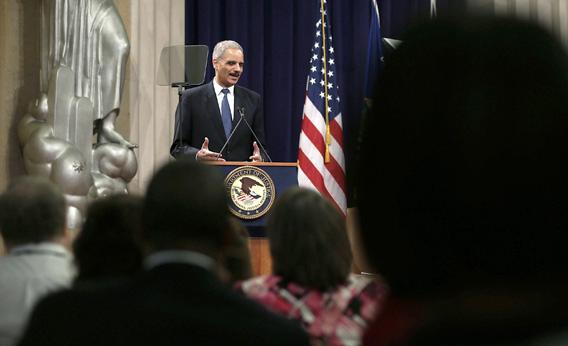
Attorney General Eric Holder has overseen more leak investigations under Obama than were pursued under Bush

Attorney General Eric Holder has overseen more leak investigations under Obama than were pursued under Bush

Shafer continues

The AP story that has so infuriated the government described the breakup of an al Qaeda in the Arabian Peninsula plot to place an underwear bomber on board a U.S.-bound airliner. Published on the afternoon of May 7, 2012, the story patted itself on the back for having heeded the White House and CIA requests to not publish the previous week, when the AP first learned of the operation. The AP states in the article that it published only after being told by “officials” that the original “concerns were allayed.” In a chronology published in today’s Washington Post, we’re told that the CIA was no longer resisting publication of the AP story on the day it hit the wire (Monday) and that the White House was planning to “announce the successful counterterrorism operation that Tuesday.”

That may be the case, but the government was still incensed by the leak. In fact, it appears that officials were livid. As my Reuters colleagues Mark Hosenball and Tabassum Zakaria reported last night, the government found the leak so threatening that it opened a leak investigation before the AP ran its story.

Now, what would make the Obama administration so furious? My guess is it wasn’t the substance of the AP story that has exasperated the government but that the AP found a source or sources that spilled information about an ongoing intelligence operation and that even grander leaks might surge into the press corps’ rain barrels.

At the risk of making the Department of Justice’s argument for it, a leak once sprung can turn into a gusher as the original leakers keep talking and new ones join them, or as the government attempts to explain itself, or as others in the government begin to speak out of turn. From what I can tell, all of the above happened after the AP story appeared.

So there you have it.  It was not the particular leak, but the fact that there was a leaker that could potentially leak again.  As Shafer points out when there is a leak there is also the problem of government officials saying too much and, in effect becoming leakers.  What happened here was the existence of a double agent got out, mostly because of what government officials said in trying to explain the original AP story.   Shafer summarizes the trail and concludes

To begin with, the perpetrators of a successful double-agent operation against al Qaeda in the Arabian Peninsula would not want to brag about their coup for years. Presumably, al Qaeda in the Arabian Peninsula will now use the press reports to walk the dog back to determine whose misplaced trust allowed the agent to penetrate it. That will make the next operation more difficult. Other intelligence operations — and we can assume they are up and running — may also become compromised as the press reports give al Qaeda in the Arabian Peninsula new clues.

Likewise, the next time the CIA or foreign intelligence agency tries to recruit a double agent, the candidate will judge his handlers wretched secret keepers, regard the assignment a death mission and seek employment elsewhere.

Last, the leaks of information — including those from the lips of Brennan, Clarke and King — signal to potential allies that America can’t be trusted with secrets. “Leaks related to national security can put people at risk,” as Obama put it today in a news conference.

The ultimate audience for the leaks investigation may not be domestic but foreign. Obviously, the government wants to root out the secretspillers. But a country can’t expect foreign intelligence agencies to cooperate if it blows cover of such an operation. I’d wager that the investigations have only begun.

None of this means we should go rooting around people’s cell phone and email records without some protection.  In his reaction to the scandal, President Obama called for Congress to enact an updated media shield law which would replace the Justice Department’s internal regulations (which I think they actually didn’t follow).  Wouldn’t it be interesting for Congress to take some proactive steps instead of just investigating?

Photograph: Alex Wong/Getty Images

Taxes, taxes, taxes

Who was it that said, “Nothing is certain but death and taxes”?  They should have added tax loopholes and exemptions to that list.

Here in Massachusetts we have a Senate candidate who took at $281,000 tax credit for agreeing not to made changes to the facade of his home located in a historic district.  I don’t know how this works in other states but here local city and town councils can pass by-laws regulating historic districts.  Cohasset, the town where Gabriel Gomez lives, has a by-law on the books that says owners of homes in the historic district may not change the facades of their homes.  So Mr. Gomez basically took a tax credit for something he was prohibited from doing anyway.  Adrian Walker wrote this in the Globe this morning.

Challenged to explain, a testy Gomez set a new standard for chutzpah. He claimed that his tax break is really the fault of his opponent, Ed Markey — because in 1981, Markey voted for the law that established tax breaks for historical preservation.

OK.  So maybe taking the tax break was not illegal, but there is something about it that makes me – and it appears – other voters wonder if this is the guy we want representing us.  Plus there is the fact that most of us don’t make $281K over many years much less get to take that much off our taxes.

Walker continues

Andy Hiller of WHDH-TV cornered Gomez and asked a few questions about it, or tried to. What he got back from Gomez was this: “I don’t apologize for any success I’ve had. Absolutely not. I’m proud of everything I’ve done. I’ve worked for everything I’ve done. I’ve earned everything I’ve done.”

Gomez is an accomplished military veteran who has earned many things in his life, but he certainly didn’t earn this. Even the Internal Revenue Service has decried the historical-preservation deduction he took as a farce.

The questions about Gomez’s taxes probably haven’t ended, either.

On a financial disclosure form filed in March, Gomez said that under his separation agreement from the private equity firm Advent International, he received something called “carried interests.”

Carried interests are fees paid to equity firms and hedge funds to manage portfolios. They are taxed as capital gains, at a rate of 20 percent, rather than the top income rate of 39.5 percent.

Carried interests are fees paid to equity firms and hedge funds to manage portfolios. They are taxed as capital gains, at a rate of 20 percent, rather than the top income rate of 39.5 percent.

The carried interest rate — which costs taxpayers an estimated $1.3 billion a year — has long been the subject of dispute, with some critics arguing that this is one of the first tax loopholes lawmakers should close.

How much of Gomez’s income falls under the “carried interest” loophole is unclear from the disclosure form.

Gabriel Gomez is running as a reformer, as an outsider but as Walker points out, he already knows all the tricks.  Maybe we need someone like him to help reform the tax code – not!
Internal Revenue Service Building

Internal Revenue Service Building

Taxes are also at the heart of what the Republicans hope will be the scandal that brings down the Obama Administration if Benghazi doesn’t work out for them.  According to the New York Times this is what we know.

The Internal Revenue Service’s special scrutiny of small-government groups applying for tax-exempt status went beyond keyword hunts for organizations with “Tea Party” or “Patriot” in their names, to a more overtly ideological search for applicants seeking to “make America a better place to live” or “criticize how the country is being run,” according to part of a draft audit by the inspector general that has been given to Capitol Hill.

The head of the division on tax-exempt organizations, Lois Lerner, was briefed on the effort in June 2011, seemingly contradicting her assertion on Friday that she learned of the effort from news reports. But the audit shows that she seemed to work hard to rein in the focus on conservatives and change it to a look at any political advocacy group of any stripe.

Since last year’s elections, Republicans in Congress have struggled for traction on their legislative efforts, torn between conservatives who drove the agenda after their 2010 landslide and new voices counseling a shift in course to reflect President Obama’s re-election and the loss of Republican seats in the House and the Senate.

But the accusations of I.R.S. abuse are sure to fuel an effort that appears to be uniting dispirited Republicans and their conservative political base: investigating Mr. Obama and his administration. Republicans are pushing a portrayal of an administration overreaching its authority and punishing its enemies.

“The bottom line is they used keywords to go after conservatives,” Representative Darrell Issa of California, the chairman of the House Oversight and Government Reform Committee, said Sunday on the NBC News program “Meet the Press.” He requested the inspector general’s audit along with another Republican, Representative Jim Jordan of Ohio. As an audit, it will not find blame or refer anyone for criminal prosecution.

This all goes back to the Citizens United decision by the Supreme Count and the flood of organization, most it seems on the right to register as 501(c)4 social welfare groups.  This leaves me puzzled.  How can a group which supports political lobbying be tax exempt?  I give money to Planned Parenthood to support clinics.  I also give money for the political operations.  The first is tax exempt, the second is not.  So maybe the problem is, once again, with the tax code.  Ezra Klein explains.

Let’s try to keep two things in mind simultaneously: The IRS does need some kind of test that helps them weed out political organizations attempting to register as tax-exempt 501(c)4 social welfare groups. But that test has to be studiously, unquestionably neutral.

The story thus far seems both chilling and cheering. Employees at the agency’s Cincinnati branch did employ a test that, in effect, targeted tea party groups. Whether they meant it to be discriminatory or they simply created one that was discriminatory is in contention, but ultimately immaterial. The IRS, more so than almost any other agency, must act in ways above  reproach.

But when the Cincinnati group explained their test to IRS exempt organizations division chief Lois G. Lerner, she objected to it and it was changed. A few months later, the IRS would release new guidance that suggested scrutinizing “political action type organizations involved in limiting/expanding Government, educating on the Constitution and Bill of Rights, social economic reform movement,” and after that, “organizations with indicators of significant amounts of political  campaign intervention (raising questions as to exempt purpose and/or excess private benefit.)”

The context for all this is that after Citizens United and some related decisions, the number of groups registering as 501(c)4s doubled. Because the timing of that doubling coincided with a rise in political activism on the right rather than the left, a lot of the politicized groups attempting to register as 501(c)4s were describing their purpose in tea party terms. A popular conceit, for  instance, was that they existed to educate on the Constitution — even if the particular pedagogical method meant participating in Republican Party primaries and pressuring incumbent politicians.

In looking for that kind of language in 2010, the Cincinnati employees were attempting to create a usable shortcut. Like Willie Sutton robbing banks, they were going where the action was. But they needed a clearer test that also identified the language of the left, even if left-leaning  groups weren’t exhibiting the same surge in activism. And, frankly, it shouldn’t have been left to career employees in Cincinnati. The IRS needed clearer rules coming from the top. But the top didn’t know what to do with these 501(c)4s, in part because it feared a situation precisely like this one.

It is worth remembering an important fact here: The IRS is supposed to reject groups that are primarily political from registering as 501(c)4s. If they’re going to do  that, then they need some kind of test that helps them flag problematic applicants. And that test will have to be a bit impressionistic. It will mean taking the political rhetoric of the moment and watching for it in applications. It will require digging into the finances and activities of groups on the left and the right that seem to be political even as they’re promising their activities are primarily non-political.

If we’re not comfortable with that, then we need to either  loosen the definition of 501(c)4s or create a new designation that gives explicitly political groups the benefits of the 501(c)4s (namely, they don’t have to pay taxes and they can keep their donors anonymous). But either way, as I wrote on Friday, the only way to make sure this doesn’t keep happening is for the IRS — or the Congress and White House that control it — to make some tough decisions about 501(c)4s.

To make things look even more suspicious, Ms. Lerner appears to have been confused about the order in which events unfolded.  But, is there a scandal here?   It does not appear that any group, on the right or left has been denied 501(c)4 status.  I believe that to get 501(c)3 status which most community development groups and organizations like the Girl Scouts and the Boys and Girls clubs have one must provide a lot of information including board membership and by-laws.  The problem here is that many these new groups appear to be political organizations regardless of whether or not they claim to be educational.  I question whether any of these groups, right or left, should be tax exempt.

“Tax-exempt social-welfare groups organized under section 501(c)(4) of the Internal Revenue Code are allowed to engage in some political activity, but the primary focus of their efforts must remain promoting social welfare. That social-welfare activity can include lobbying and advocating for issues and legislation, but not outright political-campaign activity. But some of the rules leave room for IRS officials to make judgment calls and probe individual groups for further information. Organizing as such a group is desirable, not just because such entities typically don’t have to pay taxes, but also because they generally don’t have to identify their donors.” John D. McKinnon and Siobhan Hughes in The Wall Street Journal.

The odds are against Mr. Gomez being elected to the Senate and they are likely to be against the Republicans making a credible argument about the IRS, but taxes and tax exemptions are clearly land mines for anyone in politics today.  But if the Republicans are right, that is a place where the Obama Administration and I will part company.  As my Congressman Mike Capuano said today, “There’s no way in the world, I’m going to defend that. [if the accounts are true] Hell, I spent my youth vilifying the Nixon administration for doing the same thing.”

Photograph:  Reuters

If you have a gun…

If you decided to own a gun, you may be certain that you are someone who will store and use it safely, that it will not be used except for (hunting, self-defense, target shooting).  But we are realizing what has probably always been true:  If you own a gun, you really don’t have control over how or when it is used.

We can begin with Columbine.  The weapons used were in a locked gun cabinet broken into by the two teenaged shooters.  I’m sure that the grandfather thought they were safe.  I haven’t seen any stories yet about the Newtown shooter and how he and his mother stored their many guns.  I imagine that she thought they were safe until she was shot with one of them.  Reading the column in the New York Times yesterday by Joe Nocera and listening to the speeches at the NRA convention made me realize that there are parallel worlds here and maybe they will never meet.

Nocera writes about two incidents.  The first happened last year.

On the afternoon of Aug. 7, 2012, Greg Imhoff — a big, friendly 61-year-old construction superintendent from Madison, Wis., who had moved to Florida with his partner, Shari Telvick — went to check on the home of a neighbor.

The neighbor, Richard Detlor, was a friend, someone Imhoff had known back in Madison, where the Detlors still lived for part of the year. Whenever the Detlors went back to Wisconsin, Imhoff would look in on their house, something he did for many of his neighbors.

It is impossible to know whether, on that August afternoon, Imhoff ever saw the stranger in the house with the .22 caliber revolver; all we know for sure is that Imhoff was shot in the head. When Telvick and a friend found him that evening, he was lying in a pool of blood, dead.

The killer turned out to be a man named Billy Ray Retherford, who was on the lam after killing a woman two weeks earlier and was hiding in the Detlors’ empty home. The next day, Retherford was killed in a shootout with the police. He was using the same .22 handgun.

The gun, however, was not his. It belonged to Richard Detlor, who, according to the police report, had left it, loaded, in the nightstand by his bed before departing for Wisconsin several months earlier.

Gregory Imhoff (Photograph from online obituary)

Gregory Imhoff
(Photograph from online obituary)

OK.  So Detlor probably thought the gun was safe even though he didn’t unload it and lock it up.  I know the argument:  If the gun isn’t loaded then it really isn’t any good for self-defense in the case of a home invasion.  Same with trigger locks.  But what about the various technologies that could prevent anyone by Detlor from firing it?  How can one be opposed to that?  Want your wife to be able to use it if you aren’t around?  I don’t know for sure, but I imagine there is technology to allow that, too.  In Florida, safe storage laws apply only when there is a minor in the household so leaving a loaded, unsecured weapon in an empty house is not illegal.  But it is stupid.

And you have the two year old killed by her five year old brother.

Just the other day, in Burkesville, Ky., a 5-year-old boy shot and killed his 2-year-old sister with a small rifle that had been given to him as a present. Who gives a 5-year-old a gun? (The rifle is called a Crickett; incredibly, it is marketed specifically to children.) Who leaves the room where their children are playing without checking whether the rifle in the corner is loaded? For that matter, who puts a shotgun within such easy reach of a child?

Gary White, the county coroner, was quick to say that no charges would be brought because it was an accident — and, after all, “accidents happen.” But it was a completely preventable accident. When a passenger dies in a car accident that is the result of negligence, there are usually serious legal consequences for the driver. If we really want to reduce gun violence, there must be consequences for negligent gun owners, too. The entire culture of gun ownership has to begin emphasizing safety in a way it doesn’t now. It is as important as universal background checks, or limits on magazine rounds.

And her family says that it was an accident and that she is with God.  Gun deaths and hunting accidents may be part of rural life, but does that mean things can never be different?

We are clearly living in a parallel universe and I’m not sure what we can do to make the lines meet.  Perhaps beginning with changes in the laws relating to negligence would be a place to start.