The People’s House

Julia Pierson, head of the Secret Service, testified before Congress yesterday on the security lapses that resulted in a fence jumper making it into the White House and then into the East Room.  But Omar Gonzalez in just one in a long line of uninvited guests.  Anyone remember the couple that got through security into a state dinner?  Peter Baker had a nice history of the uninvited in the New York Times.

Long before the latest fence jumper captured international attention by getting as far as the East Room, the history of White House security breaches was vast and varied. One intruder in a white karate outfit carried in a knife hidden in a Bible. A stranger slipped in to watch a movie with President Franklin D. Roosevelt. And a pilot crashed his Cessna into the mansion.

Theodore Roosevelt once agreed to see a man who identified himself as “Mr. John Smith” and insisted he had an appointment, even though the president did not recognize him. But after talking with him for a bit, Mr. Roosevelt quickly changed his mind. “Take this crank out of here,” he ordered an usher. In the man’s back pocket, it turned out, was a large-caliber pistol.

Pierson herself pointed out

…that before the most recent incident, 16 people had jumped the White House fence over the last five years, six of them this year alone. Many of them do not seem intent on harming the president, but are eager to draw attention to some issue or cause. One this year was a toddler who had slipped through the fence.

We seen to want the impossible.  We want our President and his family to be safe, but accessible.  And for much of our history, the President and the White House have been much more accessible than they are today.

During World War II, Franklin Roosevelt had just finished watching a movie when the lights came on and he discovered a stranger standing nearby. His predecessor, Herbert Hoover, came downstairs for dinner one night to find a man in the Blue Room who said he was just a sightseer. On another occasion, Mr. Hoover was having dinner with a movie producer in the State Dining Room when an intruder marched up, demanding an appointment.

During Ronald Reagan’s second inauguration, a man followed the Marine Band into the White House and wandered around for 15 minutes before being discovered. And of course, President Obama found himself with a couple of extra guests for a State Dinner in 2009, when the party crashers Tareq and Michaele Salahi managed to get past White House aides and the Secret Service even though they were not on an invitation list.

There have been shots fired (so far without hitting anyone) and President Tyler had stones thrown at him by an intruder in the White House garden.  But more disturbing are the aircraft that manage to penetrate the White House airspace.

A helicopter stolen from nearby Fort Meade by an Army private landed on the South Lawn of the White House in 1974.

A helicopter stolen from nearby Fort Meade by an Army private landed on the South Lawn of the White House in 1974.

With all the ground protection, several men have tried to pierce the White House perimeter by air. An Army private stole a helicopter from Fort Meade in 1974 and flew it to the White House, where he landed on the South Lawn, took off again and then returned. Secret Service officers eventually opened fire on the chopper, forcing it down. The private survived and was sentenced to a year in prison. That same year, a failed businessman tried to hijack a Delta passenger jet at Baltimore-Washington International Airport with a plan to crash it into the White House, but was shot by the police while in the cockpit before takeoff.

In 1994, an unlicensed pilot who had spent an evening drinking and smoking crack cocaine stole a Cessna 150L and crashed it on the South Lawn in the middle of the night. The plane skidded across the ground, smashed into a magnolia tree and eventually came to a halt against the wall of the mansion. The pilot was killed, but the building was not seriously damaged and Mr. Clinton was not at home at the time.

President Andrew Jackson famously called the White House “the People’s House” but in the current climate, protection and screening would seem to be most important.  Perhaps President Obama should take satirist Andy Borowitz seriously.

President Barack Obama has decided to move his family into a full-service doorman building in Washington, D.C., saying that “it just makes more sense right now.”

“It really will work better for us,” Obama said in a press conference Tuesday morning. “In addition to the doorman, there’s a guy at the front desk, and, if anyone comes to see you, the desk guy will call up to your apartment first to make sure it’s O.K.”

 Photograph:  Charles Tasnadi/Associated Press
A few thoughts from Professor Krugman on unemployment and my own on the mid-term election

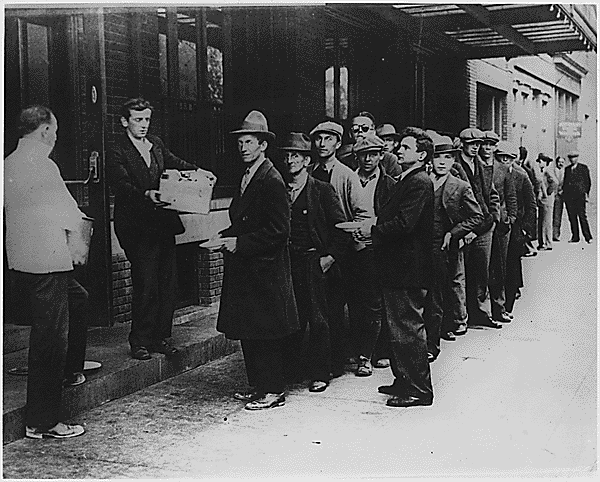
One of the issues in the mid-term elections is the failure of the economy to fully recover.  Having watched bits and pieces of the new Ken Burns series on the Roosevelts  I see some parallels between FDR and President Obama.  Both Presidents saw the economy begin to slow after showing good signs of recovery. In FDR’s case it actually fell back into recession.  The mistake in both cases is, at least in part, the failure to continue to fund government programs to create jobs,  to end the programs too quickly.  FDR came to understand this; Barack Obama always did.  But the current Congress doesn’t seem to get it.

Breadlines: long line of people waiting to be fed: New York City: in the absence of substantial government relief programs during 1932, free food was distributed with private funds in some urban centers to large numbers of the unemployed. (Circa February 1932)

Breadlines: long line of people waiting to be fed: New York City: in the absence of substantial government relief programs during 1932, free food was distributed with private funds in some urban centers to large numbers of the unemployed. (Circa February 1932)

At the end of my work life I got to administer some of the stimulus funding.  What I saw was not the direct creation of a huge number jobs with government  funding, but many jobs created as the result of the opening of a new business, new hotel, or new housing.  Those employed persons paid taxes which helped bolster the economy.  If the benefits of having people employed are obvious to an economic novice like me,  I don’t understand why the Republicans in Congress don’t want to fund infrastructure projects.  Road and bridge repairs, creating a grid that can tie in with alternative energy sources, construction of affordable housing:  these are just a few of the types of projects that can be government funded and that can create jobs.  While construction jobs may disappear, the infrastructure created will result in new opportunities.

Paul Krugman’s recent column helps me understand a little what may be going on.  He begins

Last week John Boehner, the speaker of the House, explained to an audience at the American Enterprise Institute what’s holding back employment in America: laziness. People, he said, have “this idea” that “I really don’t have to work. I don’t really want to do this. I think I’d rather just sit around.” Holy 47 percent, Batman!

People are just lazy.  Krugman continues

First things first: I don’t know how many people realize just how successful the campaign against any kind of relief for those who can’t find jobs has been. But it’s a striking picture. The job market has improved lately, but there are still almost three million Americans who have been out of work for more than six months, the usual maximum duration of unemployment insurance. That’s nearly three times the pre-recession total. Yet extended benefits for the long-term unemployed have been eliminated — and in some states the duration of benefits has been slashed even further.

The result is that most of the unemployed have been cut off. Only 26 percent of jobless Americans are receiving any kind of unemployment benefit, the lowest level in many decades. The total value of unemployment benefits is less than 0.25 percent of G.D.P., half what it was in 2003, when the unemployment rate was roughly the same as it is now. It’s not hyperbole to say that America has abandoned its out-of-work citizens.

If unemployment is too costly, then any kind of jobs program must cost way too much.

…My question for today is instead one of psychology and politics: Why is there so much animus against the unemployed, such a strong conviction that they’re getting away with something, at a time when they’re actually being treated with unprecedented harshness?

Is it race? That’s always a hypothesis worth considering in American politics. It’s true that most of the unemployed are white, and they make up an even larger share of those receiving unemployment benefits. But conservatives may not know this, treating the unemployed as part of a vaguely defined, dark-skinned crowd of “takers.”

My guess, however, is that it’s mainly about the closed information loop of the modern right. In a nation where the Republican base gets what it thinks are facts from Fox News and Rush Limbaugh, where the party’s elite gets what it imagines to be policy analysis from the American Enterprise Institute or the Heritage Foundation, the right lives in its own intellectual universe, aware of neither the reality of unemployment nor what life is like for the jobless. You might think that personal experience — almost everyone has acquaintances or relatives who can’t find work — would still break through, but apparently not.

The bottom line:  If you are still unemployed or if you are poor it is your own fault.  Besides, those people live in a world far from the world of Fox News.

I hope that people think about the state of the semi-recovered economy when they vote and that they vote for candidates who can learn from the lessons of the Depression, will vote some funding for jobs programs and not worry so much about the deficit which is shrinking.  They should instead worry about our infrastructure which is failing.  If they fix that, they may find people aren’t lazy, they just need jobs.

 Photograph:  Picture from the Franklin D. Roosevelt Library, courtesy of the National Archives and Records Administration

College reunion: My 45th

I have to begin by saying that I have no idea what a “normal” college reunion is like.  I picture football games, halftime bands, sorority and fraternity parties and a good deal of alcohol consumption.  That last may be the one thing that a homecoming reunion at St. John’s College has in common with other homecomings.

My husband (who was in my class at St. John’s) and I hadn’t been to a reunion since the 25th, but we had been tapped as co-chairs for the 45th.  The first thing you have to understand is that St. John’s is a tiny school.  I think that there are around 400 current students on the Annapolis campus and an equal number on the Santa Fe one.  In the mid to late 1960s the student bodies were smaller.  I believe that the graduation rates have increased since my time, also.  Our freshman class was around 100 and if memory serves me, about 50 or 60 of us finally graduated.  This is my long-winded way of explaining why when 11 us (plus one spouse who is also the mother of a graduate) showed up, it was a pretty good number.

But what is a reunion all about?  You go to the place where you were x number of years ago and you hang-out with people you haven’t seen for years (and maybe didn’t know so well to start).  A reunion/homecoming at St. John’s is different. What makes a St. John’s reunion for me is several things.  First, the school is small enough that one knows people from other classes.  Second, because we all had pretty much the same curriculum and read the same books we could talk to friends (some old and some new) from the Classes of 1984, 1967, 1956 and 1965 with no problem.  And, third, the experience is intellectually stimulating.  Even the Friday night lecture, which wasn’t very good, sparked a breakfast discussion at our B & B about Dostoevsky and “The Brothers Karamazov”.  We came home and researched translations and will order and read the book again.

Our class had a seminar on Moliere’s “Misanthrope” led by two tutors that many of us had studied with back when we were students. The College also mixed in some current students.  It was a lively event with discussion on comedy, tragedy and what it means to be a misanthrope.  The play came up several times in other discussions over the weekend and my husband and I talked about it on the drive home to Vermont.  That is a powerful experience.  Seminars are the heart of any reunion at St. John’s but are not the only shared experience that is re-experienced.  There was also Freshman chorus (think of a bunch of mostly non musicians singing Mozart and rounds as we were once required to do. )  That was fun!

This was the anniversary of the writing of the “Star-Spangled Banner” by Francis Scott Key who is an alumni of what we fondly refer to as the Old Program.  (St. John’s is the third oldest college in the United States after Harvard and William and Mary.)  In his honor we all toddled out to back campus after drinking much wine at dinner (and the pre-dinner reception) to watch the fireworks over College Creek after this year’s Freshmen sang the “Star-Spangled Banner”  It was a great Homecoming and Reunion.

Fireworks over College Creek, St. John's College, Annapolis 2014 Homecoming.

Fireworks over College Creek, St. John’s College, Annapolis 2014 Homecoming.


Photograph: Tia Pausic

Police departments and racial diversity

Back in the dark ages, that is the early to mid-1980s, I worked on a study for then Virginia Governor Charles Robb.  He wanted to know several things including how we could recruit more African-Americans and women to the State Police and how, once we hired them, they could be retained.  I can’t recall that we came up with anything one wouldn’t have expected including things like more training for command in diversity issues.  I do remember one black trooper I interviewed had an idea on how to recruit people.  He suggested that he be made part of the Governor’s security detail which would provide lots of visibility.  I told the Governor and the next thing I knew, the trooper was thanking me when we ran into each other on the Capitol grounds.  I have no idea if his presence helped recruit more blacks to the ranks or not but it did provide some visibility and I remember that the Capitol Police then hired several black officers.

So my little story took place in 1983.  This morning’s New York Times has some very interesting charts on large Metropolitan police departments and the differences between their racial compositions and those of the towns they serve.

In hundreds of police departments across the country, the percentage of whites on the force is more than 30 percentage points higher than in the communities they serve, according to an analysis of a government survey of police departments. Minorities make up a quarter of police forces, according to the 2007 survey, the most recent comprehensive data available. Experts say that diversity in the police force increases a department’s credibility with its community. “Even if police officers of whatever race enforce the law in relatively the same way, there is a huge image problem with a department that is so out of sync with the racial composition of the local population,” said Ronald Weitzer, a sociologist at George Washington University. Listed below are local police departments from 15 metropolitan areas, sorted so that departments with the largest percentage-point differences of white officers to white residents are at the top.

We clearly have a long way to go.  I wonder if part of the recruitment problem is the sheer number of young black and Hispanic men who have conviction records.  Perhaps we should look into that.

th

I was interested to see that Boston (+18) and Somerville (+15) were doing pretty well.  Those are two of the police departments I’ve worked with in the recent past.  Other departments should take a look at this chart and talk to some of the successful agencies – and I don’t mean towns that have a small gap because the population of the town itself is mostly white – and learn from what they have done.

Incidents like the shooting in Ferguson don’t happen in a vacuum.  Look up a town near you and ask questions if you don’t like what you see.


As a footnote:  While I was looking to a picture to add, I was surprised at the number of stock photographs showing police in riot gear and/or arresting someone, often a black male.  Just another part of the problem.

Photograph:  how2becomeanfbiagent.com

Labor, management and Market Basket

If you don’t live in New England – you have probably never heard of the Market Basket grocery chain.  It has been known for customer service and low prices.  I confess that I’ve probably shopped there maybe twice in the last 20 years so I am clearly not a regular.  But I know people who swear by Market Basket and, for some, it is the only store in town.  Whether you have heard of MB and love it, or don’t know the first thing about the store, there are lessons to be learned for Labor Day.

For more years than I can count, there has been a feud between the two cousins, Arthur S. and Arthur T. who inherited the store.  It has involved an epic court battle, and if I remember correctly, disciplinary action against some of the attorneys.  There was also an actual fist fight as at one point between the Arthurs.  All the while, Arthur T. has been managing the stores and making money for everyone.  But, according to the employees and Arthur T., the board wanted to take a bigger share of the profits for themselves and the shareholders who are mainly family members. The board decided to fire Arthur T.  Shirley Leung writes in her Boston Globe column

For six weeks, we were mesmerized by the sight of thousands of grocery clerks, cashiers, and other workers protesting at stores, on Facebook, and on the front pages of this paper. They did so at great risk, without the protection of a union, not because they wanted higher wages, but merely the return of their beloved boss, Arthur T. Demoulas.


Who among us would do that? Not many, if any at all. We were riveted because we wanted to be them. These rebellious employees gave voice to the voiceless masses who just wanted to hold on to decent wages for a decent day’s work at a time when fat cats get $50 million paychecks for showing up, and the gap between the rich and the poor is as gaping as ever.


After the Market Basket board ousted Arthur T., these foot soldiers of capitalism kept the story alive when they made flyers protesting his removal and distributed them to customers. Then they reached out to the media and politicians to talk about their improbable demand. Soon workers walked off the job and refused to restock shelves. Customers boycotted in solidarity, putting the economic squeeze on new management to do something.

While it is tempting to portray Arthur T. as the Good Arthur and Arthur S. as the Bad Arthur, as Leung points out Arthur S. and his pals never carried out threats to fire everyone and hire new people.  There was an attempt to hold a job fair, but it was never clear how many people came or if anyone was hired.  I believe eight people were fired early on, but that example didn’t slow either the employee action or customer boycotts.  The governors of New Hampshire and Massachusetts got involved.  A settlement was announced finally and Arthur T. is buying out Arthur S. so as to become the majority shareholder.  He will now be running a severely damage company in deep debt and will be borrowing money to pay for his purchase.

Employees seem optimistic.  They returned to work as soon as the announcement was made.  Whether the stores can be stocked so there are things for people to buy, whether suppliers can return, and whether Arthur T. can keep to his promise to continue to treat and pay workers well are open questions.  If Market Basket can beat the odds and make a comeback to profitability, the story will be studied in business schools and by labor historians for many years.  Actually, it will probably be studied no matter what happens.

Market Basket employees celebrate the return of Arthur T.

Market Basket employees celebrate the return of Arthur T.

The Market Basket story is one for this Labor Day.  Non-union employees took collective action to save a boss and his practice of putting employees above shareholders. I’ll let Joan Vennochi have the last word.

Most notable is the power of narrative. Market Basket workers used social media as an organizing tool, but, at the same time, they skillfully used old and new media to tell their story before the other side knew what was happening.

And, unless you were Arthur S., it was a story that had something for everyone:

Workers standing up for, not against, management.

The desire to believe in one corporate leader putting the well-being of his workers

over shareholders, in an old-fashioned “It’s A Wonderful Life” way.

Employees of modest means willing to put paychecks for rent and mortgages on the line for principle.

“It speaks to a search and yearning for respect and fairness,” said Lew Finfer, a veteran community organizer who has worked for decades with unions to do just that by promoting better worker pay, conditions, and benefits.

There are lessons here for everyone.

Photograph:  JESSICA RINALDI/GLOBE STAFF


When spouses are both in politics

I’m not necessarily referring to Bill and Hillary Clinton and whether his actions, both while governing and personally (think Monica) should be fair game if Hillary decides to run.  I’m thinking today about David Barron and his wife, Juliette Kayyem, who is running for the Democratic nomination for Governor of Massachusetts.  I happen to be a Kayyem supporter although she is fighting an uphill battle.  And I wonder if it just got even more uphill.

David Barron was just confirmed to the 1st Circuit Court of Appeals which is New England.  His nomination was held up because he is the author of the infamous “drone” memo.  The New Yorker’s Ryan Lizza had an interesting piece about Barron and the memo today.

On July 16, 2010, David J. Barron, a lawyer at the Department of Justice, sent Eric Holder, the Attorney General, a lengthy memorandum. Barron, who had celebrated his forty-third birthday earlier that month, was a professor at Harvard Law School, on leave for a couple years to work for President Barack Obama. Barron, like many young lawyers who arrived in Washington with the new Administration in 2009, had impeccable liberal credentials. As a Harvard undergraduate on the Crimson, the campus newspaper, he wrote sympathetic pieces about Jesse Jackson’s 1988 Presidential campaign. During the summer of 1993, before his third year at Harvard Law School, he interned with the N.A.A.C.P. in Washington. After graduating, he clerked for Supreme Court Justice John Paul Stevens, a leader of the court’s liberal wing, and then worked in the Clinton Justice Department. During the Bush years, he was a relatively prominent critic of the Administration’s national-security polices, especially its embrace of torture.

In 2006, while Bush’s Justice Department lawyers were tweaking a new legal regime allowing for bulk-collection surveillance and what they called “enhanced interrogation,” Barron helped review the bylaws of the Botanic Gardens Children’s Center. As a professor in Cambridge, he raised money for the campaign of Deval Patrick, who has been governor of Massachusetts since 2007. That same year, 2007, he even attended the YearlyKos convention, a sort of South by Southwest for left-leaning bloggers and activists trying to push the Democratic Party in a more unabashedly progressive direction. During his legal career, he has signed amicus-curiae briefs in several highly political cases, including one defending a living-wage ordinance in Santa Fe, New Mexico, and another defending a major campaign-finance reform law. In 2008, during an NPR interview, he mused that articles of impeachment could be justified against a President who purposely misled the country into war.


Juliette Kayyem

Juliette Kayyem

His wife has similar liberal credentials.  I first met her right after the World Trade Center bombings.  Everyone was in a panic about the possibility of more incidents, about loss of civil liberties, the prospect of some kind of martial law, and whether we were safe.  I can’t remember the exact words she used, but she was reassuring with ideas that one did not have to curtail civil liberties to combat terrorism.  After that I read her column in the Boston Globe and found, for the most part, that she had a pretty commonsense approach to things.  But I know that a number of supporters of other Democratic candidates want to tar her with the David Barron’s memo justifying the drone strike that killed an American citizen living in Yemen and involved in terrorism.

His July, 2010, missive, which was one of the last that he wrote during his eighteen months running O.L.C., was historic and—to many—troubling: yes, Barron argued, the President of the United States could kill an American citizen named Anwar al-Awlaki. And, as a rule, the memo argued, the President could kill any American citizen abroad connected to Al Qaeda or an associated group—without a trial or other legal proceedings—if he deemed that person an imminent threat.

This post is not meant to debate the memo or whether we should have killed Anwar al-Awlaki without a trial, but whether Barron’s memo is fair game for his wife’s political opponents.  None of us know what he wrote or what kind of justification he used:  We only know that al-Awalki is dead.  We don’t know if Kayyem agreed with what he wrote or if she even knows any more about the contents of the memo than the rest of us.  I do know the fact that he wrote has already been raised against her.  It is likely that if she does manage to get the nomination that some part of the progressive community will not work for her.

Boston Magazine has already raised the question.  The article opens

Gubernatorial candidate Juliette Kayyem has run into some trouble with Massachusetts Democrats over what some characterize as hawkish views on the use of tough measures in the cause of national security, her area of expertise. So, with the Democratic state convention less than six weeks away, she probably doesn’t need the trouble that’s stirring up around her husband on the issue—regardless of how irrelevant it may be to her, and how she might run the Commonwealth.

And ends with this.

None of which, of course, should have anything to do with supporting Kayyem for governor. They’re not her memos; it’s not her decision whether to release them; it’s not her nomination. But with her gubernatorial campaign hinging on what those delegates do in mid-June, this is probably a distraction she would rather have behind her.

We need to think about what happens when both spouses are politically involved.  Are they two people or do they only count as one person?  Should we assume that they agree on everything?  Are they responsible for each other’s actions?  I don’t have the answers, but we have to think about these things as we are going to see more political couples like the Clintons and like Juliette Kayyem and David Barron.

Photograph: Boston.com

The Longfellow Bridge, Part 3 or we don’t build the way we used to build

When I did my first post on the Longfellow Bridge almost four years ago, I didn’t realize it was the first in an occasional series, but that is what it has turned out to be.  The first post was about design and reconfiguring the roadway for car, the train, bicycles, and walkers.  In the second, I wrote about the final design, the construction schedule and traffic patterns during the long period of rebuilding.  And since the construction is now underway, this post is about rebuilding the historic structure.

Longfellow Bridge under construction May 2014

Longfellow Bridge under construction May 2014

I had a chance to look at the bridge the other night when we drove over to Kendall Square on Memorial Drive.  You can see the old ironwork and that one pair of the salt and pepper shakers has been removed.  So it was interesting to read the story in the Boston Globe a few days later on some of the difficulties engineers and contractors have been confronting.

It turns out that they just don’t make bridges the way they used to.

One year after the launch of the sweeping Longfellow Bridge reconstruction project, contractors are getting an education on the construction practices of yore, poring over century-old bridge building manuals, reviving obsolete metalworking techniques, and scouring the region for building materials that have long disappeared from the market.

Rockport granite, with its inimitable grain? That stuff stopped being excavated during the Great Depression.

And the art of riveting metal? Its heyday — which calls to mind black-and-white photos of fighter planes and posters of a bandanna-wearing woman named “Rosie” — has long faded into the past.

The Longfellow is historic and contractors bidding to work on the bridge were required to agree to replicate old techniques wherever possible.  Riveting for example.

The art of riveting went out of fashion a half-century ago. The practice involves heating rivets, cylindrical metal shafts with round heads, up to 2,000 degrees, until they glow bright red, then quickly jamming them into a hole before they have a chance to cool. It’s slow, costly, and dangerous. That’s why construction largely switched to nuts and bolts that can more easily be screwed into place.

“The technology never totally went away,” Sullivan [Charles from the Cambridge Historic Commission] said. “But you no longer see pictures of people standing on the frame of the Empire State Building throwing rivets through the air.”

So how did the contractors learn the technique?

Some of the contractors attended a seminar on riveting in Michigan. Others looked to 1930s-era manuals on rivet techniques — their best guide on the subject.

And the Rockport granite?

But rivets aren’t the only challenge of this project. Finding the right replacement granite has proved elusive.The particular granite hails from quarries in Rockport that began to close just after the Wall Street crash of 1929.

Concrete was cheap and easy to make, and became a more popular option for construction.

Now, Rockport granite is impossible to find freshly cut from the earth: Anything now on the market has been reclaimed, stripped from an existing structure. And most pieces available are thin slabs — not the great big blocks necessary for the work on the Longfellow.

As part of a new design for the bridge deck, contractors had already planned to strip the existing granite curb between the vehicle lanes and the T tracks. They had hoped to repurpose that granite to construct new stone stairs and barriers on the side of the bridge.

But the stone alongside the train tracks is known as Deer Isle granite, which has a lavender hue — not the black-white-and-gray speckled look of Rockport granite.

“People who know stone said, ‘Oh, it’s Deer Isle, that’s not going to work,’ ” Roper [Steve from Mass DOT] said. “They’re different grains, and they will not look good if you put them side by side.”

So where can you find Rockport granite?

What they didn’t know: Biz Reed, co-owner and executive vice president of Wakefield-based Olde New England Granite, had exactly what they needed. In 2010, on a whim, Reed’s company had purchased 3,000 tons of historic Rockport granite that had been stripped from the Hines Memorial Bridge in Amesbury during a reconstruction project.

He had no idea what the company would do with such a large amount of such a particular form of stone, but they couldn’t pass it up.

“Little did we know it would be the right match for the Longfellow,” Reed said. “We just happened to be in the right place at the right time.”

When Reed got word that a team of MassDOT officials, historical preservationists, and construction contractors were all on the hunt for the Rockport stone, he gave them a call.

So piece by piece, rivet by rivet, the Longfellow Bridge is being restored to her former self – with room to ride, walk or bike.

Longfellow before

Photograph:  Longfellow under construction David L. Ryan/Globe Staff

Photograph:  Longfellow Bridge from Wikipedia images

Warning labels

I know I’ve been neglecting my blog the last few weeks.  I’m finding much of the news depressing and it is finally spring and who wants to be depressed by dwelling on disasters – current and potentially future.  But I’m aroused from my lethargy by a couple of recent stories, so I may well go on a blogging binge.

My first subject is warning labels.  “Cigarettes are Hazardous to your health.”  “Not gluten-free”  “Keep away from water [on my hair dryer]”  All handy and relevant for physical health and safety.  But now some students are agitating for warning labels on books for reasons of psychological health.  Classic books.  Like “The Great Gatsby” .  This follows a commencement season where students got various speakers removed because of something they’d done in the past or some opinion they hold.  Something very disturbing is going on here way beyond the protection of someone’s mental health.  I love the opening of Renee Loth’s column in this mornings Boston Globe

Warning: This column may contain material you disagree with or find offensive. It may provoke a strong reaction, making you feel angry or exposed. Of course, you can log off or turn the page. But this is the opinion section of a general-interest newspaper. Shouldn’t you expect to find provocative, even threatening ideas? And shouldn’t other readers be able to see this column without a cautionary note that it might do them harm?

She goes on to explain

Something similar is happening on college campuses, where reasonable concern for students who may have suffered terrible traumas has morphed into a serious threat to intellectual freedom. Increasingly, students are expecting “trigger warnings’’ to be issued before they are asked to read certain texts or view course material that may be troubling. It can be something as raw as a graphic rape scene or a bloody wartime battle, or more conceptual, such as themes of racism or oppression. At some schools, students want to be allowed to skip a class or reading if they fear it will trigger a stressful reaction.

The criteria for the warnings are varied and ill-defined. At Rutgers University, Virginia Woolf’s novel “Mrs. Dalloway” was targeted for a warning because it contains thoughts of suicide. At Oberlin College, students requested one for Chinua Achebe’s “Things Fall Apart” — a hardy perennial on freshman reading lists — because of its treatment of colonialism. Trigger warnings have been proposed for “The Great Gatsby” and “The Merchant of Venice” because they depict violence, misogyny, or racial slurs.

Warning label

Excuse me if I thought that great writing was supposed to be thought-provoking and maybe disturbing.  In her column on the subject in today’s Washington Post, Kathleen Parker discusses a potential answer.

Without making light of anyone’s ethnicity, race or trauma, especially rape or stress disorder suffered by veterans (another specific group of concern), such precautions are misplaced in an institution of higher learning where one is expected to be intellectually challenged and where one’s psychological challenges are expected to be managed elsewhere.

There are, besides, other ways to inform oneself about a course or literary assignment that might be problematic for whatever reason. Then again, if reading “The Great Gatsby” causes one undue angst owing to its abuse, classism, sexism and whatever-ism, then one might consider that college is not the right place at the right time.

Moreover, part of literary criticism is understanding the historical context of a given work. Thus, when the egregiously offensive N-word appears in the “Adventures of Huckleberry Finn,” is it too much to ask that readers reflect upon the word’s usage when Mark Twain wrote the book?

Within that understanding is a world of learning, from the history of race to the evolution of language. Instead, we are enslaved to “responsible pedagogical practice,” as one sympathetic faculty member put it. Thus, a draft guide at Oberlin College suggests flagging anything that could “disrupt a student’s learning” or “cause trauma”:

“Be aware of racism, classism, sexism, heterosexism, cissexism [transgender discrimination], ableism and other issues of privilege and oppression. Realize that all forms of violence are traumatic, and that your students have lives before and outside your classroom, experiences you may not expect or understand.”

I once co-taught a class on women and war.  We read some disturbing stuff, especially for some class members who were veterans or who had active duty spouses.  But we didn’t have an y”trigger” warnings on what we assigned to read.  What we did was talk.  One can learn from someone else’s experience.  Besides if there are all these warning labels, maybe someone won’t read the book and find out it really isn’t so bad after all.  And where does it end?  Do we not read about the civil rights movement in Mississippi because the murder of three civil rights workers might be disturbing?  Should be miss reading “The Color Purple” because it might be a trigger for someone?  Is talk of the plague in the Middle Ages also a trigger for someone’s trauma?  Parker is right:  the proper response is discussion.

Loth ends her column this way

Trigger warnings aren’t new; they are common on the Internet, where they alert readers to a range of potentially upsetting material from common profanity and insensitive jokes to depictions of drug abuse, eating disorders, even spiders. But they are especially worrisome on college campuses, where exposure to a free exchange of ideas is paramount. “When a student opts for a liberal arts education, they have opted to jump into the cauldron of life,” said attorney Harvey Silverglate, a fierce advocate for freedom of thought on campus. “You should expect to be occasionally very disturbed. That is actually part of the education.”

Much of the focus on content warnings grows out of a concern for marginalized groups, whether minorities, the disabled, or anyone not in the “dominant culture.” Feminist studies in particular have promoted them as a way to make women feel safer in a sometimes hostile campus environment, which can and does include sexual assault. But there are as many potential triggers as there are students. It’s a practical impossibility to protect against all of them.

Nor should we try. Nancy Gertner, a former federal judge and professor at Harvard Law School, says students have asked her to disclose whether an exam in her criminal law course would contain any triggers for rape victims. She has refused. “I have a feminist objection to the notion that women need to be inoculated against certain issues,” she said. “Women need to engage, to come to grips with these issues.” The university should prepare students for the rest of life. “There are no more trigger warnings the minute they graduate,” she said.

Let’s hope that this trend has a very short life.

Picture:  istockphoto/globe staff illustration

The politics of macho

In 1992 when he was running for President in a tight Democratic primary race, Bill Clinton rushed back to Arkansas where he was governor to preside over the execution of Ricky Ray Rector.  According to a New York Times article at the time

Mr. Rector, 40 years old, was convicted in November 1982 and sentenced to die for the 1981 shooting death of Police Officer Bob Martin in Conway, Ark. He was also convicted of another murder that occurred two days earlier….

After shooting Officer Martin, Mr. Rector turned the gun on himself, destroying part of his brain. His lawyers said that even though he could speak, his mental capacities were so impaired that he did not know what death is or understand that the people he shot are not still alive.

“He is, in the vernacular, a zombie,” said Jeff Rosenzweig, a lawyer for Mr. Rector before the execution. “His execution would be remembered as a disgrace to the state.”

Mr. Rosenzweig said Mr. Clinton was harshly criticized as being soft on crime in 1980, when he was defeated by Frank White, his Republican opponent, in his first re-election bid. Mr. Clinton defeated Mr. White two years later and has been re-elected three more times.

Bill Clinton needed to show that a Democrat could be just as tough on crime as any Republican.

Oklahoma Governor Mary Fallin

Oklahoma Governor Mary Fallin

Twenty-two years later we have Oklahoma governor, Mary Fallin, threatening to defy the Oklahoma Supreme Court while her allies in the legislature start to impeach justices.  Why?  Because they wanted to proceed with two executions.

States like Oklahoma have tried to protect drug companies by passing laws prohibiting the disclosure of what’s in their lethal injections. But attorneys have argued that state secrecy about what’s in those lethal injections violates the ban on “cruel and unusual punishment,” and some courts have agreed, including a court in Oklahoma that blocked Lockett’s execution. When the state Supreme Court backed the lower court, Fallin said she would defy it, insisting the court only had authority over civil, not criminal matters. Then the court shamefully reversed itself, after a state legislator promised to impeach the justices for staying the executions. Fallin forged ahead with the killing of Lockett and Charles Warner.

Now she is investigating what happened.  I think we know already.  Mary Fallin was so anxious to prove her toughness that she abandoned all good sense and tried to execute Clayton Lockett.  We all know how that worked out.

Then there is the critique of President Obama’s foreign policy from those who seek more military intervention in places like Ukraine and Syria.  The President has his own ideas as reported in the New York Times

On a day in which he announced new sanctions against Russia for its continued threats to Ukraine, Mr. Obama said his foreign policy was based on a workmanlike tending to American priorities that might lack the high drama of a wartime presidency but also avoided ruinous mistakes.

“You hit singles, you hit doubles; every once in a while we may be able to hit a home run,” Mr. Obama said at a news conference with Mr. Aquino. “But we steadily advance the interests of the American people and our partnership with folks around the world.”

He was mocked in some circles with it being characterized as the “Ichiro” foreign policy after Ichiro Suzuki, the former Seattle Mariner and now New York Yankee who has made a very successful career out of hitting singles.  It shows that one doesn’t always have to hit home runs; home run hitters tend to strike out a lot.

Mr. Obama offered this trip as Exhibit A for the virtues of an incremental approach: He nudged along trade negotiations with Japan, consoled a bereaved ally in South Korea, cultivated ties with a once-hostile Malaysia and signed a modest defense agreement with the Philippines.

“Why is it that everybody is so eager to use military force,” Mr. Obama said, “after we’ve just gone through a decade of war at enormous cost to our troops and to our budget. And what is it exactly that these critics think would have been accomplished?”

I was hoping that the era of macho politics was fading, but now, it seems that women governors need prove themselves just a tough as a man.  No one is saying that Clayton Lockett is a wonderful man who doesn’t deserve punishment, but perhaps Mary Fallin should take a page out of the President’s book and slow down.  Mr. Lockett wasn’t going anywhere and neither are the other inmates on Oklahoma’s death row.

Photograph: AP/Cliff Owen


Some random thoughts about Cliven Bundy

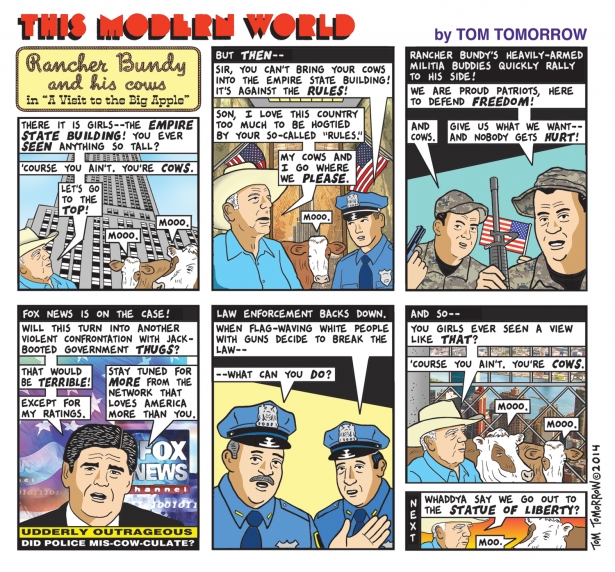
I’m with Jon Stewart:  I just don’t get it.  Here is a man who doesn’t recognize the United States government, but runs around with an American flag.  He thinks slavery was a fine institution, much better I guess than getting welfare, but Mr. Bundy doesn’t seem to realize that by grazing his cattle for free, he has been getting welfare for years.  Talk about welfare cheats!

And ya gotta love all those national political figures now in retreat.  I guess they were initially moved by the pictures of all those armed men prepared to put the women up front so they would die first.  But then came the comments about “Negroes”.   Dana Milbank had a great list of retreaters and their comments in his recent Washington Post column. 

Nevada cattle rancher Cliven Bundy knows how to start a stampede.

After Bundy, who became a right-wing hero for his refusal to acknowledge the authority of the federal government, wondered aloud about whether “Negro” people were “better off as slaves,” conservative figures who had celebrated his cause rushed to distance themselves from him.

Sen. Rand Paul (R-Ky.), who had condemned the federal government’s attempt to enforce court orders against Bundy: “Offensive.”

Sen. Dean Heller (R-Nev.), who had declared Bundy’s followers “patriots”: “Appalling and racist.”

And Sean Hannity, who had led a Fox News campaign that made a hero of Bundy: “Beyond repugnant.”

But Bundy’s daughter is still defending him.  According to Mother Jones

Bundy defended his initial comments on Thursday saying, “If they think I’m racist, they’re totally wrong…Again, I’m wondering are they better off under the old system of slavery or are they better off under the welfare slavery that they’re under now. You know, I’m not saying one way or the other.” And on Friday morning, he told CNN that he didn’t see a problem with using terms like “Negro” or “boy” for black people. “If those people cannot take those kind of words and not be (offended), then Martin Luther King hasn’t got his job done yet,” he told anchor Chris Cuomo.

Meanwhile, Bundy’s daughter, Shiree Bundy Cox, is striking back at conservatives who have turned tail on Bundy, especially Hannity. In a Facebook post Thursday night, she accused Hannity of abandoning her father and pandering to ratings. Here’s a snippet:

I’m sure most of you have heard the news about my dad being called a racist. Wow! The media loves to take things out of context don’t they? First off I’d just like to say that my dad has never been the most eloquent speaking person. Like someone said, he’s a Moses who needs an Aaron to speak for him. This is true. Second, however, is that the media has turned this into a circus side show. It’s like their trying to throw us off the real subject. Why was this ever even brought up? What does this have to do with land rights issues? Sean Hannity was all for reporting the happenings at the Bundy Ranch until this popped up. I wonder if someone hoped it would be that way…By the way, I think Mr. Hannity is more worried about his ratings than he really is about what my dad said. If he supports a supposed racist, what will that do to his ratings? He’s already lost his #1 spot on Fox.

If Shiree wants to understand the connection between land rights, race and taxes, Dana Milbank can explain it to her.

In general terms, Bundy’s notion of state supremacy — “I don’t recognize the United States government as even existing” — is a variant of states’-rights claims that go back to the Civil War and were revived in the segregationists’ opposition to civil rights laws. Because the federal government has been the protector of minority rights, states’ rights have long been used to justify discrimination.

Specifically, the Southern Poverty Law Center, which tracks anti-government and hate groups, says that Bundy’s sentiments align closely with those of the “Posse Comitatus” movement, founded by William Potter Gale in the 1970s. That movement based its anti-tax position — and its belief in the primacy of county and state authority over the federal government — on a belief that the levers of national power were controlled by Jewish bankers. “Most of the ideas that bolster positions like Cliven’s that the federal government doesn’t exist come from Posse Comitatus ideology,” the SPLC’s Ryan Lenz argues. And that ideology is rooted in bigotry.

I’m not sure how this will get resolved without violence, but if no action is taken I’m afraid that the discussion will pivot again into a questioning President Obama’s “manhood” for not fighting.  This will really obscure the issues.  In the meanwhile, we have Tom Tomorrow.

TT and Bundy