Can we send David Ortiz to the budget negotiations?

It has been a discouraging last few days with the only real bright spot being Friday (and then we went back Saturday) at Symphony Hall with the Boston Symphony Orchestra. We wanted to hear Thomas Ades, Polaris a second time and Friday night the BSO did not do Franck’s Symphony in D Minor which my husband loves.   But we came home Saturday night to no budget/debt ceiling deal and the Red Sox striking out, also.  I often tune in to some of the Sunday news shows, but couldn’t stand to hear any more Republican Congresspersons who have no clue about what the debt ceiling is much less understand any thing about the economy.  One of my friends posted this on Facebook the other day

Despite their lofty status in managing American affairs, it appears to me that few Congresspersons have any meaningful understanding of how their chronic politicization of economic policies substantially degrades, perhaps permanently, the dollar’s status as the global reserve currency. Evidence of the dollar’s decline to a commodity status is increasingly apparent. In time, every American will feel a crippling pain that no amount of political negotiating can cure.

Given this state of things, I retreated to a game of Civilization V where I could control, more or less, my own universe until after Sunday dinner when the Red Sox could take over.  But, after watching strike out after strike out with Clay Buchholz pitching sooo very slowly while getting slammed around in the sixth, I retreated.  I woke up just before 6 am this morning having just had a dream that I woke up and the Sox had come back.  I turned on the radio, I found that is was true!

Peter Abraham explains

In what has been a season full of memorable late-inning victories at Fenway Park, the Red Sox saved the best for when they needed it the most in Game 2 of the American League Championship Series Sunday night.

Trailing by four runs against the Detroit Tigers, the Sox tied the game on a grand slam by David Ortiz in the eighth inning then won it, 6-5, when Jarrod Saltalamacchia singled to drive in Jonny Gomes in the ninth.

The remarkable victory had the players chasing Saltalamacchia across the outfield and the sellout crowd of 38,029 chanting “Let’s Go Red Sox!” as they left Fenway.

“When you back us into a wall, you either do two things: cave or fight. We’re gonna fight,” Dustin Pedroia said.

That wall was hard to get over. The Sox had scored one run through the 16 innings in the series, going 3 for 51 at the plate with 30 strikeouts. Detroit starter Max Scherzer allowed one run on two hits over seven innings and struck out 13.

And then.

Will Middlebrooks doubled to left field off Jose Veras to start the rally. Then Jacoby Ellsbury drew a walk off Drew Smyly.

Al Albuquerque was next out of the Detroit bullpen. He struck out Shane Victorino for the second out, but Pedroia singled to right. Third base coach Brian Butterfield held Middlebrooks, wanting to make sure Ortiz got his chance.

Ortiz swung at the first pitch, a changeup away, and was strong enough to pull it into the Red Sox bullpen in right field for his first career postseason grand slam and the fourth in Red Sox history.

Right fielder Torii Hunter tumbled over the wall trying to make a catch as Boston police officer Steve Horgan raised his arms in joy. Bullpen catcher Mani Martinez, who was warming up Koji Uehara, casually turned and caught the ball.

It was bedlam at Fenway and the crowd kept cheering until Ortiz emerged from the dugout and tipped his helmet to them.

“My idea wasn’t to go out and hit a grand slam,” Ortiz said. “If I was telling you about thinking about hitting a grand slam, I’d be lying to you now.”
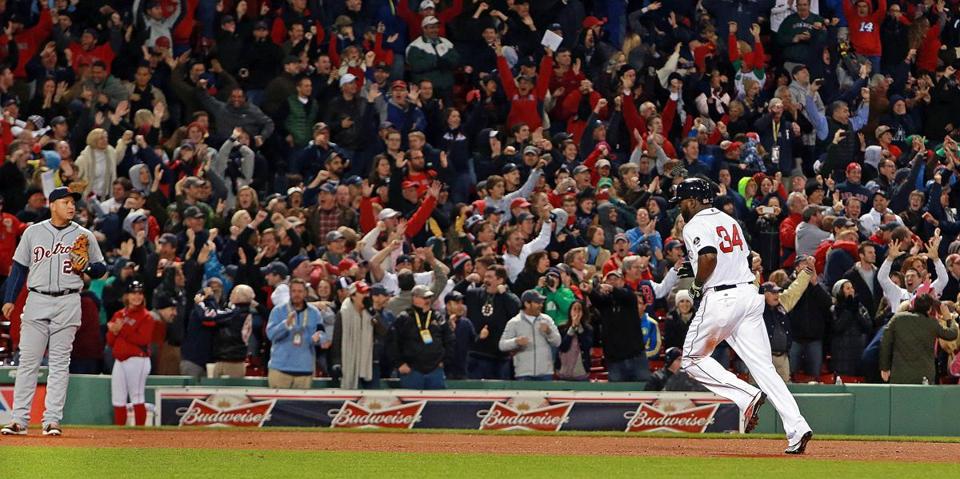
A hero of postseasons past, David Ortiz rounds third base — as the Tigers’ Miguel Cabrera looks on — to a standing ovation after his grand slam in the eighth inning tied Game 2 at 5.

A hero of postseasons past, David Ortiz rounds third base — as the Tigers’ Miguel Cabrera looks on — to a standing ovation after his grand slam in the eighth inning tied Game 2 at 5.

Gotta love David.

There was still a game to win. After Uehara retired the Tigers in order, Gomes was again the catalyst.

He reached on an infield single off Rick Porcello and took second on a throwing error by shortstop Jose Iglesias, the former Sox player known for his defensive skills.

“No is not an option for this team,” Gomes said. “Once I got on second, I was going to do anything I could to score.”

Gomes advanced on a wild pitch and scored when Saltalamacchia singled to left field.

“I felt good,” Saltalamacchia said. “Trying to hit the ball up the middle and take your chance.”

It was the 12th walkoff win of the season for the Red Sox.

So now we have something to watch on the highlight reels other than strike out after strike out.  There is joy in Mudville after all.  The Red Sox head for Detroit to face Justin Verlander, still another one of the Tigers’ great pitchers.  Let’s end this with something to ponder.  My husband heard Verlander ask this question:  If a pitch grazes a Red Sox’s beard, did he get hit by the pitch?

Now if only someone would hit a grand slam on the budget and knock out Ted Cruz and his friends.

Photograph:  Jim Davis/Globe Staff

The myth of small businesses and healthcare

One of the favorite talking points of the Republicans who oppose the Affordable Care Act (ACA) is that it will kill job growth and hurt small businesses.  Quite honestly, I think that their government shutdown which they admit is largely about defunding/delaying/repealing the ACA is doing a fine job of doing both.  Forget what they think “Obamacare” will do.  But in the current issue of the New Yorker, James Surowiecki takes on the myth, at that, according to him, is what it is, that the ACA will do horrible, terrible, no good things to the economy.

The G.O.P.’s case hinges on the employer mandate, which requires companies with fifty or more full-time employees to provide health insurance. It also regulates the kind of insurance that companies can offer: insurance has to cover at least sixty per cent of costs, and premiums can’t be more than 9.5 per cent of employees’ income. Companies that don’t offer insurance will pay a penalty. Republicans argue that this will hurt companies’ profits, forcing them to stop hiring and to cut workers’ hours, in order to stay below the fifty-employee threshold.

How much of this is true?

The story is guaranteed to feed the fears of small-business owners. But the overwhelming majority of American businesses—ninety-six per cent—have fewer than fifty employees. The employer mandate doesn’t touch them. And more than ninety per cent of the companies above that threshold already offer health insurance. Only three per cent are in the zone (between forty and seventy-five employees) where the threshold will be an issue. Even if these firms get more cautious about hiring—and there’s little evidence that they will—the impact on the economy would be small.

Meanwhile, the likely benefits of Obamacare for small businesses are enormous. To begin with, it’ll make it easier for people to start their own companies—which has always been a risky proposition in the U.S., because you couldn’t be sure of finding affordable health insurance. As John Arensmeyer, who heads the advocacy group Small Business Majority, and is himself a former small-business owner, told me, “In the U.S., we pride ourselves on our entrepreneurial spirit, but we’ve had this bizarre disincentive in the system that’s kept people from starting new businesses.” Purely for the sake of health insurance, people stay in jobs they aren’t suited to—a phenomenon that economists call “job lock.” “With the new law, job lock goes away,” Arensmeyer said. “Anyone who wants to start a business can do so independent of the health-care costs.” Studies show that people who are freed from job lock (for instance, when they start qualifying for Medicare) are more likely to undertake something entrepreneurial, and one recent study projects that Obamacare could enable 1.5 million people to become self-employed.

English: This is a diagram depicting the perce...

English: This is a diagram depicting the percentage in US who have no health insurance by age. (Photo credit: Wikipedia)

Remember that large employers get tax incentives to provide health insurance.  The ACA will actually do the same for small businesses.

Obamacare changes all this. It provides tax credits to smaller businesses that want to insure their employees. And it requires “community rating” for small businesses, just as it does for individuals, sharply restricting insurers’ ability to charge a company more because it has employees with higher health costs. And small-business exchanges will in effect allow companies to pool their risks to get better rates. “You’re really taking the benefits that big companies enjoy, and letting small businesses tap into that,” Arensmeyer said. This may lower costs, and it will insure that small businesses can hire the best person for a job rather than worry about health issues.

Surowiecki ends his short piece with this kicker.

The U.S. likes to think of itself as friendly to small businesses. But, as a 2009 study by the economists John Schmitt and Nathan Lane documented, our small-business sector is among the smallest in the developed world, and has one of the lowest rates of self-employment. One reason is that we’ve never had anything like national health insurance. In a saner world, changing this would be a reform that the “party of small business” would celebrate.

So it seems that implementation of the ACA with small business health insurance exchanges will actually help lead to more job growth.

The Senate Chaplain Speaks

Maybe you didn’t realize that the Senate and the House each have a chaplain.  If you are a C-SPAN junky you might have seen them open each daily session.  The Senate website has a brief description of the office and history.

Throughout the years, the United States Senate has honored the historic separation of Church and State, but not the separation of God and State. The first Senate, meeting in New York City on April 25, 1789, elected the Right Reverend Samuel Provost, the Episcopal Bishop of New York, as its first Chaplain. During the past two hundred and seven years, all sessions of the Senate have been opened with prayer, strongly affirming the Senate’s faith in God as Sovereign Lord of our Nation. The role of the Chaplain as spiritual advisor and counselor has expanded over the years from a part-time position to a full-time job as one of the Officers of the Senate.  The Office of the Chaplain is nonpartisan, nonpolitical, and nonsectarian.

But the current Senate Chaplain, Barry C. Black, has begun to make news with what the New York Times called “our daily Senate scolding.”

The disapproval comes from angry constituents, baffled party elders and colleagues on the other side of the Capitol. But nowhere have senators found criticism more personal or immediate than right inside their own chamber every morning when the chaplain delivers the opening prayer.

“Save us from the madness,” the chaplain, a Seventh-day Adventist, former Navy rear admiral and collector of brightly colored bow ties named Barry C. Black, said one day late last week as he warmed up into what became an epic ministerial scolding.

“We acknowledge our transgressions, our shortcomings, our smugness, our selfishness and our pride,” he went on, his baritone voice filling the room. “Deliver us from the hypocrisy of attempting to sound reasonable while being unreasonable.”

In case you were wondering, Chaplain Black was selected in 2003 by then Majority Leader, Republican Bill Frist.  He says of his politics

“I use a biblical perspective to decide my beliefs about various issues,” Mr. Black said in an interview in his office suite on the third floor of the Capitol. “Let’s just say I’m liberal on some and conservative on others. But it’s obvious the Bible condemns some things in a very forceful and overt way, and I would go along with that condemnation.”

But back to some of his recent prayers.

During his prayer on Friday, the day after officers from the United States Capitol Police shot and killed a woman who had used her car as a battering ram, Mr. Black noted that the officers were not being paid because of the government shutdown.

Then he turned his attention back to the senators. “Remove from them that stubborn pride which imagines itself to be above and beyond criticism,” he said. “Forgive them the blunders they have committed.”

Senator Harry Reid, the pugnacious majority leader who has called his Republican adversaries anarchists, rumps and hostage takers, took note. As Mr. Black spoke, Mr. Reid, whose head was bowed low in prayer, broke his concentration and looked straight up at the chaplain.

“Following the suggestion in the prayer of Admiral Black,” the majority leader said after the invocation, seeming genuinely contrite, “I think we’ve all here in the Senate kind of lost the aura of Robert Byrd,” one of the historical giants of the Senate, who prized gentility and compromise.

Senate Chaplain Barry Black

Senate Chaplain Barry Black

Chaplain Black is a federal employee who is not being paid during the shutdown.  He is also one of the few adults in the Senate chamber.

Mr. Black, who is the first black Senate chaplain as well as its first Seventh-day Adventist, grew up in public housing in Baltimore, an experience he draws on in his sermons and writings, including a 2006 autobiography, “From the Hood to the Hill.”

In his role as chaplain, a position that has existed since 1789, he acts as a sounding board, spiritual adviser and ethical counselor to members of the Senate. When he prays each day, he said, he recites the names of all 100 senators and their spouses, reading them from a laminated index card.

It is not uncommon for him to have 125 people at his Bible study gatherings or 20 to 30 senators at his weekly prayer breakfast. He officiates weddings for Senate staff members. He performs hospital visitations. And he has been at the side of senators when they have died, most recently Daniel K. Inouye of Hawaii in December.

The Senate is lucky to have him and maybe they need to pay more attention to what he is saying.

“I remember once talking about self-inflicted wounds — that captured the imagination of some of our lawmakers,” he said. “Remember, my prayer is the first thing they hear every day. I have the opportunity, really, to frame the day in a special way.”

His words lately may be pointed, but his tone is always steady and calm.

“May they remember that all that is necessary for unintended catastrophic consequences is for good people to do nothing,” he said the day of the shutdown deadline.

“Unless you empower our lawmakers,” he prayed another day, “they can comprehend their duty but not perform it.”

Senators, hear Chaplain Black.  Be adults.

Photograph:  Drew Angerer for The New York Times

The government shutdown: a letter from Congressman Capuano

I am posting the entire weekly email newsletter I just got from my Congressman, Mike Capuano.    I am proud to say that he was my boss for several years when he was the Mayor of Somerville.

Dear Friends,

The government shutdown is in its fourth day. Speaker Boehner still refuses to bring up a clean Continuing Resolution (CR), even though it would pass Congress and be signed by the President, reopening the government.

The House has spent most of this week considering bills to partially fund the government. This process is more about appearances than responsible legislating. That’s why you’ve seen attempts to fund the National Park Service so tourist attractions can reopen but not the Transportation Department. The Senate and President have both rejected this path. I’m not sure where or when this all ends. It’s certainly true that this battle is about the Affordable Care Act (ACA) and the obsession many Republicans have with sabotaging it. I think there’s more to it though.

This is also about one of the fundamental principles of our government, the idea of majority rule. The importance of that principle is vividly on display here and it’s one worth protecting.

The ACA was signed into law in 2010 after months and months of substantive and at times contentious debate. Since Republicans regained control of the House in 2010, there have been 42 attempts to repeal, defund or gut the law. Each time the effort has accomplished essentially nothing. As I noted earlier this week, Mitt Romney ran on a promise to repeal “Obamacare”. He lost the election. House Democrats got more votes than House Republicans and Democrats retained control of the Senate. The ACA was even declared constitutional by the Supreme Court.

Despite all of that, a small percentage of the House Republican Caucus refuses to accept the will of the majority, democratically expressed. They shut the government down because they can’t accept it. The ACA is the law of the land, affirmed by the results of a national election and a Supreme Court ruling. More and more moderate Republicans are speaking out on the need for a clean CR. Unfortunately there aren’t enough of those moderate voices and the extremists in the House continue to drown them out.

Imagine what our government would look like if more Members refused to respect the principle of majority rule and insisted on getting their way without regard for the consequences. It wouldn’t be 17 years between government shutdowns, that’s for sure.

I believe that this battle is also about the role that government should play in our lives. Do we want to provide some help to those less fortunate in the form of nutrition assistance or home heating aid? Do we want to help our states build world class roads, bridges and subway systems? Do we want to attract cutting edge research that results in medical advances? All of that takes an investment of federal dollars.

What has been happening over the past couple years is a steady and steep reduction in federal spending. That often gets lost in the din but numbers don’t lie. In two years, a total deficit reduction of almost $2.4 trillion has been achieved. In 2011, the Budget Control Act placed a cap on discretionary spending at $1.066 trillion for fiscal year 2014. That cap has been ignored by the House, with much deeper cuts going into effect as a result of sequestration.

Here are just a couple examples of how those cuts have impacted some important programs. In the past year, funding for the National Institutes of Health has been cut by $1.6 billion. Funding for Head Start has been cut by $400 million.

Earlier this year, the Senate passed a budget that proposed spending $1.058 trillion for fiscal year 2014. Under the clean CR proposed in the Senate in order to reopen the government, that spending is cut to $986 billion. This is much closer to the Republican proposal than the Senate’s.

In terms of cutting spending, Republicans don’t seem to recognize that they are gaining significant ground. The CR that many of them say they won’t support includes deep cuts to discretionary programming.

More votes are expected in the House tomorrow and the schedule for next week is unclear. Thanks for your calls and emails of support. I appreciate all of them.

Best,

Mike

English: Official Congressional portrait for C...

English: Official Congressional portrait for Congressman Mike Capuano. (Photo credit: Wikipedia)

Trying to made sense of it all

I think I may be ready to retreat to my cocoon to read trashy books and watch baseball and reruns of NCIS before my head explodes from trying to make sense of what is going on out there.

Yesterday, Boston Globe columnist Adrian Walker had a little anecdote from my Congressperson, Mike Capuano.

…Capuano said he was in an airport last weekend flying home from Washington when a TSA screener stopped him and said, “You really need to cut our taxes!” Capuano was incredulous to hear that from a federal employee, though he probably shouldn’t have been.

“I asked him, ‘Do you know taxes pay your salary?’ ” Capuano said with a laugh.

I wish I knew what the silly TSA screener said then.  It is an example of how divorced from reality so many people are.  Maybe we should expand the shut down to include furloughs for half of the screeners.  This would cut flights so many of the members of Congress would have trouble getting home.  I don’t think this would be a bad thing.  Maybe if they stayed in Washington more, they would figure out how to talk to each other informally over a beer.  That could only help.  Maybe some of them would get a grip on reality.

As I was getting ready to write this, I Googled  both “Republican Alternate Reality” and “Republican Alternate Universe”.  Turns out people have been writing about the topic for a number of years now.  It is one thing to talk sans facts, but another to act.  And what is happening now is the action that they have all wanted:  a government shutdown.  I think they are hoping that a few weeks without government will show people they can live without it.  Maybe a good plan except that there are already Republicans complaining that monuments in Washington are closed so veterans can’t visit them.  Duh!

Back in August 2012 (2012 not 2013), Michael Cohen wrote a piece in the Guardian about the Presidential campaign.  If you recall, they had a slogan “You didn’t build that”.

On 17 July, President Barack Obama spoke at a campaign rally in Roanoke, Virginia. It was a typical event for an incumbent president who is seeking a second term. In his remarks, he offered his vision of government’s role in spurring entrepreneurship and creating jobs in the United States:

“If you were successful, somebody along the line gave you some help. There was a great teacher somewhere in your life. Somebody helped to create this unbelievable American system that we have that allowed you to thrive. Somebody invested in roads and bridges. If you’ve got a business – you didn’t build that. Somebody else made that happen. The internet didn’t get invented on its own. Government research created the internet so that all the companies could make money off the internet.”

This is all fairly boilerplate rhetoric – a basic recitation of how Democrats view the role of government and its interplay with the private sector. But in this statement, there was one phrase that Republicans have grabbed on to like a famished dog with a new bone:

“You didn’t build that.”

That single phrase, taken out of context by Republicans, has become the GOP’s symbol of Obama’s supposed contempt for the free market and entrepreneurship, and for his socialist assault on America.

The Affordable Care Act is a prime example of government overreach and socialism even though it is built on private insurance companies.

“You didn’t build that” became “We built that”

And so, the Republicans made “We built that” the theme of Tuesday’s convention proceedings. Speaker after speaker hammered on this theme, accusing Obama of disrespecting small business. But they did so with almost a wilful sense of hypocrisy. For example, Delaware lieutenant governor candidate Sher Valenzuela attacked Obama for the line despite the fact that, just a few months ago, she gave a detailed speech to a business group about how they could do a better job getting government contracts.

Cohen goes on to detail a number of instances where the speakers at the Republican Convention ignored facts and concludes

But all of this is at pace with a conservative worldview that considers government to be nothing more than malevolent interference with the smooth operation of the private sector – except when it’s not. “Jobs don’t come from government,” said Texas Senate candidate Ted Cruz last night, a view that basically sums up GOP economic thinking. But if you listened to Republican governors on Tuesday, you might have found yourself surprised to discover that, in their states, the government has played an oddly integral role in spurring job creation. If you listened to Mary Fallin, governor of Oklahoma, extol the virtues of the energy industry in her state and bemoan “more government, bigger spending and more regulation”, you might never know that the oil and gas industry is deeply reliant on – and spends millions lobbying for – tax breaks from the federal government.

One can believe that government should play a less direct role in the workings of the private economy – clearly, this is a defensible notion. But to listen to Republicans harping on Obama’s “you didn’t build that” line is to hear a party that views “government” in the most simplistic imaginable terms. This isn’t a governing philosophy; it’s a caricature of how the economy actually works.

To be sure, it’s hardly unusual for political rhetoric to take liberties with the truth, or to stretch an argument to breaking-point, but with Republicans today, the issues runs much deeper. Very simply, the way they talk about what the federal government does or should do, and about the role of spending, taxation and regulation, is more than just a compendium of lies: it describes an alternate reality.

In the GOP’s defense: at least they can argue they built that.

So now they have shutdown the federal government which was a goal all along.  They built it.  And in their alternate universe, President Obama and the Democratic congressional leadership should negotiate with them.  Nancy Pelosi has tried to explain what she calls “regular order”:  The Senate passes a bill.  Then the House passes one.  Then there is a conference committee.  Budget bills were passed back in March, but the House declined to appoint members to a conference committee.  Contrary to what some members of Congress seem to believe there are rules and conventions as to how to proceed.

Gail Collins has a response in the New York Times.

On Wednesday, House Republicans pushed to refund bits and pieces of the government that the members particularly like, such as veterans and the National Guard. Also anything that lends itself to a dramatic press conference, such as national parks and cancer treatment for children. Since the House proposals are never going anywhere in the Senate, there’s a limit to what you want to know about what went on during the debate. Let’s summarize:

Democrats: “Meaningless political theater!”

Republicans: “Come to the table!”

Coming to the table has now replaced strangling Obamacare as the most popular G.O.P. war cry. There is a longstanding political rule that when all else fails, you demand more talking. If you’re running for office against a guy who’s got 70 percent in the polls, it’s time to call for a debate. If you’re already having four debates, it’s time to call for six.

“Why don’t we sit down and have a conference committee about how we’re going to fund the federal government?” demanded Representative Ander Crenshaw of Florida. Republicans have posed this question a lot, and it would be an excellent one if they were not the same folks who have spent the last half-year refusing to sit down and have a conference committee about the federal budget.

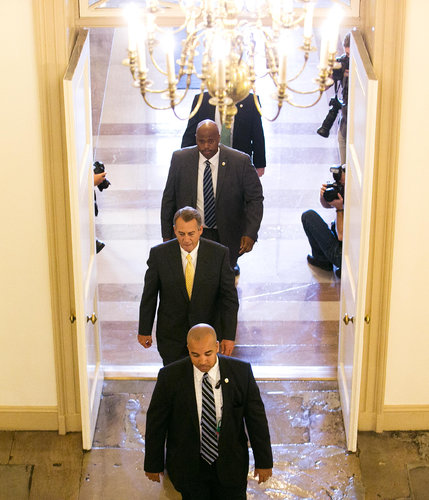
Representative John A. Boehner, the House speaker, arrived at the Capitol on Thursday with his security personnel on the third day of the government shutdown.

Representative John A. Boehner, the House speaker, arrived at the Capitol on Thursday with his security personnel on the third day of the government shutdown.

I’ll give the final word on reality to Elizabeth Kolbert in her New Yorker posted this morning.

…Shuttering the government is a dumb idea under pretty much any circumstances. Still, the objections that Republicans in Congress raise to the health-care law might be worth considering if they bore any relationship to the law in question. Rarely do they.

Some lawmakers’ comments have been so off the wall that they defy parody. A few months ago, for example, Representative Michele Bachmann announced on the House floor that Obamacare needed to be repealed “before it literally kills women, kills children, kills senior citizens.”

“Let’s not do that,” she added helpfully. “Let’s love people.”

“All of this would be funny,” President Obama noted the other day, after bringing up the Bachmann line, “if it weren’t so crazy.”

The crazy list goes on and on. As the economist Paul Krugman has repeatedly pointed out in his Times column, congressional Republicans these days seem to think that they can override not just the laws of physics but also the rules of arithmetic. They insist that the federal budget is so bloated it could easily be cut by hundreds of billions of dollars. But when a transportation bill was drafted this summer that would have actually reduced spending, they refused to vote for it. (The bill had to be pulled from the floor.) It’s hard to cut the federal budget if you’re not willing to reduce the amount of money the government spends. “What Republicans really want to do,” Krugman wrote recently, is “repeal reality.”

It’s been so long since reality has made much of a difference on Capitol Hill that it sometimes seems it genuinely has been repealed. But the thing you can always count on with reality is that it has staying power.

I hope I can hold out until reality and fact make a comeback.

Photograph: Doug Mills/The New York Times

President Obama and leadership

Like many of his supporters I am frustrated at times by what appears to be indecision on the President’s part.  You have to admit that he can take a long time to make a decision while speculation dominates the media and the blogs as to what he will do.  Look at the still to be announced appointment to be Chair of the Federal Reserve.  But when I get frustrated I tell myself that he is playing a long game.  Farah Stockman had an interesting op-ed in the Boston Globe today explaining better than I could the Obama style of leadership.

I am going to quote most of it because I can’t figure out where to cut it (and because one can’t read it from the link without a Globe subscription) and it isn’t that long..

Before we start hand-wringing over the gridlock in our domestic affairs, let’s savor the good news on the international front: Last week, after years of paralysis, the UN Security Council mandated the destruction of chemical weapons in Syria and endorsed a political transition plan that might finally sweep Syrian President Bashar Assad aside.

And after years of Iran’s refusal to talk seriously about its nuclear program, Iran’s new president, Hassan Rouhani, announced that he wants to resolve the issue in 12 months. He and President Obama even spoke on the phone, the first such contact since the 1970s.

Of course, we’re still a long way from solving those two problems. But we’re on a far better path than we were three weeks ago. Back then, we were on the verge of launching a unilateral military strike that would have inflamed the situation in Syria and hurt our chances of getting a nuclear deal with Iran. So how did that no-win situation in Syria turn into something positive? And what does this bizarre chapter in US diplomacy tell us about the nature of leadership itself?

Recall that Obama announced that he had made a decision to strike. Then he asked Congress to give its blessing. Those moves allowed time for Americans to debate, with the whole world watching. Moscow, Tehran, and Damascus were forced to contemplate the possibility of a US strike. The uncertainty of what would happen next weighed on them more heavily than a knee-jerk cruise missile. In the end, the threat of US military action proved more powerful than the action itself. Our adversaries finally agreed to a diplomatic solution that they had refused in the past.

Of course, Obama got called a lot of names for the delay that made that outcome possible: “weakling,” “ditherer-in-chief,” and— nastiest of all, in some corners —  “community organizer.” I must admit that I thought he was crazy for going to Congress, which often seems more eager to tar and feather him than to approve of anything he wants.

But political theorist Dennis Thompson, co-author of the book “Why Deliberative Democracy?” says Obama’s moves mirrored a style of leadership Thompson taught at Harvard. Thompson believes that, in a true democracy, a leader ought to explain the reasoning behind the course of action he or she wants to take. But in the end, wherever possible, the group itself should debate it and have the final word.

It stands to reason that a country that believes in democracy should have faith that a decision debated openly by a group will usually produce a better outcome than a decision one man makes alone. So, why then were some Americans so infuriated that Obama took the issue to Congress?

“It is as if we expect decisions of war and peace to be made by the president rather than society as a whole,” said Archon Fung, another Harvard professor who has studied the virtues of “deliberative democracy.” “Decisions about when to use military force . . . involve killing as a state act. If any decision should be made democratically, it’s this one.”

Peter Levine, a professor at Tufts University, sees the public reaction as a sign of the times. Americans have grown less interested in the public deliberations that that make democracies work. Participation on juries and PTA meetings are at an all-time low, he said. Voters expect their elected leaders to solve their problems. Debates over the best way to go about it are seen as a sign of failure or weakness.

“Our system is supposed to be deliberative,” Levine said. “But we live in a profoundly anti-deliberative moment.”

So maybe this episode says as much about us as it does about our leader. We like John Wayne presidents, saviors who rescue us with their quick trigger fingers. We don’t like leaders who admit uncertainty, who ask us to help choose between imperfect options. But, at the end of the day, the Syria debate taught us that when Americans deliberate as a people, we can come up with a better outcome. It’s a lesson we shouldn’t forget.

President Obama is certainly not John Wayne, but he is the leader of a democracy.  We need to remember this when we get frustrated.

The war in Syria: a confused state of affairs

English: The United Nations Security Council C...

English: The United Nations Security Council Chamber in New York, also known as the Norwegian Room Français: La Salle de réunion du Conseil de sécurité des Nations Unies à New York Nederlands: De Zaal van de Veiligheidsraad van de Verenigde Naties in New York (Photo credit: Wikipedia)

I’m probably like most Americans: confused.  On one hand, I look at the pictures of the victims in Syria, not only the dead and injured from the chemical weapons attack, but also those in refugee camps or living in caves and wonder why the world can’t do anything to help.  On the other hand, there is a seemingly intractable diplomatic stalemate and no one wants “boot on the ground”.  So what to do.

The British drafted a resolution that was discussed by the United Nations Security Council condemning use of chemical weapons but it didn’t get anywhere because of the threat of a Russian veto.  This morning, the Guardian reports on President Putin’s reaction

Vladimir Putin has rejected US intelligence claims that Bashar al-Assad’s regime used chemical weapons in Syria, saying it would be “utter nonsense” for government troops to use such tactics in a war it was already winning.

“That is why I am convinced that [the chemical attack] is nothing more than a provocation by those who want to drag other countries into the Syrian conflict, and who want to win the support of powerful members of the international arena, especially the United States,” Putin told journalists in Vladivostok.

The Russian president also challenged the US to present its case for military intervention to the UN security council, after suggesting that if Barack Obama was worthy of his Nobel peace prize, he should think about the possible victims of any intervention by foreign forces.

Is this a signal that the United States should wait to take action?  Is Putin ready to compromise – or at least to talk?

Meanwhile John Kerry, the hero of the anti-Vietnam War movement, is sounding more and more like Donald Rumsfeld – or maybe Colin Powell at the UN.  The New York Times reports

Again and again, some 24 times in all, he used the phrase “we know” as he described the intelligence that Syria’s government massacred more than 1,400 people with chemical weapons. And then, while saying no decision had been made, he left no doubt that the United States would respond with military power.

“We know that after a decade of conflict, the American people are tired of war — believe me, I am, too,” said Mr. Kerry, who opposed the Iraq war in his failed presidential bid in 2004. “But fatigue does not absolve us of our responsibility. Just longing for peace does not necessarily bring it about. And history would judge us all extraordinarily harshly if we turned a blind eye to a dictator’s wanton use of weapons of mass destruction against all warnings, against all common understanding of decency.”

Just seven months after being sworn in as secretary of state, Mr. Kerry has become President Obama’s frontman in the public argument for a military strike against the Syrian government. While the president sounds restrained in his language and even perhaps personally ambivalent about the operation he seems likely to order, Mr. Kerry came across on Friday as an unstinting advocate for action against what he called “a despot’s brutal and flagrant use of chemical weapons.”

The problem is that we were lied to once, told that there was intelligence that proved there were weapons of mass destruction in Iraq and even though some of us may want to trust Kerry, it is hard to do so even with the level of specificity in the summary report he released.

As to allies, the British Parliament has voted not to participate in any military action and French public opinion is also against.  The Arab League has said that while they think Assad used chemical weapons, they can’t support any military action.  The public here is lukewarm at best.

This is not Libya.  In Libya there was a recognized opposition which had actually established a shadow government with diplomats working with the European Union, Arab League and the United States.  We know that when she was Secretary of State, Hillary Clinton tried hard to get the opposition in Syria to form a similar government but was unable to do so.  The situation is that someone, most likely the Syrian government or someone fighting with the government, has used chemical weapons on the civilian population.  (I think we can trust Doctors Without Borders when they say they were used.)  This use goes against what 99% of the world’s people believe is right.

A large, but so far not a majority, of members of Congress think there should be a debate and resolution under the War Powers Act.  I know that Kerry and the President both believe they have already followed the Act by consulting with Congress.  It is up to John Boehner and Harry Reid to call Congress back for a debate and not just a consultation.  The question now is whether Obama will act before they can do so.  The summit for the G20 is next week.  Will the missiles fly before then?  The UN inspectors have left Syria.  Have they been told an attack is imminent?

I’m not sure that I agree with Bob Dreyfuss who called the President a “schoolyard bully” but there is a great deal of irony in seeing two men who made their reputations opposing war now trying to justify military action.

Let’s say the President waits a week.   He can talk to folks at the summit.  The UN Security Council can talk some more.  Congress gets back into town and holds a debate.  I don’t see that anything is lost.  The Syrians have all ready evacuated areas and moved military assets so maybe we don’t need an actual strike with the potential for civilian casulties.  Plus we don’t really know all the consequences of a strike.  More acts of terrorism in the United States?  More chemical attacks on civilians?  A wider conflict?  An excuse for the Republicans to try to impeach him?

There are a lot of negatives and unknowns to military action, but I haven’t heard a credible alternative either.  I can only hope that the President, who says he hasn’t made up his mind yet, thinks about this a bit longer.  Maybe he is actually like the rest of us – wanting to do something, but not sure what the something should be.  All the more reason to wait.

What’s next? Impeachment!

I sense there is a growing level of frustration among Republican members of Congress.  Their opposition to immigration reform is not playing well with either the public or Republican party elders.  Same for their desire to shut down government to prevent the Affordable Care Act/Obamacare from full implementation.  Some of them have been hammered at town hall meetings and the videos are posted all over YouTube.  The deficit is actually shrinking.  Republican governors like Rick Perry are reversing themselves and asking for Medicaid funds.  And the President and his administration are doing the best they can given that no proposal will pass the House.  So what is left for them.  Impeach Obama!

Steve Breen wrote on MaddowBlog

When fringe figures like Rep. Kerry Bentivolio (R-Mich.) talk about impeaching President Obama without cause, it’s a mild curiosity. When U.S. senators push the same idea, it’s more alarming.

“I think those are serious things, but we’re in serious times,” said Oklahoma Sen. Tom Coburn during a town hall in his home state. “And I don’t have the legal background to know if that rises to ‘high crimes and misdemeanors,’ but I think you’re getting perilously close.”

The remark came after an attendee called the Obama administration “lawless” and asked, “who is responsible for enforcing [Obama’s] constitutional responsibilities?”

Coburn apparently has given this a fair amount of thought, telling constituents, “What you have to do is you have to establish the criteria that would qualify for proceedings against the president, and that’s called impeachment. That’s not something you take lightly, and you have to use a historical precedent of what that means.” He added that he believes “there’s some intended violation of the law in this administration.”

Official portrait of Tom Coburn, U.S. Senator.

Official portrait of Tom Coburn, U.S. Senator. (Photo credit: Wikipedia)

But what violation?

And what, pray tell, has the president done that Coburn perceives as possible “high crimes”? In keeping with the recent trend, the Oklahoma Republican never got around to explaining what the grounds for impeachment would be. Coburn mentioned that he’d heard a rumor about the Department of Homeland Security choosing to “ignore” background checks for immigrants, but he did not elaborate.

Meanwhile Sam Stein tweeted David Axelrod’s reaction

“that was his considered legal opinion as an obstetrician”

Maybe it is just wishful thinking on my part, but I think that Americans still want government to fix roads and bridges, regulate our food, water, drugs and financial institutions, and help those you are in need.  Sure, we all wish for new, creative solutions to some of the problems that seem intractable, but on the whole I think Americans just wish that Congress would actually work with the President instead of just voting “no”.  But the fact that even Mitch McConnell has a challenger from the right in the Republican Primary does not make this seem possible.

I’ll give the last word to Steve Breen

And finally, for every Beltway pundit who proclaims with a tear in their eye, “Washington would be more effective if Obama showed leadership by reaching out to Republicans, schmoozing them, and offering to work cooperatively with his critics,” I hope they’re paying very close attention to current events. It is, as a practical matter, awfully difficult for a president to work constructively with radicalized lawmakers who refuse to compromise and cherish the idea of impeachment without cause.

Just so we’re clear, I don’t really expect Republicans to pursue this in a serious way, and my coverage on the issue is intended more as a “look how silly this is” than a “look at this threat to our constitutional system of government.” If for no other reason, GOP lawmakers wouldn’t try impeaching the president because they’d risk motivating the Democratic base to show up in the 2014 midterms.

That said, the recent talk about impeachment is nevertheless unnerving.

Fixing FISA

Congress is beginning to have a debate about surveillance, oversight and secrecy – the one good thing to come out of  Edward Snowden’s continuing adventure.  Of course, it is hard to debate when you can’t talk about a lot of things in public or even to your fellow members, so I was very interesting in reading Judge James G. Carr’s op-ed in yesterday’s New York Times.  His suggestion is one that Congress and the Obama Administration should be able to debate and legislate without revealing anything that needs to be kept secret.  Judge Carr is identified as a senior federal judge for the Northern District of Ohio,[who] served on the Foreign Intelligence Surveillance Court from 2002 to 2008.

CONGRESS created the Foreign Intelligence Surveillance Court in 1978 as a check on executive authority. Recent disclosures about vast data-gathering by the government have raised concerns about the legitimacy of the court’s actions. Congress can take a simple step to restore confidence in the court’s impartiality and integrity: authorizing its judges to appoint lawyers to serve the public interest when novel legal issues come before it.

The court is designed to protect individual liberties as the government protects us from foreign dangers. In 1972, the Supreme Court ruled that the Nixon administration had violated the Fourth Amendment by conducting warrantless surveillance on a radical domestic group, the White Panthers, who were suspected of bombing a C.I.A. recruiting office in Ann Arbor, Mich. In 1975 and 1976, the Church Committee, a Senate panel, produced a series of reports about foreign and domestic intelligence operations, including surveillance by the F.B.I. of suspected communists, radicals and other activists — including, notoriously, the Rev. Dr. Martin Luther King Jr.

The Foreign Intelligence Service Act set up the FISA Court in response. To obtain authority to intercept the phone and electronic communications of American citizens and permanent residents, the government must only show probable cause that the target has a connection to a foreign government or entity or a foreign terrorist group. It does not have to show, as with an ordinary search warrant, probable cause that the target is suspected of a crime.

The problem is that the court only hears from one side.  I wrote recently that the real danger to our civil liberties is the FISA Court and I hoped that people will come up with ways to try to fix it.  Judge Carr has one suggestion at which Congress should take a serious look.

Critics note that the court has approved almost all of the government’s surveillance requests. Some say the court is virtually creating a secret new body of law governing privacy, secrecy and surveillance. Others have called for declassified summaries of all of the court’s secret rulings.

James Robertson, a retired federal judge who served with me on the FISA court, recently called for greater transparency of the court’s proceedings. He has proposed the naming of an advocate, with high-level security clearance, to argue against the government’s filings. He suggested that the Privacy and Civil Liberties Oversight Board, which oversees surveillance activities, could also provide a check. I would go even further.

In an ordinary criminal case, the adversarial process assures legal representation of the defendant. Clearly, in top-secret cases involving potential surveillance targets, a lawyer cannot, in the conventional sense, represent the target.

Congress could, however, authorize the FISA judges to appoint, from time to time, independent lawyers with security clearances to serve “pro bono publico” — for the public’s good — to challenge the government when an application for a FISA order raises new legal issues.

Having lawyers challenge novel legal assertions in these secret proceedings would result in better judicial outcomes. Even if the government got its way all or most of the time, the court would have more fully developed its reasons for letting it do so. Of equal importance, the appointed lawyer could appeal a decision in the government’s favor to the Foreign Intelligence Surveillance Court of Review — and then to the Supreme Court. No opportunity for such review exists today, because only the government can appeal a FISA court ruling.

A combination of a people’s advocate and public release of decision summaries would remove some of the mystery and secrecy.

One obvious objection: judges considering whether to issue an ordinary search warrant hear only from the government. Why should this not be the same when the government goes to the Foreign Intelligence Surveillance Court?

My answer: the court is unique among judicial institutions in balancing the right to privacy against the president’s duty to protect the public, and it encounters issues of statutory and constitutional interpretation that no other court does or can.

For an ordinary search warrant, the judge has a large and well-developed body of precedent. When a warrant has been issued and executed, the subject knows immediately. If indicted, he can challenge the warrant. He can also move to have property returned or sue for damages. These protections are not afforded to FISA surveillance targets. Even where a target is indicted, laws like the Classified Information Procedures Act almost always preclude the target from learning about the order or challenging the evidence. This situation puts basic constitutional protections at risk and creates doubts about the legitimacy of the court’s work and the independence and integrity of its judges. To avert these dangers, Congress should amend FISA to give the court’s judges the discretion to appoint lawyers to serve not just the interests of the target and the public — but those of the court as well.

079 Capitol Hill United States Congress 1993

079 Capitol Hill United States Congress 1993 (Photo credit: David Holt London)

We are already deep in uncharted waters and we need to take steps to try to protect ourselves.  It serves no purpose if we lose our civil liberties while protecting them.  I don’t have a great deal of hope that Congress can actually get itself together enough to act, but there has been some glimmer of bipartisanship about this issue.  Let us hope someone writes Judge Carr’s ideas into a bill so it can be introduced.

More nails in the Republican coffin?

For a number of years now, I have watched part of the Republican party that has as its main, if not sole, purpose, to dismantle government.  They called the Democrats bluff with the sequester which so far has appeared to have little effect.  Who cares if a military base can’t afford fireworks or if the Blue Angels can’t afford to do a fly over?  In the big scheme of things, those are pretty unimportant.  But now more and more federal workers are being furloughed.  For example, local HUD (Housing and Urban Development) offices are closing for five Fridays in July and August.  That is 5 Fridays that staff will not be paid.  This is money that won’t be spent on a vacation or for car repairs or for food and clothing – all things that add to the economy.  (Here is an interesting website that tracks furloughs.)  And while a number of agencies have figured out ways to avoid furloughs, many workers will still be affected – still more if Congress can’t manage to pass a budget for the fiscal year that begins in October.  The loss of incomes will slowly begin to mount.

But it isn’t just the failure to produce a budget.  A recent New York Times editorial summed up the issue quite neatly.  They called it a refusal to govern.

On two crucial issues this week, the extremists who dominate the Republican majority in the House of Representatives made it clear how little interest they have in the future prosperity of their country, or its reputation for fairness and decency.

The two issues are immigration reform and the removal of the food stamp program for the House agriculture bill.

These actions show how far the House has retreated from the national mainstream into a cave of indifference and ignorance. House members don’t want to know that millions of Americans remain hungry (in an economy held back by their own austerity ideology), and they don’t want to deal with the desperation of immigrant families who want nothing more than a chance to work and feed themselves without fear of deportation.

On both issues, in fact, many House Republicans are proudly asserting that they will stand in the way of any attempts to conduct a conference with the Senate. That might, after all, lead to a compromise.

And it isn’t just in the House.

Few things sum up the attitude of the current crop of Republicans in Washington than their loathing of conference committees. On issue after issue, they have passed radical bills and then refused to negotiate. On Thursday, for example, Senate Republicans refused for the 16th time to allow the Democratic Senate budget to be negotiated with its dangerously stingy counterpart in the House.

On immigration, House members fear a conference with the Senate would add back the pathway to citizenship that they consider a giveaway to undesirable non-English speakers. The eventual House border bills “should not be handed to a conference committee so that they can be reconciled with the Senate bill,” wrote Representative Tom Cotton of Arkansas in The Wall Street Journal on Thursday. Instead, he and others say, the Senate should be forced to take up whatever the House produces.

Senate Minority Leader Mitch McConnell may believe that ending the filibuster with a majority vote will spell the end of the Senate and cause Harry Reid to be remembered “as the worst leader of the Senate ever”, but in my opinion, the continuous use of the filibuster has already come close to destroying the Senate.  Everything should not require 60 votes.

The New York Times editorial ends with this

A refusal to even to sit at a bargaining table is another way of refusing to govern. The nation’s founders created two chambers for a reason, but Republicans, in their blind fury to harm the least fortunate, are forgetting even those fundamental national values.

From left, Representatives Tim Murphy, Mark Sanford, Cathy McMorris Rodgers and Sean P. Duffy, all Republicans, after the House approved an agriculture bill.

From left, Representatives Tim Murphy, Mark Sanford, Cathy McMorris Rodgers and Sean P. Duffy, all Republicans, after the House approved an agriculture bill.

This is why the most recent Quinnipiac poll shows that while 53% felt the President was doing too little to compromise with Congress, a whopping 68% felt the Republicans leaders in Congress were doing to little to compromise with the President.  And everyone thinks Congress is dysfunctional blaming both parties.

There is something called the greater good and I think many in Congress, particularly Republicans, have forgotten that ideal.

Photograph: Christopher Gregory/The New York Times