Creating Jobs: which party does better

The Republicans will campaign on the idea that lowing taxes on the wealthy (I think Romney wants to keep the Bush tax cuts and even cut more) creates jobs because the money the wealthy do not pay in taxes goes to create jobs.  Fay Paxton has looked at the history of job creation and posted an analysis on Winning Progressive.   Her conclusion:  Democrats create more jobs.  These charts describe private sector job creation.

Yes, the first months of the Obama Administration were rough, but as the chart shows, we started bleeding jobs under George W. Bush.

Ronald Reagan wins among Republicans, but he wasn’t afraid of raising taxes.

So what about federal public sector jobs?  The Republicans always claim that the Democrats are the party of big government.  Is this true?  Paxton says

Republicans talk about being conservatives who believe in small government and reducing the federal workforce. The numbers don’t bear out their claims.  In a press conference, House Speaker John Boehner said, “In the last two years, under President Obama, the federal government has added 200,000 new federal jobs.”  The Republicans even advanced legislation calling for a reduction of 200,000 federal employees.

Here’s the truth:

According to the Office of Personnel Management, it is true that the federal workforce increased by 237,000 employees. What Boehner does not tell…150,000 of the employees added to the roles were uniformed military personnel, no doubt to accommodate the wars in Iraq and Afghanistan. The 237,000 figure also includes temporary Census workers.

Despite claims of huge government expansion, historically, Democratic presidents reduced the size of the federal government workforce. The federal employment numbers, according to the U.S. Office of Personnel Management, the department charged with tracking the number of employees, the data shows the following:

Paxton summarizes

If we combine the totals for all federal employees, including the military:
Reagan began office with a total of 4,982,000 employees and ended his term with 5,292,000 employees. While President Obama took office with a federal employee roster of 4,430,000 employees (fewer than Reagan). At the end of 2010 President Obama’s federal workforce numbered 4,443,000; that’s 849,000 fewer employees than Reagan, the advocate of small government! Add to this the fact that President Reagan governed during peacetime, while President Obama inherited two wars.

So the figures don’t lie:  Democrats do a much better at creating new private sector jobs and reducing the size of the federal government.


Neighborhood design, the foreclosure crisis and the death of Trayvon Martin

Neighborhood design?  Is she nuts?  What does that have to do with Trayvon Martin?  Isn’t his death related to race, guns and stand your ground laws?  My reaction when I saw the headline in yesterday’s Boston Globe.  But after reading Zach Youngerman’s op-ed, it all became clear.

PUBLIC OPINION about the killing of Trayvon Martin by George Zimmerman in Sanford, Fla., shifts every time new evidence emerges, as though each of them had a fixed character that could be revealed as easily as a video recording can be enhanced. But behavior is not simply a matter of character; it is also a matter of setting. Less than 1.2 percent of the population in Sanford walks to work, and the subdivision where the killing took place is designed for driving, so something as human as walking is odd behavior. Suspicious even.

“It’s raining, and he’s just walking around, looking about,’’ Zimmerman told the 911 dispatcher during his first exchange. Martin was in front of the clubhouse at the Retreat at Twin Lakes. He may have been looking for a sidewalk.

Depending on which way Martin entered the subdivision, he would have found at the clubhouse either a rare length of sidewalk merging into a parking lot or leading away into a sort of jogging path encircling an artificial lake. If Martin chose simply to cross the street from the corner where he was, he would have been forced to transgress in the most literal sense. The 30-foot street (enough for two driving lanes and one parking lane on Mass. Ave. [in Boston or Cambridge]) doesn’t have a painted crosswalk. Probably because the other side only has private lawns and driveways.

Most of the Retreat at Twin Lakes lacks a conventional sidewalk – a public pedestrian thoroughfare parallel to vehicle traffic but protected by a curb. Together with a landscaped tree belt, parking lanes, and occasionally bike lanes, sidewalks and roads make up what is called the public right of way. Without public rights of way, we would all be constantly having to trespass on private land or pay tolls to get anywhere. This was the situation Martin faced inside and outside the gated subdivision. On his mile walk to the nearest convenience store, the sidewalk ends twice and becomes a no-man’s-land of grassy highway shoulder. If Martin were trespassing, he had no choice but to do so.

So you have a place with wide streets, few sidewalks along the street and those not connected, and a rainy night with a teenager walking and not driving.  You can see how George Zimmerman might have been thinking that Trayvon Martin was casing the neighborhood.  Youngerman goes on

After a tragedy, we try to imagine alternatives. What if we change the laws? What if we raise awareness? To those important questions I would add: What if we design places differently, places for people?

Houses with front porches rather than driveways bring residents outside even in rainy weather and put “eyes on the street,’’ as the pre-eminent urbanist Jane Jacobs described it. When houses are closer to the property line and on narrower streets, residents feel like they are more responsible for what happens outside. Zimmerman was a self-titled neighborhood watch volunteer. Design can make residents neighborhood watch volunteers naturally.

In a place meant for people with a denser residential street, maybe the man and the boy might have felt less like they were all alone. In a place meant for people with sidewalks and street lights, maybe they would have been less alone. Maybe a couple of neighbors could have stopped the altercation before it got out of hand.

Of course, some people did hear the altercation after it started and there are accounts from the 911 tapes, Trayvon’s girlfriend, and some neighbors so this was not a totally isolated incident.  But Youngerman does have a point:  a kid walking in the that community, for at matter, anyone walking in that community was unusual enough that George Zimmerman followed the walker. 

I wanted to see the location myself to confirm Youngerman’s description so I did a search for The Retreat at Twin Lakes and like a lot of Florida, there are a number of houses for sale including bank owned properties (REO’s) and some on the market as short sales.

This is one of the REO’s.  The picture is a little fuzzy since I had to enlarge it, but it does show some of the surroundings.

Property Photo

This is a better picture of the surroundings.  It appears there are sidewalks but not, as Youngerman pointed out, conventional ones parallel to the street.

The Tampa Bay Times had a story about the community on March 25 which  pointed out that there were to be 263 houses built and at the time of the story 40 were vacant and half were rented not owned.  This is what happens when the housing market bottoms out and you have a foreclosure crisis.  Whether the property is under foreclosure or not, no one can sell.  The community was not stable.  This is the kind of place where break-ins happen and they had started there. 

This picture from the Tampa Bay Times makes the place look like an apartment complex, different from the real estate sales pictures appearing to showing single family homes or Youngerman’s description.  But the sidewalks in the picture are between buildings and not near the street.

Cheryl Brown, with the family’s boxer, Sake, says she and her family are rattled by the fatal shooting inside their gated community.

So the density that Youngerman was looking for might have been there, but the layout was poor with sidewalks between building, but none parallel to the street and with people moving in and out and lots of vacancies, Retreat at Twin Lakes may have contributed to the confrontation between George Zimmerman and Trayvon Martin that lead to Martin’s death just by its design and circumstances.  The bottom line:  Zach Youngerman is right about the impact of design if not right about all of the details.  This was a driving community, not a walking one and people did not know their neighbors.

Accept the tax increase and defeat the Republicans

I was eating my lunch at my desk today as I often do (I know a bad habit) and the Republicans were voting down the Senate bill in several complicated procedural moves I don’t pretend to understand.  I do know the bottom line:  Increase in payroll taxes, no unemployment extension, and funny things happen to reimbursements to doctors for Medicare.  Anyway, I posted on the New York Times comment section on the story of the Republican vote, that maybe we should accept the tax increase as a way of contributing to the Republican’s defeat in 2012.  Last time I check it had over 300 recommendations!  Maybe I’m on to something here.  But I have to give credit to my husband at FortRight who said at breakfast, “it might be worth $1000 to see the Republicans go down.”

Stand firm, Harry Reid.  Stand firm, Mitch McConnell.  You made your compromise as the House asked and just because John Boehner can’t herd his cats or maybe squirrels (Ana Marie Cox on her Guardian blog quoted a friend who called them squirrels because “[they] are panicky and prone to irrational running into traffic.”) doesn’t mean you have to save him.  Here is John with his squirrels.

Now they want the President to order the Senate back.  Stand firm, Mr. President.  Yes, not passing the bill will hurt briefly, but the Republicans will get the blame and will be forced to come back in January and be serious about a real bill, with real funding to pay for it.  As Ana Marie Cox said, “Congressional Republicans are roadkill.”

The complicated deficit deal

I know I’ll be writing more about the imact of the “compromise” in the days to come, but for now here a summary.  The Atlantic Wire has the best written summary I’ve been able to find.

The basic plan, as explained by The New York Times‘ Carl Hulse and Helene Cooper, Politico’s David Rogers, and The Hill‘s Alexander Bolton, goes something like this:

1. Raise the debt limit by $900 billion and cut spending by the same amount over 10 years. Members of Congress can vote to show they don’t like the increase but Obama can veto their disapproval. 
2. Create a bipartisan committee with three members of each party from each chamber of Congress to find spending cuts the size of a second debt limit increase of $1.5 trillion. As a special holiday treat, the plan must be presented to colleagues by Thanksgiving and voted on by Christmas.
3. If the plan passes, Obama can raise the limit by $1.5 trillion.
4. If the cuts committee can’t come up with a plan, Obama can get only a $1.2 trillion debt limit increase, and Congress must either:
a. Pass a balanced-budget amendment to the Constitution, or
b. Allow spending cuts the size of the debt limit increase over the next 10 years, with at least half coming from cuts to defense spending. These cuts would be automatic by the end of 2012.
 
 
There is still a chance to get revenue increases through the committee’s recommendations.  That is what the Democrats have to run around the country selling:  increased revenues and more chanced to create jobs.  I heard Nancy Pelosi say at one point that the country did not want this debt crisis business, but were interested in “jobs, jobs, jobs.”  This has to be the new Democratic message:  OK, we have pretty much caved on the debt business, now create some jobs.
 
 
We Have a Debt Limit Deal: Now What?
 
So smile now, because if there aren’t more jobs soon – and the deficit deal has the potential to make a lot more of them go away – you might not be smiling in November 2012.

Watching the circus

Watching the circus in Washington used to be a fun activity, but right now it is just depressing.  I got home from work last night expecting to watch the Republican vote on the Speaker’s plan only to learn that it had been postponed.  When I went to bed at 10 it was still pending.  At 5 this morning, I learned it didn’t happen because the Republican leadership didn’t have the votes.  All this for a bill that is DOA in the Senate.

We are all being held hostage by a handful of tea partiers and other Republicans who are convinced that their election gave them some kind of mandate to kill the country.  As they are learning in Wisconsin, people are beginning to have buyer’s remorse.  On the other hand, the tea partiers are threatening to run against the very people they elected if the new Congressmembers don’t come through.  Among those making the threats are Sarah Palin and the founder of the Texas Tea Party on Al Sharpton’s MSNBC show last night.  So I don’t think the 20 or so votes that Boehner is looking for will materialize, but then again, this whole spectacle is full of surprises so one never knows.

Everyone, including President Obama, has let this small faction define the fight.  I think Eugene Robinson is right:  The Republicans have one easily stated idea:  Reduce the deficit (and deny Obama a second term) while the Democrats and particularly Progressives don’t have an easily stated idea.

Those who would chronicle events in Washington can find no richer source of analogy and metaphor than the Three Stooges. These days, I’m thinking of the times when an exasperated Moe, having suffered the indignity of an accidental spritzing or clobbering, turns to Larry or Curly and demands, “What’s the big idea?”

The premise of the debt-ceiling fight is too far-fetched for a Stooges film, since no audience could imagine leaders of a great nation stumbling into such a mess. Moe’s trademark line is still relevant, however, even if it’s not followed by the two-fingered poke in the eyes that our elected officials richly deserve.

It is clear that unless President Obama ends up taking unilateral action to break a hopeless deadlock, Republicans will win. The House, the Senate and the White House are all working within GOP-defined parameters: New tax revenue is off the table, painful budget cuts are a given, everyone seems to accept the principle that a debt-ceiling increase — which allows the Treasury to pay bills Congress has already incurred — must be tied to reductions in future spending.

Besides not having an easily stated idea that everyone repeats, the Democrats have done all the compromising.  And it hasn’t worked out so well.  Look back at the retention of the Bush tax cuts:  Do you see any jobs?  Robinson concludes

Obama talks about “winning the future,” but that’s too nebulous. I’d suggest something pithier: jobs, jobs, jobs.

People may dislike paying taxes, but they dislike unemployment more. Progressives should talk about bringing the nation back to full employment and healthy growth — and how this requires an adequately funded government to play a major role.

The next time Moe asks about the big idea, Democrats, say “jobs.” You might avoid a slap on the noggin and a poke in the eyes.

I think it maybe time for the President to stop trying to compromise, to get together with Reid and Pelosi and make a real proposal.  To quote Paul Krugman

Some of us have long complained about the cult of “balance,” the insistence on portraying both parties as equally wrong and equally at fault on any issue, never mind the facts. I joked long ago that if one party declared that the earth was flat, the headlines would read “Views Differ on Shape of Planet.” But would that cult still rule in a situation as stark as the one we now face, in which one party is clearly engaged in blackmail and the other is dickering over the size of the ransom?

The answer, it turns out, is yes. And this is no laughing matter: The cult of balance has played an important role in bringing us to the edge of disaster. For when reporting on political disputes always implies that both sides are to blame, there is no penalty for extremism. Voters won’t punish you for outrageous behavior if all they ever hear is that both sides are at fault.

,,,

So what’s with the buzz about a centrist uprising? As I see it, it’s coming from people who recognize the dysfunctional nature of modern American politics, but refuse, for whatever reason, to acknowledge the one-sided role of Republican extremists in making our system dysfunctional. And it’s not hard to guess at their motivation. After all, pointing out the obvious truth gets you labeled as a shrill partisan, not just from the right, but from the ranks of self-proclaimed centrists.

But making nebulous calls for centrism, like writing news reports that always place equal blame on both parties, is a big cop-out — a cop-out that only encourages more bad behavior. The problem with American politics right now is Republican extremism, and if you’re not willing to say that, you’re helping make that problem worse.

Time for the President to not only talk the talk as he did last week, but also walk the walk.  Compromise by only one side has lead to this circus that is not even very entertaining.  At the very least, round up enough votes in the Senate to pass the Reid plan so the Democrats can at least say they did something.  You can compare plans here.  And please, let there be only one vote.  I don’t think anyone can take this again in 6 months.


The “gang of six” plan and the debt ceiling

In case you are wondering what it is, the New York Times has published a summary.  It is really a budget and deficit reduction plan and not something to raise the debt ceiling which still has to be done.  And time is running out.

A couple of interesting comments about the plan on Politico’s Arena.

First from Jeff Smith, professor at the New School and former Missouri State Senator:

The one real piece missing from this entire conversation? The piece that would make the numbers work and dramatically reduce the pain?

Comprehensive immigration reform. That’s right. There’s only one pool of 15 million people begging to be able to pay more into the system, and this country has spent the last several years fighting to make sure they can’t.

We need to get over our xenophobia, give them a path to citizenship, and let them start paying in to the system at regular rates in regular intervals. The nation’s immigrant population tilts much younger than the native-born population and is predominantly in the workforce, and would reverse the trend of a rising retiree-to-worker ratio, thereby shoring up both major entitlement programs

The immigrants would pay taxes, pay into social security, and Medicare.

Bernie Sanders (D-VT) points out

While the spending cuts for programs that working people desperately depend upon are enforced by specific spending caps, there is no such enforcement or clarity regarding the $1.1 trillion to be raised in revenue over 10 years.

What happens if that revenue target is not reached? There is no language that deals with that. Where does the revenue come from? That very important issue is kicked to the tax writing committees with no guarantee that hundreds of billions of dollars in new revenue will not come from the pockets of low- and moderate-income Americans. While nobody knows for certain what provisions might be adopted, there is reason to expect that some of the areas that the House and Senate will be looking at include the home mortgage deduction for middle-class families, taxes on health care benefits, and increased taxes on retirement programs such as 401(k)s and IRAs. In other words, while there is a reasonable degree of specificity in terms of cuts there is only vagueness in terms of revenue.

But Dean Baker from the Center for Economic and Policy Research asks the questions I’ve been wondering about:  What is wrong with the deficit at a time when we have no jobs and isn’t there a solution besides massive budget cutting?

The arithmetic is clear as day. The United States does not now, nor will it in the near future, face a serious problem meeting its debt obligations. It had a debt to GDP ratio of 116 percent after World War II. The baseline projections have it getting to 90 percent by 2021. 116 percent is much larger than 90 percent. (The difference will be more than $5 trillion in 2021.) This should be understandable even to a 6-figure Washington policy wonk or budget reporter.

Other countries had and have much higher ratios of debt to GDP and still face no problem paying their bills. In Japan, the ratio of debt to GDP is more than 220 percent, yet private investors are willing to lend the country money long-term at interest rates of less than 1.5 percent. Of course investors are also willing to put their money on the line in the U.S., lending us money long-term at interest rates close to 3.0 percent. So the people who actually have money on the line are saying as clearly as they can that the debt is not a serious problem.

Furthermore, there are many ways to deal with the debt that do not require attacking ordinary workers, who have been the victims of Wall Street greed and economic mismanagement by the deficit hawks. (People like Kent Conrad held positions of responsibility in the years of the build-up of the housing bubble, but were so utterly incompetent they either did not see it or recognize its danger.)

We could just have the Fed hold $3 trillion in government debt indefinitely. It would then refund more than $1 trillion in interest payments to the Treasury over the next decade. The inflationary impact of the additional reserves could be offset by raising bank reserve requirements. What could be more simple and costless than this mechanism? But the Gang of Six would rather cut Social Security and Medicare.

We could follow the example of England and impose a financial speculation on trades of stock, futures, options, credit default swaps and other financial instruments. This could raise more than $1. 5 trillion over the next decade. But the Gang of Six would rather cut Social Security and Medicare.

It is my understanding that we didn’t have a debt ceiling until World War I and that no many countries have one so why not do away with our?  Politico had this piece about that from Moody’s a few weeks ago.

The United States should do away with the debt ceiling altogether to bring greater certainty to investors in U.S. Treasury bonds, Moody’s suggested Monday.

With the August 2 deadline for raising the debt ceiling barely more than two weeks away, the bond-rating agency issued a report Monday noting that the U.S. is one of just a few countries that has a statutory borrowing limit and saying that the limit creates “periodic uncertainty” for investors, Reuters reported.

Rather than continuing to use the debt ceiling in an effort to keep U.S. borrowing down, the government should look toward Chile, Moody’s suggested. There, “the level of deficits is constrained by a ‘fiscal rule,’ which means the rise in debt is constrained though not technically limited.” Chile is considered to be Latin America’s most fiscally sound country.

And, the report noted, it’s not like the debt ceiling has been effective in keeping U.S. debt down: Congress has in the past raised it often and has not linked it to spending levels.

So the bottom line is that the Gang of Six plan may be a place to start talking budget and deficit reduction, but we should do something about the debt ceiling first – like abolish it.


Why not raise taxes?

It is 7 am here and I am about to turn on Wimbledon, but I had to write about this first.  Surfing the headlines in the New York Times this jumped out at me:  ” We Knew They Got Raises.  But This?”

The final figures show that the median pay for top executives at 200 big companies last year was $10.8 million. That works out to a 23 percent gain from 2009. The earlier study had put the median pay at a none-too-shabby $9.6 million, up 12 percent.

Total C.E.O. pay hasn’t quite returned to its heady, prerecession levels — but it certainly seems headed there. Despite the soft economy, weak home prices and persistently high unemployment, some top executives are already making more than they were before the economy soured.

Pay skyrocketed last year because many companies brought back cash bonuses, says Aaron Boyd, head of research at Equilar. Cash bonuses, as opposed to those awarded in stock options, jumped by an astounding 38 percent, the final numbers show.

Granted, many American corporations did well last year. Profits were up substantially. As a result, many companies are sharing the wealth, at least with their executives. “We’re seeing a lot of that reflected in the pay,” Mr. Boyd says.

So if companies are making money again, why aren’t they using some of that profit to hire people. you might wonder.  But I also want to know is what kind of taxes are these guys, and I’m sure they are 99% men, paying?  (I noticed that one person mentioned is Warren Buffet who thinks he ought to be paying more in taxes.)  I think that any of of these executives can afford higher taxes more than I, as a public employee, can afford an increase in health insurance premiums while getting no incease in pay.  Or than the man or woman retired on just a public pension or just social security can afford to pay for health insurance on the private market – even with a Paul Ryan voucher.

Philippe Dauman of Viacom led the executive pay list in 2010. The median was $10.8 million

 Meanwhile there are the rest of us.

Of course, these sorts of pay figures invariably push the buttons of many ordinary Americans. Yes, workers’ 401(k)’s are looking better than they did in some recent years, but many investors still have not recovered from the hit they took during the financial crisis. And, of course, millions are out of work or trying to hold on to their homes — or both.

And it’s not as if most workers are getting fat raises. The average American worker was taking home $752 a week in late 2010, up a mere 0.5 percent from a year earlier. After inflation, workers were actually making less.

Yes, as the story points out, stockholders can vote on the executive pay plan and yes, some corporate heads don’t get salaries just stock like Buffet, but the question remains:  What is wrong with raising the tax rates on people that make this type of salary?  If the argument that the Republican’s are making, that companies need their profits in order to create jobs, then where are the jobs?  I think the Democrats have a powerful argument.  They just need to get the story out.

Massachusetts Mitt, Jobs Creator?

Just so there is no mistake here:  I didn’t like Mitt Romney when he was Governor of Massachusetts.  First,  he got the Republican nomination by elbowing out a perfectly good candidate, Acting Governor Jane Swift.  Second, he spent most of his time here not being Governor, but running for President.  Third, getting universal health care was a great achievement showing the country that it can be done, but Mitt wants to forget it ever happened.  Kinda like throwing out your only child with the bath water.  But now Mitt is running again as a jobs creator because only Republicans can create jobs.

Last night Rachel Maddow reminded us of a little fact about Mitt Romney’s job creation:  He didn’t create very many. 

What Romney leaves out of his stump speech, however, is just how bad his state’s job creation statistics were during his four years as governor. Different job creation studies rank Massachusetts in the bottom four states during Romney’s administration. A study by the independent think tank MassINC ranked the state 49th in job creation from 2001-2007, ahead of only Michigan. And according to the U.S. Department of Labor, Massachusetts ranked 47th, ahead of only Michigan, Ohio, and Louisiana. Michigan and Ohio, both located in the Rust Belt, faced heavy job losses due to the flight of manufacturing jobs from the Midwest. Louisiana, meanwhile, lost hundreds of thousands of jobs in the aftermath of Hurricane Katrina in 2005.

During Romney’s period as governor, Massachusetts’ job growth was just 0.9 percent, well behind other high-wage, high-skill economies in New York (2.7), California (4.7), and North Carolina (7.6). The national average, meanwhile, was better than 5 percent.

So who does Mitt blame for this poor performance?  The Democrats in the legislature.

Romney blames the poor job numbers on Democrats in the Massachusetts state legislature. But since its economy faltered in 2008 and 2009, Massachusetts has rebounded in the job creation ranks, emerging from the recession with some of the nation’s strongest job numbers. Under current Gov. Deval Patrick (D) — and a legislature still controlled by Democrats — the state experienced 4.2 percent job growth in the first quarter of 2011, better than twice the national average and good enough to rank in the top 10 nationally. That followed a year of solid growth in 2010, when Massachusetts was among the nation’s leaders in job growth.

Mitt, you might have to find something else to run on.

More Budget Talk: The Deficit

After I posted yesterday, I started thinking about the deficit that the Republican’s are always yammering on about.  I found this chart.


This analysis is from the Center on Budget and Policy Priorities based on information from the Congressional Budget Office.

 So even if we don’t stop spending the the Wars, if we end the Bush tax cuts, we could fund all kinds of new stimulus programs (like COPS and education programs) that could help prevent more layoffs in the public sector,  fix medicare and social security and still begin to pay off the debt.  We might even extend umemployment benefits and fund programs to help unemployed homeowners save their property from foreclosure. 

The question for 2012 is how to convince people that the Ryan budget, endorsed by all the Republican candidates and most Republican members of Congress, will actually increase the projected defict by maintaining the tax cuts.

The Frank-Dodd Financial Reform Bill

Helene Cooper writes in the New York Times this afternoon

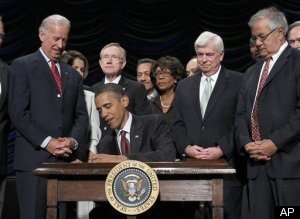
 President Obama signed into law on Wednesday a sweeping expansion of federal financial regulation, marking another — and perhaps last — major legislative victory before the midterm elections in November, which could recast the Congressional landscape.

The signature achievement — a response to the 2008 financial crisis that fundamentally alters the relationship between Wall Street and the federal officials charged with regulating it — is a culmination of two years of fierce lobbying and intense debate over how to deal with the financial excesses that tipped the nation into the worst recession since the Great Depression.

The law subjects more financial companies to federal oversight, regulates many derivatives contracts and creates a panel to detect risks as well as a consumer protection regulator. A number of the details have been left for regulators to work out, inevitably setting off complicated tangles down the road that could last for years.

Obama Financial Reform

Mr. Obama took pains to try to show how the complex legislation, with is dense pages on derivatives practices, will protect ordinary Americans.

“If you’ve ever applied for a credit card, a student loan, or a mortgage, you know the feeling of signing your name to pages of barely understandable fine print,” Mr. Obama said. “But what often happens as a result, is that many Americans are caught by hidden fees and penalties, or saddled with loans they can’t afford.”

He said the law would crack down on abusive practices in the mortgage industry, simplifying contracts and ending hidden fees and penalties, “so folks know what they’re signing.”

So what exactly is in the bill?  According to a summary in the Christian Science Monitor

A bill summary by Capitol Hill staff members includes 100 points. Here’s a shorter take, 10 points, focusing on less-publicized elements as well as some core provisions:

• A first-ever federal office focused on the insurance industry will monitor the insurance industry for systemic risk. The industry will remain regulated largely at the state level.

• FDIC deposit insurance for account-holders at banks, thrift institutions, and credit unions will be raised to $250,000 (from $100,000) retroactive to Jan. 1, 2008.

• The State Department would have to submit an “illicit minerals trade strategy” for the Congo region. Manufacturers that use minerals originating in the Democratic Republic of Congo would have to disclose measures taken to exercise due diligence on the source and chain of custody of the materials. The provision, sponsored by Sen. Sam Brownback (R) of Kansas, could affect high-tech firms like Intel and Apple.

• The bill beefs up the powers of the Securities and Exchange Commission, including extra funds for enforcement. The SEC would get new power to impose fiduriary responsibility on investment brokers. That means the brokers would have to offer advice based on the best interest of clients, not broker fees. Consumer advocates say the bill should have mandated this change, not allowed the SEC to consider it.

• New disclosure rules would apply to credit-rating firms, along with new penalties if the firms are irresponsible. In a nod to an amendment backed by Sen. Al Franken (D) of Minnesota, the bill seeks to end “shopping for ratings” by calling for the SEC to propose ways to prevent issuers of asset-backed securities from picking the firm they think will give the highest rating.

• Shareholders would get a “say on pay,” with the right to a nonbinding vote on executive pay and golden parachutes. Standards for listing on an exchange would require that compensation committees include only independent directors.

• Reforms would reshape Federal Reserve powers, including a ban on Fed bailouts targeted at specific firms (like AIG) in the future. The presidents of regional Fed banks would be selected entirely by directors representing the public, and not partly by directors representing banks that the Fed regulates.

• The bill creates a new Consumer Financial Protection Bureau to consoldiate duties now charged to various federal agencies. It would have a consumer hot line, for questions on things like mortgages, and a new office of financial literacy.

• A Financial Stability Oversight Council of top economic regulators will monitor systemwide risks. The bill summary says this group will ask the Federal Reserve to adopt “increasingly strict rules for capital, leverage, liquidity, risk management and other requirements as companies grow in size and complexity.”

• An “orderly liquidation” mechanism would allow the Federal Deposit Insurance Corp. (FDIC) to dismantle large financial companies that are on the brink of failure. Shareholders and unsecured creditors would bear losses, to end taxpayer bailouts. But the bill also allows the FDIC to shelter solvent banks from having to bear losses if there is a threat to overall US financial stability

Thank you to Barney Frank, Chris Dodd, Olympia Snowe, Susan Collins and Scott Brown and all the Democrats except Ben Nelson we have a start and reining in the runway, unregulated financial system.