Jack Lew, Secretary of the Treasury UPDATED

If Jack Lew is confirmed, we have a great thing to look forward to according to Ezra Klein.

The Treasurer signs our money.  This is Lew’s signature.

lew sig

I can’t wait to get my first bills signed by him.

But as Klein cautions

Obviously, that would turn American currency into the best money
ever. Unfortunately  there’s always the chance that Lew could ruin everything by
making his signature less, well, loopy. That’s what the fun destroyer Timothy
Geithner didwhen he became treasury secretary.

We can only hope that Mr. Lew is true to himself and we have great money for the next four years.  Don’t change your signature, Mr. Lew!


UPDATED:

President Obama had this today about his signature

“I had never noticed Jack’s signature” until media coverage of the looping letters on Wednesday, Obama said at the East Room ceremony where he announced his nomination of Lew. “I considered rescinding my offer to appoint him.”

Obama said he’s asked Lew to “make at least one letter legible in order to not debase our currency should he be confirmed as secretary of the Treasury.”


Looking back at 2012 progressively

2012 was a pretty good year for those of a progressive/liberal political point of view and Winning Progressive has compiled a good summary.  You can read the entire article here, but I’ve pulled out some of my particular favorites – in my own order of significance.

First I have to talk about Mitch McConnell who not only lost his effort to make President Obama a one-termer, but last night voted to increase taxes.  (Although since it happened after we technically went off the cliff  at midnight, he will probably spin it as a decrease.)  I think he an John Boehner were the big losers last year, not Mitt.  Mitt is done with politics, but McConnell and Boehner have to continue to try to herd their Republican members and get re-elected.

President Obama re-elected

So now to some accomplishments.

* President Obama Re-Elected With A More Diverse and Progressive Congress– The November elections saw the re-election of President Obama and the election of four new progressive U.S. Senators – Mazie Hirono (D-HI), Elizabeth Warren (D-MA), Chris Murphy (D-CT), and Tammy Baldwin (D-WI).  In addition, Joe Lieberman (I-CT) is finally leaving the Senate!  On the House side, the Democrats elected in November will be the first major party caucus in US history that is majority female and people of color.  New House progressives will include Alan Grayson (FL-09), Jared Huffman (CA-02), Dan Kildee (MI-05), Ann McLane Kuster (NH-02), Grace Meng (NY-06), Patrick Murphy (FL-18), Rick Nolan (MN-08), Mark Pocan (WI-02), Raul Ruiz (CA-36), Carol Shea-Porter (NH-01), Mark Tacano (CA-41), Hakeem Jeffries (NY-08), and Kyrsten Simena (AZ-09).  On the flip side, tea party conservatives Allen West (FL), Chip Cravaack (MN), Bobby Schilling (IL), Roscoe Bartlett (MD), Ann-Marie Buerkle (NY), Francisco Canseco (TX), and Joe Walsh (IL) were all defeat and, hopefully, will never be heard from politically again.

* LGBT Equality– 2012 was, of course, a banner year for advancing LGBT equality.  For the first time in US history, equality was supported by a majority of voters facing ballot proposals approving marriage equality in Maine, Washington, and Maryland, and refusing to ban equality in Minnesota. The first openly lesbian U.S. Senator, Tammy Baldwin (D-WI) was elected in November as were a record seven openly-gay House members.  President Obama publicly supported marriage equality, and anti-equality forces in Iowa failed in their effort to recall a state Supreme Court justice who declared that state’s ban on marriage equality unconstitutional.  In February, a federal appellate court ruled California’s anti-marriage equality Proposition 8 unconstitutional, and two federal courts in 2012 did the same with the Defense of Marriage Act.

* Health Care Reform – In a decision that surprised many commentators, the U.S. Supreme Court upheld the Patient Protection and Affordable Care Act, aka “ObamaCare.”And while the GOP-controlled House has voted at least 33 times to repeal ObamaCare, President Obama’s re-election in November virtually guarantees that will never occur.   In implementing ObamaCare, the Obama Administration, standing up to strong opposition from conservative religious organizations, finalized rules requiring that contraception be included as a preventive health service that insurance policies must cover with no co-pay.  This will help millions of women afford access to birth control and also save money by reducing unintended pregnancies.

Those are my personal big three.

Yes, there is a lot left to do and a lot that happened that I didn’t particularly think was terrific, but on the first day of a new year, we should celebrate our successes!

Going over the cliff?!

The Senate is back in town with very unhappy members who would rather be kicking back at home and who can blame them.  Senator McConnell who really, really doesn’ t want to make a fool of  himself a la Boehner and Plan B, keeps asking for a proposal from the President.  I thought the President had made at least two proposals, but I guess Mitch doesn’t follow the new much.  Meanwhile the House is called back into session on Sunday night.  That is the night of December 30 a little more than 24 hours before the cliff.  So what is going on here?  Not being an economist, I can’t explain it all but I have found a couple of things this morning that have given me some things to think about as we play chicken with the deadline.

First is this handy chart from the New York Times from the Debt Reckoning blog.

It was posted last night with this explanation.

The deadline for resolving the pending fiscal crisis is less than a week away and, absent a breakthrough, spending cuts and tax increases on every income level will go into effect on Jan. 2. During their negotiations, President Obama and Speaker John A. Boehner have sought to keep tax rates at their current level for some taxpayers while letting them rise for high earners, but they have not agreed on where to set the income threshold. Mr. Obama has called for rates to go up on income above $250,000 (he later increased his offer to $400,000), Congressional Democrats have said they would agree to $500,000, and Mr. Boehner has called for a $1 million threshold.

So we aren’t talking about a lot of taxpayers here since the vast majority of us make under $250,000 in taxable income.  As I understand it, none of these proposals would impact investment income.  (Which as we have learned from Mitt Romney, is taxed differently.)  But we do pay a lot more taxes than just income tax and if we go over the cliff, these will go up.  Payroll taxes, business taxes, various tax credits like for child care, and unemployment insurance will all be affected.

The other thing I read this morning is from the Washington Post’s Wonkblog, They have put together a set of very helpful Frequently Asked Questions – with answers.

For example

What is the fiscal cliff in one sentence?

Much too much austerity, much too quickly.

And since this is Ezra Klein and company, there are a couple of helpful graphs.

On or around Jan. 1, about $500 billion in tax increases and $200 billion in spending cuts (see table 1) [ above] are scheduled to take effect. That’s equal to about four percent of GDP, which is according to the Congressional Budget Office, more than enough to throw us into a recession

Next question:  What matters most?

It’s important to recognize that the austerity crisis is a collision between deficit reduction and stimulus. The good news is that if you look at the various components of the fiscal cliff separately, you’ll see that the parts that do the most for deficit reduction do the least for the recovery, and vice versa. This suggests the possibility of “a la carte” approach to the fiscal cliff, in which we extend the most stimulative policies and wave goodbye to the most costly policies. And if you’re looking to go a la carte then here, via the Economic Policy Institute, is the menu.

I recommend that Senator McConnell take a look at this list and the chart showing the impact of various tax increase proposals, pull out his own calculator and make a proposal.  Of course given the House and Senate rules, we will probably go over the cliff before anything can be passed.

About the Republican request for a balanced approach

Ezra Klein posted this today

This is a very sharp point by Josh Barro:

The Republicans’ main problem in this negotiation is that they know President Barack Obama will not agree to cut in the area they want to cut: aid to the poor. The signal Obama has sent is that he is willing to make a deal that cuts old-age entitlements, meaning Medicare and Social Security, and Republicans are internally conflicted over those programs.

He’s right. Think back to Mitt Romney’s proposed budget. Medicare and Social Security were held harmless for at least 10 years. Defense spending got a lift. PBS and the National Endowment for the Arts were on the table, but they cost so little it hardly mattered.

And there is the Ryan budget problem which remains the basic Republican budget outline.  It is what they ran on.

These are, however, classes of cuts the White House won’t even consider. A year ago, they were open to modest cuts in Medicaid, but after the Supreme Court’s health-care decision, even that door has shut. As for discretionary spending cuts, so many of those were made in 2011, there’s just not much left to do.

That leaves Medicare and Social Security. It’s possible that the negotiators will enact a backdoor, but significant, cut to Social Security by changing the government’s measure of inflation. But they’re not going to come at Social Security from the front. It’s too politically potent. Even Ryan’s budget left Social Security alone.

As for Medicare, as Barro says, if “Republicans ask for near-term Medicare cuts, that will mean reversing a position that is popular with a core constituency (old white people) and giving up a cudgel that they feel they have used effectively to beat up the president since 2009.” It’s a pickle.

In addition, as Steve Benen on the Rachel Maddow blog reminds us, the President has already offered spending cuts, of about 1.7 trillion over 10 years.

The White House keeps saying it wants a ‘balanced approach’ but this offer is completely unbalanced and unrealistic,” a Capitol Hill Republican said yesterday. “It calls for $1.6 trillion in tax hikes — all of that upfront — in exchange for only $400 billion in spending cuts that come later.”

Let’s put aside, for now, the irony of hearing Republicans talking about “balanced” debt-reduction plans. Instead, the importance of complaints like these is that they overlook everything that happened a year ago. Jonathan Cohn had a good piece on this.

…As part of the 2011 Budget Control Act, Obama agreed to spending  reductions of about $1.5 trillion over the next ten years. If you count  the interest, the savings is actually $1.7 trillion. Boehner should have  no problem remembering the details of that deal: As Greg Sargent points out, Boehner at the time actually gloated about the fact that the deal was “all spending cuts.”

And now, with this latest offer, Obama is proposing yet more spending  reductions, to the tune of several hundred billion dollars. Add it up  and it’s more than $2 trillion in spending cuts Obama has either signed  into law or is endorsing now. That’s obviously greater than the $1.6 trillion in new tax revenue he’s seeking. (And that doesn’t even take into account automatic cuts  from the 2011 budget sequester, which Obama has proposed to defer, or  savings from ending the wars in Afghanistan and Iraq.)

I can understand the temptation to block 2011 from memory, but what transpired is clearly relevant to the current debate. Obama wanted a “balanced” approach last year — some cuts, some new revenue — but didn’t get it. Instead, faced with the prospect of Republicans crashing the economy on purpose, the president accepted a deal with a whole lot of spending cuts.

How much new tax revenue came as the result of last year’s deal? Zero. The entire package came in the form of spending reductions and savings.

So with the new tax revenues and the already proposed budget cuts, President Obama is offering exactly what the Republicans keep asking for:  a balanced approach.  I’m not sure what they are waiting for.  Senator Harry Reid is mystified and so am I.

We need a comprehensive solution that lasts for a couple of years at a minimum because this non-economist doesn’t think the economy will improve as long as we seem to be in a continuous a budget or debt ceiling crisis.

Playing with Medicare and Social Security

I retired recently from a white collar, management, high stress job at the age I have always expected to retire, 65.  I think I can say that my retirement was a cause of envy among many of my co-workers who are just as tired and stressed as I was but have many years before they can retire.  As I said to my former staff members at lunch the other day, you don’t realize how tired you are until you retire.  And even then it takes time to de-stress.  So I can imagine if I were working a job that was physically demanding (and maybe also stressful) and how it would make me feel if I knew I had to work until 67 or 70 to get any kind of benefits which is where many Republicans (and some Democrats) want us to end up.  I don’t think that some of the corporate CEO’s and elected officials understand this which is why this piece by Ezra Klein caught my eye.

I’ll be clear: Raising the Medicare eligibility age makes no sense. It cuts federal health-care spending but raises national health spending, which is what really matters. It doesn’t modernize the system or bend the cost curve. It doesn’t connect to any coherent theory of health reform, like increasing Medicare’s bargaining power, increasing competition in Medicare, ending fee-for-service medicine, or learning which treatments work and which don’t. I’m not opposed to cutting Medicare — quite the opposite, actually — but this is a particularly brain-dead way to do it.

Its importance in the negotiations is attributable to the fact that raising the age at which Americans can receive Medicare and Social Security has a weird, symbolic power in Washington. As House Minority Leader Nancy Pelosi puts it, the eligibility age is “a trophy” that Republicans can bring back to their base. Though the policy is deeply unpopular with voters, it’s quite popular among Republican elites.

Klein floats this idea

If it’s age increases that the political system wants, there’s a better way to do it. Ezekiel Emanuel, who advised the Obama administration on health care and now works with the Center for American Progress, calls it “graduated eligibility,” and it would link the age of eligibility with lifetime earnings:

Here’s how it would work. People in the bottom half of the lifetime earnings distribution would become eligible for normal retirement benefits at age 65 for Medicare and 66 for Social Security, just as they are today. But people in the next quarter of the lifetime earnings distribution would become eligible for the respective programs at 67 and 68, and those in the top quarter would become eligible at 70 and 71. All eligibility ages would increase over time, as they are scheduled to now.

This makes sense on a few different levels. For one thing, a favorite argument for raising the age at which benefits begin is that seniors live longer today than they did when these programs began. But those gains aren’t equal: Richer seniors live six years longer than poorer seniors, on average. “Graduated eligibility” accounts for that fact.

This does make a certain amount of sense, but I still worry about those who work physically demanding jobs like construction.  I’m not even sure about the scheduled age increases for full benefits.  Maybe we should lower ages at the bottom, leave the middle, and raise it even highter at the top.

I remembered that I heard somewhere that the average retirement age is 62 and went looking for confirmation.  I found this story in the Financial Advisor from April 2012.

More than one third of pre-retirees (35%) surveyed think they will never retire, an increase from 29% in the 2009 survey. Only one in 10 pre-retirees thinks they will retire before age 60. Half of pre-retirees say they will wait until at least age 65.

In reality, 31% of retirees quit work before age 55, 20% before age 60, and another 10% before age 62.

“There is a major disconnect between when people say they plan to retire and when they actually do,” the survey says. Some of it may be because of health problems or because they are downsized. “Many who lose jobs in their 50s and 60s experience more difficulty finding new employment,” the survey adds.

The survey was taken of 800 pre-retirees and 800 retirees, ages 40 to 80. It is the sixth survey of this type taken by the Society of Actuaries since 2001.

So there is also a disconnect between the proposals on age eligibility and what people so in real life.

I am worried that we are going to end up with a policy that has very bad unintended consequences.  I saw Nancy Pelosi in an interview a few nights ago when she said she hadn’t seen how raising the Medicare age was going to create savings.  She said, “Show me the money.”  I would go further and say, I don’t think that anyone has done the math and I can only hope that the President, Democrats in Congress and maybe some Republicans will do the math first.

Photograph:  Alex Wong

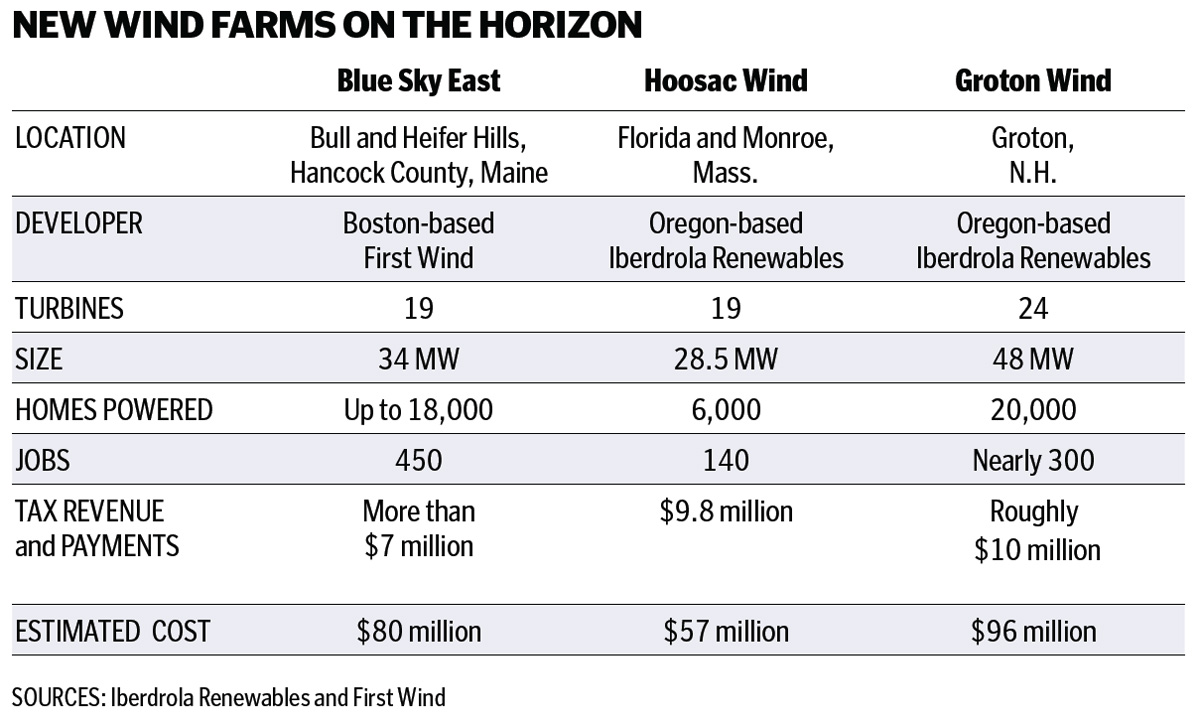
The benefits of Massachusetts wind farms

I’m hoping that with the election over we can get back to talking about energy independence in a way that includes alternate kinds of energy.  This chart which as in the Boston Globe the other day caught my eye.  As you can see,  they do create jobs and tax revenue for the local government.

Boomers and the job numbers

What does the retirement of the baby boom generation have to do with the job numbers you might ask.  I never thought of my retirement impacting the unemployment rate but reading Paul Krugman in the New York Times this morning, I realize that in a strange way I am helping the economy.  Yes, I’ve read all  the stories about how we didn’t save enough, how our homes (the big retirement plan for many) have lost value, how interest rates are hurting retirees, how the numbers are going to make Medicare and Social Security go broke and on and on.  But it never occurred to me that maybe the estimated 10.000 people a day who retire might actually be good for the economy.  Think about it.  Each person who retires has the potential to open up a job for someone else.  The bottom line is there is still work that needs to be done and at some point someone will be hired to do it.


AARP Social Security for Dummies Book Jacket


Krugman writes

 …the methods the bureau uses are public — and anyone familiar with the data understands that they are “noisy,” that especially good (or bad) months will be reported now and then as a simple consequence of statistical randomness. And that in turn means that you shouldn’t put much weight on any one month’s report.

In that case, however, what is the somewhat longer-term trend? Is the U.S. employment picture getting better? Yes, it is.

Some background: the monthly employment report is based on two surveys. One asks a random sample of employers how many people are on their payroll. The other asks a random sample of households whether their members are working or looking for work. And if you look at the trend over the past year or so, both surveys suggest a labor market that is gradually on the mend, with job creation consistently exceeding growth in the working-age population.

On the employer side, the current numbers say that over the past year the economy added 150,000 jobs a month, and revisions will probably push that number up significantly. That’s well above the 90,000 or so added jobs per month that we need to keep up with population. (This number used to be higher, but underlying work force growth has dropped off sharply now that many baby boomers are reaching retirement age.)

Meanwhile, the household survey produces estimates of both the number of Americans employed and the number unemployed, defined as people who are seeking work but don’t currently have a job. The eye-popping number from Friday’s report was a sudden drop in the unemployment rate to 7.8 percent from 8.1 percent, but as I said, you shouldn’t put too much emphasis on one month’s number. The more important point is that unemployment has been on a sustained downward trend.

But isn’t that just because people have given up looking for work, and hence no longer count as unemployed? Actually, no. It’s true that the employment-population ratio — the percentage of adults with jobs — has been more or less flat for the past year. But remember those aging baby boomers: the fraction of American adults who are in their prime working years is falling fast. Once you take the effects of an aging population into account, the numbers show a substantial improvement in the employment picture since the summer of 2011.

unemployment

unemployment (Photo credit: Sean MacEntee)


So the job growth and unemployment figures are slowly improving.  The overall trend is up for growth and down for unemployment.  I think one of the most shocking reactions to the numbers was the notion that they were somehow being manipulated and the things were actually much worse.  Do some like Jack Welsh actually want things to either get worse or at least to stay bad?  They just can’t bring themselves to admit that President Obama may be succeeding – despite Congress and the Republicans and turning things around.  Do they really need to win that badly?

Krugman says it better

…The U.S. economy is still far short of where it should be, and the job market has a long way to go before it makes up the ground lost in the Great Recession. But the employment data do suggest an economy that is slowly healing, an economy in which declining consumer debt burdens and a housing revival have finally put us on the road back to full employment.

And that’s the truth that the right can’t handle. The furor over Friday’s report revealed a political movement that is rooting for American failure, so obsessed with taking down Mr. Obama that good news for the nation’s long-suffering workers drives its members into a blind rage. It also revealed a movement that lives in an intellectual bubble, dealing with uncomfortable reality — whether that reality involves polls or economic data — not just by denying the facts, but by spinning wild conspiracy theories.

It is, quite simply, frightening to think that a movement this deranged wields so much political power.

Explaining the new jobs numbers

The number of jobs added grew again in September reflecting the slow but steady growth and unemployment dropped below 8% for the first time since January 2009, the month President Obama took office.  Republicans, including Jack Welsh the former CEO of General Electric, are going to argue that the Bureau of Labor Statistics somehow cooked the numbers to help the President. Ezra Klein explains why this couldn’t be the case.

We’ve hit that moment in the election when people begin to lose their minds. Case in point, within minutes of the jobs report, Twitter filled with Republicans claiming the books were somehow cooked, the numbers aren’t real, etc.

Let’s take a deep breath. Jobs reports are about the economy, not about the election. Confusing the two leads to very bad analysis.

This is a good jobs report in a still-weak economy. The 114,000 jobs we added in September aren’t very impressive. The revisions to the last two months, which added 86,000 jobs to the total, were much more impressive. Those revisions also suggest that September’s jobs could get revised up — or, of course, down. So be careful about reading too much into that number. Still, these are, at best, good, not great, numbers.

The chart shows the number of jobs added pretty consistent with previous numbers.  So where is the controversy?

The controversy, if it’s worth using that word, is over the unemployment rate, which dropped from 8.1 percent to 7.8 percent. That’s three-tenths of one percent. That’s what all the fuss is about.

Let’s get one thing out of the way: The data was not, as Jack Welch suggested in a now-infamous tweet, manipulated. The Bureau of Labor Statistics is set up to ensure the White House has no ability to influence it. As labor economist Betsey Stevenson wrote, “anyone who thinks that political folks can manipulate the unemployment data are completely ignorant of how the BLS works and how the data are compiled.” Plus, if the White House somehow was manipulating the data, don’t you think they would have made the payroll number look a bit better than 114,000? No one would have batted an eye at 160,000.

The fact is that there’s not much that needs to be explained here. We’ve seen drops like this — and even drops bigger than this — before. Between July and August the unemployment rate dropped from 8.3 percent to 8.1 percent — two-tenths of one percent. November-December of 2011 also saw a .2 percent drop. November-December of 2010 saw a .4 percent drop. This isn’t some incredible aberration. The fact that the unemployment rate broke under the psychologically important 8 percent line is making this number feel bigger to people than it really is.

Wonkblog posted this chart soon after the numbers were released.


The explanation

…the unemployment rate is a function of two things: the number of people
employed, and the number of people in the labor force. But the proportion of
people in the labor force actually went up, suggesting the fall in the
unemployment rate reflects a real improvement, rather than people stopping their
work search…

The Bureau of Labor Statistics looks at the unemployment rate in several ways as Klein explains.

Which leads to another argument: That U6, the broadest measure of labor-market pain, didn’t move, which should make us skeptical of the fact that U3, the normal unemployment rate, did move. That’s just misunderstanding what U6 is.

U6 is not an unemployment measure. It includes part-time workers who want full-time work. So it doesn’t count the increase in part-time work. But every measure of actual unemployment — U1, U2, U3, U4, and U5 — went down. You can see them all here. Again, there’s no mystery.

Klein concludes

This is an encouraging report. What it tells us is that the labor market has been a bit better over the last few months than we thought, and that the recovery hasn’t slowed in the ways we feared. What the response to it tells us is that the election is driving people a little bit crazy.

You can see more charts by clicking the various links.

Polls and tonight’s debate

Governor Christie of New Jersey thinks Mitt Romney will ace the debate tonight and turn the race upside down.  Let’s see.  Romney has had other game changing opportunities over course of the campaign the biggest being the Republican Convention.  What happened there?  His biographical film wasn’t done during prime time coverage.  Clint Eastwood talked to an empty chair and went over his allotted time.  Romney’s speech did not mention Afghanistan or American troops and, overall, was not very inspiring.

Tonight Romney will get another turn at bat.  The polls are still relatively close (more on them in a minute), but can the debate actually move the polls?

Ezra Klein writes in his Wonkbook this morning

Wonkbook’s number of the day: 0. That’s the number of recent elections that we can confidently say were decided by debates.

Gallup, for instance, reviewed their polls going back to 1960 and concluded they “reveal few instances in which the debates may have had a substantive impact on election outcomes.” Robert Erikson and Christopher Wlezien, in “The Timeline of Presidential Elections,” looked at a much broader array of polls and concluded that there was “there is no case where we can trace a substantial shift to the debates.” Political scientist John Sides, summarizing a careful study by James Stimson, writes that there’s “little evidence of [debate] game changers in the presidential campaigns between 1960 and 2000.

That’s not to say debates can’t matter, or that these debates won’t matter. The race remains close, and there are examples — 1960, 2000 and 2004, for instance — where  debates made a race more competitive, even if they didn’t clearly change the outcome. Simply closing the gap a bit would be a big win for Mitt Romney, if for no other reason than it would keep Republican donors invested in his chances going into the campaign’s final weeks.

One caveat to keep in mind, though: It’s not necessarily “the debates” that matter. It’s the debates plus the way the debates get spun in the media. There’s good evidence, in  fact, that the media’s spin is actually more important than the debates themselves. For more on that, read this article by Dylan Matthews, which is the best primer you’ll find on what we do and don’t know about what matters in presidential debates. The graphs are great, too

So going into the debate tonight (I’m writing this at about 7:30 am) where do the polls say we are?

Last night Nate Silver’s FiveThirtyEight blog posted these numbers for November 6:

Odds of Obama winning:  84.7%

Electoral Votes:  318.6

Popular Vate:  Obama 51.4 to Romney 47.5

Silver wrote

There were nine national polls published on Monday, which are listed in the table below. On average, they showed Mr. Obama with a 3.5 percentage point lead over Mr. Romney.

That’s smaller than the leads we were seeing in national polls last week, which seemed to be concentrated more in the range of a five- or six-point lead for Mr. Obama. It also suggests a smaller lead than recent state-by-state polls seem to imply.

So has the race already shifted back toward Mr. Romney some? Perhaps, but this is less apparent from the trendlines within these polls.

If you compare the nine surveys released on Monday against the last time they were published (in all cases, the comparison poll postdates the Democratic conventions), only four showed a shift toward Mr. Romney. An equal number, four, showed Mr. Obama gaining ground instead, while one poll remained unchanged.

In all cases but one, the shift was extremely modest — within one percentage point in one direction or the other. The exception was a new CNN national poll, which had Mr. Romney closing his deficit from six points to three points.

On average, however, the polls showed only a 0.2 percentage point gain for Mr. Romney — not a meaningful shift in either a statistical or a practical sense.

That is what I had when I went to bed last night.  I woke up to the NPR poll results.  The headline says

On Eve Of First Debate, NPR Poll Shows Romney Within Striking Distance

but the text says

The latest poll by NPR and its bipartisan polling team [pdf] shows President Obama with a 7-point lead among likely voters nationally and a nearly identical lead of 6 points in the dozen battleground states where both campaigns are spending most of their time and money.

However

More than 80 percent of respondents said they planned to watch the first televised clash Wednesday and one in four said the debate could influence their vote.

If you are a Romney supporter that may give you hope.  But remember, Governor Christie, he hasn’t come up to snuff at any big moments yet.  Maybe that means the debate is the time.

But for me, the most interesting thing to emerge from the NPR polling was this question.

On The Economy:

Now, thinking about the nation’s economy, do you believe the economy…

On The Economy

Source: NPR/Democracy Corps/Resurgent Republic

Credit: Padmananda Rama and Alyson Hurt / NPR

Almost half of those surveyed think the economy has bottomed and is starting to improve.  The economy was supposed to be Romney’s issue.

I’ll let Nate Silver have the last word.

But let me leave you with two themes that are at least reasonably well in line with the consensus of the evidence.

First, although it’s unclear whether Mr. Obama’s polls have already begun to decline, it’s more likely than not that they will tighten some between now and the election. The Nov. 6 forecast prices in some tightening while the “now-cast” does not, so sometimes they’ll have a different take on the polls.

Second, you should continue to watch the divergence between state polls and national polls.

As of Monday’s forecast, Mr. Obama was projected to win 22 states totaling 275 electoral votes by a margin of at least 4.7 percentage points — larger than his 4.1 percentage point projection in the national popular vote.

That speaks to a potential Electoral College advantage for him. But it’s important to watch the states that are just on the brink of this threshold, like Nevada and Ohio, or those where the polling has been varied, like New Hampshire.

Without Nevada, for instance, but with the other 21 states, Mr. Obama would be projected to a 269-269 in the Electoral College — which he would probably lose in the House of Representatives.

And his odds there will be a tie:  0.5%.

If you are an Obama voter you can be cautiously optimistic going into the debate tonight.

The National Debt and the GDP

Being a little behind in reading my email, I just saw this from Ezra Klein.  He suggests you keep this in mind while you watch the Republicans try to push the debt onto the President and the Democrats.

Notice that you can barely see TARP.  It is that dark blue streak that is separating the other two blue parts of the graph.  Even the stimulus is pretty small.

The deficit is pretty easy to understand when you look at it in a graph.  If you reduced the Bush tax cuts for income over &250,000 and worked on the costs of the wars – and didn’t start any new ones – you can really begin to reduce the debt.  Maybe the huge number of people who think the tax breaks for the wealthy should be eliminated understand this better than Mitt and Paul and the rest of their gang.  Certainly they understand this better than Grover Nordquist.

So when you are watching the Republicans in Tampa, remember this chart and thank Ezra Klein.