Gaming doesn’t come to Massachusetts

I have never liked the idea of casinos in Massachusetts.  I remember when they were going to save Atlantic City.  So now there is a nice strip along the boardwalk and the rest of the City and residents are in poor shape.  And resort casinos will have to go through a process including environmental reviews, design reviews, negotiations with the localities where they want to go.  At best, we are a couple of years away from even construction jobs. And with casinos in Rhode Island and Connecticut, are there enough people who want to gamble to create sufficient revenue?

This from the Boston Globe this morning on House Speaker Robert DeLeo

DeLeo initially wanted to authorize two resort-style casinos and license the state’s four racetracks to operate slot machines. He eventually agreed on a bill to allow three casinos and two slot licenses. Patrick said he would sign a bill with only one slot license. After the Legislative session ended Saturday, he withdrew his compromise and sent a bill back that had no slot licenses. The Legislature would have to muster a two-thirds vote to override Patrick. DeLeo said he does not expect a return to session, meaning the bill is likely dead.

The editorial explains it well.

HOUSE SPEAKER Robert DeLeo’s decision to put the needs of the state’s racetracks ahead of all other interests is a staggering example of why voters worry about legislative excesses. His stubbornness has hurt his party and put a governor of his own party in a terrible bind. Thus, it’s a relief that Governor Patrick is standing up forcefully to the speaker, and he must continue to do so.

DeLeo has tried to corner Patrick into approving a gambling bill that allows slot-machine parlors at racetracks, insisting in a statement that a veto would “ “kill the prospects of 15,000 new jobs’’ and money for local aid. But it’s the speaker’s own intransigence that has put at risk the benefits that a more targeted bill could create. Patrick supports the licensing of three resort casinos, which would represent an enormous expansion of gambling in Massachusetts. But DeLeo has deep personal and political connections to the racing industry; his father worked in it, and it’s a major presence in his district. And the speaker was unyielding in demanding that racetrack owners be given special consideration in the gambling bill.

We have had the last couple of House Speakers leave under a cloud.  I can’t believe that Speaker DeLeo would risk even the appearance of a conflict of interest to get the race tracks in his districts slot machines.

I do play the lottery on occasion and I complete  the March Madness bracket every year, but casinos and slot machines have consequences beyond the creation of jobs and revenue for the state.  Thank you to my State Reps, Gloria Fox and Jeff Sanchez and my state Senator, Sonia Chang-Diaz for voting no.  Thank you also to Governor Patrick for standing on principle.

The case for ending tax cuts

This week Kenneth Feinberg announced the list of banks that took tax payer money while paying our huge bonuses.  On NPR, John Ydstie reported that

In the fall of 2008, with the financial system on the verge of collapse, 17 large banks that were being propped up by taxpayers doled out $1.6 billion in bonuses.

On Friday, the Obama administration’s pay czar, Kenneth Feinberg, passed judgment.

According to Feinberg, “…many were over $10 million per individual.”

And what exactly have these individuals done with their bonuses?  Have they created jobs?  I don’t think so.

Which brings me to the tax cut which is looming as the next hot potato for the Democrats and for President Obama.  We all remember the conversation the President had with Joe the Plumber during the campaign during which Obama, who clearly thought he was talking with someone rational, tried to explain that he was not going to raise taxes on the middle class.

The New York Times reports

Democratic leaders, including Mr. Obama, say they are intent on letting the tax cuts for the wealthy expire as scheduled at the end of this year. But they have pledged to continue the lower tax rates for individuals earning less than $200,000 and families earning less than $250,000 — what Democrats call the middle class.

Most Republicans want to extend the tax cuts for everyone, and some Democrats agree, saying it would be unwise to raise taxes on anyone while the economy remains weak. If no action is taken, taxes on income, dividends, capital gains and estates would all rise.

We do not buy into the theory that because the economy is still recovering, extending tax cuts for the highest earners is a necessary or effective policy response,” said Gene Sperling, counselor to Mr. Geithner.

“While we are supporting measures like small-business lending and tax cuts to spark growth,” Mr. Sperling added, “it is also important to show the world that we are following through on our commitment to long-term fiscal discipline.”

Senator Bernie Sanders of Vermont makes the case for the change in the Nation.

The American people are hurting. As a result of the greed, recklessness and illegal behavior on Wall Street, millions of Americans have lost their jobs, homes, life savings and their ability to get a higher education. Today, some 22 percent of our children live in poverty, and millions more have become dependent on food stamps for their food.

And while the Great Wall Street Recession has devastated the middle class, the truth is that working families have been experiencing a decline for decades. During the Bush years alone, from 2000-2008, median family income dropped by nearly $2,200 and millions lost their health insurance. Today, because of stagnating wages and higher costs for basic necessities, the average two-wage-earner family has less disposable income than a one-wage-earner family did a generation ago. The average American today is underpaid, overworked and stressed out as to what the future will bring for his or her children. For many, the American dream has become a nightmare.

 But, not everybody is hurting. While the middle class disappears and poverty increases the wealthiest people in our country are not only doing extremely well, they are using their wealth and political power to protect and expand their very privileged status at the expense of everyone else. This upper-crust of extremely wealthy families are hell-bent on destroying the democratic vision of a strong middle-class which has made the United States the envy of the world. In its place they are determined to create an oligarchy in which a small number of families control the economic and political life of our country.

The New York Times story points out how difficult changing the tax policy will be as it will involve many different element.

Congress must also wrestle with the estate tax, which lapsed last year but will automatically be reinstated effectively at a 55 percent rate on Jan. 1 for estates larger than $1 million. Lawmakers must also deal with an array of other provisions, including tax rates on dividends and capital gains, and the Alternative Minimum Tax, which has been adjusted annually to prevent millions of middle-class families from paying higher tax bills. The child tax credit would also be reduced.

So what should the strategy be?

Negotiations are expected to start in the Senate, where it is hardest for Democrats to advance legislation because of Republican filibusters. But some Democrats say a fallback plan would be to have their larger majority in the House approve a continuation of the lower rates just for the middle class right before the election, almost daring Republicans to oppose them.

In that case, Democrats say, Republicans who opposed the bill would be blocking a tax cut for more than 95 percent of Americans to defend tax cuts for a relatively few wealthy households. Republicans are readying an arsenal of economic data to portray the Democrats as endangering the precarious recovery and harming small-business owners, some of whom are taxed at the top personal income tax rates.

But some lawmakers, including Mr. Wyden, [Senator from Oregon] say the deficit concerns and the attention on the debt commission could help forge a deal: a short-term continuation of the tax cuts for the middle class, and perhaps some new tax breaks for businesses, that would buy lawmakers time to undertake a broad overhaul of the tax code in the next Congress.

It will be interesting to see if a change for the middle class can be made before the election and even more interesting to see what the National Commission on Fiscal Responsibility and Reform reports in December.

I am not an economist, but won’t the revenue generated by increasing taxes on wealthy individuals and corporations making over a certain amount – or that off shore their jobs-  help the deficit?   And I wonder if some are not actually paying more on their unemployment than those bankers are on their bonuses?

The Frank-Dodd Financial Reform Bill

Helene Cooper writes in the New York Times this afternoon

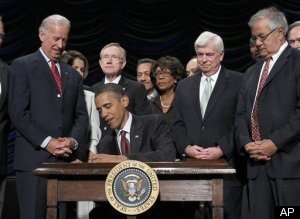
 President Obama signed into law on Wednesday a sweeping expansion of federal financial regulation, marking another — and perhaps last — major legislative victory before the midterm elections in November, which could recast the Congressional landscape.

The signature achievement — a response to the 2008 financial crisis that fundamentally alters the relationship between Wall Street and the federal officials charged with regulating it — is a culmination of two years of fierce lobbying and intense debate over how to deal with the financial excesses that tipped the nation into the worst recession since the Great Depression.

The law subjects more financial companies to federal oversight, regulates many derivatives contracts and creates a panel to detect risks as well as a consumer protection regulator. A number of the details have been left for regulators to work out, inevitably setting off complicated tangles down the road that could last for years.

Obama Financial Reform

Mr. Obama took pains to try to show how the complex legislation, with is dense pages on derivatives practices, will protect ordinary Americans.

“If you’ve ever applied for a credit card, a student loan, or a mortgage, you know the feeling of signing your name to pages of barely understandable fine print,” Mr. Obama said. “But what often happens as a result, is that many Americans are caught by hidden fees and penalties, or saddled with loans they can’t afford.”

He said the law would crack down on abusive practices in the mortgage industry, simplifying contracts and ending hidden fees and penalties, “so folks know what they’re signing.”

So what exactly is in the bill?  According to a summary in the Christian Science Monitor

A bill summary by Capitol Hill staff members includes 100 points. Here’s a shorter take, 10 points, focusing on less-publicized elements as well as some core provisions:

• A first-ever federal office focused on the insurance industry will monitor the insurance industry for systemic risk. The industry will remain regulated largely at the state level.

• FDIC deposit insurance for account-holders at banks, thrift institutions, and credit unions will be raised to $250,000 (from $100,000) retroactive to Jan. 1, 2008.

• The State Department would have to submit an “illicit minerals trade strategy” for the Congo region. Manufacturers that use minerals originating in the Democratic Republic of Congo would have to disclose measures taken to exercise due diligence on the source and chain of custody of the materials. The provision, sponsored by Sen. Sam Brownback (R) of Kansas, could affect high-tech firms like Intel and Apple.

• The bill beefs up the powers of the Securities and Exchange Commission, including extra funds for enforcement. The SEC would get new power to impose fiduriary responsibility on investment brokers. That means the brokers would have to offer advice based on the best interest of clients, not broker fees. Consumer advocates say the bill should have mandated this change, not allowed the SEC to consider it.

• New disclosure rules would apply to credit-rating firms, along with new penalties if the firms are irresponsible. In a nod to an amendment backed by Sen. Al Franken (D) of Minnesota, the bill seeks to end “shopping for ratings” by calling for the SEC to propose ways to prevent issuers of asset-backed securities from picking the firm they think will give the highest rating.

• Shareholders would get a “say on pay,” with the right to a nonbinding vote on executive pay and golden parachutes. Standards for listing on an exchange would require that compensation committees include only independent directors.

• Reforms would reshape Federal Reserve powers, including a ban on Fed bailouts targeted at specific firms (like AIG) in the future. The presidents of regional Fed banks would be selected entirely by directors representing the public, and not partly by directors representing banks that the Fed regulates.

• The bill creates a new Consumer Financial Protection Bureau to consoldiate duties now charged to various federal agencies. It would have a consumer hot line, for questions on things like mortgages, and a new office of financial literacy.

• A Financial Stability Oversight Council of top economic regulators will monitor systemwide risks. The bill summary says this group will ask the Federal Reserve to adopt “increasingly strict rules for capital, leverage, liquidity, risk management and other requirements as companies grow in size and complexity.”

• An “orderly liquidation” mechanism would allow the Federal Deposit Insurance Corp. (FDIC) to dismantle large financial companies that are on the brink of failure. Shareholders and unsecured creditors would bear losses, to end taxpayer bailouts. But the bill also allows the FDIC to shelter solvent banks from having to bear losses if there is a threat to overall US financial stability

Thank you to Barney Frank, Chris Dodd, Olympia Snowe, Susan Collins and Scott Brown and all the Democrats except Ben Nelson we have a start and reining in the runway, unregulated financial system.

Talking jobs and unemployment

Today I went to a graduation for 58 men and women – almost all over 3o – who went to a program at the local YMCA to sharpen skills and make them more competitive in the job market.  I shared an intern with several others in my agency.  It was announced that 8 or 9 had found jobs.  Not bad in this market, but not good either. 

Last week the Boston Globe ran a story about the report by the National Skills Coalition. 

The report projects that by 2016, Massachusetts will have nearly 400,000 job openings that require more than a high school diploma, but less than a four-year college degree. The report says “middle-skill” jobs will account for 38 percent of all openings.

Ranging from licensed practical nurses to computer support specialists, the jobs have median annual incomes of about $50,000 to $55,000.

The report says the state faces challenges in meeting the demand for middle-skilled workers, with only 32 percent of current employees having the credentials.

The graduation I attended was designed to train people for these middle-skill jobs.  But until the jobs are created, the graduates still need to pay the rent, the mortgage, buy food and clothes.  These are men and women who are doing the rights things and are still finding it tough to find a job.  Some of them were unemployed before entering the program and some will be unemployed after graduation.  Some may be eligible for unemployment benefits, but may have exhausted their time.  Which brings me to the unemployment benefits issue.

Let’s start with Paul Krugman.

There was a time when everyone took it for granted that unemployment insurance, which normally terminates after 26 weeks, would be extended in times of persistent joblessness. It was, most people agreed, the decent thing to do.

But that was then. Today, American workers face the worst job market since the Great Depression, with five job seekers for every job opening, with the average spell of unemployment now at 35 weeks. Yet the Senate went home for the holiday weekend without extending benefits. How was that possible?

The answer is that we’re facing a coalition of the heartless, the clueless and the confused. Nothing can be done about the first group, and probably not much about the second. But maybe it’s possible to clear up some of the confusion.

So who are the heartless?  They are Republicans and some Democrats a tiny number of whom may be acting out of principle.  They hide behind the deficit and statements from the clueless.

By the clueless I mean people like Sharron Angle, the Republican candidate for senator from Nevada, who has repeatedly insisted that the unemployed are deliberately choosing to stay jobless, so that they can keep collecting benefits. A sample remark: “You can make more money on unemployment than you can going down and getting one of those jobs that is an honest job but it doesn’t pay as much. We’ve put in so much entitlement into our government that we really have spoiled our citizenry.”

Now, I don’t have the impression that unemployed Americans are spoiled; desperate seems more like it. One doubts, however, that any amount of evidence could change Ms. Angle’s view of the world — and there are, unfortunately, a lot of people in our political class just like her.

And then Krugman tackles the misinformed.

But there are also, one hopes, at least a few political players who are honestly misinformed about what unemployment benefits do — who believe, for example, that Senator Jon Kyl, Republican of Arizona, was making sense when he declared that extending benefits would make unemployment worse, because “continuing to pay people unemployment compensation is a disincentive for them to seek new work.” So let’s talk about why that belief is dead wrong.

Do unemployment benefits reduce the incentive to seek work? Yes: workers receiving unemployment benefits aren’t quite as desperate as workers without benefits, and are likely to be slightly more choosy about accepting new jobs. The operative word here is “slightly”: recent economic research suggests that the effect of unemployment benefits on worker behavior is much weaker than was previously believed. Still, it’s a real effect when the economy is doing well.

But it’s an effect that is completely irrelevant to our current situation. When the economy is booming, and lack of sufficient willing workers is limiting growth, generous unemployment benefits may keep employment lower than it would have been otherwise. But as you may have noticed, right now the economy isn’t booming — again, there are five unemployed workers for every job opening. Cutting off benefits to the unemployed will make them even more desperate for work — but they can’t take jobs that aren’t there.

Will extending benefit add the to deficit?  Krugman tackles this one also.

But won’t extending unemployment benefits worsen the budget deficit? Yes, slightly — but as I and others have been arguing at length, penny-pinching in the midst of a severely depressed economy is no way to deal with our long-run budget problems. And penny-pinching at the expense of the unemployed is cruel as well as misguided.

But is being against extending benefits a political plus?  Not according to two new polls out today.  According to the New York Times story in the Caucus both a CBS News and a ABC News/Washington Post poll found the majority of those surveyed believed that Congress should extend benefits.

In the CBS News survey, 52 percent of respondents said Congress should extend unemployment benefits for people currently out of work, even if it meant increasing the budget deficit. Thirty-nine percent disagreed, and the rest said “it depends” or gave no opinion.

Broken down by party affiliation, about 7 in 10 Democrats said they supported an extension, while most Republicans said they opposed it. Independents were more evenly divided, with 47 percent in favor and 42 percent opposed.

The ABC News/Washington Post poll asked the question a little differently, and found even more support for an extension of unemployment benefits. The question noted that Congress had previously extended benefits because of the economic downturn, and was considering extending them again. It also presented capsules of each side of the debate, noting that supporters of the extension say it “will help those who can’t find work” while opponents say it “adds too much to the federal budget deficit.”

The result: 62 percent of respondents said Congress should approve another extension, while 36 percent said it should not. Those in favor included 80 percent of Democrats and 59 percent of independents, as well as 43 percent of Republicans.

So there doesn’t seem to be a lot of gain in opposition.

Standing with three Americans who have struggled to find work, President Obama spoke in the Rose Garden about the need to extend unemployment benefits.

The last word goes to the President.

Under pressure in an election year to reduce the unemployment rate, now at 9.5 percent, Mr. Obama also urged the Senate to approve a package of tax cuts and an expansion of lending to small businesses. “We all have to continue our efforts to do everything in our power to spur growth and hiring,” Mr. Obama said at the White House.

Mr. Obama, appearing before reporters in the Rose Garden flanked by three Americans who have had difficulty finding work, took aim at that argument. “That attitude reflects a lack of faith in the American people,” Mr. Obama said. “They’re not looking for a handout. They desperately want to work.”

Mr. Obama sharply criticized Republicans who have several times in the past month voted against bringing an unemployment extension bill to the Senate floor.

“After years of championing policies that turned a record surplus into a massive deficit, the same people who didn’t have any problem spending hundreds of billions of dollars on tax breaks for the wealthiest Americans are now saying we shouldn’t offer relief to middle-class Americans like Jim or Leslie or Denise, who really need help,” Mr. Obama said, referring to the three people who stood with him in the Rose Garden, brought to Washington by the White House to help illustrate the president’s point.

The Bill will pass this week, probably without Republican support, after we get the new temporary Senator from West Virginia, Carte Goodwin. 


Keeping the Faith

I’ve been thinking about the mid-term elections a lot recently.  With financial reform and health care reform passed, President Obama has kept two big promises.  Of course, neither bill is perfect.  But both are steps in the right direction.  So when his poll numbers go down anyway and the pundits think mid-term election disaster it is hard to keep the faith.  In this connection, I’m looking at a piece from last Sunday’s Boston Globe and Paul Krugman’s New York Times column from yesterday.

The Globe article by Joe Keohane in the Ideas section was titled “How Facts Backfire”  and the role factual information plays in a democracy.  It was pretty bleak and discouraging.

It’s one of the great assumptions underlying modern democracy that an informed citizenry is preferable to an uninformed one. “Whenever the people are well-informed, they can be trusted with their own government,” Thomas Jefferson wrote in 1789. This notion, carried down through the years, underlies everything from humble political pamphlets to presidential debates to the very notion of a free press. Mankind may be crooked timber, as Kant put it, uniquely susceptible to ignorance and misinformation, but it’s an article of faith that knowledge is the best remedy. If people are furnished with the facts, they will be clearer thinkers and better citizens. If they are ignorant, facts will enlighten them. If they are mistaken, facts will set them straight.

Maybe not. Recently, a few political scientists have begun to discover a human tendency deeply discouraging to anyone with faith in the power of information. It’s this: Facts don’t necessarily have the power to change our minds. In fact, quite the opposite. In a series of studies in 2005 and 2006, researchers at the University of Michigan found that when misinformed people, particularly political partisans, were exposed to corrected facts in news stories, they rarely changed their minds. In fact, they often became even more strongly set in their beliefs. Facts, they found, were not curing misinformation. Like an underpowered antibiotic, facts could actually make misinformation even stronger.

This bodes ill for a democracy, because most voters — the people making decisions about how the country runs — aren’t blank slates. They already have beliefs, and a set of facts lodged in their minds. The problem is that sometimes the things they think they know are objectively, provably false. And in the presence of the correct information, such people react very, very differently than the merely uninformed. Instead of changing their minds to reflect the correct information, they can entrench themselves even deeper.

“The general idea is that it’s absolutely threatening to admit you’re wrong,” says political scientist Brendan Nyhan, the lead researcher on the Michigan study. The phenomenon — known as “backfire” — is “a natural defense mechanism to avoid that cognitive dissonance.”

Paul Krugman wrote Friday about the Republicans proposed economic plan.  Basically tax cuts for the rich and nothing for the rest of us according to Krugman.

Republicans are feeling good about the midterms — so good that they’ve started saying what they really think. This week the party’s Senate leadership stopped pretending that it cares about deficits, stating explicitly that while we can’t afford to aid the unemployed or prevent mass layoffs of schoolteachers, cost is literally no object when it comes to tax cuts for the affluent

And that’s one reason — there are others — why you should fear the consequences if the G.O.P. actually does as well in November as it hopes.

For a while, leading Republicans posed as stern foes of federal red ink. Two weeks ago, in the official G.O.P. response to President Obama’s weekly radio address, Senator Saxby Chambliss devoted his entire time to the evils of government debt, “one of the most dangerous threats confronting America today.” He went on, “At some point we have to say ‘enough is enough.’ ”

But this past Monday Jon Kyl of Arizona, the second-ranking Republican in the Senate, was asked the obvious question: if deficits are so worrisome, what about the budgetary cost of extending the Bush tax cuts for the wealthy, which the Obama administration wants to let expire but Republicans want to make permanent? What should replace $650 billion or more in lost revenue over the next decade?

His answer was breathtaking: “You do need to offset the cost of increased spending. And that’s what Republicans object to. But you should never have to offset the cost of a deliberate decision to reduce tax rates on Americans.” So $30 billion in aid to the unemployed is unaffordable, but 20 times that much in tax cuts for the rich doesn’t count.

The next day, Mitch McConnell, the Senate minority leader, confirmed that Mr. Kyl was giving the official party line: “There’s no evidence whatsoever that the Bush tax cuts actually diminished revenue. They increased revenue, because of the vibrancy of these tax cuts in the economy. So I think what Senator Kyl was expressing was the view of virtually every Republican on that subject.”

The Republicans seem to be making it pretty clear that they want to go back to the old economic way.  Krugman continues

But we’re talking about voodoo economics here, so perhaps it’s not surprising that belief in the magical powers of tax cuts is a zombie doctrine: no matter how many times you kill it with facts, it just keeps coming back. And despite repeated failure in practice, it is, more than ever, the official view of the G.O.P.

Why should this scare you? On paper, solving America’s long-run fiscal problems is eminently doable: stronger cost control for Medicare plus a moderate rise in taxes would get us most of the way there. And the perception that the deficit is manageable has helped keep U.S. borrowing costs low.

But if politicians who insist that the way to reduce deficits is to cut taxes, not raise them, start winning elections again, how much faith can anyone have that we’ll do what needs to be done? Yes, we can have a fiscal crisis. But if we do, it won’t be because we’ve spent too much trying to create jobs and help the unemployed. It will be because investors have looked at our politics and concluded, with justification, that we’ve turned into a banana republic.

Krugman also looks at the facts

…But the real news here is the confirmation that Republicans remain committed to deep voodoo, the claim that cutting taxes actually increases revenues.It’s not true, of course. Ronald Reagan said that his tax cuts would reduce deficits, then presided over a near-tripling of federal debt. When Bill Clinton raised taxes on top incomes, conservatives predicted economic disaster; what actually followed was an economic boom and a remarkable swing from budget deficit to surplus. Then the Bush tax cuts came along, helping turn that surplus into a persistent deficit, even before the crash.

So the facts seem to be higher taxes on higher incomes results in lower deficits and more economic benefit for the rest of us.  But if we believe Joe Keohane, the facts don’t matter much to those that have settled beliefs.

…Most of us like to believe that our opinions have been formed over time by careful, rational consideration of facts and ideas, and that the decisions based on those opinions, therefore, have the ring of soundness and intelligence. In reality, we often base our opinions on our beliefs, which can have an uneasy relationship with facts. And rather than facts driving beliefs, our beliefs can dictate the facts we chose to accept. They can cause us to twist facts so they fit better with our preconceived notions. Worst of all, they can lead us to uncritically accept bad information just because it reinforces our beliefs. This reinforcement makes us more confident we’re right, and even less likely to listen to any new information. And then we vote.

This effect is only heightened by the information glut, which offers — alongside an unprecedented amount of good information — endless rumors, misinformation, and questionable variations on the truth. In other words, it’s never been easier for people to be wrong, and at the same time feel more certain that they’re right.

So how exactly do the Democrats combat all the Republican nonsense?  Not only the Kyl and McConnell quotes that Krugman mentions, but also statements that if the Republicans take over during the mid-terms they will repeal the health and financial reforms.  They know very well that if they try, there will be a Presidential veto and that they will not be able to keep that promise, but despite that fact, they will be believed.  Keohane discusses a number of studies and possibilities but the most immediate solution to this problem seems to be increasing self-esteem.

One avenue may involve self-esteem. Nyhan worked on one study in which he showed that people who were given a self-affirmation exercise were more likely to consider new information than people who had not. In other words, if you feel good about yourself, you’ll listen — and if you feel insecure or threatened, you won’t. This would also explain why demagogues benefit from keeping people agitated. The more threatened people feel, the less likely they are to listen to dissenting opinions, and the more easily controlled they are.

Increasing the self-esteem of the American electorate right now means creating jobs and making some radical moves on the economy.  Some of the benefits of the reforms will also begin to impact voters by fall.

The Democrats should take Eugene Robinson’s advice on Keith Olbermann’s Countdown last night. 

I mean it’s not like the Democrats don’t have something to run on this fall. So get out there and run on it.

Gene also said in a recent column in the Washington Post

One reason I’m not so confident of a Republican blowout in the fall is that while polls clearly show that the country is in an anti-incumbent mood, there’s also considerable evidence that people see the GOP as part of the problem, not part of the solution. A new Post-ABC News poll, for example, showed that 58 percent of voters have “just some” confidence, or even less, in President Obama’s leadership, and that 68 percent were similarly doubtful about the ability of congressional Democrats to lead. But 72 percent had little or no faith in congressional Republicans — which suggests to me that the GOP has work to do before its leaders start picking out new office suites in the Capitol.

Another reason for caution is that the Republican Party is out of step with the American public on so many issues. Americans want to see unemployment benefits extended. They want tougher financial regulation, complete with consumer protections. Even health-care reform, which the GOP succeeded in painting as the apocalypse, becomes more popular as the months pass and somehow the world does not end.

I have to believe that there is a large portion of the American electorate that can be swayed by facts.  And the ray of hope is in the slide that Olbermann showed with the results of the NBC/Wall Street Journal Poll which indicates that the majority would like more, not less regulation of Wall Street, big business, the health care industry and, by a big margin, the oil industry.  They won’t get that from the Republicans who want a moratorium on regulation.

Union negotiations and health care benefits

Next week my bargaining unit will have an all employee meeting to prepare for bargaining for a new contract.  Our current contract, like a lot of city contracts, ends September 30.  So what will be the most contentious issues:  Wages and Health Care.

Last year, we narrowly voted to support the Mayor by putting off a scheduled 2.5% raise what was to be effective at the beginning of the current contract year.  What will happen to that raise?  We gave up money under the general threat of layoffs – a ridiculous proposition in my unit which is about 95% federally funded and with stimulus funds to hand out, we are swimming in money compared to general funded agencies like the libraries, police and  schools.  The teachers and police, by the way, voted against a freeze and no one was laid off – at least not yet.  I judge our changes of getting any kind of COLA to be slim to none – except maybe that elusive 2.5%.

So that leaves health care benefits.  I admit we do have a great deal.  The employee paid part is low and the co-pays small but it does cost the city a bundle.   This is a chart from the Boston Globe.

Looking at the chart it makes sense that we would agree to joing GIC.  And certainly retirees whould join Medicaid.  (My bargaining unit agreed to that last year for future retirees.)  But here are the political problems.

Sean Murphy, in his series of Globe articles, writes

Public employee unions are leery of changes to municipal health care plans.

Brad Tenney, secretary-treasurer of the Professional Fire Fighters of Massachusetts, an umbrella group of local unions, said his members are willing to “sit down with leaders on Beacon Hill and in the municipalities to reach a meeting of the minds.’’

“We recognize the significant cost of health care,’’ he said. “But we feel it is unfair to look at health insurance in a vacuum. Members gave up pay raises or accepted smaller pay raises through the years for the health care benefits they have.’’

Public employee unions and retiree groups, which make generous donations to the treasuries of many state officer-holders, are well-connected on Beacon Hill.

In brief interviews on Monday, House Speaker Robert DeLeo and Senate President Therese Murray expressed little desire to strip union employees of long-held collective bargaining rights. Murray also said she did not believe the GIC was capable of accepting cities and towns without increasing its staff.

The GIC provides health insurance for about 300,000 state employees, retirees, and elected officials, including employees and retirees of numerous independent authorities. State law allows the GIC to adjust the amounts subscribers pay in premiums and copayments without union negotiations.

I think that last sentence is at the heart of why a lot of unions, including mine, are reluctant to endorse the move to GIC, but I think it will be a big part of the bargaining this year.  I also think Tenney has it right that health insurance isn’t something to be looked at in a vacuum.  I was on the bargaining team last round and we worked very hard to make sure that the combination of wage increases and health care costs did not result in a negative amount for any employees.

Kevin Cullen sums it all up in his column in the Sunday Globe

In the case of cities and towns, we taxpayers are the owners, and we’ve got no gun. Taxes come out of a spigot we can’t shut off. And if we don’t pay taxes, we’ll be escorted to jail by some guy whose health plan we’re paying for. The idea that taxpayers are forced to underwrite health care plans that the vast majority of us can only dream about is more than galling.

But aside from being good doobies, and in some cases averting layoffs, what’s the incentive for the unions to give up their benefits?

Before you go bashing the unions, which is irresistible in this case, would you, short of having that gun to your head, give up benefits?

After Murphy’s stories ran, the Boston Foundation put out a report saying that the only way we can stave off the financial ruin of many cities and towns is for the Legislature to stand up to the vested interests and change the law, forcing municipal employees to shoulder more of their health care costs. The report also urged mayors and other municipal executives to force retirees onto Medicare at 65.

So the financial solvency of many cities and towns rests on the premise that politicians will do the right, as opposed to the expedient, thing by going after two of the most politically active demographic groups in the state, the unions and retirees.

God help us.

Murphy’s stories have caused understandable anger. But they should also cause everybody to pick up the phone and tell the pols in Washington they have to put aside the ridiculous charade that has passed for debate and produce something that will improve the way health care gets doled out and, just as important, rein in runaway costs.

It is hard to say what will happen with municipal unions.  I have a feeling that since we can’t strike, we will be working without a contract for a while.  But there is some hope.  The workers from one of the largest supermarket chains have announced just a short while ago that a strike had been avoided.

Grocery workers this morning approved a new contract with Stop & Shop Supermarket Co., ending months of tense negotiations and averting a threatened strike.

A day after reaching a tentative agreement with the supermarket chain, some 2,000 union members agreed to a three-year deal that will boost wages and preserve benefits, said a spokesman for the area branch of the United Food and Commercial Workers.

“Through the hard work of negotiators, we were able to reach an agreement that maintained our great health and pension benefits and provided general wage increases,” said Jim Carvalho, a spokesman for UFCW Local 1445, which represents 36,000 Stop & Shop employees in southern New England.

So maybe there is hope.  And the bottom line is everyone should have access to the kind of benefits government workers have.

12 Days of Christmas

Stories about the 12 Days of Christmas seem to be everywhere this year – or maybe I just never noticed them before.

Clyde Haberman of the New York Times tried to purchase a partridge in a pear tree.  He found the pear tree with difficulty but had no success finding a live partridge.

…“We’ve got pear trees all over the city,” said Adrian Benepe, the parks commissioner.They are the Bradford Callery variety, often called ornamental. Their fruit is tiny and inedible. But their white blossoms are appealing, and they usher in spring. They are so pretty, “they were overplanted for many, many years,” Ms. Watt said. “As foresters, we’re trying to achieve a balance of species and not have too many of one species.”

“We try to steer people away from pear trees,” she said, “which is not helping you in your quest.”

No, it isn’t, but that’s O.K. The city has nurseries. The trouble is that they tend not to have pear trees at this time of year, just when it has dawned on your true love to get cracking. “They would certainly be scarce at any urban garden center,” said Phil Tietz, a salesman at the Chelsea Garden Center, on 11th Avenue in Manhattan. His store was out.

So you have to poke around a bit. It’s doable.

And here is a picture of a pear tree.  Not quite the real thing, but pretty anyway.

The live partridge is a different story.

Much trickier is finding a partridge in the city — a live partridge, that is. Several bird shops were contacted on a lark. None sold partridges. “I don’t know anyone who does,” said Roz Gibson at Birdcamp, a store on East 53rd Street.

Some poultry shops carry them. Chinatown is always a good place to start. But those partridges are almost always, um, dead. Somehow, presenting a slaughtered bird doesn’t seem terribly Christmassy or romantic, unless maybe you’re going out with Tippi Hedren.

“You could just say it’s sleeping,” suggested Jeffrey Ruhalter, who owns Jeffrey’s Meat Market in the Essex Street Market on the Lower East Side. Thanks, but no. Mr. Ruhalter had a few partridges in his freezer, but it is “very rare,” he said, that anyone buys them.

There are evidently a lot of small birds that are referred to as partridges and here is one.

And then there is this news from NPR:  If you bought all the items on the list it would cost you $72,000 this year.

Buying the 12 Days of Christmas for your true love will cost you 10 percent more this year. PNC Financial Services Group calculates that turtle doves and French hens were way up — mostly due to avian flu restricting shipments from France, and the high cost of fuel. Lords-a-leaping and ladies-dancing were a bargain: Few dancers got raises this year. Starting with a partridge in a pear tree, it all adds up to $72,000.

This is just for one complete set.  My husband insisted when he heard this story that you had to have 12 partridges in 12 pear trees, 22 turtle doves, 30 French hens, etc. since you repeat the entire song every day for the 12 days.  Don’t think I’m even getting one set this year!

The “Recovery”

It is just before 6 am and I logged on to the New York Times.  Two headlines say it all:

“Federal Pay Czar Tries Again to Trim A.I.G. Bonuses”  and  “Still on the Job, But Making Only Half as Much”

The first story is about the difficulties in getting A.I.G to reduce or not pay $198 million to employees of the trading unit.  The same unit that is part of the cause of this recession.

But the Treasury’s special master for compensation, Kenneth Feinberg, is running into legal hurdles because those bonuses fall outside new rules against bonus payments at companies receiving government assistance. The bonus agreements at issue were struck before last year’s emergency rescues by the Treasury and the Federal Reserve, and thus are not directly covered by the new rules.

The problem is a recurring one. A.I.G. payments early this year to the same employees elicited public outrage, though government officials said then that they had little legal authority to rescind pre-existing contracts.

The second story is about people who still have jobs, but have taken deep pay cuts and/or demotions in pay grade to keep their jobs.

In recent decades, layoffs were the standard procedure for shrinking labor costs. Reducing the wages of those who remained on the job was considered demoralizing and risky: the best workers would jump to another employer. But now pay cuts, sometimes the result of downgrades in rank or shortened workweeks, are occurring more frequently than at any time since the Great Depression.

State workers in Georgia are taking home smaller paychecks. So are the tens of thousands of employees in California’s public university system. The steel company Nucor and the technology giant Hewlett-Packard have embraced the practice. So have several airlines and many small businesses.

Let’s face it.  AIG is not solely responsible for the economic crisis.  Many of the rest of us were also riding high and spending beyond our means. The couple in the paycut story is an example.  Both seem to have their self esteem tied up in the amount of money they make. 

But most of the rest of the world must now scale back while a company which played a large role in the collapse still gives out bonuses.  Makes you wonder.  Hope the bonus recipients save the money for their rainy day.

Rethinking budget priorities

In a recent op-ed column in the New York Times, Nicholas Kristof asks a simple question:  Prisons or Health Care?  We could expand that to ask the states, education or prisons?

At a time when there is no state that is not having trouble balancing its budget and cuts are being made to things like physical education and after school programs while class sizes are increasing, I haven’t heard anyone talk about cost we pay for incarceration.  And our prisons are also overcrowded.  There was a recent distrubance in the Middlesex County jail during which water pipes were destroyed leaving the prison uninhabitable.  We taxpayers will pay to reconstruct the jail, of course.

Why is no one talking about reducing the prison population as a way to save money?  We’ve known for a long time that the three strikes rule is great in baseball, but not so great when it comes to criminal justice, but I haven’t heard of anyone who has repealed their law.

To quote Kristof

It’s time for a fundamental re-evaluation of the criminal justice system, as legislation sponsored by Senator Jim Webb has called for, so that we’re no longer squandering money that would be far better spent on education or health. Consider a few facts:

¶The United States incarcerates people at nearly five times the world average. Of those sentenced to state prisons, 82 percent were convicted of nonviolent crimes, according to one study.

¶California spends $216,000 annually on each inmate in the juvenile justice system. In contrast, it spends only $8,000 on each child attending the troubled Oakland public school system, according to the Urban Strategies Council.

¶For most of American history, we had incarceration rates similar to those in other countries. Then with the “war on drugs” and the focus on law and order in the 1970s, incarceration rates soared.

¶One in 10 black men ages 25 to 29 were imprisoned last year, partly because possession of crack cocaine (disproportionately used in black communities) draws sentences equivalent to having 100 times as much powder cocaine. Black men in the United States have a 32 percent chance of serving time in prison at some point in their lives, according to the Sentencing Project.

I think Jim Webb is becoming one of my favorite Senators.

Senator Webb has introduced legislation that would create a national commission to investigate criminal justice issues — for such a commission may be the best way to depoliticize the issue and give feckless politicians the cover they need to institute changes.

“There are only two possibilities here,” Mr. Webb said in introducing his bill, noting that America imprisons so many more people than other countries. “Either we have the most evil people on earth living in the United States, or we are doing something dramatically wrong in terms of how we approach the issue of criminal justice.”

Opponents of universal health care and early childhood education say we can’t afford them. Granted, deficits are a real constraint and we can’t do everything, and prison reform won’t come near to fully financing health care reform. Still, would we rather use scarce resources to educate children and heal the sick, or to imprison people because they used drugs or stole a pair of socks?

Health Care: A couple of things to think about

I’m like most Americans:  I have employer paid health care with pretty decent coverage and better than average care.  I belong to a doctor run HMO.  I like my primary care doctor who shares my philosophy that less can be more when it comes to drugs, but she makes sure that I get all the necessary tests amd tracks the results which I can see online.  But the cost of my coverage keeps going up and what I contribute to the cost will be a big part of our next union negotiations.

So this whole debate about reform boils down to two things for me.  First, can care be provided more efficiently and at less cost for everyone.  Two, we need to solve the question of the uninsured because we all pay when they use the emergency room for care. 

I live in Massachusetts and we have made a stab at universal coverage which is now under a great deal of pressure given the fiscal situation for the state.  But one thing I have observed is that without national reform on things like Medicare and Medicaid, states will have trouble balancing coverage with cost.  Somehow we have to control costs and improve quality.  I posted about this in my piece on Health Care as a Subprime Mortgage.

So here are a couple of other things to consider.  Nate Silver  did an analysis of where the largest concentrations of uninsured are living. 

Throughout last year, Gallup included a module on health and well being in their standard tracking surveys. This meant they had tens of thousands of interviews between all 435 Congressional Districts. One of the questions on the well-being module was about whether or not people had health insurance. Eric Nielsen at Gallup was kind enough, a while back, to send me these results broken down by Congressional District.

The median Congressional District has an uninsured population of 14.6 percent, according to Gallup’s data (the average is slightly higher at 15.5 percent). Of the 48 McCainocrat districts, 31 (roughly two-thirds) have an above-median number of uninsured. A complete list follows below (actual Blue Dogs are denoted in … you guessed it … blue):


So why are the blue dog Democrats so unwilling to vote for reform? 

 The second thing to consider is the Dennis Kucinich amendment.  Joshua Holland writes on Alternet

No time today for a lengthy analysis of the Tri-Committee health bill. My quick-and-dirty take is this. Those who think the bill is a wonderful progressive victory with a robust public option are wrong, and, on the flip side, the charge that it’s a “bailout for the insurance industry” is totally divorced from what the bill would actually do if passed.

 It is the most progressive, comprehensive and significant health care legislation to come down the pike since Medicare was passed in 1965. If it were enacted as written, it’d go a long way to solving a lot of our problems (but by no means all) and wouldn’t break the bank in the process.

 But it also fails some of the basic criteria that most progressives have long said is a red-line that can’t be crossed. First and foremost, it doesn’t have a public option that can compete with private insurers and result in significant cost savings. 

Enter the Kucinich Amendment,

Obviously, a public insurance plan for which 10 million are eligible to enroll isn’t going to serve as an example of the efficiency that comes with a single-payer type system. And the fact that they designed a pretty good public option for which most of the public will be ineligible to enroll (and that wouldn’t have as much potential for cost savings as one would hope) was enough to make me consider opposing it. Howard Dean told me recently that he thought a bill without a robust public option wasn’t worth passing, and I agree.

 And that’s where Kucinich, a supporter of single-payer, comes in. He’s trying to save the whole promise of this project.

 On Friday, an amendment he authored was added to the House bill that allows states to create their own single-payer systems instead of adopting the federally-run exchange system. The original bill allowed states only to enact their own exchange system — it was a nod to federalism — with the proviso that if a state (think a deep red one in the South) refused to adopt the plan, the feds could step in and set it up.

 The Kucinich amendment is really key. If it were to survive the legislative sausage-making and be enacted into law, the we might expect a progressive state to take advantage of the opportunity and enact a single-payer system in the coming years. And, if those of us who have been pushing such an arrangement are correct, the result will be greater access and better outcomes at a lower price tag for that state’s residents. 

Health care reform is going to cost us, but I think doing nothing will cost more in the long run.  I am looking forward to President Obama’s Wednesday press conference where this will probably be topic A.  Stay ‘tooned.