The importance of place

Amy Davidson has written  a piece for the New Yorker summarizing the last year using seven addresses.  It must have been on my mind after I read it last night because early this morning in that time when you are not quite awake and yet not asleep, I tried to name the street and visualize all the places I’ve lived.  I don’t, of course, remember the first place I went after I was born except from a vague memory of visiting as a very young child.  I do remember with some effort the other places.  Some of them – particularly early rentals as a young adult – were actually pretty awful.  I even remember a couple of the landlords.  But the last, almost 40 years, I’ve only lived at three addresses.  All of them were/are wonderful in their own way.  The seven addresses Davidson picked to remember 2014 evoke feelings from horrifying and sad to wonderment.

Davidson begins with West Florissant Avenue, Ferguson, Missouri and Bay Street, Staten Island, New York where Michael Brown and Eric Garner died at the hands of the police, events which have the potential to change policing as well as the way we talk about race.  Her next set of addresses are where Thomas Eric Duncan was exposed to Ebola and where he first became ill:  72nd Samuel K. Doe Boulevard, Paynesville, Liberia and The Ivy Apartments, Fair Oaks Avenue, Dallas.  Duncan’s illness set off an extraordinary and irrational panic here.  An epidemic never materialized and so, in the American way, we have mostly forgotten that people are still dying in West Africa.  One consequence is that people there no longer seek medical help for problems that have cures because they fear medical facilities and Ebola causing the number of deaths from ordinary medical problems to rise also.

A memorial for Eric Garner at the site where he died, on Staten Island.

A memorial for Eric Garner at the site where he died, on Staten Island.

Have you heard of this next address?

Nathan Road [Hong Kong], which is six lanes wide and cuts through the central Mong Kok district, was closed for weeks this fall, as students and others assembled to protest what they saw as Beijing’s broken promises about free elections. It, along with other gleaming thoroughfares, was the scene of standoffs whose contrasts—crowds holding up umbrellas amid teargassing near destination boutiques and offices—embodied some trade-offs that have accompanied China’s economic rise in graphic, or geographic, terms. (Traffic or democracy?) The barricades on Nathan Avenue were mostly cleared away in a major police action at the end of November. Cars are passing through again, but the story is not complete, for either side.

We hear almost nothing about the students and their supporters these days unless one listens to the BBC.  Right now, no one is sure where the protests are headed and protesters themselves are divided about whether to continue or to rethink tactics.

I had never heard of this next address:  Naem Roundabout, Raqqa, Syria.

The rise of the Islamic State in Iraq and al-Sham, also known as ISIS, has been geographically disorienting: it has made sudden, sweeping moves into Northern Iraq, threatened the Turkish border, and put out videos, shot in indeterminate stretches of desert, in which hostages are mocked and killed. But there are moments when the group’s brutality and degraded character can be given an exact address, as when, in Raqqa, the Syrian town that serves as its base, prisoners were beheaded and their remains put on display along the Naem Roundabout. (Naem, in Arabic, means “bliss.”)

Davidson ends with the wonderful address of Comet 67/P Churyumov-Gerasimenko.

The Rosetta spacecraft’s trip to this address took a decade and covered four billion miles. On November 12th, after a couple of bouncy knocks, Rosetta’s Philae module landed on the comet’s surface—the first such visit in human history. The lander settled in a shady spot and then, over a frantic fifty-seven hours, scientists at the European Space Agency performed all the experiments they could before its solar-powered batteries shut down. Philae is sleeping on the comet now, but it may wake up again next summer, when the comet next turns toward the sun.

Thinking about the world and one’s own life through place is a fascinating thing to do.  Try thinking about all of your addresses and how they shaped your life and how they will shape your future.  Think about places you have been.  And I can’t wait to see if Philae wakes up next summer.

Photograph:  MARK PETERSON/REDUX


Grand juries, Ferguson, lots of questions and incredible sadness

What do I feel this morning after the grand jury failed to indict Officer Wilson on any charge?  Just incredible sadness and weariness.

I served on a grand jury in Boston.  It was supposed to be a six month gig, but turned out to be over a year because we were following evidence in a case.  We heard maybe 75 or 80 different cases and I can only recall two in which we didn’t indict.  One was a drug deal complete with very bad video and audio.  We decided we just couldn’t see or hear well enough to know what was going on.  There was another case, don’t remember exactly what it involved, where there was also not enough evidence.  If I remember correctly, the prosecutors can find more evidence and present again to a different grand jury.  In both cases where we declined to indict, they came to talk to us about why we didn’t do so.  In my year and a half, we heard many cases of unemployment insurance fraud, one child porn case, several Big Dig contractor fraud cases, and the biggie, a public corruption case.  We were constantly reminded that we were not a jury deciding guilt or innocence, but were just to decide if there was enough that a jury should hear the case.  We were often given the option, as was the Ferguson grand jury, of indicting on one of several charges.  We heard the prosecutor’s case only as the process was designed to determine if the prosecutor had enough evidence to go to trial.  It is an interesting process.

We have no idea what went on inside that grand jury room.  We don’t know if there were jurors who voted to indict and on which charges.  (Grand juries usually need a minimum, but not unanimous, vote.)  This was a special grand jury which heard no other cases.  We do know that in this instance, the grand jury did hear from Darren Wilson the defendant.  According to the New York Times summary of the case

The prosecutor usually chooses the evidence that a grand jury will hear, but in this case, the grand jury was given more latitude in calling witnesses and issuing subpoenas, according to Susan McGraugh, a law professor at the St. Louis University who has followed the case extensively. Grand jurors viewed photographs, forensic evidence and medical reports. Witnesses who testified include people who saw the events and police officers who worked on the investigation. While it is unusual in grand jury proceedings for the defendant to appear, Officer Wilson also gave testimony.

I watched Prosecutor McCulloch give his lengthy and sometimes repetitious statement on why the grand jury decided not to indict and I was left with several nagging questions.  There had been an altercation at Officer Wilson’s car and Officer Wilson was the only one who fired a weapon.  Michael Brown was clearly not armed.  Why was he shot, from the front, twelve times?   Why the press conference at night?  John Cassidy, writing in the New Yorker this morning, has many of the same questions.

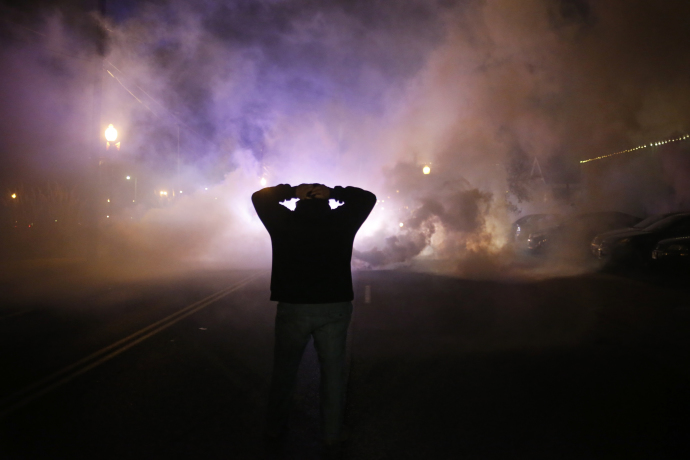
A protester stands with his hands on his head as a cloud of tear gas approaches after a grand jury returned no indictment in the shooting of Michael Brown in Ferguson, Missouri

A preliminary question to ask is why the St. Louis authorities scheduled such an incendiary announcement for after dark, even though the news that the grand jury had reached a decision had become public hours earlier. Surely, it would have been wiser for Robert P. McCulloch, the St. Louis County prosecutor, to have met with reporters earlier in the day.

A more important question, also unanswered in anything but the most general terms, is this: Why did the grand jury decide not to indict the police officer, Darren Wilson? McCulloch’s press conference, when it eventually took place, was notably lacking in detail about the shots that killed Brown.

But we didn’t learn precisely how far away Brown was when Wilson shot him fatally, or what persuaded the police officer that his life was in danger, which is one legal justification in Missouri for shooting someone who is unarmed. According to some accounts, Brown had his arms raised when he was shot for the final time. Other accounts say that he was charging at Wilson. McCulloch, beyond saying that some eyewitnesses provided contradictory statements, didn’t say what evidence the grand jury had relied on in reaching its decision. He did say, though, that the grand jury had met for twenty-five days and heard from more than sixty witnesses.

I’m sure that there will be extensive analysis from legal scholars in the coming days and I look forward to reading them.  I hope someone answers one of my questions which is:  Did hearing from Darren Wilson make the grand jury feel this was a trial where they were to determine guilt or innocence?

Meanwhile, if the grand jury decision makes me sad, the reaction of the fools on the streets makes me even sadder.  I’ve seen this too many times before – when Dr. King was killed, after Rodney King, right after Michael Brown’s death, etc. etc.   John Cassidy writes

Perhaps the grand-jury transcripts, some of which were released late on Monday, will help clear up what actually happened. More likely, the exact sequence of events will remain in dispute, and so will the grand jury’s decision. Americans who believe that the legal system generally works well, and fairly, will be inclined to believe that the members of the grand jury reached the right decision. Those who believe the criminal-justice system is stacked against minorities, particularly against young African-American men, will be inclined to believe that this was another whitewash.

I am among those who can’t understand the grand jury’s decision, but burning police cars and Walgreen’s will not change the racism in the criminal justice system.  There is more than enough blame to go around.  The announcement made after dark and the declaration of martial law and calling out the National Guard before the decision created a confrontational atmosphere and, in the end, didn’t prevent anything.  Prosecutor McCulloch’s long non-explanation explanation.  The rioters who through their actions fulfilled every stereotype.  There are no good guys here.

It just leaves me sad and frustrated.

Photograph:  ADREES LATIF/REUTERS

Anger, fear, and violence

People made fun of President Carter when he spoke of a national malaise.  I’m not sure we were in one back then, but I’d say we are sure in one today.  Everyone seems tired.  The upcoming election is very important, but many can’t get up enough energy to decide to vote.  But added to the tiredness is anger.   You can see it in what is said about the President, in the disrespect shown him and the office.  You can see it in the fear about Ebola.  You can see it in the increased racial tension in Missouri and elsewhere.  You can see it the attempts to restrict voting.  I see the fear of “the other” manifesting as anger.  But you can also see it in the anger against women.

Jessica Valenti had a piece in the Guardian the other day, “Why are Men so Angry?”.  I’ve been thinking about it since I first came across it.  She begins

There’s a Margaret Atwood quote that I can’t get out of my head these days: “Men are afraid that women will laugh at them. Women are afraid that men will kill them.”

Last Friday, a young man from Washington state walked into his high school cafeteria and shot five people, killing one young woman. Early reports from other students indicate that the shooter, who reportedly shot himself, was upset over a girl. In early October, Mary Spears was shot to death in Detroit, allegedly by a man whose advances she rejected at a social club. In April, a Connecticut teen stabbed his classmate to death when she rejected his prom invitation. Turning men down is a risky business.

But the madness doesn’t stop there. From Gamergate to mass shootings todomestic violence and the NFL – the common denominator is male rage. Women are not committing most acts of mass and individual violence, nor are women lobbing out most death threats online or raping most college students. Violence – and the threat of it – remains a decidedly male domain.

But why are men so violently angry?

I believe that it is the same kind of fear that drives the fear of the racially other.  When it comes to women, it is fear of losing some perceived superiority.  Valenti puts it this way

Is it the fear that women’s progress means a loss of all that shiny male privilege? That our society is a zero sum game and power can’t be shared? Maybe some men’s anger stems from good old-fashioned misogyny, which is then stoked by political, social and cultural forces that say there’s nothing lower in this world than a woman so how dare she … well, anything. Or perhaps that anger at women comes from straight-up entitlement: the men who believe that women are meant to be there for them, whether it’s to wash their toilets or warm their beds, and that denying them access to us is an unthinkable affront.

But it’s no coincidence that anti-feminist backlash happens most often when women’s rights are on an upswing. And male anger towards women isn’t going anywhere – if anything, it’s gaining steam. Online forums that provide anonymity are creating spaces for men to say the things they no longer can in “real life”, police and courts that disbelieve and blame women for the violence done to them give men the impression their bad behavior is acceptable and a conservative movement that refuses to let go of traditional gender roles teaches our children that being a man is synonymous with being “tough”, having guns and, yes, being violent.

domestic_violence_awareness_ribbon

I’m old enough to remember when no one talked about violence against women.  We were just beginning to recognize domestic violence and create shelters.  The concepts of sexual harassment and date rape were just being named.  Rape was beginning to be taken seriously.  Now we have special months, ribbons, and rape is generally depicted as a crime of violence.  So it makes me tired to think that after all these decades that we are still trying to figure out how to deal with male violence.  (And before someone complains that women can be violent also, yes they can be.  But the vast majority of violent incidents are perpetrated by men.)

Valenti concludes

If we want to put a dent in male anger and the chaos it creates, we need to stop looking at problems like sexual assault, harassment, domestic violence and even violent threats online and assigning their solutions to feminists. We need to stop calling them “just women’s issues”. We have to address men and men’s behavior together – not just their direct violence against women, but their propensity to protect their own. Not the outcomes of their rage, but the causes. Because, until we do, we’ll continue to be afraid. All of us.

I think she is right, but I worry that the conversation about male violence will be like the national dialog on race which everyone talks about but no one knows how to begin.  I’m not sure I know how to talk to the person who still believes that President Obama is really Kenyan, much less talk to someone to wants to commit violence against me to keep me in my place.


A guide to talking about race

With the Michael Brown shooting leading the news and talk about possible ISIS attacks in the United States, racial and ethnic profiling is in the spotlight once again.  And you hear people saying that we need to have a conversation about race.  We keep talking about having one and somehow it never happens.  This is why I was interested to see Charles Blow’s recent column in the New York Times titled “Constructing a Conversation on Race.”

Let’s start with understanding what a racial conversation shouldn’t look like. It shouldn’t be an insulated, circular, intra-racial dialogue only among people who feel aggrieved.

A true racial dialogue is not intra-racial but interracial. It is not one-directional — from minorities to majorities — but multidirectional. Data must be presented. Experiences must be explored. Histories and systems must be laid bare. Biases, fears, stereotype and mistrust must be examined. Personal — as well as societal and cultural — responsibility must be taken.

And privileges and oppressions must be acknowledged. We must acknowledge how each of us is, in myriad ways, materially and spiritually affected by a society in which bias has been widely documented to exist and in which individuals also acknowledge that it exists

We all carry our own baggage:  an encounter with someone of a different race or background that didn’t go well; a perceived slight; or feeling passed over for someone for what we felt were racial reasons.  We may talk about these things within our own circles which are often made up of people just like us.  I am usually one of the very few Asian Americans in any group and it was only when I moved to Boston that I could be on the street or even in a meeting that was predominantly Asian.  And now I’ve moved to Vermont which is one of the whitest states and where my sister and I have already been confused because we have the same last name.  I have been referred to as “white” which somehow offends me but I think it is meant as a kind of compliment.  Race can be a no win thing.

Blow continues

I often tell people that while I know well that things aren’t fair or equal, we still have to decide how we are going to deal with that reality, today. The clock on life is ticking. If you wait for life to be fair you may be waiting until life is over. I urge people to fight on two fronts: Work to dismantle as much systematic bias as you can, as much for posterity as for the present, and make the best choice you can under the circumstances to counteract the effects of these injustices on your life right now.

He also advises that we should think about what we mean by race.

Next, understand that race is a weaponized social construct used to divide and deny.

According to a policy statement on race by the American Anthropological Association, “human populations are not unambiguous, clearly demarcated, biologically distinct groups” and “there is greater variation within ‘racial’ groups than between them.”

The statement continues:

“How people have been accepted and treated within the context of a given society or culture has a direct impact on how they perform in that society. The ‘racial’ worldview was invented to assign some groups to perpetual low status, while others were permitted access to privilege, power, and wealth. The tragedy in the United States has been that the policies and practices stemming from this worldview succeeded all too well in constructing unequal populations among Europeans, Native Americans, and peoples of African descent.”

It ends:

“We conclude that present-day inequalities between so-called ‘racial’ groups are not consequences of their biological inheritance but products of historical and contemporary social, economic, educational, and political circumstances.”

We need to think hard about why race and ethnicity are among the first things we recognize about someone and what we see is often not how the person thinks of herself.  One thing seems clear.   We need to talk and think about race a great deal more constructively that most current conversations where the parties can never get past their anger.  Maybe we can start the discussion by talking about Mr Blow’s column,

Some random thoughts about Cliven Bundy

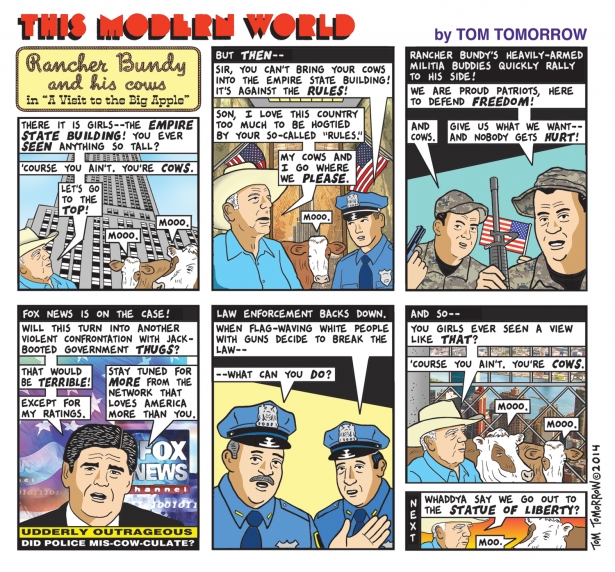
I’m with Jon Stewart:  I just don’t get it.  Here is a man who doesn’t recognize the United States government, but runs around with an American flag.  He thinks slavery was a fine institution, much better I guess than getting welfare, but Mr. Bundy doesn’t seem to realize that by grazing his cattle for free, he has been getting welfare for years.  Talk about welfare cheats!

And ya gotta love all those national political figures now in retreat.  I guess they were initially moved by the pictures of all those armed men prepared to put the women up front so they would die first.  But then came the comments about “Negroes”.   Dana Milbank had a great list of retreaters and their comments in his recent Washington Post column. 

Nevada cattle rancher Cliven Bundy knows how to start a stampede.

After Bundy, who became a right-wing hero for his refusal to acknowledge the authority of the federal government, wondered aloud about whether “Negro” people were “better off as slaves,” conservative figures who had celebrated his cause rushed to distance themselves from him.

Sen. Rand Paul (R-Ky.), who had condemned the federal government’s attempt to enforce court orders against Bundy: “Offensive.”

Sen. Dean Heller (R-Nev.), who had declared Bundy’s followers “patriots”: “Appalling and racist.”

And Sean Hannity, who had led a Fox News campaign that made a hero of Bundy: “Beyond repugnant.”

But Bundy’s daughter is still defending him.  According to Mother Jones

Bundy defended his initial comments on Thursday saying, “If they think I’m racist, they’re totally wrong…Again, I’m wondering are they better off under the old system of slavery or are they better off under the welfare slavery that they’re under now. You know, I’m not saying one way or the other.” And on Friday morning, he told CNN that he didn’t see a problem with using terms like “Negro” or “boy” for black people. “If those people cannot take those kind of words and not be (offended), then Martin Luther King hasn’t got his job done yet,” he told anchor Chris Cuomo.

Meanwhile, Bundy’s daughter, Shiree Bundy Cox, is striking back at conservatives who have turned tail on Bundy, especially Hannity. In a Facebook post Thursday night, she accused Hannity of abandoning her father and pandering to ratings. Here’s a snippet:

I’m sure most of you have heard the news about my dad being called a racist. Wow! The media loves to take things out of context don’t they? First off I’d just like to say that my dad has never been the most eloquent speaking person. Like someone said, he’s a Moses who needs an Aaron to speak for him. This is true. Second, however, is that the media has turned this into a circus side show. It’s like their trying to throw us off the real subject. Why was this ever even brought up? What does this have to do with land rights issues? Sean Hannity was all for reporting the happenings at the Bundy Ranch until this popped up. I wonder if someone hoped it would be that way…By the way, I think Mr. Hannity is more worried about his ratings than he really is about what my dad said. If he supports a supposed racist, what will that do to his ratings? He’s already lost his #1 spot on Fox.

If Shiree wants to understand the connection between land rights, race and taxes, Dana Milbank can explain it to her.

In general terms, Bundy’s notion of state supremacy — “I don’t recognize the United States government as even existing” — is a variant of states’-rights claims that go back to the Civil War and were revived in the segregationists’ opposition to civil rights laws. Because the federal government has been the protector of minority rights, states’ rights have long been used to justify discrimination.

Specifically, the Southern Poverty Law Center, which tracks anti-government and hate groups, says that Bundy’s sentiments align closely with those of the “Posse Comitatus” movement, founded by William Potter Gale in the 1970s. That movement based its anti-tax position — and its belief in the primacy of county and state authority over the federal government — on a belief that the levers of national power were controlled by Jewish bankers. “Most of the ideas that bolster positions like Cliven’s that the federal government doesn’t exist come from Posse Comitatus ideology,” the SPLC’s Ryan Lenz argues. And that ideology is rooted in bigotry.

I’m not sure how this will get resolved without violence, but if no action is taken I’m afraid that the discussion will pivot again into a questioning President Obama’s “manhood” for not fighting.  This will really obscure the issues.  In the meanwhile, we have Tom Tomorrow.

TT and Bundy