FortLeft is moving

No, not the blog, just physically.  We are moving off the hill in Roxbury (Boston) to a hill in Brattleboro, VT.  As one of my Vermont friends said, “Welcome to Bernieland!”

You may – or may not- have noticed that I haven’t posted anything new in quite a while but things have been a little crazy what with house hunting, getting loans, etc.  And now that we have a target closing date there are all the details to deal with.  Home inspection, insurance, changing everything to another state and finding contractors when you are not on the scene is a challenge.  My advice is to have a good broker.  And then there is packing.

Packing up 20 years of stuff spread out in a 14 room house is quite an experience.  At least we are moving to another large house with attic and a basement that is dry and are sorting and culling rather than downsizing.  The trick is to imagine where things will go in the new house.  That’s what I do at 3 am when I can’t sleep – along with worrying about what kinds of quirks the new house will have.  My grandson said the other night that he thinks it will take at least a year to know all about the new house.  He’s 10.

I’ve been sorting though papers and have found a lot of treasures in piles and boxes. For example, I found some old letters and emails from two of my best friends.  One of them died of a rare form of cancer, the other now has a form of dementia.  We were all so happy and cheerful 12 and 15 years ago.  And then there are all the loose photographs from back when there was actual film. Remember, people would take pictures and then send prints of the best ones so a lot of them are still in envelopes which assists in identification.  And then there are all the ones my husband and I have taken.  At one time I did try to put them in albums, but that fell of the radar early on.  Now they are just loose or in the envelopes they came back from the developer in.  They will mean something some day.  My husband and I are our respective family historians so we have many of the old family albums.  It was a wonderful moment to find the picture I had thought was lost: My grandfather, the Reverend Kyogoku, with his friend, D.T. Suzuki.  (A subject for a future post.)  That photograph is now digitized and saved in several places.

I am an admitted pack rat and had saved old Christmas cards carefully bundled by year.  I ditched the cards, but saved the pictures.  One long Vermont winter I will pull them out to group chronologically by family.  I also had papers from a lot of the big projects I’ve worked on over the years in Boston.  I kept the final products but have recycled most of the work papers.  I have program books and announcements and copies of speeches from (to mane a few) the Jackson Square redevelopment (the early years); “Women on the Edge of Time”, the annual conference of the National Commissions for Women held in Boston in 1999; the creation of the Massachusetts Commission for Women; the first statue of women on Commonwealth Avenue; grants I helped write for domestic violence efforts; and booklets I put together for the Boston Housing Authority on civil rights issues. When I last  moved 20 years ago, I did the same thing with my stuff from Richmond which is still in neatly labeled boxes.  I also have political stuff from the various campaigns I’ve worked on – from George McGovern to Elizabeth Warren.  My lesson learned is to try to file things as you go along.  At least I’m starting with good intentions but I think I had them after Richmond.  Oh, well.

And then there are the books.  All 7,000 or so that are moving with us.  A small library.  I’ve been cataloging them on LibraryThing, for the last two years, but I’m only about half finished.  (LibraryThing is a great way to keep track of your books even if you just have a few.)

Mr. Bunter and piles to be sorted.

Mr. Bunter and piles to be sorted.

There is lots of excitement and anxiety on Fort Hill these days.  The cats are confused by all the piles of boxes and things that keep getting moved around as we pack. We talk to them and try to explain, but all they know is that things are different and they aren’t happy about it.  Mr. Bunter cries and Harriet eats Kleenex out of the boxes.  They are just as stressed out as their humans.

I will continue to write about life in a new place, living in a small town, and – always national politics.  My location will change but FortLeft will endure – perhaps a little irregularly for a while, but I hope not with as long a gap as just occurred.


Blaming the victim – and the family

Last August in a Boston suburb, a man stabbed his girlfriend to death in front of their child and other witnesses.  This is an all too familiar occurrence all over the country, all over the world.  What made this especially big news in Boston was that the perpetrator is the son of a former Red Sox second baseman and long time television commentator, Jerry Remy.

Yesterday the son, Jared Remy, pled guilty to first degree murder.  According to the Boston Globe story reported by Eric Moskowitz

Remy’s admission means he will spend life in state prison without the possibility of parole. His plea, entered before Middlesex Superior Court Judge Kathe Tuttman, spares friends and family of Martel and Remy the added anguish of a protracted trial and the airing of even more gruesome details. It also means Remy will forgo what the judge called his possible “partial defense” of anxiety, depression, and steroid and prescription drug use.

“I would like to say, ‘Blame me for this, not my family,’ ” said Remy, the 35-year-old son of Jerry Remy, the celebrated Red Sox infielder-turned-broadcaster.

Rising to speak in handcuffs, Jared Remy delivered in a gravelly voice a two-minute statement in which he called himself a “bad apple” and imagined Martel watching over their daughter from heaven while playing with the couple’s late chihuahua, Buddy.

Though he said he wanted to “take responsibility for what I have done,” he also put some blame on Martel and on his “love for drugs.”

In another part of the proceeding, Remy clearly blamed Jennifer Martel for her own death.

When the prosecutor finished, the judge asked Remy if he understood and admitted to all those facts. “Yes, I do,” he said, before protesting one point. “She had a knife in her hand, and she was threatening me about my daughter,” he said. Authorities have never indicated they had evidence suggesting Martel had a knife.

Yvonne Abraham wrote in her Boston Globe column today

What a bizarre mix of contrition and blame-shifting we saw in Middlesex Superior Court Tuesday. What a spectacle of the depths to which people can sink. What a vividly detailed map of the wasteland brutality leaves behind.

Standing in that low-ceilinged, fluorescent lit courtroom, Jared Remy called Jennifer Martel, the woman he murdered with gruesome force at least partly witnessed by their 4-year-old daughter, “an angel.”

He’s the one at fault for killing her, he said. No share of the blame should go to his parents, who his lawyer said had been unfairly maligned, held partly responsible by some for not doing more to rein in a violent son who had been spiralling blatantly out of control for years.

For a man surrendering to fate, he was maddeningly defiant. He said he murdered Martel after she picked up a knife and violated a clear rule he said he had set.

“I always told Jen she could leave,” he said. “But do not threaten me with my child. That night, Jen had a knife in her hand and threatened me with my daughter, so I killed her. I don’t think it’s right when women use their kids against their fathers.”

Abusers have rules.  We’ve heard about Jared Remy’s need to control Martel just as we’ve heard it countless times about other abusers.  It is one of the primary signs of abuse.  Unfortunately, many women just think it is a sign of “masterfulness” as if we were  living in a novel set Victorian England where women were still property.  Jennifer Martel broke one of Jared Remy’s rules so she had to die.

Jennifer Martel and Arianna Remy

Jennifer Martel and Arianna Remy


But there is also the question of the blame which some think rests on father, Jerry Remy’s, shoulders.  Margery Egan wrote this morning another in a series of columns she has written on the subject  in the Boston Herald.

Jared Remy has spared his daughter Arianna and Jennifer Martel’s family the anguish of a gruesome trial. He has also spared his father Jerry and helped him keep his job behind the NESN microphone broadcasting Red Sox games.

Sox fans are clearly divided over whether the sins of the son should be visited upon the father. But they might feel differently about Jerry Remy’s lighthearted banter if they heard Martel’s murder described in stomach-churning testimony by neighbor Kristina Flickinger Hill.

Hill watched Jennifer Martel crawl across her patio pleading for help. Hill paid for her funeral. And she repeatedly said Phoebe Remy texted Martel the day before the killing begging her not to pursue criminal charges against Jared.

I don’t think anyone disputes the fact that the Remys tried to help their son and to help the mother of their grandchild.  It is a matter of record that two of their other children have also had legal problems.  I have read that the Jerry Remy persona we see on TV is very much at odds with who he is in private.  From things said during broadcasts, I believe he is a loner who has suffered from depression as after his bout with lung cancer. He probably was not an easy parent.

According to Egan and at least one woman who called into the radio show Boston Public Radio yesterday, the Red Sox broadcasts are taking a hit because women in particular, don’t want to hear Jerry.  I personally think they are taking a hit because the Red Sox can’t seem to win and it is painful to watch, but I digress.

Egan continues

No one is blaming Jerry and Phoebe Remy for murder. What I’ve blamed them for is enabling their son to evade responsibility for brutalizing five girlfriends over 18 years. And when I’ve written that Jerry should quit his NESN job, it wasn’t about taking away his right to make a living. It was about facing the tragic reality that his jokes in the Red Sox broadcast booth just don’t work anymore.

Let’s be honest. The enduring loyalty to Jerry Remy in this town is about the double standard enjoyed by beloved sports figures and, to a lesser degree, by fathers.

Jerry’s defenders say he did all he could for his son. I don’t think many would say that if it were Phoebe Remy’s career on the line. If a mother spent thousands of days on the road while all three of her children were having run-ins with the law, they’d say she abandoned her children, cruelly and selfishly, when they needed her most. She’d also lose her job in a nanosecond.

There is a lot to think about here.  The image of an admitted killer still blaming his victim.  A famous father with a job that puts him in the public eye almost every night during the baseball season.  A broadcaster who has built his reputation not only on shrewd analysis but his ability to poke fun at himself, the team and his broadcast partner.  I don’t blame him for his son, and Margery may well be right about the sexism that allows him to keep his job, but for me it was just weird to hear him before Jared pled guilty and now that he has it will just be painful to hear Jerry.

Photograph from BostonHerald.com


Amazon’s war on books, writers and publishers

I got the word through a post on Facebook by one of my favorite writers, Margaret Maron.

“When elephants fight, it’s the grass that gets trampled.” Amazon has turned into a real bully, blocking a publisher’s sales in order to squeeze more money out of them. Last year, it was the Macmillan Group; this year, it’s my publisher, Hachette. I would urge my readers to order from your local bookstore or from Barnes and Noble. Up until this week, Amazon was taking preorders for my book, Designated Daughters. No longer.

For those who don’t know her work, she writes mysteries.  Her primary focus over the last few years has been on a North Carolina judge and her huge extended family.  Along the way, Maron comments on contemporary issues and national and local politics.  My late mother always used to ask me if there were any new books about that judge as she was an avid reader.  But I digress.  Maron included a link to a  New York Times story.

Amazon’s power over the publishing and bookselling industries is unrivaled in the modern era. Now it has started wielding its might in a more brazen way than ever before.

Seeking ever-higher payments from publishers to bolster its anemic bottom line, Amazon is holding books and authors hostage on two continents by delaying shipments and raising prices. The literary community is fearful and outraged — and practically begging for government intervention.

“How is this not extortion? You know, the thing that is illegal when the Mafia does it,” asked Dennis Loy Johnson of Melville House, echoing remarks being made across social media.

The battle is being waged largely over physical books. In the United States, Amazon has been discouraging customers from buying titles from Hachette, the fourth-largest publisher by market share. Late Thursday, it escalated the dispute by making it impossible to order Hachette titles being issued this summer and fall. It is using some of the same tactics against the Bonnier Media Group in Germany.

Hachette publishes Maron’s books.

Publishers tried to rein in Amazon once, and got slapped with a federal antitrust suit for their efforts. Amazon was not directly a party to the case but has reaped the rewards in increased market power. Now it wants to increase its share of the digital proceeds. The publishers, weighing a slide into irrelevance if not nonexistence, are trying to hold the line.

Late Friday afternoon, Hachette made by far its strongest comment on the conflict.

“We are determined to protect the value of our authors’ books and our own work in editing, distributing and marketing them,” said Sophie Cottrell, a Hachette senior vice president. “We hope this difficult situation will not last a long time, but we are sparing no effort and exploring all options.”

The Authors Guild accused the retailer of acting illegally.

“Amazon clearly has substantial market power and is abusing that market power to maintain and increase its dominance, which likely violates Section 2 of the Sherman Antitrust Act,” said Jan Constantine, the Guild’s general counsel.

Independent booksellers, meanwhile, announced they could supply Hachette books immediately. The second-largest physical chain, Books-a-Million, advertised 30 percent discounts on select coming Hachette titles. Among the publisher’s imprints are Grand Central Publishing, Orbit and Little, Brown.

Maron urged her readers to purchase locally or from Barnes and Noble – which still has actual bookstores.

And there is a second New York Times story which points out that Amazon has walked into the predictions of critics who never like the way it did business.

Physical bookstores sell books at a huge markup, which necessarily reduces the number of books that people can afford to buy. Amazon sells printed books, e-books and audiobooks for much, much less. Anyone who has used Amazon’s services has noticed how that fact changes one’s attitude toward books. Through its Prime program, through the Kindle, and through its audiobook subsidiary Audible, Amazon has made it possible to buy books on impulse.

Just wait, the company’s critics have always shot back. Wait till Amazon controls the whole market — then see how well it treats authors, publishers and customers.

Now Amazon is walking right into its detractors’ predictions. There are a couple obvious reasons this is a bad strategy. It’s bad public relations — if it doesn’t already, Amazon may soon control a monopolistic stake of the e-book market and its tactics are sure to invite not only scorn from the book industry but also increased regulatory oversight.

Maybe the local bookstore does charge more, but there are places other than Amazon where you can get discounts.  And not everyone loves e-books. Higher prices probably do mean fewer impulse sales, but publishers and writers are fighting back.  The first Times story reports

The confrontations with the publishers are the biggest display of Amazon’s dominance since it briefly stripped another publisher, Macmillan, of its “buy” buttons in 2010. It seems likely to encourage debate about the concentration of power by the retailer. No firm in American history has exerted the control over the American book market — physical, digital and secondhand — that Amazon does.

James Patterson, one of the country’s best-selling writers, described the confrontation between Amazon and Hachette as “a war.”

“Bookstores, libraries, authors, and books themselves are caught in the crossfire of an economic war,” he wrote on Facebook. “If this is the new American way, then maybe it has to be changed — by law, if necessary — immediately, if not sooner.”

Mr. Patterson’s novels due to be released this summer and fall are now impossible to buy from Amazon in either print or digital form.

The retailer’s strategy seems to be to drive a wedge between the writers, who need Amazon sales to survive, and Hachette. But this does not seem to be working the way Amazon might want. Nina Laden, a children’s book writer, was one of many Hachette authors lashing out at Amazon in the last week.

“I have supported Amazon for as long as Amazon has existed,” she wrote in a Facebook posting she also sent to the retailer.

She went on to say that she was “frankly shocked and angry at what you are doing” to her new book, “Once Upon a Memory.” “It has made me tell my readers to shop elsewhere — and they are and will,” she wrote. (Amazon customer service wrote back, saying “We will be glad to investigate this issue further” if Ms. Laden would provide additional information.)

Physical books are, unfortunately, under siege and this doesn’t help.  So if books are important to you, I think it is important to stop shopping for them on Amazon.

Books

Photograph:  madeinepal.com

The Longfellow Bridge, Part 3 or we don’t build the way we used to build

When I did my first post on the Longfellow Bridge almost four years ago, I didn’t realize it was the first in an occasional series, but that is what it has turned out to be.  The first post was about design and reconfiguring the roadway for car, the train, bicycles, and walkers.  In the second, I wrote about the final design, the construction schedule and traffic patterns during the long period of rebuilding.  And since the construction is now underway, this post is about rebuilding the historic structure.

Longfellow Bridge under construction May 2014

Longfellow Bridge under construction May 2014

I had a chance to look at the bridge the other night when we drove over to Kendall Square on Memorial Drive.  You can see the old ironwork and that one pair of the salt and pepper shakers has been removed.  So it was interesting to read the story in the Boston Globe a few days later on some of the difficulties engineers and contractors have been confronting.

It turns out that they just don’t make bridges the way they used to.

One year after the launch of the sweeping Longfellow Bridge reconstruction project, contractors are getting an education on the construction practices of yore, poring over century-old bridge building manuals, reviving obsolete metalworking techniques, and scouring the region for building materials that have long disappeared from the market.

Rockport granite, with its inimitable grain? That stuff stopped being excavated during the Great Depression.

And the art of riveting metal? Its heyday — which calls to mind black-and-white photos of fighter planes and posters of a bandanna-wearing woman named “Rosie” — has long faded into the past.

The Longfellow is historic and contractors bidding to work on the bridge were required to agree to replicate old techniques wherever possible.  Riveting for example.

The art of riveting went out of fashion a half-century ago. The practice involves heating rivets, cylindrical metal shafts with round heads, up to 2,000 degrees, until they glow bright red, then quickly jamming them into a hole before they have a chance to cool. It’s slow, costly, and dangerous. That’s why construction largely switched to nuts and bolts that can more easily be screwed into place.

“The technology never totally went away,” Sullivan [Charles from the Cambridge Historic Commission] said. “But you no longer see pictures of people standing on the frame of the Empire State Building throwing rivets through the air.”

So how did the contractors learn the technique?

Some of the contractors attended a seminar on riveting in Michigan. Others looked to 1930s-era manuals on rivet techniques — their best guide on the subject.

And the Rockport granite?

But rivets aren’t the only challenge of this project. Finding the right replacement granite has proved elusive.The particular granite hails from quarries in Rockport that began to close just after the Wall Street crash of 1929.

Concrete was cheap and easy to make, and became a more popular option for construction.

Now, Rockport granite is impossible to find freshly cut from the earth: Anything now on the market has been reclaimed, stripped from an existing structure. And most pieces available are thin slabs — not the great big blocks necessary for the work on the Longfellow.

As part of a new design for the bridge deck, contractors had already planned to strip the existing granite curb between the vehicle lanes and the T tracks. They had hoped to repurpose that granite to construct new stone stairs and barriers on the side of the bridge.

But the stone alongside the train tracks is known as Deer Isle granite, which has a lavender hue — not the black-white-and-gray speckled look of Rockport granite.

“People who know stone said, ‘Oh, it’s Deer Isle, that’s not going to work,’ ” Roper [Steve from Mass DOT] said. “They’re different grains, and they will not look good if you put them side by side.”

So where can you find Rockport granite?

What they didn’t know: Biz Reed, co-owner and executive vice president of Wakefield-based Olde New England Granite, had exactly what they needed. In 2010, on a whim, Reed’s company had purchased 3,000 tons of historic Rockport granite that had been stripped from the Hines Memorial Bridge in Amesbury during a reconstruction project.

He had no idea what the company would do with such a large amount of such a particular form of stone, but they couldn’t pass it up.

“Little did we know it would be the right match for the Longfellow,” Reed said. “We just happened to be in the right place at the right time.”

When Reed got word that a team of MassDOT officials, historical preservationists, and construction contractors were all on the hunt for the Rockport stone, he gave them a call.

So piece by piece, rivet by rivet, the Longfellow Bridge is being restored to her former self – with room to ride, walk or bike.

Longfellow before

Photograph:  Longfellow under construction David L. Ryan/Globe Staff

Photograph:  Longfellow Bridge from Wikipedia images

Warning labels

I know I’ve been neglecting my blog the last few weeks.  I’m finding much of the news depressing and it is finally spring and who wants to be depressed by dwelling on disasters – current and potentially future.  But I’m aroused from my lethargy by a couple of recent stories, so I may well go on a blogging binge.

My first subject is warning labels.  “Cigarettes are Hazardous to your health.”  “Not gluten-free”  “Keep away from water [on my hair dryer]”  All handy and relevant for physical health and safety.  But now some students are agitating for warning labels on books for reasons of psychological health.  Classic books.  Like “The Great Gatsby” .  This follows a commencement season where students got various speakers removed because of something they’d done in the past or some opinion they hold.  Something very disturbing is going on here way beyond the protection of someone’s mental health.  I love the opening of Renee Loth’s column in this mornings Boston Globe

Warning: This column may contain material you disagree with or find offensive. It may provoke a strong reaction, making you feel angry or exposed. Of course, you can log off or turn the page. But this is the opinion section of a general-interest newspaper. Shouldn’t you expect to find provocative, even threatening ideas? And shouldn’t other readers be able to see this column without a cautionary note that it might do them harm?

She goes on to explain

Something similar is happening on college campuses, where reasonable concern for students who may have suffered terrible traumas has morphed into a serious threat to intellectual freedom. Increasingly, students are expecting “trigger warnings’’ to be issued before they are asked to read certain texts or view course material that may be troubling. It can be something as raw as a graphic rape scene or a bloody wartime battle, or more conceptual, such as themes of racism or oppression. At some schools, students want to be allowed to skip a class or reading if they fear it will trigger a stressful reaction.

The criteria for the warnings are varied and ill-defined. At Rutgers University, Virginia Woolf’s novel “Mrs. Dalloway” was targeted for a warning because it contains thoughts of suicide. At Oberlin College, students requested one for Chinua Achebe’s “Things Fall Apart” — a hardy perennial on freshman reading lists — because of its treatment of colonialism. Trigger warnings have been proposed for “The Great Gatsby” and “The Merchant of Venice” because they depict violence, misogyny, or racial slurs.

Warning label

Excuse me if I thought that great writing was supposed to be thought-provoking and maybe disturbing.  In her column on the subject in today’s Washington Post, Kathleen Parker discusses a potential answer.

Without making light of anyone’s ethnicity, race or trauma, especially rape or stress disorder suffered by veterans (another specific group of concern), such precautions are misplaced in an institution of higher learning where one is expected to be intellectually challenged and where one’s psychological challenges are expected to be managed elsewhere.

There are, besides, other ways to inform oneself about a course or literary assignment that might be problematic for whatever reason. Then again, if reading “The Great Gatsby” causes one undue angst owing to its abuse, classism, sexism and whatever-ism, then one might consider that college is not the right place at the right time.

Moreover, part of literary criticism is understanding the historical context of a given work. Thus, when the egregiously offensive N-word appears in the “Adventures of Huckleberry Finn,” is it too much to ask that readers reflect upon the word’s usage when Mark Twain wrote the book?

Within that understanding is a world of learning, from the history of race to the evolution of language. Instead, we are enslaved to “responsible pedagogical practice,” as one sympathetic faculty member put it. Thus, a draft guide at Oberlin College suggests flagging anything that could “disrupt a student’s learning” or “cause trauma”:

“Be aware of racism, classism, sexism, heterosexism, cissexism [transgender discrimination], ableism and other issues of privilege and oppression. Realize that all forms of violence are traumatic, and that your students have lives before and outside your classroom, experiences you may not expect or understand.”

I once co-taught a class on women and war.  We read some disturbing stuff, especially for some class members who were veterans or who had active duty spouses.  But we didn’t have an y”trigger” warnings on what we assigned to read.  What we did was talk.  One can learn from someone else’s experience.  Besides if there are all these warning labels, maybe someone won’t read the book and find out it really isn’t so bad after all.  And where does it end?  Do we not read about the civil rights movement in Mississippi because the murder of three civil rights workers might be disturbing?  Should be miss reading “The Color Purple” because it might be a trigger for someone?  Is talk of the plague in the Middle Ages also a trigger for someone’s trauma?  Parker is right:  the proper response is discussion.

Loth ends her column this way

Trigger warnings aren’t new; they are common on the Internet, where they alert readers to a range of potentially upsetting material from common profanity and insensitive jokes to depictions of drug abuse, eating disorders, even spiders. But they are especially worrisome on college campuses, where exposure to a free exchange of ideas is paramount. “When a student opts for a liberal arts education, they have opted to jump into the cauldron of life,” said attorney Harvey Silverglate, a fierce advocate for freedom of thought on campus. “You should expect to be occasionally very disturbed. That is actually part of the education.”

Much of the focus on content warnings grows out of a concern for marginalized groups, whether minorities, the disabled, or anyone not in the “dominant culture.” Feminist studies in particular have promoted them as a way to make women feel safer in a sometimes hostile campus environment, which can and does include sexual assault. But there are as many potential triggers as there are students. It’s a practical impossibility to protect against all of them.

Nor should we try. Nancy Gertner, a former federal judge and professor at Harvard Law School, says students have asked her to disclose whether an exam in her criminal law course would contain any triggers for rape victims. She has refused. “I have a feminist objection to the notion that women need to be inoculated against certain issues,” she said. “Women need to engage, to come to grips with these issues.” The university should prepare students for the rest of life. “There are no more trigger warnings the minute they graduate,” she said.

Let’s hope that this trend has a very short life.

Picture:  istockphoto/globe staff illustration

The politics of macho

In 1992 when he was running for President in a tight Democratic primary race, Bill Clinton rushed back to Arkansas where he was governor to preside over the execution of Ricky Ray Rector.  According to a New York Times article at the time

Mr. Rector, 40 years old, was convicted in November 1982 and sentenced to die for the 1981 shooting death of Police Officer Bob Martin in Conway, Ark. He was also convicted of another murder that occurred two days earlier….

After shooting Officer Martin, Mr. Rector turned the gun on himself, destroying part of his brain. His lawyers said that even though he could speak, his mental capacities were so impaired that he did not know what death is or understand that the people he shot are not still alive.

“He is, in the vernacular, a zombie,” said Jeff Rosenzweig, a lawyer for Mr. Rector before the execution. “His execution would be remembered as a disgrace to the state.”

Mr. Rosenzweig said Mr. Clinton was harshly criticized as being soft on crime in 1980, when he was defeated by Frank White, his Republican opponent, in his first re-election bid. Mr. Clinton defeated Mr. White two years later and has been re-elected three more times.

Bill Clinton needed to show that a Democrat could be just as tough on crime as any Republican.

Oklahoma Governor Mary Fallin

Oklahoma Governor Mary Fallin

Twenty-two years later we have Oklahoma governor, Mary Fallin, threatening to defy the Oklahoma Supreme Court while her allies in the legislature start to impeach justices.  Why?  Because they wanted to proceed with two executions.

States like Oklahoma have tried to protect drug companies by passing laws prohibiting the disclosure of what’s in their lethal injections. But attorneys have argued that state secrecy about what’s in those lethal injections violates the ban on “cruel and unusual punishment,” and some courts have agreed, including a court in Oklahoma that blocked Lockett’s execution. When the state Supreme Court backed the lower court, Fallin said she would defy it, insisting the court only had authority over civil, not criminal matters. Then the court shamefully reversed itself, after a state legislator promised to impeach the justices for staying the executions. Fallin forged ahead with the killing of Lockett and Charles Warner.

Now she is investigating what happened.  I think we know already.  Mary Fallin was so anxious to prove her toughness that she abandoned all good sense and tried to execute Clayton Lockett.  We all know how that worked out.

Then there is the critique of President Obama’s foreign policy from those who seek more military intervention in places like Ukraine and Syria.  The President has his own ideas as reported in the New York Times

On a day in which he announced new sanctions against Russia for its continued threats to Ukraine, Mr. Obama said his foreign policy was based on a workmanlike tending to American priorities that might lack the high drama of a wartime presidency but also avoided ruinous mistakes.

“You hit singles, you hit doubles; every once in a while we may be able to hit a home run,” Mr. Obama said at a news conference with Mr. Aquino. “But we steadily advance the interests of the American people and our partnership with folks around the world.”

He was mocked in some circles with it being characterized as the “Ichiro” foreign policy after Ichiro Suzuki, the former Seattle Mariner and now New York Yankee who has made a very successful career out of hitting singles.  It shows that one doesn’t always have to hit home runs; home run hitters tend to strike out a lot.

Mr. Obama offered this trip as Exhibit A for the virtues of an incremental approach: He nudged along trade negotiations with Japan, consoled a bereaved ally in South Korea, cultivated ties with a once-hostile Malaysia and signed a modest defense agreement with the Philippines.

“Why is it that everybody is so eager to use military force,” Mr. Obama said, “after we’ve just gone through a decade of war at enormous cost to our troops and to our budget. And what is it exactly that these critics think would have been accomplished?”

I was hoping that the era of macho politics was fading, but now, it seems that women governors need prove themselves just a tough as a man.  No one is saying that Clayton Lockett is a wonderful man who doesn’t deserve punishment, but perhaps Mary Fallin should take a page out of the President’s book and slow down.  Mr. Lockett wasn’t going anywhere and neither are the other inmates on Oklahoma’s death row.

Photograph: AP/Cliff Owen


Are starlings taking over?

According to a recent story on the BBC, the answer is “yes, they are.”

“Starlings are lean and mean. In the industry they’re often called feathered bullets,” says Michael Begier, National Coordinator for the US Department of Agriculture (USDA) Airports Wildlife Hazards Program.

“They’re a particular problem at airports because they flock in very large numbers, and compared to other birds their bodies are very dense. They are about 27% more dense than a herring gull which is a much larger bird.”

When a flock of starlings strikes an airplane the effects can be devastating. In 1960 they caused the most deadly bird strike in US aviation history

The birds flew into the engines of a plane as it took off from Boston’s Logan Airport, and it crashed into the harbour, killing 62 people on board.

Starlings also cost US agriculture an estimated $1bn (£595m) a year in damage to crops – particularly fruit trees.

They can even cause milk production to drop at dairy farms because they steal the grain being fed to cows.

Taken on a recent visit to Central Park, NYC, these fellows are direct descendants of those first 80 to 100 first starlings.

Taken on a recent visit to Central Park, NYC, these fellows are direct descendants of those first 80 to 100 first starlings.


If you look at any bird book or website you can see that they are common all across the United States.  We have a few in our neighborhood and for many years I’ve watched from the bedroom window as a pair (probably not the same ones!) nest in an air vent in the house next door.  OK, so they are kinda mean and can be a problem but they are beautiful up close and fun to watch when they occasionally visit our feeders.  The purplish black spotted bird is technically the European Starling.  According to the Cornell Lab of Ornithology it all begins with Shakespeare.

First brought to North America by Shakespeare enthusiasts in the nineteenth century, European Starlings are now among the continent’s most numerous songbirds. They are stocky black birds with short tails, triangular wings, and long, pointed bills. Though they’re sometimes resented for their abundance and aggressiveness, they’re still dazzling birds when you get a good look. Covered in white spots during winter, they turn dark and glossy in summer. For much of the year, they wheel through the sky and mob

  • All the European Starlings in North America descended from 100 birds [the BBC says there were 80] set loose in New York’s Central Park in the early 1890s. The birds were intentionally released by a group who wanted America to have all the birds that Shakespeare ever mentioned. It took several tries, but eventually the population took off. Today, more than 200 million European Starlings range from Alaska to Mexico, and many people consider them pests.
  • Because of their recent arrival in North America, all of our starlings are closely related. Genetically, individuals from Virginia are nearly indistinguishable from starlings sampled in California, 3,000 miles away. Such little genetic variation often spells trouble for rare species, but seems to offer no ill effects to starlings so far.

So why are starlings Shakespearean?  The BBC says they are mentioned in Henry IV Part 1

Hotspur is in rebellion against the King and is thinking of ways to torment him. In Act 1 Scene III he fantasizes about teaching a starling to say “Mortimer” – one of the king’s enemies.

“Nay, I’ll have a starling shall be taught to speak nothing but Mortimer, and give it to him to keep his anger still in motion,” Shakespeare wrote.

This might actually not be so much of a fantasy as they, like the Northern Mockingbird are mimics according to the ornithologists at Cornell.

Starlings are great vocal mimics: individuals can learn the calls of up to 20 different species. Birds whose songs starlings often copy include the Eastern Wood-Pewee, Killdeer, meadowlarks, Northern Bobwhite, Wood Thrush, Red-tailed Hawk, American Robin, Northern Flicker, and many others.

So maybe Henry could have taught a starling to speak the name of Mortimer

Close-up of a handsome starling

Close-up of a handsome starling

Photograph of flock:  Robert L. Wyckoff

Photograph of single starling:  Lisa Bradley for the BBC.

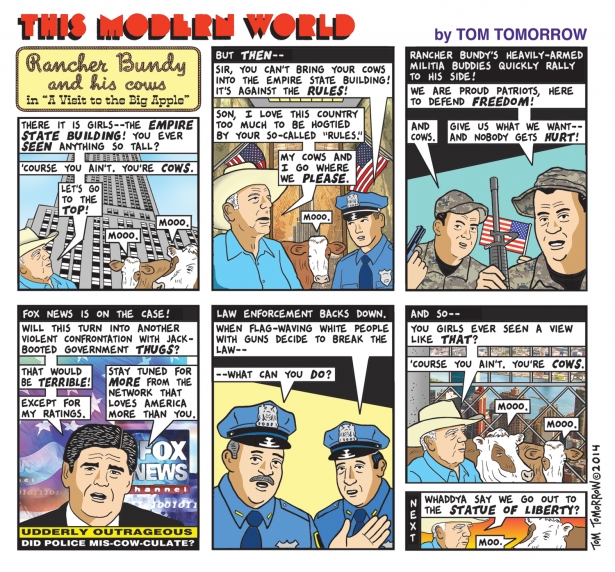
Some random thoughts about Cliven Bundy

I’m with Jon Stewart:  I just don’t get it.  Here is a man who doesn’t recognize the United States government, but runs around with an American flag.  He thinks slavery was a fine institution, much better I guess than getting welfare, but Mr. Bundy doesn’t seem to realize that by grazing his cattle for free, he has been getting welfare for years.  Talk about welfare cheats!

And ya gotta love all those national political figures now in retreat.  I guess they were initially moved by the pictures of all those armed men prepared to put the women up front so they would die first.  But then came the comments about “Negroes”.   Dana Milbank had a great list of retreaters and their comments in his recent Washington Post column. 

Nevada cattle rancher Cliven Bundy knows how to start a stampede.

After Bundy, who became a right-wing hero for his refusal to acknowledge the authority of the federal government, wondered aloud about whether “Negro” people were “better off as slaves,” conservative figures who had celebrated his cause rushed to distance themselves from him.

Sen. Rand Paul (R-Ky.), who had condemned the federal government’s attempt to enforce court orders against Bundy: “Offensive.”

Sen. Dean Heller (R-Nev.), who had declared Bundy’s followers “patriots”: “Appalling and racist.”

And Sean Hannity, who had led a Fox News campaign that made a hero of Bundy: “Beyond repugnant.”

But Bundy’s daughter is still defending him.  According to Mother Jones

Bundy defended his initial comments on Thursday saying, “If they think I’m racist, they’re totally wrong…Again, I’m wondering are they better off under the old system of slavery or are they better off under the welfare slavery that they’re under now. You know, I’m not saying one way or the other.” And on Friday morning, he told CNN that he didn’t see a problem with using terms like “Negro” or “boy” for black people. “If those people cannot take those kind of words and not be (offended), then Martin Luther King hasn’t got his job done yet,” he told anchor Chris Cuomo.

Meanwhile, Bundy’s daughter, Shiree Bundy Cox, is striking back at conservatives who have turned tail on Bundy, especially Hannity. In a Facebook post Thursday night, she accused Hannity of abandoning her father and pandering to ratings. Here’s a snippet:

I’m sure most of you have heard the news about my dad being called a racist. Wow! The media loves to take things out of context don’t they? First off I’d just like to say that my dad has never been the most eloquent speaking person. Like someone said, he’s a Moses who needs an Aaron to speak for him. This is true. Second, however, is that the media has turned this into a circus side show. It’s like their trying to throw us off the real subject. Why was this ever even brought up? What does this have to do with land rights issues? Sean Hannity was all for reporting the happenings at the Bundy Ranch until this popped up. I wonder if someone hoped it would be that way…By the way, I think Mr. Hannity is more worried about his ratings than he really is about what my dad said. If he supports a supposed racist, what will that do to his ratings? He’s already lost his #1 spot on Fox.

If Shiree wants to understand the connection between land rights, race and taxes, Dana Milbank can explain it to her.

In general terms, Bundy’s notion of state supremacy — “I don’t recognize the United States government as even existing” — is a variant of states’-rights claims that go back to the Civil War and were revived in the segregationists’ opposition to civil rights laws. Because the federal government has been the protector of minority rights, states’ rights have long been used to justify discrimination.

Specifically, the Southern Poverty Law Center, which tracks anti-government and hate groups, says that Bundy’s sentiments align closely with those of the “Posse Comitatus” movement, founded by William Potter Gale in the 1970s. That movement based its anti-tax position — and its belief in the primacy of county and state authority over the federal government — on a belief that the levers of national power were controlled by Jewish bankers. “Most of the ideas that bolster positions like Cliven’s that the federal government doesn’t exist come from Posse Comitatus ideology,” the SPLC’s Ryan Lenz argues. And that ideology is rooted in bigotry.

I’m not sure how this will get resolved without violence, but if no action is taken I’m afraid that the discussion will pivot again into a questioning President Obama’s “manhood” for not fighting.  This will really obscure the issues.  In the meanwhile, we have Tom Tomorrow.

TT and Bundy


New England, St. John’s College and the War of 1812

What do you know about the War of 1812?  If you live in Boston, you know about the U.S.S. Constitution capturing the HMS Guerriere  early in the war.  If you live near the Great Lakes you know about Captain Oliver Perry and the Battle of Lake Erie.  Everyone knows about the Fort McHenry and the writing of the “Star-Spangled Banner” as well as Andrew Jackson and the Battle of New Orleans.  And who can forget Dolley Madison saving the portrait of George Washington,  But do you know why the war was fought in the first place?

In the Sunday Boston Globe, Ted Widmer had a long piece in the Ideas section titled “The silent bicentennial:  In 1814, the US experienced everything you’d want to forget about a war.  Which is exactly why we should be thinking about it now.”  Although written from a New England perspective, Widmer has a number of interesting observations surprisingly relevant to national politics today.

After the fact, it was hard to remember exactly why war had broken out at all. The American Revolution had established the United States as an independent nation, but relations with England remained vexed—many Americans resented the motherland for its condescension, but also valued the memory of a shared heritage. In the years leading up to 1812, American tempers began to flare over the many ways the British conveyed their lack of respect for the upstart country, forcing American sailors to work on their ships and encouraging Indians to attack settlers in the interior.

Though serious at times, these irritants did not add up to grounds for war. England was America’s principal commercial partner, and wielded the greatest navy on earth. To anyone who participated in the maritime economy—as most of New England did—it was the height of folly to risk everything over a few insults.

Yet rhetoric, so easy to dish out, can be hard to take back. Driven by exuberant talk from Western and Southern politicians, Congress proposed a war measure in June 1812. New England and New York voted overwhelmingly against it, but it passed the Senate 19 to 13, and on that wobbly basis, the United States lurched into war. Its rationale was vague; its goals (which included some hope of gaining territory in Canada and Florida) were not entirely selfless; and it never resembled the kind of homegrown cause that had united the Colonists in 1775. On village greens around New England, church bells tolled in mourning.

Wars that are declared badly are often fought badly, and it soon became apparent that the United States was ill-prepared to wage a war against the world’s preeminent military power, whose troops had been toughened by years of fighting against Napoleon. The Republicans clamoring for war had balked at paying taxes, and voted down efforts to build up the Navy. Debt tripled. The War Department could never raise an army to even half the strength it sought, and had to resort to only 10,000 soldiers, who enlisted for a single year.

The young “War Hawks” in Congress were better at speeches than fighting. Henry Clay promised that he could conquer Canada with Kentucky militia; in the end, Kentucky only furnished 400 men. Among the many delusions was a belief that Canadians would surrender as soon as Americans appeared. They did not—in fact, many Canadians were former New Englanders who fought just as courageously as their cousins did, and to this day, memories of defeating the American invaders are as important to Canadians as Lexington and Concord are to Americans.

Sound kinda familiar?

It seems that despite voting against declaring war, New England ended up providing much of the money and manpower including Captain Perry and the Constitution.

Washington was burned and the “Star-Spangled Banner” written in late summer and early fall of 1814.  But New England was tired and was looking for ways out.

Thoughout the fall, gloom settled around New England. In Boston, many leading citizens became furious at a stupid war going badly and began to threaten action. The Boston Gazette wrote, “If James Madison is not out of office, a new form of government will be in operation in the eastern section of the Union.” Madison was hanged in effigy in Augusta, Maine. Huge rallies filled Faneuil Hall. The Massachusetts House voted 406 to 240 to denounce the war as “awful” and “revolting.” The governor of Massachusetts, Caleb Strong, sent out secret feelers to his counterpart in Halifax. A new kind of flag was occasionally seen around New England, with five stars and five stripes—the five states of New England (Maine was then a district of Massachusetts). Throughout the interior, town meetings expressed deep feelings against the war—in much the same way that earlier generations had protested British tyranny. From these currents came a call for the New England states to convene a meeting at Hartford to consider options. The Hartford Convention began in December 1814, and to its credit, stopped short of any activity that might have led to New England breaking away from the United States. But it was a close call.

Another New Englander, John Quincy Adams, negotiated the Treaty of Ghent signed in December 1814 ending the war.  Andrew Jackson didn’t hear about the Treaty until after the Battle of New Orleans.  Just think, with modern communications, Jackson might not have become a hero and might not have become a two-term president.  The war also had other unforeseen consequences.

The war had other unexpected legacies as well. Abraham Lincoln would later cite the heroism of African-American soldiers at New Orleans as an important precedent for allowing them to fight for the Union cause. Native Americans, on the other hand, were the clear losers of a conflict that did not produce much victory for anyone. Without the British to protect them, they were helpless before the relentless advance of settlers across the continent. That is not the most triumphant note for an anniversary reflection to end on. But how else do we commemorate a near-defeat, a conflict with an ally, and New England’s flirtation with secession? Perhaps by acknowledging the fragility of history itself, the fickleness of the forces that separate “victory” from “defeat,” and the many possible results in between.

Cover of sheet music for "The Star-Spangled Banner", transcribed for piano by Ch. Voss, Philadelphia: G. Andre & Co., 1862

Cover of sheet music for “The Star-Spangled Banner”, transcribed for piano by Ch. Voss, Philadelphia: G. Andre & Co., 1862


My class at St. John’s College in Annapolis will be holding its 45th reunion in September.  Francis Scott Key was an alumni and we will be marking his anniversary by singing his anthem and setting of some fireworks.  But I’ll also be thinking of the War of 1812 and unintended consequences.


Does context matter?

When the National September 11 Memorial Museum opens next month at the World Trade Center, visitors will find a stark wall separating them from a repository containing about 8,000 unidentified human remains from the 2001 terrorist attack.

On the wall is a 60-foot-long inscription, in 15-inch letters made from the steel of the twin towers: “No day shall erase you from the memory of time. Virgil.”

The quote is from the Aeneid but the inscription doesn’t say so.  In earlier versions, as in this rendering, both Virgil and the Aeneid are cited.

An early rendering of the inscription at the National September 11 Memorial Museum.

An early rendering of the inscription at the National September 11 Memorial Museum.

At issue is the context of the quote.  In 2011, Caroline Alexander, wrote an opinion piece for the New York Times in which she argued the inappropriateness of the quotation.

The memorial inscription, “No day shall erase you from the memory of time” is an eloquent translation of the original Latin of “The Aeneid” — “Nulla dies umquam memori vos eximet aevo.”

The impulse to turn to time-hallowed texts, like the classics or the Bible, is itself time-hallowed. In the face of powerful emotions, our own words may seem hollow and inadequate, while the confirmation that people in the past felt as we now feel holds solace. And the language of poets and great thinkers can be in itself ennobling.

But not in this case. Anyone troubling to take even a cursory glance at the quotation’s context will find the choice offers neither instruction nor solace.

The immediate context of the quotation is a night ambush of the Rutulian enemy camp by two Trojan warriors, Nisus and Euryalus, whose mutual love is described in terms of classical homoerotic convention and whose deaths represent one of the epic’s famously sentimental set pieces. Falling on the sleeping enemy, the two hack away with their swords, until the ground reeks with “warm black gore.” Stripping the murdered soldiers of their armor, the two are in turn ambushed by a returning Rutulian cavalry troop. As each Trojan tries to save his companion, both are killed, brutally and graphically. At this point the poet steps in to address them directly:

“Fortunati ambo! si quid mea carmina possunt, nulla dies umquam memori vos eximet aevo.”

“Happy pair! If aught my verse avail, no day shall ever blot you from the memory of time.” (The translation here is from the famously literal Loeb edition.) At dawn’s light, the severed heads of the two Trojans are paraded by the enemy on spears.

The central sentiment that the young men were fortunate to die together could, perhaps, at one time have been defended as a suitable commemoration of military dead who fell with their companions. To apply the same sentiment to civilians killed indiscriminately in an act of terrorism, however, is grotesque.

That’s one argument for context matters.  But

Alice M. Greenwald, the museum director, said last week that the quotation appropriately characterized the “museum’s overall commemorative context.”

“The quote speaks to the indelibility of our memories,” she said. “In selecting this quote, our focus was not on the specific narrative of the classic story nor its characters. What resonated with us, and with everyone who reviewed its use in the context of the museum, was the reference to a single day not being able to erase the memory of those we love.”

The museum has opted to use the quote without the reference to the Aeneid.  I, for one, dislike quotations without a citation. And without the reference to the Aeneid, I fear that the context will become lost.

James Zetzel, a professor of the Latin language and ancient literature at Columbia, said he was troubled by a line describing such specific characters — and “not the best role models” — used as a kind of epitaph for those whose identities are not known.

“On the other hand,” Mr. Zetzel said, “the story is an example of willing self-sacrifice for somebody you love.”

As Virgil tells it, Nisus realized as he was fleeing from the enemy that he had been separated from Euryalus. Rather than spare himself, Nisus returned to a scene of mortal peril in the hope of saving another’s life. Both young men died as a result.

Now that sounds like a 9/11 story.

The answer for me is to use the inscription with reference to both Virgil and the Aeneid – just as in the rendering.

Rendering by:  Thinc/National September 11 Memorial & Museum