
The People’s House

Julia Pierson, head of the Secret Service, testified before Congress yesterday on the security lapses that resulted in a fence jumper making it into the White House and then into the East Room.  But Omar Gonzalez in just one in a long line of uninvited guests.  Anyone remember the couple that got through security into a state dinner?  Peter Baker had a nice history of the uninvited in the New York Times.

Long before the latest fence jumper captured international attention by getting as far as the East Room, the history of White House security breaches was vast and varied. One intruder in a white karate outfit carried in a knife hidden in a Bible. A stranger slipped in to watch a movie with President Franklin D. Roosevelt. And a pilot crashed his Cessna into the mansion.

Theodore Roosevelt once agreed to see a man who identified himself as “Mr. John Smith” and insisted he had an appointment, even though the president did not recognize him. But after talking with him for a bit, Mr. Roosevelt quickly changed his mind. “Take this crank out of here,” he ordered an usher. In the man’s back pocket, it turned out, was a large-caliber pistol.

Pierson herself pointed out

…that before the most recent incident, 16 people had jumped the White House fence over the last five years, six of them this year alone. Many of them do not seem intent on harming the president, but are eager to draw attention to some issue or cause. One this year was a toddler who had slipped through the fence.

We seen to want the impossible.  We want our President and his family to be safe, but accessible.  And for much of our history, the President and the White House have been much more accessible than they are today.

During World War II, Franklin Roosevelt had just finished watching a movie when the lights came on and he discovered a stranger standing nearby. His predecessor, Herbert Hoover, came downstairs for dinner one night to find a man in the Blue Room who said he was just a sightseer. On another occasion, Mr. Hoover was having dinner with a movie producer in the State Dining Room when an intruder marched up, demanding an appointment.

During Ronald Reagan’s second inauguration, a man followed the Marine Band into the White House and wandered around for 15 minutes before being discovered. And of course, President Obama found himself with a couple of extra guests for a State Dinner in 2009, when the party crashers Tareq and Michaele Salahi managed to get past White House aides and the Secret Service even though they were not on an invitation list.

There have been shots fired (so far without hitting anyone) and President Tyler had stones thrown at him by an intruder in the White House garden.  But more disturbing are the aircraft that manage to penetrate the White House airspace.
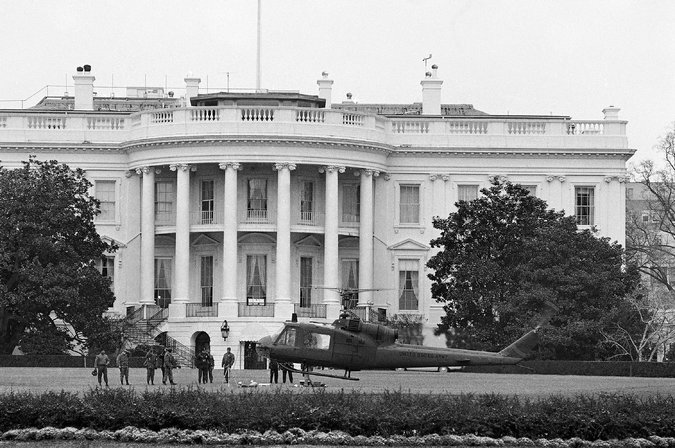
A helicopter stolen from nearby Fort Meade by an Army private landed on the South Lawn of the White House in 1974.

A helicopter stolen from nearby Fort Meade by an Army private landed on the South Lawn of the White House in 1974.

With all the ground protection, several men have tried to pierce the White House perimeter by air. An Army private stole a helicopter from Fort Meade in 1974 and flew it to the White House, where he landed on the South Lawn, took off again and then returned. Secret Service officers eventually opened fire on the chopper, forcing it down. The private survived and was sentenced to a year in prison. That same year, a failed businessman tried to hijack a Delta passenger jet at Baltimore-Washington International Airport with a plan to crash it into the White House, but was shot by the police while in the cockpit before takeoff.

In 1994, an unlicensed pilot who had spent an evening drinking and smoking crack cocaine stole a Cessna 150L and crashed it on the South Lawn in the middle of the night. The plane skidded across the ground, smashed into a magnolia tree and eventually came to a halt against the wall of the mansion. The pilot was killed, but the building was not seriously damaged and Mr. Clinton was not at home at the time.

President Andrew Jackson famously called the White House “the People’s House” but in the current climate, protection and screening would seem to be most important.  Perhaps President Obama should take satirist Andy Borowitz seriously.

President Barack Obama has decided to move his family into a full-service doorman building in Washington, D.C., saying that “it just makes more sense right now.”

“It really will work better for us,” Obama said in a press conference Tuesday morning. “In addition to the doorman, there’s a guy at the front desk, and, if anyone comes to see you, the desk guy will call up to your apartment first to make sure it’s O.K.”

 Photograph:  Charles Tasnadi/Associated Press
Thinking about knots

I have to admit that I generally don’t read those fancy magazines that often come with the Sunday New York Times.  I may flip though them and look at some of the ads – I like reading about fancy $60 million penthouses with views of the Hudson or palatial estates with zillions of bedrooms – but I rarely read any of the articles.  But this morning I was leafing though the magazine that came yesterday and saw the article by Jody Rosen about knots.  Yes, knots.

Knot enthusiasts like to say that civilization is held together by knots. It sounds like a wisecrack — but if you take a look around, you may begin to see the truth behind the quip. You could start by scrutinizing your shoes. They’re tied, undoubtedly, with the first knot that you ever learned, the famous shoelace knot, or bowknot, or as some knot experts prefer to call it, the double-slipped reef knot: a knot that combines a simple half-hitch with those two bunny-eared loops to create an ingenious little mechanism, taut enough to keep your feet snugly sheathed but with a built-in quick-release that can free them in an instant, with a single tug on a string. Glance in the mirror and you may find more knots: the one in your necktie, perhaps, or the one made by the elastic band that is wound around to hold your hair in place. Your hair itself might be plaited into a braid: another knot.

Now consider the clothing you’re wearing. What is your cable-knit sweater but a whole lot of knotting? Your shirt, your pants, your socks, your underwear: These sewn or knitted or woven garments are likely held together by knots, and what’s more, the materials from which they’re made — cotton or wool or acrylic or what have you — are themselves glorified knots, fibers that have been twisted together to form stronger tensile strands. Knots, it seems, are the only thing standing between you and an indecent-exposure charge.

And that’s just the beginning. There may well be a knot in the cinnamon bun on your breakfast table. There were definitely knots in the fishing net that caught the halibut on your dinner plate. Doctors staunch the bleeding in an open wound with tourniquets bound by knots, and they employ knots when stitching up a body after surgery. Knots are used in the construction of houses and skyscrapers; the cables supporting suspension bridges extend time-honored principles of cordage and knotting to “ropes” of galvanized steel wire.

There are even knots on the Mars Rover.

I learned about knots as a Girl Scout when we had to learn a particular number as a requirement for one of the badges.  I even learned to splice rope from my father when he was preparing the lines for one of our sailboats.  And, pre-frozen shoulder, I used to knit all the time.  I want to learn to braid bread dough.  So, like most people, knots are part of my life.  One just doesn’t think of them very often.

In other words, knots are ubiquitous — so threaded, as it were, into the fabric of everyday life that they are easily overlooked, hidden in plain sight. In certain quarters, though, knots command center stage. One such place is a house that sits along a well-trafficked residential through street a couple of hundred yards from the River Orwell in the town of Ipswich, in Suffolk, southeast England. It is a modest two-story brick building of Edwardian vintage, distinguished from neighboring houses only by a telling detail: a forged iron door knocker in the shape of knotted rope. Use that door knocker and you will be greeted by Des Pawson, a vibrant 67-year-old man with large round eyeglasses, a white beard worthy of a biblical patriarch and hair that stretches down nearly to his shoulders. Pawson’s mane is partially concealed beneath a red Kangol cap. “I’m a socialist, of a sort,” Pawson says. “I want the rope makers, I want the riggers, I want the sailmakers to be recognized for their contributions. They are a huge part of the story of knots.”

Pawson is one of the world’s foremost knot experts, a co-founder of the International Guild of Knot Tyers, and a prolific author of knotting books. His home, which he shares with his wife, Liz, is a shrine to knots. In a sun-flooded library on the ground floor, there are pieces of rope and fish netting dangling from timber beams, dozens of nautical paintings and artifacts, and rows of old bottles of Stockholm tar, also known as pine tar, a substance used to weatherproof rope. The bookshelves that line all four walls are packed with what may be the world’s largest private collection of knot literature. There are 19th-century knot treatises and multiple copies of the knotter’s bible, “The Ashley Book of Knots” (1944), a monumental work of history, reference and how-to, written and illustrated by the American Clifford W. Ashley. There are also copies of books written by Pawson himself, which include basic knotting handbooks as well as more specialized monographs: “Sailors’ Rope Mats From Yarn, Strands and Sennit,” “Some Notes on the Rogue’s Yarn,” ” ‘Tom Bowling’ and the Book of Knots: A Bibliography and Commentary, Together With a Solution to the Mystery.”

Who knew there was an organization for knot tyers?

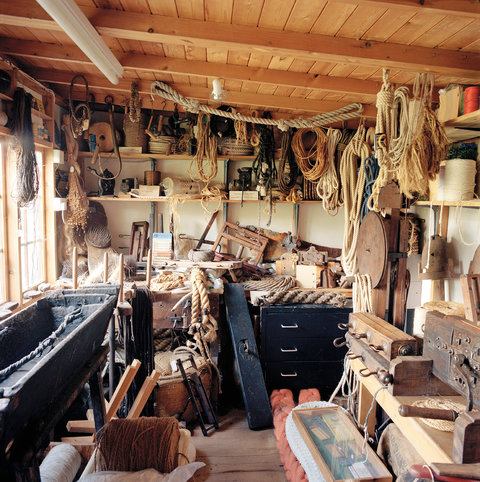
nside Pawson's Museum of Knots and Sailors' Ropework in Suffolk, England

nside Pawson’s Museum of Knots and Sailors’ Ropework in Suffolk, England

Pawson also has a museum which has limited public access, but is described in loving detail in the article.  Among the treasures in his collection is

…an improbably chunky piece of age-blackened rope, more than two feet in circumference, as thick and gnarled as a tree trunk. It is a part of the anchor cable from the H.M.S. Victory, the ship that Lord Nelson commanded, and died aboard, in the Battle of Trafalagar.

There are other knots that aren’t necessarily physical ones.  Like marriage – tying the knot.

Of course, you don’t need to be a satellite engineer or an artisan to be a knotter: We all tie knots. If you pause for a moment the next time you’re lacing up your boots, you might glimpse what Pawson and other devotees see in knot-tying: an exercise in physics and in metaphysics, a homely everyday activity that can also be a science experiment, a work of art and something along the lines of a spiritual practice. In “The Ashley Book of Knots,” Clifford Ashley wrote: “[The] simple act of tying a knot is an adventure in unlimited space … an excursion that is limited only by the scope of our own imagery and the length of the rope maker’s coil.” To which one might also add: Knots are damn useful. “Where would we be,” Pawson says, “without a knot in the pajama cord?”

So now I’m going to be super aware of knots when I tie my shoes or the belt to my bathrobe.  I may even try to take up knitting again.

Photograph:  Tobias Harvey

Time capsules

There are stories about kids burying treasures and then forgetting where exactly they dug the hole and never digging it up.  But I remember one from an old episode of “NCIS” when the best friend of Gibbs’ deceased daughter tells him about a box they buried.  Gibbs digs it up and finds a picture and some childhood treasures.  And how many stories have you read about time capsules put in corner stones or in monuments and then forgotten?  But when one is actually found it is exciting.

I’ve looked at the gold statues on top of the Old State House in Boston for 20 years.  The last 8 years I was working I probably looked up at them every day.  I had no idea that one of them held a time capsule.  This morning I saw this story in the Boston Globe.

It’s confirmed, Boston. A time capsule has been found in the head of the lion statue that has been sitting atop the Old State House for more than a century.

An iconic statue of a lion atop the Old State House on Washington Street in Boston was hoisted down from its rooftop perch for restoration.

An iconic statue of a lion atop the Old State House on Washington Street in Boston was hoisted down from its rooftop perch for restoration.

This time capsule had also been forgotten.

Rumors swirled last week about the possibility of the long-forgotten time capsule, which was reported in a Globe story from 1901.

“We [the Bostonian Society] didn’t know about the Globe article until several years ago,” [Heather] Leet said.

A descendant of one of the statues’ original sculptors found a letter that revealed the existence of the capsule and listed its contents. It was after the society saw the letter that it did research that turned up the 113-year-old Globe story.

The question now for statue restorer, Robert Shure, is how to remove the capsule without damaging the statue.

On Monday, Shure used a fiber optic camera to detect the capsule, which is in a sealed copper box about the size of a shoe box and secured to the sculpture with copper straps, Leet said. According to the Globe story, the capsule contains photographs, autographs, and sealed letters from politicians and prominent Bostonians of the time, along with old newspaper clippings.

Leet said Shure hopes to find a way to retrieve the time capsule with minimal damage to the lion by the end of the week. It is hoped that by next week, the Bostonian Society can have a small ceremony at the Woburn sculpture studio to extract the box.

There are plans to replace the old capsule with a new one.  I trust that its presence will be fully documented.

Globe story by Kiera Blessing

Photograph: DINA RUDICK


College reunion: My 45th

I have to begin by saying that I have no idea what a “normal” college reunion is like.  I picture football games, halftime bands, sorority and fraternity parties and a good deal of alcohol consumption.  That last may be the one thing that a homecoming reunion at St. John’s College has in common with other homecomings.

My husband (who was in my class at St. John’s) and I hadn’t been to a reunion since the 25th, but we had been tapped as co-chairs for the 45th.  The first thing you have to understand is that St. John’s is a tiny school.  I think that there are around 400 current students on the Annapolis campus and an equal number on the Santa Fe one.  In the mid to late 1960s the student bodies were smaller.  I believe that the graduation rates have increased since my time, also.  Our freshman class was around 100 and if memory serves me, about 50 or 60 of us finally graduated.  This is my long-winded way of explaining why when 11 us (plus one spouse who is also the mother of a graduate) showed up, it was a pretty good number.

But what is a reunion all about?  You go to the place where you were x number of years ago and you hang-out with people you haven’t seen for years (and maybe didn’t know so well to start).  A reunion/homecoming at St. John’s is different. What makes a St. John’s reunion for me is several things.  First, the school is small enough that one knows people from other classes.  Second, because we all had pretty much the same curriculum and read the same books we could talk to friends (some old and some new) from the Classes of 1984, 1967, 1956 and 1965 with no problem.  And, third, the experience is intellectually stimulating.  Even the Friday night lecture, which wasn’t very good, sparked a breakfast discussion at our B & B about Dostoevsky and “The Brothers Karamazov”.  We came home and researched translations and will order and read the book again.

Our class had a seminar on Moliere’s “Misanthrope” led by two tutors that many of us had studied with back when we were students. The College also mixed in some current students.  It was a lively event with discussion on comedy, tragedy and what it means to be a misanthrope.  The play came up several times in other discussions over the weekend and my husband and I talked about it on the drive home to Vermont.  That is a powerful experience.  Seminars are the heart of any reunion at St. John’s but are not the only shared experience that is re-experienced.  There was also Freshman chorus (think of a bunch of mostly non musicians singing Mozart and rounds as we were once required to do. )  That was fun!

This was the anniversary of the writing of the “Star-Spangled Banner” by Francis Scott Key who is an alumni of what we fondly refer to as the Old Program.  (St. John’s is the third oldest college in the United States after Harvard and William and Mary.)  In his honor we all toddled out to back campus after drinking much wine at dinner (and the pre-dinner reception) to watch the fireworks over College Creek after this year’s Freshmen sang the “Star-Spangled Banner”  It was a great Homecoming and Reunion.

Fireworks over College Creek, St. John's College, Annapolis 2014 Homecoming.

Fireworks over College Creek, St. John’s College, Annapolis 2014 Homecoming.


Photograph: Tia Pausic

Police departments and racial diversity

Back in the dark ages, that is the early to mid-1980s, I worked on a study for then Virginia Governor Charles Robb.  He wanted to know several things including how we could recruit more African-Americans and women to the State Police and how, once we hired them, they could be retained.  I can’t recall that we came up with anything one wouldn’t have expected including things like more training for command in diversity issues.  I do remember one black trooper I interviewed had an idea on how to recruit people.  He suggested that he be made part of the Governor’s security detail which would provide lots of visibility.  I told the Governor and the next thing I knew, the trooper was thanking me when we ran into each other on the Capitol grounds.  I have no idea if his presence helped recruit more blacks to the ranks or not but it did provide some visibility and I remember that the Capitol Police then hired several black officers.

So my little story took place in 1983.  This morning’s New York Times has some very interesting charts on large Metropolitan police departments and the differences between their racial compositions and those of the towns they serve.

In hundreds of police departments across the country, the percentage of whites on the force is more than 30 percentage points higher than in the communities they serve, according to an analysis of a government survey of police departments. Minorities make up a quarter of police forces, according to the 2007 survey, the most recent comprehensive data available. Experts say that diversity in the police force increases a department’s credibility with its community. “Even if police officers of whatever race enforce the law in relatively the same way, there is a huge image problem with a department that is so out of sync with the racial composition of the local population,” said Ronald Weitzer, a sociologist at George Washington University. Listed below are local police departments from 15 metropolitan areas, sorted so that departments with the largest percentage-point differences of white officers to white residents are at the top.

We clearly have a long way to go.  I wonder if part of the recruitment problem is the sheer number of young black and Hispanic men who have conviction records.  Perhaps we should look into that.

th

I was interested to see that Boston (+18) and Somerville (+15) were doing pretty well.  Those are two of the police departments I’ve worked with in the recent past.  Other departments should take a look at this chart and talk to some of the successful agencies – and I don’t mean towns that have a small gap because the population of the town itself is mostly white – and learn from what they have done.

Incidents like the shooting in Ferguson don’t happen in a vacuum.  Look up a town near you and ask questions if you don’t like what you see.


As a footnote:  While I was looking to a picture to add, I was surprised at the number of stock photographs showing police in riot gear and/or arresting someone, often a black male.  Just another part of the problem.

Photograph:  how2becomeanfbiagent.com

Labor, management and Market Basket

If you don’t live in New England – you have probably never heard of the Market Basket grocery chain.  It has been known for customer service and low prices.  I confess that I’ve probably shopped there maybe twice in the last 20 years so I am clearly not a regular.  But I know people who swear by Market Basket and, for some, it is the only store in town.  Whether you have heard of MB and love it, or don’t know the first thing about the store, there are lessons to be learned for Labor Day.

For more years than I can count, there has been a feud between the two cousins, Arthur S. and Arthur T. who inherited the store.  It has involved an epic court battle, and if I remember correctly, disciplinary action against some of the attorneys.  There was also an actual fist fight as at one point between the Arthurs.  All the while, Arthur T. has been managing the stores and making money for everyone.  But, according to the employees and Arthur T., the board wanted to take a bigger share of the profits for themselves and the shareholders who are mainly family members. The board decided to fire Arthur T.  Shirley Leung writes in her Boston Globe column

For six weeks, we were mesmerized by the sight of thousands of grocery clerks, cashiers, and other workers protesting at stores, on Facebook, and on the front pages of this paper. They did so at great risk, without the protection of a union, not because they wanted higher wages, but merely the return of their beloved boss, Arthur T. Demoulas.


Who among us would do that? Not many, if any at all. We were riveted because we wanted to be them. These rebellious employees gave voice to the voiceless masses who just wanted to hold on to decent wages for a decent day’s work at a time when fat cats get $50 million paychecks for showing up, and the gap between the rich and the poor is as gaping as ever.


After the Market Basket board ousted Arthur T., these foot soldiers of capitalism kept the story alive when they made flyers protesting his removal and distributed them to customers. Then they reached out to the media and politicians to talk about their improbable demand. Soon workers walked off the job and refused to restock shelves. Customers boycotted in solidarity, putting the economic squeeze on new management to do something.

While it is tempting to portray Arthur T. as the Good Arthur and Arthur S. as the Bad Arthur, as Leung points out Arthur S. and his pals never carried out threats to fire everyone and hire new people.  There was an attempt to hold a job fair, but it was never clear how many people came or if anyone was hired.  I believe eight people were fired early on, but that example didn’t slow either the employee action or customer boycotts.  The governors of New Hampshire and Massachusetts got involved.  A settlement was announced finally and Arthur T. is buying out Arthur S. so as to become the majority shareholder.  He will now be running a severely damage company in deep debt and will be borrowing money to pay for his purchase.

Employees seem optimistic.  They returned to work as soon as the announcement was made.  Whether the stores can be stocked so there are things for people to buy, whether suppliers can return, and whether Arthur T. can keep to his promise to continue to treat and pay workers well are open questions.  If Market Basket can beat the odds and make a comeback to profitability, the story will be studied in business schools and by labor historians for many years.  Actually, it will probably be studied no matter what happens.

Market Basket employees celebrate the return of Arthur T.

Market Basket employees celebrate the return of Arthur T.

The Market Basket story is one for this Labor Day.  Non-union employees took collective action to save a boss and his practice of putting employees above shareholders. I’ll let Joan Vennochi have the last word.

Most notable is the power of narrative. Market Basket workers used social media as an organizing tool, but, at the same time, they skillfully used old and new media to tell their story before the other side knew what was happening.

And, unless you were Arthur S., it was a story that had something for everyone:

Workers standing up for, not against, management.

The desire to believe in one corporate leader putting the well-being of his workers

over shareholders, in an old-fashioned “It’s A Wonderful Life” way.

Employees of modest means willing to put paychecks for rent and mortgages on the line for principle.

“It speaks to a search and yearning for respect and fairness,” said Lew Finfer, a veteran community organizer who has worked for decades with unions to do just that by promoting better worker pay, conditions, and benefits.

There are lessons here for everyone.

Photograph:  JESSICA RINALDI/GLOBE STAFF


Hitting reset

A few weeks ago, my husband and I both noted an article in the New York Times Week in Review section called “Hit the Reset “Button in Your Brain.”  The authors argued the need for a true vacation from work.  In other words not one like President Obama had where according to a news report I heard he talked to at least 9 foreign leaders and held at least 4 press conferences.  This would be in addition to the normal routine of daily briefings, etc.  Some of the rest of us call work and read email while ostensibly on vacation.  They argue

If you’re feeling overwhelmed, there’s a reason: The processing capacity of the conscious mind is limited. This is a result of how the brain’s attentional system evolved. Our brains have two dominant modes of attention: the task-positive network and the task-negative network (they’re called networks because they comprise distributed networks of neurons, like electrical circuits within the brain). The task-positive network is active when you’re actively engaged in a task, focused on it, and undistracted; neuroscientists have taken to calling it the central executive. The task-negative network is active when your mind is wandering; this is the daydreaming mode. These two attentional networks operate like a seesaw in the brain: when one is active the other is not.

0810BRAIN-master495


So what helps us reset and overcome the overload?

Increasing creativity will happen naturally as we tame the multitasking and immerse ourselves in a single task for sustained periods of, say, 30 to 50 minutes. Several studies have shown that a walk in nature or listening to music can trigger the mind-wandering mode. This acts as a neural reset button, and provides much needed perspective on what you’re doing.

Daydreaming leads to creativity, and creative activities teach us agency, the ability to change the world, to mold it to our liking, to have a positive effect on our environment. Music, for example, turns out to be an effective method for improving attention, building up self-confidence, social skills and a sense of engagement.

I suspect that by moving to Vermont with cleaner air, quiet, and lots of space to walk and appreciate nature even within a few blocks of our house, we have hit our reset buttons.  Being able to sit on the screened in porch and watch daylight fade as I did last night or taking a walk to see the stars tonight provides time to think and reflect.  We did try to do this in Boston by walking around Jamaica Pond for example, but even there you could hear traffic.  I used to walk over to Boston Harbor at lunch and look at the water.  These are urban dwellers solutions which people in cities can employ.  But they need to do so without cellphones and other devices.

I know it is a privilege to be able to retire to a place where we can so easily hit reset.

Illustration by Matthieu Bourel

A guide to talking about race

With the Michael Brown shooting leading the news and talk about possible ISIS attacks in the United States, racial and ethnic profiling is in the spotlight once again.  And you hear people saying that we need to have a conversation about race.  We keep talking about having one and somehow it never happens.  This is why I was interested to see Charles Blow’s recent column in the New York Times titled “Constructing a Conversation on Race.”

Let’s start with understanding what a racial conversation shouldn’t look like. It shouldn’t be an insulated, circular, intra-racial dialogue only among people who feel aggrieved.

A true racial dialogue is not intra-racial but interracial. It is not one-directional — from minorities to majorities — but multidirectional. Data must be presented. Experiences must be explored. Histories and systems must be laid bare. Biases, fears, stereotype and mistrust must be examined. Personal — as well as societal and cultural — responsibility must be taken.

And privileges and oppressions must be acknowledged. We must acknowledge how each of us is, in myriad ways, materially and spiritually affected by a society in which bias has been widely documented to exist and in which individuals also acknowledge that it exists

We all carry our own baggage:  an encounter with someone of a different race or background that didn’t go well; a perceived slight; or feeling passed over for someone for what we felt were racial reasons.  We may talk about these things within our own circles which are often made up of people just like us.  I am usually one of the very few Asian Americans in any group and it was only when I moved to Boston that I could be on the street or even in a meeting that was predominantly Asian.  And now I’ve moved to Vermont which is one of the whitest states and where my sister and I have already been confused because we have the same last name.  I have been referred to as “white” which somehow offends me but I think it is meant as a kind of compliment.  Race can be a no win thing.

Blow continues

I often tell people that while I know well that things aren’t fair or equal, we still have to decide how we are going to deal with that reality, today. The clock on life is ticking. If you wait for life to be fair you may be waiting until life is over. I urge people to fight on two fronts: Work to dismantle as much systematic bias as you can, as much for posterity as for the present, and make the best choice you can under the circumstances to counteract the effects of these injustices on your life right now.

He also advises that we should think about what we mean by race.

Next, understand that race is a weaponized social construct used to divide and deny.

According to a policy statement on race by the American Anthropological Association, “human populations are not unambiguous, clearly demarcated, biologically distinct groups” and “there is greater variation within ‘racial’ groups than between them.”

The statement continues:

“How people have been accepted and treated within the context of a given society or culture has a direct impact on how they perform in that society. The ‘racial’ worldview was invented to assign some groups to perpetual low status, while others were permitted access to privilege, power, and wealth. The tragedy in the United States has been that the policies and practices stemming from this worldview succeeded all too well in constructing unequal populations among Europeans, Native Americans, and peoples of African descent.”

It ends:

“We conclude that present-day inequalities between so-called ‘racial’ groups are not consequences of their biological inheritance but products of historical and contemporary social, economic, educational, and political circumstances.”

We need to think hard about why race and ethnicity are among the first things we recognize about someone and what we see is often not how the person thinks of herself.  One thing seems clear.   We need to talk and think about race a great deal more constructively that most current conversations where the parties can never get past their anger.  Maybe we can start the discussion by talking about Mr Blow’s column,

New laptop, new location

First post from FortLeft’s new home.  I am still trying to figure out all the ins and outs of this new laptop.  Ok, I’m a bit of a luddite and finally got a laptop, probably the last person to do s0.

Our furniture and boxes and boxes and boxes of stuff arrived two weeks ago tomorrow.  Progress has been made in unpacking, but when you have 6000+ books and the new house is configured differently, it is hard to place bookshelves and unbox.  Lots of stuff is ending up in the attic for now. But things are beginning to feel like home.  New routines – like curbside composting – are being established.

Don’t know when you last moved to a new state, but trying to change everything has taken a lot of energy and time.  I’m sure we will be discovering things we’ve missed for a while, but I think all the important stuff has been changed.  Moving to a different country would be even more difficult, I imagine.

The cats are adjusting and all the fish also survived the move.  The cats have explored their new digs and have found their sleeping spots.  I think they will miss the stacks of boxes when they are gone as places to jump to and sit on.

A fellow outside of the post office tried to get me to sign a petition about something the Board of Selectmen did, or maybe didn’t, do.  Had to tell him I didn’t know enough to have an opinion.  Not having an opinion is a bit strange for me, but I will keep reading the local paper and will figure things out.  For now, just enjoying a rainy day in Vermont.

Haven’t quite gotten the hang of inserting links and pictures yet so am re-using one.  But I wanted to do this first post before too much more time passed.

Books

Maps

I have loved maps ever since the 3rd or 4th grade when I scored really high on a map reading skills section of (the Iowa tests?) a test that ranked us nationally as well as individually.  We could have GPS in our new car, but we don’t.  I am generally the navigator on our road trips.  I used old fashioned foldy maps or a road atlas or both.  Once I was in a car with GPS and it wanted us to take a turn into the Charles River.  This was maybe 12 years ago, but I’ve never forgotten.

travel

So when I saw this article in the New York Times Sunday Review, I knew I had found a kindred spirit in Steven Kurutz.

CALL me a fossil, but when I take a road trip I like to get around by using printed maps. I’ve been licensed to drive for 20 years, and every car I’ve owned has contained a Rand McNally Road Atlas, with the maps of the Northeastern states dog-eared and loosened from their staples. Navigating by map carries over to foreign roads, too. In May my wife and I went to France, where we drove around Provence and dipped a wheel into Italy.

Before we left, I amassed the blanket topographical coverage I imagine the Allied generals had when they stormed the Continent. Collecting the maps was an interminable process. Bookstores have scaled back their selection in recent years. Or stopped selling maps altogether. Apparently, a good number of people think printed maps are pointless nowadays.

I guess you can still go to AAA and get triptiks and maps,  but map stores are closing.  I used to go to the Globe Bookstore for maps and guidebooks.  Now Brookline Booksmith has a small Globe Bookstore travel section.  And you can order maps from places like Barnes and Noble.  But it is harder to just wander into a store and open up a map and wonder what it would be like driving on a particular road.

As part of packing for our move, we have kept a lot of maps of places we have been.  I opened some of them and could remember when we drove to a certain place. As Kurutz says

Consider this, though: Using printed maps requires travelers to work together. You become a team. Driver and navigator. Your ability to get along and solve problems is tested in valuable, revealing ways. GPS removes that entire interpersonal dynamic. It encourages a passive form of journeying: sit back and drift, because the vaguely Australian-sounding computer lady will tell you to turn left in a quarter mile.

Driving by map, on the other hand, engages you actively with your surroundings. It makes you observe road signs, be in the moment. And that closer engagement, I’ve found, imprints the landscape more vividly and permanently on your mind. When I return home, I can unfold my maps and take myself back to a town or a stretch of highway.

Often I’ll buy a map months before the trip, and by studying it try to pull the opposite trick — to transport myself into the place I intend to visit. It builds anticipation. Eric Riback, a map publisher in upstate New York who writes a blog called Mapville, described this to me poetically as the “seeking, dreaming part of travel that you can do with a map.”

That is the joy of a map:  you can dream before and you can remember after.  You can’t really do that with a GPS.

Illustration:  Andrew Ho for the New York Times