Where is the real America?

A while back, my nephew posted a piece from FiveThirtyEight “”Normal America” is Not a Smal Town of White People” with a lament that Vermont, where he grew up and I live now, is not normal America.  The piece begins

Earlier this week, Jim VandeHei, a former executive editor of Politico, wrote an op-ed article for The Wall Street Journal accusing the Washington political establishment of being out of touch with “normal America.”

“Normal America is right that Establishment America has grown fat, lazy, conventional and deserving of radical disruption,” he wrote, citing his regular visits to Oshkosh, Wisconsin, and Lincoln, Maine, as his credentials of normality.

Jed Kolko, the author of the piece for FiveThirtyEight, responded by looking at demographics.

I calculated how demographically similar each U.S. metropolitan area is to the U.S. overall, based on age, educational attainment, and race and ethnicity.1 The index equals 100 if a metro’s demographic mix were identical to that of the U.S. overall.2

By this measure, the metropolitan area that looks most like the U.S. is New Haven, Connecticut, followed by Tampa, Florida, and Hartford, Connecticut. All of the 10 large metros that are demographically most similar to the U.S. overall are in the Northeast, Midwest or center of the country, with the exception of Tampa. Two of them — New Haven and Philadelphia — are even on Amtrak’s Acela (that’s “uh-SELL-ah”) line. None is in the West, though Sacramento, California, comes close at No. 12.

The precise location of Normal America.

The precise location of Normal America.

But do demographics really show us the “normal” America?  According to the 2010 Census, 80.7% of American live in urban areas.  And we are creating new urban areas.  According to a Reuter’s analysis of the 2010 data

As a result of the growth in population and geography, the Census identified 36 new urbanized areas, which it defines as “densely developed residential, commercial and other nonresidential areas” with populations of 50,000 or more.

The Midwest dominated the birth of new major cities, with Cape Girardeau, Missouri; Grand Island, Nebraska; Manhattan, Kansas, and Midland, Michigan, all joining the ranks. Arizona’s Lake Havasu City and Sierra Vista are also now considered urbanized areas.

But are the urban places where most of the population lives “normal America?”  If we mean typical America, then, yes, the urban dweller is the typical American and when you add in demographics you get New Haven.

But in the past few years, my husband and I have spent a good deal of time driving back roads largely in New York, Massachusetts, Pennsylvania, Ohio, Maryland, and Vermont.  We have eaten at diners and stayed in some small and medium sized towns many with well-known colleges and universities.  We have found a rich culture, interesting people and things to do, and fresh air.  Driving across New York on U.S. 20 yesterday made me think about more about Kolko’s piece.   Of course, he was writing about politics and arguing that Iowa and New Hampshire shouldn’t have such a large influence because they – and by implication other places that don’t have the urban area racial and ethnic diversity – are not normal America.  But I’m not sure that those states, at least on the Democratic side, vote much differently than the rest of the country.  Yesterday, I saw a handful of Bernie bumperstickers and yard signs along with one Trump yard sign.  I saw no sign of any other candidates.  Kolko writes

We all, of course, have our own notions of what real America looks like. Those notions might be based on our own nostalgia or our hopes for the future. If your image of the real America is a small town, you might be thinking of an America that no longer exists. I used the same method to measure which places in America today are most similar demographically to America in 1950, when the country was much whiter, younger and less-educated than today. Of course, nearly every place in the U.S. today looks more like 2014 America than 1950 America.

I guess I am arguing that Kolko may be the one taking too narrow a view.  He concludes with what the 20% that don’t live in urban areas would consider an insult.

There are lots of reasons to care deeply about places that are demographically different from today’s America: Some of those places may turn out to be bellwethers for a future America that will be older, more educated and more racially and ethnically diverse than today; and some of those places are especially deserving of public attention and investment because they worse off than most other places.

But if you’re trying to get outside of your bubble and get in touch with “normal America,” skip the small towns of your actual or imagined past and instead start with New Haven or Tampa.

But I think he needs to take a ride on US 20 or US 40 or even the Western part of MA 2 and visit a place like Lincoln, Maine and get out of his own bubble.

Illustration by Getty Images and FiveThirtyEight

Re-writing Shakespeare

My husband and I catalog our books on LibraryThing and I often get books to review through the Early Reviewers Project.  Most recently I got Anne Tyler’s re-writing of “The Taming of the Shrew”, Vinegar Girl.  Why is Tyler re-writing Shakespeare?  Hogarth Publishing is doing a series for the 400th Anniversary of Shakespeare’s death by having well known author’s take on a variety of plays.

The Telegraph story on the series started this way

Booker Prize-winning authors Margaret Atwood and Howard Jacobson are to write modern prose versions of two of Shakespeare’s most widely-read plays, despite admitting they maybe “mad” to do so.

Atwood will take on The Tempest, while Jacobsen, who won the Booker Prize in 2010 for The Finkler Question, will rework The Merchant of Venice.

The story ends

The pair will now join Anne Tyler and Jeanette Winterson as part of the Hogarth Shakespeare project, producing their updated version in time for the 400th anniversary of the Bard’s death in 2016.

Tyler’s will take on The Taming of the Shrew, while Jeanette Winterson works with The Winter’s Tale.

A spokesman for Hogarth, the transatlantic fiction imprint of Penguin Random House, promised the publishing house was still in talks with other esteemed writers, with more expected to be added to the line-up in the coming months.

Shakespeare

So I got Vinegar Girl to review.  I started it, didn’t like anyone in the book and put it down 25 or so pages later.  Maybe, I said to myself, if I read the Shakespeare I will like it better.  I hadn’t read The Taming of the Shrew for decades and I found it very funny, but Kate the Shrew is almost no where to be found.  The play is about Petruchio’s efforts to woo her and about the men vying for her sister.

Back to Vinegar Girl.  One has to appreciate Tyler’s attempt to put Kate front and center, but it also shows the difficulties of  having a central character who is grumpy and ill-tempered – although not without reason.  I didn’t like Kate until the very end of the book when she is a renowned plant biologist.  I don’t know if Tyler is making a statement about the importance of having a life of one’s own or not, but it certainly seems that way.  But it isn’t Shakespeare who doesn’t have many women characters.  Making Kate a real person who grows really is an update.

Many of the other reviewers for LibraryThing had never read Shakespeare and seemed to enjoy the book a great deal more than I.  I am, however, interested enough in the series to want to read Atwood’s re-telling of The Tempest, one of my favorites.

Photograph:  Alamy (from the Telegraph)

Democracy at the local level

Last year I attended the reunion of the Class of 1970 at St. John’s College in Annapolis, MD.  (That was the class I actually graduated with even though I am technically 1969.)  Our seminar reading was Democracy in America by de Tocqueville.  A lively discussion ensued one topic being whether the de Tocqueville vision of what we in the 1960s called participatory democracy still survives.  I argued that I thought it did survive at least in New England and particularly in Vermont.  For example, Brattleboro where I live, has citizen committees for everything from planning to finance to trees.  And, yes, while there are sometimes problems in finding sufficient people to serve, I believe committees eventually find volunteers.  Some committees are appointed by the elected Selectboard, while others are appointed at Town Meeting.

Every town in Vermont has town meeting on the first Tuesday of March.  Most towns have an open meeting with all town residents.  Budgets are approved and important issues are discussed and voted on.  These are de Tocqueville’s farmers conducting business.  Here is the link to a nice explanation done for middle school students.  Brattleboro is a little different.  On the first Tuesday, which is a holiday, we vote for people who will represent us at town meeting as well as for other local offices like Select Board, School Board, Lister, and Constable.  All the elected representatives meet several weeks later at Brattleboro’s Town meeting.

I decided to run for Town Meeting Representative, got 14 people (you need 10) to sign my nominating petition and got elected with a respectable number of votes.  Town Meeting this year was divided into two meetings.  The first was on a single question of authorizing the Selectboard to take money allocated for renovations at the current police station and, instead, purchase a building in a new location and move the police station.  I voted “no” because I was opposed to moving an essential government service out of downtown, and we lost big.  There is some move to do a town wide referendum on the question, but I don’t know if that will succeed.  My feeling is that my side lost and we just need to get on with it for the sake of the police officers.

The second meeting was yesterday and was a more traditional town meeting.  We arrived at 8:30 and adjourned about 4:30 with an hour for lunch.  (Unlike smaller towns, we have no pot luck, but a high school club sold us stuff for breakfast and lunch to raise money for a trip to Costa Rico.)  There were 30 articles on the agenda beginning with appointment of the Town Clerk (no controversy there) and accepting the audit reports for the Town and for the Town Schools.  We elected people to the Capital Grant Review, Library, and Finance Committees (I got on that one.)  And then a motion was made to raise the compensation of the Selectboard members. They currently get $3,000 a year with the Chair getting $5,000.  Interesting questions were asked during the discussion including whether increasing the compensation would attract people to run who could not afford to volunteer and whether paying the Selectboard more would change the character of the government from volunteer to professional.  The motion that finally passed was to have the Finance Committee study the matter.  I can see what I will be doing this year!  Interestingly we did decide to raise the Town School Board member pay from $2,000 to $3,000 and the chair from $3,000 to $5,000 to make them the same as the Selectboard.

We voted for modest sums to support a variety of local human service non profits and for tax relief for others.  I don’t think any of those votes were unanimous.  And we approved after much discussion, the town budget and school budgets for the next year.  I am more familiar with general government budgets than with school ones, but the town budget is very lean.

Finally we passed two non-binding resolutions:  First, to eliminate fees for activities at the Senior Center and second, to designate the second Monday in October, Indigenous People’s Day.

20160319__p_REF-L-TownMeeting-0319~5_500

All in all a very interesting day.  I heard a lot of concern about poverty in Brattleboro.  I think the number of children who qualify for free lunch – 62% – shocked a lot of people.  (According to the 2010 Census, the median income for a household in the town was $31,997, and the median income for a family was $44,267.)  I can see this becoming more of a topic for discussion at future town meetings.

We heard a plea for civility at the start and other than some mutterings and calls for points of order when one representative in particular spoke, that request was answered.  I think that if he attended any of the town meetings I’ve read about in the local paper for have friends who attended, de Tocqueville would have no trouble recognizing his democracy in America.

Photograph:  Chris Mayes, Brattleboro Reformer.

What is being a feminist all about?

I’ve got credentials.  I was a delegate from Virginia to the First National Women’s Conference held in Houston in 1977.  I shepherded one of the early pay equity cases – a professor at Old Dominion University who was being paid less than her colleague with similar degrees and experience – to a successful conclusion.  I worked to make marital rape a crime and to ratify  the Equal Rights Amendment in the Virginia legislature.  The first successfully, the second not.  I’m the same age as Hillary Clinton.  And I am very disappointed in how her campaign somehow feels entitled to my vote.  Some how I lose my standing as a feminist if I support Bernie Sanders.  She seems to have migrated a long way from her wonderful speech in Beijing.

Women listening to Hillary Clinton at a campaign event in New Hampshire

Women listening to Hillary Clinton at a campaign event in New Hampshire

I was trying to figure out how to write about this when I read Frank Bruni’s column this morning in the New York Times.  I think he was hit the nail on the head.  He begins

I’m 51. My health is decent. And while my mother died young, there’s longevity elsewhere in the family tree.

I could live to see an openly gay presidential candidate with a real chance of victory.

Will there be a “special place in hell” for me if I, as a gay man, don’t support him or her?

I can guess Madeleine Albright’s answer. She more or less told women that they’re damned if they’re not on Hillary Clinton’s team.

I’m still trying to get my head around that — and around Gloria Steinem’s breathtakingly demeaning assertion that young women who back Bernie Sanders are in thrall to pheromones, not ideas or idealism, and angling to score dates with the young bucks in the Sanders brigade.

I could substitute Asian American for gay and ask the same question.

There’s a weird strain of thought swirling around Clinton’s campaign: that we should vote for her because she’s a woman. Or that she’s inoculated from certain flaws or accusations by dint of gender. Or that, at the least, there’s an onus on forward-looking people who care about gender inequality to promote her candidacy.

I care about gender inequality, and I don’t buy it. It’s bad logic. It’s even worse strategy. People don’t vote out of shame. They vote out of hope.

Perhaps that was among the lessons of Clinton’s defeat in New Hampshire on Tuesday, where she lost to Sanders among all women by at least seven percentage points, according to exit polling, and among women under 30 by more than 60 points.

Somehow we got from the positive nature of a woman running for President to what must seem like a bunch of old women scolding young ones for supporting – gasp -a man instead.

Clinton’s gender indeed matters. Just as you couldn’t properly evaluate Obama’s arc without factoring in race, you can’t see her accurately without recognizing that she’s a woman of her time, with all the attendant obstacles, hurts, compromises and tenacity.

That informs — and, ideally, illuminates — her perspective. And her presidency would carry a powerful, constructive symbolism that can’t and shouldn’t be ignored.

But those are considerations among many, many others in taking her measure and in casting a vote. To focus only or primarily on them is more reductive than respectful, and to tell women in particular what kind of politics they should practice is the antithesis of feminism, which advocates independence and choices.

We’re all complicated people voting for complicated people. We’re not census subgroups falling in line.

I’ll go to the barricades for that imagined gay candidate if he or she has talents I trust, positions I respect and a character I admire. If not, I’ll probably go elsewhere, because being gay won’t be the sum of that person, just as womanhood isn’t where Clinton begins and ends.

I will be voting for her in November should she be the Democratic nominee, but I will never quite admire either Madeline Albright or Gloria Steinham in quite the same way as I did before.

Photograph:   Richard Perry/The New York Times

Thoughts and questions about reparations

You have to admire Ta-Nehisi Coates for his persistence is getting the discussion started.  In 2014, Coates wrote a long piece in the Atlantic Magazine titled “The Case for Reparations”.  He generated a lot of buzz back then and we are still talking about it almost two years later.  If you haven’t read it, you probably should if you have any interest in race in America.

My parents were incarcerated into “relocation” camps during World War II because of their race.

In 1988, President Reagan signed the Civil Liberties Act to compensate more than 100,000 people of Japanese descent who were incarcerated in internment camps during World War II. The legislation offered a formal apology and paid out $20,000 in compensation to each surviving victim. The law won congressional approval only after a decade-long campaign by the Japanese-American community.

Reparations were easily determined in this instance.  There was a list of everyone who was in a camp regardless of age.  Those who had died in the meanwhile got nothing and their estates and heirs got nothing.  My parents, uncles, and aunts got checks.  But the money was not enough to cover what had been lost, but was more of a token giving the apology some weight.

Coates has recently taken Vermont Senator and Presidential candidate Bernie Sanders to task for not supporting reparations.

What candidates name themselves is generally believed to be important. Many Sanders supporters, for instance, correctly point out that Clinton handprints are all over America’s sprawling carceral state. I agree with them and have said so at length. Voters, and black voters particularly, should never forget that Bill Clinton passed arguably the most immoral “anti-crime” bill in American history, and that Hillary Clinton aided its passage through her  invocation of the super-predator myth. A defense of Clinton rooted in the claim that “Jeb Bush held the same position” would not be exculpatory. (“Law and order conservative embraces law and order” would surprise no one.) That is because the anger over the Clintons’ actions isn’t simply based on their having been wrong, but on their craven embrace of law and order Republicanism in the Democratic Party’s name.

One does not find anything as damaging as the carceral state in the Sanders platform, but the dissonance between name and action is the same. Sanders’s basic approach is to ameliorate the effects of racism through broad, mostly class-based policies—doubling the minimum wage, offering single-payer health-care, delivering free higher education. This is the same “A rising tide lifts all boats” thinking that has dominated Democratic anti-racist policy for a generation. Sanders proposes to intensify this approach. But Sanders’s actual approach is really no different than President Obama’s. I have repeatedly stated my problem with the “rising tide” philosophy when embraced by Obama and liberals in general. (See hereherehere, and here.) Again, briefly, treating a racist injury solely with class-based remedies is like treating a gun-shot wound solely with bandages. The bandages help, but they will not suffice.

To a certain extent Coates is correct.  Whether one uses the rising tide image or sticks with trickle down, programs begun in the 1960s like affirmative action and various anti-discrimination laws in employment and housing have helped but have not come close to solving the problem that black Americans are more likely to be poor than white Americans.  No one can deny that slaves, former slaves, and their present day descendents have not suffered every form of economic discriminations one can think of because they have.  The question is are reparations a good solution.

Bernie

Conor Friedersdorf provided some speculative reasons why Bernie Sanders is right in not embracing reparations in his recent piece in the Atlantic.

Perhaps Sanders just thinks reparations are bad policy on the merits. There are many plausible reasons that a principled radical might come to that conclusion (though it isn’t entirely clear to me that Sanders is that radical even on matters of class).

Perhaps he is convinced that the highest incarnation of justice is a government that redistributes resources toward its citizens based wholly on their need, and doesn’t want to shift the Overton Window toward any model that is predicated on dessert beyond need, or that would redistribute wealth from poor to rich in some instances.

That seems consistent with principled socialism.

Perhaps when Sanders says that reparations would be divisive, he doesn’t mean that they would damage his campaign or the Democratic coalition by dividing its supporters––the plausible interpretation that Ta-Nehisi argued against in his critiques––but that it would divide Americans of different races against one another in a manner likely to cause more harm to vulnerable minority groups than good, or necessitate a divisive process of bureaucrats defining who qualifies as black.

The Overton Window referred to above is a media pundit term meaning the range of discourse the public is willing to accept.

When I commented on a friends Facebook page during a discussion of reparations that I thought it would be difficult if not impossible to figure out who was owed, another friend commented that maybe that was what Coates was trying to do – get us to talk about the issue.  If that was his aim, to move or enlarge the Overton Window, then he has succeeded.

I have a question for Sanders.  Why not take up Coates’ call to support a study?

…For the past 25 years, Congressman John Conyers Jr., who represents the Detroit area, has marked every session of Congress by introducing a bill calling for a congressional study of slavery and its lingering effects as well as recommendations for “appropriate remedies.”

A country curious about how reparations might actually work has an easy solution in Conyers’s bill, now called HR 40, the Commission to Study Reparation Proposals for African Americans Act. We would support this bill, submit the question to study, and then assess the possible solutions. But we are not interested.

Perhaps rather than demand reparations now we, Coates included, should push Congress – and all of the Democratic Presidential candidates to support HR 40.   Let’s keep talking about this.

Photograph:  huffingtonpost.com


Guns and public health

There are too many guns in the United States.

Last October Christopher Ingraham wrote in the Washington Post’s Wonkblog

It’s tough to know exactly how many guns we have in the United States. Most estimates of the number of guns in the U.S. use federal tallies of the firearms manufactured, imported and exported by U.S. gunmakers. A 2012 Congressional Research Service report published exactly one month before the Sandy Hook school shooting put the number of civilian firearms at 242 million in 1996, 259 million in 2000, and 310 million as of 2009.

If that 310 million number is correct, it means that the first year of Barack Obama’s presidency was an inflection point: It marked the first time that the number of firearms in circulation surpassed the total U.S. population.

It is clear that the Obama years have been a boon to gun manufacturers regardless of whether the number of guns is 245 million, 270 million, or 300 million.

guns

Do they keep us safe?  Some gun owners point to falling homicide rates, but there are studies showing that places with few guns have lower rates.  Ingraham writes

It’s important to note that even as the number of guns has increased since the early-to-mid-90s, the per-capita gun homicide rate has fallen by nearly half over the same time period. On the other hand, it’s also true that when you make comparisons between states and countries, you see that places with more guns have more gun homicides, as research from the Harvard School of Public Health shows.

These two seemingly unreconcilable facts form the factual basis for much of the contemporary gun policy debate. Defenders of gun rights can point to falling homicide rates and rising gun numbers and argue that the solution to gun violence is more guns. Gun control advocates, meanwhile, can point out the correlations between gun ownership and gun crime and push for tighter restrictions on gun ownership.

Ingraham concludes

Is there a way to reconcile these divisions? It’s hard to tell. I keep coming back to this quote, from the Economist earlier this year in response to the Charleston massacre.

Those who live in America, or visit it, might do best to regard [mass shootings] the way one regards air pollution in China: an endemic local health hazard which, for deep-rooted cultural, social, economic and political reasons, the country is incapable of addressing.

Which brings me to Margaret Talbot’s comment in the January 18 issues of The New Yorker.  Talbot writes about President Obama’s Executive Order on background checks.

Last week at the White House, as President Obama announced a set of executive actions aimed at blunting gun violence, he seemed anything but numb. He wept as he invoked the first graders killed at Sandy Hook Elementary School, in Newtown, Connecticut—a response for which some gun advocates mocked him. He quoted Martin Luther King, Jr.,’s words about the “fierce urgency of now.” But he also acknowledged the numbness that can overcome people in the face of one mass shooting after another. That numbness puts proponents of unfettered gun rights at an advantage. People can easily start thinking of gun violence as something native to America’s angry, intractable soul—the armed, anti-federalist takeover of wildlife-refuge buildings in Oregon this month seemed like proof. And when, time and again, Congress thwarts gun reforms that are supported by majorities of Americans it can be hard to imagine that the status quo will ever change.

If numbness benefits gun-rights absolutists, uninformed numbness might serve them even better. In 1993, The New England Journal of Medicine published a study showing that “keeping a gun in the home was strongly and independently associated with an increased risk of homicide” in that home. The researchers had been funded by the C.D.C.’s National Center for Injury Prevention, and the N.R.A. responded by trying to get the prevention center defunded. It didn’t succeed, but, in 1996, Congress amended an appropriations bill to the effect that “none of the funds made available for injury prevention and control at the Centers for Disease Control and Prevention may be used to advocate or promote gun control.” It was a little like saying that no research on the health effects of smoking should be interpretable as anti-smoking. Congress also removed $2.6 million from the C.D.C.’s budget—the precise amount that had gone to the prevention center’s research—and then restored it, earmarked for an entirely different purpose. As a result, one of the study’s authors said in a public-radio interview last spring, “many, many people stopped doing gun research.”

With gun research, maybe we could have safer weapons as we have safer cars.  Maybe we would better understand the dangers of gun ownership.  Maybe we wouldn’t have to read about the six year old who finds Daddy’s gun and kills his two year old sister.

Jay Dickey, the Republican representative and N.R.A. member from Arkansas who sponsored the amendment, came to regret it. Dismayed by the continuing toll of gun violence, he was eventually persuaded that firearm deaths could be reduced without violating the Second Amendment. He now believes that research on gun violence can help prevent it, much as similar work on highway safety resulted in innovations like seat belts, air bags, highway dividers, and minimum drinking ages, and prevented hundreds of thousands of traffic deaths. In December, in a letter to Mike Thompson, the chairman of the House Democrats’ Gun Violence Prevention Task Force, Dickey wrote, “Research could have been continued on gun violence without infringing on the rights of gun owners, in the same fashion that the highway industry continued its research without eliminating the automobile.” He added, “We should slowly but methodically fund such research until a solution is reached. Doing nothing is no longer an acceptable solution.”

Talbot cites a recent study (not government funded) comparing the repeal of a permit and background check law in Missouri and the initiation of more stringent laws in Connecticut:  Gun homicides dropped around 40% in Connecticut and rose by a similar percentage in Missouri.

Those opposed to background checks, bans on weapons with large capacity magazine, or even trigger locks often say that the issue is one of mental health not guns.  I think our national obsession with guns IS the mental health issue.  They are a public health issue.  Talbot concludes

In part, Obama is trying to reframe the gun discussion not as a Second Amendment issue but as one of public health. This approach acknowledges that, while we can’t eliminate gun crime, we can reduce it, and that doing something is better than fatalistically doing nothing.

Photograph:  M&R Glasgow/Flickr


G. K Chesterton, Jane Austen and Mr. Wickham

In his collection of essays, “Come to Think of It” published in 1930 we find this little gem On Jane Austen in the General Election.  I’m not interested in what Chesterton writes about how political commentators are using – or misusing – Austen to argue about the New Woman as much as I am in his observations about George Wickham.  When my husband handed be a print-out of the short essay, I was just finished with my annual re-reading of Pride and Prejudice.  This includes re-reading the novel, watching the Colin Frith/Masterpiece Theater adaptation, and more recently, re-reading the P.D. James sequel, Death Comes to Pemberley, so everything was fresh in my mind.

For anyone who has not read Pride and Prejudice or seen one of the many adaptations, there is a kind of love triangle between the heroine, Elizabeth Bennett; the handsome, wealthy, brooding Fitzwilliam Darcy; and the charming, handsome, impoverished George Wickham.  Darcy is private and quiet; Wickham, open and talkative.  When we, and Elizabeth, first meet the men, Wickham is the more attractive.  Made more so, perhaps, by the fact that Mr. Darcy, proud and aloof, publicly refuses to acknowledge Mr. Wickham.

Wickham

It is Wickham’s explanation that Chesterton writes about.

….A writer in a leading daily paper, in the course of a highly optimistic account of the new attitude of woman to men, as it would appear in the General Election, made the remark that a modern girl would see through the insincerity of Mr. Wickham, in Pride and Prejudice, in five minutes.

Now this is a highly interesting instance of the sort of injustice done to Jane Austen.  The crowd, (I fear the considerable crowd) of those who read that newspaper and do not read that author will certainly go away with the idea that Mr Wickham was some sort of florid and vulgar imposter like Mr. Mantalini. [Mantalini, a character in Dicken’s Nicholas Nickerby, is a handsome man who lives off his wife and eventually ruins her.  Also described as a gigolo.]  But Jane Austen was a much more shrewd and solid psychologist than that.  She did not make Elizabeth Bennett to be a person easily deceived, and she did not make her deceiver a vulgar imposter.  Mr. Wickham was one of those very formidable people who tell lies by telling the truth.

Wickham tells Elizabeth the part of the story that puts Darcy in the wrong.  She has no reason not to believe him and neither do we until we learn the rest of the story from Mr. Darcy himself.  As the story unfolds we learn that while Wickham may not be vulgar, he has a lot in common with the gigolo, Mantalini.  But I digress.

Chesterton, thinking of the General Election, views Wickham as the perfect politician.

….For Mr. Wickham was, or is, exactly the sort of man who does make a success of political elections….And he owes his success to two qualities, both exhibited in the novel in which he figures.  First, the talent for telling a lie by telling half of the truth.  And second, the art of telling a lie not loudly and offensively, but with an appearance of gentlemanly and graceful regret.

George Wickham as the perfect member of Parliament and perfect politician.  I love it!  Maybe the problem with politics today is there are not enough George Wickhams.

Photograph is a still of Adrian Lukis as George Wickham in the 1995 BBC/Masterpiece Theater version of Pride and Prejudice.


Main Stream Media

I confess that I am a news junky.  I will watch disaster coverage until it gets repetitious because there is nothing new to report.  I signed Bernie Sanders’ petition to get the MSM to cover him more (maybe after Iowa and New Hampshire?).  I have news alerts from the New York Times as one of my apps and I get email from at least 3 news organizations.  And I have even been known to watch the Brattleboro Selectboard meeting on local cable.

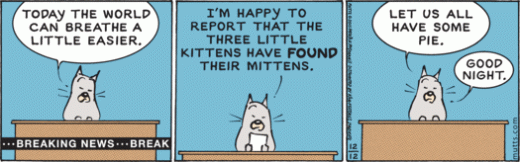
Part of what I watch on cable news is how breaking news stories are handled.  That is why I loved the Mutts series that ran last week.  I have long been a Patrick McDonnell fan following the adventures of Mooch and Earl (I get the new strip emailed to me every morning) closely.  They don’t often make what I would consider political comments unless about the environment but this was such as gentle poke at news coverage, I have to share it.  Here they are:  Monday through Saturday.


mutts1


Day two:

Mutts2


Day three features Mooch as the reporter:

Mutts3


Day four:  The family interview

Mutts4

Day five:

Mutts5


And the happy ending:

Mutts6


Drawings by Patrick McDonnell.

American Terrorists

Try this exercise.  Yesterday morning I thought about terror attacks here in the United States and as the day went on I wrote them down.  I ended up with two lists:  One of Muslim perpetrators, one of white males.  Guess which is longer.  The lists are in no particular order and are by place not shooter.

Muslim Killer:

-Boston Marathon Bombing (one US Citizen, one green card)

-Fort Hood Shooting (US Citizen)

-Chattanooga Recruiter Shooting (US Citizen)

– San Bernardino (one US Citizen, one legal resident)

– World Trade Center


White Male Killer:

– Charleston AME Church

– Oregon Community College

– Aurora, CO movie theater

– Atlanta Olympics (plus his other bombings)

– Colorado Planned Parenthood

– Unibomber

-Murrah Federal Building

-Lafayette, LA movie theater

– Gabby Giffords and others

– Sandy Hook Elementary School

-Columbine

-California McDonald’s

-Texas Tower

– Boston, MA Planned Parenthood


These lists are not the result of any research except to see which Muslim perpetrators were citizens and to confirm the race of the shooters when I wasn’t sure.  I know I haven’t remembered all the incidents as there have been too many.  Some who read this may not remember some of them like the Texas Tower sniper as they are not recent, but I remember them.  I have not included the SDS/WeatherUnderground incidents as I believe the only people killed were the bombers themselves.

Do your own list.  Let me know what I have forgotten.

And most of all, remember this list when Donald Trump and others start talking about excluding Muslims.  Many of the Muslims involved were citizens.  Do you think the way we talk about their religion had anything to do with their becoming violent?Remember who actually dominates these lists.  I am not saying there is no danger from Islamic extremists, but I am saying that our own disaffected white men are also a danger.  Our culture perpetuates violence.  We need make the guns and ammunition less available not scapegoat a particular group and stir up hatred.

Mourners near the Charleston AME Church.

Mourners near the Charleston AME Church.

Photograph:  Travis Dove for The New York Times


The future of the Olympic Games: a permanent site needed

The United States Olympic Committee decided for some reason to pick Boston as the site for their bid.  Boston was a bad idea from the beginning.  Geographically too small, it would have destroyed neighborhoods even if some venues went to other parts of Massachusetts and New England.  From the beginning, it was promised that no taxpayer money would be spent on the Games.  How could that have been?  The Boston public transit system needs desperate upgrades already, and the crush of visitors would have overwhelmed it.  There would have to be investment in commuter rail upgrades to get people to out of town venues.  The final straw was, so it seems, Boston Mayor Marty Walsh refusing to sign a taxpayer guarantee.  Combined with strong opposition it spelled the end.

Hosting the Games has become expensive and disruptive.  Yes, I know there are countries that want the Games, but I worry about Brazil and how they can afford the games.  They will likely end up razing huge swaths of housing, as Boston probably would have done.  Actually, I worry about any place that wants the Games.

So I have a proposal.  Move the Summer Games permanently to Athens.  The facilities there are unused and deteriorating.

IN AN obscure corner of a park sits a forlorn reminder that, 10 years ago, Athens hosted the 2004 Summer Olympics.

The crumbling miniature theatre is inscribed with the words “glory, wealth, wisdom, victory, triumph, hero, labour” — and it is where visiting Olympic officials planted an olive sapling that would bear their names for posterity.

Once a symbol of pomp, the marble theatre is now an emblem of pointless waste in a venture that left a mixed legacy: a brand-new subway, airport and other vital infrastructure that significantly improved everyday life in a city of 4 million, set against scores of decrepit sports venues built in a mad rush to meet deadlines — with little thought for post-Olympic use.

This story is from last year.  And while no one blames the Olympics for the current meltdown of the Greek economy, it couldn’t have helped.

As Greece groans under a cruel economic depression, questions linger as to whether the Athens Games were too ambitious an undertaking for a weak economy. While economists agree it would be unfair to blame Greece’s meltdown on the 17-day Games, the post-Olympic era is seen as a decade of lost opportunities — including failure to significantly boost the country’s sporting culture. It’s a lesson to which Brazil may pay heed, as it races to complete projects ahead of the 2016 Olympics in Rio de Janeiro.

“We didn’t take advantage of this dynamic that we got in 2004,” said former Olympic weightlifting champion Pyrros Dimas, a Greek sporting hero-turned-Socialist member of Parliament.

“We simply made the biggest mistake in our history: We switched off, locked up the stadiums, let them fall to pieces, and everything finished there.”

“We spent a lot of money for some projects (that) are shut and rotting,” said Dimas, who won his last Olympic medal in an Athens arena now reinvented as a lecture and conference venue. “There were projects that should have cost 2 and 3 million (euros) and suddenly became so big that they cost 13 and 14 million. There was no control.”

The latest government estimate sets the final cost of the Games at 8.5 billion euros ($12.2 billion), double the original budget but a drop in the ocean of the country’s subsequent 320 billion-euro ($460 billion) debt, which spun out of control after 2008.

Instead of picking still another host city, pick Athens.  Make it the permanent home of the Summer Games. Greece is, after all, the birthplace of the Olympics.  The countries and cities that would normally spent millions of dollars just preparing a bid could pool that money to fix all the Greek venues.  They can start work anytime.  In fact, maybe the 2020 games (I’m assuming the Brazilians are too far along to cancel now, but maybe not.) scheduled for Tokyo could be moved.  The Japanese probably could use the money for something else – and maybe they could contribute a restoration/redesign to a venue in Athens.  In fact, various countries could take different venues in Greece.  I think that would be real Olympic spirit.  And it couldn’t hurt Greece.

Meanwhile the Boston Games are down the drain.

Boston Globe cartoon by Dan Wasserman.

Boston Globe cartoon by Dan Wasserman.