Gaming doesn’t come to Massachusetts

I have never liked the idea of casinos in Massachusetts.  I remember when they were going to save Atlantic City.  So now there is a nice strip along the boardwalk and the rest of the City and residents are in poor shape.  And resort casinos will have to go through a process including environmental reviews, design reviews, negotiations with the localities where they want to go.  At best, we are a couple of years away from even construction jobs. And with casinos in Rhode Island and Connecticut, are there enough people who want to gamble to create sufficient revenue?

This from the Boston Globe this morning on House Speaker Robert DeLeo

DeLeo initially wanted to authorize two resort-style casinos and license the state’s four racetracks to operate slot machines. He eventually agreed on a bill to allow three casinos and two slot licenses. Patrick said he would sign a bill with only one slot license. After the Legislative session ended Saturday, he withdrew his compromise and sent a bill back that had no slot licenses. The Legislature would have to muster a two-thirds vote to override Patrick. DeLeo said he does not expect a return to session, meaning the bill is likely dead.

The editorial explains it well.

HOUSE SPEAKER Robert DeLeo’s decision to put the needs of the state’s racetracks ahead of all other interests is a staggering example of why voters worry about legislative excesses. His stubbornness has hurt his party and put a governor of his own party in a terrible bind. Thus, it’s a relief that Governor Patrick is standing up forcefully to the speaker, and he must continue to do so.

DeLeo has tried to corner Patrick into approving a gambling bill that allows slot-machine parlors at racetracks, insisting in a statement that a veto would “ “kill the prospects of 15,000 new jobs’’ and money for local aid. But it’s the speaker’s own intransigence that has put at risk the benefits that a more targeted bill could create. Patrick supports the licensing of three resort casinos, which would represent an enormous expansion of gambling in Massachusetts. But DeLeo has deep personal and political connections to the racing industry; his father worked in it, and it’s a major presence in his district. And the speaker was unyielding in demanding that racetrack owners be given special consideration in the gambling bill.

We have had the last couple of House Speakers leave under a cloud.  I can’t believe that Speaker DeLeo would risk even the appearance of a conflict of interest to get the race tracks in his districts slot machines.

I do play the lottery on occasion and I complete  the March Madness bracket every year, but casinos and slot machines have consequences beyond the creation of jobs and revenue for the state.  Thank you to my State Reps, Gloria Fox and Jeff Sanchez and my state Senator, Sonia Chang-Diaz for voting no.  Thank you also to Governor Patrick for standing on principle.

Rebuilding the Longfellow Bridge

During the years I lived in Boston and worked in Somerville, I often took the red line train home in the late afternoon.  You would emerge from underground at the Kendall Square station onto the Longfellow Bridge and a spectacular panoramic view of the Charles River and the Boston skyline.  Often there were boats sailing.  You might see rowers, a Duck Boat Tour, and in the winter, ice forming on the edges of the shore.  The view rarely failed to make me feel better about the day.

Longfellow Bridge

But the bridge is now falling apart and a discussion has begun about how to redesign it.  The bridge will not be widened and there will still be room for inbound and outbound red line trains. 

Eric Moskowitz wrote in the Boston Globe on July 25

But the rebuilding of the Longfellow is about more than saving it from collapse. It comes at a time when key policy makers, from Boston’s mayor to the Obama administration, have pledged to rethink transportation and pull back from decades of favoring drivers and cars over bicycles and walkers.

As a result, the Longfellow has emerged as a touchstone and test case in the debate over urban transportation, with officials, highway engineers, civic leaders, and community advocates grappling over whether to reclaim some of the pavement used by automobiles to make more room for everybody else. It is a thorny issue that remains unresolved even as construction begins on a bridge that is both a treasure to preservationists and a lifeline for thousands who traverse it each day by subway, car, bicycle, and foot.

This is the proposal from the Massachusetts Department of Transportation

 Then the Liveable Streets proposal

You can also see the existing configuration.

Advocates [for the liveable streets alternative] say such a plan would honor a raft of recent policy changes and public pronouncements from leading officials. On his blog in March, US Transportation Secretary Ray LaHood declared “the end of favoring motorized transportation.’’ Mayor Thomas M. Menino, at a bicycle summit, announced to cheers that “the car is no longer king.’’

The advocates note that car traffic on the Longfellow has been steadily declining for a decade, coinciding largely with the opening of the nearby Zakim Bridge. And they point out that traffic adjusted when the Longfellow Bridge’s travel lanes were temporarily closed for safety reasons. Now they see an ideal, highly visible opportunity for permanently taking some of that pavement to encourage more bikers and walkers.

I love the idea of cutting down on car traffic and benches on the walks.  This is a chance to really change the urban environment.

A shot of the Longfellow Bridge on a foggy night in January, 1919.

The Longfellow is named for a pedestrian: poet Henry Wadsworth Longfellow, who regularly walked the earlier West Boston Bridge over the Charles during his long and turbulent courtship of the daughter of a Beacon Hill industrialist. In 1845 he published a poem inspired by those crossings, “The Bridge.’’

First Daughters

If I am not mistaken, John Kennedy, Jr. was the last boy to live in the White House.  Since then we have had the Johnson Daughters, Nixon girls, Amy Carter, Chelsea Clinton, the Bush twins, and the Obama girls.  One could also count Margaret Truman who did live in the White House even though she was in her twenties.  I have to say, that all of the first daughters have done pretty well for themselves.

Lynda Johnson married Charles Robb, a Marine she met while he was assigned to the White House.  Lynda once told some of us that she never thought she was marrying another politician.  She assumed that Chuck would be a career Marine.  [I had the pleasure of working for Governor Robb and knew Mrs. Robb from her work with the Virginia Commission of the Status of Women of which I was a member.]  Tricia Nixon and Luci Johnson opted for quieter lives.  Julie Nixon married an Eisenhower.

Gail Collins has an interesting column in today’s New York Times on the almost eve of Chelsea Clinton’s wedding.

This is hard, let me tell you,” said Hillary Clinton.She was referring to preparations for her daughter’s big day, not high-stakes diplomacy. Although the two might be connected. Maybe the North Koreans threatened to nuke the American-South Korean war games because they thought our country would be easy to bulldoze while the secretary of state was laboring under the stress of wedding planning.

“I was one of those brides of our vintage,” Clinton told me a while back. We are of the same generation, and during her presidential campaign she once said that she was always happy to see me because at least there would be somebody her age on the press plane.

“We agreed to get married one weekend, got married the next weekend,” Clinton reminisced.

Chelsea is definitely going in a different direction. The estimates of the cost of her wedding have all been coming from people who aren’t actually involved in it, but if they get any more grandiose, we will have stories on Fox News about how the ceremony cost more than the national budget of Burundi.

Let her have her day. She’s due. Chelsea has been a national public figure against her will since she was 12, and in all that time she has never embarrassed her family — or us. Before she went off to Columbia to study public health policy, she worked for a New York management consulting firm and a hedge fund where her colleagues unanimously (and off-the-recordly) reported that she was a stupendously hard worker. She recognized early on that when celebrity is thrust on you, the trick is to learn to do something besides being famous.

(Talking to you, Bristol.)

Caroline Kennedy married a non political man just as Chelsea seems to be doing.  But Caroline made an abortive attempt to enter politics as New York Senator, has been campaigning for Obama and may yet have a political future.  Her brother died much too young but I think everyone thought he was planning on entering politics.  It is too early to tell about Chelsea’s political future.

Caroline Schlossberg

Collins talks about Amy Carter

I  always had a feeling that Amy Carter, who was sent to public school in Washington amid a crush of publicity, did not love the experience.But she seemed to be happy at her own wedding in 1996 in the yard of her late grandmother’s house, cutting a wedding cake she had baked herself. The bride wore an embroidered dress from the 1920s. The groom, a computer consultant, wore a ponytail. Her father did not give her away because, as Jimmy Carter told the press, “Amy said she didn’t belong to anyone.”

The Bush twins also turned out well.

Jenna Bush had a few unfortunate brushes with the law during her White House years. But it was nothing that couldn’t have been avoided if the legal drinking age in Texas had been 18. Anyway, she seems to have turned out great. After graduation, she worked for Unicef, taught at an inner-city public school in Washington and wrote a book about a young woman with AIDS in Latin America. She is now a reading coordinator at a school in Baltimore and makes occasional reports on education for “Today.”

Her sister, Barbara, worked at a hospital in South Africa, did educational programming for a museum and now leads a Peace Corps-type organization called Global Health Corps. The twins are only 28, but they already seem to have racked up more good works than Mother Teresa.

Collins concludes

Happy wedding, Chelsea. Excellent job, Bush twins. Good luck, Amy Carter, wherever you are. We are pleased to be a country that produced such nice young adults out of such a lunatic political environment.

Amen.  And good luck to the Obama girls.  I’m sure they will turn out just as well as the other First Daughters.

Race is complicated

3 days ago no one had heard of Shirley Sherrod who turns out to be the wife of Charles Sherrod, a founding member of the Student Nonviolent Coordinating Committee.

The Nation reports on Melissa Harris-Lacewell’s appearance on MSNBC’s Morning Joe.

Up until a few days ago, most of the nation didn’t know who Shirley Sherrod was, but for people who have made a life and a career out of studying civil rights, like Nation columnist Melissa Harris-Lacewell, that name was no news to them. Shirley Sherrod is the wife of Charles Sherrod, a foundational member of the Civil Rights Movement and one of the founders of Student Nonviolent Coordinating Committee (SNCC). Lacewell explains that Sherrod “was not just a bureaucrat working away in Georgia; this is a woman who is part of a family that has made real contributions to advancing the conversation on race in America.”

And even though right-wing blogger Andrew Breitbart only showed a short excerpt of Shirley Sherrod’s NAACP banquet speech and the administration rushed to judgment, Harris-Lacewell told Morning Joe that some good could come out of this scenario. She says that a national conversation on race is a bad idea, but a national classroom on race should be considered. Embedded under all of this mess is a beautiful story of Sherrod, the Spooner Family and interracial cooperation around issues of justice, Harris-Lacewell says. “The real narrative that Ms. Sherrod was telling is the narrative of someone who’s father was killed by the Ku Klux Klan, who developed prejudices and yet found a way through her advocacy and work to be a true advocate for this white farm family.”

And lest we forget, the NAACP also rushed to judgement by first applauding her dismissal.  I guess we can forgive Ben Jealous who is too young to have lived though the SNCC days or the segregated schools attended by Shirley Sherrod.  Did he recognize the last name, I wonder.  The white family she helped, the Spooners, jumped to her defense.

Image: Former Agriculture Department official Shirley Sherrod

For wisdom on this issue, I turn to Eugene Robinson’s column in today’s Washington Post.

After the Shirley Sherrod episode, there’s no longer any need to mince words: A cynical right-wing propaganda machine is peddling the poisonous fiction that when African Americans or other minorities reach positions of power, they seek some kind of revenge against whites.

A few of the purveyors of this bigoted nonsense might actually believe it. Most of them, however, are merely seeking political gain by inviting white voters to question the motives and good faith of the nation’s first African American president. This is really about tearing Barack Obama down.

It looked like a clear case of black racism in action. Within hours, Agriculture Secretary Tom Vilsack had forced her to resign. The NAACP, under attack from the right for having denounced racism in the Tea Party movement, issued a statement blasting Sherrod and condemning her attitude as unacceptable.

But Breitbart had overstepped. The full video of Sherrod’s speech showed that she wasn’t bragging about being a racist, she was telling what amounted to a parable about prejudice and reconciliation. For one thing, the incident happened in 1986, when she was working for a nonprofit, long before she joined the federal government. For another, she helped that white man and his family save their farm, and they became friends. Through him, she said, she learned to look past race toward our common humanity.

In effect, she was telling the story of America’s struggle with race, but with the roles reversed. For hundreds of years, black people were enslaved, oppressed and discriminated against by whites — until the civil rights movement gave us all a path toward redemption.

So why was she forced to pull over and text a resignation?  Robinson explains

The Sherrod case has fully exposed the right-wing campaign to use racial fear to destroy Obama’s presidency, and I hope the effect is to finally stiffen some spines in the administration. The way to deal with bullies is to confront them, not run away. Yet Sherrod was fired before even being allowed to tell her side of the story. She said the official who carried out the execution explained that she had to resign immediately because the story was going to be on Glenn Beck’s show that evening. Ironically, Beck was the only Fox host who, upon hearing the rest of Sherrod’s speech, promptly called for her to be reinstated. On Wednesday, Vilsack offered to rehire her.

Shirley Sherrod stuck to her principles and stood her ground. I hope the White House learns a lesson.

Tom Vilsack, the Secretary of Agriculture has apologized and offered her a job.  President Obama called to apologize.  It seems unlikely at this writing that she will go back to work for the USDA, but one can never tell.

The New York Times story points out

That, however, is unlikely to be the end of it for Mr. Obama, who has struggled since the beginning of his presidency with whether, when and how to deal with volatile matters of race. No matter how hard his White House tries to keep the issue from defining his presidency, it keeps popping back up, fueled in part by high expectations from the left for the first black president, and in part by tactical opposition politics on the right.

The Sherrod flap spotlighted how Mr. Obama is caught between these competing political forces, and renewed criticism from some of his supporters, especially prominent African-Americans, that he has been too defensive in dealing with matters of race — and too quick to react to criticism from the right

“I think what you see in this White House is a hypersensitivity about issues of race, that has them often leaning too far to avoid confronting these issues, and in so doing lays the foundation for the very problem they would like to avoid,” said Wade Henderson, president and chief executive of the Leadership Conference on Civil and Human Rights, an advocacy group here.

I don’t pretend to know what the President should do.  On one hand you have the right including leaders like Newt Gingrich and the Tea Party quick to find reverse racism, i.e. favoritism, is anything that the President tries to do.  It is unlikely that given what is happened Congress will vote to fund the settlement for black farmers denied loans and other benefits for which he requested an appropriation.   The lawsuit was settled in 1999, but farmers have never seen a penny.  According the NPR story, some of them are hopeful that the Shirley Sherrod incident will help move things along, but I am afraid just the opposite will happen.  I hope they are right.

A small group of black farmers rally at the Agriculture Department

The White House may have, as Eugene Robinson hopes, learned the lesson not to react without all the facts.  But I fear that race is still an issue that divides us to the point we can’t talk about it.  During the Lincoln-Douglas debates. the part of Andrew Breitbart/Glenn Beck was played by Stephen Douglas.  Douglas said “I do not regard the negro as my equal, and positively deny that he is any kin to me whatsoever.”  The problem for all the modern day Stephen Douglas’s is that a black man has been elected President.  The problem for Barack Obama is being the first.  And the ultimate irony is that it is almost exactly one year since Henry Lewis Gates was arrested.

The politics of Presidential vacations

If we want to go away for a long weekend, Bob and I just pick the place and book a place to stay or more likely, just tell my sister we are coming up to Vermont.  No politics involved.  But where and for how long a President vacations becomes grist for the political mill.

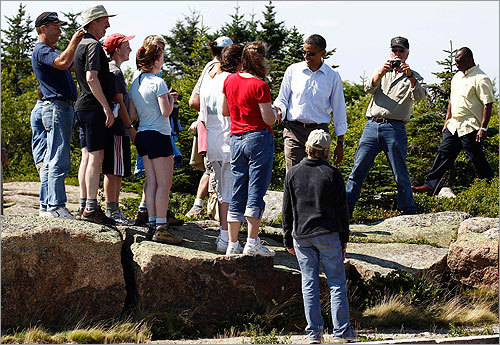
The Obamas walked along a trail with their daughters Sasha, left, and Malia on Cadillac Mountain.

The first family picked Bar Harbor, Maine and Acadia National Park.  But the big flap is that they didn’t go to the Gulf.

In a New York Times “White House Memo”, Sheryl Gay Stolberg wrote

Mr. Obama arrived here Friday for a summer weekend getaway with his wife, Michelle, and their daughters, Malia, 12, and Sasha, 9 — a precursor to a longer family vacation they are planning next month on Martha’s Vineyard. But what sounds like a much-needed family escape from the literal and political heat of Washington to some sounds like hypocrisy to others, given recent statements by both the president and first lady urging Americans to spend their vacation time and money along the shores of the oil-stricken Gulf of Mexico.

“Michelle Obama: Take your Vacation in the Gulf, America — If You Need Us, We’ll be In Maine,” blared the headline on the Web site of Michelle Malkin, the conservative commentator, on Monday, the day Mrs. Obama toured the gulf. ABC News served up similar, if more muted fare: “First Lady Encourages Americans to Vacation on Gulf — But Obamas Head to Maine Instead.”

A trip to the Gulf Coast, of course, would hardly be much of a vacation for Mr. Obama, whose political fortunes were undercut by the spill. But the flap does point up how politically fraught the modern presidential vacation — or, for that matter, presidential leisure time in general — has become.

Of course, if they did go to the Gulf Coast for a vacation scheduling no public events, everyone would be upset by their not having helped clean up a beach or visiting fishermen who are not working because of the spill.  It would not, as the Memo points out, have been a vacation.  This is a trip with their children, Ms. Malkin.  Remember family values?   Both the President and First Lady have gone often to the Gulf and they will be returning many times, I’m sure.

The Memo continues

Bill Clinton and his family traveled to Jackson Hole, Wyo., in the summer of 1996 after polling showed that Americans viewed Martha’s Vineyard as too elitist. George W. Bush caught so much flak for spending a month at his ranch in Crawford, Tex., in the summer of 2001, said his former press secretary, Ari Fleischer, that his staff printed T-shirts listing all the work-related side trips he had taken. Mr. Fleischer may disagree with Mr. Obama’s policies, but he said he was protective of the president’s right to “recharge his batteries” wherever it suited him.

“I just think that people should leave the president alone and not make a political issue of where he takes vacation or how he takes vacation,” Mr. Fleischer said. “He and his family are perfectly entitled to do whatever works for them.”

President Obama greeted people after walking along a trail on Cadillac Mountain.

One thing I have noticed is that President Obama likes ice cream.  He seem to gravitate to ice cream shops wherever he goes.

Once last thing:  While looking through  pictures of the trip to put in this entry, I kept  spotting Reggie Love.  Does he ever get to go on a vacation by himself? 

The pictures are from the Boston Globe and the New York Times.

Queen Elizabeth at the United Nations

On July 6, Queen Elizabeth addressed the General Assembly of the United Nations for eight minutes.  The speech received little of no attention and I wouldn’t even have known about it until I read the most recent Newsweek and Jon Meacham’s very interesting thoughts on the speech.

Queen Elizabeth

First from the New York Times

Queen Elizabeth II addressed the United Nations for the first time since 1957 on Tuesday, paying homage to the organization’s accomplishments since she last stood at the famous green podium of the General Assembly.

It was a brief speech (see text), just eight minutes, assuring that  the queen’s remarks would not join the annals of infamous harangues from the podium delivered by long-reigning leaders like Muammar al-Qaddafi, who spoke for more than 90 minutes last fall, or Fidel Castro of Cuba. It was the first of three public visits during the queen’s daylong stop in New York City.

On her first visit, just four years after she took the throne, the queen came gliding into the United Nations in a black slip dress (or at least it looked black in the rapturous newsreels about the visit), high heels and a fur wrap. There was definitely no need for the fur wrap in the suffocating July heat on Tuesday — the queen wore a flowered suit and a curvy, elegant hat.

If the monarch, now 84, did not exactly sweep through the hall with the same grace as her 31-year-old self, the United Nations building itself looked rather more tattered, only now undergoing its first renovations since it was built around 1950.

So what did Jon Meacham make of the speech?

Given her audience and the constitutional restraints on her role—the personification of political life, she must be above politics—Elizabeth’s brief address could be read as an exercise in ceremonial conventionality. Yet her little-noted remarks offer a meditation on globalism and post-imperialism from a woman whose ancestors ruled much of the world. For American conservatives who worry that President Obama (or, really, any Democratic president) veers dangerously close to “one worldism,” the queen’s speech in New York serves as an inadvertent endorsement of a habit of mind in which power, both military and economic, is best exercised cooperatively rather than coercively. Saluting the U.N.’s diplomatic and relief work, she specifically cited the challenges of terrorism and climate change; the latter is of special concern, she said, for a “careful account must be taken of the risks facing smaller, more vulnerable countries, many of them from the Commonwealth.”

Meacham continues

What she takes very seriously—and I use that “very” advisedly—is the British Commonwealth, the loose association of 54 countries of which she is the titular head. There is no single superpower in her realm; she came to the throne in 1952 in the aftermath of World War II, a conflict in which the U.K. saved freedom but lost an empire. She has spent the last half century offering the Commonwealth a kind of subtle but steady rhetorical leadership—not unlike that provided by the U.N.

In a world of asymmetrical threats—terror, nuclear proliferation, disease, poverty, and climate change—multilateralism is not, to borrow an image from Richard Haass of the Council on Foreign Relations, a policy of choice but of necessity. This does not mean America ought to go limp. Quite the opposite, in fact: the projection of our strength is magnified when we project it in concert with allies, whether through the U.N., NATO, or some provisional force created for a given military or policy purpose.

Foreign-policy doctrines are, in my view, chiefly useful in retrospect, not in real time, for the making of policy is almost always provisional, subject to the forces and the exigencies of a given moment. Which is why if we have to go it alone, we will. We learned how from Elizabeth’s first prime minister, Winston Churchill. But those hours will prove the exception, not the rule.

The rule is a world like Elizabeth’s Commonwealth. And the work endures. Quoting the late U.N. secretary-general Dag Hammarskjöld, the queen said, “ ‘Constant attention by a good nurse may be just as important as a major operation by a surgeon.’ Good nurses get better with practice; sadly, the supply of patients never ceases.”

This quote from Queen Elizabeth sums up what she believes and what I think Barack Obama’s view of diplomacy comes close to

It has perhaps always been the case that the waging of peace is the hardest form of leadership of all.  I know of no single formula for success, but over the years I have observed that some attributes of leadership are universal, and are often about finding ways of encouraging people to combine their efforts, their talents, their insights, their enthusiasm and their inspiration, to work together.

I have to think that the conservative, George W. Bush/Dick Cheney/Tea Party view of the world where the United States is the ultimate power and can just tell other countries what is going to happen is rapidly becoming outdated.  The world is becoming a large democracy with everyone needing to have a say.  We need to listen to the Queen and work together.

Bob Smith, White House Piano Man

Politico.com had this great human interest piece today about Bob Smith who first played at the White House for Richard Nixon, but retired before George W. 

According to Politico

Former White House pianist Bob Smith provided entertainment to presidents, their spouses and guests for more than 30 years. As such, he has plenty of stories to tell — like the one from his White House debut, with the Army Band Chorus, at Tricia Nixon’s 1971 St. Patrick’s Day engagement party. “My Three Sons” star Fred MacMurray arrived at the event seemingly inebriated and took up the saxophone. 

 “He was just horrible. … The most awful thing you heard in your life,” Smith recalled. President Richard Nixon asked Smith to “get rid of him,” and Smith, with help from the Secret Service, complied.

Bob Smith plays the piano.

Made official White House pianist,

…First lady Pat Nixon, Smith said, used to bypass protocol and call him directly on his home phone to ask him personally to play various events—from background music at cocktail parties and receptions, to sitting in as accompanist to a hired musical act.

He later played for and with the Clintons and Gores

Later, he got along great with the Clintons. He and the president bonded over their shared love of playing music. Smith recalled several duets he played with Clinton on sax, an instrument “that was always in reaching distance” of the president.

 He was in with the Gores, too.

 “So while I’m doing saxophone things with [Clinton] at the White House, I’d go over to the vice president’s house, [where] Tipper Gore had her drum set set-up outside in the living room next to the grand piano. She’d come over and say, ‘Can I sit in?,’” Smith recalled. Tipper Gore was a “very good player,” he said.

Over the years, Smith also had numerous interactions with celebrity White House visitors, including Audrey Hepburn and Lena Horne, who sang along while he played. Cary Grant once skipped out of a White House dinner to sit outside the dining room at the piano with Smith. At the actor’s request, Smith said, the two played Cole Porter songs for over an hour.

But the reason he retired is one of the most interesting parts of the story

Smith decided to retire when the Clintons moved out of the White House because, after playing for Bush 41 and spending time with the Bush family, he preferred leave before Bush 43 moved in.

 President George H.W. Bush “was very cool,” Smith said. “But there were too many times where I saw [his son, President George W. Bush,] over that time where he was less than statesmanlike,” he laughed.

Maybe the Obamas should get him out of retirement.


Diversity in the making

I am often amazed when I ride the T at the variety of languages I hear.  I can’t identify them all, but a lot of students will mix in American Slang.  In my office people speak Korean, Spanish, Turkish, Chinese and Vietnamese and I speak a little Japanese.  On my own staff I have Turkish and Spanish.  This is the new Boston.

In the Boston Globe this morning was a story about 27 people who became citizens yesterday on the U.S.S. Constitution.

Yesterday, on the deck of the world’s oldest commissioned warship that is still afloat, on the birthday of the country, the country’s newest citizens — 17 women and 10 men from 20 countries — were the guests of honor. They included a young Moroccan woman who won a visa through the green card lottery and now works as a housekeeper in a Boston hotel; a Brazilian woman from Medford who just finished basic training in the Army National Guard; a Wellesley College human rights leader and Harvard Law School graduate from Sri Lanka; and a husband and wife, born in India, who met at the University of Southern California and now live with their son in Newton.

The immigrants came from Barbados, Brazil, Cameroon, Cape Verde, China, France, Guyana, India, Ireland, Indonesia, Kenya, Liberia, Malaysia, Morocco, Mexico, Nigeria, Russia, Somalia, Sri Lanka, and the United Kingdom.

Lianne Smith and Luke Wanami, who just became a US citizen, left the USS Constitution after the ceremony yesterday.

I know that many people are opposed to immigration reform.  And I don’t deny that these 27 did things right.  But there are many children of illegals who should be granted citizenship if they will serve in the military, the Peace Corps, City Year or go to college.  What the new citizens from the Constitution achieved yesterday, needs to be available to many more.

Retirement at the New York City Ballet: Phillip Neal

Thirty some years ago I was a volunteer at the Richmond Ballet as well as a not so talented adult student who danced mostly for the exercise as well as the friends I made.  We all knew this kid, Phillip Neal, who was extremely talented and a favorite of Arnott Mader who taught us adults as well as the boys.

We watched him grow up. All of us were excited for him when he went to New York to study summers at the American School of Ballet, part of the New York City Ballet.  And one year I one of my volunteer jobs was to sew him into and out of his Prince costume for one of the “Nutcracker” performances.  After he started dancing with NYCB, I would try to get tickets to ballets he performed in the hope that I would hit the correct performance.  I saw him once in “Nutcracker” and once in “Mozartiana”.  I’m sorry I never saw him “Who Cares?”

And now I’m feeling old because after 22 years he has retired.  The New York Times had a review by Roslyn Sulcas of his final performance on June 14.

After the bouquets and flowers from his colleagues, the laughter and hugging and joking, Philip Neal stood alone on the stage, his final performance as a principal dancer with New York City Ballet over. His bearing was that of the danseur noble — upright, shoulders back, head high, one hand placed flat against his heart. As those in the audience rose to their feet, Mr. Neal slowly opened out his arms, his face grave, acknowledging the wave of love and appreciation that flowed over him as tangibly as the confetti that rained from above and the flowers that flew onto the stage.

It was a deeply touching moment, and one that Mr. Neal managed with the same elegance and dignity that he has shown in performances over his 22 years with City Ballet. There was no sobbing, no emoting, just a full and appropriately graceful acknowledgment of the intensity and meaning of the moment.

He was always a quiet, dignified boy.  Unpretentious, but serious.  Polite to all of us ladies who were most likely older than his mother. 

Mr. Neal has never been a flashy dancer, nor has he seemed to particularly seek the limelight. But he has a quiet showmanship, a stylish accomplishment in movement that nonetheless brought the limelight to him, shining on his beautifully honed technique, his impeccable placement and gifts as a partner to countless grateful ballerinas.

Have a great rest of your life staging ballets and living in Florida with your husband.  You haven’t a clue who I am, but like thousands of others I can say it was great watching you dance.  And I’ll also remember that young boy at the Richmond Ballet.