Red Sox, Celtics and Pride Week in Boston

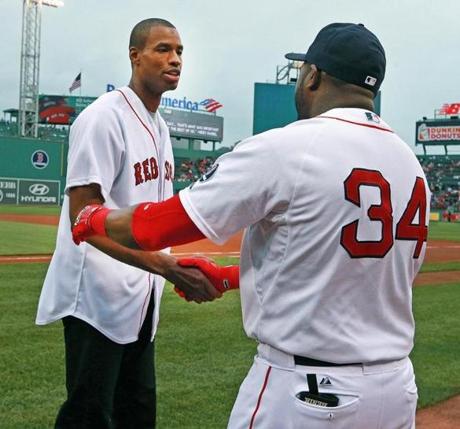
Jason Collins spent time last season with the Boston Celtics (and he might be back next season) before he came out in a now famous Sports Illustrated story.  Last night Collins helped the Red Sox celebrate Pride Night by throwing out the first pitch to Manager John Farrell.  It should be noted that managers rarely do this.

The Boston Globe ran this story from the Associate Press

The 7-foot center was greeted with a nice applause when the PA announcer read the opening of the SI article: ‘‘I’m a 34-year-old NBA center. I’m black. And I’m gay.’’

Wearing a Red Sox jersey with the No. 98 on the back, Collins threw out the first pitch to Red Sox manager John Farrell.

Red Sox slugger David Ortiz feels everyone should support each other based on how they act.

‘‘Nobody knows what is perfect and what is not,’’ Ortiz said, sitting at his locker about three hours before the game. ‘‘If you are respectful and you do what you’re supposed to do, it doesn’t matter what you are and what you come from, people should respect you and love you the same way.’’

Collins wears 98 on his jerseys to honor Matthew Shepard who was killed in 1998, a decision welcomed by Shepard’s parents.

2015 Pride Night at Fenway

2015 Pride Night at Fenway

Hey Danny and Doc, bring him back to the Celtics!

By the way, the Sox won on a walk-off 3 run homer by – David Ortiz.

Photograph Jim Davis/Globe Staff

Baseball and Justice Sotomayor or Flood v. Kuhn revisited

Anyone who loves baseball and history will love this story.  I found it on NPR reported by Nina Totenberg who covers the Supreme Court.  It is about a combination moot court and historic re-enactment.  The case is Curt Flood v. Bowie Kuhn from 1972.  Law school often do this kind of re-enactment, but this one was sponsored by the Supreme Court Historical Society.  Justice Sotomayor presided from the seat of the Chief Justice.

For those who don’t remember, the case was brought by St. Louis Cardinals great Curt Flood, who challenged baseball’s reserve clause — the provision that allowed teams to virtually own players, set salaries and conduct trades, with the players for all practical purposes never able to negotiate freely with other teams. That meant that at the time Flood brought his challenge in 1970, he was earning what was then considered a top salary of $90,000. This, for a player who had signed with the Cards at age 18, with no agent or lawyer, and who in six of the next 12 seasons batted .300 and won seven Gold Glove awards. So, when he was traded to the Philadelphia Phillies, a definitely lesser team at the time, he refused to go, and could not play for any team.

He wrote to the then-baseball commissioner, Bowie Kuhn, protesting that he was “not a piece of property to be bought and sold.” Kuhn denied his request for free agency — a concept unrecognized by baseball back then — and Flood sued, seeking to block the perpetual use of the reserve clause.

Flood lost, but baseball changed forever as the free agency system was put into place anyway.

In 1994, however, nearly two decades after the Flood decision and the ensuing changes in baseball, the owners sought to effectively nullify the free agency system, and the baseball players struck, wiping out the playoffs and the World Series. The National Labor Relations Board went to court, contending that the owners were negotiating in bad faith, and the case came before a young federal district court judge named Sonia Sotomayor.

She agreed that the owners were colluding illegally to fix salaries and granted a temporary injunction barring them from doing that. Sotomayor, a wildly dedicated Yankees fan, issued her opinion in time to allow the new baseball season to begin as scheduled on opening day, with the old baseball contract in effect. She thus earned the title, “the judge who saved baseball.”

The arguments in the re-enactment veered between history and current day baseball.

Representing Flood at the re-enactment was Stanford Law professor Pamela Karlan, a frequent Supreme Court advocate, and ironically, a former Blackmun law clerk. And representing Major League Baseball was another frequent Supreme Court advocate, Roy Englert.

Karlan opened, noting that the Supreme Court’s 1922 and 1953 decisions upholding baseball’s antitrust exemption were outliers and that the court had not permitted such an exemption for any other professional sport.

Sotomayor asked why the court should “break with tradition,” thus depriving the owners of their “reliance” on previous decisions.

Karlan shot back that if the court were to side with the owners for a third time, it would amount to something done in baseball only once before — three errors on a single play.

Sotomayor, with a straight face, opined that the court could apply another baseball rule: three strikes and you’re out.

Karlan, undaunted, replied, “I’m swinging for the fences here, your honor.”

Sotomayor is escorted onto the field by New York Yankees catcher Jorge Posada to throw out the ceremonial first pitch before the New York Yankees game against the Boston Red Sox at Yankee Stadium on Sept. 26, 2009.

The next exchange con free agency and salaries management to get in a dig at Sotomayor’s favorite Yankees.

Sotomayor asked what would happen if the court were to take away the antitrust exemption. Wouldn’t the players move around so much that fans would have no team loyalty?

No, rejoined Karlan, the owners would just have to pay the players what they are worth in order to hold on to them, and instead of year-to-year contracts that leave players with no leverage, the owners would have to negotiate longer-term contracts.

Sotomayor, in mock horror, said that if the antitrust exemption were abolished and owners could no longer collude to set player salaries at will, the Yankees might have to pay Reggie Jackson $1 million a year!

Worse, replied Karlan, would be if the Yanks paid Alex Rodriguez a quarter of a billion dollars not to play.

“I can’t imagine such a thing!” answered a shocked Sotomayor.

Next at bat were the owners.

Next up to the lectern was Roy Englert, representing the baseball commissioner and owners. He noted that some 50 bills had been introduced in Congress over the years to eliminate the antitrust exemption, and none had passed. The court, he said, should leave the question to Congress.

But Sotomayor asked, “Where are the rights of the players?” Quoting Curt Flood, she said that the baseball system was a form of “involuntary servitude” that does not exist in any other industry.

Englert replied that “these young men are making on average $28,000 … as much as Supreme Court justices.” Moreover, unlike other sports, he observed, baseball puts enormous investment into training players in the minor leagues.

The case does involve some serious legal questions, some raised by the decision written by Justice Blackmun.  It appears that Blackmun was reluctant to overturn the prior decisions, but wrote his opinion in such a was that everyone understood that baseball did in fact fall under that anti-trust laws and does engage in interstate commerce.

Justice Sotomayor concluded

‘There are Supreme Court decisions that are wrong,” she said. The court’s 1896 decision upholding segregation was wrong, and the Supreme Court was right to reverse it in 1954. But sometimes, she said, the question is not whether the decision was wrong, but whether this is the right time to overrule it.

Today, she observed, we see as “horrible” the reserve clause that deprived players of any real negotiating power. But at the time, what both sides thought they were arguing about was “the very survival of baseball.”
A little humor for a gray day

It is kind of gray and coolish today the kind of weather that makes you wish that spring would really arrive in New England, that the weather would be a little more consistently 60s and 70s.  So to cheer myself up I put up a new theme.  I’d had the old one for a few years (!) now and it was time for a change.

To go with the new theme, here are 10 Great Headlines which I have copied out of the 2013 Old Farmer’s Almanac.  They were submitted to the Almanac by S.P. of Manchester, NH.

1.  Hospitals Sued by 7 Foot Doctors

2.  Police Begin Campaign to Run Down Jaywalkers

3.  Panda Mating Fails: Veterinarian Takes Over

4.  War Dims Hope for Peace

5.  Astronaut Takes Blame for Gas in Spacecraft

6.  Juvenile Court to Try Shooting Defendant

7.  Something Went Wrong in Jet Crash

8.  New Study of Obesity Looks for Larger Test Group

9.  Cold Wave Linked to Temperatures

10.  Typhoon Rips Through Cemetery; Hundreds Dead.

Cover of the Old Farmer's Almanac.

Cover of the Old Farmer’s Almanac. (Photo credit: Wikipedia)

I was once the headline editor of my high school newspaper so I have a lot of sympathy for those who wrote these.  Which is your favorite?  I’m torn between 7 and 10.


A Nobel Prize Winner and questions about Nagasaki

There was a very interesting profile in the New York Times Science section this week about Osamu Shimomura the Nobel Prize winning chemist.  Never heard of him?  Me either.  It was his life, not his science I found most interesting.  My mother’s family is from a small town near Hiroshima and I grew up knowing about Hiroshima and Nagasaki.

Sixty-eight years ago, Osamu Shimomura was a 16-year-old high school student working in a factory seven and a half miles from Nagasaki, Japan. Sitting down to work, a light flashed, briefly blinding him, and the pressure wave from an explosion came rolling through.

On his walk home from the factory, he was drenched with a black rain. His grandmother immediately had him bathe, most likely saving him from radiation-related illness.

Dr. Shimomura has said that he mostly doesn’t think about the bomb dropped on Nagasaki, but he recently delivered a lecture at the Los Alamos National Laboratory.  Los Alamos is the home of the Manhattan Project and the birthplace of the atomic bombs dropped on Hiroshima and Nagasaki.  The bomb was not the topic of Dr. Shimonura’s lecture.

Instead, he recounted the discovery and development of one of the most significant tools for modern biotechnology: the green fluorescent protein, or G.F.P., used widely in cell and molecular biology as a visual tracer. The discovery, which has deepened the understanding of a wide range of fundamental biological processes, brought him the Nobel Prize in Chemistry in 2008, along with Martin Chalfie and Roger Y. Tsien.

Together with my father who returned briefly from Manchuria in 1939. Front row from left: my mother Yukie, grandmother Tsuki, grandfather Kosaburo, father Chikara, younger brother Sadamu, and myself behind Sadamu, together with my uncle Eijiro Sata's family in back row.

Together with my father who returned briefly from Manchuria in 1939. Front row from left: my mother Yukie, grandmother Tsuki, grandfather Kosaburo, father Chikara, younger brother Sadamu, and myself behind Sadamu, together with my uncle Eijiro Sata’s family in back row.

In his autobiography accompanying his Nobel information, Dr. Shimomura did talk about Nagasaki.

On August 6, 1945, news reports informed us that the city of Hiroshima had been completely destroyed by a new type of bomb; we didn’t know what kind. Three days later, shortly before 11 AM, a siren sounded at the Isahaya factory, notifying us of an air raid. As usual, rather than going into a bunker, I went to the top of a nearby hill with a couple of friends and looked at the sky. We saw a single B-29 going from north to south towards Nagasaki, about 15 km away. I thought that its course was unusual. The B-29 dropped two or three parachutes and I heard sporadic gunshots. Watching carefully, I saw no people attached to the parachutes. Within a few minutes, another B-29 followed the first one, and a siren sounded the “all clear” signal. We returned to our factory building.

At the moment I sat down on my work stool, a powerful flash of light came through the small windows. We were blinded for about 30 seconds. Then, about 40 seconds after the flash, a loud sound and sudden change of air pressure followed. We were sure there was a huge explosion somewhere, but we didn’t know where. The sky was rapidly filling with dark clouds, and when I left the factory to walk home, about three miles away, a drizzling rain started. It was black rain. By the time I arrived home, my white shirt had turned gray. My grandmother quickly readied a bath for me. That bath might have saved me from the ill effects of the strong radiation that presumably existed in the black rain.    The next morning, a technical officer told us that the parachutes we had seen the day before contained measurement instruments and a transmitter. He also mentioned that there was serious damage in Nagasaki, but the details were unknown. The chief of the factory organized a rescue party. We tried to enter Nagasaki, but could not because the roads and the railroad were impassable. Later that afternoon, the railroad was opened to Michinoo, near Nagasaki station, and rescuers began to transport injured people to Isahaya and other cities.

On August 15, in a radio broadcast, Emperor Hirohito declared unconditional surrender. This was the first time that most Japanese citizens had heard the emperor’s voice. I think there was a widespread feeling of relief, and also fear for an uncertain future.    Many years passed before we had detailed information about the atomic bombs that were dropped on Hiroshima and Nagasaki. The Nagasaki bomb was a different type and far more powerful than the Hiroshima bomb. Even if the use of the Hiroshima bomb was justifiable in order to precipitate an end to the war, the bomb dropped on Nagasaki three days later was clearly a test of new arms. It cannot be justified.

It cannot be justified.  I have always had questions about Nagasaki.  Why didn’t the Emperor call for surrender immediately?  Why didn’t we wait a few more days before dropping the second bomb?

The Times story recounts others at the Los Alamos dinner raising the subject.

At a dinner, Bette Korber, a theoretical biologist at the Los Alamos National Laboratory, told of how her father had been on a troop ship preparing for the invasion of Japan. For years, she said, he had credited the decision to drop the bombs with sparing his life. Years later, however, when declassified documents reopened questions about whether the Nagasaki bomb had been necessary to end the war, he was in despair, she said.

Gary Doolen, a physicist who had been a weapon designer at the lab, said there was evidence that the second bomb had been dropped as a demonstration of American power to Russians, who were then massing troops in East Asia.

Dr. Shimomura, tall and stooped, mostly listened.

The next day he and his wife returned to the museum.

…Moments before the Nagasaki bombing, Dr. Shimomura had seen a B-29 bomber drop three parachutes. The drop had puzzled him. He would later learn that they carried instruments for data transmission and measurement.

He asked John E. Pearson, the Los Alamos physicist who had invited him to lecture, about the instruments. After some hunting they found models of the original parachute payloads.

“Some guy came up and started explaining what we were looking at,” said Dr. Pearson. “Osamu said, ‘Yes. I watched them falling.’ I don’t think I’ve ever seen anyone quite as stunned as that guy.”

I wonder what those instruments recorded.  I wonder if the information would be useful as we try to deal with other nuclear disasters.  I wonder if they were destroyed by the bomb.

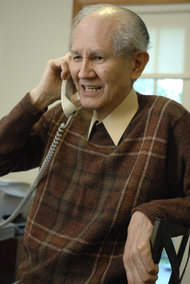
Shimomura

Photograph of the family from Shimomura’s Nobel Autobiography

Photograph of Shimomura Josh Reynolds/Associated Press

Burying the dead

Tamerlan Tsarnaev hijacked a car and kidnapped the owner but did not kill him.  He died in a shootout with police – maybe from gunshots, maybe from his younger brother running over him.  These are facts.  It is likely he set off at least two explosive devices near the finish line of the Boston Marathon.  Either he or his brother shot a MIT police officer in cold blood.  Does this mean he does not deserve to be buried in his adopted hometown of Cambridge?  Or barring that, somewhere in the Boston area.

We have a long history of abusing the bodies of our enemies.  Antigone wants to bury of the body of her brother, Polyneices.  At the beginning of the play named for her, she tells her sister

…they say he [Creon] has proclaimed to the whole town

that none may bury him and none bewail,

but leave him unwept, untombed, a rich sweet sight

for the hungry birds’ beholding.

Antigone is trying to persuade her sister they should commit what we would call civil disobedience and bury Polyneices anyway.

Achilles dragged the body of Hector behind his chariot for days after the Trojan had killed his best friend, Patroclus.  Achilles finally relents to Hector’s father.  We are told that the gods had kept the body from showing signs of abuse.

Adam Lanza, the Newtown shooter, and Albert DeSalvo perhaps the Boston Strangler, were both buried in private cemeteries.  So was Lee Harvey Oswald.

Massachusetts law gives a cemetery the right to refuse burial, but I haven’t seen any stories that discuss how often this right is invoked.  A number of funeral home directors have spoken out saying that the protests outside the funeral home are not right.  The most interesting comment came from a North Carolina Republican who sponsored legislation to limit protests by groups like Westboro Church.

“The family can have peace and say goodbye to their loved ones without hearing screaming and noise,” says North Carolina Republican state Rep. John Szoka, who sponsored a bill this year to strengthen that state’s ban.

Most Americans find the Westboro protests outrageous because they believe deeply in the right of a family to bury their dead and not be challenged about it, Sloane [David C. Sloane, author of The Last Great Necessity: Cemeteries in American History] says.

That’s what makes the protests in Worcester unusual. Tradition dictates that bodies of even the most heinous criminals be given over to the families to deal with in their private grief.

Regardless of his actions, though, a funeral home is not the appropriate place for such public expression of anger, says Szoka, the North Carolina legislator.

“I’m not really in favor of protesting outside funeral homes, no matter how disgusting the individual or whatever he did,” Szoka says. “There are other venues for that.”

Cemeteries in Massachusetts may have the legal right to refuse, but they should think more about why they exist and what their mission is.  The problem they are thinking of is future vandalism.  Another act that most of those protesting would normally find outrageous.

Protesters outside the funeral home.

Protesters outside the funeral home.

As I understand it, Muslim dead, like Jewish dead need to be buried as soon as possible.  They cannot be cremated.  Quite honestly, I think the statements of all the Massachusetts politicians who have spoken including Representative and Senate candidate Ed Markey, Senate candidate Gabriel Gomez, Mayor Thomas Menino and Governor Deval Patrick have been less than worthy of them.  They are behaving like so many Creons.  The Worcester funeral home director, Peter A. Stefan and the Worcester Police Chief Gary Gemme seem to be the only ones actively and constuctively working toward a solution.

Whether Tamerlan Tsarnaev’s body is buried in another state or sent back to Russia, what is going on is not worthy of Massachusetts.  It is not worthy of “OneBoston.”  We are better than this.

Photograph:  AP

Translation of Antigone: Richmond Lattimore

Voting for MVP

As Gary Washburn put it in his Boston Globe column this morning

…this isn’t the Best Player in the Game award, it’s the Most Valuable Player award, and I think what [Carmelo]Anthony accomplished this season was worthy of my vote. He led the Knicks to their first division title in 19 years.

That’s a long time ago.

I have to admit that for some reason I didn’t follow basketball – college or pro – much this past season so I don’t know much about the teams in the playoffs although I know that the Knicks beat the Celtics in the first round.  I also know that I think LeBron James may be a great basketball player, but he has yet to win me over as a human being.  I’m with Cleveland here.

121 votes cast and only one not for LeBron James.   Last night I was listening to the BBC news and even they wanted to know who the voter who didn’t pick James was.  And now we know:  Gary Washburn from the Boston Globe.

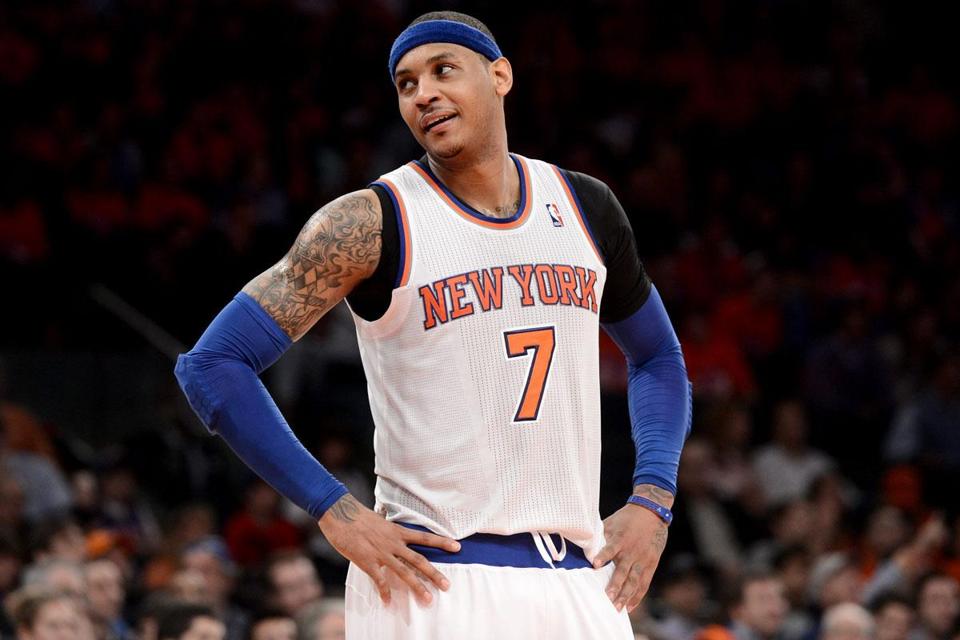
Gary Washburn voted for Carmelo Anthony based on his importance to the New York Knicks

Gary Washburn voted for Carmelo Anthony based on his importance to the New York Knicks

Washburn continued

Anthony led the league in scoring average and basically carried an old Knicks team to the No. 2 seed in the Eastern Conference. Amar’e Stoudemire missed most of the season with knee issues, Raymond Felton missed six weeks, and Tyson Chandler dealt with nagging injuries, leaving Anthony, J.R. Smith, and a bunch of lottery picks from the mid-1990s to win 54 games and beat the Miami Heat three times.

LeBron can win the MVP award every year. He is that good. And it’s to the point where I put him on a Michael Jordan scale. Jordan won five MVP awards but could have earned 10. In the 1992-93 season, Jordan averaged 32.6 points, 6.7 rebounds, 5.5 assists, and 2.8 steals and shot 49.5 percent from the field.

And the MVP award went to Charles Barkley.

So my vote had more to do with Anthony and less to do with the dominance of LeBron. If you were to take Anthony off the Knicks, they are a lottery team. James plays with two other All-Stars, the league’s all-time 3-point leader, a defensive stalwart, and a fearless point guard. The Heat are loaded.

If LeBron was taken away from the Heat, they still would be a fifth or sixth seed. He is the best player of this generation, a multifaceted superstar with the physical prowess of Adonis, but I chose to reward a player who has lifted his team to new heights.

Does James have the other writers so snowed they forgot the meaning of MVP?  Bravo to Gary Washburn!

Photograph:  EPA

If you have a gun…

If you decided to own a gun, you may be certain that you are someone who will store and use it safely, that it will not be used except for (hunting, self-defense, target shooting).  But we are realizing what has probably always been true:  If you own a gun, you really don’t have control over how or when it is used.

We can begin with Columbine.  The weapons used were in a locked gun cabinet broken into by the two teenaged shooters.  I’m sure that the grandfather thought they were safe.  I haven’t seen any stories yet about the Newtown shooter and how he and his mother stored their many guns.  I imagine that she thought they were safe until she was shot with one of them.  Reading the column in the New York Times yesterday by Joe Nocera and listening to the speeches at the NRA convention made me realize that there are parallel worlds here and maybe they will never meet.

Nocera writes about two incidents.  The first happened last year.

On the afternoon of Aug. 7, 2012, Greg Imhoff — a big, friendly 61-year-old construction superintendent from Madison, Wis., who had moved to Florida with his partner, Shari Telvick — went to check on the home of a neighbor.

The neighbor, Richard Detlor, was a friend, someone Imhoff had known back in Madison, where the Detlors still lived for part of the year. Whenever the Detlors went back to Wisconsin, Imhoff would look in on their house, something he did for many of his neighbors.

It is impossible to know whether, on that August afternoon, Imhoff ever saw the stranger in the house with the .22 caliber revolver; all we know for sure is that Imhoff was shot in the head. When Telvick and a friend found him that evening, he was lying in a pool of blood, dead.

The killer turned out to be a man named Billy Ray Retherford, who was on the lam after killing a woman two weeks earlier and was hiding in the Detlors’ empty home. The next day, Retherford was killed in a shootout with the police. He was using the same .22 handgun.

The gun, however, was not his. It belonged to Richard Detlor, who, according to the police report, had left it, loaded, in the nightstand by his bed before departing for Wisconsin several months earlier.

Gregory Imhoff (Photograph from online obituary)

Gregory Imhoff
(Photograph from online obituary)

OK.  So Detlor probably thought the gun was safe even though he didn’t unload it and lock it up.  I know the argument:  If the gun isn’t loaded then it really isn’t any good for self-defense in the case of a home invasion.  Same with trigger locks.  But what about the various technologies that could prevent anyone by Detlor from firing it?  How can one be opposed to that?  Want your wife to be able to use it if you aren’t around?  I don’t know for sure, but I imagine there is technology to allow that, too.  In Florida, safe storage laws apply only when there is a minor in the household so leaving a loaded, unsecured weapon in an empty house is not illegal.  But it is stupid.

And you have the two year old killed by her five year old brother.

Just the other day, in Burkesville, Ky., a 5-year-old boy shot and killed his 2-year-old sister with a small rifle that had been given to him as a present. Who gives a 5-year-old a gun? (The rifle is called a Crickett; incredibly, it is marketed specifically to children.) Who leaves the room where their children are playing without checking whether the rifle in the corner is loaded? For that matter, who puts a shotgun within such easy reach of a child?

Gary White, the county coroner, was quick to say that no charges would be brought because it was an accident — and, after all, “accidents happen.” But it was a completely preventable accident. When a passenger dies in a car accident that is the result of negligence, there are usually serious legal consequences for the driver. If we really want to reduce gun violence, there must be consequences for negligent gun owners, too. The entire culture of gun ownership has to begin emphasizing safety in a way it doesn’t now. It is as important as universal background checks, or limits on magazine rounds.

And her family says that it was an accident and that she is with God.  Gun deaths and hunting accidents may be part of rural life, but does that mean things can never be different?

We are clearly living in a parallel universe and I’m not sure what we can do to make the lines meet.  Perhaps beginning with changes in the laws relating to negligence would be a place to start.

And the question is…

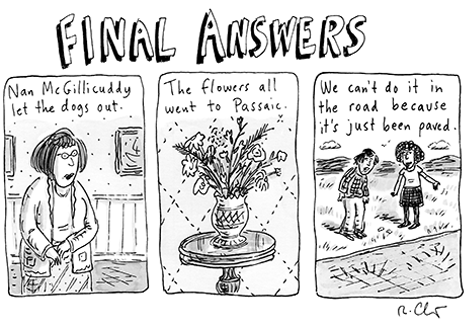
I’m sure that Roz Chast had Jeopardy in mind when she did this cartoon for the April 29, 2013 issue of the New Yorker magazine.

How many can you get?  The answer must be in the form of a question, remember.  The category is Music.

R. Chast, April 29, 2013

R. Chast, April 29, 2013

Bonus points if you get the writer of the song.

One year in Boston

OK.  So maybe we are a little self-absorbed right now what with congratulating each other on how well we survived and how much money we have raised for the victims.  The police are at all the events (Sox, Bruins, etc.) being honored.  And maybe everyone is laughing at us for letting the entire City be locked down for an entire day, but it worked for us.  I can’t imagine it happening in New York or LA or Philly.  Maybe San Francisco.  But Boston is pretty connected and compact and if you shut down the public transit, it gets difficult for many people to move around.  I’m sure someone will do a study on why Bostonians pretty universally listened to Governor Deval Patrick.  I wasn’t even in town and I got an alert voice mail.  Maybe it went on too long, but that’s a judgement call and after the fact.  I have read that the “shelter in place” order was lifted on suggestion from President Obama – which might be true, but I’m not sure at this point.  There are still a lot of rumors flying around and as with Newtown, Sandy, and all the other horrific events, we will know the real story months and even years from now.

I was happy to see Brian McFadden’s take on the situation.

12 Months of Boston

12 Months of Boston

Yes, we are getting back to normal and there will be another Boston Marathon in 2014.  And we will learn the truth about what went on that horrible week.  But for now, the Sox are on a roll, the Bruins are in the playoffs and the Celtics stayed alive for another game.