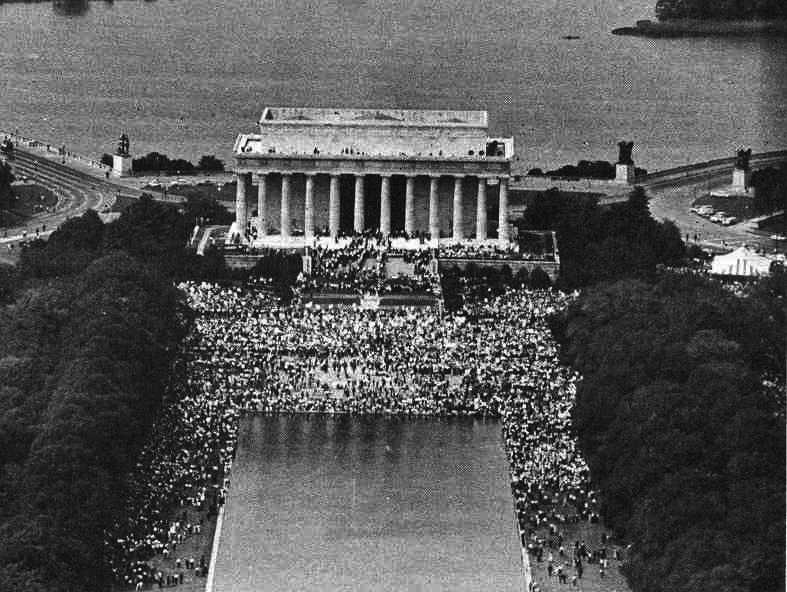
Economic justice and the March on Washington

Correction:  I refer to today as if it were the 28th.  The date I posted this is the 27th.  I seem to not know what day it is!


The official name of the march we celebrate today is the March on Washington for Jobs and Freedom.  Notice what comes first.  Jobs.  And while no one can deny that Martin Luther King, Jr. was a brilliant leader who served as a public face for the civil rights movement, we tend to forget that when he was assassinated in Memphis he was there to support sanitation workers striking for higher wages and employment rights.  Dr. King had moved past the simple movement for integration of public facilities and voting rights to understand that gaining equality meant a great deal more that sitting at a lunch counter or riding in the front of a bus.  Yes, those were monumental achievements, but true equality also means economic justice.

One man to whom we owe the March on Washington 50 years ago today is someone few have heard of:  Asa Philip Randolph.  Jack Curtis celebrated him in last Sunday’s Boston Globe.  The headline and subhead kinda of say it all:

Economic equality: What the March on Washington didn’t win

Fifty years later, why we remember King and not A. Philip Randolph

Rep. Byron Rushing (left) from Roxbury and John Dukakais at the unveiling of the A. Phillip Randolph statue in Boston’s Back Bay Station.

Rep. Byron Rushing (left) from Roxbury and John Dukakais at the unveiling of the A. Phillip Randolph statue in Boston’s Back Bay Station.

Today we can still point to the high unemployment rates, the lack of health care in many places, the failing schools and know that black Americans suffer the most.

The director of the march and its opening speaker, A. (for Asa) Philip Randolph (1889 – 1979) was established by 1963 as the century’s preeminent force on black labor and the dean of American civil rights leaders. Born in Crescent City, Fla., the son of a minister and a seamstress, Randolph moved in 1911 to Harlem, where he became a staunch socialist, a labor organizer, and a renowned soapbox orator. In 1925, Randolph was named the first president of the Brotherhood of Sleeping Car Porters, which he guided for over four decades.

In 1941, Randolph leapt onto the national stage. He and his fellow activist Bayard Rustin initiated what they called the March on Washington Movement, or MOWM, with the goal of staging a massive march to protest racial discrimination in the armed forces and defense industries. An alarmed Franklin Roosevelt summoned Randolph to the White House. Just one week later, Roosevelt issued an order prohibiting workplace discrimination throughout the nation’s defense industries, which led Randolph to call off the scheduled march
MOWM lasted only through 1946. But in the 1960s, as the nation’s African-Americans faced high unemployment and low wages and the country was shocked by violent attacks on civil rights demonstrators in the South, Randolph and Rustin turned to the same organizing tactics. In early 1963, Rustin and three associates addressed a memo to Randolph, then 74, calling for “mass descent” upon Washington, with 100,000 participants protesting “the economic subordination of the American Negro.” They envisioned a groundswell of protest calling for freedom and jobs.  Randolph and Rustin, aided by labor organizers and civil rights activists, organized the march with the dual goals of ending racial segregation and discrimination in the Jim Crow South and achieving economic equality for all Americans.
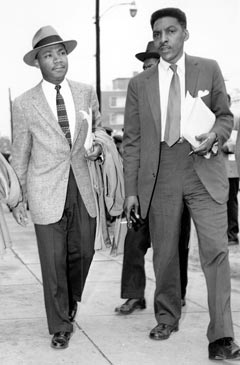
Randolph was a union organizer and Bayard Rustin (someone else you may never have heard of), often called “brother outsider” was a pacifist and gay.  Together they put together the event now best known for Martin Luther King, Jr.’s “I have a dream speech.  Rustin was also a major influence in bringing Dr. King  to embrace non violence.
Bayard Rustin with Martin Luther King, Jr.  in 1956

Bayard Rustin with Martin Luther King, Jr.
in 1956

In February 1956, when Bayard Rustin arrived in Montgomery to assist with the nascent bus boycott, Martin Luther King, Jr. had not personally embraced nonviolence. In fact, there were guns inside King’s house, and armed guards posted at his doors. Rustin persuaded boycott leaders to adopt complete nonviolence, teaching them Gandhian nonviolent direct protest.
Rustin was the speaker who read the list of the marcher’s demands.  You can read or listen to the transcript of Rustin reading the list of the demands in this link from WGBH radio.   They were seen as quite militant and including a living minimum wage. We all recited the pledge that committed ourselves to action.  I think it was in our programs.  (I found my button but so far haven’t located my program.)
As you watch the 50th anniversary coverage, remember A. Phillip Randolph and Bayard Rustin.  Without them, we would not be celebrating this important milestone today,  We can honor them by supporting the continuing fight for economic justice.
Jack Curtis concludes

But King’s emphasis on integration and legal equality gradually came to be seen as the primary impetus for the movement. In the years since, the optimistic and basically patriotic appeal of King’s speech has served to eclipse the march’s agenda and distort the popular understanding of its significant challenge to the status quo. The standard narrative skirts the more controversial, no less patriotic, themes of the march, and the radicalism that was front and center that day.

Randolph’s legacy is not forgotten, including in Boston. In the waiting area of Back Bay Station sits a larger-than life statue of Randolph by sculptor Tina Allen, dedicated in 1988 by Governor Michael Dukakis. Speakers at the dedication ceremony, including state Representative Byron Rushing, hailed the contributions to the railroad industry by porters and waiters from the black community, many of whom had lived in the Roxbury and South End neighborhoods by the station. A quote inscribed in the monument’s base attests to Randolph’s militant stance: “Freedom is never granted; it is won. Justice is never given. It is exacted.”

As we look back over the last 50 years, and look around at a country with rising and racially inflected economic inequality, that revolutionary spirit sits less easily than the hope of King’s “dream speech.” We embrace King’s dream in part because we sense that the country has indeed gone some way down that long road to freedom, and his vision can still set us dreaming and move us forward. But focusing on the demands by Randolph that fell to the wayside, we see even more glaringly that the march’s core aims of economic justice are not close to fruition; even today, we stand at the start of that path. It’s been a long time coming, and it may be a long time yet to come.

Photograph:  Randolph Statue John Tlumacki/Globe staff
Photography:  Rustin and King Associated Press

Voting rights: 2013

This Brian McFadden cartoon seemed appropriate for posting as people are Marching on Washington for Jobs and Freedom once again.

mcfadden voting

Justice Ruth Bader Ginsberg has it right in her dissent from the recent decision:  Why would we want to do away with something that is working?

The world loses two jazz greats

One played the piano and hosted a wonderful radio show; the other was a writer who wrote about jazz and blues (among many other things) and whose prose style was said to reflect those musical styles.  Marion McPartland was 95; Albert Murray, 97.

Marion McPartland was a white English woman in the world of American jazz first coming to New York in 1964.  Her New York Times obituary quotes the critic Leonard Feather

“Oh, she’ll never make it: she’s English, white and a woman.”

Mr. Feather, she [McPartland] added, “always used to tell me it was a joke, but I don’t think he meant it as a joke.”

Little did he know.  After many several years  of touring with her husband, Jimmy McPartland’s group, she struck out on her own.

The bare-bones accompaniment of bass and drums was always Ms. McPartland’s preferred format, but she also appeared in concert with symphony orchestras, and in 1996 she recorded an album of her own compositions, “Silent Pool,” on which she was accompanied by a string orchestra.

Marian McPartland, who became an articulate spokeswoman for jazz, and the jazz trumpeter Roy Eldridge around the 1950s.

Marian McPartland, who became an articulate spokeswoman for jazz, and the jazz trumpeter Roy Eldridge around the 1950s.

But what she will most be remembered for in the United States is “Piano Jazz”.

Ms. McPartland’s contributions to jazz were not limited to her piano playing. An enthusiastic and articulate spokeswoman for the music, she lectured at schools and colleges and wrote for Down Beat, Melody Maker and other publications. (A collection of her essays, “All in Good Time,” was published in 1987 and reissued in 2003.) Most notably, for more than 30 years her “Piano Jazz” was one of the most popular jazz shows ever on the radio.

The show, produced by South Carolina’s public radio network, made its debut on NPR in 1978. The format was simple: an informal interview interspersed with extemporaneous duets.

“I didn’t have any idea I’d be good at something like this,” Ms. McPartland told The Associated Press in 2000. “I certainly never thought people would know me because of my voice.” But she proved a natural.

As its title suggests, “Marian McPartland’s Piano Jazz” was originally a show about piano players. But the guest list came to include vocalists, among them Mel Tormé, Tony Bennett and even Willie Nelson and Elvis Costello, as well as trumpeters, saxophonists and other instrumentalists.

I listened on the radio and in recent years often streamed it though headphones at work.  She was understated in her interview style and never got too tangled in the technical aspects of the music she and her guest were performing.  Her voice was instantly recognizable.

In her last years Ms. McPartland received numerous honors. She was named a National Endowment for the Arts Jazz Master in 2000, given a lifetime achievement Grammy Award in 2004, inducted into the National Radio Hall of Fame in 2007 and named a member of the Order of the British Empire in 2010.

And she continued playing almost to the end. Reviewing her appearance at Dizzy’s Club Coca-Cola in Manhattan the night before her 90th birthday in 2008, Nate Chinen wrote in The Times, “Ms. McPartland still has her pellucid touch and her careful yet comfortable style.”

Albert Murray was not a musician.  In fact he was about as different from Marion McPartland as one could be.  Murray was black (a term he disliked), he was born in the segregated American south, and he was an academic.  The New York Times said in his obituary

As blacks fought in the streets for civil rights, black integrationists and black nationalists dueled in the academy and in books and essays. And Mr. Murray was in the middle of the debate, along with writers and artists including James Baldwin, Richard Wright, Romare Bearden and his good friend Ralph Ellison.

One of his boldest challenges was directed toward a new black nationalist movement that was gathering force in the late 1960s, drawing support from the Black Panthers and the Nation of Islam, and finding advocates on university faculties and among alienated young blacks who believed that they could never achieve true equality in the United States.

With a freewheeling prose style influenced by jazz and the blues — Duke Ellington called him “the unsquarest man I know” — Mr. Murray challenged conventional assumptions about art, race and American identity in books like the essay collection “Stomping the Blues” and the memoir “South to a Very Old Place.” He gave further expression to those views in a series of autobiographical novels, starting with “Train Whistle Guitar” in 1974.

Mr. Murray insisted that integration was necessary, inescapable and the only path forward for the country. And to those — blacks and whites alike — who would have isolated “black culture” from the American mainstream, he answered that it couldn’t be done. To him the currents of the black experience — expressed in language and music and rooted in slavery — run through American culture, blending with European and American Indian traditions and helping to give it its very shape and sound.

“The United States is not a nation of black and white people,” Mr. Murray wrote. “Any fool can see that white people are not really white, and that black people are not black.” America, he maintained, “even in its most rigidly segregated precincts,” was a “nation of multicolored people,” or Omni-Americans: “part Yankee, part backwoodsman and Indian — and part Negro.”

Albert Murray in his home in Harlem in 1998

Albert Murray in his home in Harlem in 1998

He wrote often about blues and jazz as part of the American culture.

In Mr. Murray’s view, the essential bond between American culture and what he called Negro culture is the shared embrace of a “blues aesthetic,” which he said permeated the works of black musicians, writers and artists and was being increasingly adopted by whites. To Mr. Murray, the blues were “the genuine legacy of slavery,” Laura Ciolkowski, a professor of literature now at Columbia University, wrote in The New York Times Book Review in 2002.

“For him,” she wrote, “blues music, with its demands for improvisation, resilience and creativity, is at the heart of American identity.”

In “Stomping the Blues” (1976), he argued that the essence of the blues was the tension between the woe expressed in its lyrics and the joy infusing its melodies. He saw the blues, and jazz, as an uplifting response to misery.

“The blues is not the creation of a crushed-spirited people,” Mr. Murray said years later. “It is the product of a forward-looking, upward-striving people.”

He next began a long collaboration with Count Basie on his autobiography, “Good Morning Blues,” which was published in 1985, a year after Basie’s death. Along with the writer Stanley Crouch and the trumpeter Wynton Marsalis, Mr. Murray was actively involved in the creation of Jazz at Lincoln Center, the institution’s first permanent jazz program.

Murray tried to help us understand that our American culture is not purely one thing or another, but a mix.  That mix is what makes us different from any other country in the world.

I couldn’t find any mention of a meeting between McPartland and Murray, but I can’t imagine that they never met.  I hope they are with the other jazz and blues performers and critics gone before them talking and improvising.

Photograph of Marion McPartland:  Bob Parent/Getty Images

Photograph of Albert Murray:  Suzanne Mapes/Associated Press

Richard the Third – still controversial – updated

King Richard III was a polarizing figure during and after his brief reign over England and he continues to generate controversy still.

You may remember that his bones were found in a Leicester parking lot last year and confirmed to be his earlier this year.  The discovery and my subsequent re-reading of Josephine Tey’s “The Daughter of Time” were subjects for several posts.  Now Leicester and York are in court fighting over where to bury his bones.  The New York Times story appeared yesterday.

As if 500 years of ignominy lying in a grave hastily dug after his defeat in battle were not enough, King Richard III now faces a new battle in the English courts over which of two cities, Leicester or York, will be his final resting place.

A high court judge in London, Charles Haddon-Cave, ruled on Friday that a group backing York’s case, called the Plantagenet Alliance and involving several distant relatives of the slain monarch, could take legal action against the government and the University of Leicester.

The university has laid plans for Richard’s reinterment in Leicester based on a government license that authorized the dig that found the remains. The license specified that the university should decide where the dead king’s remains, if found, should be reburied.

The skeleton of King Richard III was unearthed beneath a municipal parking lot late last year.

The skeleton of King Richard III was unearthed beneath a municipal parking lot late last year.

The plans for a tomb in the near-by Leicester Cathedral and a visitor center began shortly after the remains were discovered.

But in the case heard in London, York’s champions argued that Leicester was never more than a waypoint for Richard on his last night before the Battle of Bosworth Field on Aug. 22, 1485, 20 miles from Leicester. They contend that the slain king’s ancestral home, and the place he had designated as his preferred burial place, was York. They have described Leicester’s haste to lay permanent claim to Richard as a “hijack,” prompting some in the Leicester camp to retort, tartly, that king or not, it is a case of “finders keepers.”

The link with York was underscored by no less an authority than Shakespeare, who began his play “Richard III” with a monologue in which the future king, speaking as the Duke of Gloucester before the tortuous events that would make him monarch, speaks of his older brother, Edward IV, in one of the playwright’s most quoted lines, as a Yorkist. “Now is the winter of our discontent/Made glorious summer by this son of York,” Richard says, before laying out the treacherous schemes that form the webbing of Shakespeare’s work.

It is all quite wonderful.  Maybe the War of the Roses will begin again.

In his ruling on Friday, Judge Haddon-Cave urged Leicester and York to settle the case out of court and to not renew the animosities that drove the 15th-century period known as the Wars of the Roses, between two rival branches of the Plantagenet dynasty, the houses of York and Lancaster. The hostilities ended with Richard’s defeat at Bosworth Field, which gave rise to the Tudor kings under the Bosworth victor, Henry Tudor, who became Henry VII.

“In my view, it would be unseemly, undignified and unedifying to have a legal tussle over these royal remains,” the judge said, appealing to the two sides to avoid engaging in a “Wars of the Roses, Part 2.”

He added that it was inevitable that the question of Richard’s final burial place should arouse “intense, widespread and legitimate public interest” since it involved “the remains of a king of England of considerable historical significance, who died fighting a battle which brought to an end a civil war which divided this country.”

It will be interesting to see where Richard ends up.  Maybe he can be buried in London in Westminster Abbey as a compromise.  And according to the BBC, there are seven other kings (well, six kings and a ruler) whose burial places are unknown.  They are:  Alfred the Great, Harold II, Henry I, Stephen, Edward V, Oliver Cromwell, and James II.  Some one needs to get to work!

UPDATE:  The New York Times reported on May 24, 1014

A British court ruled on Friday​ that King Richard III should be ​re​buried in a cathedral in Leicester,​ the city​ where his remains were found in a parking lot two years ago. The ruling was a defeat for the king’s descendants​ who wanted his remains to be reburied in York,​ arguing that he had spent ​much of his life there. But archaeologists who discovered the king’s remains decided to keep the body in Leicester, a decision backed by Britain’s Justice Ministry. The judges said, ​”There were no public law grounds for the court interfering with the decisions in question.”

Photograph: Getty Images

The 1963 March on Washington for Jobs and Freedom: My memories

Fifty years ago I was a sixteen year old high school student living in New Jersey.  My parents were community activists and very politically involved.  My mother and several of her friends decided to go to Washington for the march and took me and several of my high school friends.  I know there was some discussion about whether the march would turn violent and some calls were made (and long distance was a big deal back then) to my uncle who lived in D.C.  He must have reassured them and said that he had signed up to make sandwiches to give out to people who didn’t bring their own.  I remember being impressed because he was still a bachelor and, as far as I knew, wasn’t much of a cook.

So we kids were allowed to go along.  I remember the bus ride as long and the bathrooms at the Maryland House really horrible.  When we got to Washington, we asked to go off on our own and set off with a thermos jug of ice water (No bottles of water back then, just a jug and paper cups)  and some bags of oranges and peanut butter and jelly (they wouldn’t spoil in the hot weather) and set off.  It was an interesting little group:  me (Japanese American), at least one African American girlfriend, and several white American boys.  We wormed our way toward the front of where the march was to start instead of going to the end.  I remember people shouting and seeing the folks from the famous picture of the front of the march go by.  We fell in behind them.  I later learned that some people had already started marching and the dignitaries were trying to catch up.

Baez and Dylan

Baez and Dylan

Once we got to the Lincoln Memorial, we first found a spot to sit near some trees, but we soon moved closer to the Reflecting Pool so we could see better.  As it got hotter, and it was very hot,  we joined many by putting our feet in the pool.  We were pretty close to the front, close enough to see Joan Baez and Bob Dylan as well as Marion Anderson and Mahalia Jackson.  We heard rumors that President Kennedy was going to come join us.

I’ll be honest and say that there were a lot, a huge number, of speeches.  I don’t remember very many of them, to be honest.  I know that I was excited to hear and see Myrlie Evers, Rosa Parks and Daisy Bates as part of a tribute to women of the Movement.  But the speech that I remember best was not the famous one given by Martin Luther King, Jr.  The one I remember most clearly was given by John Lewis.   I think that was because he was with the Southern Student Non-Violent Coordinating Committee and I had met SNCC organizers.  Also he was young and had been arrested many times.  I had no idea at the time the speech was given that it had been censored, but it was still the most militant speech given that day.  He ended

To those who have said, “Be patient and wait,” we must say that we  cannot be patient. We do not want our freedom gradually but we want to  be free now.

We are tired. We are tired of being beat by policemen. We are tired of  seeing our people locked up in jail over and over again, and then you  holler “Be patient.” How long can we be patient? We want our freedom and  we want it now.

We do not want to go to jail, but we will go to jail if this is the  price we must pay for love, brotherhood and true peace. I appeal to all  of you to get into this great revolution that is sweeping this nation.  Get in and stay in the streets of every city, every village and hamlet  of this nation until true freedom comes, until a revolution is complete.  We must get in this revolution and complete the revolution. In the Delta  of Mississippi, in Southwest Georgia, in the Black Belt of Alabama, in  Harlem, in Chicago, Detroit, Philadelphia and all over this nation the  black masses are on a march for jobs and freedom.

John Lewis at the Lincoln Memorial, 1963

John Lewis at the Lincoln Memorial, 1963

They’re talking about slow down and stop. We will not stop. All of the  forces of Eastland, Barnett, Wallace, and Thurmond will not stop this  revolution. If we do not get meaningful legislation out of this  Congress, the time will come when we will not confine our march into  Washington. We will march through the South, through the streets of  Jackson, through the streets of Danville, through the streets of  Cambridge, through the streets of Birmingham. But we will march with the  spirit of love and with the spirit of dignity that we have shown here  today.

By the forces of our demands, our determination and our numbers, we  shall send a desegregated South into a thousand pieces, put them  together in the image of God and Democracy. We must say wake up America,  wake up! For we cannot stop, and we will not and cannot be patient.

I still carry that image in my mind.  A young black man thundering, “We want our freedom and we want it now.”   But if he had included words he had wanted to include it is likely that the microphone would have been cut off.  The original text included

I want to know, which side is the federal government on?

The revolution is at hand, and we must free ourselves of the chains of  political and economic slavery. The nonviolent revolution is saying, “We  will not wait for the courts to act, for we have been waiting for  hundreds of years. We will not wait for the President, the Justice  Department, nor Congress, but we will take matters into our own hands  and create a source of power, outside of any national structure, that  could and would assure us a victory.”

At sixteen those words would have sounded so much better than “I have a dream.”

View of the Lincoln Memorial

View of the Lincoln Memorial

I think this was taken relatively early in the day.  My friends and I were at the pool on the left, not too far back and for all I remember, we might already have been there when this was taken.

It was a long ride back to New Jersey and it turned out that I had heat exhaustion, but it was worth it to have been part of history.

There were about 250,000 people there and probably many more will claim that they were there, but I really was.  It was my first large demonstration, but by the time the War in Vietnam was winding down, I was a veteran at these events.  I’m not planning on attending the 50th Anniversary March this year, but I will be there in spirit.

Photograph:  Baez and Dylan uncredited from Wikipedia

Photograph:  John Lewis  Bettmann/ Corbis

Photograph:  Lincoln Memorial  Miles Hodges, Kingsacademy.com

A cautionary tale

Some Republicans want to pass a comprehensive immigration bill and some voted to do so in the Senate.  And now two of them, Marco Rubio and Lindsey Graham, will likely have challengers from the Tea Party wing.  Which brings me to the cautionary tale.  They should read some history and look at what happened to the Federalist Party.  They could begin by reading the very interesting piece in yesterday’s New York Times by James Traub.

Tea Partyers often style themselves as disciples of Thomas Jefferson, the high apostle of limited government. But by taking the ramparts against immigration, the movement is following a trajectory that looks less like the glorious arc of Jefferson’s Republican Party than the suicidal path of Jefferson’s great rivals, the long-forgotten Federalists, who also refused to accept the inexorable changes of American demography.

The Federalists began as the faction that supported the new Constitution, with its “federal” framework, rather than the existing model of a loose “confederation” of states. They were the national party, claiming to represent the interests of the entire country.

Culturally, however, they were identified with the ancient stock of New England and the mid-Atlantic, as the other major party at the time, the Jeffersonian Republicans (no relation to today’s Republicans), were with the South.

John Quincy Adams portrait. "John Quincy ...

John Quincy Adams portrait. “John Quincy Adams”. Metropolitan Museum of Art . . Retrieved September 4, 2009 . (Photo credit: Wikipedia)

And then came the Louisiana Purchase.

“The people of the East can not reconcile their habits, views and interests with those of the South and West,” declared Thomas Pickering, a leading Massachusetts Federalist.

Every Federalist in Congress save John Quincy Adams voted against the Louisiana Purchase. Adams, too, saw that New England, the cradle of the revolution, had become a small part of a new nation. Change “being found in nature,” he wrote stoically, “cannot be resisted.”

But resist is precisely what the Federalists did. Fearing that Irish, English and German newcomers would vote for the Jeffersonian Republicans, they argued — unsuccessfully — for excluding immigrants from voting or holding office, and pushed to extend the period of naturalization from 5 to 14 years.

They even thought about separating New England from the rest of the country.

,,,in the fall of 1814, the Federalists convened the Hartford Convention to vote on whether to stay in or out of the Union. By then even the hotheads realized how little support they had, and the movement collapsed. And the Federalists, now scorned as an anti-national party, collapsed as well.

Contrast that defiance with Jefferson’s Republicans, who stood for decentralized government and the interests of yeoman farmers, primarily in the coastal South.

They ruled the country from 1801 to 1825, when they were unseated by Adams — who, after splitting with the Federalists, had joined with a breakaway Republican faction.

In response, Jefferson’s descendants, known as the Old Radicals, did exactly what the Federalists would not do: they joined up with the new Americans, many of them immigrants, who were settling the country opened up by the Louisiana Purchase.

Their standard-bearer in 1828, Andrew Jackson, favored tariffs and “internal improvements” like roads and canals, the big-government programs of the day. The new party, known first as the Democratic-Republicans, and then simply as the Democrats, thrashed Adams that year. (Adams’s party, the National Republicans, gave way to the Whigs, which in turn evolved into the modern Republican Party.)

Will the Republicans disappear like the Federalists?  Traub doesn’t think so.  But hey are, like the Federalists, on the wrong side of history.

Digging in Boston

Nothing new here you might think.  Someone is always digging up a street, a hole for a foundation, or for planting in the park across my street.  But I’m talking about a different kind of digging.  Think Indiana Jones.  Boston City Archeologists have been digging in a backyard in the North End of Boston this summer.  Think Old North Church, Paul Revere, and lanterns.

The dig followed a decision by the Old North Church, which owns the Clough House, to build a new public walkway to the rear of the home. Under its deed, the patch of land must be studied by archeologists before work can proceed.

The city offered to do the dig for free, Bagley [City archeologist, Joseph] said, in a section of church property where archeologists had never dug before. “We knew we would find stuff back here, but we never expected to find so much stuff from the 1700s,” Bagley said.

I first learned about the dig a couple of weeks ago in an email newsletter from the City.  And I found out that archeology program has a Facebook page where they have been posting nice pictures of pottery shards.  The Boston Globe ran a story yesterday explaining more about the dig.

“This whole backyard was a trash dump,” city archeologist Joseph Bagley said, smiling as he walked gingerly around the site. “And back in the day, I think the backyard would have been just disgusting.”

In other words, perfect.

During two weeks of digging, Bagley and a crew of volunteers collected tens of thousands of items from the 1700s. The haul included long-ago leftovers of everyday life: animal bones, doll parts, and uncounted chips and fragments of dishes and cups that archeologists hope will reveal more about how Bostonians lived as a bustling city sprang up around them.

North End map

If you have ever visited the North End, you know that every square inch seems to be developed so an undisturbed backyard is very unusual.

The household debris came from a home built around 1715 by master mason Ebenezer Clough, who bought open land down the slope from Copp’s Hill. Clough also helped construct the Old North Church, which opened only steps away in 1723.

“He wasn’t hurting, but he wasn’t rich,” Bagley said of the mason.

The home, originally two stories, was passed down through the family and later used by a merchant, then a mariner, and finally a glazier before being expanded to three stories and converted into a tenement about 1808.

So far no Ark of the Covenant has been uncovered, but we will learn a great deal about life in Boston in the 18th Century.

This beautiful piece of pink-bodied tin glazed ceramic was just washed. It dates to the 18th century and was found 70-80 cm down during the Clough House dig

This beautiful piece of pink-bodied tin glazed ceramic was just washed. It dates to the 18th century and was found 70-80 cm down during the Clough House dig

Photograph:  City of Boston Archeology Program

American defectors: life for Edward Snowden in Russia

Now that Edward Snowden has been granted temporary asylum in Russia (I suspect they mostly just wanted him gone from the airport.), it is not so certain he will have an easy life.  No matter how terrible you think surveillance is in the United States, I can guarantee that it is worse there.  And he likely has nothing more to trade to get better treatment.  NPR ran this story a few days ago.

If NSA leaker Edward Snowden is allowed to leave the Moscow airport and enter Russia, as some news reports suggest, he’ll join a fairly small group of Americans who have sought refuge there.

So how did it work out for the others?

In short, not so well. Some became disillusioned and left, like Lee Harvey Oswald. Others were sent to Josef Stalin’s gulags, where they served long sentences or were executed. Some lived out their days in an alcoholic haze.

“There’s little evidence from historical records that [Snowden] has anything good to look forward to,” says Peter Savodnik, a journalist and author of the upcoming book, The Interloper: Lee Harvey Oswald Inside the Soviet Union. “Essentially, nobody from the U.S. who has defected to Russia has gone on to think that’s a smart decision.”

In the 1920s and ’30s, hundreds of American leftists moved to what was then the Soviet Union, motivated by a desire to build socialism.

Alexander Gelver of Oshkosh, Wis., was taken there by his parents. But when the 24-year-old wanted to return to the U.S., he was stopped by Soviet police outside the U.S. Embassy in Moscow. He was arrested and disappeared. Only in the 1990s did his fate become clear: He was executed in 1938, one of Stalin’s many victims.

The Associated Press documented the case of Gelver and 14 other Americans who disappeared in the Soviet Union in the 1930s and ’40s. All were either imprisoned or executed. Dozens, perhaps hundreds of other Americans, met a similar fate during the rule of Stalin, who suspected that foreigners were spies.

A famous case in the Cold War era has parallels to Snowden. William Martin and Bernon Mitchell, cryptologists at the NSA, defected in 1960. But they came to regret their decision and became alcoholics. Martin died in Mexico in 1987. Mitchell died in Russia in 2001.

One defector who did return was Oswald. He left for the Soviet Union in 1959, returned to the U.S. three years later, and became infamous as the assassin of President Kennedy in 1963.

Edward Snowden, the NSA leaker seen here in a photo taken in July, has been granted temporary asylum in Russia. Thursday, he left Moscow's airport for the first time in more than a month.

Let’s hope that Snowden has better luck.  It will be tough not knowing many people and not speaking Russian.  Personally, I don’t think he made a good choice or got good advice.  I have never understood why he couldn’t go directly from Hong Kong to South American someplace.

Photograph:  Tatyana Lokshina/AP

On the opposite sides of the Civil Rights struggle: Lindy Boggs and Robert Byrd, Jr.

This week has brought notice of the death of two political figures from the past:  Lindy Boggs and Harry Byrd, Jr.  Both in their late 90s and had been out of office and out of the news for a number of years.  But it is notable that although of similar age and from the south, they were opposites when it came to civil rights.

Lindy Boggs was the window of House Speaker Hale Boggs who died in a plane crash in Alaska.  I remember when this happened in 1972,  I was moving out of my student movement phase and beginning to take an interest in electoral politics. Boggs ran to replace him following a tradition of widows taking over for their politician husbands.   Boggs, however, was different.  She went on to serve nine terms in Congress (several of them representing a majority black district) and become a champion of women’s rights and civil rights while representing Louisiana.  The New York Times describes some of her legislative efforts.

Mrs. Boggs during her Congressional campaign in 1973

Mrs. Boggs during her Congressional campaign in 1973

The velvet Southern charm she had absorbed growing up on two Louisiana plantations was her not-so-secret weapon.

She displayed it early in her first term when the House banking committee was composing an amendment to a lending bill banning discrimination on the basis of race, age or veteran status. She added the words “sex or marital status,” ran to a copying machine and made a copy for each member.

In her memoir she recalled saying: “Knowing the members composing this committee as well as I do, I’m sure it was just an oversight that we didn’t have ‘sex’ or ‘marital status’ included. I’ve taken care of that, and I trust it meets with the committee’s approval.”

Thus was sex discrimination prohibited by the Equal Credit Opportunity Act of 1974.

I always loved that story.

Mrs. Boggs used her membership on the Appropriations Committee to push for other women’s economic concerns, like equal pay for government jobs and equal access to government business contracts. She became a champion of historic preservation and port development, flood control and housing in her New Orleans district.

Mrs. Boggs championed racial justice at a time when doing so invited the resentment if not hostility of most Southern whites. She saw the growing civil rights movement as necessary to the political reform movement of the 1940s and ’50s.

“You couldn’t want to reverse the injustices of the political system and not include the blacks and the poor; it was just obvious,” she said in 1990.

While her husband was in office, she supported civil rights legislation as well as Head Start and antipoverty programs. As the president of two organizations of Congressional wives, she saw to it that each group was racially integrated.

She has been honored by the House with the naming, in 1991, of the Lindy Claiborne Boggs Congressional Women’s Reading Room.  She was 97 when she died.

At the other end of the civil rights spectrum is Harry Byrd, Jr., the long time Senator from Virginia, and not to be confused with Robert Byrd of West Virginia.  When I moved to Virginia in 1965, Byrd was my Senator.  He had just been appointed to replace his father who had died.  The Byrd Machine ruled Virginia Democratic State politics at the time and both Byrds worked hard to maintain segregation in Virginia schools.  The New York Times writes

Even as a middle-aged man, Mr. Byrd was often called “Little Harry” or “Young Harry.” By the 1920s, his father, Harry F. Byrd Sr., had built a formidable Democratic political machine in Virginia that eventually elected him governor and then to the Senate, where he served from 1933 until his resignation in 1965. (Like his son, Harry Sr. was initially appointed to the Senate to fill a vacancy, after the resignation of Claude A. Swanson.)

The elder Mr. Byrd was a conservative Democrat who served for 11 years as chairman of the Senate Finance Committee. He also supported “massive resistance,” the name given to Virginia’s opposition to public school desegregation in the late 1950s. The son, who was serving in the State Senate at the time, helped develop the policy, which included closing some schools for several years rather than integrate them.

Harry F. Byrd  in 1965, when he was appointed to his father’s seat

Harry F. Byrd in 1965, when he was appointed to his father’s seat

Moorestown, N.J. where I was living as a teenager was one of the northern towns that hosted African-American high school seniors so they would have a chance to get diplomas and go to college.  I went to a number of social activities that were hosted for them, but never, much to my regret, got to know any of them well enough to stay in touch.

Although the Byrd machine began coming apart amid the fractured politics of the 1960s, it held together long enough to get Gov. Albertis S. Harrison Jr., a longtime supporter of the family, to appoint Harry Jr. to his father’s seat in 1965. The following year Mr. Byrd won a special election to complete his father’s term. By 1970, with blacks voting in larger numbers and urban labor unions supporting more liberal candidates, Mr. Byrd faced a potentially challenging Democratic primary in pursuit of his first full term. That March, saying he was unwilling to sign a party oath to support the Democratic nominee in the 1972 presidential election, particularly since the candidate was not yet known, he announced that he would become an independent.

If the decision seemed striking given his family history, it was also prudent. Taking votes from his Democratic and Republican opponents, he won easily that November. Mr. Byrd had dropped his party affiliation but essentially kept his voters, his politics and much of his power.

I don’t think he could have supported either George McGovern or Hubert Humphrey so he made the correct choice.  Byrd, however,  continued to caucus with the Democrats.  There is one more shameful incident I remember.

In the late 1970s, President Jimmy Carter asked Mr. Byrd to form judicial commissions to name black and female candidates for Virginia’s federal courts. In 1980, after Mr. Byrd’s commissions had named only white men, none of whom were judges, President Carter nominated James E. Sheffield, a black state court judge. Mr. Byrd vowed to fight his Senate confirmation and did so successfully.

I remember Judge Sheffield’s rejection well.  The only reason for his failure to be confirmed was race.

Senator Byrd was a bigot throughout his public life.  He did not run for re-election in 1982 by which time I think he would have lost as new young Democrats were winning office like Charles Robb who became governor in then.  And people like me who were taking over the Virginia Democratic Party.  Byrd’s time was thankfully passing.

He was 98 when he died.

Photographs:  United Press International

The USS Constitution: The nation’s oldest commissioned warship

Did you know that the Frigate Constitution is a fully commissioned ship in the United States Navy?  According to the official website

USS CONSTITUTION was developed and built in response to the threat of Barbary corsairs, which threatened American merchant shipping off northern coast of Africa. Following the American Revolution, the United States’ Continental Navy and disbanded, leaving the new nation without a credible seapower to defend its interests abroad. Signed into law on March 27, 1794 by President George Washington, the Naval Armament Act called for the construction of six frigates, to be built at shipyards along the eastern seaboard. The 44-gun USS CONSTITUTION, built in Boston, was launched on Oct. 21, 1797.

You can also use the link to read about some of her famous victories.  But I wanted to write about the ceremony that takes place every couple of years, most recently yesterday.  That is the transfer of command.

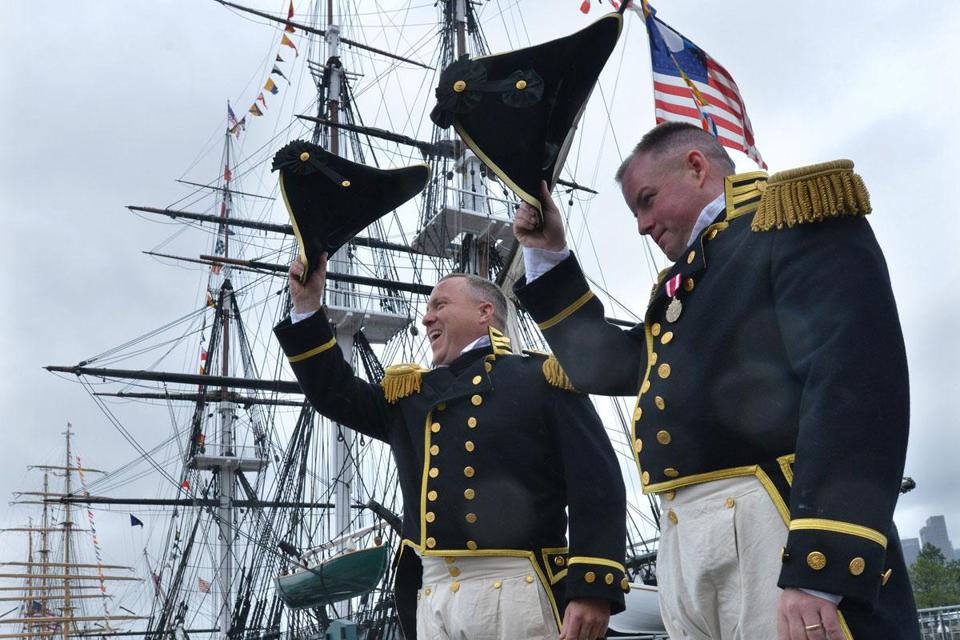
Commander Sean D. Kearns (left) and the USS Constitution’s outgoing commanding officer, Matthew J. Bonner, saluted attendees after Kearns officially took over as the ship’s new leader.

Commander Sean D. Kearns (left) and the USS Constitution’s outgoing commanding officer, Matthew J. Bonner, saluted attendees after Kearns officially took over as the ship’s new leader.

Since he was a child visiting relatives in Braintree, Sean D. Kearns has always been drawn to the USS Constitution and its storied legacy.

He collected models and posters and studied the ship’s legendary commanders. It was on the deck of Old Ironsides where the Hampden, Maine, native became a Navy officer in 1994.

On Friday morning, under overcast skies and light rain, the 44-year-old stood in Charlestown Navy Yard, clad in the classic 1813 commanding officer’s uniform, and was sworn in as the latest skipper of the 215-year-old warship.

During an emotional ceremony, Kearns approached Matthew J. Bonner, the ship’s 72d commander, and presented him with his orders. The two tucked their bicorn hats under their arms as more than 150 friends, family, former commanders, and the ship’s crew looked on.

“Sir,” Kearns announced, “I relieve you.”

“I stand relieved,” Bonner said.

With that, Kearns became the ship’s 73d commander, joining the ranks of such naval legends as Captain Isaac Hull, the Constitution’s commander when it laid waste to the British frigate HMS Guerriere in the War of 1812.

That is what I love about history:  There is always some thread of continuity.  I have visited the Constitution, but have never seen a turnaround in Boston Harbor.

One of Constitution’s most complicated events is a turnaround, the short round trip the ship makes out to Castle Island and back, docking on its return faced in the opposite direction. The ship generally makes about a half-dozen turnarounds a year. Although the maneuver, aided by tugboats, is necessary to evenly expose the ship to prevailing tidal pressure, a turnaround is always an event. That was the case when the ship staged a turnaround voyage to honor the 70th anniversary of the Battle of Midway and members of the Wounded Warrior Project, which serves injured members of the US Armed Forces.

English: Navy photo of USS Constitution under ...

English: Navy photo of USS Constitution under sail for the first time in over a century Español: El US Constitution, buque insignia de la Armada Americana. (Photo credit: Wikipedia)

The last one was on July 4 when it was just too hot to go stand out on Castle Island and watch.  And she generally doesn’t go under sail.  This was in 2012 to celebrate the 200th Anniversary of her victory over the Guerriere,  Maybe this fall.

The Constitution is a regular and must sought after Naval assignment.

Photograph: JOSH REYNOLDS FOR THE GLOBE