A sort of apology

I generally don’t have a lot to say about international politics, but I am interested in education, especially education for girls.  This story was in the Guardian.

A senior member of the Pakistani Taliban has written an open letter to Malala Yousafzai – the teenager shot in the head as she rode home on a school bus – expressing regret that he didn’t warn her before the attack, but claiming that she was targeted for maligning the insurgents.

Adnan Rasheed, who was convicted for his role in a 2003 assassination attempt on the country’s then-president Pervez Musharraf, did not apologise for the attack, which left Malala gravely wounded, but said he found it shocking.

“I wished it would never happened [sic] and I had advised you before,” he wrote.

Malala was 15 when she and two classmates were targeted by a masked gunman who picked them out on a school bus as they went home from school in Pakistan‘s northwest Swat valley last October.

Last week, she celebrated her 16th birthday by delivering a defiant speech at the United Nations in New York, in which she called on world leaders to provide free schooling for all children.

In the letter, Rasheed claimed that Malala was not targeted for her efforts to promote education, but because the Taliban believed she was running a “smearing campaign” against it.

“You have said in your speech yesterday that pen is mightier than sword,” Rasheed wrote, referring to Malala’s UN speech, “so they attacked you for your sword not for your books or school.”

Malala Yousafzai speaking at the United Nations

Malala Yousafzai speaking at the United Nations

I think most of us know that what the Taliban was interpreting as a “smear campaign” was her advocacy of education.  An educated person, and an educated woman in particular, is a threat to any kind of fundamentalism.  (Ask Rick Perry.)

The letter doesn’t make a lot of sense:  “they attacked you for your sword not for your books or school”.  Huh?  Do you think he considers education a sword?  Or maybe talking about education.

He admitted that the Taliban are “blowing up” schools, but justified the attacks on the grounds that the Pakistani army and the paramilitary Frontier Corps use schools as hideouts.

Hundreds of schools have been targeted in Pakistan’s north-west: activists say some had been used by the military, but many attacks were motivated by the Taliban’s opposition to girls’ education.

The Taliban commander also justified recent attacks in Pakistan on health workers vaccinating children against polio by claiming the west was trying to sterilise Muslims.

The letter is clearly intended to influence opinion in Pakistan: although in much of the world Malala has been hailed as a symbol of courage, at home she has been the subject of intense criticism and vilification. Online commentators have described her as a “drama queen” and even accused her of spying for the CIA.

Rasheed contrasted international support for Malala with the lack of coverage given to those killed in US drone attacks – a source of intense grievance in Pakistan.

I understand the anger about civilian deaths from drone attacks since I don’t think they can simply be excused as collateral damage, but I think that may be the only part I do understand.

Rasheed wants Malala to return to Pakistan and attend a female seminary so she can advocate for Islam.  I think that her advocacy for women and for education generally can do a lot to show people in the West who think of Muslims as only terrorists another side of Islam.  She IS an advocate,  Rasheed.

Photograph:   Rick Bajornas/UN Photo/PA

Florida’s strange gun laws

I’ve been thinking a great deal about the verdict in the Trayvon Martin/George Zimmerman case and have concluded that one reason for the verdict is Florida law.  I’ve read the jury instructions and while they were confusing, they had to follow the law which led to acquittal.

The best piece I’ve read on Florida gun laws is an OpEd by Farah Stockman in the Boston Globe.  Stockman writes about Florida gun laws generally and cites 4 currently incarcerated people as examples:  Marissa Alexander, Ronald Thompson, Orville Lee Wollard and Erik Weyant.    All but Alexander are white men, all including Alexander fired a gun to frighten and not to kill.  All are currently serving 20 year minimum sentences.

IF IT BOGGLES your mind that George Zimmerman, a 29-year-old with a gun, could be acquitted after pursuing — and killing — an unarmed 17-year-old, here’s another brain teaser: How could Marissa Alexander, a 31-year-old mother of three, receive a 20-year prison sentence for firing a bullet into a wall near her abusive ex-husband, even though no one was harmed?

It’s true. Florida is one of the worst places to fire a gun into the air, even as it appears to be one of the best places to actually shoot at a person.

Marissa Alexander of Florida received a 20-year prison sentence for firing a warning shot at her abusive ex-husband.

Marissa Alexander of Florida received a 20-year prison sentence for firing a warning shot at her abusive ex-husband.

She goes on to explain.

Alexander, whose ex-husband admitted that she was afraid of his abuse, is not the only one in prison for shooting at nothing.

Ronald Thompson, 62, a disabled veteran, fired two shots into the ground to protect an elderly woman from her violent 17-year-old grandson. State Attorney Angela Corey — the same prosecutor in the Zimmerman case — charged him with four counts of aggravated assault. Thompson was sentenced to 20 years in prison,  a punishment that the judge in the case called a “crime in itself.”  (He is currently awaiting a new trial.)

Orville Lee Wollard, a former auxiliary police force member, shot a bullet into the wall to scare away his daughter’s abusive boyfriend. Prosecutors offered him probation. But he wanted to be exonerated at trial. Now he’s serving 20 years.

Erik Weyant, 22, fired shots in the air to disperse a group of drunk men who accosted him in a parking lot outside a bar and blocked his car. No one was hurt. But he’s in for 20 years.

In many cases, the fact that they chose to fire a warning shot, instead of aiming to kill, was used as evidence against them at trial, said Greg Newburn of Families Against Mandatory Minimums. If you were truly in fear of your life, the logic goes, you would aim at the chest, not the wall.

Florida lawmakers, in their infinite wisdom, began to notice that a lot of people were getting severely punished simply for defending themselves. But instead of repealing the Draconian measure, they passed another one: the “stand your ground” law.

Somehow, both of the laws are not working.  George Zimmerman who killed Trayvon Martin is free, the four named above are in prison.

…And had Alexander shot and killed her abusive ex-husband, would she have had a better chance of getting immunity with a “stand your ground” defense?

“I think so,” said her attorney Michael Dowd.

So in the sick logic of Florida’s gun laws, the message is clear: If you are going to shoot, shoot to kill. You stand a better chance of walking free.

What is happening in Florida is just another reason we need to take a careful look at all of our gun laws.  Florida’s gun laws have little to do with race and as pressure mounts to help Alexander, let us not forget everyone else.

Photograph:  Bob Self/The Florida Times-Union

Republicans try to attract women

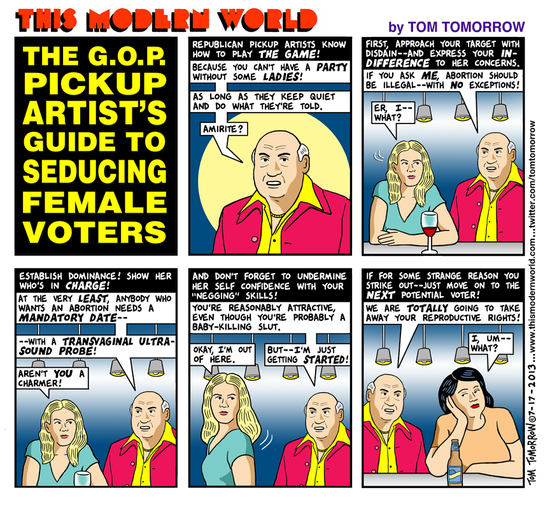
I was getting ready to call it a night as my head is swimming with a half written post about Trayvon Martin when I saw the new Tom Tomorrow cartoon.  It really needs no explanation.

TMW2013-07-17color  Great pick up lines.  I’m sure that women voters will be flocking to them in droves.

The real danger: The FISA Court

Congress and the President can say all they want to that everything about the surveillance is approved by the FISA Court.  OK.  But what do we know about this secret court?  Some revelations this past weekend by the Wall Street Journal and the New York Times tell us a great deal that I, for one, didn’t know.  For example, did you know that Chief Justice John Roberts was in charge?

The Ezra Klein/Evan Soltas Wonkblog had a great summary this morning.

The laws we live by aren’t just the bills Congress passes and the president signs. It’s what the courts decide those bills actually mean.

We’re used to that. The Affordable Care Act, for instance, says that states that don’t accept the Medicaid expansion lose all their Medicaid money. The Supreme Court decided that went too far. The law might still say that if you read the underlying bill, but it no longer means that. Now states can reject the Medicaid expansion without jeopardizing the rest of their Medicaid money — and many are.

But here’s the thing: When judges make the laws, Congress can always go back and remake the laws. The changes the court makes are public, and so is their reasoning. Both the voters and Congress know what the court has done, and can choose to revisit it.

Well, usually.

The Foreign Intelligence Surveillance Court (FISA court) that governs the national surveillance state is also remaking the law. But it’s remaking the law in secret. The public has no opportunity to weigh in, and Congress can’t really make changes, because few know what the court is deciding, and almost no one can discuss the decisions without endangering themselves.

So that’s a real Catch 22.

Surveillance types make a distinction between secrecy of laws, secrecy of procedures and secrecy of operations. The expectation is that the laws that empower or limit the government’s surveillance powers are always public. The programs built atop those laws are often secret. And the individual operations are almost always secret. As long as the public knows about and agreed to the law, the thinking goes, it’s okay for the government to build a secret surveillance architecture atop it.

But the FISA court is, in effect, breaking the first link in that chain. The public no longer knows about the law itself, and most of Congress may not know, either. The courts have remade the law, but they’ve done so secretly, without public comment or review.

These rules have been remade in a court where the government is the only witness, and there’s no possibility for appeal, and all 11 judges were chosen by Chief Justice John Roberts, and 10 of the 11 judges were Republican appointees to the federal bench. This is not a court like any other court in the United States save for the secrecy. It’s a court pretty much unlike any other in the United States.

When asked who watches over the National Security Agency’s surveillance efforts, the administration says that the FISA courts do. Trite as it may be, that leads to the age-old question: Well, then who watches over the watchers?

The answer would be to rewrite the law but how does one do that with a dysfunctional Congress and a law with impacts that no one can discuss without violating it?  As I said, a Catch-22.  But there is a proposal by Senator Jeff Merkley of Oregon and a bi-partisan group of other senators to end some of the secrecy.

We should be discussing ways to rein in the FISA Court and modify the Patriot Act.  Forget Edward Snowden.  He can stay at the Moscow airport or get smuggled to South American.  Fixing the law is what is important.

Let me end with Tom Tomorrow.

This Modern World

This Modern World

Official end to California’s Prop 8

I woke up this morning to this news from the New York Times

Gay Couples Who Sued in California Are Married

Kris Perry and Sandy Stier, who have been together for more than 15 years and have four sons, were married at San Francisco City Hall by Attorney General Kamala Harris on Friday.

Kris Perry and Sandy Stier, who have been together for more than 15 years and have four sons, were married at San Francisco City Hall by Attorney General Kamala Harris on Friday.

The two couples who sued to overturn California’s ban on same-sex marriage were married late Friday afternoon, just hours after the United States Court of Appeals for the Ninth Circuit, in San Francisco, lifted the stay that had been in place.

The court had stopped same-sex marriages while the case wound its way through the Supreme Court, which issued its decision to clear the path for same-sex marriages in California on Wednesday.

Attorney General Kamala Harris rushed to San Francisco City Hall within minutes of the ruling to perform the wedding for Kris Perry and Sandy Stier, who have been together for more than 15 years and have four sons.

And in LA

Mayor Antonio R. Villaraigosa of Los Angeles, on his last workday in office, officiated at the Friday evening wedding of Paul Katami and Jeffrey Zarrillo, the two other plaintiffs in the case. Until Friday afternoon, they had no idea when their marriage could take place.

“Nobody really knew; that’s what our lawyers are there for. We don’t really care about any of that at this point, but we’re on our way to see the mayor,” Mr. Zarrillo told KCRW, a public radio station in Los Angeles.

The pair were stuck in traffic en route from their home to the county office to obtain their marriage license and then to City Hall downtown. But by 6:30 they walked in front of dozens of television cameras, kissed Mayor Villaraigosa and were pronounced married.

“Your relationship is an inspiration to us all,” Mr. Villaraigosa said. “Today, your wait is finally over.”

“Equal feels different,” Mr. Katami said. Mr. Zarrillo added, “Equal feels good.”

The Ninth Circuit acted with unusual speed.

Many legal experts and advocates had expected the court to wait for an official decision from the Supreme Court, as is the normal practice. But after the initial ruling was issued on Wednesday, Ms. Harris urged the Circuit Court to act immediately and said she would ensure that all counties in the state were prepared to issue licenses to same-sex couples.

Just after 3 p.m. Friday, the three-judge panel issued a one-sentence ruling lifting the stay on a district judge’s injunction to not enforce the ban on same-sex marriages.

Gov. Jerry Brown issued a statement late Friday afternoon saying that he had directed the state’s Department of Health to notify all 58 counties in the state that “same-sex marriage is now legal in California and that marriage licenses must be issued to same-sex couples immediately.”

I know there had been some confusion about the impact of the Supreme Court decision.  Some thought it would only apply to the plaintiff, but since the District and Appeals courts had already ruled Prop 8 unconstitutional it turns out that only the stay had to be lifted.

From Massachusetts:  Welcome to Marriage Equality, California!  And an aside to the opponents – don’t worry, the sky will not fall.  This is number 13.  Which state will be next?

Photograph:  Jim Wilson/The New York Times

Someone has always been watching

The June 24th issue of the New Yorker has an excellent short history of privacy and surveillance by Jill Lepore.  You should try to read the entire article either online (I can’t remember what rules the New Yorker has about access) or get a copy of the magazine.  For my purposes today, I am going to concentrate on the story of Giuseppe Mazzini.  Never heard of him before?  Me either, but his story is instructive.

An extraordinary fuss about eavesdropping started in the spring of 1844, when Giuseppe Mazzini, an Italian exile in London, became convinced that the British government was opening his mail. Mazzini, a revolutionary who’d been thrown in jail in Genoa, imprisoned in Savona, sentenced to death in absentia, and arrested in Paris, was plotting the unification of the kingdoms of Italy and the founding of an Italian republic. He suspected that, in London, he’d been the victim of what he called “post-office espionage”: he believed that the Home Secretary, Sir James Graham, had ordered his mail to be opened, at the request of the Austrian Ambassador, who, like many people, feared what Mazzini hoped—that an insurrection in Italy would spark a series of revolutions across Europe. Mazzini knew how to find out: he put poppy seeds, strands of hair, and grains of sand into envelopes, sealed the envelopes with wax, and sent them, by post, to himself. When the letters arrived—still sealed—they contained no poppy seeds, no hair, and no grains of sand. Mazzini then had his friend Thomas Duncombe, a Member of Parliament, submit a petition to the House of Commons. Duncombe wanted to know if Graham really had ordered the opening of Mazzini’s mail. Was the British government in the business of prying into people’s private correspondence? Graham said the answer to that question was a secret.

Sound familiar?

Questions raised this month about surveillance conducted by the National Security Agency have been met, so far, with much the same response that Duncombe got from Graham in 1844: the program is classified. (This, a secret secret, is known as a double secret.) Luckily, old secrets aren’t secret; old secrets are history. The Mazzini affair, as the historian David Vincent argued in “The Culture of Secrecy,” led to “the first modern attack on official secrecy.” It stirred a public uproar, and eventually the House of Commons appointed a Committee of Secrecy “to inquire into the State of the Law in respect of the Detaining and Opening of Letters at the General Post-office, and into the Mode under which the Authority given for such Detaining and Opening has been exercised.” In August of 1844, the committee issued a hundred-and-sixteen-page report on the goings on at the post office. Fascinating to historians, it must have bored Parliament silly. It includes a history of the delivery of the mail, back to the sixteenth century. (The committee members had “showed so much antiquarian research,” Lord John Russell remarked, that he was surprised they hadn’t gone all the way back to “the case of Hamlet, Prince of Denmark, who opened the letters which had been committed to his charge, and got Rosencrantz and Guildenstern put to death instead of himself.”)

The report revealed that Mazzini’s mail had indeed been opened and that there existed something called the Secret Department of the Post Office. Warrants had been issued for reading the mail of the king’s subjects for centuries. Before Mazzini and the poppy seeds, the practice was scarcely questioned. It was not, however, widespread. “The general average of Warrants issued during the present century, does not much exceed 8 a-year,” the investigation revealed. “This number would comprehend, on an average, the Letters of about 16 persons annually.” The Committee of Secrecy was relieved to report that rumors that the Secret Department of the Post Office had, at times, sent “entire mail-bags” to the Home Office were false: “None but separate Letters or Packets are ever sent.”

“Secresy is an instrument of conspiracy,” Jeremy Bentham argued, in an essay called “Of Publicity,” first published in 1843, a year before the Mazzini affair. “It ought not, therefore, to be the system of a regular government.” By “publicity,” Bentham meant what is now usually called transparency, or openness. “Without publicity, no good is permanent: under the auspices of publicity, no evil can continue.”

In 1844, during the parliamentary debate that followed the report issued by the Committee of Secrecy, some members, believing, with Bentham, that publicity is the enemy of secrecy, suggested that it was fine for the government to open people’s mail, as long as the recipients of the mail were notified that it had been read. (Disraeli said that he would be only too happy to hand over his mail to the Home Office: “They may open all my letters, provided they answer them.”) In “Letter-Opening at the Post-Office,” Mazzini revealed just how much the debate had been informed by Bentham’s arguments about publicity. Diplomats might have their secrets, he granted, but postmen? “Why, who are these men who treat as enemies their fellow subjects of the realm?” he asked. “For public servants, we want responsibility and responsibility cannot be obtained without publicity. Secrecy is but another word for fear. MYSTERY was the name of the beast in the revelations. The great monster by which was typified all the civil and ecclesiastical corruptions of the earth, had on its forehead a name written and that name was MYSTERY.”

There is a delicate balance between privacy and surveillance.  Is it  OK for the government to collect all the metadata but not look at content without a warrant so long as we know that is what is happening?  And who keeps an eye on the FISA court?

In 1890, two Boston lawyers, Samuel Warren and Louis Brandeis, published an article in the Harvard Law Review called “The Right to Privacy.” Warren was a Boston Brahmin, but Brandeis’s parents were Eastern Europeans who had supported a failed uprising in Austria in 1848—the very revolution that, four years before, had been anticipated by the Austrian Ambassador who persuaded the British Home Secretary to read Giuseppe Mazzini’s mail. The suppression of the uprising had been followed by a wave of anti-Semitism, leading to the Brandeis family’s decision to emigrate to the United States. Louis Brandeis was born in Kentucky in 1856. In the eighteen-seventies, he and Warren were classmates at Harvard Law School (Brandeis helped found the Harvard Law Review); after graduation, they opened a law firm together. Warren married Mabel Bayard, a senator’s daughter, in 1883. As the legal scholar Amy Gajda has shown, nearly sixty articles of gossip about the Warren-Bayard family appeared in newspapers between 1882 and 1890—including front-page stories, two weeks apart, about the funerals of Mrs. Warren’s mother and sister. Warren was infuriated. His household had been violated; his family’s privacy, like a letter, had been purloined. (A great many ideas about privacy have to do with hiding women and families.)

In “The Right to Privacy,” Warren and Brandeis argued that there exists a legal right to be let alone—a right that had never been defined before. Their essay lies at the heart of every legal decision that has been made about privacy ever since. The right to privacy, as they understood it, is a function of history, a consequence of modernity. Privacy, they argued, hadn’t always been necessary; it had become necessary—because of the shifting meaning and nature of publicity. By the end of the nineteenth century, publicity, which for Bentham had meant transparency (the opposite of secrecy), had come to mean the attention of the press (the opposite of privacy). Making public the deliberations of Congress was a public good; making public the names of mourners at Mrs. Warren’s mother’s funeral was not. (The same distinction informed the debate that resulted, in the eighteen-eighties and nineties, in the adoption of the secret ballot. Citizens vote in private; legislative votes are public.)

But with blogs, Facebook, Twitter and other new media, those of us who post and tweet want people to read what we say and when we do so we should be aware that we are being public.  Email, however, is the new version of writing a letter and the government reading email is like reading Mazzini’s mail.  There is a very fine line between collecting email records and looking at content and many wonder if we can actually trust the government to honor the distinction.  With cell phones and GPS, our whereabouts can also be tracked. (I’m a fan of NCIS and love the way McGee can locate the bad guys – and sometimes the good ones – using a cell phone number.)  It seems that we are beginning, if we haven’t already, accepted that a lot of our private lives are now public because we put them out there.  We are not like the Warren family who did not want a list of the mourners at a funeral made public.

It is likely that someone has always been watching and it is clear that we still haven’t figured out that troublesome line between public and private.

Here is an old New Yorker cartoon from around 1973.

Bugging

The House passes still another restriction on abortion

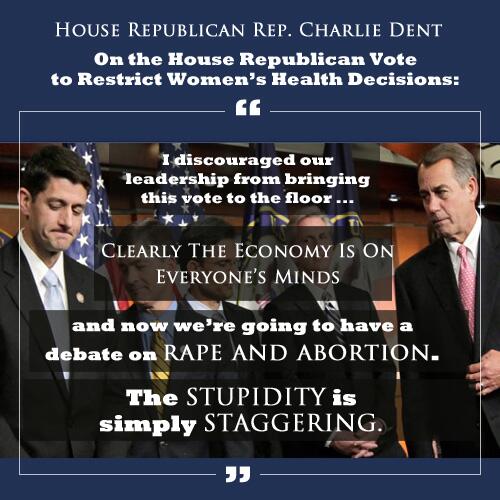
Nancy Pelosi tweeted this picture with a quote from Representative Dent last night

Embedded image permalink

Clearly the Republican leaders didn’t listen to Dent.  They love to have votes on abortion, birth control and, the favorite – repealing the Affordable Heath Care Act instead of actually passing measures that might also pass in the Senate and get signed into law.
The result of pandering again to their base was passage of a bill that will ban abortions after 22 weeks.  According to the New York Times story

The measure, which would ban abortion after 22 weeks of pregnancy based on the medically disputed theory that fetuses at that stage of development are capable of feeling pain, passed in a 228-to-196 vote that broke down mostly along party lines. Reflecting how little common ground the two parties share these days, just six Republicans voted against the bill; six Democrats voted for it.

“I’m not waging a war on anyone,” said Kristi Noem, Republican of South Dakota, offering a rejoinder to the Democratic assertion that Republicans have waged a war on women, a line of attack that harmed conservative candidates in 2012. “Regardless of your personal beliefs, I would hope that stopping atrocities against little babies is something we can all agree to put an end to.”

How about stopping atrocities like cutting food stamps and voting against bills that would provide health care and jobs for after this child that you have “saved” is born, Representative Noem?
But, remembering the bad press from hearings where all the legislators and all the witnesses were men discussing birth control the leadership did show they can learn something.

The tableau in the House chamber on Tuesday was intentionally far different from the scene last week at a meeting of the House Judiciary Committee at which all 19 of the Republicans arguing for and then voting to approve the bill were men. Republican leaders made sure that their female members were front and center for the debate this time.

Representative Virginia Foxx, a North Carolina conservative and Tea Party favorite, and Representative Marsha Blackburn, a longtime abortion opponent from Tennessee, were assigned to manage the floor debate. Representative Candice S. Miller of Michigan and Representative Ileana Ros-Lehtinen, one of the Republican conference’s more moderate members, controlled the gavel.

But the simple math was difficult to ignore. Only 19 of the 234 Republican House members are women. Nearly all of them spoke on Tuesday. Only three Republican men were allowed to participate in the debate. Notably, Trent Franks of Arizona, the bill’s sponsor who last week caused an uproar after claiming that instances of pregnancy after rape were “very low,” said nothing from the floor.

I think that 22 weeks is getting close to the time of viability which most see as 23 to 26 weeks.  As bills move ever closer to that line,  those of us who agree that women have a right to choose to continue the pregnancy or not will be faced with a difficult question and one that we need to be prepared to answer: where, if anywhere, should the line be drawn?

Even if Democrats believed the political upper hand was theirs as they used the issue of reproductive rights to portray their opponents yet again as hostile and indifferent to the needs of women, it was clear that the question at hand — the termination of pregnancies that are five months or more along — was an uncomfortable one.

At a news conference Tuesday morning led by Democrats who favor abortion rights, the mood quickly turned tense after two journalists tried to press the representatives about their support for late-term abortions. Representative Diana DeGette of Colorado cut off questions after being asked whether she would draw the line at legal abortion later in pregnancy. “The Supreme Court has spoken, and this bill is unconstitutional. Next question,” she said.

As medical science advances, the time limits laid out in Roe v. Wade may no longer hold.  There are medical and social costs to having a child born at 25 weeks.  In a 1997 story, the New York Times reported

”At the time of Roe vs. Wade it was around 26 weeks pregnant,” Dr. Ezra Davidson, past president of the American College of Obstetrics and Gynecology, said. ”It has come down a couple of weeks since that time.”

But many babies who survive birth at that stage have terrible problems.

”You have to temper any discussion about viability because though you may get into a 24-week period, or a 23-week period, a large portion of those infants are going to have serious disabilities,” Dr. Davidson said.

Most experts believe that the current limit of viability is 23 or 24 weeks into the normal 40-week term of pregnancy. Babies born at this stage are known as micropreemies and are extremely fragile. The typical micropreemie weighs 500 to 600 grams — slightly more than a pound — and can fit in the palm of a hand.

According to the American College of Obstetrics and Gynecology, fewer than 40 percent of infants born from 23 to 25 weeks’ gestation survive.

Moreover, Dr. William Taeusch, chief of pediatrics at San Francisco General Hospital, said: ”That’s strictly survival. That’s getting out of the hospital alive, usually at three months, at a cost of hundreds of thousands of dollars. And if you get out of the hospital alive and you haven’t had major problems, then your chances of having a normal brain are 90 percent.”

But according to the obstetrics and gynecology group, nearly 50 percent of surviving children who weigh less than 750 grams at birth experience moderate or severe disability, including blindness and cerebral palsy.

Things haven’t really changed a great deal since 1997.  This is from the Wikipedia article on fetal viability.

Fetal Viability Chart

Fetal Viability Chart

Of course, most women who don’t have late term abortions have a full term baby.  This means the mother and hopefully father need to have jobs and assistance in caring for the baby for the next 18 years – the kind of assistance the Republicans often vote against.  It means available contraception so women aren’t faced with the choice at all.  It means sex ed  beginning in middle schools that includes information on what it is like to care for a baby.  (What happened to those programs where teens had to care for a doll that was life-like and demanded diaper changes and feedings 25/7?)

I personally have problems with late term abortions that are not for medical reasons – either the mother’s or the child’s.  But I also think we should be spending what is needed to make sure those children are fed, educated and not abused.  And I understand why sometimes the decision is so late.

Jessica Valenti has column in the Nation thinking through many of these issues, but it is her conclusion that sticks with me.

Abortion is complicated, as are our lives and health—and the fact that these  choices are so complex and nuanced is precisely why we can’t legislate them.  Wishing otherwise will never 
make it so.

Syria? Really?

The President, probably never believing that Assad would use chemical weapons, drew a red line.  He’s been stalling around saying he needs verification, but now he has it.  The question is what should we do now.  I think Obama is stuck.

130612_barack_obama_ap_605

The United States has a long history of failed interventions.  Vietnam was basically a civil war.  We armed the Taliban when they were our “friends”.  We actually started a civil war in Iraq by stupidly dismissing all the Baathists saying they can’t be part of any new Iraqi government.  Now we are again taking sides against the Baathist who currently rule Syria.  My big fear is that the region will explode into a Sunni v. Shia conflict and we will be seen as taking sides.

Andrew Sullivan wrote this morning

My strong view, vented last night as I absorbed this stunning collapse of nerve, is that we shouldn’t fight at all. We are damn lucky to have gotten every GI out of Iraq, and the notion of being sucked back into that region again – and to join sides in a sectarian conflict – is a betrayal of everything this president has said and stood for. It’s a slap in the face for everyone who backed him because he said he wouldn’t be another Bush or McCain or Clinton. If he intervenes in Syria, he will have no credibility left with those of us who have supported his largely sane and prudent foreign policy so far. Libya was bad enough – and look at the consequences. But Syria? And the entire Middle East? Is he out of his mind?

And can you think of a dumber war than this one?

The man who said he would never engage in a dumb war is apparently preparing to join the dumbest war since … well, Iraq.

My only hope right now is that we can somehow use our threat of intervention to maneuver some type of international peace keeping force while we try to bring both sides to a negotiating table.  And let us hope that President Obama knows to get Congress involved, gets a UN resolution and the Arab League to agree before we take any action.

Sullivan concludes

One reason I supported Obama so passionately in 2008 and 2012 was because I thought he understood this and had the spine to stand up to drama queens like McCain and armchair generals like William Jefferson Clinton. But it is beginning to appear that this president isn’t actually that strong. We voted for him … and he’s giving us Clinton’s and McCain’s foreign policy. If Cameron and Hollande want to pull another Suez, for Pete’s sake be Eisenhower – not Kennedy.

My cri de coeur is here. Don’t do it, Mr President. And don’t you dare involve us in another war without a full Congressional vote and national debate. That wouldn’t just be a mistake; it would be a betrayal.

Photograph:  AP

Whistle-blower, maybe. Hero, probably not.

I just can’t figure Edward Snowden.  The more little pieces I hear about and read about him, the more I wonder about him and his motivation.  This is why I found Jonathan Capehart’s piece so interesting.  Writing in the Washington Post’s Post Partisan blog, Capehart begins

A sidewalk encounter with a friend drove home my conflicted feelings about Edward Snowden. The national-security leaker was surely a “narcissist,” he said, but Snowden was definitely “a hero.” And the more my friend talked about the reaction to Snowden, especially that of congressional Democrats, the more angry his own reaction appeared to become. Part of me wished I could work up that much passion for this self-professed champion of government transparency. Alas, I can’t.

I feel the same way.

Edward Snowden

Edward Snowden

Snowden told the Guardian which broke the story that he wanted to go to a place where the government doesn’t spy on people.  The last time I checked, Hong Kong has a complicated legal relationship to China.  China is not exactly a country that eschews spying on citizens.  In an article about extradition the Guardian says

Hong Kong has not accepted a political defence against extradition since the handover in 1997. In the 1930s it turned down a bid by French authorities for Ho Chi Minh’s return to what was then IndoChina, in a case that went all the way to the privy council. More recently, in 1994, its courts stayed the extradition of the politician Jeffrey Kitigan to Malaysia.

Guy Goodwin-Gill QC, a leading expert on extradition at Blackstone Chambers in London, noted that the international climate had changed, with offences that previously might have qualified – such as hijacking – no longer accepted as political.

“The times are very much one of co-operation across a broad range of activities. You hardly ever find a state refusing extradition for political offences any longer,” he said.

In the case of Snowden, “you certainly see political dimensions: you have members of the US senate or House of Representatives calling him a traitor – so they are building a very good case for another state to treat this as political,” added Goodwin-Gill.

Of course, there are avenues for appeal through the courts in Hong Kong which could drag out the process for years according to some British legal experts.  It remains unclear why he went to part of China when he was professing a wish to be free of surveillance.

I have also heard that he may have misrepresented his salary to the Guardian – that it was much lower than he claimed.  Snowden also claimed that as a contractor with the NSA he had broad authority to do a lot of things that some experts question.  This is from NPR

Edward Snowden’s claim that as systems administrator for a defense contractor in Hawaii he had the authority “to wiretap anyone, from you or your accountant to a federal judge to even the president,” just isn’t plausible, says a former national security lawyer at the Justice Department and Office of the Director of National Intelligence.

Carrie Cordero, the former Justice and DNI lawyer, is now director of national securities studies at Georgetown University Law Center. She tells Steve that “the notion that this individual has the authority to go ahead and … ‘wiretap’ people is just ridiculous.”

Without discussing the details of how such surveillance programs work and the safeguards that are in place to protect privacy, Cordero says that Snowden’s claim “does not resemble anything close to what I observed within the intelligence community.”

Snowden may turn out to be a braggart who stretches the truth.  And this may damage his credibility overall.  But the bottom line for me is that he doesn’t seem to have told us anything that a lot of people didn’t know before.  Capehart again

We absolutely should know what our government is up to. And, according to The Post’s Walter Pincus, we’ve known about this for quite some time.

The legendary national-security writer cites a May 2006 USA Today story that revealed “the NSA ‘has been secretly collecting the phone call records of tens of millions of Americans, using data provided by AT&T, Verizon and BellSouth,’ attributing that information to ‘people with direct knowledge of the arrangement.’” Then there was the March 15, 2012, Wired magazine story on the new $2 billion NSA Data Center in Utah and “its ability to ‘intercept, decipher, analyze, and store vast swaths of the world’s communications as they zap down from satellites and zip through the underground and undersea cables of international, foreign, and domestic networks.’”

“Was there any follow-up in the mainstream media to [James] Bamford’s disclosure, or anything close to the concerns voiced on Capitol Hill this past week? No,” Pincus writes in Tuesday’s paper.

So where should we go from here?  I agree with Capehart’s conclusions

Still, that doesn’t mean we shouldn’t have a debate about what we now know and its appropriateness now that we know it. Eugene Robinson zeroes in on this in his Tuesday column.

The NSA, it now seems clear, is assembling an unimaginably vast trove of communications data, and the bigger it gets, the more useful it is in enabling analysts to make predictions. It’s one thing if the NSA looks for patterns in the data that suggest a nascent overseas terrorist group or an imminent attack. It’s another thing altogether if the agency observes, say, patterns that suggest the birth of the next tea party or Occupy Wall Street movement.

Is that paranoia? Then reassure me. Let’s talk about the big picture and decide, as citizens, whether we are comfortable with the direction our intelligence agencies are heading. And let’s remember that it was Snowden, not our elected officials, who opened this vital conversation.

Yes, Snowden opened this conversation. But that’s as much credit as I’m willing to give him.

That sounds about right.  Let’s see if Congress talk about this without a lot of finger-pointing and hysteria.  Should the result be changes to the Patriot Act, we can give Snowden a little piece of the credit.

Photograph: AP